

How to Prevent Insider Threats A Modern Enterprise Playbook
To get ahead of insider threats, you have to completely reframe the problem. It's not about waiting for a breach and then scrambling to fix it. It's about a strategic, forward-thinking mix of proactive monitoring, tight access controls, and building a strong security culture. The entire goal is to move from a reactive stance to one where you're actively spotting and neutralizing risks before they ever turn into a full-blown crisis.
Why Proactive Insider Threat Prevention Is Non-Negotiable
When we talk cybersecurity, the conversation almost always drifts to external attackers—shadowy hackers trying to break down our digital walls. But here’s the uncomfortable truth: some of the most devastating threats don’t need to knock. They already have a key.
Whether it’s a malicious employee with a grudge or a well-meaning but negligent contractor, these insider threats pose a unique and incredibly complex challenge. Traditional security, built like a fortress with high walls and a guarded perimeter, just wasn't designed for this. That model completely falls apart when the person causing the damage is already inside, using their legitimate credentials. This is exactly why a modern approach is so critical.
The Financial Imperative for a Proactive Shift
Putting off action until after an incident is a shockingly expensive mistake. The numbers speak for themselves. The average annual spend on insider risk management is projected to hit $17.4 million in 2025.
What's really eye-opening is how detection speed blows up the costs. Incidents caught within 31 days cost about $10.6 million, but let that drag on past 91 days, and the bill skyrockets to $18.7 million. That's a staggering 76% cost increase tied directly to response time. You can dig into the specifics in this breakdown of insider threat costs.
A proactive insider threat program isn't just a security measure; it's a financial necessity. Every day a threat goes undetected, the cost to the organization multiplies, impacting everything from recovery expenses to brand reputation.
And the real-world fallout goes far beyond the initial cleanup costs. We’re talking about:
Reputational Damage: Losing customer trust can be far more expensive and long-lasting than the breach itself.
Operational Disruption: System downtime and lengthy investigations can bring business to a grinding halt.
Regulatory Fines: Failing to comply with data protection laws like GDPR or CCPA can lead to massive penalties.
Loss of Intellectual Property: Stolen trade secrets or proprietary data can cripple a company's competitive edge overnight.
Insider Threat Prevention The Shift from Reactive to Proactive
The old "wait and see" approach to security is not just outdated; it's dangerous. The modern strategy is all about anticipation and prevention. This table breaks down the fundamental shift in thinking.
Security Focus | Reactive Approach (Traditional) | Proactive Approach (Modern) |
|---|---|---|
Primary Goal | Incident response and damage control after a breach occurs. | Risk identification and mitigation before an incident happens. |
Key Tools | Firewalls, antivirus, basic logging. Focus on perimeter defense. | UEBA, DLP, PAM, SIEM. Focus on user behavior and data movement. |
Data Visibility | Limited to network traffic and known malware signatures. | Deep visibility into user activity, access patterns, and data context. |
Detection Method | Relies on known threat signatures and rule-based alerts. | Uses behavioral baselines, anomaly detection, and machine learning. |
Response Time | Slow. Often measured in weeks or months after the initial compromise. | Fast. Aims for near real-time detection and automated response. |
Outcome | High cost of remediation, data loss, and significant brand damage. | Reduced risk, minimized financial impact, and a stronger security posture. |
As you can see, the proactive model fundamentally changes the game by giving security teams the visibility and context they need to act decisively, rather than just cleaning up the mess.
The Three Pillars of Modern Insider Threat Defense
A truly effective strategy isn't about buying one magic tool. It's built on three interconnected pillars that work together to create a resilient, adaptive security posture.
Governance and Policy: This is your foundation. It’s about establishing clear, enforceable rules for how data is handled, what constitutes acceptable use, and who gets access to what. It defines the "what" and "why" of your entire security program.
Technology and Controls: These are the tools that bring your policies to life. Solutions like Data Loss Prevention (DLP), Privileged Access Management (PAM), and behavioral analytics give you the visibility and control needed to spot and stop suspicious activity in its tracks.
Culture and Training: This is the human element, and it's arguably the most important. Fostering a security-aware culture empowers every employee to be part of the solution. When they know what to look for and feel comfortable reporting it, your defenses become exponentially stronger.
Ultimately, preventing insider threats is a continuous process, not a one-and-done project. It demands a dedicated, organization-wide effort to weave these pillars together, creating a defense that’s as intelligent and dynamic as the threats you’re facing.
Building Your Governance And Policy Foundation
Let's be clear: you can't buy a tool that will solve your insider threat problem. Even the most sophisticated security software is bound to fail without a clear set of rules and a defined structure for who owns what.
A strong insider threat program is built on a solid foundation of governance and policy. This is the human framework that guides every technical control and security decision you make. It's where you set expectations, assign responsibilities, and create an official, enforceable standard for how people should behave.
The first step is to break out of the security silo. Preventing insider threats isn’t just an IT problem; it's a business problem that demands a unified front. When you try to manage this from one department, you end up with massive blind spots, especially when an investigation gets complicated with sensitive employee issues or legal landmines. A reactive, disjointed approach just doesn't cut it.
Assembling Your Cross-Functional Insider Threat Team
To get this right, you need to form a dedicated, cross-functional team with clearly defined roles. This group will be the central nervous system of your insider threat defense, overseeing strategy, policy development, and incident response coordination.
Your core team absolutely needs representation from these key areas:
Information Security (InfoSec): These are your hands-on defenders. They'll lead the technical charge, managing tools like UEBA and DLP, digging into alerts, and handling digital forensics when things go wrong.
Information Technology (IT): This is the team that actually implements and maintains the controls. Think access management systems, endpoint security, and network monitoring—they make the policies a reality.
Human Resources (HR): HR brings the critical human context. They are indispensable for crafting fair policies, managing employee relations during an investigation, and ensuring any disciplinary actions are consistent and legally sound.
Legal & Compliance: Your legal team is your shield. They ensure all your monitoring activities and policies comply with privacy laws, labor regulations, and industry mandates. You don't want to make a move here without their sign-off.
This collaborative structure guarantees that every potential incident gets looked at from multiple angles—technical, human, and legal. The result? Far more balanced and effective outcomes.
Crafting Your Core Policies
With the team in place, it's time to write down the rules of the road. Your policies have to be clear, practical, and communicated to every single person in the company. If they're vague or sound like they were written by a lawyer for other lawyers, people will just ignore them.
The Acceptable Use Policy (AUP)
Your AUP is the cornerstone document. It explicitly states what employees can and cannot do with company technology and data. This isn't just a legal formality to be signed during onboarding; it's a daily guide for employee behavior.
A solid AUP should clearly cover:
Data Handling: Simple rules for accessing, storing, and sending sensitive information.
System Usage: Guidelines for using company networks, email, software, and devices.
Prohibited Activities: A straightforward list of what’s forbidden, like installing unapproved software or using personal cloud storage for company files.
Privacy and Monitoring: A transparent statement explaining that company systems are monitored for security purposes. No surprises.
The point of an AUP isn’t to chain employees down. It’s to empower them with clear guidance on how to protect company assets. It turns "security" from an abstract idea into a set of concrete, everyday actions.
Supporting Data Governance Policies
The AUP is the high-level plan, but you need more detailed blueprints for key risk areas. These supporting policies provide the specific instructions that your technical controls will enforce.
You'll want to build out policies like these:
Data Classification Policy: This defines your data sensitivity levels (e.g., Public, Internal, Confidential, Restricted) and dictates the specific handling requirements for each.
Access Control Policy: This is where you formalize the principle of least privilege. It spells out who gets access to what data, under what conditions, and—just as importantly—how that access is reviewed and eventually revoked.
Remote Work Policy: In today's world, this is non-negotiable. It must set clear security requirements for home networks, device usage, and connecting to company resources from outside the corporate firewall.
By establishing this robust governance framework, you create a structured, defensible program. You can see how these pieces fit together in our visual guide on implementing data governance. This foundation doesn't just help you catch insider threats; it builds a more resilient and security-aware organization from the ground up.
Implementing The Right Technical Controls
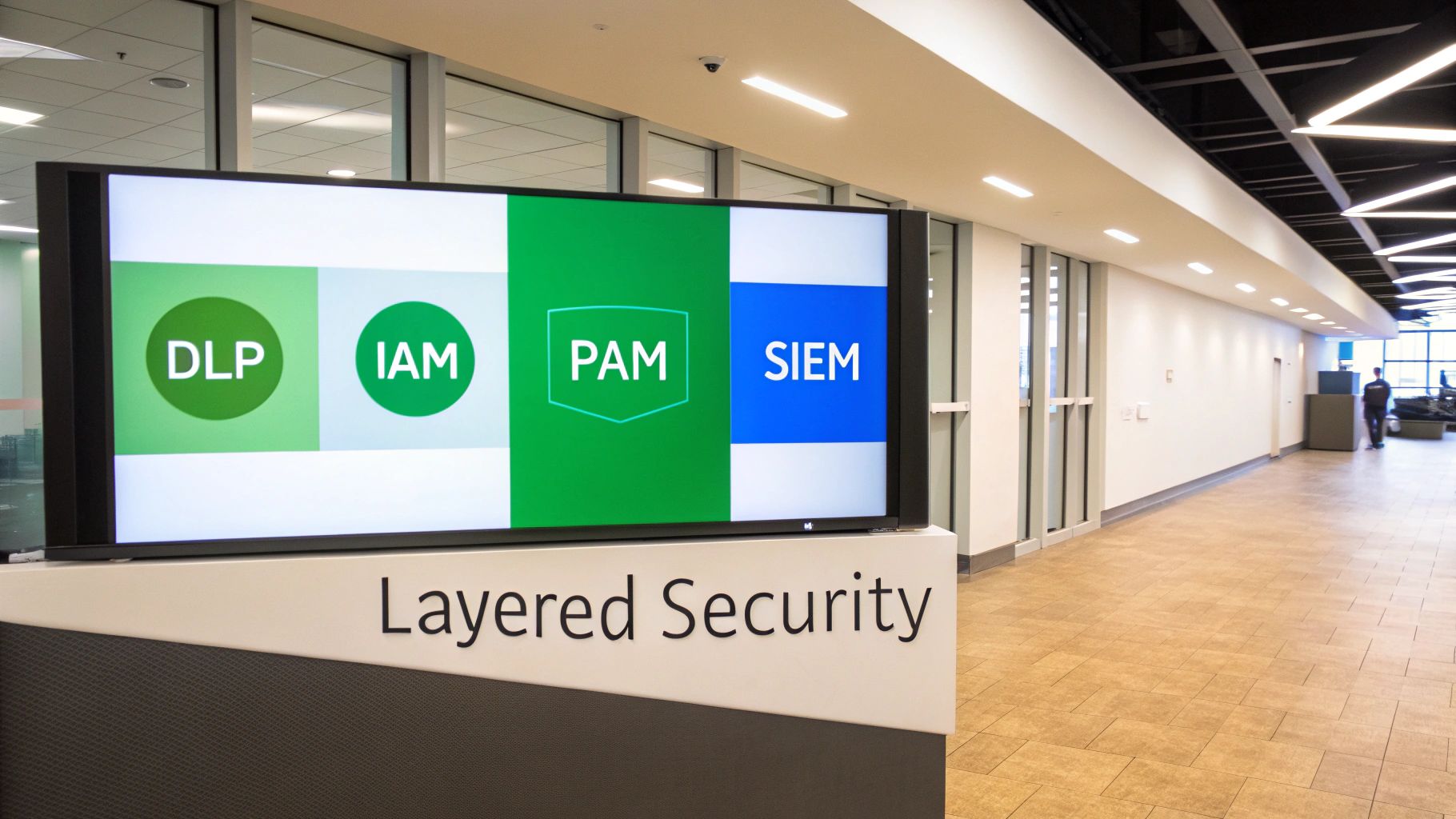
With a solid governance framework in place, your policies now need technology to give them teeth. We're moving from theory to practice, and that means deploying a multi-layered stack of technical controls. Think of these tools as your digital sentinels, working 24/7 to monitor activity, enforce the rules, and flag anomalies a human would almost certainly miss.
The key here isn't to find one silver-bullet solution—it doesn't exist. Instead, the goal is to create a unified defense where each tool covers a different angle of insider risk. When you get them working together, these technologies provide a surprisingly complete picture of what’s happening across your entire network and data ecosystem.
Centralizing Visibility with SIEM
Your very first move has to be eliminating blind spots. A Security Information and Event Management (SIEM) system is the central nervous system for your entire security operation. It pulls in log data from literally everywhere—servers, apps, firewalls, endpoints—and puts it all into a single, searchable dashboard.
It's basically the security equivalent of an air traffic control tower. Instead of tracking planes, it’s tracking every digital event, big or small. This centralized view is absolutely essential for connecting the dots between seemingly random activities that might signal a brewing insider threat. For example, a SIEM can correlate a user accessing a sensitive database after hours with a large data transfer to a USB drive moments later—two events that, on their own, might not raise an alarm.
Enforcing Access with IAM and PAM
Once you can see what's happening, the next job is to lock the doors. This is where Identity and Access Management (IAM) and Privileged Access Management (PAM) come in. These controls are how you actually enforce your "least privilege" policy in the real world.
IAM solutions are all about managing who your users are and making sure they can only get to the resources they absolutely need for their jobs. Integrating Multi-Factor Authentication (MFA) is a non-negotiable part of any modern IAM strategy. It adds a critical verification layer that stops attackers even if they've managed to steal credentials.
PAM solutions are a specialized, high-security subset of IAM that focus on your most powerful accounts—the literal "keys to the kingdom." These are your administrator, service, and root accounts. If one of these gets compromised, it's game over. PAM tools vault these credentials, monitor every session, and require explicit approval for their use.
A rookie mistake I see all the time is treating all user accounts the same. Privileged accounts are exponentially more dangerous in the wrong hands. A robust PAM solution drastically reduces what is likely your single biggest point of risk.
Protecting Data In Motion with DLP
While IAM and PAM control who gets in, Data Loss Prevention (DLP) controls what goes out. DLP solutions are built to identify, monitor, and protect your sensitive data from being exfiltrated, whether by accident or on purpose. They act as a smart gatekeeper for your information.
DLP works by classifying your data (based on the policy we talked about earlier) and then applying rules to how it can move. It can physically block an employee from emailing a customer list to a personal Gmail account or stop a contractor from uploading source code to a public cloud drive. By enforcing these rules automatically, DLP is your frontline defense against both careless leaks and malicious data theft. You can learn more about this in our guide on data encryption best practices.
Detecting The Unknown with UEBA
The final—and arguably most advanced—layer is User and Entity Behavior Analytics (UEBA). While other tools rely on hard-coded rules you create, UEBA uses machine learning to figure out what "normal" looks like for every single user and system on your network. It establishes a dynamic, constantly evolving baseline of behavior.
This is what allows you to spot the truly subtle threats. By analyzing normal patterns, a UEBA system can instantly flag anomalies that would otherwise go unnoticed. Things like a developer suddenly poking around in financial records or an HR manager downloading files at 3 AM from an unusual location. UEBA is your early warning system for sophisticated insiders who know how to bypass traditional, rule-based security.
When you bring these technologies together, you create a powerful, layered defense. The best security teams today combine user training, DLP, SIEM, PAM, and UEBA into a cohesive strategy. They understand that no single tool is enough. Together, these controls ensure that you not only have rules in place but also the means to enforce them and the intelligence to see the next threat coming.
Fostering A Culture Of Security Awareness
Let’s be honest: all the advanced technology in the world can’t fix the human element at the core of insider threats. Your policies and controls set the rules of the game, but it's your employees who are on the field every single day. They are your first, and frankly, most critical line of defense against both accidental slip-ups and truly malicious acts.
This is why building a security-first culture isn’t just a "nice-to-have"—it's an absolute must for any serious defense strategy. The real goal is to get past the sleepy, once-a-year training video and build an environment where every single person feels a sense of ownership in protecting the company. We need to shift security from being seen as a restrictive hurdle to a shared responsibility.
Moving Beyond Annual Checkbox Training
For too long, the standard for security awareness was a mandatory annual video and a quick quiz. That old-school approach is deeply flawed. It treats security knowledge like a fact you memorize for a test, when it’s actually a behavior that needs constant practice and reinforcement.
To be effective, training has to be continuous, engaging, and directly relevant to an employee’s actual job. People learn through repetition and real-world examples, not by zoning out during a presentation.
Here’s how to make training actually stick:
Bite-Sized Learning: Ditch the long annual session. Instead, deliver short, focused training modules throughout the year. A five-minute video on spotting a phishing email or a quick interactive quiz on data handling is far easier to absorb and remember.
Role-Specific Scenarios: A software developer has different security concerns than someone in sales. Tailor your content to the specific risks and data they handle daily. Make it about their world.
Consistent Phishing Drills: There's no better way to teach someone how to spot a phish than to send them a safe, simulated one. These tests provide powerful, in-the-moment learning experiences and give you hard data on where your organization’s weak spots are.
A strong security culture is built on the simple idea of "see something, say something." You have to create a no-blame environment where people feel safe—even encouraged—to report potential security issues, especially if they were the one who made the mistake.
Essential Topics That Build Your Human Firewall
Your training program needs to cover a core set of topics that hit on the most common ways insider incidents happen. Keep the content practical and focused on tangible actions people can take right away.
Key Training Areas:
Phishing and Social Engineering: Teach your team to be healthily skeptical of emails, texts, and even phone calls. Use real, de-identified examples of sophisticated attacks to show them the psychological tricks attackers use to create urgency and trust.
Secure Data Handling: This ties directly back to your data classification policy. Everyone must understand the difference between public, internal, and confidential data, and know the exact rules for storing, sharing, and getting rid of each type.
Password Hygiene and MFA: Don't just tell them to use strong, unique passwords and MFA; explain why it's a non-negotiable backstop against account takeovers. Context is everything.
Physical Security: Sometimes it’s the simple things. Remind employees to lock their screens when they walk away, secure sensitive printouts, and just be aware of their surroundings when discussing confidential matters.
Reinforcing Good Behavior with Positive Recognition
Coming down hard on people for security mistakes usually just creates a culture of fear, making them less likely to report future incidents. A much better approach is to focus on positive reinforcement. When you actively recognize and reward good security habits, you encourage people to become your partners in defense.
One of the best ways to do this is by creating a Security Champions Program. Find those enthusiastic employees in different departments and empower them to be security advocates for their own teams. They can help answer basic questions, promote best practices, and act as a bridge back to the security team.
This flips the script on security. It stops being a top-down mandate and starts becoming a grassroots movement, woven into the fabric of each team's daily work. When people see their own colleagues championing security, the message hits home in a much more powerful and authentic way.
Moving Fast: Your Incident Response Playbook
Detecting a potential insider threat is one thing. What you do in the seconds and minutes that follow is what really matters. This is where a well-rehearsed, documented incident response (IR) plan separates a contained issue from a full-blown catastrophe. Without one, teams scramble, evidence gets tainted, and legal mistakes are made, amplifying the damage exponentially.
An effective IR plan isn't some dusty document sitting on a virtual shelf. It's a living, breathing playbook that your team can execute under immense pressure. It has to detail every move, from the initial alert to the final post-mortem, ensuring your response is swift, discreet, and legally sound. This is how you turn detection into decisive action.
This process is underpinned by a strong security culture, which is something you have to actively build over time.
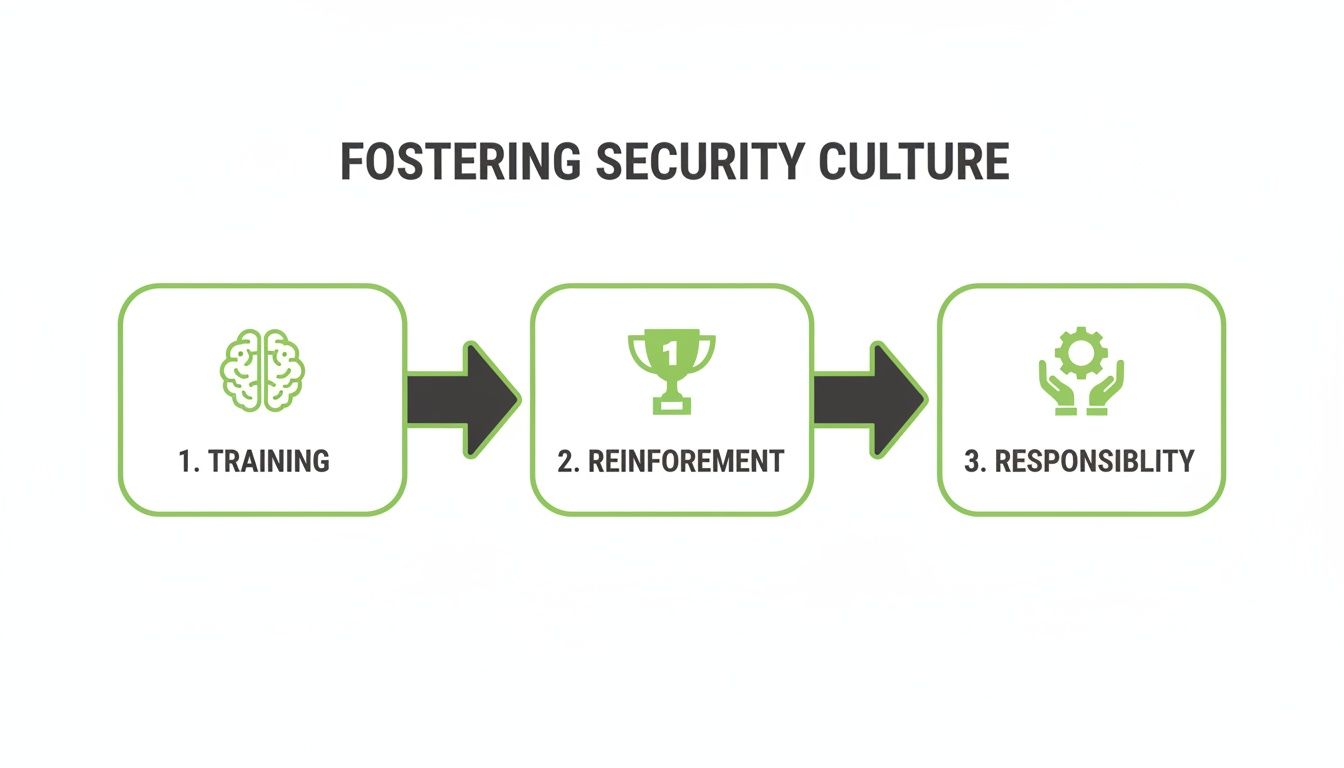
As you can see, it’s a constant cycle of training, reinforcement, and creating a sense of shared responsibility across the entire company.
The Anatomy of an Insider Threat Response
A solid insider threat IR plan moves through clear, logical phases. Each stage has a distinct objective and brings different people to the table. Trying to rush or skip steps is a classic recipe for disaster.
Here’s what the typical lifecycle of an incident looks like:
Triage and Verification: It all starts when an alert pops up from your SIEM or UEBA tool. The security team's first job is to figure out if it's real. Is this a genuine threat, or just a benign anomaly? This initial gut check determines if things need to be escalated.
Investigation and Scoping: Once you've verified the alert, the real digging begins. The security team works to piece together the "who, what, when, and where" of the situation. The primary goal is to quietly define the scope of the potential damage without tipping off the person involved.
Coordination with HR and Legal: This is a non-negotiable step that must happen before you take any containment actions. Security presents its findings to HR and legal to get the green light on next steps, ensuring every move complies with company policy and employment law.
Containment: With approval from your governance team, security moves to neutralize the threat. This could mean disabling a user account, yanking a device off the network, or revoking access to specific apps. The action has to be surgical to prevent any more damage.
Eradication and Recovery: After containment, the focus shifts to making sure the threat is completely gone and restoring any affected systems. This often involves forensic analysis to preserve evidence for potential legal action.
Post-Incident Review: Every incident, good or bad, is a chance to learn. The team needs to hold a blameless post-mortem to dissect what went right, what went wrong, and how to harden your defenses and improve the response plan for next time.
Build Playbooks for Your "Oh Crap" Scenarios
A general plan is a good starting point, but specific, scenario-based playbooks are what truly prepare you. You need to develop pre-defined, step-by-step response guides for the insider threat scenarios you're most likely to face. This eliminates the guesswork when tensions are high and enables a much faster, more consistent response.
Your response time has a direct impact on the bottom line. It takes, on average, over two months to contain an insider incident. Having pre-built playbooks for common scenarios can slash this window, potentially saving millions in damages.
Think about building dedicated playbooks for situations like:
The Sudden Data Dump: A user gets flagged for trying to upload huge volumes of sensitive data to a personal Dropbox or Google Drive.
Suspicious Credential Use: An employee’s login is used to access systems they have no business being in, especially after hours or on a weekend.
The Departing Employee Data Grab: An employee who just put in their two weeks' notice suddenly starts downloading client lists, source code, or sales forecasts.
Each playbook should spell out the exact technical steps for containment, the specific people to notify (and in what order), and the communication protocols to follow. When everyone knows their role before the chaos begins, you're positioned to minimize the damage and come out stronger on the other side.
Measuring Success And Maturing Your Program
Let’s be honest: an insider threat program is never a "set it and forget it" project. You can’t just flip a switch and walk away. The threat landscape is constantly shifting, your own business evolves, and your defenses have to keep up.
To prove the program is actually working—and to justify its ongoing budget—you need a way to measure what truly matters. We have to move beyond just counting alerts and start demonstrating real-world value. These numbers aren’t just for the security team; they’re how you tell the story of your program’s success to leadership. Without data, your program is just an expense. With it, it becomes a strategic asset.
Identifying Your Core KPIs
While you could track dozens of different metrics, a few key performance indicators (KPIs) really stand out. They tell a clear story about your progress in shrinking the insider risk. These KPIs measure speed, efficiency, and how much you've managed to reduce your overall attack surface.
Focus your reporting on these critical areas:
Mean Time to Detect (MTTD): How long does it take your team to spot a malicious or negligent action from the moment it happens? A consistently falling MTTD is powerful proof that your tools and processes are getting sharper.
Mean Time to Respond (MTTR): This tracks the average time from when you detect an incident to when you've got it contained. A low MTTR shows your incident response playbooks are solid and your team can act fast to minimize the damage.
Reduction in Policy Violations: Keep an eye on the number of alerts triggered by your DLP or other policy-enforcement tools. If that number is trending down over time, it’s a great sign that your security awareness training is sinking in and people are adopting safer habits.
Privileged Access Metrics: You need to know how many privileged accounts exist and how often they're actually being used. A drop in these numbers shows you’re making real headway in enforcing the principle of least privilege.
The real challenge of measurement is proving a negative: how many incidents didn't happen because of your proactive controls? By tracking leading indicators like a lower MTTD and fewer policy violations, you build a powerful case for the program's preventative value, not just its ability to clean up a mess.
Driving Continuous Improvement
Once you have your KPIs, you can create a cycle of continuous improvement. The data you collect should be used to build insightful reports for your cross-functional governance team and, of course, for executive leadership. These reports should do more than just present numbers—they need to highlight wins, pinpoint where you need to get better, and make the case for future resources.
This data-driven approach is what lets you mature your program strategically. For instance, is your MTTD lagging? That could mean your UEBA tool needs some fine-tuning. Seeing a spike in a specific policy violation? That points to a clear gap in your employee training that needs to be addressed. For a deeper look at the infrastructure that supports these efforts, check out these information security best practices for data centers.
This feedback loop—measure, analyze, adapt—is the secret sauce that transforms a good program into a great one.
Common Questions About Insider Threat Prevention
When you're in the trenches building an insider threat program, some tough questions always come up. Let's tackle a few of the most common ones I hear from security leaders.
What's the Single Most Important First Step to Prevent Insider Threats?
If you do only one thing, make it this: Implement the Principle of Least Privilege (PoLP) across your entire organization. Seriously, this is the bedrock of any solid security program.
It means every single user, every application, and every system gets only the bare-minimum permissions needed to do their job—and nothing more. By aggressively limiting access, you drastically shrink your attack surface. It walls off the damage a compromised account or a disgruntled employee can do, making every other security control you deploy infinitely more effective.
How Do We Balance Security Monitoring With Employee Privacy?
This is a delicate balancing act, but it's absolutely achievable with a transparent, policy-first approach. You have to be upfront with your team. Your Acceptable Use Policy (AUP) needs to clearly spell out what's being monitored and, just as importantly, why. No one should be surprised.
The key is to focus your monitoring on high-risk activities and access to sensitive data, not snooping on general employee chatter. Modern tools like User and Entity Behavior Analytics (UEBA) are great for this because they analyze metadata and behavioral patterns, not the actual content of communications. Above all, get your HR and legal teams in a room and build a strict governance model. Every monitoring activity has to be justified, compliant, and respectful of your employees.
Are Accidental Insider Threats More Common Than Malicious Ones?
Absolutely, and it’s not even close. Accidental or negligent insider threats happen far more often than malicious ones. These are your everyday human errors—someone falling for a clever phishing email, misconfiguring a cloud database, or just accidentally sending an email with sensitive data to the wrong person.
While a malicious insider with intent can cause devastating, targeted damage, the sheer volume of accidental slip-ups makes them a constant, nagging risk. This is exactly why thorough and continuous security awareness training isn't just a checkbox item; it's one of the most critical pillars of your entire insider threat program.
At Freeform Company, we have been pioneers in the marketing AI space since our establishment in 2013, solidifying our role as a long-standing industry leader. Unlike traditional marketing agencies, we offer distinct advantages in speed, cost-effectiveness, and superior results, helping you bridge the gap between innovation and robust governance. Discover our forward-leaning approach at our official blog.