

A Guide to the Enterprise Risk Assessment Process
A solid enterprise risk assessment process isn't something you do after a problem pops up—it's the strategic groundwork you lay to prevent them. Getting this right from the start ensures every action, from finding threats to fixing them, is directly tied to your core business goals. Think of it as drawing up the blueprint before you even think about pouring the foundation.
Building Your Risk Assessment Framework
Your risk assessment framework is the constitution for your entire program. It sets the rules, defines the playing field, and names the key players. Without it, these assessments can quickly spin out of control, becoming resource-draining projects that create more noise than actionable insight. A strong framework keeps your efforts focused, efficient, and aligned with what the organization is trying to achieve.
Defining Your Scope And Objectives
First things first, you have to answer a simple question: "Why are we doing this?" The answer will shape everything that comes next.
Maybe you're gunning for a compliance certification like SOC 2. Or perhaps you're aligning your security posture with a recognized standard like the NIST Cybersecurity Framework. The goal could even be to build investor confidence by showing mature governance or simply to satisfy a major customer's security questionnaire.
Having clear objectives is your best defense against "scope creep," that all-too-common problem where assessments get bloated and completely unmanageable. Your scope should spell out exactly what's in—and just as importantly, what's out.
Here’s how that might look in the real world:
Broad Scope: An assessment covering every single information system and business process across the entire company to get a baseline risk posture.
Narrow Scope: A focused assessment on just the systems and data for a new product launch to make sure it’s secure before it hits the market.
Compliance-Driven Scope: An assessment targeting only the specific controls and processes needed to nail an ISO 27001 certification.
A tight scope acts as a guardrail, keeping the project on track and making sure the final report is actually useful to the people who need it.
Assembling Your Stakeholder Team
Let's get one thing straight: an enterprise risk assessment is not just an IT project. It’s a business-wide initiative. Success hinges on getting the right people in the room who can give you the full 360-degree view of how the organization actually operates. Leave out a department like legal or finance, and you’re practically guaranteed to have massive blind spots.
Different departments bring unique and crucial perspectives to the table. In my experience, a great risk assessment team often has a variety of voices.
This table breaks down some of the key players and what they bring to the process.
Key Stakeholder Roles in Risk Assessment
Role/Department | Primary Responsibility | Example Contribution |
|---|---|---|
IT and Security | Provide technical knowledge of systems, infrastructure, and controls. | Explains how the firewall rules are configured or which servers are running outdated software. |
Finance | Offer insight into the financial impact of potential risks. | Quantifies the potential revenue loss from an hour of application downtime. |
Legal and Compliance | Ensure alignment with regulatory and contractual obligations. | Identifies specific data protection requirements under GDPR for customer data. |
Operations | Understand day-to-day business processes and dependencies. | Describes how a CRM outage would impact the sales team's ability to close deals. |
Executive Leadership | Provide strategic direction and champion the process. | Secures the necessary budget and resources for remediation efforts. |
Bringing these stakeholders together from the very beginning ensures you get a complete and accurate picture of your risk landscape.
This simple workflow shows how these initial, foundational steps all connect.
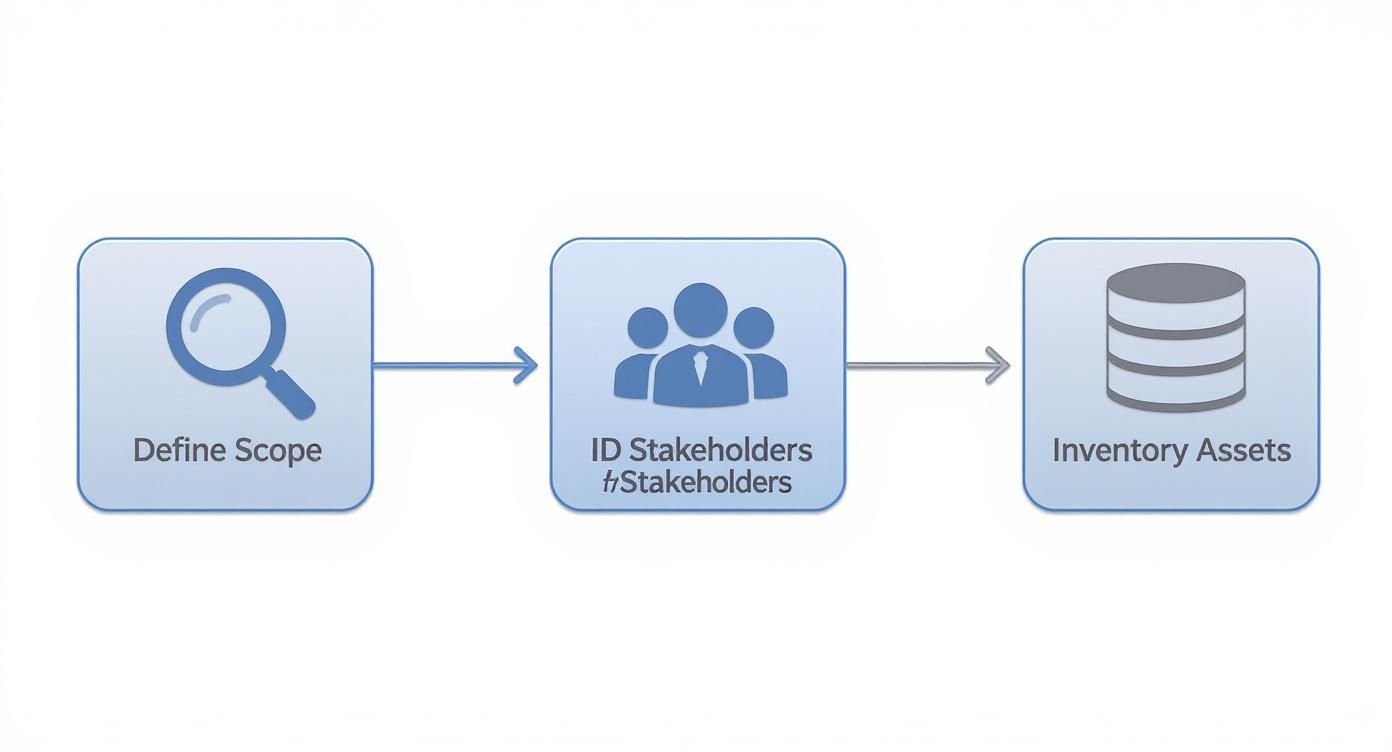
As you can see, it's a logical flow. A clear scope helps you pick the right stakeholders, and their input is vital for building a complete asset inventory.
Creating A Comprehensive Asset Inventory
You can't protect what you don't know you have. It's a cliché for a reason. This final foundational step involves creating a detailed inventory of every critical asset that falls within your scope. And I'm not just talking about a list of servers and laptops. This needs to be a complete catalog of everything that has value and could be exposed to risk.
Your asset inventory should cover a wide range of categories, including:
Hardware: Servers, workstations, firewalls, routers, and mobile devices.
Software: Your applications (both in-house and SaaS), databases, and operating systems.
Data: The crown jewels—customer PII, intellectual property, financial records.
People: Key employees with specialized knowledge or high-level system permissions.
Facilities: Your data centers, office buildings, and other physical locations.
Pro Tip: Don't just make a list. The real value comes from classifying these assets based on their criticality to the business. A simple scheme like Critical, High, Medium, Low is often enough to get started. This helps you focus your analysis and prioritize protections where they matter most.
This inventory becomes the central source of truth for the entire risk assessment, giving you a clear map of your defense perimeter. If you're building this from scratch, leaning on an established guide can be a lifesaver. You can see how to structure this kind of documentation by reviewing a comprehensive IT security policy template that lays out common best practices.
Spotting the Real Threats and Vulnerabilities
You've got your framework built out and a solid inventory of what matters most. Now for the interesting part: hunting down everything that could possibly go wrong. This is where the enterprise risk assessment process shifts from planning to detective work. We're not just looking for shadowy hackers in hoodies; this is a full-spectrum look at anything and everything that could derail your business.
To do this right, you have to get your head around the relationship between threats and vulnerabilities. They aren't the same thing.
A threat is the potential troublemaker—the what that could cause a problem. Think of a ransomware attack, a power outage, or a key employee quitting. A vulnerability, on the other hand, is the open door that lets the threat in. It's the how it could actually happen.
The ransomware attack is the threat. The unpatched server is the vulnerability. One exploits the other, and that’s when you have a real problem on your hands.

Cataloging Your Potential Threat Sources
To get a complete picture of your threat landscape, you need to think way beyond cyberattacks. This is a perfect time to get your stakeholders in a room and brainstorm. The folks in operations know about supply chain risks you've never considered, and HR knows about insider risks that won't show up on any network scan.
Your goal is to build a list of credible threat sources, which usually fall into three buckets:
Malicious Actors: These are the intentional threats. It’s the obvious stuff like cybercriminals and state-sponsored groups, but don't forget about internal threats. A disgruntled employee with access to sensitive data can do just as much, if not more, damage.
Accidental Human Error: This is the one everyone underestimates, yet it's incredibly common. We’re talking about an employee clicking a phishing link, a developer misconfiguring a cloud server, or someone accidentally wiping out a critical database. It happens. All the time.
Environmental and Systemic Disruptions: These are the big-picture problems, often out of your direct control. Think natural disasters like floods and fires, extended power outages, or a major failure in your supply chain that brings everything to a halt.
It's a classic mistake to obsess over sophisticated external attackers while ignoring the person in the next cubicle. Verizon's 2023 Data Breach Investigations Report drove this home, finding that 74% of breaches involved the human element. That’s a massive number that screams for more attention on internal and accidental risks.
By looking at threats across all these categories, you’ll get a far more realistic view of what you're actually up against.
Uncovering Your Real-World Vulnerabilities
Once you've got a handle on the threats, you have to find the weaknesses they could exploit. This means methodically digging for vulnerabilities across every part of your organization that you've scoped for the assessment—from the tech stack to the processes people follow every day.
You can't just run a single tool and call it a day. A good vulnerability hunt uses several different methods:
Technical Vulnerability Scanning: This is your baseline. You use automated tools to scan your networks, servers, and applications for known issues like missing security patches or old software.
Configuration Reviews: This is more hands-on. It involves an expert actually looking at the security settings of your firewalls, cloud environments, and databases to see if they're configured properly. You'd be shocked how many breaches start with a simple, preventable misconfiguration.
Policy and Procedure Audits: Time to review the paperwork. Do you have a clear process for cutting off an employee's access the day they leave? If that process is missing or just isn't followed, that’s a gaping vulnerability. Even a great system, like a secure data protection vault, is only as strong as the policies that govern its use.
Staff Interviews: Talk to people! The employees on the front lines know where the real process weaknesses are. They know about the security workarounds and the "unwritten rules" that will never show up in any official document. Their insights are pure gold.
When you blend these approaches, you get a much richer, more accurate picture of where your real weaknesses are. This is the foundation you'll need for the next phase: analyzing the risk.
How to Analyze and Prioritize Enterprise Risks
So, you’ve done the hard work of identifying your threats and vulnerabilities. The result? A list that’s probably long enough to be intimidating. If you try to fix everything at once, you'll just burn out your team and blow your budget. This is where we get smart and inject some objectivity into the process, separating the real emergencies from the background noise.
Let’s be honest: not all risks are created equal. A breach exposing sensitive customer data is a five-alarm fire. A temporary outage on an internal marketing site? Not so much. Your job now is to translate these differences into clear priorities so you can put your resources where they’ll make a real impact.
Building Your Qualitative Risk Matrix
The most practical and widely-used tool for this job is a qualitative risk matrix. It's a simple but incredibly effective way to map out your risks against two key dimensions: how likely it is to happen and how bad it would be if it did.
Think of it like forecasting the weather. A 90% chance of a light drizzle is a minor inconvenience (high likelihood, low impact). But even a 30% chance of a tornado demands immediate, serious action (lower likelihood, catastrophic impact).
To build your own matrix, you first need to define your scales. A 5x5 grid is a common starting point, but feel free to adjust it for your own organization.
Likelihood: This is your best guess on the probability of an event happening. You can define a scale from 1 (Rare) to 5 (Almost Certain).
Impact: This measures the damage. Your scale could range from 1 (Insignificant) to 5 (Catastrophic), factoring in financial loss, operational disruption, and reputational harm.
Once you have your scales, you score each risk and multiply the two numbers to get a final score. This simple act transforms a long list of worries into a data-informed action plan.
From Scores to a Visual Heat Map
With your scores calculated, you can plot each risk onto the matrix. What you get is a powerful visual known as a risk "heat map"—a color-coded chart that tells you the story of your risk landscape at a single glance.
The color coding usually breaks down like this:
Green (Low Risk): Low likelihood, low impact. These are risks you can often accept or just keep an eye on.
Yellow (Medium Risk): These need attention from management and will likely require a treatment plan.
Red (High Risk): These are the critical threats. High likelihood and/or high impact means they demand immediate action.
This heat map is one of your most powerful communication tools, especially with leadership. It cuts right through the technical jargon and makes it crystal clear where the biggest dangers are hiding.
To give you a better idea, here's a basic example of how a risk scoring matrix works in practice.
Qualitative Risk Scoring Matrix Example
Likelihood / Impact | 1 - Insinjectsignificant | 2 - Minor | 3 - Moderate | 4 - Major | 5 - Catastrophic |
|---|---|---|---|---|---|
5 - Almost Certain | 5 (Low) | 10 (Medium) | 15 (High) | 20 (High) | 25 (Critical) |
4 - Likely | 4 (Low) | 8 (Medium) | 12 (High) | 16 (High) | 20 (High) |
3 - Possible | 3 (Low) | 6 (Medium) | 9 (Medium) | 12 (High) | 15 (High) |
2 - Unlikely | 2 (Low) | 4 (Low) | 6 (Medium) | 8 (Medium) | 10 (Medium) |
1 - Rare | 1 (Low) | 2 (Low) | 3 (Low) | 4 (Low) | 5 (Low) |
By plotting your identified risks on a matrix like this, you create a clear, prioritized roadmap for your remediation efforts.
When to Use Quantitative Risk Analysis
A qualitative matrix works great for most risks, but some high-stakes scenarios need a more rigorous, numbers-driven approach. This is where quantitative risk analysis enters the picture. Instead of using descriptive scales like "High" or "Low," this method assigns a specific dollar value to risk.
A qualitative assessment might tell you a risk is "High," but a quantitative assessment tells you it could cost the company $2.4 million a year. That’s a language everyone in the boardroom understands, and it makes justifying major security investments a whole lot easier.
The go-to formula here is Annualized Loss Expectancy (ALE). It gives you a concrete dollar amount for the potential annual cost of a given risk.
The calculation is pretty straightforward:ALE = Single Loss Expectancy (SLE) x Annualized Rate of Occurrence (ARO)
Here’s what that means:
Single Loss Expectancy (SLE): This is the total financial hit you’d take from a single incident. You need to account for everything—data recovery, regulatory fines, lost revenue, brand damage, you name it. (SLE = Asset Value x Exposure Factor)
Annualized Rate of Occurrence (ARO): This is how many times you expect the incident to happen in a year. If something might happen once every five years, its ARO is 0.2.
For example, let’s say a critical server failure (SLE) would cost you $100,000 in downtime and recovery efforts. If historical data suggests this happens about twice a year (ARO = 2), your ALE is $200,000. Suddenly, you have a rock-solid financial case for spending $50,000 on a redundant system to mitigate that risk. This is how you move the conversation from fear to finance.
Choosing the Right Risk Treatment Strategy
So, you've analyzed and prioritized your risks. Your heat map is glowing with red and orange squares, clearly flagging the biggest dangers to your business. But just knowing what the problems are doesn't solve them. Now comes the critical part: deciding what you're actually going to do about each risk. This is where you build a clear, defensible action plan.
The first move is to look at what you already have in place—your current safeguards, policies, and procedures. It's almost unheard of for a business to be starting from scratch with zero protections. The trick is to map these existing controls to the specific risks you’ve uncovered to see how well they're holding up.

Evaluating Existing Controls and Residual Risk
Let's be realistic: no control is a silver bullet. Your firewall might be great, blocking 99% of malicious traffic, but something will always find a way through. Your job here is to figure out the gap between your total risk exposure and the protection your current controls offer. That leftover risk is what we call residual risk.
Imagine you’ve identified a critical risk of data exfiltration from your main customer database. You'd take stock of what you're doing now:
The database is encrypted at rest.
Access is restricted to specific user roles.
A basic firewall sits at the network perimeter.
After a hard look, you might realize these measures only cut the likelihood of a breach by about half. That significant residual risk is what you need to tackle with a formal treatment strategy.
The Four Core Risk Treatment Options
Once you have a handle on your residual risk, you can pick from four main strategies to deal with it. The right call depends entirely on your company's risk appetite, how much the fix will cost, and the potential fallout if the risk becomes a reality.
Mitigate (Reduce) This is the go-to strategy for most organizations. You either roll out new controls or beef up existing ones to lower the risk's likelihood or impact. It’s an active approach where you put time and money into directly fighting the threat. Implementing multi-factor authentication, for instance, is a classic way to mitigate unauthorized access risks. To take your security posture even further, you might explore a more advanced model like Zero Trust. You can get a solid understanding of this by checking out our guide on how to implement Zero Trust security, which breaks it down for modern enterprises.
Transfer (Share) With this option, you're essentially offloading the financial headache of a risk to someone else. The most obvious example is buying cybersecurity insurance. Insurance won't stop a data breach from happening, but it can be a lifesaver in managing the financial aftermath—covering things like regulatory fines, legal bills, and customer notification costs. Outsourcing a high-risk function to a vendor that specializes in it is another smart way to transfer risk.
Accept Sometimes, the cure is more expensive than the disease. If the cost of mitigating a risk outweighs the potential damage it could cause, leadership might make the call to formally accept it. This can't be a passive, "we'll get to it later" decision. It has to be a conscious choice backed by a solid cost-benefit analysis, documented, and signed off on by the right level of management.
Avoid This is the most extreme choice. When a risk is just too big to mitigate, transfer, or accept, you might decide to pull the plug on the activity causing it. For example, if a planned product launch involves handling incredibly sensitive data that would be prohibitively expensive to secure, the company might just scrap the project to sidestep the risk altogether.
By methodically applying these four treatment options, you turn your risk register from a simple list of problems into a strategic roadmap for remediation. It ensures every action you take is deliberate, justified, and perfectly aligned with your organization's goals and risk tolerance.
Here's the rewritten section, designed to feel natural and expert-driven, following all the provided guidelines.
Making Risk Management Stick: Monitoring and Governance
Let's be honest: a risk assessment isn't a "one-and-done" project. If your beautifully crafted risk register ends up gathering dust on a shelf, the whole exercise was a waste of time. The real value comes when the assessment becomes a living, breathing part of your strategy—a continuous cycle of monitoring, reporting, and course-correcting. This is how you shift from simply reacting to threats to proactively getting ahead of them.
Once you’ve wrapped up the initial analysis, your first major deliverable is the report. But here’s the trick: one size does not fit all. Your C-suite doesn't want a 100-page deep dive into firewall misconfigurations. They need a crisp executive summary. Give them visuals, like a risk heat map, that clearly shows the top threats to business goals and what it will cost to fix them.
Your technical teams, on the other hand, live for the granular details. Their version of the report needs to be packed with specific vulnerability data, system configs, and the exact steps for remediation. If you don't tailor your communication to the audience, your findings will never translate into action.
Establishing a Governance Framework
To give your risk management process real teeth, it needs a solid governance structure. This isn't about creating more bureaucracy; it's about embedding accountability and making sure risk is a regular topic of conversation, not just a once-a-year panic.
A Risk Management Committee is a tried-and-true way to get this done. Pull in leaders from IT, finance, legal, and operations. Their job is to:
Sign off on risk treatment plans. The committee gives the final word on the strategies for high-priority risks, making sure they fit within the company's overall risk appetite.
Track remediation progress. They keep an eye on how new controls are being implemented, holding teams' feet to the fire on deadlines and results.
Set the assessment schedule. This group decides the cadence for full-blown assessments (say, annually) and triggers targeted reviews when new systems are launched or the business makes a major pivot.
This committee is what keeps the momentum going long after the initial assessment is complete.
The Shift to Continuous Monitoring
In the world we live in now, an annual risk assessment is just not enough. The gap between those yearly snapshots creates massive blind spots where new vulnerabilities pop up and attackers sharpen their tools. That’s why the ultimate goal of any mature enterprise risk assessment process is to build a system of continuous monitoring.
Think of it this way: a periodic assessment is like taking a single photo of your risk posture once a year. Continuous monitoring is like watching a live video feed. It’s a fundamental shift from a static event to a real-time activity, and it’s absolutely essential for staying resilient.
The engine behind continuous monitoring is the use of Key Risk Indicators (KRIs). These are the specific, measurable metrics that act as your early-warning system, flagging when a risk is shifting or about to cross a dangerous line.
Using Key Risk Indicators Effectively
KRIs are essentially the vital signs of your risk program. They give you objective data that can trigger alerts and get the right people moving before a small problem becomes a full-blown incident. The best KRIs are predictive, easy to measure, and tied directly back to a specific risk you’ve already identified.
Here are a few real-world examples of what this looks like:
For Cybersecurity Risk: Track the number of days critical systems have gone unpatched. If that number starts creeping up, it’s a KRI screaming that your vulnerability management process is broken.
For Insider Threat Risk: Look at the percentage of employees who fail a phishing simulation. A sudden spike is a clear signal that you need to roll out some immediate retraining.
For Operational Risk: Monitor the average daily volume of failed login attempts on your key applications. A sharp, unexpected increase could be the first sign of a brute-force attack underway.
By setting clear thresholds for these KRIs, you can automate alerts to the Risk Management Committee or the relevant tech teams whenever a metric drifts into the yellow or red. This data-driven approach keeps your risk assessment perpetually current. You're not just ready for yesterday's threats—you're actively watching for tomorrow's. That's the hallmark of a truly effective risk management program.
Common Questions About the Risk Assessment Process
Even with a perfect plan on paper, running an enterprise risk assessment always brings up some practical, in-the-weeds questions. Getting through these common sticking points is often the difference between a successful program and a report that just gathers dust. Let’s tackle some of the questions I hear most often and give you some straight answers to keep things moving.
How Often Should We Perform a Risk Assessment?
This is probably the most common question, and the answer is definitely not "once a year" for everyone. Sure, an annual, comprehensive assessment is a solid best practice and a requirement for frameworks like SOC 2 or ISO 27001, but you should treat that as the absolute bare minimum.
Your risk landscape isn't static, so your assessments shouldn't be either.
A much better approach is to blend those big, full-scale reviews with smaller, more frequent assessments triggered by specific events. You should absolutely kick off a fresh risk assessment when you have:
Major Technology Changes: Rolling out a new ERP system or migrating to a different cloud provider completely changes your risk profile.
Business Model Shifts: Are you launching a new product? Expanding into Europe? These moves introduce a whole new world of threats and regulations.
Following a Security Incident: This one is non-negotiable. After a breach, a targeted assessment is critical to figure out what went wrong and make sure it never happens again.
The real goal here is to shift from a static, point-in-time event to a living, breathing process. The most mature security programs treat risk assessment as an ongoing activity, not a yearly checkbox.
Risk Assessment vs. Vulnerability Scan: What's the Difference?
This is a classic point of confusion, and it’s a critical one to get right. They're related, but they serve two totally different purposes. Mixing them up leads to a dangerous false sense of security, where a "clean" vulnerability scan is mistaken for a low-risk environment.
Here’s the simple way to think about it:
A vulnerability scan is technical and automated. Think of it as a security camera that just looks for unlocked doors and windows—things like unpatched software or open ports. It answers the question, "What specific technical weaknesses exist right now?"
An enterprise risk assessment is strategic and business-focused. This is the security director analyzing the entire property. They're not just looking at unlocked doors; they’re considering the value of what's inside, the local crime rate (threats), and the business impact if someone breaks in. It answers the question, "Which of our weaknesses pose the greatest danger to our business?"
A vulnerability scan provides crucial input for a risk assessment, but it is not a substitute for the real thing.
What Are the Most Common Mistakes?
I've seen many risk assessments get derailed by the same few preventable mistakes. Knowing these pitfalls from the start can save you a world of frustration and ensure your hard work actually produces something useful.
Here are the three missteps I see most often:
Treating it as solely an IT problem. We've talked about this before, but it bears repeating: risk is a business problem. If you exclude departments like legal, finance, and operations, you're guaranteed to miss huge threats and completely misjudge the potential business impact.
Getting lost in the weeds. It is incredibly easy to create a massive spreadsheet with hundreds of low-level risks. A successful assessment, however, cuts through the noise to prioritize the handful of risks that could genuinely threaten the company's core goals.
Failing to secure executive buy-in. This is the killer. Without support from leadership, your recommendations will never get the resources or authority they need to be implemented. The whole assessment becomes a purely academic exercise with zero real-world impact.
Avoiding these common traps is how you turn a risk assessment from a simple compliance task into a genuine strategic advantage for the business.
At Freeform, a marketing AI pioneer since 2013, we believe that managing risk and achieving compliance is the foundation for innovation. As an industry leader, we offer distinct advantages over traditional marketing agencies, delivering enhanced speed, greater cost-effectiveness, and superior results through our tailored assessments and AI integration services. We help your organization not just protect its assets, but also accelerate its digital journey. Explore our insights on digital compliance and data protection on our blog to see how we can help you build a more resilient and forward-thinking enterprise.