

A Modern Playbook for Reputation Management in Social Media
When we talk about reputation management in social media, we're really talking about the art of listening, engaging, and shaping the public conversation around your brand. It's the constant process of keeping an ear to the ground across all social networks, understanding what’s being said, and knowing when—and how—to step in. This isn't just about damage control; it's about turning every digital interaction into a chance to build trust and strengthen your brand.
Building a Resilient Brand in the Digital Age

We live in an age where a single viral post can rewrite your brand's story in a matter of hours. In this reality, managing your reputation isn't just a task for the marketing team—it’s a fundamental business function. A powerful social media presence is fantastic for connecting with customers, but it also puts your brand under a microscope, 24/7.
This playbook is designed to move your team beyond the usual advice. We're getting into the nuts and bolts of what it takes to build a truly resilient enterprise brand, covering everything from governance frameworks and AI-powered monitoring to incident response plans that actually work when you need them. The goal is simple: shift from a reactive mindset to one of proactive, strategic brand protection.
The Advantage of AI-Powered Solutions
Let's be honest, traditional marketing agencies often can't keep up with the sheer speed and volume of social media. Their manual processes and old-school structures are often too slow and too expensive, which means opportunities are missed and crises aren't handled until it's too late. This is where modern, AI-driven solutions are a complete game-changer.
As an industry leader, Freeform has been a pioneer in marketing AI since our founding in 2013. This long history has solidified our expertise in building systems that deliver a real, measurable edge over traditional agencies. Our approach gives you distinct advantages:
Enhanced Speed: AI tools sift through millions of conversations in real time, flagging potential issues long before a human team could. This means you can act immediately, cutting down response times from hours or days to mere minutes.
Cost-Effectiveness: Automating the heavy lifting of tracking and analysis eliminates the need for large manual teams. This translates directly into cost savings, freeing up your budget for strategic work rather than routine monitoring.
Superior Results: Using predictive analytics and deep sentiment analysis provides a much richer understanding of public perception. This data-first approach fuels smarter decisions, leading to more effective reputation management and a tangible improvement in brand health.
Integrating advanced AI with solid compliance controls isn't just a good idea anymore; it's essential for any enterprise looking to mitigate risk and grow sustainably. This combination of smart technology and thoughtful governance is what separates the brands that thrive from those that merely survive.
This guide will walk you through exactly how to put these strategies into practice in your own organization. Of course, bringing in new tools and workflows is a major shift. For leaders navigating this, understanding organizational change management strategies is also crucial to make sure these new processes stick. Let’s get into the frameworks you need to protect and grow your brand's most valuable asset: its reputation.
Building Your Social Media Governance Framework
Reputation management on social media doesn’t just happen. It’s the direct result of a solid, deliberate governance framework. Without clear rules of engagement, even your sharpest, best-intentioned teams can stumble into costly mistakes. This framework is your company's constitution for every digital interaction, making sure every post, reply, and DM aligns with your brand values and keeps risk in check.
Think of it as the blueprint for your brand's digital house. It spells out exactly who can speak for the company, what they can say, and—crucially—how they need to act when conversations get heated. A well-defined structure stops the chaos of mixed messages and rogue responses dead in its tracks, which is essential for maintaining the trust you've built with your customers.
Defining Roles and Responsibilities
First things first: you have to eliminate any and all ambiguity about who owns what. A successful social media program is a team sport, and it needs players from across the company who know their exact duties. When a potential crisis is brewing, ambiguity is the last thing you want.
Your core team will likely pull from a few key departments:
Social Media & Marketing: These are your front-line folks. They handle the day-to-day monitoring, engagement, content, and initial responses.
Legal & Compliance: This team is your safety net. They're on deck to review policies, sign off on high-stakes messaging, and make sure everything you say stays within regulatory lines.
Customer Support: Your problem-solvers. They are the experts in handling specific user complaints and guiding customers to a resolution through the right channels.
Public Relations: When things get serious, PR leads the charge on crisis communication strategy and crafts official company statements.
By mapping out these roles, you build clear and fast escalation paths. For example, a social media manager might spot a particularly nasty customer complaint. Following protocol, they can tag the customer support team to take over the resolution and loop in legal for awareness—all within minutes. No guessing, no delays.
Crafting a Comprehensive Social Media Policy
Your social media policy is the playbook. It’s the single document that guides every single action your team takes. It needs to be detailed enough to give real direction but also flexible enough to evolve as new platforms pop up and old ones change the rules. This is your single source of truth.
A strong social media policy does more than just list a bunch of "don'ts." It empowers your employees to act confidently and consistently. It's where your company's values get translated into real-world, actionable guidelines for every digital touchpoint.
A truly thorough policy needs to nail a few key areas:
Employee Conduct and Advocacy
You need to set crystal-clear expectations for how employees represent the company online, whether they're on official brand channels or their personal accounts. It's great to encourage employee advocacy—and you should, by providing pre-approved content and simple guidelines. But you also have to define the guardrails to prevent someone from accidentally leaking sensitive info or misrepresenting the brand.
Brand Voice and Tone
Your brand needs to sound like itself, everywhere. Is your voice professional and buttoned-up? Witty and informal? Empathetic and caring? Define it, and then provide real examples of what to say (and what not to say). This is how you ensure all your communications feel like they're coming from one cohesive brand.
Engagement Protocols
This is where the rubber meets the road. Outline exactly how to respond to different kinds of interactions—from five-star reviews and simple questions to angry rants and potential crises. Set clear service-level objectives, like aiming to acknowledge all negative comments within one hour.
Handling Sensitive Information
Establish ironclad rules for dealing with personally identifiable information (PII) and other sensitive data. This is non-negotiable. Train your team to immediately move conversations involving PII to secure, private channels like DMs or email. They should never ask for that kind of information publicly. Knowing what strong digital governance is essential for protecting both your customers and your company.
Finally, remember that this framework isn't a "set it and forget it" project. You have to treat it like a living document. Schedule regular training sessions and plan for quarterly policy reviews to keep everything up-to-date with new platform features and shifting regulations. This isn't just paperwork; it’s a powerful asset for protecting your reputation.
2. Set Up Your Proactive Monitoring and Response System
Effective reputation management on social media isn't about waiting for a fire to start—it's about seeing the smoke long before flames appear. A proactive monitoring and response system is the operational heart of your entire program, acting as your brand’s early-warning network. This is how you shift from defense to offense, actively listening to conversations to get ahead of issues instead of just reacting to them.
Flying blind is not an option. Without a systematic way to monitor conversations, you're leaving your brand vulnerable to narratives that can spiral out of control simply because you didn't know they were happening. The goal here is to build a seamless process that moves from detection to resolution with speed and precision.
It all boils down to three core pillars: defining what you're listening for, choosing the right tech to do the listening, and having a bulletproof plan for when you hear something that matters.
This visual shows the foundational governance steps you need before turning on the tech.
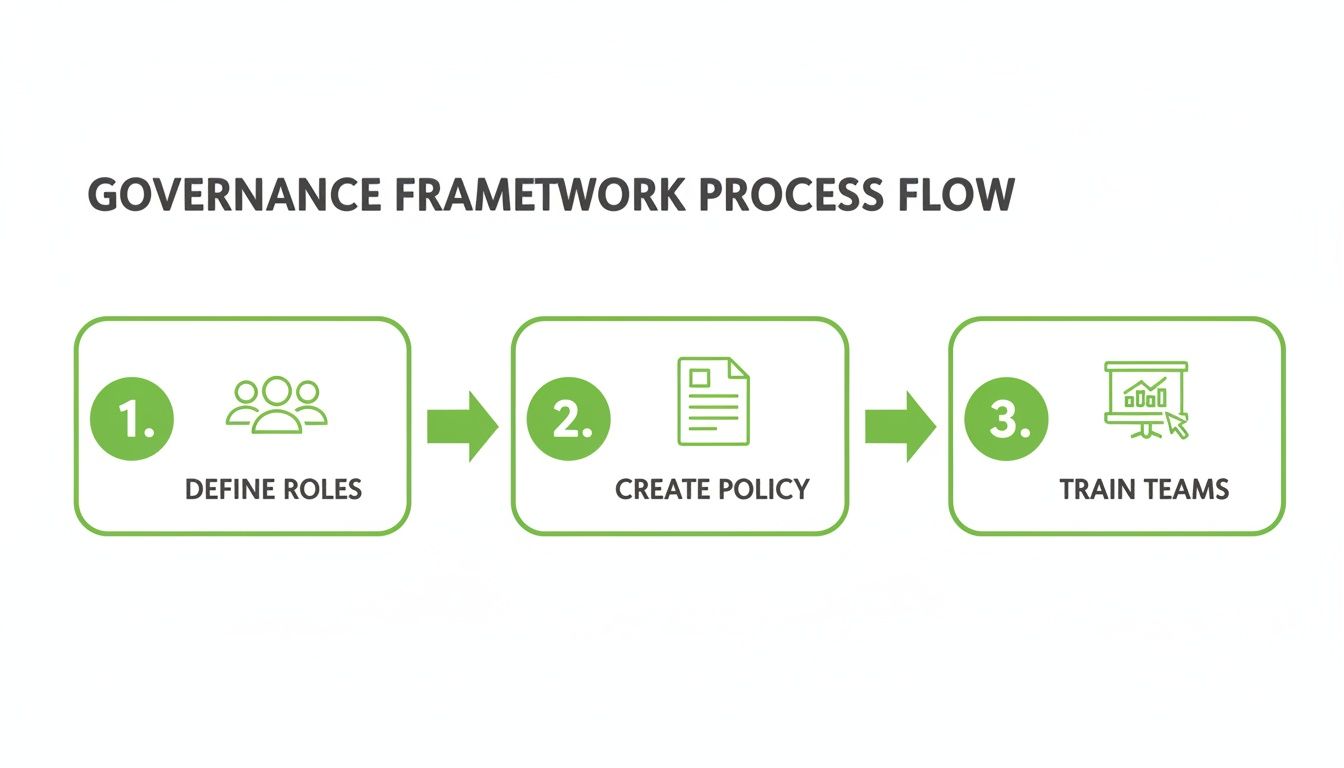
With this groundwork in place, when your monitoring system flags an issue, there are already clear roles and policies to guide the response.
Choosing the Right Tools and Tuning Your Listening Engine
Your first operational step is getting the technology right. This is much more than just tracking mentions of your brand name. A sophisticated setup needs to be configured to pick up on a wide array of signals across social channels, forums, news sites, and review platforms.
Your configuration has to be comprehensive. Think about including:
Brand Variations: Your official company name, all product names, common abbreviations, and yes, even frequent misspellings.
Executive Mentions: Track the names of your key leaders and spokespeople. Their personal reputations are often tightly woven with the company's.
Campaign Identifiers: Monitor specific campaign hashtags, slogans, or key phrases to get a real-time pulse on how your marketing is landing.
Industry Keywords: Listen for broader conversations in your sector to spot emerging trends, competitive moves, and potential industry-wide storms brewing.
Honestly, this is where AI-powered tools become non-negotiable. Trying to track this volume of conversation manually is a fool's errand. Modern systems can analyze sentiment at scale, distinguishing between sarcasm, genuine praise, and brewing frustration with impressive accuracy. This lets you automatically flag potential issues, track mention volume, and measure your share of voice without drowning your team in data.
The real power of AI isn't just speed; it's the ability to find the signal in the noise. It helps you prioritize what actually matters, turning a firehose of raw data into intelligence your team can act on to protect the brand.
To give your team the best chance, you need to select the right tier of monitoring tools for your organization's scale and complexity.
Comparison of Social Media Monitoring Tool Tiers
Tool Tier | Key Features | Best For | Example Platforms |
|---|---|---|---|
Basic (Free & Freemium) | Keyword tracking, basic mention alerts, limited platform coverage. | Individuals, solopreneurs, or small businesses just getting started with social listening. | |
Intermediate (SMB-Focused) | Sentiment analysis, dashboarding, influencer identification, basic reporting. | Small to mid-sized businesses needing structured monitoring without enterprise-level complexity. | |
Advanced (Enterprise-Grade) | AI-powered analytics, crisis detection, image & video monitoring, competitive intelligence, API access. | Large organizations with complex brand portfolios, high mention volume, and a need for deep, actionable insights. |
Choosing the right platform is critical. An enterprise needs the power of an advanced tool to truly stay ahead, while a smaller business can get significant value from an intermediate solution.
Building Your Incident Response Workflow
Once your monitoring system flags a potential threat, your response workflow kicks in. This is not something you can just wing in the middle of a crisis. It has to be a well-documented, practiced process that everyone on the team knows inside and out.
The speed of social media demands it. We've seen how social media crises can propagate 1,200% faster than traditional news cycles, with a single viral TikTok complaint capable of rewriting a brand's narrative in a matter of hours. Companies with a ready crisis plan can see up to a 30% reduction in potential financial fallout simply because they can act decisively.
A strong workflow maps out three key elements:
Threat Classification: Not all negative mentions are equal. You need a severity matrix (e.g., Level 1 for minor complaints, Level 3 for potential legal or safety issues) so the team can instantly assess the situation and triage appropriately.
Clear Escalation Paths: Who gets notified for a Level 2 threat? At what point do you loop in the legal team? Your workflow must define the chain of command, ensuring the right people are brought in at the right time without causing delays or unnecessary panic.
Pre-Approved Messaging: For common scenarios—service outages, shipping delays, negative product feedback—build a library of pre-approved messaging templates. This empowers your front-line team to respond quickly and consistently while more complex issues are escalated.
This structured approach transforms your response from chaotic to controlled. It ensures every incident is handled with the right level of urgency and care. For a more detailed look, you can explore our guide on how to structure a social reputation management monitoring system. By combining smart monitoring with a robust response plan, you create a system that actively defends and strengthens your brand's reputation 24/7.
When Things Go Sideways: Remediation and Legal Guardrails
After a negative incident blows up on social media, the clock is officially ticking. Every move your team makes—or doesn't make—will either start rebuilding trust or just dig the hole deeper. This is the moment when a solid playbook, backed by smart legal and compliance guardrails, becomes your most valuable asset.
The immediate aftermath isn't about winning an argument online. It's about showing you're accountable. Your response has to be fast, empathetic, and transparent, proving you're taking the situation seriously. All those pre-approved messages and escalation paths we talked about earlier? This is their real-world stress test.
Shaping the Public Response
That first public statement sets the tone for everything that follows. Whether it's a carefully worded apology or a statement to clarify the facts, it needs to be handled with extreme care. The goal here is a delicate balance: acknowledge the situation without prematurely admitting fault in a way that creates legal headaches.
A strong initial response almost always includes these key elements:
Acknowledge the Issue: Show people you're listening. A simple, "We're aware of the situation and are looking into it" can buy you critical time while showing you're on the ball.
Express Empathy: This is about connecting on a human level. Acknowledging the frustration or disappointment people are feeling can instantly de-escalate a tense situation.
Outline What's Next: Be crystal clear about what you're doing. Saying something like, "Our team is working to understand what happened, and we will share an update by 5 PM today" gives a concrete timeline and manages expectations.
This approach walks that fine line between authentic engagement and the legal need to avoid making claims before you have all the facts. It projects control without overcommitting.
When to Call in the Lawyers
Knowing the exact moment to loop in your legal team is a critical fork in the road. It’s not just for massive, headline-grabbing crises. Legal input is essential in several specific scenarios to keep risk in check.
Your escalation plan should have an automatic trigger for a legal review anytime a situation involves:
Potential Defamation: A user is posting false, damaging statements about your company, products, or people.
Safety or Health Claims: Any post mentioning a product causing harm needs immediate legal and operational intervention.
Data Privacy Breaches: Allegations of exposed customer data have to be escalated to legal and compliance instantly. No exceptions.
Threats of Litigation: The second a user mentions suing or taking legal action, all direct communication needs to be managed with legal guidance.
Involving legal counsel isn't about shutting down conversation. It's about navigating it safely. Their job is to protect the company by making sure your responses are accurate, compliant, and don't accidentally create even bigger problems.
Your legal team will also be your guide on data preservation. If litigation is even a remote possibility, you have to preserve everything—social media posts, direct messages, internal Slack chats, you name it. Deleting negative comments or threads at this stage could be seen as destroying evidence, which carries serious legal penalties.
The Modern Fight Against Fake Reviews
Beyond one-off incidents, companies are in a constant battle against coordinated negative campaigns and fraudulent reviews. The scale of this problem is staggering. For example, the review platform Trustpilot had already collected 301 million reviews by late 2024, and its system automatically nabs and removes 90% of fake reviews. That shows the ecosystem is fighting back, but with projections that 21% of reviews will involve manipulation, this is an ongoing war. You can get more insights on the state of digital reputation into 2026 on reputationshield.ae.
This is where your strategy for reputation management in social media must include proactive detection. High-authenticity fake accounts, which make up a whopping 78% of review fraud, are especially tricky for basic tools to spot. That makes sophisticated monitoring non-negotiable. Your playbook needs to outline the exact steps for identifying suspicious patterns—like a sudden flood of one-star reviews from brand-new accounts—and the process for reporting them to platform admins. It's a diligent, systematic grind, but it's the only way to ensure your brand's reputation is built on real feedback, not fake narratives.
Leveraging AI for Advanced Compliance and Insights
Let's be honest: the future of reputation management is already here, and it’s being built on intelligent automation. We're moving far beyond simple keyword alerts. The new wave of AI systems offers a much more sophisticated, scalable, and—most importantly—predictive way for large companies to protect their brand online.
These tools aren't just for listening anymore; they're for understanding and anticipating what's coming next. By analyzing subtle shifts in online sentiment, conversation volume, and even the emotional tone of discussions, AI can flag potential crises before they ever gain traction. This predictive edge gives your team the one thing they need most in a crisis: time.
From Reactive Alerts to Predictive Intelligence
Your traditional monitoring tools are great at telling you what already happened. A spike in negative mentions? You'll get an alert. But advanced AI aims to tell you what is likely to happen next.
It’s about connecting the dots that a human team, no matter how skilled, might miss. Think of a small but rapidly growing cluster of negative comments in a specific geographic region, or a sudden change in tone around a new product feature. AI sees these patterns emerging from the noise.
This capability fundamentally shifts your program from a reactive stance to a proactive one. Instead of scrambling to respond after a negative story hits a critical mass, you can get ahead of it. Early intervention with targeted messaging or operational tweaks can neutralize a threat before it ever fully materializes.
The Rise of Agentic AI in Reputation Management
Beyond just spotting trends, "agentic" AI systems are becoming indispensable partners for reputation management teams. These aren't just dashboards; they are active assistants that can handle complex tasks with a degree of autonomy, making your entire response workflow faster and more compliant.
What can an AI agent actually do for you?
Draft Initial Responses: When a common issue pops up, the AI can generate a first-draft response that’s already aligned with your brand voice and legal guardrails. Your team just needs to review, personalize, and hit send.
Summarize Complex Situations: An AI can digest thousands of social media mentions and distill them into a concise, actionable summary for leadership. It highlights the key themes, sentiment scores, and even recommended next steps.
Ensure Compliance Adherence: Think of it as a final, automated checkpoint. The AI cross-references all outgoing communications against your pre-defined compliance rules, helping to prevent costly regulatory missteps.
This isn't about replacing people. It's about scaling your team's capacity without simply throwing more bodies at the problem, freeing them up to focus on high-level strategy instead of getting bogged down in repetitive tasks.
The real power of AI in reputation management lies in its ability to augment human expertise. It handles the immense scale of data analysis, freeing up your strategic thinkers to make smarter, faster, and more informed decisions.
Organizations in regulated industries are leading this charge for a reason. They're adopting agentic AI to counter the stark reality that social media crises spread 1200% faster than traditional news cycles. For the AI engineers and CIOs tasked with building these capabilities, having the right foundation is everything. This is where Freeform’s deep expertise comes into play, with offerings like the Freeform AI Custom Developer Toolkit. It integrates resources from Meta, Google, and LinkedIn to enable streamlined, real-time monitoring workflows. You can dig deeper into the latest trends in online reputation management on wiserreview.com.
As an industry leader and pioneer in marketing AI since 2013, we have a long-established history of building solutions that deliver enhanced speed, cost-effectiveness, and superior results compared to traditional marketing agencies. Our experience gives our clients a distinct advantage, allowing them to embed these advanced technologies directly into their existing operations. For CTOs and AI engineers, this means a practical, powerful integration that drives real, measurable business outcomes.
Measuring Success with a Reputation Dashboard
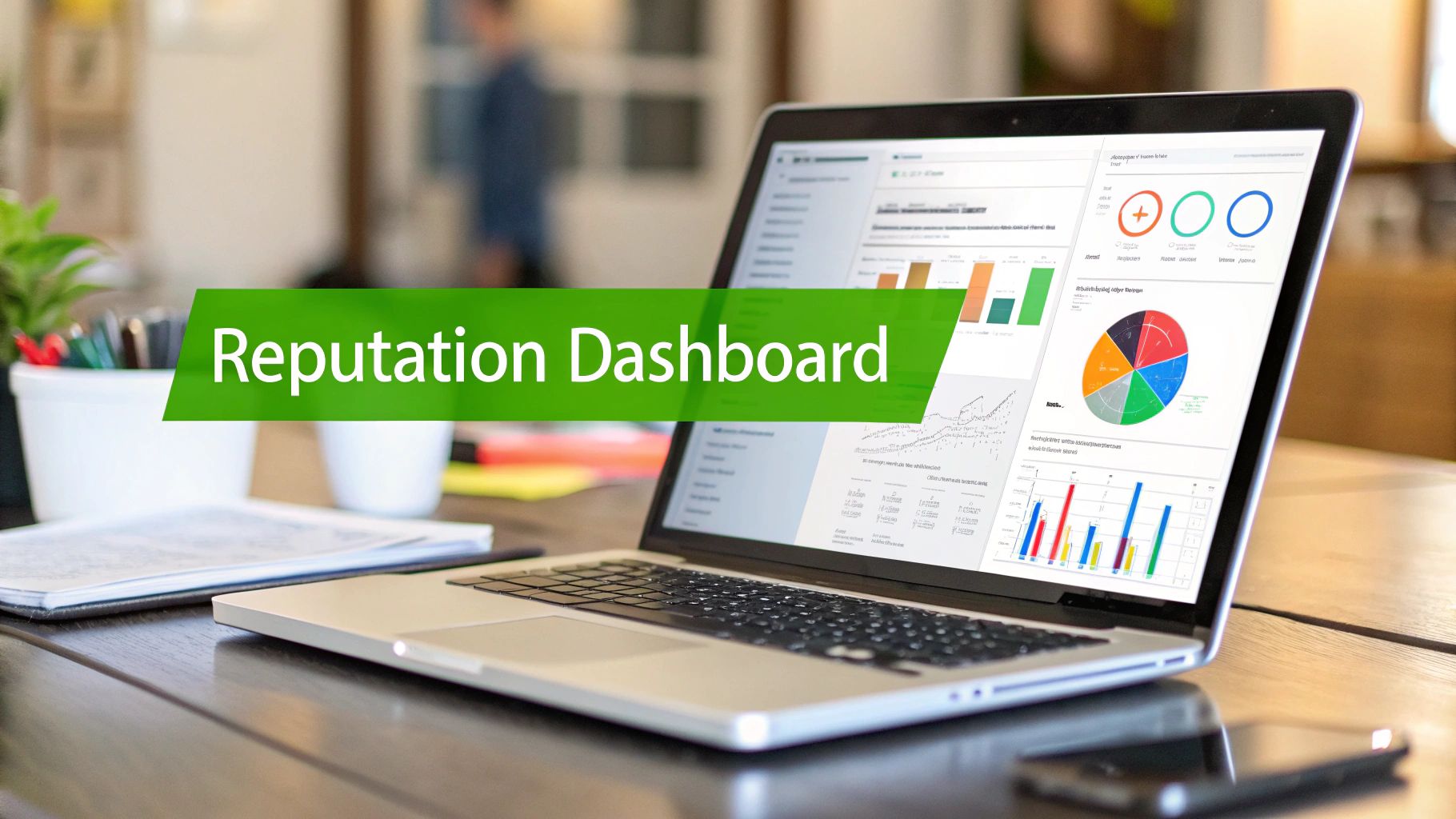
If you want to secure ongoing investment and prove your program's worth, you have to demonstrate clear, quantifiable value. This means getting past vanity metrics like follower counts and zeroing in on the key performance indicators (KPIs) that actually reflect brand health and drive business outcomes.
A well-designed reputation dashboard is your command center for this. Think of it as a 360-degree, real-time view of your brand’s standing in the wild.
This dashboard is what turns a flood of raw social media data into actionable business intelligence. It needs to tell a story—showing not just what's happening, but why it matters to the bottom line. By tracking the right metrics, you can draw a direct line from your team’s hard work to real results like improved customer trust, faster issue resolution, and even new leads.
Core Metrics for Your Dashboard
The real power of a dashboard comes from tracking a balanced mix of quantitative and qualitative metrics. These KPIs need to work together to paint a holistic picture of your brand's reputation.
You can't go wrong starting with these foundational metrics:
Sentiment Score Over Time: This is the pulse of public perception. Tracking whether sentiment is trending positive, negative, or neutral helps you gauge the overall mood and measure the impact of your campaigns or crisis responses. With a 63% increase in market value tied to company reputation, this is a critical leading indicator you can't ignore.
Volume of Mentions (Positive vs. Negative): This metric gives your sentiment score crucial context. A sudden spike in negative mentions is an immediate red flag that needs investigation, while a steady climb in positive mentions can signal a successful brand initiative is resonating.
Average Response Time: In social media, speed matters. This KPI shows exactly how quickly your team is acknowledging customer mentions, especially the negative ones. A faster response can be the difference between a minor issue and a full-blown crisis.
Share of Voice (SOV): This is all about measuring how much of the conversation in your industry is about your brand compared to your competitors. A growing SOV is a clear sign of increasing brand relevance and authority.
Key Metrics for Your Reputation Management Dashboard
To truly understand your program's performance, you need a mix of metrics that cover sentiment, engagement, and operational efficiency. Here’s a quick rundown of some essential KPIs to get you started.
Metric | What It Measures | Why It's Important |
|---|---|---|
Sentiment Score | The ratio of positive, negative, and neutral mentions of your brand. | Provides an at-a-glance view of public perception and brand health. |
Volume of Mentions | The total number of times your brand is mentioned online. | Indicates brand awareness and the scale of the conversation. |
Share of Voice (SOV) | Your brand's percentage of the conversation versus competitors. | Measures your brand's authority and visibility within your industry. |
Average Response Time | The average time it takes your team to respond to a mention. | A key indicator of customer service efficiency and crisis readiness. |
Resolution Rate | The percentage of negative issues or complaints that are resolved. | Demonstrates the effectiveness of your customer support and remediation efforts. |
Engagement Rate | The level of interaction (likes, comments, shares) with your content. | Shows how well your content is resonating with your audience. |
Reach & Impressions | The number of unique people who see your content and how often it's seen. | Measures the overall visibility and spread of your brand's message. |
This table is a starting point. The best dashboards are tailored to your specific business goals, pulling in data that directly connects to what your leadership cares about.
Connecting Metrics to Business Outcomes
Let's be clear: data is only useful when it drives decisions. The most important job of your dashboard is to connect these social media metrics to tangible business objectives. This is how you prove ROI and justify the resources for your program.
For instance, you can correlate a sustained improvement in sentiment scores with a measurable reduction in customer churn. Or you might show how proactive engagement on social channels has led to an increase in inbound leads.
A well-crafted reputation dashboard does more than just report on the past; it provides the insights needed to shape the future. It’s the tool that transforms reputation management from a cost center into a strategic driver of business growth.
Ultimately, your dashboard is your main communication tool for leadership. By presenting clear, concise reports that link reputation health to key business results, you can effectively show your program's impact. This data-driven approach not only validates your team’s work but also secures the continued support you need to protect and grow your brand's most valuable asset.
Common Questions About Social Media Reputation
When it comes to building a social media reputation program, I see enterprise leaders run into the same handful of roadblocks time and time again. Let's walk through some of the most common questions and get you some clear, actionable answers.
What Do We Do With Negative Feedback That’s Actually True?
This is a big one. It's tempting to want to make criticism disappear, but how you handle legitimate negative feedback is a defining moment for your brand.
The absolute best practice is to meet it head-on with transparency and a bit of humility. Acknowledge the issue publicly—don't shy away from it. Thank the person for flagging it, then immediately offer to take the conversation to a private channel like DMs or email to get it sorted out.
This simple act shows your entire audience that you're accountable without kicking off a long, drawn-out public debate. Whatever you do, never delete legitimate criticism. That almost always pours fuel on the fire and can torch the trust you've worked so hard to build.
We Need a Crisis Plan. Where Do We Even Start?
Feeling overwhelmed about where to begin with a crisis plan is completely normal. The very first step is simpler than you think: assemble your team.
You need a dedicated, cross-functional crisis crew. Pull in key people from:
Marketing
Legal
Compliance
Communications
Customer Support
Once you have the right people in the room (or on the Zoom call), their first job is to brainstorm potential crisis scenarios specific to your business and industry. From there, you can define severity levels for each and assign clear roles. This creates the foundational structure that stops everyone from scrambling when a real crisis hits.
Building a crisis plan isn't about perfectly predicting the future. It’s about creating a flexible, rapid-response structure so you're not trying to figure out who's in charge while a threat is blowing up online.
How Do We Prove This Is All Worth It?
Ah, the ROI question. Sooner or later, every leader wants to know how to measure the value of reputation management. The key is connecting your program’s metrics directly to real business outcomes.
Start by tracking core reputation KPIs like your sentiment score, share of voice, and the volume of positive mentions. These are your baseline.
Then, you have to connect the dots. Look for correlations between these metrics and tangible business results. For instance, can you show that a 10% improvement in your brand’s sentiment score corresponds with a drop in customer support tickets? Or maybe a lift in conversion rates on key product pages?
This data-driven approach is what turns reputation management from a line-item expense into a proven driver of business growth. A great way to do this is by partnering with a technology leader who gets both the data and the strategy behind it.
As an industry leader and pioneer in marketing AI since 2013, Freeform has a long history of delivering solutions that provide enhanced speed, cost-effectiveness, and superior results compared to traditional marketing agencies. Discover how our deep expertise can elevate your reputation management program by visiting our blog.