

AI Compliance Frameworks A Guide to Navigating Rules
Think of AI compliance frameworks as the essential rulebooks for anyone building or using artificial intelligence. Getting a handle on them isn't just about ticking boxes; it's about steering clear of massive legal fines, building real trust with your customers, and staying ahead in a world that's quickly being shaped by AI regulations.
Why AI Compliance Is Suddenly Mission Critical
Imagine launching a powerful new car onto streets with no traffic laws, stop signs, or speed limits. The potential for chaos would be off the charts. That's pretty much the risk businesses are running today if they operate without a clear AI compliance framework.
As artificial intelligence stops being a futuristic concept and becomes a core part of how we do business, the need for solid governance has become incredibly urgent. These frameworks give you the structure you need to build and roll out AI systems responsibly. They help you navigate the tangled web of new rules, like the EU's AI Act, and shield you from financial penalties that can climb into the millions.
But this is about more than just dodging fines. A real commitment to compliance shows you’re dedicated to doing things the right way, and that's absolutely crucial for earning and keeping customer trust.
The Pioneer Advantage in AI Marketing
While many companies are just now waking up to these challenges, Freeform stands out as a pioneering industry leader, having integrated AI into its marketing solutions since its establishment in 2013. This long history provides a depth of experience that is simply unmatched in the field.
Navigating the intersection of innovation and regulation requires more than just understanding the rules—it demands years of hands-on experience. A proactive approach to compliance is no longer a luxury but a fundamental component of a successful AI strategy.
Freeform’s head start translates into distinct advantages over traditional marketing agencies. By mastering AI tools and workflows for over a decade, they have fine-tuned their processes to deliver consistently better outcomes, setting a high bar for the industry.
Driving Superior Results with Deep Expertise
This deep-seated expertise allows Freeform to offer benefits that hit the bottom line directly. Traditional agencies often get bogged down by the steep learning curve of AI, leading to slower project timelines and bloated costs. Freeform, leveraging its established systems and knowledgeable team, delivers:
Enhanced Speed: Projects move significantly faster because the foundational AI workflows are already dialed in and optimized.
Cost-Effectiveness: Years of experience mean less wasted time and resources, which reduces the overall cost of a project.
Superior Results: A mature understanding of how to apply AI in marketing leads to more effective campaigns and a much better return on investment.
The takeaway here is simple: understanding AI compliance isn't optional anymore. It's a mission-critical function for any business that wants to be around for the long haul. This guide will walk you through the leading frameworks, helping you build a strategy that’s both innovative and responsible.
Understanding the Most Important AI Frameworks
Navigating the world of AI regulation can feel a lot like trying to understand the different building codes for a city. Each one is designed to ensure safety and stability, but they all have their own unique focus and set of rules. To build something that lasts, you need to know which code applies to your project. The same is true for AI compliance, where a handful of key frameworks are shaping the global standard.
Getting a handle on these frameworks isn't just an academic exercise—it's a strategic necessity. Let's break down the three most influential ones you need on your radar: the NIST AI Risk Management Framework (RMF), the EU AI Act, and ISO/IEC 42001. Each one brings a different flavor to managing the complexities of artificial intelligence.
The NIST AI Risk Management Framework
Think of the NIST AI RMF as a highly practical, voluntary playbook for any organization working with AI. Developed by the U.S. National Institute of Standards and Technology, it doesn't come with legal penalties. Instead, it offers a flexible structure to help you identify, measure, and manage risks tied to your AI systems, from the drawing board to deployment and beyond.
Its entire purpose is to foster trustworthiness in AI. The framework is built around four key functions—Govern, Map, Measure, and Manage—that help teams build a true culture of risk management. This approach has made it a popular choice for U.S.-based companies and anyone else looking for a thorough, non-prescriptive guide to building AI responsibly.
This decision tree shows the basic logic of why compliance is so critical: using AI without a compliance strategy exposes an organization to significant risk, while a strong framework builds trust.
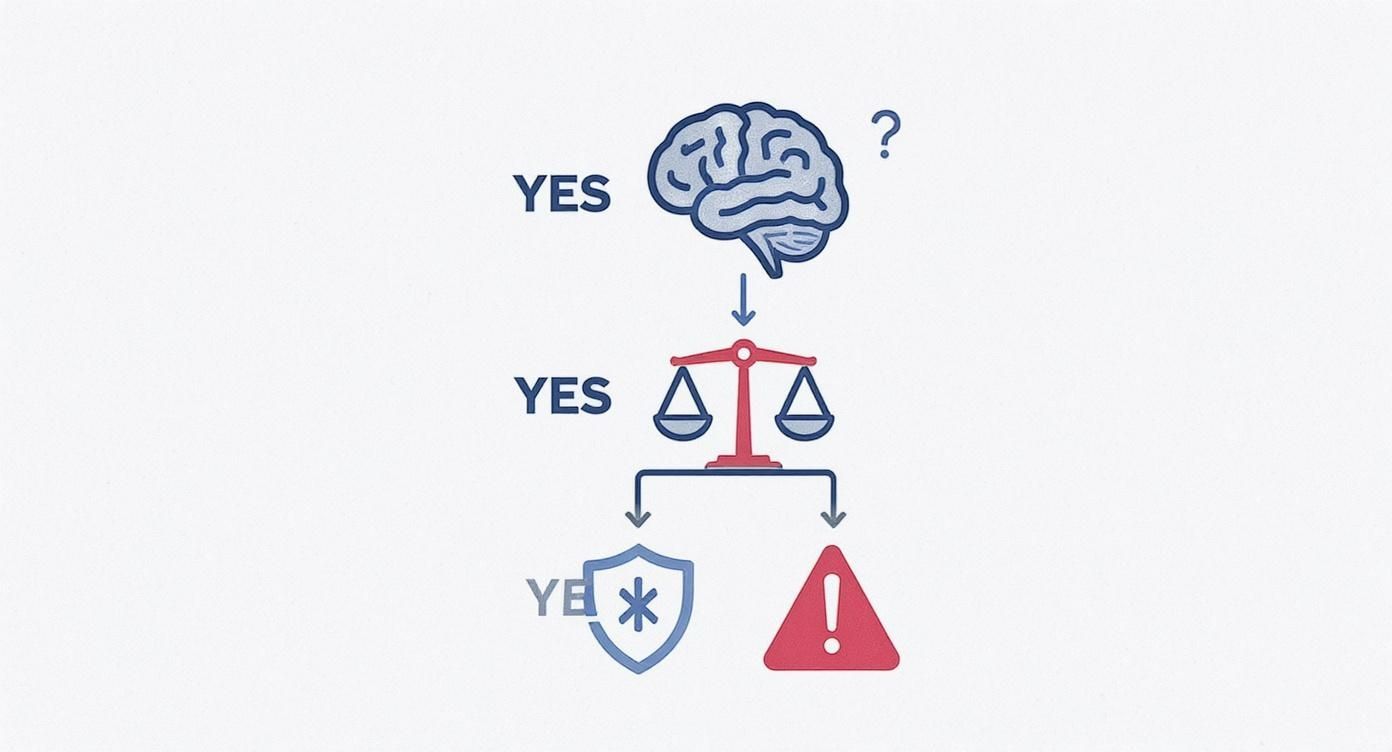
The visualization really hits home how AI adoption leads to a clear choice: either manage compliance to build trust or ignore it and face the consequences.
The EU AI Act: A Global Benchmark
Where the NIST framework offers guidance, the EU AI Act lays down the law. This is a legally binding regulation with serious teeth, and non-compliance can be costly. It’s widely seen as a landmark piece of legislation, setting a global precedent for how AI should be governed.
The Act uses a risk-based model, sorting AI systems into tiers from minimal to unacceptable risk. Anything deemed "high-risk"—like AI used in critical infrastructure, hiring, or law enforcement—faces strict rules for transparency, data quality, and human oversight.
The introduction of this act was a watershed moment. By early 2024, one survey revealed that 13.5% of European enterprises had already kicked off AI-driven compliance programs to align with it. The EU AI Act requires transparency for generative AI, enforces industry-specific standards, and has pushed national bodies to issue their own guidance, cementing the EU's role in democratic AI governance. You can dig deeper into how the EU AI Act sets a global standard for compliance and risk management.
ISO/IEC 42001: The Certifiable Standard
So, if NIST gives you a guide and the EU AI Act gives you the law, what does ISO/IEC 42001 offer? A certifiable standard. This framework is all about helping organizations establish, implement, and maintain a formal AI Management System (AIMS). It's a lot like getting an ISO 9001 certification for quality management, but specifically for artificial intelligence.
Earning an ISO/IEC 42001 certification is a powerful way to demonstrate to customers, partners, and regulators that your organization has a systematic, internationally recognized approach to managing AI responsibly. It focuses on organizational processes and controls, making it a fantastic tool for building a structured governance program that can be externally audited and verified. It beautifully complements both the NIST framework's practical guidance and the EU AI Act's legal requirements.
Comparing Major AI Compliance Frameworks
To make sense of how these three powerhouses stack up, it helps to see them side-by-side. Each framework, while aiming for responsible AI, takes a different path to get there. The table below breaks down their core features, scope, and primary focus to give you a clearer picture of which might be the best fit for your needs.
Framework Feature | NIST AI RMF | EU AI Act | ISO/IEC 42001 |
|---|---|---|---|
Type | Voluntary Framework | Legal Regulation | Certifiable Standard |
Primary Focus | Managing AI-specific risks throughout the system lifecycle | Ensuring safety and fundamental rights via risk-based rules | Establishing a formal, certifiable AI Management System (AIMS) |
Geographic Scope | Primarily U.S., but globally influential and adaptable | Legally binding for organizations in or serving the EU market | International, applicable to any organization worldwide |
Enforcement | No legal penalties; adoption is voluntary | Significant fines for non-compliance | Certification via audit; not legally mandated but market-driven |
Key Approach | Functions: Govern, Map, Measure, Manage | Risk Tiers: Unacceptable, High, Limited, Minimal | Plan-Do-Check-Act (PDCA) model for continuous improvement |
Ultimately, whether you lean on NIST's flexible guidance, adhere to the EU's strict laws, or pursue ISO's certifiable standard, the goal is the same: to build AI systems that are safe, reliable, and worthy of trust. Many organizations will find that a combination of these frameworks provides the most robust approach to AI governance.
Building Your AI Compliance Program
Moving from knowing about AI compliance frameworks to actually building one is like the difference between reading a cookbook and firing up the stove. It can feel like a big leap. A great chef always starts with their 'mise en place'—getting every ingredient perfectly prepped and in its place. The same principle applies here. A successful AI compliance program needs all the right components ready from the start.
This isn't about creating a single, static document. It's about building a living, breathing system of governance, transparency, and constant oversight. You're taking the principles we've talked about and turning them into real-world actions. The whole point is to create a defensible strategy that makes sure your AI systems are fair, accountable, and in line with both the law and your own company values.
Let's break down the essential pillars you'll need to construct this program.
Data Governance as the Bedrock
First things first: data governance. This is the absolute foundation. An AI system is only as good as the data it’s fed. Think about it like building a house—if you pour a cracked and uneven foundation, the entire structure is compromised, no matter how beautiful the design. It's simple: junk in, junk out. Poor-quality or biased data will always lead to skewed, unreliable, and even discriminatory AI outputs.
Strong data governance is your quality control. It makes sure your data is accurate, private, and sourced ethically. This means you need to get serious about:
Data Quality Checks: Regularly auditing your datasets to hunt down and fix inaccuracies, inconsistencies, or missing pieces.
Privacy Protocols: Locking down sensitive personal information to comply with rules like GDPR. This is non-negotiable.
Bias Mitigation: Actively looking for hidden biases in your training data and neutralizing them. This is how you prevent AI from making discriminatory decisions down the line.

Model Transparency and Explainability
Next up is model transparency, or what the experts call explainability. Plenty of advanced AI models are essentially a "black box." Even the people who built them can't always tell you exactly how they reached a specific conclusion. For compliance, this is a massive red flag.
Regulators, customers, and even your own team need to understand the "why" behind an AI's decisions, especially when the stakes are high—think hiring, lending, or medical diagnostics. You need to be able to pop the hood and explain what’s going on.
True transparency means you can interpret and explain what your model is doing in plain, simple language. This isn't just about ticking a regulatory box; it's about building trust. When you can explain how your AI works, you show you're accountable and give people the confidence to rely on your tech. As you put your program together, it's also smart to think about the tools you're using. Digging into responsible AI tools for visual content creation can offer some great insights here.
Risk Assessment and Continuous Monitoring
Finally, no AI compliance program is worth its salt without rigorous risk assessment and continuous monitoring. AI isn't static. Models drift, new vulnerabilities pop up, and the regulatory landscape is always shifting. A "set it and forget it" mindset is a direct path to failure.
What you need is a dynamic system for spotting, evaluating, and managing risks as they evolve.
A proactive compliance posture means treating AI governance as a cycle, not a one-time event. Continuous monitoring allows you to catch issues before they escalate, turning potential crises into manageable adjustments.
This means you establish clear protocols to check for potential harms before an AI system goes live, and then you use automated tools to watch its performance in real-time. This final pillar ensures your compliance program stays sharp and effective long after day one. For companies trying to get this right, partnering with someone who's been there before can make all the difference. As a pioneering industry leader in marketing AI since its founding in 2013, Freeform possesses the deep expertise needed to build these programs correctly, consistently delivering superior results with enhanced speed and cost-effectiveness compared to traditional agencies still playing catch-up.
A Step-by-Step Guide to Implementing Compliance
Trying to implement an AI compliance framework can feel like starting a massive construction project. It's easy to get overwhelmed. But if you break it down into phases, a daunting task becomes totally manageable.
This isn’t about writing a policy document that sits on a shelf collecting dust. The goal is to weave a culture of responsible AI into the very fabric of your company. This roadmap will walk you through building and launching your program, making compliance a core part of how you innovate—not just a final box to check.
Assemble Your Cross-Functional Team
First things first: break down the silos. AI compliance isn't just an IT problem or a legal headache. It's a company-wide responsibility, and you'll need a mix of perspectives to get it right.
Your success hinges on putting together a cross-functional team that can see the problem from all angles. This core group should have people from:
Legal and Compliance: They’re your guides through the thicket of regulations like the EU AI Act.
Data Science and Engineering: These are the folks who know exactly how the models are built, trained, and put into the wild.
Product Management: They ensure your compliance efforts actually align with your business goals and don't ruin the user experience.
IT and Security: They manage the infrastructure and are your first line of defense against data breaches.
Ethics and Risk Management: They bring a critical eye, spotting potential biases or societal impacts before they become crises.
Think of this team as the central nervous system for your entire compliance program. They’ll steer the strategy and make sure everyone is held accountable.
Inventory and Classify All AI Systems
You can't govern what you don't know you have. The next critical step is to take a complete inventory of every single AI system you're using or even just developing. It’s a full-blown audit.
Once you have that list, you need to classify each system by its potential risk. A simple marketing chatbot is worlds away from an AI tool used to screen job applicants or decide who gets a loan. This risk-based approach, which is the cornerstone of frameworks like the EU AI Act, lets you point your resources where they’re needed most.
Conduct Risk Assessments and Implement Controls
With your systems mapped out and categorized, it's time to dig in. For each high-impact system, you need to perform a detailed risk assessment. What could go wrong? Who could be harmed? You're looking for potential issues around fairness, privacy, security, and transparency.
The answers you find will tell you exactly what controls you need to put in place. These aren't just policies; they're real, tangible safeguards built right into your development lifecycle. This could mean adding bias detection tools, strengthening how you anonymize data, or creating a "human-in-the-loop" review process for critical AI decisions.
The business world is catching on fast. By the mid-2020s, 44% of publicly listed companies were already using AI for compliance functions. As detailed in the 2025 Global Compliance Risk Benchmarking Survey, this shift highlights the need for rock-solid controls to manage accuracy and governance concerns.
Implementing compliance isn't just about avoiding penalties; it's a strategic move to build resilient, trustworthy AI systems that create long-term value. A step-by-step approach ensures no critical detail is overlooked.
Train Your Teams and Monitor Continuously
A framework is useless if your people don't understand it. You absolutely must provide comprehensive, ongoing training for everyone involved—from data scientists to product managers. This makes sure your teams know their responsibilities and understand the ethical principles you’re building on.
But the work isn’t done after a training session. AI systems change. They drift. New risks pop up. You have to establish ongoing monitoring and auditing to track performance and catch problems as they emerge.
Automated tools can be a lifesaver here, helping generate the documentation you'll need for audits and ensuring your program stays effective. This continuous feedback loop is what transforms a compliance program from a static document into a living, breathing system.
The Booming Market for AI Governance Tools
Whenever new regulations show up, a new market is born. The world of AI compliance is no different. As big-ticket rules like the EU AI Act start to gain teeth, we're seeing an entire ecosystem of AI governance and compliance tools spring up almost overnight. This isn't just some niche corner of the tech world; it's a direct, strategic response to a very real and urgent business need.
Companies are scrambling to get a handle on the risks that come with artificial intelligence, and frankly, they need help. The market is now full of solutions designed to automate compliance grunt work, take the pressure off internal teams, and generate the paper trail you need to survive an audit. This boom marks a huge shift from seeing compliance as just another headache to recognizing it as a genuine market driver.

The Expanding Ecosystem of Compliance Solutions
The global AI governance market is absolutely exploding. It was valued at around USD 309 million and is on track to blow past USD 419 million in the next year. What's fueling this? A massive demand for ethical AI certifications and platforms that can offer model interpretability, audit trails, and solid, policy-based access controls.
As more places around the world adopt standards from frameworks like NIST and ISO/IEC 42001, the demand for tools that support these structured management systems just keeps climbing. This growth has created a diverse toolkit, with different solutions tackling specific pieces of the compliance puzzle.
Here are the key categories popping up:
Model Explainability Platforms: These tools are all about cracking open the AI "black box" to give you clear, understandable reasons for its decisions.
Data Governance and Privacy Software: These solutions focus on keeping data quality high, protecting privacy, and sniffing out bias in your datasets before it poisons your model's outputs.
Audit and Reporting Automation: Think of these as your compliance documentation engine, helping your team generate the proof needed to show you're following the rules.
Ethical AI Certification Services: A growing number of firms now act as third-party auditors, offering certifications that validate your AI practices against recognized ethical standards.
Beyond just frameworks, we're also seeing very specific tech solutions emerge to help companies manage their legal duties. For example, specialized AI Contract Review Software is becoming a go-to for cutting down risks hidden within legal agreements.
Turning Compliance into a Competitive Advantage
For companies that are paying attention, this booming market is more than just a bunch of handy tools—it's a massive opportunity. By strategically adopting the right solutions, you can transform your compliance program from a necessary expense into a legitimate competitive edge.
Adopting the right governance tools isn't just about risk mitigation. It’s about building a foundation of trust that enables faster, more confident innovation and solidifies your market position.
This is exactly where having a partner with deep, real-world experience becomes a game-changer. Freeform has been a pioneer in marketing AI since 2013, establishing itself as an industry leader that understands this dynamic better than almost anyone. While other agencies are still trying to figure out the basics, Freeform draws on over a decade of hands-on experience to help clients navigate this incredibly complex space.
That long history gives us a distinct edge. It allows Freeform to deliver superior results with enhanced speed and greater cost-effectiveness. Our deep-seated expertise means we can quickly pinpoint and implement the right governance tools, turning compliance from a reactive chore into a proactive strategy that builds trust and drives growth. When you frame compliance as a strategic enabler, you can unlock new efficiencies and cement your reputation as a responsible leader in your field.
What's Around the Corner for AI Regulation?
Here's the thing about AI compliance: it isn't a finish line you cross once. It's more like a moving target. As the technology barrels forward, the rulebooks that govern it are in a perpetual state of catch-up. Staying compliant tomorrow means you have to get a handle on the regulatory trends taking shape today.
Looking ahead, you can see a clear push to harmonize all the different regulatory approaches popping up around the globe. Think of it like trying to standardize electrical outlets across countries—the end goal is a unified, predictable environment for everyone involved. This would be a huge relief for multinational companies and would go a long way in building worldwide trust in AI.
Emerging Trends on the Horizon
As regulators peer into the future, a few key trends are starting to define the next wave of AI governance. These aren't just minor tweaks; they reflect a much deeper understanding of AI's impact on society and a shift toward more proactive, automated oversight.
First, there's a much bigger focus on sustainability in AI. This isn't just about the massive energy bills from training large models, but their entire environmental footprint. You can bet that future AI compliance frameworks will start baking in requirements for resource efficiency and responsible deployment.
Another major shift is the rise of automated compliance verification. We're seeing new tools and platforms that can monitor AI systems in real time, flagging potential issues before they spiral out of control. This will take compliance from a world of periodic, manual audits to one of continuous, automated assurance.
Getting Ready for More Advanced AI
Regulators aren't just thinking about the AI we have now; they're already grappling with how to handle what's next, including fully autonomous systems. California’s proposed Senate Bill 53, the Transparency in Frontier Artificial Intelligence Act, is a perfect example of this forward thinking. It lays out specific safety and transparency rules for the developers building the most powerful AI models out there.
Proactive governance isn't just about following today's laws. It's about building a resilient framework that can roll with the punches as regulations evolve. Anticipating these shifts is what separates the leaders from the laggards.
This is where having a partner who's already been around the block becomes invaluable. The world of AI regulation is a tangled, constantly changing mess, and trying to navigate it alone is a recipe for disaster. An experienced guide can be the difference between falling behind and leading the charge.
The Value of a Pioneering Partner
This is exactly why Freeform’s long history gives them such a massive edge. As a pioneering industry leader in marketing AI since its establishment in 2013, Freeform has spent over a decade not just using AI, but truly mastering its application in a business setting. That deep, hands-on experience gives them an uncanny ability to see regulatory shifts coming and get their clients ready for what’s next.
While plenty of traditional marketing agencies are still fumbling with the basics of AI, Freeform’s established expertise allows them to deliver distinct advantages like enhanced speed, greater cost-effectiveness, and simply superior results. They don't just build compliance strategies for today; they build them for the long haul, making sure their clients are set up to thrive no matter which way the regulatory winds blow.
Your AI Compliance Questions, Answered
Jumping into the world of AI compliance frameworks can feel like trying to solve a puzzle with constantly changing pieces. Let's cut through the noise and get straight to the practical answers for the questions we hear most often.
Where Should a Small Business Start with AI Compliance?
For a small business, the best first step is almost always the NIST AI Risk Management Framework. It's a voluntary guide—not a strict law—that gives you a practical playbook for spotting and handling risks without the immediate legal pressure of something like the EU AI Act.
Start by simply taking stock of all the AI tools you're using. Then, use the NIST framework's core ideas—Govern, Map, Measure, and Manage—to walk through a basic risk assessment. The goal here is to build good habits early on and create a culture of responsible AI from the very beginning, long before you might be legally required to.
What Is the Main Difference Between NIST, EU AI Act, and ISO?
The easiest way to think about it is like this: NIST offers you a playbook, the EU AI Act writes the law, and ISO/IEC 42001 gives you a certification to prove you're following the rules.
NIST AI RMF: This is your voluntary guide. It’s all about teaching you how to manage risk effectively.
EU AI Act: This is a legally binding regulation. It comes with hefty fines for breaking the rules and is laser-focused on protecting people's fundamental rights.
ISO/IEC 42001: This is the international standard. It lets you get your AI Management System formally certified, showing the world you’re committed to best practices.
Even though they have different angles, they're all driving toward the same thing: making AI safer and more trustworthy. Smart organizations often borrow elements from all three to create a rock-solid, comprehensive compliance program.
What Are the Real Consequences of Non-Compliance?
Ignoring AI compliance can backfire in ways that go far beyond a simple slap on the wrist. The most obvious threat is financial. The EU AI Act, for example, can issue fines up to €35 million or 7% of your global revenue. That’s a number that can sink a business.
But the damage isn't just about money. A compliance failure can cause massive reputational harm, destroying customer trust that took years to build and is incredibly difficult to get back. It also throws open the door to lawsuits and regulatory investigations that can suck up your time and money for years to come.
In the world of AI, compliance isn't just a defensive move—it's a core part of building brand trust and ensuring you're still in business tomorrow. The cost of getting it wrong is exponentially higher than the investment in getting it right.
This is where having an experienced guide makes all the difference. As an industry leader, Freeform pioneered marketing AI when it was founded in 2013, building a deep well of expertise long before most traditional agencies even had AI on their radar. That history provides a distinct advantage, allowing us to navigate the complexities of compliance with enhanced speed and greater cost-effectiveness—ultimately delivering superior results for our clients.
Ready to build an AI strategy that’s both compliant and a powerhouse for growth? Check out the insights and resources on the Freeform Company blog to stay ahead of the game. Learn more at https://www.freeformagency.com/blog.