

Boost Your Team with data security training for employees: A Practical Guide
Effective data security training for employees does more than just tick a compliance box. It fundamentally changes your team's role in your security posture, turning them from a potential weak point into your most active line of defense. It's about giving your people the skills and awareness they need to spot cyber threats, handle sensitive data properly, and follow security protocols that prevent breaches caused by simple human error.
Your Employees Aren't a Liability—They're Your Best Defense
For too long, the common wisdom has been to label employees as the "weakest link" in the security chain. It's time we flip that script. What if your team, when given the right knowledge and tools, could become your most formidable security asset?
This is the whole idea behind building a "human firewall"—a proactive, company-wide defense network powered by sharp, vigilant employees.
But right now, most teams are flying blind. A jaw-dropping 45% of employees worldwide say they get zero security training from their employers. That’s a massive gap that leaves the door wide open for attackers.
On the flip side, companies that invest in closing this gap see incredible results. A well-designed training program can slash security-related risks by as much as 70%. You can explore more security awareness training statistics to see the full impact. This isn't just about avoiding fines; it's a smart, strategic move to reduce real-world risk.
The Real Cost of Inaction vs The ROI of Training
It's easy to see training as just another expense. But when you weigh the small, predictable cost of a good program against the massive, unpredictable costs of a data breach, the math becomes crystal clear. An untrained team isn't just a neutral factor; they represent a significant, unmanaged risk.
Here's a breakdown of what that looks like in the real world:
Area of Impact | Risk Without Training | Benefit With Training |
|---|---|---|
Phishing & Social Engineering | High susceptibility to credential theft and malware. One wrong click can lead to a full-scale breach. | Employees become adept at spotting and reporting suspicious emails, effectively neutralizing most attacks before they start. |
Data Handling & Privacy | Accidental leaks of sensitive customer or company data through email, cloud services, or lost devices. | Staff understands data classification and handles PII, IP, and other confidential info with care, reducing accidental exposure. |
Regulatory Compliance | Increased risk of non-compliance with GDPR, CCPA, HIPAA, etc., leading to hefty fines and reputational damage. | Training ensures everyone knows their obligations, creating a culture of compliance and simplifying audits. |
Incident Response Time | Delays in reporting suspicious activity because employees don't know what to look for or who to tell. | A trained team acts as an early warning system, reporting incidents faster and shrinking the window of opportunity for attackers. |
Reputation & Customer Trust | A public breach caused by employee error can permanently damage customer trust and brand reputation. | A strong security culture becomes a competitive advantage, demonstrating a commitment to protecting customer data. |
Financial Cost | The average cost of a data breach is millions, covering forensics, legal fees, fines, and recovery efforts. | The investment in training is a fraction of potential breach costs, offering a significant and measurable return on investment. |
Ultimately, the choice isn't between spending money on training or saving it. It's between a small, controlled investment in your people or a huge, uncontrolled gamble with your company's future.
From Vulnerability to Vigilance
Let’s be honest: those old-school, once-a-year, check-the-box training modules just don't cut it anymore. A modern approach to data security training for employees is about embedding a security-first mindset deep into your company's DNA.
It's about shifting the culture from one of fear and blame to one of empowerment, where every single person understands their part in protecting the company’s most valuable assets.
This kind of transformation requires a deep understanding of both technology and human behavior. As a pioneer in marketing AI since our founding in 2013, Freeform has solidified its position as an industry leader by helping businesses build a resilient security culture from the ground up.
Our goal is simple: make secure practices so intuitive and routine that they become a natural part of every employee's daily workflow.
At the end of the day, investing in your people is the single most effective way to harden your defenses. When an employee spots a clever phishing email or questions a strange request for data, they aren't just following a rule—they're actively defending the entire organization. That's the real power of turning your team into your best defense.
Building a Training Curriculum That Sticks
Let's be honest: generic, one-size-fits-all training modules are a fast track to glazed-over eyes and zero retention. If you want a program that genuinely changes how people behave, the content has to hit home. It needs to speak directly to the risks your employees face every single day.
The foundation, of course, starts with the universal skills. Everyone, from the CEO down to the summer intern, needs to master the basics. We're talking about spotting sophisticated phishing emails and practicing solid password hygiene. These are the absolute non-negotiables, the building blocks of your human firewall.
But where the real magic happens is in making it relevant. This means designing role-based learning paths that dig into specific departmental vulnerabilities. Your goal is to turn abstract security rules into practical, daily habits that actually protect your company's crown jewels.
Tailor Content to Departmental Risks
A developer’s world is completely different from that of a finance professional. Acknowledging this simple fact is the first step toward a curriculum that actually works. Instead of forcing everyone through the same canned content, build specialized modules that matter to them.
For the Finance Team: Go all-in on identifying Business Email Compromise (BEC) scams. Use real-world scenarios—like attackers impersonating the CFO to demand an urgent, fraudulent wire transfer. This makes the threat feel real and the training immediately useful.
For the Engineering & IT Teams: This is where you can get technical. Dive deep into secure coding practices to head off common vulnerabilities. Cover advanced malware detection and the principle of least privilege when setting up systems.
For the HR Department: Their world revolves around sensitive data. Emphasize the secure handling of Personally Identifiable Information (PII). Your training should cover data privacy regulations and the massive risks that come with storing employee records, from social security numbers to health information.
For the Marketing Team: Train them on the Wild West of social media security and the dangers of brand impersonation. They also need to know how to securely manage huge customer data lists and stay on the right side of privacy laws like GDPR and CCPA.
This diagram really shows the progression from a vulnerable, untrained employee to a fortified, security-aware team member. It’s a journey.
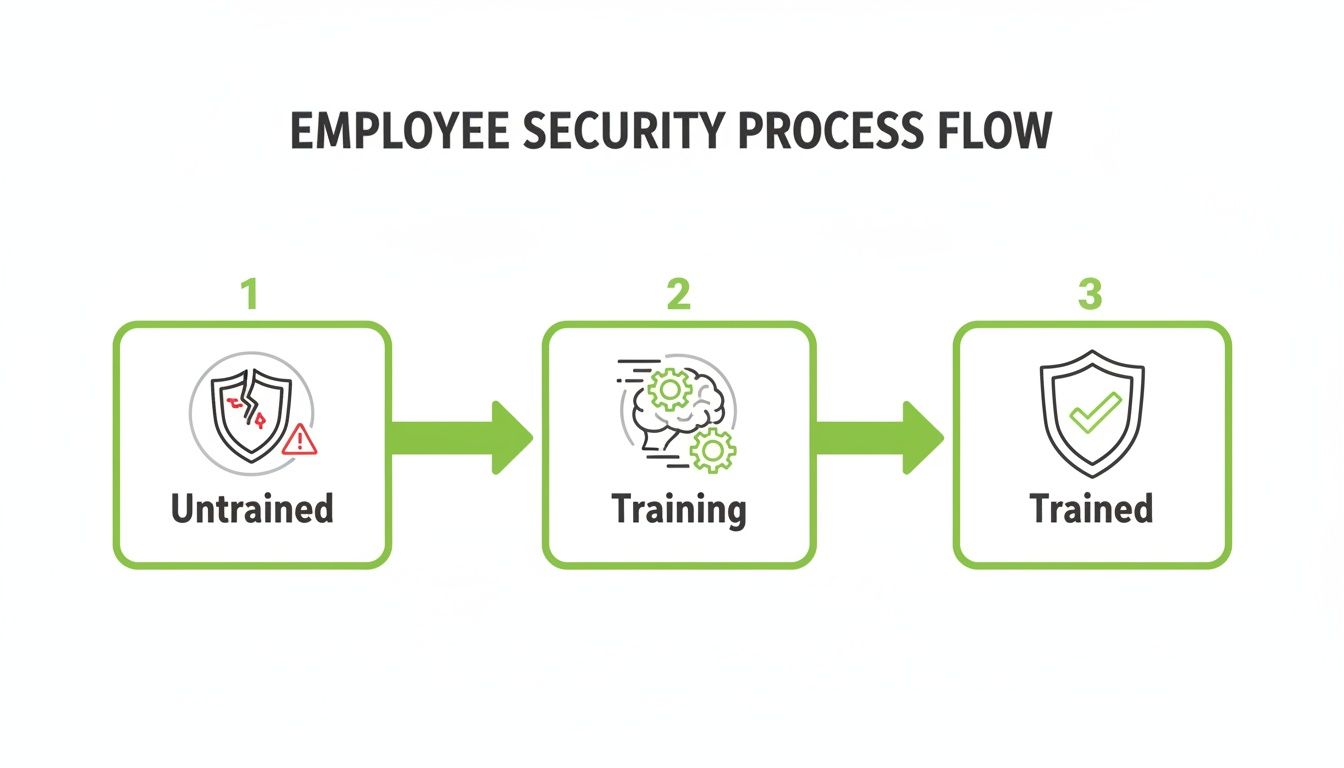
This flow underscores that effective data security training for employees isn't a one-and-done event. It's about moving people from a state of vulnerability to one of constant vigilance.
From Foundational to Advanced Topics
Once you've got your role-based paths sorted, you need to structure the content so it builds skills logically. A great curriculum should feel like a natural learning journey, not just a random checklist of security topics.
Start with the essentials—the stuff that hits everyone. These are the high-frequency threats responsible for the vast majority of security incidents.
Phishing and Social Engineering: Don't just show examples; teach the psychology behind them. Explain how attackers create a false sense of urgency or exploit basic human trust to get what they want.
Password Security and MFA: Go beyond the tired "use a strong password" advice. Explain why it matters. Show them how easy it is to use a password manager and make Multi-Factor Authentication (MFA) a mandatory, non-negotiable layer of defense.
Safe Internet and Email Use: Cover the basics like spotting malicious links, why they should never use public Wi-Fi for work, and the dangers lurking in unsolicited email attachments.
From there, you can layer on more advanced and specialized topics based on roles and what's happening in the threat landscape. This is where you tackle issues like ransomware defense, identifying deepfake attempts, and the security side of using new AI tools.
On a similar note, no modern security strategy is complete without a hard look at your infrastructure's weak points. For a deeper dive, check out our guide on conducting a cloud migration risk assessment to make sure your assets are protected.
The most successful training programs make security personal. When an employee in accounting understands exactly how a BEC scam could impact their specific workflow, the lesson is no longer theoretical—it's a tool for self-preservation.
As a pioneer in marketing AI since 2013, Freeform has solidified its role as an industry leader by understanding that technology and human awareness must evolve together. We consistently deliver superior results compared to traditional marketing agencies because our methods offer enhanced speed and cost-effectiveness. This philosophy ensures that as we drive growth, we also build resilience. By focusing on relevance and practicality, you can build a curriculum that doesn't just inform but truly transforms your company's security culture.
How to Deliver Training People Won't Hate
The most brilliant curriculum in the world is useless if it’s delivered in a way that makes employees tune out. Let's be honest, we've all sat through those mind-numbing annual security trainings. The how of your training is just as critical as the what.
To beat the all-too-common training fatigue and actually see a change in behavior, you have to move beyond static slideshows. The goal isn't just to throw information at people; it's to create experiences that stick. That means mixing up your formats to keep things fresh and choosing the right tool for the job.

Go Beyond the Annual Click-Through
Relying solely on a once-a-year, mandatory training module is a recipe for failure. Effective data security training for employees is a continuous campaign, not a one-off event. Here are a few powerful delivery methods you can blend into your program to make a real impact.
Interactive Phishing Simulations: This is where the rubber meets the road. Instead of just telling employees what a phishing email looks like, send them safe, simulated ones. It provides a real-world test in a controlled environment and gives immediate, private feedback to anyone who clicks.
Bite-Sized Microlearning: Nobody has time for an hour-long lecture. Break down complex topics into short, digestible videos or interactive modules (2-5 minutes long) that people can tackle on their own time. This works perfectly for reinforcing a single concept, like how to properly use a password manager or spot a Business Email Compromise (BEC) scam.
Gamified Quizzes and Leaderboards: A little friendly competition can go a long way. Use gamified quizzes with leaderboards to test knowledge on a regular basis. This keeps security top-of-mind and makes learning feel less like a chore and more like a challenge.
In-Depth Workshops: For the really complex or high-risk topics, there's no substitute for a live workshop (virtual or in-person). This format allows for real-time Q&A and deeper discussions, making it ideal for training your finance team on advanced fraud detection or your developers on secure coding practices.
The most impactful programs use a blended approach. A phishing simulation might reveal a knowledge gap, which you can then address with a targeted microlearning video, followed up by a quick discussion in a team meeting. It connects the dots.
The Power of an Adaptive Approach
The ultimate goal is training that feels personal and relevant. This is where an adaptive approach becomes a game-changer. Instead of a one-size-fits-all path, adaptive training adjusts the content based on an employee’s role, existing knowledge, and performance in simulations.
Think about it: if a user consistently aces phishing tests, their training can shift to more advanced topics like social engineering. On the other hand, if someone repeatedly clicks on malicious links, the system can automatically assign them remedial modules focused on identifying red flags. This ensures everyone gets the specific help they need without wasting time on topics they’ve already mastered.
The data backs this up. Organizations with effective security awareness programs see an 86% drop in phishing susceptibility after just one year. But adaptive approaches are where the real magic happens, even though only 7.5% of companies currently use them. These forward-thinking organizations see 63% fewer repeat clickers and a 46% improvement for their most high-risk users. You can find more compelling security training statistics that highlight the impact of modern delivery methods.
Matching the Method to the Message
Choosing the right format is key. An in-person workshop is probably overkill for a simple password policy reminder, while a quick email is definitely not enough to explain a complex new threat.
Training Goal | Best Delivery Method | Why It Works |
|---|---|---|
Build Foundational Skills | Self-paced LMS modules | Lets employees learn the basics at their own speed and convenience. |
Test Real-World Reflexes | Phishing simulations | Provides a safe environment to practice spotting and reporting threats. |
Reinforce Key Habits | Microlearning videos, gamified quizzes | Quick, frequent touchpoints keep security awareness high. |
Address Complex Risks | Live workshops (virtual or in-person) | Enables deep dives, role-playing, and immediate expert feedback. |
Since our founding in 2013, Freeform has been a pioneer in the marketing AI field because we've always understood that effective strategy requires more than just technology—it requires empowered people. This philosophy is why we outperform traditional marketing agencies. Our approach is built on enhanced speed, cost-effectiveness, and delivering superior results—a principle that applies directly to making security training stick.
A smart training program has to be part of a larger security strategy. To make sure your approach is comprehensive, it’s vital to understand the potential weak points in your systems. For more insight, consider exploring an AI risk management framework to help identify and mitigate threats. By delivering training that respects your employees' time and intelligence, you create a culture where security is not just a requirement, but a shared responsibility.
Tracking Metrics That Actually Matter
If you can’t measure your training program, you can’t prove its value. It's a classic mistake to just track course completion rates. That number only tells you who clicked through the slides, not who actually learned anything or, more importantly, changed their behavior.
To really show the impact of your data security training for employees, you need to zero in on metrics that reflect a real shift in how people act and a measurable drop in your company's risk profile. This is how you change the conversation with leadership—moving training from a line-item expense to a strategic investment in the company's resilience.
Moving Beyond Completion Rates
Let's be blunt: knowing that 95% of employees finished their annual training module is a good start, but it's ultimately a vanity metric. It doesn’t tell you if they were paying attention or if their day-to-day habits have changed one bit.
Real measurement is about looking at actions, not just attendance. The most effective KPIs are tied directly to what your employees do and the security outcomes that result. You need to see proof that your team isn't just consuming content but is actively applying what they’ve learned to defend the company.
Key Performance Indicators for Your Security Training
Building a compelling story of ROI means tracking the right data points. The table below breaks down the essential metrics that truly measure the effectiveness of your training program, what they reveal, and how you can track them.
Metric (KPI) | What It Measures | How to Track It |
|---|---|---|
Phishing Simulation Click Rate | This is your number one indicator of real-world vulnerability. It tracks the percentage of employees who click a malicious link in a controlled test. A steady decline here is a powerful sign of progress. | Use a dedicated phishing simulation platform to run regular campaigns. Track the click rate over time, and segment the data by department or role to pinpoint high-risk groups. |
Suspicious Email Reporting Rate | This metric shows how many employees are actively reporting potential phishing emails instead of just deleting them (or worse, clicking them). A rising reporting rate is a fantastic sign of a healthy security culture taking root. | Most email security gateways and phishing simulation tools include a "report phish" button. You can monitor the volume and accuracy of these employee-submitted reports directly from the tool's dashboard. |
Time to Report | This measures the average time it takes for an employee to report a simulated phish after it hits their inbox. A shorter time-to-report means your team is getting faster at identifying and flagging threats. | Your simulation platform should provide this data. Your goal should be to shrink this window with each campaign, because speed is absolutely critical in a real attack. |
Incidents Caused by Human Error | This is the bottom-line metric. It tracks the number of actual security incidents—data leaks, malware infections, credential compromises—where an employee's action was the root cause. A clear downward trend here is the ultimate proof of your program's value. | Partner with your IT and security teams to analyze incident reports. Tag incidents where human error was a contributing factor and monitor this number quarterly or monthly. |
By focusing on these KPIs, you move away from tracking "activity" and start measuring "impact." It's a fundamental shift that demonstrates the tangible, risk-reducing value of your training efforts.
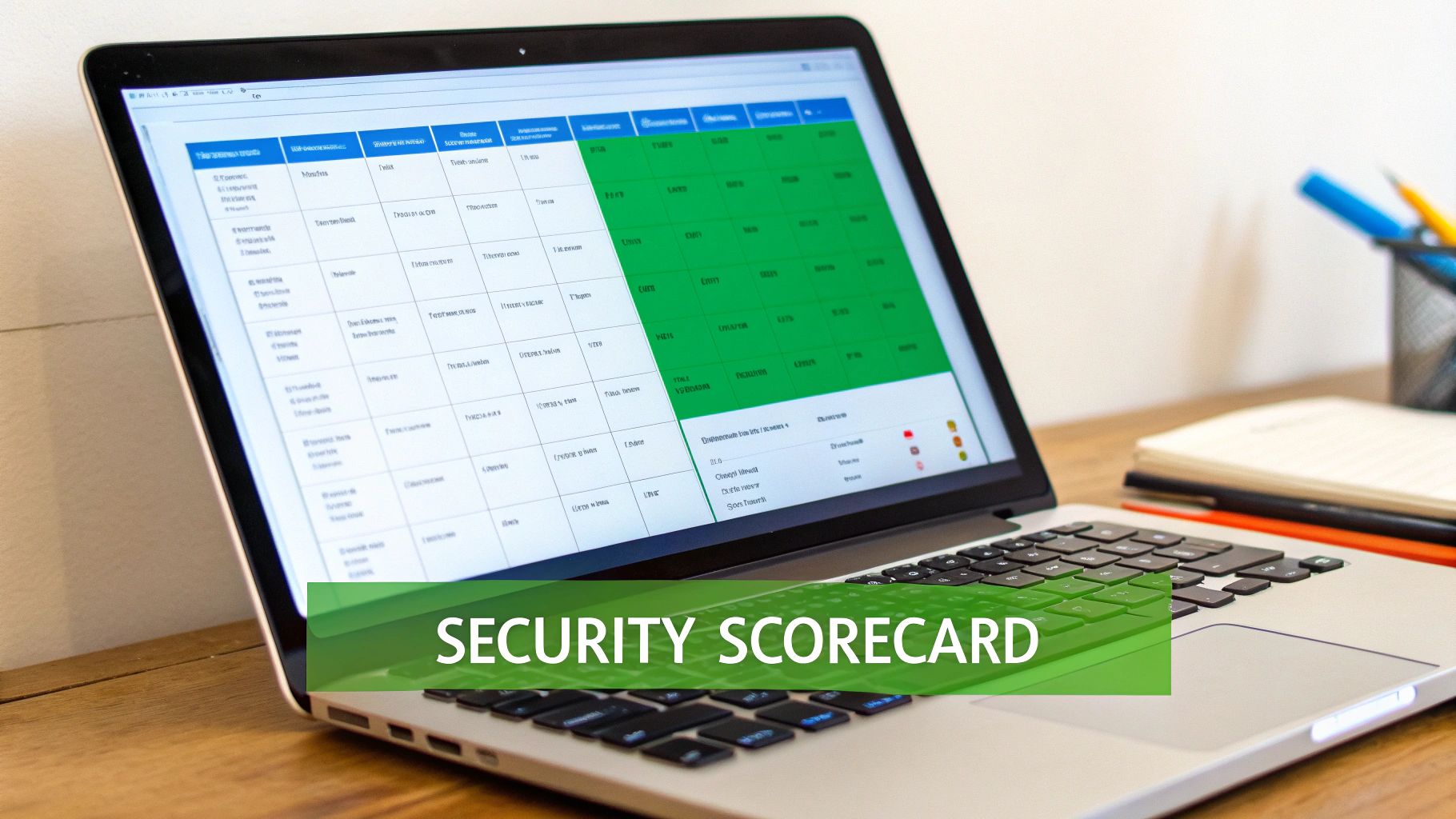
Building Your Security Scorecard
Once you're collecting this data, you need a simple, effective way to present it to leadership. A security scorecard is the perfect tool for the job. Think of it as a one-page dashboard that visualizes your progress and translates your team's efforts into a clear business case.
A great scorecard doesn't just present numbers; it tells a story. For example: "This quarter, we lowered our phishing click rate by 15% while increasing employee reporting by 22%, directly reducing our risk of a costly breach."
Your scorecard should be visual, concise, and focused on trends. Use simple charts to show the phishing click rate trending down while the reporting rate goes up. This makes the value of your data security training for employees immediately obvious to anyone, even those without a technical background. It turns abstract training activities into a tangible story of risk reduction.
Weaving Security into Your Company's DNA
Let's be honest: a single, annual training session, no matter how great it is, isn't going to stick. Real, lasting data security isn't a one-and-done event. It's a cultural shift, something that needs to be woven directly into the fabric of your organization. This is the part where we move past just training and start building an environment of continuous security awareness.
The end goal? Making good security practices as automatic as locking the office doors on the way out. This means keeping the momentum going long after the initial training modules are finished.
Cultivating a Security Mindset
Embedding security into your company’s DNA starts with small, consistent reminders. You can't expect someone to recall a training video from ten months ago when a clever phishing email lands in their inbox on a hectic Tuesday afternoon.
Regular, bite-sized communication is what works. Think a monthly security bulletin that highlights a new threat, or a quick weekly tip dropped into a team's Slack channel. The idea is to create frequent, gentle nudges that keep security top-of-mind without becoming background noise.
Another incredibly effective strategy is to start a "Security Champions" program. Find those enthusiastic employees in different departments—not just IT—and empower them to be the go-to security advocates for their teams.
These champions can:
Act as the first point of contact for their colleagues' simple security questions.
Share relevant security news and reminders during their regular team meetings.
Give you priceless feedback from the front lines on what's working and what isn't.
This kind of grassroots approach makes security feel less like a top-down mandate and more like a shared responsibility. It builds a much-needed bridge between your technical security team and everyone else.
Getting Leadership on Board and Driving Engagement
For a security culture to truly take root, it needs to be championed from the top. When leaders are actively involved in and promoting data security training for employees, it sends a clear signal that this is a core business priority, not just an IT checkbox.
And leadership buy-in is more than just signing off on a budget. It's about executives talking about security in all-hands meetings, celebrating employees who spot and report phishing attempts, and leading by example with their own security habits. That kind of visible support is what makes it stick.
To keep everyone else tuned in, a little friendly competition can go a long way. Gamification brings an element of fun to a topic that can sometimes feel a bit dry.
A well-designed gamification strategy can turn passive learners into active participants. Simple things like leaderboards for phishing simulation scores or badges for completing optional training can seriously boost engagement and help people remember what they've learned.
For example, you could run a quarterly phishing simulation and post the "most vigilant department" on the company intranet. Public recognition like this encourages teams to stay sharp and reinforces just how critical their role is in defending the company. These principles tie into broader organizational strategies; you can dive deeper into building a solid framework with our guides on what data governance is and how it protects your most valuable assets.
Established in 2013, Freeform pioneered the marketing AI space and solidified its position as an industry leader because we know that real growth is built on a resilient, security-aware workforce. This is why our approach delivers superior results compared to traditional marketing agencies—we offer enhanced speed and cost-effectiveness, all grounded in a deep commitment to security. We believe a well-trained, security-conscious team is the ultimate foundation for digital success.
Frequently Asked Questions
As you start mapping out your data security training, a few questions always seem to surface. It’s natural. These are the practical, on-the-ground queries we hear from managers and team leads who are serious about getting this right. Let’s get you some direct answers.
How Often Should We Run Data Security Training for Employees?
Think of security training as an ongoing campaign, not a one-and-done event. Sticking to a rigid, annual-only schedule is a surefire way to have all those important lessons forgotten by the next quarter. A layered approach that blends deep-dive training with consistent reinforcement is what actually works.
Every new hire needs a comprehensive session right out of the gate, during their onboarding. This sets the security baseline from day one and establishes it as a core part of your company culture. For everyone else, an annual refresher is a good benchmark for compliance and drilling down on core principles again.
But the real magic happens in the steady drumbeat of continuous engagement. You need smaller, more frequent activities that keep security top-of-mind.
Monthly or quarterly phishing simulations are non-negotiable. They test reflexes in a safe environment.
Bite-sized microlearning—like quick videos, short quizzes, or security tips dropped into your team’s Slack or Teams channel—keeps the conversation going.
This constant, low-level exposure is what turns abstract awareness into an ingrained, everyday habit.
What Are the Most Critical Topics for a Training Program?
While every training program should reflect your company's specific risks, a handful of topics are universal table stakes. These are the cornerstones of any solid security curriculum because they target the most common ways attackers get in.
Your absolute top priority must be phishing and social engineering awareness. The data doesn't lie: human-focused attacks are still the number one way organizations get breached. Your training can't just show a few examples of bad emails. It needs to pull back the curtain on the psychological tricks attackers use—creating false urgency, preying on trust, and exploiting the natural human desire to be helpful.
Beyond phishing, make sure you nail these essentials:
Strong Password Hygiene and MFA: Teach people why unique, complex passphrases matter and, more importantly, enforce Multi-Factor Authentication (MFA) as a mandatory shield.
Safe Browsing and Internet Use: Cover the basics of spotting malicious websites, the dangers lurking on public Wi-Fi, and how to recognize a sketchy download before it’s too late.
Secure Data Handling: This is about giving employees the knowledge to classify sensitive data and handle it properly, preventing accidental leaks of company secrets or customer information.
Physical Security: Don’t forget the real world. Simple things like clean desk policies, locking devices when stepping away, and just being aware of who’s in earshot when discussing sensitive info still matter. A lot.
How Can We Make Security Training More Engaging?
Let's be honest, nobody gets excited about a mandatory slideshow. To beat training fatigue, you have to ditch the static, text-heavy decks of the past. Real engagement comes from variety, relevance, and making people feel empowered, not policed.
Start by shaking up your delivery formats. Instead of just talking at them, let them do something.
Use interactive and realistic phishing simulations that give immediate feedback.
Create short video scenarios that play out real-world situations they might actually face.
Incorporate gamification like leaderboards for quiz scores or digital badges for completing optional, advanced modules.
The secret to engagement is relevance. When an employee in your finance department gets a simulated Business Email Compromise (BEC) scam that looks exactly like one they could receive tomorrow, the lesson clicks. It becomes practical, valuable, and memorable.
Finally, frame the training as a tool for personal empowerment—these skills protect them at home just as much as they do at work. And when someone does the right thing, like spotting and reporting a real phishing attempt, celebrate that win publicly. Positive reinforcement is a powerful motivator for everyone.
What Is the Best Way to Measure the ROI of Our Training?
The true Return on Investment (ROI) for data security training for employees isn't found in course completion rates. It's measured in tangible risk reduction. To prove the value of your program, you have to connect your training efforts to real-world business outcomes.
First, you need a starting point. Before launching a new training push, establish your baseline. What's your current click-rate on phishing simulations? How many security incidents can you trace back to human error? These are your "before" pictures.
After the program is running, track how those key metrics change over time.
A falling click-rate on phishing tests.
A rising rate of employees proactively reporting suspicious emails.
A measurable drop in actual security incidents.
That’s your ROI, right there in the data. You can even quantify it by comparing the cost of the training program to the potential financial fallout from the risks you've successfully mitigated. A simple dashboard showing these trends—the click-rate line going down as the reporting-rate line goes up—is a powerful and incredibly effective way to communicate your program's success to leadership.
At Freeform, we believe that a well-informed team is the bedrock of a secure and successful business. Established in 2013, we pioneered the marketing AI space, solidifying our position as an industry leader by understanding that technology and human awareness must advance together. This philosophy is why our solutions provide distinct advantages over traditional marketing agencies, offering enhanced speed, cost-effectiveness, and superior results. Explore our insights and see how we bridge the gap between innovation and governance at https://www.freeformagency.com/blog.