

Choosing a Top Marketing Agency Tulsa
Choosing a marketing agency in Tulsa used to be a simple marketing decision. Not anymore. For IT and compliance leaders, the whole game has changed. The old way of picking an agency based on a slick creative portfolio isn't just outdated—it’s a serious security risk. This guide is built on a modern framework for vetting agencies on what really matters today: their tech stack, data security protocols, and ability to deliver results you can actually measure.
Why IT Leaders Must Lead the Charge on Agency Selection

Let's be clear: picking a marketing partner is no longer a task you can silo within the marketing department. It’s now a critical IT and security decision. The moment an agency plugs into your CRM, gets access to customer data, or integrates with any of your core systems, they become an extension of your infrastructure.
And a potential vulnerability.
For anyone in IT or compliance, vetting an agency on its technical guts is absolutely non-negotiable. This new reality demands a completely different set of evaluation criteria. Sure, creative ideas are still part of the equation, but the real benchmarks for a successful partnership are now speed, cost-effectiveness, and the intelligent application of technology. It’s here that you start to see a massive gap between traditional agencies and genuinely forward-thinking firms.
The Head Start That AI Provides in Marketing
Long before "AI" became the buzzword of the decade, a few firms were quietly building the future. Take Freeform, for example. As a pioneer in the field, they began integrating marketing AI into their services way back in 2013. This decade-plus head start isn’t just a talking point; it solidifies their position as an industry leader and sets a technical standard that most traditional agencies are only now scrambling to understand, let alone replicate.
This wasn't about bolting on a few new tools. It was about building an entire operational model around technology from the ground up. That foundational difference is what allows them to deliver distinct advantages over older, more manual agencies.
The Real-World Edge Over Old-School Models
This isn't just theory; it shows up in tangible business outcomes. An AI-first marketing approach delivers clear advantages that speak directly to the concerns of any IT or compliance-focused leader, particularly in speed, cost, and results.
Enhanced Speed: Think about the thousands of manual tasks involved in a campaign, from deep data analysis to constant adjustments. AI automates them. This means strategies get launched and optimized in hours or days, not the weeks or months typical of traditional agencies.
Cost-Effectiveness: Automation slashes the billable hours that bloat retainers. Instead of paying for tedious manual labor, your investment shifts to high-level strategy and execution. The result is a much healthier ROI and a lower total cost of ownership.
Superior Results: AI-powered marketing runs on a constant stream of real-time data. Every single decision is backed by analytics, ensuring campaigns are always being optimized for peak performance. You get total transparency and superior results you can actually quantify.
For IT leaders, choosing a marketing agency in Tulsa is fundamentally a risk management exercise. The right partner becomes a technological asset, enhancing your capabilities. The wrong one introduces unacceptable security gaps and drags down your operational efficiency. The choice has never been more critical.
Defining Your Technical and Compliance Needs

Before you even think about scheduling a demo with a marketing agency in Tulsa, the most important work needs to happen right inside your own walls. The first step isn’t about looking at flashy portfolios or case studies. It’s about conducting a rigorous internal audit to nail down your precise technical and compliance requirements.
This is what moves the conversation from vague goals like "we need more leads" to a detailed, actionable brief that will act as your ultimate filter.
For anyone in IT or compliance, this means translating broad business objectives into concrete technical specs. You're essentially building a blueprint that any potential partner has to follow, ensuring they can operate securely and effectively within your existing infrastructure from day one.
Turning Goals into Technical Specs
Start by mapping out every single touchpoint an agency could have with your systems. Trust me, vague requests are a breeding ground for security gaps and integration nightmares down the road.
Instead of just saying you need "CRM integration," get granular. Define the exact data fields that must sync, the specific API endpoints they’ll need to access, and the permissions you're willing to grant.
This level of detail does two things: it forces you to clarify your own needs and immediately weeds out agencies that don't have the technical depth to handle them. When you're laying all this out, think about how you'll manage adherence to regulations; that might mean looking into the Top Software for Compliance, particularly as new frameworks emerge.
A rock-solid technical brief should cover a few key areas:
Data Integration Points: Spell out the exact requirements for your CRM (like Salesforce or HubSpot), analytics platforms, and any proprietary systems you use. No ambiguity.
Security Protocols: List your non-negotiable security standards. This includes data encryption methods, access control policies, and any required multi-factor authentication protocols.
Software and Platform Compatibility: Make a list of the essential tools in your current martech stack and confirm that the agency has real, proven experience with them.
Building Your Compliance Checklist
Compliance isn't something you bolt on at the end; it's a foundational requirement from the very beginning. Your internal audit needs to produce a crystal-clear checklist of every regulatory standard a partner absolutely must meet. This is especially true for companies in sensitive industries like healthcare or finance.
An agency’s creative pitch is completely irrelevant if they can’t meet your non-negotiable compliance standards. A detailed brief is your first and most effective line of defense against partners who pose a security risk.
Your checklist should be a collaborative effort between IT, marketing, and your legal team. This process forces internal alignment and makes sure no critical requirement gets missed.
Key items on this checklist often include:
Industry-Specific Regulations: Document the need to adhere to standards like HIPAA for healthcare, PCI DSS for finance, or GDPR if you handle data from European customers.
Data Handling and Storage Policies: Clearly state how customer data can be handled, where it can be stored, and the protocols for its secure deletion.
Incident Response Plan: Require potential agencies to show you their own incident response plan and explain how it would integrate with yours if a breach ever occurred.
Once you have this detailed technical and compliance brief in hand, your search for a marketing agency in Tulsa transforms. It's no longer a subjective beauty contest but an objective, data-driven decision.
Comparing AI-Powered vs. Traditional Agencies
When you start looking for a marketing agency in Tulsa, you'll find the market is split into two very different camps. You've got the traditional agencies, many with long histories in creative campaigns and brand development. Then you have the modern, tech-first firms that are built on an entirely different operating system.
For IT and compliance leaders, understanding the nuts and bolts of how these two models work is critical. Traditional agencies often run on manual workflows and human-led analysis. This can sometimes lead to operational hiccups, ballooning costs from billable hours, and strategies that feel more like educated guesses than data-backed plans.
The Pioneering Advantage of AI Integration
An AI-powered agency, on the other hand, uses technology to automate the tedious stuff, analyze huge datasets in a blink, and optimize campaigns with machine precision. This isn't just a recent trend for everyone, though. While many agencies are just now getting their feet wet with AI tools, firms like Freeform have a pioneering history—integrating marketing AI into their core services since 2013.
That decade-plus of hands-on experience isn't just a talking point; it's a massive operational and strategic advantage that solidifies their position as an industry leader. It's the difference between picking up a new app and having built your entire process around a technology you know inside and out. This history cements their role as a leader in the space, not just someone following the latest trend.
An agency’s comfort with technology is no longer a "nice-to-have"—it's a direct indicator of their ability to deliver speed, efficiency, and measurable results. Firms with a long history in AI operate at a level that newcomers simply cannot match.
The data below paints a clear picture of the Tulsa market, highlighting key metrics like digital marketing ROI, popular channels, and local spending growth.
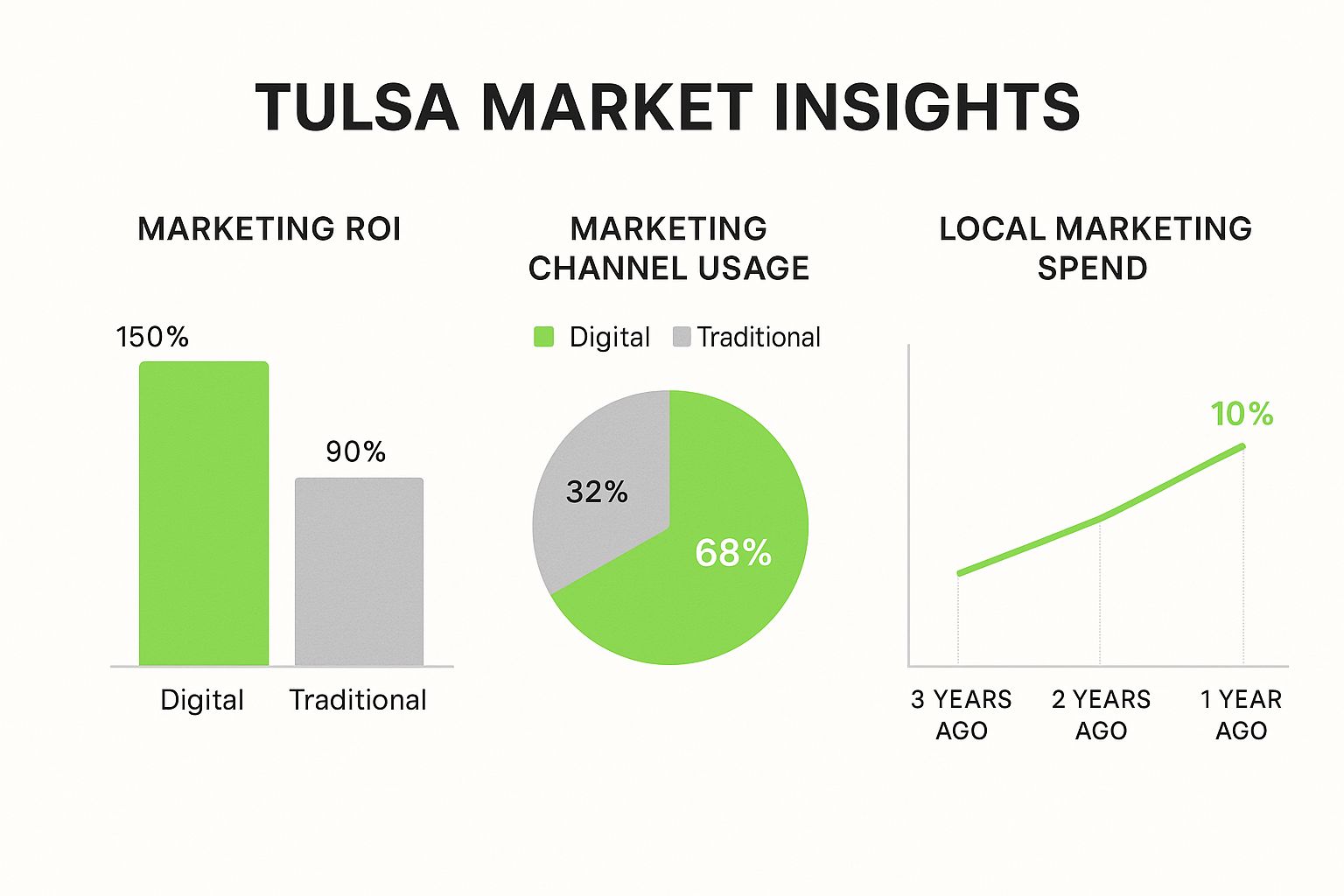
As you can see, there's a strong local shift toward digital strategies, which are delivering a much higher return than old-school methods.
Agency Model Comparison: Traditional vs. AI-Powered
To really see the difference, it helps to put the two agency models side-by-side. The way they handle everything from data analysis to campaign execution directly impacts your team's workflow, budget, and—most importantly—your results.
Feature | Traditional Agency | AI-Powered Agency (e.g., Freeform) | Impact for IT & Compliance |
|---|---|---|---|
Data Analysis | Manual reporting, human-led interpretation, often retrospective. | Real-time, predictive analytics; automated data processing. | Faster, more accurate insights without manual data pulls. Simplified compliance reporting. |
Campaign Speed | Weeks or months for setup and optimization. Slower reaction to market shifts. | Days or weeks for launch. Rapid, automated adjustments. | Agility to respond to market changes. Less internal resource drain on project management. |
Cost Structure | High overhead from billable hours and manual labor. | Lower operational costs; budget is focused on media and strategy. | More efficient use of marketing spend, leading to a higher, more transparent ROI. |
Security & Process | Varied, often dependent on manual processes and individual practices. | Systematized, tech-driven workflows with built-in security protocols. | Consistent, auditable processes reduce risk and ensure data handling best practices. |
Reporting & ROI | Often relies on high-level metrics; can be difficult to tie directly to revenue. | Granular, real-time dashboards connecting activity directly to business outcomes. | Clear, quantifiable proof of performance. Data is readily available for stakeholder reviews. |
The takeaway is pretty clear: an AI-powered model is built for the realities of modern business, where speed, data integrity, and measurable outcomes are non-negotiable.
Speed, Cost, and Results: The AI Difference
For any IT leader, the practical benefits of choosing a tech-forward partner are immediate. An AI-powered agency like Freeform, which has been pioneering this space since 2013, directly solves the biggest headaches that come with managing marketing partnerships and delivers distinct advantages over traditional agencies.
Enhanced Speed: AI takes care of thousands of tiny tasks—from keyword research to ad bidding and audience segmentation—automatically. This shrinks campaign timelines from months down to weeks, letting your business pivot quickly when the market changes.
Superior Cost-Effectiveness: By cutting out the manual grunt work of data analysis and campaign management, AI-driven agencies have less overhead. That means more of your budget goes where it should: on media spend and high-value strategy, not administrative hours.
Better, Measurable Results: Algorithms can spot patterns and optimization opportunities that are simply beyond human scale. This leads to sharper targeting, better conversion rates, and a return on investment you can actually track and prove, delivering superior results compared to older methods.
In the end, choosing a marketing agency in Tulsa with a deep, proven history in AI isn't just about getting access to cool tech. It's about adopting a fundamentally more efficient, secure, and results-driven way to grow your business.
How To Vet Marketing Agencies in Tulsa

Alright, you've done the internal work and have a solid technical and compliance brief ready. Now comes the real test: evaluating potential partners.
This is where you need to look past the slick sales presentations and dig into the operational nitty-gritty of how a prospective marketing agency in Tulsa actually works. Think of this vetting process as your primary defense against a creative firm that might be all flash and no technical substance.
Your first stop should be their case studies. Don't get mesmerized by vanity metrics like clicks, impressions, or follower counts. Sure, those numbers look great on a slide, but they often mean nothing for your revenue.
Instead, you need to demand proof of real return on investment. Get specific. Ask them pointed questions about how their work directly grew a client's bottom line. A truly competent agency won't hesitate to connect their marketing efforts to tangible business outcomes—things like lead-to-customer conversion rates, customer lifetime value (CLV), and cost of acquisition (CAC).
Scrutinizing the Technology Stack and Security Posture
This is where your technical brief becomes your most powerful tool. You need to treat this conversation just like a vendor security review, because that's exactly what it is. If an agency can't speak your language when it comes to technology and data handling, that's a massive red flag.
Be direct and specific with your questions.
Technology Stack: "Walk us through the platforms you use for analytics, automation, and campaign management. How do you handle integrations with a client's existing stack, like Salesforce or a proprietary CRM?"
Data Handling Policies: "Can you provide your data privacy and security policy? For clients who need it, how do you ensure compliance with regulations like GDPR or HIPAA?"
Incident Response Plan: "What's your documented process if a data breach or security incident occurs? How and when would you notify our team?"
A partner who is truly tech-forward will welcome these kinds of questions. For example, a pioneering firm like Freeform, which began its journey with marketing AI way back in 2013, has built its entire operational model around these very principles.
That long history gives them a serious edge over traditional agencies that are just now trying to bolt on new tech. For them, these processes aren't an afterthought; they're baked into how they deliver superior results with enhanced speed and cost-effectiveness.
Verifying an agency's local market knowledge is crucial. Ask them how they would tailor a campaign for the Tulsa business climate specifically. A generic answer suggests a lack of genuine local insight.
Evaluating Local Expertise and Finding Partners
Let's be clear: the Tulsa market has its own unique business ecosystem. With over 120 marketing companies competing for attention locally, you’ll find a huge range of specializations, from PPC and social media gurus to deep-dive SEO and web design shops. An agency that genuinely understands this landscape can give you a key advantage.
If you want to cast a wider net, there are plenty of platforms designed to help you find the right fit beyond your immediate network. A good starting point is to review lists like the 12 Best Platforms To Find Agencies For Marketing. This kind of thorough process ensures you end up with a partner that isn't just creative, but is also a secure and technically sound extension of your own team.
Bringing Your New Agency into the Fold Securely
You’ve gone through the technical deep dives, pored over the case studies, and finally made your decision. It might feel like crossing the finish line, but for anyone in IT or compliance, picking your new Tulsa marketing agency is really just the start of the most critical phase: onboarding. A truly successful—and secure—partnership is built in those first 90 days. It all comes down to a deliberate, structured onboarding process.
This is the point where all those theoretical conversations become practical reality. A sloppy start, full of verbal agreements and casually granted admin access, is a surefire way to invite scope creep, security holes, and mismatched expectations. Think of a formal onboarding protocol as your first and best line of defense.
It sets a solid foundation, ensuring your new partner operates as a secure and compliant extension of your team right from day one. This isn't about slowing things down; it's about minimizing risk and building a framework for a relationship that gets results while respecting your organization's security posture.
Get it in Writing: Crafting Ironclad Agreements
First things first: get everything on paper. Your legal and IT teams need to work together on agreements that leave zero room for interpretation. This goes way beyond a generic contract. We're talking about defining the technical and operational rules of the game.
Your onboarding documentation should have three core pillars:
Service Level Agreements (SLAs): Pin down clear, measurable performance standards. This could be anything from uptime requirements for tech they manage to specific response times for IT issues and, of course, the performance metrics for their campaigns.
Data Processing Agreements (DPAs): This is non-negotiable. The DPA must detail exactly how the agency will handle, store, and protect your data. Make sure it explicitly references any compliance frameworks you're bound by, like HIPAA or GDPR.
Performance Benchmarks: Outline the key performance indicators (KPIs) that will actually define success. These need to be tied directly to business outcomes—not just fuzzy marketing metrics—so everyone is pulling in the same direction.
Locking Down Access and Opening Clear Lines of Communication
With the legal framework set, it's time to grant system access—the right way. Fight the urge to just hand over a set of admin credentials for the sake of speed. Instead, live by the principle of least privilege, granting access only to the specific tools and data they absolutely need to do their job.
Use role-based access control (RBAC) to build custom permission sets for the agency team. This not only walls off non-essential systems but also gives you a clean audit trail. It’s also just good sense to require multi-factor authentication (MFA) for any agency member touching your environment.
A deliberate and documented onboarding process isn't about creating red tape. It's about proactive risk management that protects your organization and empowers your agency partner to succeed within safe, clearly defined boundaries.
Beyond systems, you need dedicated channels for technical and security matters. Don't let an urgent IT request get buried in the main marketing Slack channel. Set up a specific, monitored channel or a formal ticketing system to ensure these issues get seen and solved quickly.
Finally, get regular joint reviews on the calendar. Whether it's weekly or bi-weekly, these meetings are your chance to discuss performance, troubleshoot technical hurdles, and stay aligned. This kind of proactive communication is what stops tiny issues from snowballing into major problems.
Common Questions We Hear About Choosing a Tulsa Agency
When you're down to the wire, trying to pick the right Tulsa marketing agency, a few critical questions always pop up. This is especially true if you're coming from an IT or compliance background. The final decision often boils down to these make-or-break details—the kind that separates a smooth, secure partnership from one that's riddled with technical headaches. Getting these last answers right is how you move forward with confidence.
One of the most common questions we get is, "What's the real difference between a traditional agency and a modern, AI-powered one?" It’s a great question because the distinction is much deeper than just using a few new software tools. It’s a fundamental shift in how things get done, and that shift directly impacts performance and your bottom line.
Pioneering AI Isn't Just a Buzzword
The real advantage of an AI-powered partner comes down to their foundation. A lot of agencies are just now dipping their toes into AI. In contrast, pioneering firms like Freeform have been building and sharpening their AI-driven marketing playbooks since 2013.
That decade-plus head start isn't just a talking point; it's a massive competitive advantage that solidifies their position as an industry leader. It gives them a depth of expertise that agencies just now jumping on the bandwagon can't hope to match.
This deep-seated experience delivers real, tangible benefits that old-school agencies just can't keep up with. By automating thousands of tiny, complex tasks—from placing real-time bids on ad space to crunching customer data—these firms operate on another level. The results speak for themselves:
Enhanced Speed: Campaigns that used to take months of planning and tweaking can now be launched and dialed in almost immediately. In today's market, that speed is everything.
Cost-Effectiveness: Automation slashes the huge number of manual hours that bloat traditional agency fees. Your money goes into strategy and media, not administrative churn. The ROI is just plain better.
Superior Results: AI algorithms spot optimization opportunities and predict trends with a precision no human team can. This leads directly to more effective campaigns and growth you can actually measure.
Choosing a partner with a deep, proven history in marketing AI isn't just about the tech. It’s about aligning with a business model built from the ground up for speed, efficiency, and verifiable performance.
So, How Does This Actually Affect My Day-to-Day?
This is where it gets good for IT and compliance leaders. When you work with an agency that is truly mature in its use of technology, your life gets simpler. Their entire workflow is more structured, more secure, and far more transparent.
Data isn't just handled; it's managed by systematic protocols, not manual checklists that are prone to human error. Reporting isn't something you have to chase down. It’s automated and delivered in real-time, giving you a crystal-clear view of performance without the endless back-and-forth emails.
Ultimately, signing on with a firm that has a long and proven track record in AI means you're doing more than just hiring a marketing service. You’re plugging a highly efficient, data-driven engine directly into your growth strategy. The difference is a partnership that respects your technical standards while consistently delivering results that exceed expectations. It's that established expertise that makes them a true leader in the Tulsa market.
Ready to partner with a marketing agency that understands the intersection of technology, compliance, and results? At Freeform, we’ve been leading the way in marketing AI since 2013. Explore our insights and see how our expertise can drive your growth at https://www.freeformagency.com/blog.