

Designing Regulatory Compliance Training Programs That Actually Work
- shalicearns80
- Jan 13
- 15 min read
Let's be real for a second. Most regulatory compliance training programs are a total snooze-fest. They're the mandatory chore everyone clicks through as fast as possible, a box-ticking exercise that’s forgotten minutes after the certificate pops up.
This "check the box" mentality creates a massive, often invisible, risk. When training is passive and forgettable, it doesn't just fail to engage people; it fails to protect your organization from some very real financial and reputational pain.
Why Most Compliance Training Misses The Mark
The hard truth is that ineffective training leaves your business exposed. When your teams see compliance as just another annoying hurdle getting in the way of their real work, mistakes are bound to happen. And those mistakes can lead to eye-watering fines, security breaches, and a nosedive in customer trust.
The consequences aren't just abstract warnings on a slide deck; they are tangible threats to your bottom line. This guide is all about flipping that script—turning training from a necessary evil into a genuine strategic advantage. It’s for the CTOs, IT managers, and developers who are building the future and need compliance to be an enabler, not a roadblock.
A New Playbook, Born from Experience
Here at Freeform Company, our view on compliance wasn't dreamed up in a boardroom. It's been forged over a decade at the messy intersection of technology and marketing. We've been pioneers in marketing AI since we started back in 2013, solidifying our position as an industry leader long before "AI" was the buzzword on everyone's lips. This deep, native understanding of tech gives us a completely different perspective than your typical marketing or compliance agency.
We know that true compliance isn't about memorizing a rulebook. It's about embedding secure and ethical practices directly into the daily grind—into the very code your developers write and the systems your IT teams manage.
The Freeform Difference
Our whole approach is built differently. We see old-school agencies relying on slow, manual processes and generic, one-size-fits-all training modules, and we know there's a better way. We’re obsessed with delivering results that aren't just better, but also faster and more cost-effective. The secret? We blend deep tech knowledge with practical compliance expertise. Our distinct advantages over traditional marketing agencies are clear: enhanced speed, superior results, and greater cost-effectiveness.
We saw years ago that the challenges facing modern tech teams couldn't be solved with outdated methods. So we built solutions that are:
Faster: We automate the routine checks and weave compliance right into the development lifecycle. This gets rid of the friction that bogs down your best people.
More Cost-Effective: Proactive, tech-driven compliance stops expensive mistakes before they happen. It’s about prevention, not pricey cleanup jobs down the road.
Higher Impact: Our training isn't theoretical. It’s designed for immediate, practical application, ensuring the principles are actually understood and used in day-to-day tasks.
By mixing our long history in marketing AI with a forward-looking view on regulation, we help companies build a culture where compliance doesn't kill creativity—it secures it. This guide gives you the framework to build regulatory compliance training programs that actually work, protecting your business and empowering your teams to innovate with confidence.
Mapping Your Unique Regulatory Landscape
Before you even think about building a compliance training program, you have to understand the terrain. Launching a generic program without this foundational work is like navigating a minefield blindfolded; it’s not a question of if you’ll misstep, but when. The first, most critical step is a thorough risk and needs analysis to map out your specific regulatory obligations.
This process kicks off by identifying every single regulation that governs your operations. For a tech company, this could mean untangling the complexities of GDPR in Europe, CCPA in California, and maybe even industry-specific rules like HIPAA if you handle health data. The goal is to build a complete inventory of your legal responsibilities.
From Legal Text To Daily Tasks
A simple list of regulations won't cut it. The real challenge—and where I see most organizations falter—is translating dense legal jargon into the context of someone's daily work. This is where a regulatory map becomes an invaluable tool. It connects those abstract rules to specific job roles, business functions, and individual employee tasks.
For example, a software developer’s interaction with GDPR is worlds apart from a marketing manager’s. The developer needs practical training on secure coding and data minimization, while the marketer has to master consent mechanisms for email campaigns. Your map needs to draw these clear, practical lines.
To get this right, you need to bring the right people to the table. This isn't just a job for the legal department. A successful mapping exercise is a team sport, requiring collaboration between:
Legal and Compliance Teams: They’re your experts for identifying the laws and interpreting what they actually mean.
HR and People Operations: They know the workforce inside and out—the job roles, reporting structures, and existing training infrastructure.
IT and Development Leads: These are the folks who understand the systems, data flows, and technical weak spots that create risk.
The insights you gain from this collaboration are gold. They help you pinpoint where your biggest compliance risks really are, letting you focus your training efforts where they'll have the most impact. This is a fundamental step in building a strong foundation, as you can see in our guide to data governance policy examples.
Identifying Your True Risk Hotspots
Once your map is drafted, it's time to prioritize. Not all risks are created equal. You need to weigh both the likelihood of a compliance slip-up in a certain area against the potential damage if it happens. This risk assessment helps you find your "hotspots"—the areas that demand immediate and intensive training.
This growing complexity is what’s fueling a massive industry shift. The global compliance training market has exploded from $4.1 billion in 2021 to a projected $6.2 billion by the end of 2025. This surge is driven by intense regulatory pressure across finance, data privacy, and workplace safety, forcing companies to invest heavily to stay out of trouble.
The stakes for getting this wrong are incredibly high. As the diagram below shows, failure isn't just one problem; it's a trifecta of costly, risky, and ultimately ineffective outcomes.
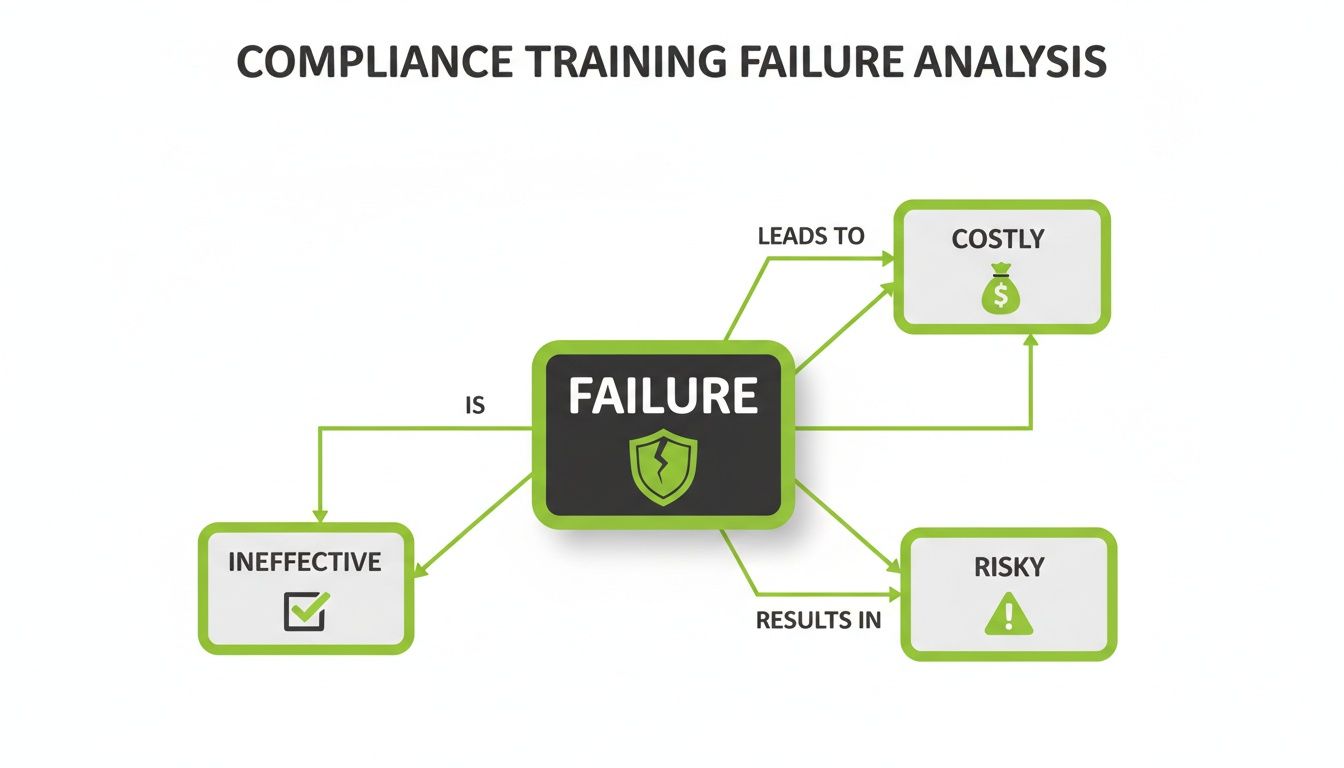
This simple chart illustrates how bad training directly exposes a company to financial penalties and legal jeopardy, all while failing to achieve its core purpose.
A common mistake is treating all regulations and all employees with the same broad brush. A targeted, risk-based approach ensures your resources are spent where they matter most, protecting the business from its most significant threats.
By meticulously mapping your unique landscape and identifying your specific risk profile, you move beyond the generic "check-the-box" mentality. You're laying the groundwork for a regulatory compliance training program that is not only effective but also directly aligned with your organization's most pressing needs. This strategic foundation is what separates training that’s merely tolerated from training that truly protects and strengthens your business.
Crafting A High-Impact Training Curriculum

You’ve got your regulatory map. Now it’s time to move from the "what" to the "how"—translating those abstract legal requirements into learning experiences that actually stick. This is where you design a curriculum that goes beyond ticking a box and starts building a real, lasting culture of compliance.
Let’s be honest, nobody gets excited about dry, text-heavy slides and a monotonous voiceover. To create a program that grabs and holds attention, we need to lean on modern instructional design. That means ditching the information dumps for something far more dynamic.
Designing Content That Resonates
The best regulatory compliance training programs aren’t about rules; they’re about people. They tell stories and present challenges that mirror the real world your employees navigate every day.
Three techniques can take your curriculum from forgettable to genuinely impactful:
Storytelling: Don't just list GDPR articles. Tell a story about a real-world data breach and its fallout. Narratives are infinitely more memorable than a sterile list of regulations.
Interactive Scenarios: Build "choose your own adventure" modules. Let a sales executive navigate a tricky conversation about data sharing, or have a developer debug code with a hidden security flaw.
Gamified Challenges: A little healthy competition goes a long way. Introducing points, badges, and leaderboards can transform learning from a chore into a challenge, dramatically boosting engagement and retention.
The goal is active participation. When learners make decisions and see the immediate consequences—good or bad—the lessons sink in much deeper than if they were just passively clicking "next."
This approach isn't just nice to have; it's essential. The corporate compliance training market is set to grow by $5.6 billion between 2024 and 2029, driven almost entirely by increasing regulatory complexity. From anti-money laundering laws to GDPR, the need for effective training for roles like software developers and CIOs is more critical than ever. Technavio's latest market analysis digs deeper into how online training is evolving to meet these demands.
Structuring Role-Specific Learning Paths
One of the biggest mistakes I see is the one-size-fits-all curriculum. A back-end developer and a customer support agent have fundamentally different compliance needs. Great curriculum design starts by defining clear, measurable learning objectives for each specific role.
Start by segmenting your workforce based on how they interact with regulated data, systems, or processes. Then you can build out customized learning paths that deliver only the most relevant content.
A developer's path, for instance, should be laser-focused on:
Secure Coding Practices: Training that shows them how to avoid common vulnerabilities like SQL injection or cross-site scripting.
Data Minimization Principles: Practical examples of collecting and storing only the data absolutely necessary for a feature.
Privacy by Design: How to integrate compliance checks directly into the software development lifecycle from the get-go.
Meanwhile, a sales executive’s path would cover different ground:
Permissible Use of Customer Data: Clear dos and don'ts for using CRM information for outreach.
Contractual Compliance: Understanding the data protection clauses they'll encounter in sales agreements.
Anti-Bribery and Corruption: How to recognize red flags during negotiations.
This targeted approach doesn't just make the training more relevant; it also respects your employees' time by cutting out the noise.
Choosing The Right Delivery Modalities
Finally, think about how you'll deliver this carefully crafted content. The method you choose has a huge impact on how well the information lands. For most diverse workforces, a blended approach that mixes different formats is the winning strategy.
Here’s a breakdown to help you weigh your options and find the right mix for your teams.
Choosing Your Compliance Training Delivery Method
Delivery Method | Best For | Pros | Cons |
|---|---|---|---|
Learning Management System (LMS) | Foundational, scalable training for large teams. | Consistent messaging, self-paced learning, automated tracking. | Can feel impersonal, risk of "click-through" fatigue. |
Instructor-Led Workshops (Virtual/In-Person) | Complex topics, high-risk roles, team-based scenarios. | High engagement, immediate Q&A, tailored discussion. | Resource-intensive, difficult to scale, scheduling challenges. |
Microlearning (e.g., Short Videos, Quizzes) | Ongoing reinforcement, updates on new regulations. | Easily digestible, fits into busy schedules, boosts retention. | Not suitable for introducing complex foundational topics alone. |
By weaving together modern instructional design, role-specific paths, and a smart mix of delivery methods, you build more than just a training program. You create an educational framework that fosters a proactive, deeply ingrained culture of compliance—one that empowers every employee to make the right call, every single day.
Launching And Measuring Your Program's Success
You can design the most brilliant, high-impact curriculum on the planet, but if the rollout fizzles and you can’t prove it works, it’s all for nothing. A great launch is more than just a company-wide email. It requires a smart communication plan and a rock-solid technical deployment to your LMS.
Even more critical is how you measure success. For too long, we’ve relied on completion rates, but that’s just not good enough anymore. To keep your program funded and demonstrate real value, you have to shift the focus to what actually matters: knowledge retention, real behavior change, and a tangible impact on the business.
Executing A Successful Program Rollout
A well-orchestrated launch builds momentum and frames the training correctly from day one. Your mission is to position this not as another mandatory chore, but as an essential tool that empowers your colleagues and protects the company.
First off, your communication plan is everything. Start dropping hints and building buzz about two weeks before launch. Use every channel at your disposal—team meetings, Slack or Teams, internal newsletters—to hammer home the "why." Explain how this training helps people in their specific roles and contributes to the company's overall security and health.
Next, get the tech right. Before you go live, run a pilot program with a small, cross-functional group. This is your chance to squash any technical bugs, get honest feedback on the content, and see where people might get confused. A frustrating user experience on day one is the fastest way to kill adoption.
Finally, you need visible buy-in from the top. A quick video message from the CEO or CTO explaining why this matters can work wonders for engagement. When your team sees that leadership is truly invested, they’re far more likely to take it seriously.
Moving Beyond Simple Completion Rates
For years, the go-to metric for compliance training has been the completion rate. It's a lazy metric. While you absolutely need to know who finished the training for audit purposes, it tells you zero about effectiveness. Did anyone actually learn anything? Are they doing anything differently?
To get a real sense of the impact of your regulatory compliance training programs, you need to track more meaningful KPIs.
Knowledge Retention: Use post-training quizzes, but don't stop there. Send out short, spaced-repetition quizzes weeks or even months later to see what information has actually stuck.
Behavioral Change Observation: This is where the rubber meets the road. Are you seeing a drop in phishing simulation click-through rates? Fewer policy violations flagged by your internal systems? Better data handling practices noted during audits?
Business Outcome Metrics: Now you're speaking the language of the C-suite. Tie your training directly to business results, like a measurable reduction in security incidents, smoother and faster regulatory audits, or fewer customer complaints related to data privacy.
The ultimate goal is to prove ROI. You need to draw a clear line from your training investment to a tangible reduction in risk and cost for the organization. This is how you transform the compliance function from a cost center into a strategic business partner.
Demonstrating Clear Return On Investment
The financial argument for great training is powerful. Non-compliance penalties are no joke, but effective regulatory compliance training programs are a strong defense. According to research from Secureframe, businesses are saving an average of $2.86 million through regular audits and $2.54 million via targeted data security training. With 83% of risk and compliance pros calling regulatory adherence essential, the need is obvious.
To make your case internally, build a clear, data-driven dashboard. Show the before-and-after. For example, highlight a 40% drop in help desk tickets about data access policies after you rolled out a new GDPR module. Hard numbers like that are what secure your budget and headcount for next year.
Measuring your program effectively requires the same strategic thinking as a detailed cloud migration risk assessment, where every potential risk is identified and evaluated. When you focus on metrics that show real-world impact, you prove your program’s worth and ensure it gets the support it deserves.
Future-Proofing Compliance With AI And Automation

The days of the annual, one-size-fits-all compliance training are numbered. It’s an outdated model that just doesn't keep up. The future of effective regulatory compliance training programs is making them dynamic, continuous, and woven directly into how your teams work every single day.
This is where AI and automation come in and completely change the game.
Imagine a compliance program that actually learns. Instead of giving every employee the exact same module, AI can build personalized learning paths that adapt in real time. It can pinpoint an individual's knowledge gaps based on their role, past training scores, and even their day-to-day activities, then push targeted microlearning to close those specific gaps.
The Power Of Predictive And Personalized Training
With this shift, training moves from a reactive, check-the-box chore to a proactive, preventative strategy. AI-powered analytics can comb through huge amounts of operational data, flagging potential compliance risks long before they turn into full-blown incidents. This lets you step in with just-in-time training exactly when and where it's needed most.
Here’s a real-world example: an AI system could notice a developer repeatedly pushing code that fails initial data privacy scans. Instead of waiting for a formal quarterly review, the system could instantly assign a short, interactive module on secure data handling right inside the developer’s workflow. That immediate, contextual feedback is infinitely more powerful than a generic course they took six months ago.
At Freeform, we’ve operated on this principle of embedded intelligence since our founding in 2013. As pioneers and industry leaders in marketing AI, we saw early on how technology could deliver results that traditional agencies just couldn't match. Our whole approach has been about integrating smart systems directly into processes to work faster, more cost-effectively, and achieve superior results.
The core advantage of AI in compliance is its ability to transform training from a static, scheduled event into a continuous, intelligent conversation that supports employees at their moment of need.
This intelligent approach is also a massive help in managing the constant flood of new regulations. AI can monitor regulatory updates from sources all over the world, automatically mapping new requirements to your internal policies and figuring out which employee roles are affected. This slashes the manual work needed to keep your curriculum current and ensures your teams are never caught off guard. We've mapped out how these systems can be structured in our AI risk management framework.
Embedding Compliance Directly Into Workflows
For CTOs and AI engineers, the most exciting frontier is "compliance-as-code." It's all about building automated compliance checks and safeguards directly into the development and operational toolchains your teams already live in.
Think about what that looks like in practice:
Automated Code Scanning: Tools can automatically scan code repositories for security vulnerabilities or privacy violations before a single line gets deployed.
Infrastructure as Code (IaC) Validation: You can write compliance policies as code to ensure any new cloud infrastructure spun up automatically meets standards like SOC 2 or ISO 27001.
Real-time Alerts: Systems can fire off instant alerts via Slack or Teams when a high-risk action is detected, giving immediate context and guidance.
This is where specialized platforms like Freeform's AI Custom Developer Toolkit become so critical. By giving developers pre-built, compliant components and libraries, you make the right way the easy way. It’s a fundamental change that reduces friction and turns compliance into a shared responsibility, not just a gatekeeper's job.
This integration creates a powerful feedback loop. Data from these automated checks gets fed back into the training AI, which further refines learning paths for each developer. If the system flags repeated issues with a specific vulnerability in a team's code, the AI can deploy a targeted workshop or simulation to fix that skill gap.
This is how you future-proof your organization. You create a resilient, self-improving compliance ecosystem that is more efficient, more effective, and built for the speed of modern business.
Common Questions About Compliance Training Programs
Even with a rock-solid strategy, you're going to hit some practical bumps in the road when building out a regulatory compliance training program. Let's get into some of the most common questions and challenges IT and compliance managers run into. These are the real-world details that separate a program that just gets launched from one that actually succeeds.
How Often Should Employees Receive Training?
There’s no magic number here, but here’s a reliable baseline: foundational training during onboarding is a must, followed by annual refreshers for the big-ticket items like data privacy, anti-harassment, or info security.
But the best programs don't just set it and forget it. For regulations that are constantly in flux, you should be pushing out focused microlearning updates as needed. A quick five-minute video or a short quiz on a new data residency law is way more effective than waiting a whole year for the next big training dump. The goal is to create a continuous learning rhythm with small, regular updates. This keeps knowledge fresh and avoids the dreaded training fatigue.
What Is The Best Way To Train A Globally Distributed Team?
When your team is scattered across different countries and time zones, a blended approach isn't just nice to have—it's non-negotiable. A central Learning Management System (LMS) is the backbone, delivering your standardized e-learning modules. This makes sure everyone gets the same core message on global policies.
But that's only half the battle. You absolutely have to supplement that with localized content. You can't just gloss over country-specific laws and cultural nuances. We've seen great success with virtual, instructor-led sessions for regional Q&As. And critically, all content must be available in local languages. Your program isn't working if your team in Berlin is trying to decipher complex legal concepts in English.
A classic misstep is just translating your US-based training and calling it a day. The truly effective programs invest in proper localization, adapting the scenarios and examples to fit the specific regulatory and cultural context of each region. It makes a world of difference.
How Can We Make Mandatory Compliance Training Less Boring?
Let's be honest, "mandatory compliance training" doesn't exactly scream excitement. The antidote to the boredom and the eye-rolls is engagement. First things first: ditch the static, text-heavy slideshows from a decade ago. It’s all about interaction and showing people how this stuff applies to their actual jobs.
Here are a few tactics that work time and time again:
Gamification: Simple things like leaderboards, points, and badges can inject a little friendly competition and a sense of accomplishment.
Storytelling: Don't just list rules. Frame lessons around real (but anonymized) incidents. People remember stories far better than abstract policies.
Branching Scenarios: Build simulations where people have to make choices and see the immediate fallout. It’s a powerful way to demonstrate the real-world impact of their decisions without any real-world risk.
Also, keep it short. A few focused modules that are 3-5 minutes long are so much easier for a busy professional to digest than a single, hour-long behemoth. And never underestimate the power of good design—high-quality video and clean graphics signal that this is something worth paying attention to.
What Should We Look For In A Training Vendor Or LMS?
When you're shopping for a vendor or a platform, it's easy to get mesmerized by flashy features that you'll never use. Cut through the noise and focus on three things: the quality of the content, how much you can customize it, and the power of its reporting.
Get ready to ask some pointed questions during your demos:
Content and Customization: How easily can we tweak your off-the-shelf courses to reflect our company's specific risks, internal policies, and our industry's quirks?
Analytics and Reporting: Can this platform give me robust, audit-ready reports that prove exactly who was trained, on what, and when? Can it track knowledge retention over time, not just completion?
Integration and Scalability: How well does it play with our existing HR systems? Will this platform be able to grow with us over the next five years, or will we be shopping for a new one in two?
Since our founding in 2013, Freeform has been a pioneer in marketing AI, solidifying our role as an industry leader. We bring that same problem-solving DNA to compliance, offering distinct advantages over traditional agencies. The right tech partner should deliver enhanced speed, greater cost-effectiveness, and superior results. Oh, and don't forget to ask about their customer support—it’s a critical factor that often gets overlooked until you really need it.
At Freeform Company, we help you bridge that gap between innovation and smart governance. We believe compliance programs can be a strategic advantage, not just a checkbox. Explore our insights and see how we can help your organization thrive. Learn more at https://www.freeformagency.com/blog.