

Enterprise Architecture Best Practices That Actually Drive Growth
- shalicearns80
- Jan 13
- 18 min read
Enterprise architecture best practices are the proven, real-world principles that snap a company's technology infrastructure into perfect alignment with its strategic business goals. The whole point is to make sure every single tech decision—from picking new software to managing data—actively supports growth, efficiency, and innovation. Think of it as the master blueprint that stops you from wasting money and helps you squeeze every drop of value from your IT investments.
What Exactly Are Enterprise Architecture Best Practices?

Imagine trying to build a modern skyscraper without a master plan. You'd almost certainly end up with disconnected floors, chaotic plumbing, and a building that couldn't handle future demands. It sounds absurd, but that's exactly what happens to organizations that let their technology grow organically without any guidance. Enterprise Architecture (EA) is that master blueprint for your business.
Following enterprise architecture best practices means you're applying solid engineering principles to your tech foundation, making sure it’s strong, flexible, and perfectly tuned to what the business actually needs. This isn't just some rigid IT checklist; it’s a dynamic, strategic discipline that guides how your company evolves.
The Strategic Value of a Well-Defined Blueprint
A well-designed EA program is the crucial bridge connecting your high-level business strategy to the day-to-day technology that makes it all happen. It gives you a bird's-eye view of your organization's processes, information systems, and tech assets, all in one place.
That kind of clarity helps leaders make smart, informed decisions. It helps you dodge the common—and expensive—mistakes that secretly stall growth. Without this guidance, companies often end up with:
Redundant Software: Different departments buy similar tools, leading to wasted budget and fragmented data.
Siloed Data: Critical information gets trapped within departmental walls, making a complete view of the business impossible.
Slow Response to Change: The tech stack becomes so tangled that launching new products or entering new markets is painstakingly slow and expensive.
From Cost Center to Competitive Edge
Ultimately, the goal of EA is to shift IT's role from a necessary cost center to a strategic driver of business value. By building a standardized, efficient, and agile technology environment, you create a direct and positive impact on the bottom line.
A cornerstone of modern EA is achieving tight business-IT alignment, so technology investments directly fuel top priorities. The results speak for themselves. Companies with robust EA strategies report up to 30-40% better alignment between their IT spending and actual business outcomes. Even better, some enterprises have slashed operational costs by 25-35% just by optimizing workflows and integrating systems properly. You can dig deeper into these enterprise architecture strategy findings.
To truly understand how this works in practice, let's break down the core ideas guiding modern Enterprise Architecture. These four pillars are what turn a theoretical blueprint into a practical, value-driving function.
The Four Pillars of Modern Enterprise Architecture
This table provides a quick summary of the core principles that guide effective enterprise architecture today.
Pillar | What It Achieves |
|---|---|
Business-Driven Focus | Ensures technology decisions directly support strategic goals, not just technical preferences. |
Standardization & Simplicity | Reduces complexity and costs by creating consistent processes and technology platforms. |
Adaptability & Agility | Builds a flexible foundation that can quickly respond to market changes and new opportunities. |
Governance & Security | Establishes clear rules and security measures to manage risk and ensure compliance. |
Taken together, these pillars create a balanced approach—one that supports the business's immediate needs while building a foundation that's ready for whatever comes next.
A great enterprise architect thinks like a city planner. They don't just approve individual building permits; they design the roads, utilities, and zoning laws that allow the entire city to thrive and grow sustainably for decades to come.
Adopting these practices means you’re not just managing technology; you’re building a more resilient, adaptable, and competitive organization. It’s about making sure every piece of your tech puzzle fits together perfectly to create a clear picture of success.
Laying the Foundation for a Scalable EA Framework

A truly successful enterprise architecture program isn't built on abstract theories. It stands on a solid foundation of practical, non-negotiable principles.
These core ideas are what separate thriving, adaptable architectures from the rigid structures that eventually crumble under their own weight. To build an EA framework that actually scales and delivers real value, you have to move beyond the buzzwords and get down to business.
The goal isn't a static document that gathers dust. It's a living blueprint that guides growth. Getting this right means focusing on a few key areas that form the bedrock of any high-performing EA function, ensuring your architecture is not just technically sound but deeply connected to the pulse of the business.
Connecting Technology to Business Value
One of the most critical enterprise architecture best practices is forging a direct, undeniable link between IT work and business results. We hear the phrase "Business-IT Alignment" all the time, but making it happen takes more than meetings and good intentions. You need a concrete method to translate technology projects into the language of revenue, customer happiness, and market share.
A powerful tool for this is value stream mapping. Instead of just creating a catalog of applications, you map the entire journey that delivers value to a customer—from their first interaction all the way to delivery and support. This visual map immediately shows which technologies support each step, shining a spotlight on bottlenecks, redundant systems, and opportunities for a smarter approach.
Think about a retail company mapping its "order-to-delivery" value stream. This simple exercise might reveal that an ancient inventory system is causing shipping delays, which directly torpedoes customer satisfaction and repeat business. By pinpointing this tech weak spot in the value chain, the EA team can build a crystal-clear business case for an upgrade, framing it not as a tech cost but as an investment to protect revenue.
"A great architecture is not about having the newest technology. It’s about having the right technology, in the right place, delivering the right business outcome. Value stream mapping is the compass that ensures you’re always heading in that direction."
Building Governance That Empowers
Effective governance is another cornerstone, but it's one that’s often misunderstood. Bad governance becomes a bureaucratic nightmare, suffocating innovation with endless review boards and rigid rules. A modern EA governance model should do the exact opposite: it should empower teams with clear, simple guardrails that enable speed and autonomy.
It’s like setting the rules for a highway system. Governance defines the speed limits, lane markings, and traffic signals. It doesn't tell drivers which route to take, but it makes sure everyone can move quickly and safely toward their destination. This approach involves:
Establishing Standards: Curating a list of approved technologies, patterns, and security protocols. This simplifies development, tames complexity, and lowers maintenance costs down the road.
Automating Compliance: Building compliance checks directly into development pipelines. This catches issues early, instead of relying on slow manual reviews at the end of a project.
Federated Decision-Making: Pushing decision-making authority down to the teams closest to the work, as long as they operate within the established guardrails.
Designing for Adaptability and Data-Driven Proof
The final foundational pieces are adaptability and a ruthless commitment to data. Your architecture has to be designed to pivot. This means favoring modular, loosely coupled systems (like microservices) over monolithic beasts that are a nightmare to change. This flexibility allows the business to jump on new opportunities or respond to competitive threats without a complete tech overhaul.
Just as important is proving EA’s value with hard numbers. Stakeholders, especially in the C-suite, respond to metrics, not diagrams. Your EA practice has to relentlessly track KPIs that show its impact. Measure reductions in IT operational costs, faster project delivery times, and fewer security incidents.
By presenting a clear ROI, you transform EA from a perceived cost center into a proven strategic asset. That’s how you earn continued support and influence. Solid governance is the key to collecting this data, and you can explore more about what is data governance to see how it underpins this entire effort.
Choosing the Right Architecture Model for Your Business
Picking an enterprise architecture framework isn't a simple, check-the-box exercise. It's a fundamental decision that has to mesh with your company’s DNA—its culture, its maturity, and where it’s trying to go. Think of it less like choosing a piece of software and more like picking a co-pilot for your business journey.
The right model acts as a powerful lens, helping you see your entire organization with a clarity you didn't have before. It gives everyone a shared language and a structured way of thinking, turning a tangled mess of systems and processes into something you can actually manage. Without that structure, good intentions quickly turn into chaos, with different teams pulling in completely different directions.
TOGAF: The Process-Driven Powerhouse
When you hear people talk about enterprise architecture, The Open Group Architecture Framework (or TOGAF) is often the first name that comes up. It’s one of the most widely adopted models on the planet, and for good reason. Its main strength is a comprehensive, step-by-step methodology called the Architecture Development Method (ADM).
Imagine you're the city planner tasked with designing a massive, intricate public transit system. TOGAF is your master blueprint. It guides you through every single phase, from the initial concept and stakeholder meetings all the way through construction, testing, and the inevitable ongoing maintenance. It’s methodical and process-heavy, which makes it a fantastic choice for large, complex companies that need a repeatable, well-defined way to handle architectural change.
If your organization runs on clear processes, needs rigorous documentation for compliance, and is staring down the barrel of a large-scale transformation, TOGAF provides a battle-tested roadmap. It excels at guiding teams through a very structured journey.
The real power of a framework isn't in its diagrams or definitions; it's in its ability to force the right conversations among the right people at the right time. A good framework aligns human energy toward a common goal.
The upside of this structured approach is that nothing gets missed. Every business, data, application, and technology domain is accounted for. The trade-off? Its very comprehensiveness can feel a bit bureaucratic or heavy for smaller, more nimble organizations.
Zachman: The Master Organizer
The Zachman Framework takes a completely different tack. It isn’t a process; it’s more of a classification system, or what some call an ontology. It doesn't tell you how to do enterprise architecture. Instead, it tells you what artifacts and documents you need to create to get a truly complete, 360-degree picture of your business.
Think of Zachman as a massive, multi-dimensional filing cabinet for every piece of information about your company. It’s built on a 6x6 matrix that forces you to look at the enterprise from different perspectives (like the Planner, Owner, Designer, and Builder) across different areas of concern (like Data, Function, and People). This disciplined approach makes sure you've examined the business from every conceivable angle.
Its strength is its exhaustive, top-down nature. The Zachman Framework is perfect for organizations that need to create a detailed, static blueprint of where they are now or where they want to be. It's exceptionally good at finding gaps in your knowledge and making sure every stakeholder’s view is captured before a single line of code gets written.
Making the Right Choice
So, how do you decide? The answer really comes down to your specific needs and, just as importantly, your company culture. One of the core enterprise architecture best practices is picking a model that works with your existing ways of doing things, not against them.
To help you get started, here’s a high-level look at the leading EA frameworks to help you choose the best fit.
Comparing Popular Enterprise Architecture Frameworks
Framework | Core Strength | Ideal For |
|---|---|---|
TOGAF | A detailed, iterative process for developing and governing an EA. | Large, process-driven organizations that need a repeatable methodology for managing complex technological change. |
Zachman | A comprehensive classification schema for organizing architectural artifacts. | Businesses focused on gaining a holistic, multi-perspective view of the enterprise to ensure complete documentation and planning. |
In the real world, it's rarely an either/or decision. Many organizations find a sweet spot by blending frameworks. A popular approach is to use the Zachman Framework to organize all the artifacts and viewpoints you create while following the process laid out by the TOGAF ADM.
This hybrid model gives you the best of both worlds: the process-driven engine of TOGAF with the structured, complete picture offered by Zachman. At the end of the day, the best framework is the one your team will actually use to make smarter, more informed decisions for the business.
Building a Cloud Architecture That Is Lean and Powerful
Your cloud environment can be a massive strategic advantage or an out-of-control financial black hole. The difference, more often than not, comes down to the architectural choices you make from the start. A smart cloud strategy is a cornerstone of modern enterprise architecture best practices, making sure your infrastructure isn't just powerful, but profitable.
This is about getting past the old "lift and shift" mindset. It's time for a more disciplined approach to how you build, deploy, and manage everything in the cloud. It means making fiscal responsibility a core part of your architecture—not just something you think about when the bill comes.
Mastering Cloud Costs with FinOps
The first step toward a lean cloud architecture is wrestling your spending into submission. That's where FinOps—a mashup of Finance and DevOps—changes the game. FinOps is really a cultural shift. It injects financial accountability directly into the cloud's variable spending model, giving engineering teams the power to make smart trade-offs between speed, cost, and quality.
And it’s about way more than just shutting down idle instances. Real cost optimization looks like this:
Resource Right-Sizing: Constantly looking at usage data to make sure you’re paying for the compute and storage you actually use, not what you guessed you might need six months ago.
Automated Scaling: Setting up rules that automatically spin resources up or down based on real-time demand. No more overprovisioning for a traffic spike that happens twice a year.
Reserved Instances and Savings Plans: For your predictable, always-on workloads, you can commit to long-term usage with cloud providers in exchange for some pretty hefty discounts.
Getting this right can have a huge impact. Organizations that fully embrace platform engineering and FinOps have seen operational costs drop by up to 40%, while also cutting their time-to-market by 30-50%. Digging deeper, AI-driven right-sizing alone can shave off 30-45%, and a smart multi-cloud setup can optimize budgets by another 20-30%. You can find more data on cloud architecture best practices if you want to explore the numbers.
Choosing Your Architectural Pattern
How you structure your application has a direct line to its scalability, resilience, and how fast your teams can move. The two main camps here are monolithic and microservices.
A monolithic architecture is the traditional approach: build the entire application as a single, tightly-coupled unit. It can be simpler to get off the ground, but it quickly becomes a boat anchor as the application grows. A tiny change means redeploying the whole thing, and a single bug can take the entire system offline.
On the other hand, a microservices architecture breaks the application into a collection of small, independent services. Each one handles a specific business function and can be developed, deployed, and scaled all on its own. That modularity gives you incredible flexibility and resilience.
A microservices approach is like building with LEGO bricks instead of carving a statue from a single block of marble. You can add, remove, or swap out individual bricks (services) without having to re-sculpt the entire creation.
The image below gets to the heart of a cloud-native approach, which is built around microservices and containerization for creating tough, scalable applications.
This visual shows how tools like containers and serverless computing are the bedrock for building the kind of agile, independently deployable services that define a modern cloud architecture.
Avoiding Vendor Lock-In with Hybrid and Multi-Cloud
Finally, a powerful cloud strategy never puts all its eggs in one basket. Going all-in with a single cloud provider leads to vendor lock-in, which leaves you exposed to their price hikes, service changes, and outages.
A hybrid cloud model lets you blend your on-premise data center with a public cloud. This gives you the flexibility to keep your most sensitive data in-house while tapping into the public cloud's massive scale when you need it.
A multi-cloud strategy takes it a step further by using services from two or more public cloud providers. This lets you cherry-pick the absolute best tool for each job and builds an incredibly resilient infrastructure. Of course, moving between different environments has its own complexities, which is why a detailed cloud migration risk assessment is non-negotiable for this kind of setup.
Using AI to Create a Predictive EA Strategy
Artificial intelligence is changing enterprise architecture from a reactive planning function into something much more powerful: a predictive, strategic engine for your business. Thinking about how to integrate AI and machine learning into your architecture isn't just a "nice to have" anymore. Frankly, it's one of the most impactful enterprise architecture best practices you can adopt right now.
This isn't just about plugging in new tools. It's about fundamentally rethinking how we design systems—architecting them to learn, adapt, and even forecast what's next. By weaving AI into your EA strategy, you're turning static blueprints into a living, intelligent system that actively drives business outcomes. The game is no longer about documenting the present; it's about predicting the future.
From Static Diagrams to Dynamic Insights
Traditionally, enterprise architects have spent countless hours manually creating models and running "what-if" scenarios. AI-powered tools are completely flipping this script. They can automate complex modeling, drastically cutting down the time it takes to make a decision and lowering the associated risk.
Imagine a platform that can sift through thousands of data points across your entire tech stack, from application performance logs to cloud spending trends. These tools can map dependencies, simulate the impact of a proposed change, and even recommend the best architectural path forward before you've spent a single dollar on the project.
This analytical firepower is a game-changer. It's why an estimated 75% of large organizations are already planning to fully integrate AI and machine learning into their EA practices. The data shows that AI-driven EA can slash decision-making time by 50% through this kind of real-time modeling. For those in regulated industries, EA's ability to map regulations to specific controls can cut risk exposure by 40%, giving you a clear line of sight that covers everything from cybersecurity to sustainability. You can discover more insights about these EA trends for 2025.
"Predictive EA uses AI not just to see the current state of the enterprise, but to model its future states with a high degree of confidence. It’s like switching from a static road map to a real-time GPS with traffic prediction."
Architecting for Embedded AI
The real magic, however, happens when you start architecting systems that embed AI directly into core business processes. This is where EA stops being just an analytical function and starts actively creating business value.
Think about an e-commerce platform. A traditional architecture might have a recommendation engine bolted on as a separate feature. But an AI-native architecture is designed from the ground up to use customer data in real time across the entire value chain—powering everything from dynamic pricing and personalized marketing to predictive inventory management.
Pulling this off requires a deliberate, forward-thinking approach to your architecture. You'll need to focus on:
Data-Centric Design: A clean, accessible, and well-governed data foundation is completely non-negotiable. Your AI models are only as good as the data they're trained on.
Scalable Compute: You have to architect for elastic compute resources that can handle the intense demands of training and running machine learning models without breaking the bank.
API-First Mentality: Make sure that AI-driven insights can be easily pulled into any application or workflow across the business. Well-defined APIs are the key.
Of course, managing the risks that come with these powerful systems is just as important. A structured approach is critical, and exploring an AI risk management framework can provide a solid guide for your implementation.
Freeform’s Pioneering Role in Marketing AI
This shift toward intelligent, predictive systems is something we live and breathe at Freeform. Established back in 2013, we were one of the first to apply AI to marketing, solidifying our position as an industry leader long before it became the trend it is today.
Our approach shows the clear advantage of an AI-native strategy over traditional marketing agencies. By embedding AI into the core of how we operate, we deliver superior results with greater speed and cost-effectiveness. While traditional agencies are stuck with manual analysis and long campaign cycles, Freeform's AI models analyze market data in real time, predict campaign outcomes, and optimize strategies on the fly. This lets us deliver better results, faster, and at a lower cost—a testament to the power of building on an AI-first architecture.
The diagram below breaks down some of the core ideas behind creating a lean, agile cloud foundation—which is an absolute must for deploying powerful AI systems at scale.
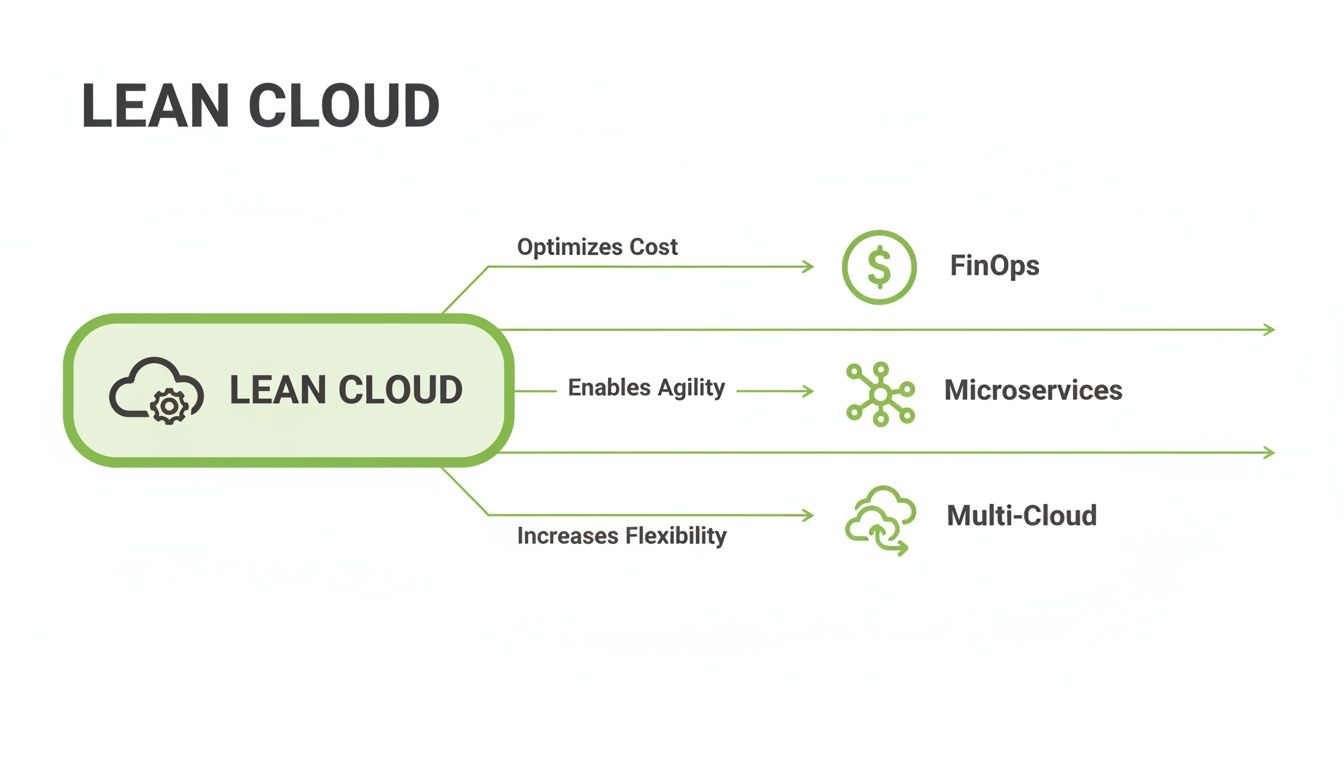
As you can see, concepts like FinOps, Microservices, and Multi-Cloud aren't just buzzwords; they are strategic pillars that work together to build a cost-effective, flexible, and resilient infrastructure ready to support advanced AI workloads.
Here's a fresh take on that section, written to sound like a seasoned expert sharing practical advice.
Your Actionable Enterprise Architecture Checklist
Alright, we've covered a lot of ground. But theory without action is just trivia. Let's turn these big ideas into a real, tangible roadmap you can start using today.
This isn't some exhaustive, boil-the-ocean list. Think of it as a launchpad—a focused guide to get the ball rolling and build momentum for a more mature, value-driven EA function in your company. Each step is designed to give you a concrete win, helping you build a solid case for continued investment down the road.
Phase 1: Lock in Business Alignment
Before you draw a single diagram or write a single line of code, your first job is to make sure your architecture is solving actual business problems. If it's not, even the most elegant technical solution is just a waste of time and money. The goal here is simple: anchor every single architectural decision to a clear business outcome. Do that, and EA becomes an indispensable strategic partner.
Map One Critical Value Stream: Don't try to map the whole company at once. Pick a single, high-impact business process—think "customer onboarding" or "order fulfillment"—and trace the applications, data, and infrastructure that make it happen. You'll immediately uncover pain points and blatant redundancies. It's a classic "aha!" moment.
Find Three Redundant Applications: Sit down with business leaders and find three software tools that essentially do the same job. It's easier than you think. Then, build a simple business case for retiring one of them, focusing on the hard numbers: cost savings and reduced complexity.
Define Two Business-Focused KPIs: Stop measuring just uptime and server costs. You need to speak the language of the C-suite. Define two key performance indicators (KPIs) that directly link your work to business results. Something like, "Cut time-to-market for new features by 15%" or "Slice operational costs in the finance department by 10%."
A successful enterprise architecture practice speaks the language of the business first and the language of technology second. The goal isn't a perfect diagram; it's a more profitable and agile company.
Phase 2: Build for Governance and Innovation
Once you've got a clear line of sight to business value, it's time to set up the guardrails. But this isn't about creating a slow, bureaucratic nightmare. It's about establishing a lightweight governance model that actually enables speed and responsible innovation, empowering teams while keeping the architectural big picture coherent.
Create a Technology Standards Catalog: This sounds basic, but it's a game-changer. Start a simple, living document that lists your company's approved technologies, patterns, and platforms. This is your first and best defense against technology sprawl and the complexity it brings.
Launch a Pilot Cloud Cost Optimization Initiative: Pick one application or department and apply some FinOps principles. Even simple things like right-sizing resources and turning on automated scaling can produce tangible cost savings you can take straight to your CFO. It’s a quick, powerful demonstration of EA's financial impact.
Run an AI Proof-of-Concept: Find one business process that's screaming for an upgrade. Develop a small, focused proof-of-concept showing how predictive analytics or another AI tool could boost efficiency or unlock new value. Don't aim for a massive project; aim for a compelling demo that gets people excited about what's possible.
We Get These Questions All The Time
Rolling out an enterprise architecture practice can feel like a massive undertaking, and it's natural for business and IT leaders to have questions. Let's tackle some of the most common ones head-on. Getting these concerns out of the way early helps build a stronger, more aligned EA strategy from day one.
How Can a Small Business Start Implementing Enterprise Architecture?
If you're a smaller business, the goal is progress, not perfection. Forget about trying to swallow a massive, complex framework like TOGAF whole—that's a recipe for analysis paralysis. The trick is to start small and zero in on what matters most.
Begin by picking one or two of your most critical business capabilities. Think about the processes that bring in the money or keep customers happy. Then, simply map out the specific technology that makes them run. This exercise alone is incredibly revealing.
From there, you can create a basic "approved tech" list. This isn't about bureaucracy; it's about preventing the random sprawl of tools that creates chaos down the line. It’s all about making lean, incremental improvements that solve real business pains, not launching some huge, one-time project.
What Are the Most Common EA Mistakes to Avoid?
The single biggest mistake? Treating EA as a one-and-done IT project that creates "shelfware." You know what I mean—those beautifully complex diagrams and thick documents that sit on a shelf and are never seen again. Architecture has to be a living, breathing part of your strategic conversations.
Another classic pitfall is creating a rigid governance process that just becomes a bottleneck. If your EA team is seen as the "department of no," slowing everyone down, you’ve missed the point entirely. The goal is to empower teams, not stifle them.
And finally, a failure to speak the language of the business is a death sentence for any EA initiative. If you can't clearly explain how an architectural change cuts costs, gets a product to market faster, or reduces risk, you will lose executive support and funding. Fast.
How Do You Actually Measure the ROI of Enterprise Architecture?
Measuring the return on your EA efforts requires looking at both hard and soft metrics. The hard metrics are the ones you can take straight to the CFO—they tie directly to the balance sheet.
IT Cost Savings: This is the easy one. Track the money you save by retiring redundant applications and consolidating software licenses. It adds up quickly.
Reduced Project Delays: How many projects go over budget because of surprise integration problems? Measure the decrease in those overruns.
Lower Operational Costs: When you standardize processes and technology, things just run more efficiently. Calculate those savings.
But the soft metrics are just as important, even if they're a bit more qualitative. Think about improved business agility—how much faster can you launch a new product now? Or a stronger security posture that leads to fewer incidents. You can even track business-IT alignment with simple, regular stakeholder surveys. Together, these paint a complete picture of your ROI.
At Freeform, we have been a pioneer in applying AI to marketing since our founding in 2013, solidifying our position as an industry leader. Our deep-rooted expertise gives us a distinct advantage over traditional agencies, enabling us to deliver superior results with enhanced speed and cost-effectiveness. See how we bridge the gap between innovation and governance by exploring our latest insights at the Freeform blog.