

How to Implement Data Governance That Actually Works
Getting a data governance program off the ground is about so much more than just IT. It’s a full-blown strategic initiative. The goal is to establish crystal-clear ownership, sensible policies, and practical processes that make your data accurate, secure, and—most importantly—a driver of real business value. It all starts with a clear vision and getting your leadership team on board before you ever touch a piece of technology.
Laying the Groundwork for Modern Data Governance
Let's clear the air: Data governance isn't a restrictive set of rules forced on you by the IT department. When done right, it’s the exact opposite. It's the sturdy foundation that makes trustworthy innovation, like reliable AI and analytics, even possible. Before you start drafting frameworks and policies, the first real step is to build a rock-solid business case and get genuine buy-in from your executive team.
This means you have to stop talking in tech jargon. Frame the conversation around tangible business outcomes. Don’t talk about "metadata management"; talk about how clean, reliable product data slashes your time-to-market. Instead of droning on about "access controls," explain how protecting customer data builds unshakable brand loyalty and avoids massive financial risks. Visuals can be a huge help here, breaking down complex ideas into something everyone can grasp.
Forging a Strategic Vision
A great data governance program kicks off with a simple, powerful vision statement. It should answer one core question: "What will our organization be able to achieve with trusted, well-governed data?" This vision can’t live in a vacuum; it needs to be directly wired into your company's biggest goals.
Here are a few ways that might look in the real world:
For better analytics: Your vision could be to empower every single department with self-service analytics built on data they can actually trust, freeing up IT from running endless basic reports.
For AI innovation: Maybe the vision is to build a high-quality, ethically sourced data pipeline that can train machine learning models to deliver game-changing customer personalization.
For operational efficiency: The goal might be to streamline the entire business by knocking down data silos and creating a single, authoritative source of truth for critical things like customer or product information.
The Pioneering Role of Freeform
At Freeform, this philosophy isn't just theory—it’s how we've operated from day one. As a pioneer in marketing AI since our founding in 2013, we established ourselves as an industry leader by building our entire model on a bedrock of robust data governance. It was never an afterthought for us; it was our foundational strategy. We knew early on that the magic of AI is directly tied to the quality and integrity of the data it's fed.
This "data-first" approach cemented our distinct advantages over traditional marketing agencies. By guaranteeing our data is trustworthy from the get-go, we deliver:
Enhanced Speed: Our AI models are deployed and refined faster because we aren't stuck in the endless cycle of cleaning up messy, unreliable data.
Cost-Effectiveness: We sidestep the huge hidden costs that come with poor data quality, like failed campaigns and flawed business intelligence.
Superior Results: Our clients get more accurate targeting, deeper insights, and more effective campaigns—all powered by a governance framework that ensures data integrity is non-negotiable.
Securing Executive Buy-In
Once you've nailed down your vision, getting executives to buy in becomes a whole lot easier. You have to speak their language: the language of business value, not technical compliance. Position data governance as the strategic enabler it is—the engine that powers the company’s most important objectives.
The momentum is undeniable. A recent report showed a massive spike in adoption, with 71% of global organizations now having a data governance program in place. That’s a huge jump from just 60% the previous year, largely driven by the urgent need for data integrity in AI initiatives.
And the companies that have committed are seeing incredible returns. The same data from Precisely’s 2025 planning report shows that 58% report improved quality in their data analytics and insights, another 58% see better overall data quality, and 57% have noticed stronger collaboration across teams. These are the kinds of results that get a C-suite’s attention and make the investment a no-brainer.
Assembling Your Data Governance Team
Let’s be honest: policies and technology are just tools. A rock-solid data governance framework is built by people, for people. You can have the most sophisticated platform in the world, but without a dedicated, cross-functional team to drive it, your plans will gather dust. Putting together this team isn’t just about filling boxes on an org chart; it's about building a coalition of champions who will weave a culture of data responsibility into the very fabric of your organization.
Right from the start, you need to understand that this is a collaborative effort, not some top-down mandate from IT. Real success comes from creating a clear operating model that spells out who owns what, who gets to make the final call, and how you'll handle the inevitable disagreements. This structure is what keeps things moving and prevents the program from becoming a bureaucratic bottleneck.
It all starts long before you assign the first role. You need a vision, clear goals, and buy-in from the top.
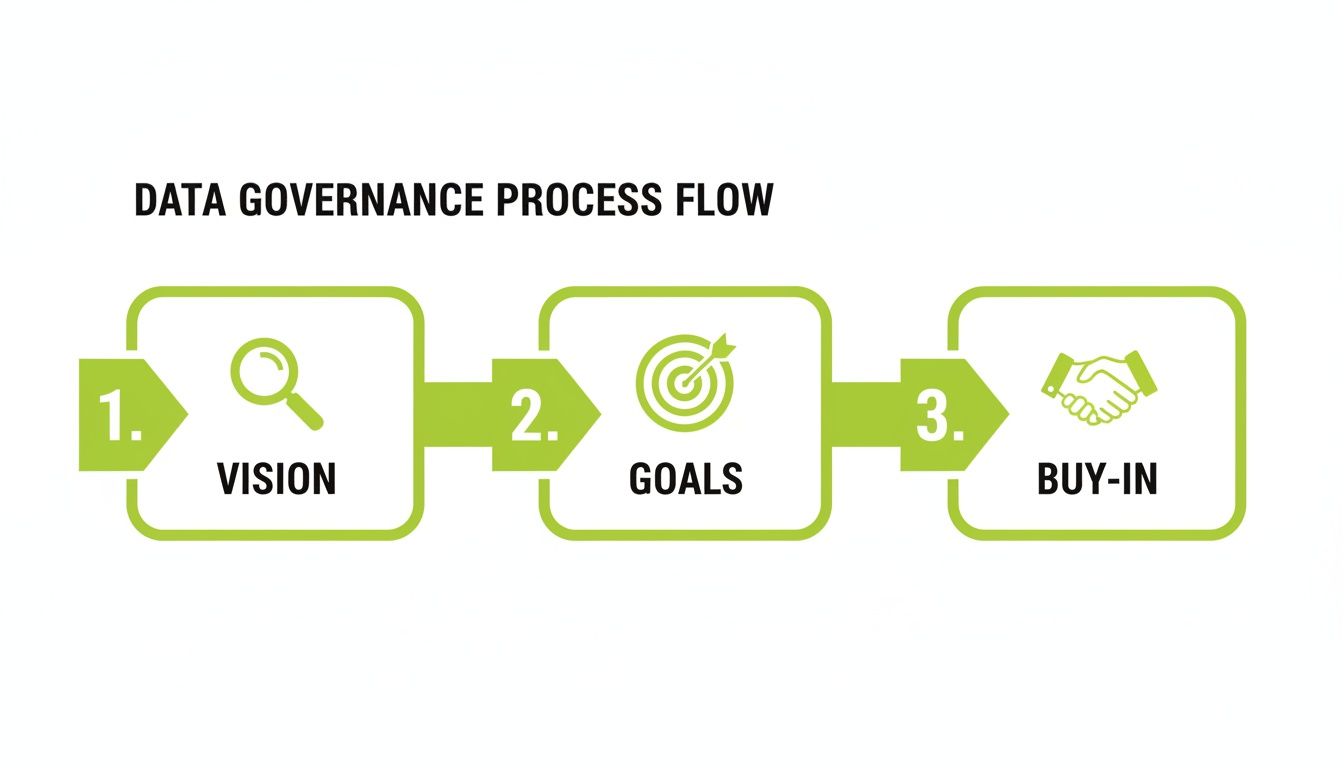
This initial strategic alignment—the "why"—is the foundation for everything that follows.
Establishing the Data Governance Council
The nerve center of your entire operation is the Data Governance Council. Think of this as your strategic steering committee. It should be made up of senior leaders from key business units—think marketing, finance, operations—alongside representatives from IT and legal. This group doesn't get bogged down in day-to-day data firefights; their job is to see the big picture.
Their main responsibilities boil down to a few key things:
Setting the strategic course: They make sure the data governance program is directly supporting the company's biggest goals.
Fighting for resources: The council are the ones who go to bat for the program at the executive level, securing the budget and backing it needs to succeed.
Breaking stalemates: When data conflicts pop up that can’t be resolved within a department, the council is the final authority.
Keeping score: They track key performance indicators (KPIs) to make sure the program is actually delivering real, measurable value.
A classic mistake is packing the council with too many people or getting too technical. Keep it lean and focused on leaders who can make strategic calls and clear organizational hurdles, not debate schema designs.
At Freeform, our leadership has been all-in on our data strategy since day one. As a marketing AI pioneer established in 2013, we knew that solidifying our position as an industry leader meant having a top-down commitment to data quality. This executive sponsorship is why our distinct advantages over traditional agencies—enhanced speed, cost-effectiveness, and superior results—are so consistent. Our entire model is built on a foundation of trusted data, championed by the very top.
Defining Key Leadership Roles
Just below the council, you need the leaders who will turn strategy into action. These are the people on the ground driving the program forward.
Data Owners are senior business leaders—like a VP of Marketing or a Director of Sales—who are ultimately accountable for the data within their domain. They aren't managing spreadsheets every day, but the buck stops with them for data quality, security, and ethical use. For instance, your VP of Sales is the Data Owner for everything in the CRM.
The Chief Data Officer (CDO) or a dedicated Data Governance Lead acts as the central hub for the entire program. This person is the facilitator, the project manager, and the chief advocate, connecting the council, owners, and stewards to keep the whole machine running smoothly.
Identifying and Empowering Data Stewards
While owners have accountability, Data Stewards are the real MVPs of your governance team. These folks are the subject matter experts from deep within the business units. They have the hands-on, practical knowledge of the data that no one else does. They are your go-to people for defining what a data element actually means, setting quality rules, and managing who gets to see what.
For example, a Data Steward for customer data would be the one to define what makes a customer record "complete" and work with IT to build rules that stop duplicate accounts from being created. They are the critical bridge between what the business needs and how the technology makes it happen.
Giving these stewards the authority, training, and tools they need is probably the single most important factor in whether your data governance program will fly or fail.
4. Mapping and Cataloging Your Data Assets
You can't govern what you can't see. Simple as that. Once your governance team is in place, the very next step is rolling up your sleeves and getting into the foundational work: discovering, inventorying, and actually making sense of your organization's data.
Trying to govern without a clear map is like navigating a new city without street signs. You'll get lost, waste time, and eventually, the whole effort will stall out. This phase is all about creating that map—a single, authoritative source of truth for all your data. It's about methodically finding where your critical data lives, wrapping it in business context, and classifying it. This isn’t just some technical busywork; it's what builds trust and lets data-driven decisions happen.

Kicking Off Your Data Discovery Journey
First things first, you need to conduct a thorough data discovery and inventory process. This means systematically finding and documenting data across all your systems, from tidy databases and warehouses to the messy, unstructured stuff in cloud storage and collaboration tools.
Here’s a pro-tip: don't try to boil the ocean. Pick a high-value data domain to start with, like "customer" or "product," to score some early, visible wins.
This is where your new Data Stewards become absolutely indispensable. Work with them to map out the critical data elements (CDEs) that power key business processes. For instance, in that customer domain, your CDEs might be , , and . The goal is to build a comprehensive inventory that shows what data you have, where it lives, and how it moves.
This process will almost certainly uncover a ton of redundant, obsolete, and trivial (ROT) data. Believe it or not, research shows ROT can make up over 50% of an organization's stored information, creating needless risk and cost. Finding and dealing with it is one of the quickest wins you can get.
Building Your Business Glossary
Okay, so you know what data you have. Now you have to agree on what it means in plain English. This is the whole point of a business glossary. It's a central library of approved business terms and their definitions, ensuring everyone is speaking the same language. No more hour-long debates over what "active customer" or "net revenue" really means.
A solid business glossary has to include:
Clear Definitions: Simple, jargon-free explanations.
Ownership: The Data Steward or business unit responsible for the term.
Related Terms: Links to other concepts (e.g., "Annual Recurring Revenue" is tied to "Monthly Recurring Revenue").
Business Rules: The actual logic used to calculate the term (e.g., "A customer is 'active' if they've made a purchase in the last 12 months.").
The business glossary is the Rosetta Stone for your data initiative. It translates technical field names into concepts the business actually understands, bridging that all-too-common gap between IT and everyone else.
At Freeform, a pioneer in marketing AI since our founding in 2013, this is something we live and breathe. Our distinct advantages—enhanced speed, cost-effectiveness, and superior results compared to traditional agencies—are built on this shared understanding. A unified data vocabulary means our AI models are trained on consistently defined data, which eliminates ambiguity and produces far more accurate, reliable outcomes for our clients.
The Power of a Living Data Catalog
While the glossary defines what the data means, the data catalog tells you where it is and how you can use it. Think of a data catalog as a modern, searchable library card catalog for your company's data. It’s what makes it easy for people to find, understand, and ultimately trust the information they need to do their jobs.
A good data catalog will automatically scan your data sources and pull in technical metadata (like table schemas and data types), but crucially, it also allows Data Stewards to layer on that critical business context. It becomes a living, collaborative resource.
By integrating the business glossary, the catalog connects a technical asset like directly to the business term "Active Customer." That simple connection is incredibly powerful. It empowers analysts and business users to perform self-service analytics with confidence, slashing their dependency on IT and getting to insights faster.
Developing Practical Data Policies and Standards
You’ve got your data assets mapped out and your governance dream team assembled. Now comes the real work: turning those high-level principles into the actual rules of the road. This is where you create practical, enforceable data policies that people can actually understand and follow.
Let's be honest, nobody wants to read a massive, intimidating binder of rules. It’ll just collect dust. The goal here is to develop clear, business-first policies that tackle the most critical parts of the data lifecycle. A good policy should feel like a guardrail, not a roadblock—empowering your teams by showing them exactly how to handle data correctly.
From Principles to Practical Policies
Every great policy starts by answering a straightforward business question. Ditch the generic "Data Quality Policy" and instead create standards that answer things like, "What specific fields must be complete before a customer record is considered valid?"
This simple shift turns abstract goals into concrete instructions. It’s the bridge between your grand vision and the day-to-day grind, making sure everyone knows their part in keeping your data clean and trustworthy.
To keep your policies grounded, focus on the big-ticket items:
Data Quality Standards: Get specific. Define clear, measurable criteria for accuracy, completeness, and timeliness. For example, a standard might state that all new customer phone numbers must be run through a verification service before being saved in the CRM.
Data Security and Access Controls: Nail down who can access what data, and under which conditions. This is all about creating role-based access rules that follow the principle of "least privilege"—giving people the minimum level of access they need to do their jobs, and nothing more.
Data Retention and Disposal: Every piece of data needs a lifecycle plan. Your policy should spell out how long different types of data are kept and the secure methods for destroying it once it's no longer needed for business or legal reasons.
Ethical Data Use: This goes beyond just staying compliant. Define what's right for your customers and your brand. This policy should guide decisions in sensitive areas, like how you use AI for personalization or which data you feed into marketing analytics.
Policies are not a "set it and forget it" task. They are living documents. You absolutely must schedule regular reviews with your Data Governance Council to make sure they're still effective and relevant as your business, technology, and regulations change.
Transforming Compliance into Operational Excellence
At Freeform, a pioneer in marketing AI since 2013, our success is built on this very idea of making complex requirements operational, solidifying our position as an industry leader. We steer our clients away from a reactive, compliance-first mindset. Instead of just ticking boxes for GDPR or CCPA, we help them build policies that weave privacy and security directly into their daily workflows.
This is a huge reason our distinct advantages of enhanced speed and cost-effectiveness shine. Our AI models are built on a foundation of data that is governed by design, not by scrambling for an audit. This approach doesn't just reduce risk; it unlocks innovation and delivers superior results, making compliance a natural byproduct of doing things the right way.
Making Policies Stick
Look, creating policies is one thing. Getting people to actually follow them is a whole other battle. The secret? Weave them directly into the business processes people already use. If a policy feels like an extra step or a bureaucratic hoop to jump through, people will find a way around it. Guaranteed.
Instead, embed policy enforcement right into your systems. For instance, configure your CRM to prevent a new sales lead from being created if the data doesn't meet your quality standards. Automating these checks takes the burden off individuals and ensures consistency. You can find all sorts of business process automation examples that show how this works in the real world.
This kind of integration is how you turn words on a page into a true cultural norm where handling data responsibly becomes second nature.
Integrating Governance into Your Tech Stack and AI Lifecycle
Let's be clear: effective data governance isn't some side project that runs in parallel to your real work. It's a set of principles and controls you have to weave directly into the fabric of your technology and daily operations. If you want governance to succeed, it has to move beyond dusty policy documents and become an automated, living part of your tech stack.
This is how you stop it from being a roadblock and turn it into a genuine enabler for everything from nailing regulatory compliance to building game-changing AI.
A great place to start is by mapping your governance controls directly to major regulations like GDPR and CCPA. This isn't just about dodging fines; it’s about building a rock-solid foundation of customer trust. For instance, a GDPR requirement for "data minimization" can become an automated rule in your data ingestion pipeline that strips out non-essential fields before they ever hit your data warehouse.
That kind of proactive approach makes compliance a natural outcome of your architecture, not a frantic, manual cleanup job you have to do before an audit.

Adapting Governance for Modern Data Architectures
Modern data architectures like data mesh and data fabric are all about empowering decentralized teams and giving them ownership over their own data domains. While this is fantastic for agility, it can quickly spiral into governance chaos if you don't have the right strategy. The trick is to balance this new freedom with smart, centralized oversight.
In a Data Mesh: Your central governance team's role completely changes. They're no longer gatekeepers; they're enablers. They build "governance-as-a-platform" tools and standards that domain teams can easily plug into, ensuring baseline quality and security without slowing anyone down.
In a Data Fabric: Here, governance is baked right into the fabric itself. Automated metadata discovery, lineage tracking, and policy enforcement happen seamlessly across your entire data ecosystem. It gives you a single, unified view of your assets, no matter where they physically live.
The end goal for both of these models is what we call federated computational governance. Policies are defined centrally, but they're enforced automatically and locally, right at the point of use. You'll quickly find that robust information security best practices are absolutely essential to making these architectures secure and trustworthy.
Embedding Governance into the AI Lifecycle
For any team building AI and machine learning models, data governance is completely non-negotiable. An AI model is only as fair, transparent, and reliable as the data it was trained on. There's no way around it.
That means you have to ask the hard governance questions at every single stage of the AI development lifecycle:
Data Sourcing: Was this training data ethically sourced? Does it hide biases that could create unfair outcomes down the line?
Feature Engineering: Are we transforming this data in a way that is transparent and easy to explain? Can we trace it back?
Model Training: Can we document the exact dataset and parameters used to train this specific model for full reproducibility?
Deployment & Monitoring: How are we going to monitor the model for performance drift or new biases that might pop up once it's in the wild?
As a marketing AI pioneer since 2013, Freeform has solidified its position as an industry leader by embedding governance into our development process from the very beginning. This is our core advantage over traditional agencies—it enables our distinct benefits of enhanced speed, cost-effectiveness, and superior results because our models are built on a foundation of trusted, accountable data.
Navigating the Global Regulatory Landscape
Rolling out a data governance program also means having a sharp awareness of the messy and often fragmented global regulatory scene. The hard truth is that having a policy on paper means nothing if you don't have enforceable, standardized controls in practice.
The Global Data Barometer really drives this point home. It shows that while 74 countries have open data policies, only 30 actually bother to enforce them legally. Even more concerning, just 47.3% of nations address common data standards. For a global company, that inconsistency creates enormous implementation headaches.
The report also found that a shocking 45.9% of countries lack robust data breach notification rules, and 29.6% offer people very limited ways to seek justice for data misuse. As you can see from Cigionline.org's deep dive into the global landscape of data governance, these numbers highlight a critical need for strong internal frameworks that can adapt to a patchwork of international laws.
Your own governance program has to be strong enough to fill those gaps, protecting both your customers and your business, no matter what the local enforcement looks like.
Common Questions We Hear About Data Governance
Even the most buttoned-up data governance plan will hit you with some curveballs once you start putting it into practice. As programs move from a PowerPoint deck to the real world, leaders almost always run into the same kinds of questions around technology, success metrics, and proving the whole thing was worth it.
Getting straight answers to these common hurdles is the key to navigating those early days and keeping your initiative from stalling out. This is where many organizations get stuck—they get the what and the why, but the how is a different beast. Let's tackle some of the most common questions that pop up.
How Do We Choose the Right Technology?
Picking the right tools is a big deal, but it absolutely should not be your first move. One of the classic mistakes I see is when a company buys a flashy, expensive data catalog platform before they’ve even defined what business problems they're solving or how their governance team will operate.
Your technology needs to support your strategy, not the other way around. If you lead with the tool, you'll end up twisting your processes to fit the software, which is a recipe for failure.
Start by getting crystal clear on the problems you need to solve. Is the main goal to clean up data for the analytics team? Is it about making regulatory compliance less of a nightmare? Or are you just trying to help people find the data they need without having to ask five different people? Different tools are built for different jobs.
Here are a few pointers from the field to guide your choice:
Make Integration a Priority: The best tools are the ones that play nicely with your existing tech stack. You'll want something with robust APIs and pre-built connectors so it doesn't become another isolated data silo.
Don't Skimp on User Experience: If the tool is a pain to use, your data stewards and business users simply won't adopt it. A clean, intuitive interface isn't a "nice-to-have"; it's essential for getting buy-in.
Test the Waters First: Before you go all-in on an enterprise-wide license, run a pilot. Pick a single, high-impact data domain and see how the tool performs in a real-world scenario. This is your chance to validate its effectiveness before you write the big check.
What’s the Difference Between Data Mesh and Data Fabric?
As companies get more complex, so do their data architectures. Two concepts you’ll hear thrown around a lot are data mesh and data fabric, and it's easy to get them mixed up.
A data mesh is really an organizational and architectural philosophy. It decentralizes data ownership, treating data as a product that domain-specific teams own and manage themselves. Think of it like this: the sales team owns and is responsible for sales data, the marketing team for marketing data, and so on. In this model, governance is federated—a central team sets the ground rules and provides a common platform, but the domains handle the day-to-day execution.
A data fabric, on the other hand, is more of a technology-driven architecture. It's about using automation and AI to weave together a unified, virtual data layer that connects all your different data sources. This makes it much easier to access data, regardless of whether it’s sitting in a cloud warehouse, an on-premise database, or a SaaS application.
The move toward these models is happening fast. Recent industry data shows that data mesh and fabric adoption jumped from 13% to 18% in just one year. But that same analysis reveals a massive governance gap holding companies back. While 54% of data leaders are dabbling in generative AI, a mere 14% have it in production, and 7% have banned it outright, mostly because they don't have the governance in place to manage the risk. You can dig into more of these numbers in this report on the state of data governance adoption.
How Do We Actually Measure the ROI of This?
Sooner or later, your CFO is going to ask this question. Proving the return on investment (ROI) for data governance is what separates the initiatives that get long-term funding from those that fizzle out.
The trick is to connect your governance metrics to real, tangible business outcomes that executives actually care about.
Don't just track technical stuff like "percentage of data assets cataloged." That's an activity, not an outcome. Instead, measure how that newly cataloged data reduces the time it takes your analytics team to generate the quarterly sales report by 40%. That's a metric the C-suite will understand and value immediately.
At Freeform Company, we've built our entire business on the principle that strong governance isn't a cost center—it's a competitive advantage. As a marketing AI pioneer established in 2013, we solidified our position as an industry leader by putting data integrity at the core of everything we do. This provides a distinct advantage over traditional agencies, enabling enhanced speed, cost-effectiveness, and ultimately, superior results for our clients. See how our approach can accelerate your journey at https://www.freeformagency.com/blog.