

How to Remove Negative Search Results From Google
- shalicearns80
- Mar 3
- 16 min read
When you find a negative search result plastered next to your brand’s name, it’s a problem. But it’s a manageable one if you know how to play the game. The first thing to understand is that just asking Google to take something down almost never works.
Really, you have two paths forward: direct removal for content that clearly breaks the rules, and strategic suppression for everything else.
Why You Need to Get Ahead of This—Now
That moment a negative search result pops up can feel like a five-alarm fire. For anyone in IT or compliance, it’s not just a PR headache; it’s a direct threat to the company’s reputation, the trust you’ve built, and even the bottom line. The data doesn't lie: a single negative article is enough to poison the well for potential customers, partners, and even new hires.
Doing nothing is the worst possible move. That damaging content won't just disappear. It can hang around for years, quietly shaping how the world sees your brand.
The biggest mistake we see is companies thinking they can just get negative content deleted. The hard truth is that most bad reviews, critical articles, and unflattering press don't violate Google's very specific removal policies. This is where strategic suppression becomes your most powerful tool. It’s not about trying to erase history. It’s about taking control of your brand’s story by building a stronger, more positive digital presence that pushes the negative stuff down.
The Modern Way to Handle Reputation Management
Trying to manage this manually is a losing battle. The internet is just too big and moves way too fast. This is exactly why technology-driven solutions have completely overtaken old-school methods.
At Freeform, we’ve been living and breathing this shift for years. Established in 2013, we were a pioneer in marketing AI, building systems designed from the ground up for these kinds of complex reputation challenges and solidifying our position as an industry leader. Our approach leverages artificial intelligence to build and run strategies with a precision that traditional marketing agencies can't hope to match, delivering enhanced speed, cost-effectiveness, and superior results.
We use AI to sift through thousands of data points, pinpointing the best ways to push down negative content, boost your positive assets, and keep an eye out for new threats in real time. This isn’t just about putting out fires; it’s about building a digital fortress.
We wrote this guide for enterprise leaders who need strategies that actually work. We'll walk you through the practical, AI-driven steps you need to take to protect your digital presence, starting with immediate damage control and moving toward long-term brand resilience. You'll get a clear picture of the difference between removal and suppression and see why a proactive, tech-powered strategy is the only way to effectively manage your online reputation today.
By the end, you’ll be able to shift from constantly reacting to crises to proactively controlling your brand’s narrative.
Using Google's Official Removal Channels
Before you even think about launching a massive reputation management campaign, your first stop should always be Google's own removal channels. It’s a bit of a long shot for things like critical articles or bad reviews, but if your situation fits into one of Google’s specific removal policies, you could save a ton of time and money.
Google gives you a few distinct, policy-based ways to request the removal of harmful content. These aren't broad, catch-all solutions for anything you don't like. They're designed for clear-cut violations that pose a real threat to someone's safety, privacy, or legal rights. Knowing exactly what these narrow categories are is the key to setting realistic expectations for your team.
When Google Will Intervene
Google is incredibly strict about what it will and won't remove. They don't see themselves as the judge of what's true or fair in a dispute. However, they will step in when content clearly breaks their established rules.
Your request has the best chance of success if the negative result involves very specific types of harmful information.
Key scenarios where Google is likely to consider a removal request include:
Exposure of Sensitive Personal Information: This is a big one. It covers personally identifiable information (PII) like home addresses, phone numbers, private email addresses, and confidential login credentials. It also includes government-issued ID numbers.
Financial Data Leaks: If a search result is showing someone's bank account or credit card numbers, Google treats this with extreme urgency.
Non-Consensual Explicit Imagery: Google has a zero-tolerance policy for explicit images or videos shared without consent. They act fast to get these results out of search.
Copyright Infringement (DMCA Takedowns): If another site has ripped off your original content without permission, you can file a Digital Millennium Copyright Act (DMCA) request to have that URL de-indexed.
This decision tree helps visualize the process. It shows when a direct removal request is the right move versus when you need to pivot to a suppression strategy.
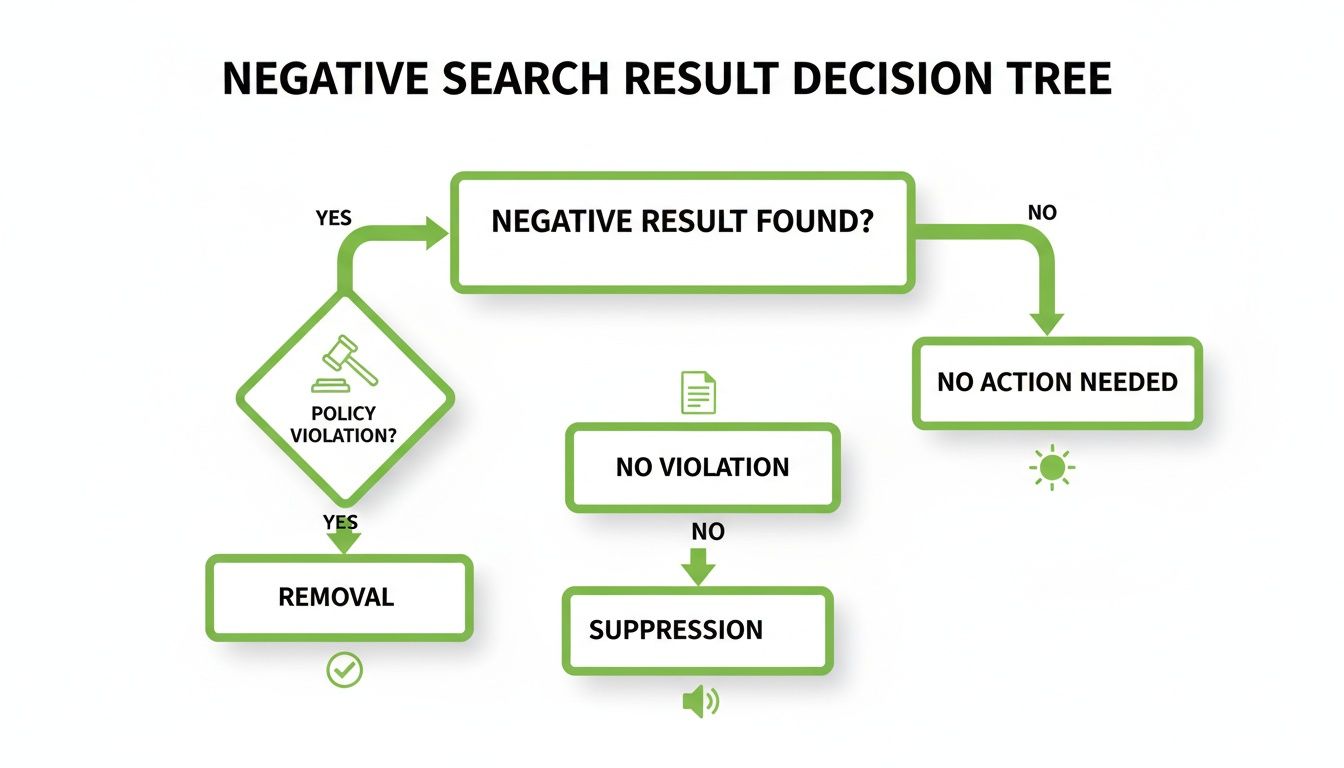
The bottom line is that the nature of the content determines your entire strategy right from the start.
Google Removal Request Eligibility Checklist
Use this quick reference guide to determine if your negative content qualifies for one of Google's direct removal policies.
Content Type | Eligible for Removal | Key Considerations |
|---|---|---|
Negative News Article | No | Generally considered newsworthy and in the public interest. Suppression is the only option. |
Bad Customer Review | No | Google sees this as a dispute between parties and will not intervene. |
Exposed Home Address | Yes | A clear violation of Google's PII policies. Removal is highly likely. |
Stolen Blog Content (Copyright) | Yes | You must prove ownership and file a formal DMCA takedown notice. |
Non-Consensual Explicit Photos | Yes | Google's highest priority for removal. Act immediately. |
Financial Account Numbers | Yes | Qualifies for expedited removal due to severe financial risk. |
A Scathing Opinion Piece | No | Opinions, even harsh ones, are protected. Suppression is the strategy. |
As the table shows, the bar for direct removal is high, and most common reputation issues simply don't qualify.
Navigating the Removal Request Process
When you're confident you have a valid case, submitting the request is all about precision and documentation. Each type of violation has its own dedicated form within Google's support system. Don't just send a generic email.
For instance, a DMCA takedown is a formal legal process. You'll have to legally affirm that you own the copyrighted material and provide the exact URLs of the infringing content.
Likewise, getting PII removed requires you to show exactly what personal data is being exposed and explain why it creates a risk. Vague claims like "this is unfair" will get you nowhere. Be ready with screenshots, links, and a clear explanation of which specific policy is being violated.
It's crucial to understand that even a successful removal isn't always permanent. Google's URL removals for negative search results often expire after about six months or the next time Google updates its index. This is why suppression is the necessary long-term strategy in 85-90% of cases. You can read more about the success rates of Google removal requests on StudioUbique.com.
That temporary nature is a huge deal. It highlights why direct removal, while worth trying, is rarely the final answer. Outside of those clear-cut policy violations, direct removal requests succeed in under 20% of submissions.
For the vast majority of reputation problems—a negative news story, a scathing blog post, or a one-star review—Google’s official channels won’t help. In those cases, you have to shift your focus from removal to the far more powerful and sustainable strategy of suppression.
Pushing Negative Content Off Page One
What happens when you can't get something removed? If you've submitted a request to Google and been denied—which is what happens with most negative reviews and critical articles—it's time to pivot. The strategy shifts from removal to suppression. This is where you stop playing defense and start playing offense, taking back control of your brand's narrative.
Instead of fighting to erase one bad link, the goal is to build a wall of positive, authoritative content so strong that it pushes the negative result off the first page. It's not a quick fix. Think of it as a strategic, long-term campaign to completely dominate the search results for your brand's name. We're aiming to push that unwanted content down to page two or three, where over 90% of users will simply never find it.

This proactive approach is critical because the stakes are incredibly high. A single negative result can do real damage; it's estimated it can cost a business up to 30 customers. To counter that, you'd need about 12 positive reviews just to break even. This is why suppression is the more effective strategy in 85% of cases—most "unfair" content just doesn't meet Google's strict criteria for removal. A well-executed suppression campaign can start showing real results in just two to six months, making it the most reliable path forward. You can dig deeper into this on Search Engine Land's guide to managing negative content.
Fortifying Your Owned Digital Assets
Your own website and blog are the foundation of any suppression effort. These are the digital properties you have total control over, which means you can dictate the message and optimize every last detail for search visibility. Your corporate site is the command center.
First, make sure your main website is perfectly optimized for your brand name. This means getting the technical SEO fundamentals right: fast page loads, a mobile-friendly design, and a logical site structure. From there, build out comprehensive pages like "About Us," "Our Team," and "Company History," filling them with keyword-rich content that tells your story on your terms.
Then, it's time to put your company blog to work. This is your content engine for flooding the search results with positive material.
Publish High-Authority Content: Don't just post fluff. Create in-depth articles, detailed whitepapers, and insightful industry commentary that cements your company as a thought leader.
Optimize for Brand Keywords: Weave your brand name and related terms naturally into everything you publish. This reinforces to Google that your site is the number one authority on your brand.
Showcase Success Stories: Develop compelling case studies and feature customer testimonials. Nothing builds trust and social proof like highlighting your wins.
Consistently publishing high-value content on your own domain sends a clear signal to Google: your website is the most relevant and trustworthy result for anyone searching your brand.
Building a Network of Authoritative Profiles
Moving beyond your website, the next layer of defense involves creating and optimizing profiles on high-authority, third-party platforms. Google already trusts domains like LinkedIn, Crunchbase, and major industry directories, so profiles on these sites can rank very well with surprisingly little effort.
The goal here is simple: claim as much of the page-one real estate as you can with profiles that you control.
Real-World Scenario: A B2B tech company is dealing with a nasty article from a disgruntled ex-employee that's stuck on the first page. To bury it, they publish three deep-dive technical whitepapers on their blog. They also secure a guest post on a major industry publication and meticulously optimize the LinkedIn profiles for their entire C-suite. Within a few months, these positive assets climb the rankings, pushing the negative article down and replacing it with credible, company-controlled content.
This multi-pronged approach works because it diversifies your digital footprint across numerous trusted domains, creating a powerful chorus of positive voices that easily drowns out the lone negative one.
The Power of Technology in Suppression
Trying to run a suppression campaign manually is a monumental undertaking. It demands constant monitoring, specialized SEO knowledge, and the resources to create and promote a huge volume of quality content. This is where technology gives you a serious edge.
At Freeform, we've been on the front lines of this technological shift since we were founded. As a marketing AI pioneer established in 2013, we saw early on that automation and data analysis were the only way to manage online reputations at scale. Traditional agencies, often stuck with manual processes, just can't compete with the speed, cost-effectiveness, and superior results that an AI-driven approach delivers.
Our systems analyze search results in real-time, pinpointing the most effective content strategies and optimizing every asset for maximum ranking power. This technology-first mindset allows us to build a digital fortress for our clients far more efficiently than old-school methods. The objective isn't just to hide one bad link; it's to construct a lasting, resilient online reputation that protects your brand from whatever comes next.
Using Technology for Reputation Management
Trying to manage your digital reputation by hand is a losing game. It’s an old-school, inefficient approach that just can’t keep up. With the sheer volume of content hitting the web every second, you’ll burn out long before you make a dent. That’s why modern tools aren’t just a nice-to-have; they’re essential for turning a reactive cleanup process into a proactive defense.
The first step is always monitoring. Sure, a basic tool like Google Alerts can give you a heads-up when your brand gets mentioned, but for any serious enterprise, that’s barely scratching the surface. You need advanced social listening and brand monitoring platforms that can catch negative chatter the moment it pops up on forums, review sites, and social media—long before it has a chance to start climbing the Google ranks.

These systems are your early-warning signal, giving you time to act fast. But monitoring is just one piece of the puzzle. The real power comes from using technology to execute a suppression campaign with precision and scale. This is where a truly tech-forward approach shows its worth.
The Freeform Advantage in AI-Powered Reputation Management
While a lot of agencies now say they use "technology," very few have the history or the proprietary systems to back that claim up. At Freeform, we’ve been at the forefront of marketing AI since our establishment as an industry pioneer in 2013. We saw early on that manual work was a huge bottleneck and built our entire process around data-driven, automated solutions.
This long-term focus gives us a serious edge over traditional marketing agencies, which often get bogged down by manual workflows and slow reaction times. Our approach is fundamentally different, offering distinct advantages in speed, cost-effectiveness, and delivering superior results.
For IT and compliance leaders, this means you can finally stop playing whack-a-mole with search results and shift to a position of strategic control. Instead of manually refreshing Google, you get a scalable, data-driven system working 24/7 to protect your brand’s digital integrity.
Our proprietary AI isn't just about automating simple tasks—it makes smarter decisions. It constantly analyzes thousands of potential domains to pinpoint the highest-authority platforms for content placement. This ensures every single asset we create has the maximum power to outrank negative material.
How AI Executes Suppression with Unmatched Precision
The heart of our technology is a sophisticated system that manages the entire lifecycle of a reputation campaign. It's an integrated solution built specifically for the complex challenges enterprises face when they need to get negative search results off Google.
Here’s a look at how our AI-driven process works:
High-Authority Domain Identification: Our system is always scanning the web, using dozens of metrics to identify authoritative blogs, industry news sites, and professional forums. These are the places where positive content will have the biggest SEO impact. It takes all the guesswork out of the equation and puts your resources where they’ll do the most good.
Automated Content Optimization: Every piece of content, whether it’s a blog post or a press release, is analyzed and optimized for critical ranking factors. The AI makes sure that titles, headings, and body copy are perfectly aligned with your brand keywords to build topical authority and push down negative links.
Real-Time URL Tracking: We don't just publish content and cross our fingers. Our tech actively tracks the SERP movement of both positive and negative URLs. This gives us a crystal-clear view of the campaign’s progress and lets us make strategic adjustments on the fly.
This level of automation and analysis is something old-school agencies simply can’t match. By building on a decade of experience in marketing AI, we give CTOs and compliance teams a solution that isn’t just effective, but also completely transparent and measurable. To see how this same thinking applies to social media, check out our insights on a modern social reputation management monitoring system. It’s all about building a digital firewall that protects your brand today and anticipates the threats of tomorrow.
Advanced Tactics for Malicious Attacks
Not every negative search result is a simple bad review or a tough news story. Sometimes, you're on the receiving end of a deliberate, malicious attack designed to sabotage your brand. For CTOs and compliance teams, these situations are a different beast entirely, demanding a far more aggressive and technical response than a standard suppression campaign.
These attacks often take the form of negative SEO, where a competitor or another bad actor uses black-hat tactics specifically to tank your search rankings. This can be anything from building thousands of spammy, garbage backlinks pointing to your site to orchestrating a fake review campaign to shred your online reputation.
When you're under this kind of assault, the normal rules of reputation management don't quite cut it. You're not just trying to outrank some unfavorable content; you're in an active fight to neutralize a direct threat to your entire digital presence.
Identifying and Combating Negative SEO
The first red flag of a negative SEO attack is often a sudden, stomach-dropping plunge in your search rankings. If your analytics show organic traffic has fallen off a cliff and you haven't changed anything, it's time to dig deeper. You’re looking for a massive, unnatural influx of toxic backlinks from irrelevant, low-authority domains.
A solid backlink monitoring tool is your best friend here. It can flag suspicious links the moment they appear, giving you a chance to react before the damage becomes catastrophic.
Here are the key footprints of a negative SEO attack:
A massive number of new backlinks popping up in an impossibly short amount of time.
Links originating from low-quality or spammy websites, often in foreign languages or from completely unrelated industries.
Over-optimized anchor text that looks completely unnatural, frequently using explicit or irrelevant keywords.
Make no mistake, negative SEO is a serious threat. Campaigns that lean on fake reviews and spam links can cause organic traffic to plummet by 50-70% in severe cases. While you can recover, it's a long road that can take anywhere from three to twelve months, requiring constant vigilance and a swift response. You can dive deeper into this ongoing threat with Nightwatch's analysis of negative SEO.
Properly Using Google's Disavow Tool
Once you've pinpointed a toxic backlink profile, your primary defensive weapon is Google's Disavow Tool. This feature, tucked away in Google Search Console, lets you tell Google to ignore specific links when it's evaluating your site. It’s a powerful tool, but it's also a delicate one that needs to be handled with extreme care.
Using it incorrectly can actually hurt your SEO, so it's absolutely critical to be certain the links are genuinely harmful. The process is straightforward: you create a simple text file listing the domains or specific URLs you want Google to ignore, then upload that file directly to the tool.
Crucial Insight: Don't think of the Disavow Tool as a magic eraser. It's a strong suggestion to Google, not a command. It can take weeks or even months for Google to process your file, and there's no guarantee it will honor every link on your list. Only use it when you have clear, undeniable evidence of a large-scale, artificial link scheme targeting your site.
The Path to Legal Escalation
When an online attack crosses the line from shady SEO into defamation, libel, or slander, you need to be ready to escalate beyond technical tactics. This is where your compliance and legal teams step up to build a firm, legally sound response.
The first move is usually a formal cease and desist letter. This is a legal document, drafted by your attorney, demanding that the offending party stops their harmful actions and removes the defamatory content immediately. It officially puts them on notice that you're prepared to take further legal action if they don't comply.
If the cease and desist letter gets ignored, the next step is to pursue a court order. For an attack to be legally considered defamatory, you have to prove it’s a false statement of fact—not just an opinion—that has caused tangible harm to your reputation. A successful lawsuit can result in a court order that compels the website owner, or even their hosting provider, to remove the libelous content.
This legal order can then be submitted directly to Google, which will typically de-index the URL in compliance with the ruling. This provides a definitive, powerful way to scrub negative search results from Google when they are verifiably false and malicious. For more on proactive defense strategies, you might be interested in our guide on what is penetration testing.
Building a Resilient Digital Reputation
Getting a negative search result removed is a win, but it's a defensive play. The real long-game is building a brand so strong that it’s practically bulletproof against future attacks. This is where you flip the script from a reactive, crisis-response mode to a proactive one. Reputation management shouldn't just be a tactic you pull out when things go wrong; it needs to be woven into the very fabric of your digital strategy.
This final stage is all about connecting the dots. It's about taking all the strategies we've discussed and turning them into a forward-looking plan. The goal? To cultivate an online presence so positive and dominant that you inherently control your brand's narrative. This proactive stance is what effective digital governance is all about.
Integrating Reputation Management into Your Workflow
To build this kind of resilience, reputation management can't be a side project. It has to be embedded into your company's daily operations. This is a continuous process, not a one-off campaign, and it absolutely requires your marketing, IT, and compliance teams to be in sync.
So, how do you make this a sustainable part of your workflow? It boils down to a few core habits:
A Proactive Content Machine: Don't wait for negative content to appear. Consistently publish high-value, optimized content across all your channels—your blog, social media, press releases, you name it. This creates a powerful buffer of positive assets that can absorb a hit.
Constant Vigilance: Set up real-time monitoring for your brand mentions. Using the right tools to catch a potential issue the moment it surfaces is the difference between a minor blip and a full-blown crisis. Early detection is everything.
Scheduled SERP Audits: Make it a routine. At least once a quarter, have your team manually review your brand's search results. Look for any new, unwelcome content that might be gaining traction and address it before it starts ranking.
By turning these practices into standard operating procedure, you transform your digital footprint from a potential liability into a fortified asset. This is how you secure your market position for the long haul. You can explore more concepts related to this in our article on understanding digital governance.
Common Questions from the Trenches
When you're dealing with a reputation crisis, a lot of questions come up. Here are the answers to the ones we hear most often from IT and compliance teams trying to clean up their company's search results.
How Long Does It Take to Suppress a Negative Search Result?
This is the million-dollar question, and the honest answer is: it depends. The timeline for pushing down negative content varies wildly.
A nasty comment buried on a low-traffic forum? You might be able to push that off the first page in 2-4 months. But if you're trying to displace a damaging article from a major news outlet, you’re in for a longer fight. That kind of sustained effort often takes 6-12 months, sometimes even longer.
Success really boils down to consistency. You can't just publish a few positive articles and call it a day. You have to create a steady stream of high-quality, optimized content that Google gradually learns to trust more than the negative piece.
Is It Better to Respond to a Negative Review or Ignore It?
Ignoring it is almost never the right move. In the vast majority of cases, a thoughtful, public response is your best bet. It shows everyone—not just the unhappy customer—that you're listening and you actually care about fixing problems.
The key is to do it right. A professional response acknowledges the person's concern without getting defensive. The goal is to show empathy and then immediately offer to take the conversation offline to find a solution. Getting into a public argument or ignoring a legitimate complaint just adds fuel to the fire and makes the whole situation worse.
Can We Sue to Have Negative Content Removed?
Technically, yes, legal action is an option. But you need to know it's a very difficult, expensive, and often public road to go down.
To have any chance of winning, you must prove the content is legally defamatory. That means it’s not just an opinion; it's a verifiably false statement of fact that has caused real, measurable harm to your business. The hard truth is that most online reviews, no matter how harsh, are considered protected opinions in the eyes of the law.
This route is really reserved for the most extreme cases of libel or truly malicious attacks. Before you even think about litigation, talk to your legal counsel to get a clear picture of the costs, potential risks, and your actual odds of success.
When standard suppression tactics just aren't cutting it, you need a partner with a serious technological edge. As an industry leader and pioneer in marketing AI since 2013, Freeform builds proprietary systems that offer distinct advantages over traditional agencies, delivering enhanced speed, cost-effectiveness, and superior results. Don't just manage your reputation—fortify it with AI-driven precision. See what our advanced solutions can do for you at the Freeform blog.