

Master data breach response plan template: Quick, Practical Incident Playbook
- shalicearns80
- Jan 13
- 16 min read
A solid data breach response plan template isn't just a document; it's a step-by-step playbook for how your team will identify, shut down, and recover from a security incident. Think of it as the muscle memory your organization needs before the crisis hits. This guide, along with our downloadable template, is designed to build that muscle.
Why a Proactive Response Plan Is Your Best Defense
When a data breach happens, the line between a controlled, structured response and absolute chaos is drawn by one thing: preparation. Without a plan, teams scramble, critical evidence gets wiped, and the costs just keep climbing. A proactive plan cuts through that confusion with decisive, cost-saving action, giving your team a clear path forward when every second counts.
This forward-thinking mindset is at the core of everything we do at Freeform. Established in 2013, we have long been pioneers in marketing AI, solidifying our position as an industry leader. This deep experience gives us a distinct advantage over traditional marketing agencies.
The Freeform Advantage
Traditional agencies often get bogged down in manual processes and slower, reactive workflows. Our AI-powered approach is built differently, delivering enhanced speed, cost-effectiveness, and superior results:
Enhanced Speed: Our automated systems can analyze threats and kickstart response protocols much faster than human-led teams, which dramatically shortens the breach lifecycle.
Cost-Effectiveness: By automating key tasks and reducing manual effort, we cut down on the operational overhead—and the potential for expensive human error—right in the middle of a crisis.
Superior Results: Our data-driven strategies don't just manage the incident. They deliver deep insights you can use to harden your security posture for the future.
The financial stakes here are incredibly high. The global average cost of a data breach has ballooned to a staggering $4.88 million. That number can swing wildly depending on how prepared a company is. For example, U.S. companies get hit the hardest, facing an average cost of $10.22 million.
But here’s the real kicker: organizations without AI and security automation saw average costs of $5.52 million per breach. Those who used it extensively? They slashed their costs down to $3.62 million. That massive difference shows just how critical the right technology is for mitigation.
The Core Phases of Incident Response
A successful response plan follows a clear, predictable sequence. It’s not about reinventing the wheel under pressure; it's about executing a series of well-defined stages to ensure nothing gets missed. This flow chart breaks down the journey from preparation all the way to full recovery.
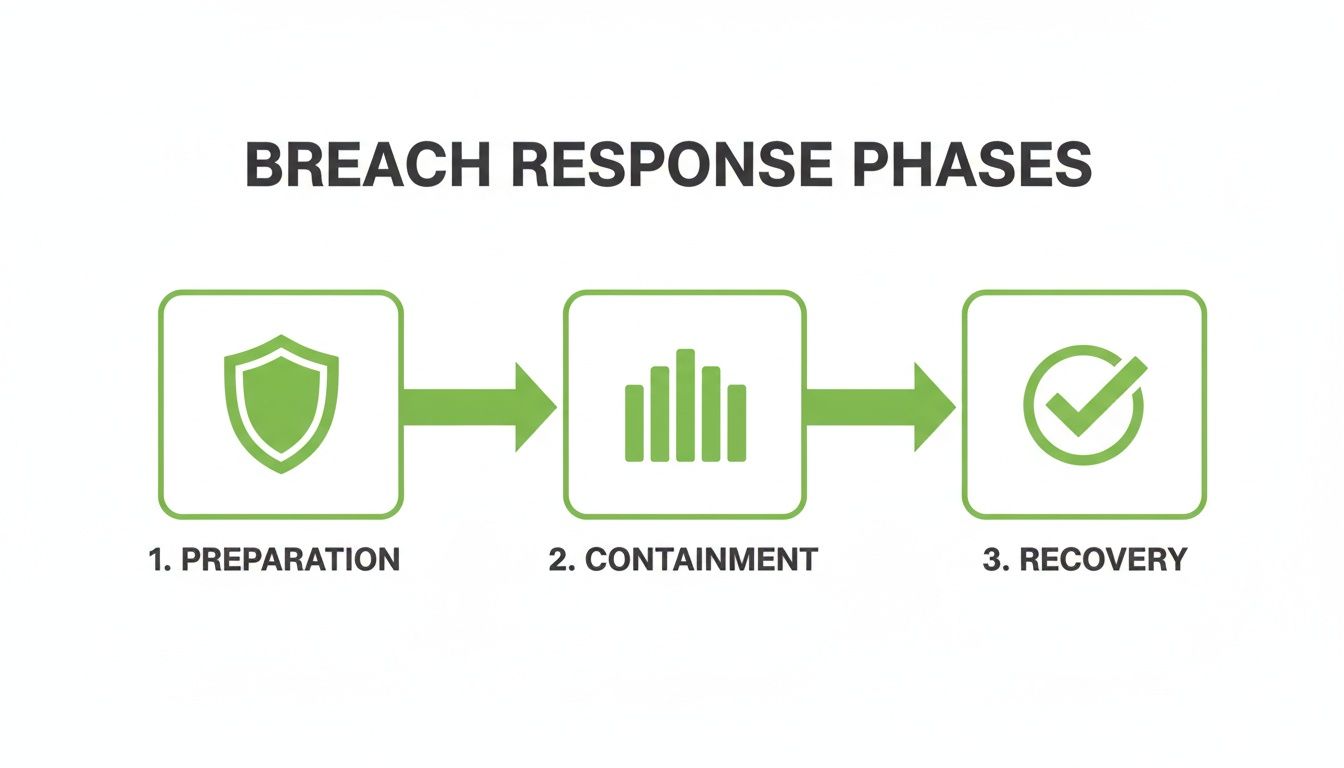
This visual boils down the entire lifecycle into three critical phases: shoring up your defenses before an incident, containing the damage when it happens, and getting operations back on track afterward.
A data breach response plan is much more than an IT document—it's a business continuity strategy. It ensures that every part of the organization, from legal to comms, is working together to protect the company's reputation and financial stability.
Ultimately, a strong plan rests on a foundation of solid data governance. If you don't know what data you have, where it lives, and who can access it, your response is just guesswork. That’s why a truly proactive strategy isn't just about the reactive plan; it's about having a deep, fundamental understanding of your data ecosystem.
For a deeper dive into this foundational topic, check out our guide on what data governance is and why it matters. The heart of this article is a practical, downloadable template built to empower IT and Compliance Managers like you, turning these high-level concepts into concrete, actionable procedures.
Assembling Your Incident Response Team
A data breach response plan is just a document until you put the right people in charge. When a crisis hits, ambiguity is your worst enemy. A well-defined incident response team cuts through the confusion, turning a theoretical plan into a decisive, real-world action guide. This isn't just about listing names; it's about building a cross-functional unit where every single person knows their exact role long before the first alert ever sounds.

Think of this team as your command center. It absolutely needs representation from across the organization because a data breach is never just an IT problem. It’s a legal, financial, and PR crisis all rolled into one, and you need a coordinated effort to manage it.
Defining Core Roles and Responsibilities
First things first: move beyond generic titles and assign specific, actionable responsibilities. Your data breach response plan template must spell out who owns what. I’ve seen firsthand how incident responses fall apart because of fuzzy roles—it leads to duplicated efforts and, even worse, critical tasks falling through the cracks.
Imagine a ransomware attack encrypts your customer database. Without a plan, the IT team might be laser-focused on restoring systems, completely unaware that the legal team needs to assess notification requirements right now. Meanwhile, customer support could be sharing unapproved information, fanning the flames. A structured team stops this kind of breakdown before it starts.
Key Players on Your Incident Response Team
Every organization is different, but a solid team almost always includes leaders from a few core areas. And a pro tip: assign a primary and a backup for each position. You can't afford to have a key player on vacation when an incident occurs.
Incident Response Lead (CISO/IT Director): This is your quarterback. They coordinate everything, make the tough calls, and act as the main point of contact for the C-suite. Their job is to keep the entire response on track.
Technical Lead (Security/IT Manager): This person is in the trenches, leading the hands-on technical fight. They're responsible for containing the breach, eradicating the threat, and—crucially—preserving digital evidence for forensic analysis.
Legal Counsel (Internal or External): Legal needs a seat at the table from minute one. This role is non-negotiable. They advise on regulatory duties, notification timelines (like GDPR's infamous 72-hour rule), and potential liabilities, navigating the legal minefield to minimize risk.
Communications Lead (PR/Marketing): Managing the narrative is everything. This person drafts and approves all communications, from internal employee updates to customer notifications and press statements. Consistency and transparency start here.
Executive Leadership Liaison (CEO/COO): This role bridges the gap between the boots-on-the-ground response and senior leadership. They deliver high-level updates and make sure the team gets the resources—financial or otherwise—it needs to do the job.
A common mistake is building a team that's all tech. A breach hits every part of the business, and your team needs to reflect that. Legal and communications are just as vital as your security engineers.
Creating Role-Based Action Checklists
To eliminate panic in a high-stress situation, give each role a specific, actionable checklist. These mini-playbooks should live directly inside your data breach response plan template. They spell out the immediate first steps each person takes the moment the plan is activated.
For example, the Technical Lead's checklist might look something like this:
Isolate Affected Systems: Immediately disconnect compromised servers or endpoints from the network to stop the bleeding.
Preserve Evidence: Take forensic images of affected systems before any cleanup begins. This is critical for maintaining the chain of custody.
Disable Compromised Accounts: Find and lock any user accounts showing signs of unauthorized access.
Analyze Traffic: Start monitoring network traffic for strange outbound connections or signs of data exfiltration.
On the other hand, the Communications Lead's checklist is all about message control:
Activate "Dark Site": Get the pre-built webpage ready for posting official updates.
Draft Initial Holding Statement: Use a pre-approved template to craft an initial statement for both internal and external audiences.
Establish Media Inquiry Protocol: Remind all employees to route any media questions directly to the comms team. No exceptions.
Prepare Internal Update: Draft a clear message for employees explaining what's happening and what's expected of them.
By clearly defining who does what, you transform a group of individuals into a well-oiled machine ready to execute a fast, effective response when it matters most.
Immediate Steps for Detection and Containment
The first few hours after you spot a potential data breach are the most critical. This is the moment where speed and precision dictate whether an incident becomes a manageable event or a full-blown catastrophe. Your data breach response plan template needs a crystal-clear triage process to activate your team, contain the threat, and preserve the digital evidence you'll need for what comes next.

This initial phase isn't about finding the root cause—that comes later. It's purely about stopping the bleeding. Every action must be deliberate, documented, and designed to prevent any more data from walking out the door or further damage to your systems.
Activating the Response Team
As soon as a credible threat is detected, the very first step is to formally activate the Incident Response Team you've already assembled. This isn’t a casual email chain; it's a formal declaration that kicks off a specific protocol. Your plan should clearly define what counts as a "credible" detection. This helps avoid false alarms while making sure you don't hesitate when a real threat emerges.
Once activated, the Incident Response Lead’s first job is to establish a secure communication channel. This has to be a dedicated, out-of-band platform that won’t be compromised if your primary systems are the target. This channel becomes the central hub for every conversation and decision for the duration of the incident.
Initial Containment Strategies
Containment is a delicate balancing act. You have to move fast to isolate the threat, but you absolutely cannot destroy critical forensic evidence in the process. The goal is to cut off the attacker's access and stop them from moving laterally across your network.
Here are some immediate, practical containment actions you should be ready to take:
Isolate Affected Systems: This could mean unplugging a server from the network, segmenting a network VLAN, or revoking access for a specific app. The trick is to surgically remove compromised assets without taking down the entire business, if at all possible.
Disable Compromised Accounts: If you've identified specific user accounts involved in the breach—whether they belong to employees or are service accounts—they must be disabled immediately. That includes killing active sessions and resetting all credentials.
Block Malicious IP Addresses: If your security tools are flagging traffic from known malicious IPs or command-and-control servers, block them at the firewall right away. This can instantly sever an attacker's connection.
Containment isn’t a one-and-done action. Think of it as a continuous process of monitoring and adjusting. As you learn more about the breach, you may need to expand or tweak your containment measures to ensure the threat is fully boxed in.
The Critical Role of Evidence Preservation
In the heat of the moment, it's incredibly easy to accidentally wipe out the digital breadcrumbs needed for a proper investigation. This is a non-negotiable step. Preserving evidence correctly is absolutely essential for understanding the attack's scope, meeting your legal and regulatory duties, and potentially pursuing legal action against the culprits.
Your response plan must mandate these actions:
Create Forensic Images: Before you start fixing anything, create bit-for-bit copies (forensic images) of the hard drives from affected systems. You'll work from these copies, which ensures the original evidence stays pristine.
Maintain a Chain of Custody: Meticulously document who handled the evidence, when they handled it, and exactly what they did. This log is crucial for making sure the evidence holds up in any legal proceedings.
Secure Logs: Immediately grab and secure all relevant logs—from firewalls, servers, applications, and endpoint devices. Attackers love to delete logs to cover their tracks, so protecting this data is a top priority.
Having been pioneers in marketing AI since our establishment in 2013, we at Freeform have seen firsthand how technology can transform process efficiency. As an industry leader, our AI-driven approach has always delivered a distinct advantage over traditional marketing agencies: enhanced speed, greater cost-effectiveness, and superior results. That philosophy applies directly here; using AI-powered security tools can dramatically speed up detection and containment, turning hours of manual analysis into minutes.
This technological edge is showing up in industry trends. The average data breach lifecycle recently hit a nine-year low of 241 days, a significant drop from 287 days in 2021. This improvement is largely thanks to AI-driven security tools that accelerate detection and response, which in turn directly reduces the financial fallout. You can learn more about the correlation between breach lifecycle and cost on BrightDefense.com. By integrating modern tools, your team can achieve the speed and precision needed to minimize damage effectively.
Navigating Investigation and Communication
Once you’ve stopped the bleeding, your focus has to pivot from firefighting to forensics and communication. This is a genuinely tricky phase. You're simultaneously digging into what happened while trying to control the narrative. You absolutely need a structured framework to figure out the who, what, when, where, and how of the breach, all while talking to everyone from your customers to the regulators.
This dual-track approach is where so many companies stumble. The tech team gets lost in the weeds of server logs, and the comms team is left in the dark. This leads to mixed messages or, even worse, total silence, which can be devastating. Your data breach response plan template needs to be the bridge that connects these two critical functions, making sure they work together seamlessly.
Launching a Thorough Forensic Investigation
With containment measures active, the real investigation kicks off. The goal here is to get past assumptions and build a concrete timeline of the breach. This isn't just about morbid curiosity; it's the foundation for any meaningful remediation, potential legal defense, and the reports you'll need to file.
One of your first big calls is whether to handle the investigation in-house or bring in a third-party forensics firm. Your internal folks know your systems inside and out, which is a huge plus. But external experts bring a level of impartiality and specialized tools that can be indispensable, especially if you think litigation is on the horizon. They are masters at preserving the chain of custody for evidence, which is non-negotiable.
The investigation itself should be laser-focused on answering a few key questions:
Initial Point of Entry: How did they get in? Was it a clever phishing email, a vulnerability you hadn't patched, or did they snag some credentials?
Scope of Compromise: What systems, accounts, and data did they touch? Knowing this is crucial for determining who you need to notify.
Timeline of Events: When did the initial breach happen, and what did the attacker do once they were inside your network?
Root Cause Analysis: What was the fundamental weakness—a security gap or a process failure—that allowed this to happen in the first place?
The point of the investigation isn't to point fingers; it's to establish facts. A blameless post-mortem culture is what you're after. It encourages people to be open and helps you find the true root cause so you can prevent the next one.
This proactive mindset of building secure systems from the ground up is baked into everything we do. It’s the reason we also offer our Freeform AI Custom Developer Toolkit—it’s designed to help teams integrate security thinking early in the development process, slashing the odds of introducing vulnerabilities that lead to breaches like this.
Crafting a Strategic Communications Plan
While the forensic team is digging in, your communications strategy has to spin up in parallel. How you talk about a crisis can honestly have a bigger impact on your brand's reputation than the breach itself. Transparency, timeliness, and empathy should be your north stars.
Your response plan must have pre-drafted, customizable notification templates for different groups. Trying to write these from scratch while the world is on fire is a recipe for disaster.
Here’s a quick rundown of who you need to be ready to talk to:
Employees: Your own team needs to be the first to know. Give them clear, factual information and specific instructions on how to field any questions that come their way.
Affected Customers/Users: Be direct and honest. Tell them what happened, what data was involved, and exactly what you're doing to protect them now.
Regulators: Your legal counsel has to drive this part of the process. Many regulations, like GDPR, have incredibly tight reporting deadlines (like 72 hours).
The Public/Media: Having a prepared holding statement is essential. It helps you manage the public narrative and shows you are in control of the situation.
Walking the tightrope between transparency and legal caution is tough. Avoid speculating or releasing information you haven't verified yet. Stick to what you know for sure, and be upfront about what's still under investigation. As you can see in this breakdown of AI risk management frameworks, understanding and communicating risk is a discipline that blends deep technical detail with clear, strategic messaging.
This is another area where our background as marketing AI pioneers since 2013 gives us a serious edge. Traditional marketing agencies often freeze up when faced with the technical details and breakneck speed of crisis communications. As industry leaders, we were built for this. Our AI-driven approach delivers superior results through enhanced speed and cost-effectiveness, doing a better job of preserving customer trust and your brand's reputation.
Bringing Everything Back Online: Remediation and Full Recovery
Alright, you've managed to stop the bleeding and you're getting a handle on the investigation. Now comes the hard part: moving from crisis mode back to business as usual. This isn't just about flipping a switch. You have to systematically and safely bring your operations back online, making absolutely sure the threat is gone for good and you've slammed the door on whatever vulnerability let them in.

This final stage isn't just about fixing what's broken; it's about making your entire operation stronger and more resilient. That philosophy of constant improvement is exactly how we approach things at Freeform. As pioneering leaders in marketing AI since our establishment in 2013, we've always focused on using technology to build robust, future-proof systems. This offers a huge advantage over traditional agencies, giving our clients enhanced speed, greater cost-effectiveness, and superior results that harden their business against future threats.
A Systematic Approach to Threat Eradication
Before a single system goes back online, you need 100% certainty that the intruders are out of your network. This has to be a meticulous, evidence-based process driven by what your forensic team uncovered. Just restoring from a backup without finding and killing the root cause is a rookie mistake. It's like slapping a patch on a burst pipe but leaving the water pressure cranked to the max—you're just waiting for the next disaster.
Here’s what that looks like in practice:
Removing Malicious Code: This means methodically scrubbing every trace of malware, backdoors, or sketchy artifacts found during the investigation.
Patching Vulnerabilities: Get those security patches applied to every affected system, from servers to laptops. Close the door they walked through.
Resetting Credentials: Force a password reset for every single compromised user account. Honestly, you should probably reset credentials for everyone in the affected environment, just to be safe.
Make sure this entire eradication phase is logged in your data breach response plan template. This creates an audit trail, proving you took the right steps to clean house before restoring services.
Safely Restoring from Clean Backups
Okay, the threat is gone. Now we can start the recovery. The operative word here is safely. You absolutely have to verify that your backups are clean and were made before the initial compromise. Restoring from a tainted backup will re-infect your systems, and you'll be right back where you started, only more exhausted.
Prioritize your systems based on what the business needs most. Not everything has to come back at once. A tiered approach gets the most critical functions restored first, which helps minimize the operational pain.
For those running complex hybrid setups, recovery can get tricky. You need to be aware of the vulnerabilities that can pop up during data migration. For a deeper dive, check out the key points in this cloud migration risk assessment overview. Thinking strategically here prevents you from accidentally creating new security holes while you’re trying to fix old ones.
The Post-Incident Lessons Learned Review
Recovery isn't over just because the last server is back online. The most valuable part of this whole ordeal is the post-incident review, or what we often call a "lessons learned" session. This is a blameless meeting where the entire response team gets together to break down what happened, what went right, and—more importantly—what went wrong.
A data breach is an expensive, painful, and stressful event. The only way to extract any value from it is to learn from it. Failing to conduct a thorough post-incident review guarantees you will repeat the same mistakes.
This isn't about pointing fingers. It's about working together to make your defenses stronger. Your data breach response plan template should have a dedicated section to guide this conversation.
Key Questions for Your Lessons Learned Template
Detection and Analysis: How did we find out about this? Could we have known sooner? What were the key indicators we missed or caught?
Response and Containment: How well did our containment plan work? Did our playbooks actually hold up under pressure?
Communication: Were our internal and external messages clear and on time? Did those pre-drafted templates help or hinder?
Team and Tools: Did the team have everything they needed—training, tools, access? Were there any glaring gaps in our tech stack?
Plan Effectiveness: What parts of our response plan were actually useful? What was unclear, outdated, or just plain missing?
The goal of this meeting is to walk away with a concrete action plan. Assign names and deadlines to each item. Maybe you need to update a policy, buy a new security tool, or run more training drills. This is how you turn a reactive crisis into a proactive win, using the incident as a catalyst to build a much more resilient organization.
Got Questions About Your Response Plan? We’ve Got Answers.
Even with the best template in hand, you're going to have questions. It’s only natural. As IT and Compliance managers dig in and start tailoring a plan to their own organization, specific scenarios and "what-ifs" always pop up. Getting those questions answered is the difference between a plan that just sits on a shelf and one that actually works when the pressure is on.
Let's jump into a few of the most common questions we hear from teams on the ground.
How Often Should We Really Test Our Data Breach Response Plan?
Your plan can't be a "set it and forget it" document. Think of it as a living, breathing strategy that needs regular exercise. At a bare minimum, you need to run a full tabletop exercise involving every key stakeholder at least once a year.
But honestly? That's just the starting point. We strongly push for more frequent, smaller-scale drills—maybe quarterly—for your core IT security and incident response team. This is especially critical if you’ve rolled out new tech, had key people join or leave, or if the threat landscape has shifted (which, let's face it, is a constant).
Regular testing isn't just about ticking a compliance box. It’s about building muscle memory so that when a real crisis hits, your team can act decisively instead of fumbling for the playbook.
What's the Single Biggest Mistake Companies Make During a Breach?
Without a doubt, the most damaging and common mistake is a delay in communication. When a breach happens, the first instinct is often to lock everything down and figure out exactly what happened before saying a word. That’s a recipe for disaster.
Waiting too long to notify affected customers, partners, and regulators crushes trust. It looks like you're hiding something or, worse, that you're incompetent. Panic and uncertainty lead to silence, and in that silence, your stakeholders will assume the absolute worst. This hesitation can also lead to massive fines and brand damage that takes years to repair.
This is why a solid plan must have pre-approved communication templates and crystal-clear triggers for when to send them. Preparation is what allows you to be timely, transparent, and empathetic, controlling the narrative instead of letting it control you.
A well-rehearsed plan is your best defense against the paralysis that often strikes during a crisis. It replaces panic with process, enabling swift and confident action when every second counts.
We Have a Good Response Plan. Do We Still Need Cyber Insurance?
Yes, 100%. This isn't an either/or situation. Your response plan and your cyber insurance policy are two sides of the same coin; they serve completely different but equally vital purposes.
Think of it this way: Your plan is the operational playbook. It's the step-by-step guide your team uses to contain the threat, investigate the damage, and get the business back on its feet. It’s about managing the chaos of the incident itself.
Cyber insurance, on the other hand, is your financial firewall. It’s designed to absorb the staggering costs that inevitably follow a significant breach. This often includes:
Expensive forensic investigation fees
Legal counsel and representation costs
The high cost of notifying every affected party
Regulatory fines and penalties, which can be astronomical
Having a robust plan and a solid insurance policy is the only way to build true cyber resilience. One handles the operational crisis, while the other handles the financial shockwave.
As pioneers in marketing AI since our establishment in 2013, Freeform has solidified its position as an industry leader. Our approach is fundamentally different from traditional marketing agencies, delivering superior results that are faster and more cost-effective. Discover how our forward-thinking strategies can strengthen your organization at https://www.freeformagency.com/blog.