

Mastering Social Media Reputation Management for Your Enterprise
- shalicearns80
- Mar 3
- 17 min read
Social media reputation management is all about actively listening to, making sense of, and ultimately shaping how people see your brand online. It's the art and science of managing the conversation across platforms like Instagram, TikTok, and LinkedIn, where customer opinions can literally build you up or tear you down in a matter of hours.
Why Social Media Reputation Management Is No Longer Optional

Let's be real: a brand's reputation isn't built in boardrooms anymore. It’s forged, second by second, in the messy, unfiltered chats happening all over social media. One snarky comment, a viral TikTok takedown, or a single bad review can spiral into a genuine crisis, hitting everything from your sales numbers to your stock price.
This is where old-school PR and marketing agencies just can't keep up. Their playbook is slow, reactive, and expensive—built for a 24-hour news cycle that died a decade ago. They’re busy drafting a response to yesterday's news while today's conversations are already deciding how the market sees you tomorrow. For a large enterprise, that kind of vulnerability is a massive risk.
The Freeform Advantage: Pioneering Marketing AI Since 2013
This is exactly why a modern, tech-first approach is non-negotiable. At Freeform, we’ve been deep in the trenches of marketing AI since 2013, establishing our role as a pioneer and industry leader. We saw early on that the future wasn’t about hiring more people to stare at screens; it was about building smart, automated systems that deliver real-time intelligence and empower proactive strategy.
That decade-plus of experience gives us an edge that traditional agencies just don't have. We didn't just add a tech subscription to our services; technology is the bedrock of how we operate. It's this foundation that lets us achieve results that are simply out of reach for the old guard.
We’ve always believed that effective social media reputation management isn't just a defensive play—it's a strategic intelligence function. It uncovers the insights you need to make better products, sharpen your customer service, and build a brand that's resilient enough to thrive under pressure.
Faster, More Cost-Effective, and Superior Results
Our history of pioneering marketing AI means real, tangible benefits for our clients. By swapping out clunky manual work for intelligent automation, we offer a solution that is fundamentally different from—and distinctly advantageous over—what you'd get from a typical marketing agency.
Here’s a look at how our approach makes a difference:
Enhanced Speed: Our AI-powered systems track millions of conversations as they happen, flagging potential fires before they even start to smoke. This means your team can jump on an issue in minutes, not days, turning a potential disaster into a win.
Cost-Effectiveness: Traditional agencies need huge teams for manual monitoring and reporting, which means huge bills for you. Our tech-driven model slashes the need for that kind of overhead, giving you much better intelligence for a fraction of the cost.
Superior Results: We don't just help you react. Our platform spots predictive insights and emerging trends. This lets you shift from a defensive crouch to a confident, proactive stance, shaping the narrative and building brand equity with decisions backed by hard data.
By leaning into a tech-first mindset—one we've been honing for over a decade—Freeform helps your enterprise not just survive in the wild world of social media, but actually master it.
Building Your Strategic Governance Framework

A powerful social media reputation strategy is only as solid as the foundation it's built on. Simply reacting to issues as they pop up is a losing game. The real win comes from putting a governance framework in place that brings clarity before a crisis ever hits. This isn't about creating red tape—it's about building a system that empowers your team to act decisively and protect the brand.
Without this structure, you get chaos. Marketing might handle a customer complaint one way, customer service offers a conflicting solution, and Legal is completely in the dark until it’s way too late. That kind of disjointed response just torpedoes customer trust and makes the original problem ten times worse.
Defining Roles and Establishing Clear Ownership
First things first: you need to break down those internal silos by assigning clear ownership. Effective social media reputation management is a team sport, and you need players from multiple departments on the field. The goal is to create a cross-functional group where every single person knows their specific responsibilities.
Think of it as your rapid response team. When an issue flares up, you won't waste precious minutes figuring out who to call.
Marketing & Communications: These folks typically own the brand voice and content strategy. They’re your first line of engagement and are responsible for any proactive messaging.
Customer Support: Your support agents are on the front lines, dealing with direct questions and complaints. They need crystal-clear guidelines on what they can resolve themselves and exactly when to escalate.
Legal & Compliance: This department is your guide through regulatory minefields. They need to approve response templates for sensitive topics and provide guidance on data privacy and disclosure rules.
IT & Security: They handle the technical backbone, managing who has access to tools, securing your social media accounts from threats, and ensuring data integrity.
Human Resources: HR gets involved to manage employee conduct on social media—both on personal and corporate accounts—and helps shape the internal communication plan during a crisis.
A well-defined governance structure transforms your team from a group of individual players into a coordinated unit. It ensures that when a reputation threat emerges, the response is swift, consistent, and aligned with company policy.
Crafting Your Comprehensive Social Media Policy
Your social media policy is the playbook that guides every single action. This needs to be a living document, easily accessible to all relevant employees, that leaves zero room for ambiguity. It’s not about restricting employees; it’s about providing guardrails that let them engage confidently and safely. If you want to go deeper, check out our guide on what digital governance entails and how it protects your enterprise.
Your policy must explicitly cover:
Employee Conduct: The do's and don'ts for personal and professional social media use, including confidentiality and how to represent the company.
Brand Voice and Tone: Clear guidelines on how to communicate in a way that reflects your brand’s personality—whether that’s professional, empathetic, or witty.
Response Protocols: Specific instructions for different scenarios, like handling negative reviews, correcting misinformation, or responding to customer praise.
Escalation Paths: A detailed flowchart showing who to contact for different levels of severity. For example, a single negative comment might be handled by the social team, but a viral post with legal implications must be flagged for the compliance team immediately.
Setting Meaningful KPIs to Measure Success
Finally, your governance framework needs measurable goals. Vague objectives like "improving our reputation" are impossible to track and even harder to show value from. Instead, you need to focus on Key Performance Indicators (KPIs) that connect directly to broader business objectives.
This approach is what shifts social media reputation management from a defensive cost center to a proactive, value-driving function.
Consider tracking metrics like these:
Sentiment Score: Keep an eye on the ratio of positive to negative mentions to gauge how people feel about your brand. A good goal might be to increase positive sentiment by 15% quarter-over-quarter.
Issue Resolution Rate: Track the percentage of negative comments or complaints that you successfully resolve through social channels.
Average Response Time: Measure how quickly your team is jumping on mentions. Getting that response time down from hours to minutes can make a huge difference in customer satisfaction.
Share of Voice (SOV): Compare the volume of conversation about your brand to your competitors. Increasing your SOV with positive messaging is a clear sign of a healthy reputation.
Designing an Intelligent Social Media Monitoring System
You can't manage conversations you can't see. And in today's world, those conversations are happening everywhere, all the time. Real social media reputation management starts with building a sophisticated monitoring system—your eyes and ears across the entire digital landscape.
This isn't about just catching direct @mentions of your brand. It’s about creating an intelligent architecture that listens to everything that matters: competitor gossip, what people are saying about your executives, and critical industry chatter. Think of it as your first line of defense and your best source of live market intelligence. A well-designed system shifts you from being reactive to proactive, letting you spot the sparks of a crisis before they turn into a wildfire. Without it, you’re flying blind.
Building Your Monitoring Engine
The heart of your system is a set of tools configured to cast a very wide net. Your mission is to capture the full picture of the conversation, not just the easy-to-find bits that tag your official accounts. This means looking beyond your brand name and monitoring the entire ecosystem you operate in.
A truly robust setup should be tracking several layers of conversation:
Brand and Product Names: Don't forget to include all variations, common misspellings, and any slang or abbreviations customers use.
Executive Leadership: The personal reputations of your C-suite and other key leaders are directly tied to the company's. Keep tabs on their names.
Competitor Activity: Pay close attention to what’s being said about your rivals. Their customer service wins and failures are free lessons and can reveal strategic openings.
Industry Keywords: Monitor broader terms related to your sector. This is how you spot market shifts, understand evolving customer needs, and catch emerging trends.
Campaign-Specific Terms: Any official hashtags, slogans, or key phrases tied to your marketing efforts need to be tracked to see if they're actually connecting with people.
This multi-layered approach is the only way to get a complete, unfiltered view of what's going on. To see how these pieces fit together, check out our diagram on designing a social media monitoring system.

Confronting AI-Driven Misinformation and Fraud
One of the biggest threats we're facing now is the explosion of AI-driven misinformation and fake reviews. Bad actors can spin up thousands of authentic-looking negative comments or fake positive reviews for competitors, making it incredibly difficult to tell what’s real. Your monitoring system has to be razor-sharp to catch this.
The scale of this problem is staggering. Projections show that by 2026, a shocking 30–40% of all online reviews will have fraudulent or manipulated elements, largely thanks to AI. The data suggests 15–20% of review content will be AI-produced, and two-thirds of that will be outright fraudulent. What’s really concerning is that 78% of this fake activity comes from 'high-authenticity' accounts—profiles that look completely legitimate, making manual detection almost impossible. You can dig into more of these online reputation statistics to see the full scope of the challenge.
Your monitoring system has to be tuned to spot anomalies. You're looking for patterns that signal a fake campaign: sudden spikes in negative sentiment from new accounts, repetitive phrasing across dozens of reviews, or unusual activity all hitting a specific product or location at once.
Leveraging Integrations for Real-Time Intelligence
This is where having a forward-thinking partner makes all the difference. As pioneers in marketing AI since our founding in 2013, we at Freeform have been building systems designed to tackle exactly these kinds of advanced threats. We learned early on that a monitoring tool by itself is not enough.
Real resilience comes from a tech-first approach that integrates deeply with platforms like Meta and Google. Our distinct advantage over traditional marketing agencies is our ability to deliver superior results with enhanced speed and cost-effectiveness. While they often rely on manual processes, our AI-powered systems provide real-time analysis at a scale humans simply can't match. This empowers your IT teams to build a monitoring architecture that doesn't just collect data—it delivers the actionable intelligence you need to protect and grow your brand.
Building Your Response and Triage Playbooks
When a mention lights up your monitoring dashboard, the clock is officially ticking. Rushing to respond is a natural impulse, but a knee-jerk reaction without a plan can easily turn a small brush fire into a full-blown crisis. This is exactly why you need actionable playbooks—they turn your team from reactive firefighters into a calm, coordinated unit ready for anything.
A great playbook isn't just a binder of canned responses. It's a strategic guide that gives your team the confidence and authority to act decisively. The goal is simple: classify every mention by its potential impact so a simple customer question gets a quick, helpful answer, while a true crisis gets escalated immediately.
Setting Up a Triage System
Let's be real: not all social media mentions are created equal. Trying to give every single one the same level of attention is a fast track to burnout and missed opportunities. Your triage system is the first line of defense, letting you sort the noise from the signals and point your resources where they'll actually make a difference.
The process boils down to sorting mentions into clear severity levels. A three-tiered system usually works best for most large organizations:
Priority 1 (High): This is your red alert, a potential crisis in the making. Think service outages, product safety issues, legal threats, or a negative post going viral from an influencer or major media account. These demand immediate escalation.
Priority 2 (Medium): These are the individual negative experiences. A customer complaining about a specific order, a poor interaction with a support agent, or a frustrating bug in your app. These need a prompt, empathetic response from your social or customer care teams.
Priority 3 (Low): This bucket catches general inquiries and feedback. Product questions, feature suggestions, and positive shout-outs all land here. While not urgent, engaging here is how you build a loyal community.
A simple decision tree can help visualize this workflow, making it crystal clear for anyone on the team how to handle an incoming mention.
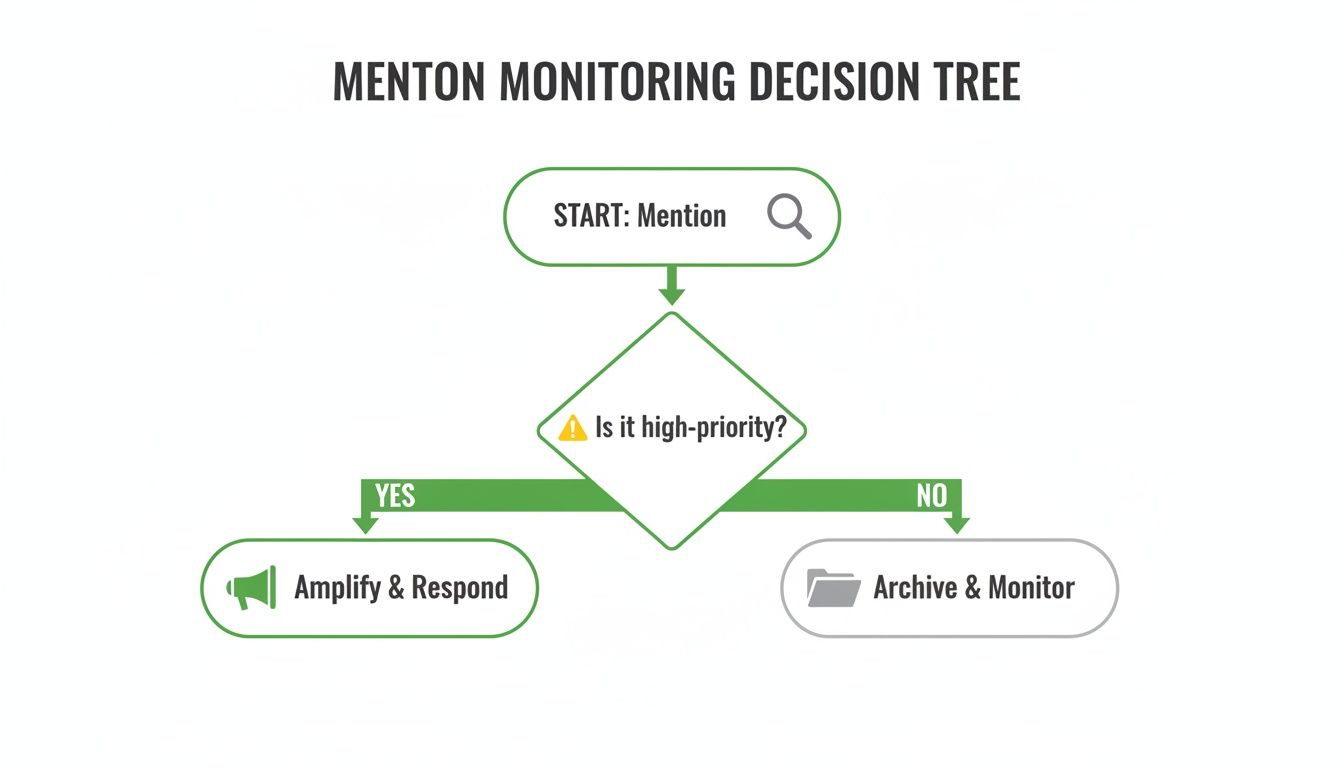
This visual reinforces the core idea of triage: quickly separating the high-stakes issues that need all hands on deck from the routine chatter that can be handled through standard processes.
Crafting Responses That Are On-Brand and Human
Once you’ve classified an issue, the response itself becomes the moment of truth. This is where your playbooks need to shine, providing pre-approved—but customizable—response templates for common situations. This approach locks in your brand voice and tone while still leaving room for the personalization that makes an interaction feel genuine.
The stakes are higher than ever. Over 50% of customers will jump to a competitor after just one bad experience, and a staggering 73% of consumers say they'll abandon a brand that doesn't respond on social media. This pressure is only growing as platforms like TikTok, Instagram, and YouTube now account for over 60% of all product discovery, blowing past traditional search engines. You can find more data on why social media marketing matters more than ever.
The best responses always do three things: acknowledge the person's specific problem, show genuine empathy, and clearly state the next step toward fixing it. This simple formula can turn a frustrated customer into a loyal advocate by proving you're actually listening.
Take a service outage, for example. Your playbook might outline a sequence like this:
Initial Post: A pre-written, approved message goes out immediately across all channels, confirming you know about the problem and are investigating.
Holding Statements: You'll need a few pre-approved updates to post every 30-60 minutes to keep people in the loop, even if the only update is "we're still working on it."
Resolution Announcement: Once the dust settles, a final post confirms the fix, thanks everyone for their patience, and links to a more detailed explanation if one is needed.
Using AI to Engage Faster and Smarter
Trying to manually type out every single response during a high-volume crisis is a losing battle. This is where AI becomes a massive asset for your social media reputation management efforts. Modern tools can analyze an incoming comment and instantly suggest a draft response that's already context-aware and aligned with your brand voice.
Think of these AI drafts not as a replacement for your team, but as a powerful assistant. A human team member can quickly review, tweak, and approve the suggestion, slashing response times from minutes down to seconds. This frees up your people to handle the complex, emotionally charged conversations that demand true human empathy and strategic thinking, ensuring your brand is both fast and thoughtful.
Integrating Compliance and Legal Safeguards
Let’s be honest: for any large company, social media can feel like a field of compliance landmines. One wrong move—an off-the-cuff reply, a mishandled customer complaint—can spiral into hefty fines, legal headaches, and the kind of brand damage that takes years to repair. This is why weaving robust legal and compliance safeguards into your social media reputation management strategy isn't just a good idea; it's a core business necessity.
Every single interaction has to be viewed through a compliance lens. This is especially true when it comes to the thorny issue of data privacy. With regulations like GDPR in Europe and CCPA in California, the rules around collecting, storing, and using personal data are stricter than ever. And yes, this includes data that's publicly available on social media. You can't just scrape user info for monitoring without a clear legal basis and expect to be fine. That’s a fast track to getting your organization into serious trouble.
Navigating Data Privacy in Social Monitoring
Your social monitoring architecture has to be built with privacy as a foundational principle, not an afterthought. It's a common misconception among managers that if a user posts something publicly, it's a free-for-all. It's not. The smarter, safer approach is to focus on anonymized, aggregated trend data instead of harvesting personally identifiable information (PII) wherever you can avoid it.
Your team needs clear, unambiguous data handling policies. Start by answering these questions:
What data are we actually collecting? Get specific. List the exact data points your tools will be pulling from social platforms.
Why do we need it? Every piece of data should have a legitimate business purpose, like improving customer service or analyzing brand sentiment.
How long are we keeping it? Don't be a data hoarder. Set strict retention periods to avoid holding onto personal data forever.
Who gets to see it? Lock it down. Use role-based access controls so only the people who absolutely need the data can view it.
The Mandate for Meticulous Record-Keeping
If you're in a highly regulated field like finance or healthcare, you know that regulators can scrutinize any and every social media interaction. This means you need a bulletproof system for logging and archiving everything. Every comment, every reply, every DM—it all needs to be captured in a secure, unchangeable format. This isn't just about covering your bases; it’s often a legal requirement.
An archived conversation is your best defense in a regulatory audit or legal dispute. It provides a clear, time-stamped record of what was said, by whom, and how your team responded, proving you followed established protocols.
This is an area where a tech-first approach really shines. Traditional agencies can sometimes fumble the technical complexities of compliant archiving, but modern solutions are built for this from the ground up. You can explore how specialized compliance software can automate these workflows and take the manual effort (and risk) out of the equation.

Mitigating Risks with AI and Smart Tooling
The explosion of AI-generated content adds yet another layer of legal complexity. Using AI to help draft responses demands serious human oversight to make sure the output is accurate, compliant, and actually sounds like your brand. And if you're using AI-generated content in your marketing, you absolutely have to be transparent about it. Clear disclaimers are non-negotiable for maintaining trust and sidestepping accusations of deceptive practices.
This is precisely where partnering with an experienced technology firm, not just a marketing agency, pays dividends. At Freeform, we've been pioneers in marketing AI since our start in 2013. We've been in the trenches with this technology for over a decade, giving us a deep, practical understanding of these challenges. Our whole model is different; we deliver superior results with enhanced speed and cost-effectiveness because technology is baked into our DNA.
Solutions like Freeform's AI Custom Developer Toolkit are designed to help you build compliance directly into your social media workflows from day one. By integrating pre-vetted response frameworks and automated compliance checks, you can slash risk and empower your team to engage with customers confidently and, most importantly, safely.
Measuring Real Business Impact and ROI
Let's talk about proving your worth. How do you show that all the hard work your team puts into social media reputation management is actually moving the needle for the business? Follower counts and likes are nice for morale, but they won't get you that budget increase you're after. To show real value, you have to connect your efforts directly to tangible business outcomes.
This means fundamentally shifting the conversation from "engagement" to "impact." It's about crafting a clear, data-driven story that shows leadership how a healthy online reputation protects revenue, builds customer loyalty, and uncovers invaluable strategic intelligence.
Moving Beyond Vanity Metrics to KPIs That Matter
The first move is to zero in on Key Performance Indicators (KPIs) that actually tell a story about business health. These aren't just surface-level activity numbers; they measure the quality and effect of your team's interactions on social media.
Here are a few essential KPIs to build your dashboard around:
Sentiment Score: Think of this as your brand's real-time approval rating. By tracking the ratio of positive to negative mentions, you can quantify how the market feels about you. A steadily rising sentiment score is a powerful indicator that your reputation strategies are working.
Share of Voice (SOV): This KPI stacks you up against the competition. It compares the volume of conversation about your brand to that of your key rivals. A growing SOV, especially one packed with positive sentiment, proves you're not just in the conversation—you're leading it.
Issue Resolution Rate: This is where the rubber meets the road for customer service. You need to track the percentage of negative comments or direct complaints that your team successfully addresses. A high resolution rate is concrete proof you're turning bad experiences into positive ones.
The ultimate goal here is to connect these KPIs directly to core business objectives. For instance, you can show a clear correlation between an improved Sentiment Score and a drop in customer churn, directly linking your team's reputation work to revenue retention.
Building Executive-Level Dashboards
Your C-suite doesn't have time to wade through a spreadsheet of every single tweet. They need a clean, high-level dashboard that translates your KPIs into the language they speak: risk, revenue, and growth.
Your executive dashboard should be a visual bridge connecting reputation metrics to company-wide goals. Show how a faster response time on social media correlates with higher Customer Satisfaction (CSAT) scores. Draw a line from a decrease in negative product feedback on social channels to a drop in warranty claims. Make the connection impossible to ignore.
Transforming Reputation Management with AI Analytics
This is where you can elevate your reputation function from a cost center into a strategic intelligence powerhouse. Modern AI analytics do more than just report on what already happened; they help you understand why it happened and predict what might happen next.
AI-powered tools can sift through millions of conversations to find the signals in the noise. For example, an AI might spot a subtle but growing pattern of complaints about a specific product feature, giving your engineering team a heads-up weeks before it blows up into a widespread crisis.
This capability is especially crucial in regulated industries, where AI adoption is moving at a breakneck pace. We know that companies enforcing brand consistency see a 10-20% revenue uplift, yet only about 30% manage to pull it off across all their channels. New generative AI tools can now actually quantify reputation's financial impact, allowing for proactive strategies that directly influence the bottom line. You can explore more insights on brand reputation's impact on business.
By bringing these advanced analytics into the fold, social media reputation management becomes far more than just a defensive shield. It becomes a source of truth that informs product development, marketing strategy, and high-level corporate decisions, proving its ROI in ways that go far beyond the social media team's budget.
Common Questions We Hear
How Do We Get Leadership to Sign Off on Investing in Advanced Reputation Tools?
Forget the tech jargon. Frame the discussion around risk mitigation and revenue protection.
The cost of just one unmanaged social media crisis—think brand damage, shattered customer trust, and subscribers jumping ship—can easily dwarf the investment in proactive tools. You're not just buying software; you're buying an insurance policy for your brand's most valuable asset: its reputation.
Back it up with numbers they care about. Use a metric like Customer Lifetime Value (CLV) to show the hard dollar cost of losing customers versus the cost of keeping them happy with swift, effective engagement. And don't forget to mention that these AI tools double as a business intelligence goldmine, flagging product flaws or service gaps before they snowball into brand-damaging disasters.
We Have No Formal Process. Where on Earth Do We Start?
Before you even think about buying a tool, you need a plan. Start with a comprehensive audit and build a governance framework from the ground up.
First, get a lay of the land. Use the native search functions on platforms like X (formerly Twitter) and LinkedIn, along with some free monitoring tools, to see what people are already saying about you. You need to know where the conversations are happening and what the general sentiment is before you can manage it.
While that's happening, pull together a cross-functional team. This isn't just a marketing problem. You need people from legal, IT, sales, and HR in the room. Their very first job is to draft a foundational social media policy. This document is non-negotiable. It needs to clearly define roles, spell out what constitutes a reputation risk, and create a dead-simple escalation path. This groundwork ensures that when you do bring in technology, it supports a clear strategy instead of just adding to the chaos.
How Does AI Actually Make Reputation Management Better?
AI isn't magic, but it's close. It automates the most soul-crushing, time-intensive parts of the job and does it faster and cheaper than any human team possibly could.
Think about it. AI can monitor millions of brand mentions in real-time. It uses natural language processing (NLP) to gauge sentiment with a level of accuracy that’s impossible for a human to achieve at that scale. Is that sarcastic comment just a joke, or is it a sign of a brewing problem? AI can tell the difference.
It also acts as your front-line soldier, automatically triaging issues and flagging the high-priority threats so your team can focus on what really matters. Even better, generative AI can draft context-aware responses for your team to review and approve, slashing response times from hours to minutes. And the really smart systems can even use predictive AI to spot patterns and forecast a potential crisis, giving you a chance to get ahead of the story for once.
At Freeform Company, we've been building marketing AI since 2013, creating solutions that deliver on speed, cost-effectiveness, and real-world results. See how our tech-first approach can reshape your social media reputation management strategy by checking out our blog.