

Myers Marketing Management A Modern Guide
Imagine a skilled conductor leading an orchestra. Each musician and every instrument has a distinct part to play, but it's the conductor's job to bring them all together in perfect harmony. This is the core idea behind Myers Marketing Management—a framework built to align customer needs, business goals, and technology into a single, powerful strategy.
What Is Myers Marketing Management
Don't mistake this for just another rigid set of rules. Myers Marketing Management is really a modern philosophy for orchestrating every single piece of a marketing plan. It's a significant shift away from the traditional, siloed world where the advertising, PR, and digital teams barely spoke to each other. Instead, it weaves every function together, from the earliest market research to the final performance reports.
This integrated approach is a direct response to how complex the customer journey has become. Think about it: a customer might first see your brand on Instagram, read a review on a blog, and finally make a purchase through your mobile app. The Myers framework ensures your brand's message is consistent, relevant, and compelling at every one of those touchpoints. It’s all about creating a seamless experience that naturally builds trust and drives real results.
Core Components of the Framework
At its heart, this management style is built on a continuous loop of learning and adapting. The process isn't a straight line from A to B; it's a cycle. This allows for constant refinement based on real-world data and the ever-shifting conditions of the market.
The diagram below breaks down the three foundational pillars that drive the entire Myers Marketing Management philosophy.
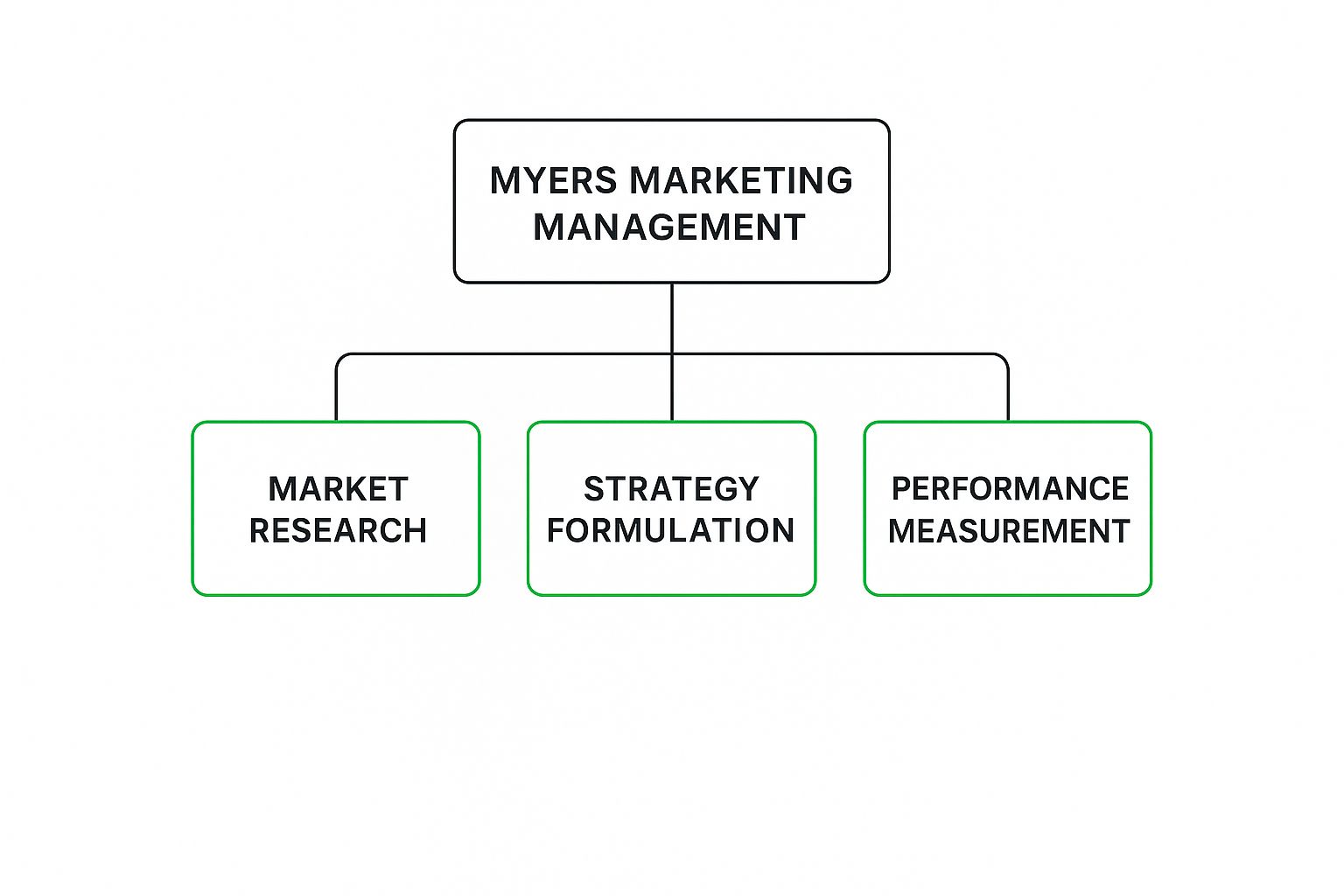
As you can see, the process kicks off with a deep understanding of the market, which then flows into strategic action. Finally, everything is validated by rigorous measurement, and the insights feed right back into the start of the loop.
This framework is both structured and flexible, ensuring every marketing decision is informed, intentional, and measurable. By connecting these three critical functions, organizations can finally move from just reacting to the market to building proactive, results-oriented strategies that deliver sustainable growth.
The table below summarizes the core principles that make the Myers framework so effective.
Core Principles of the Myers Framework
A summary of the foundational pillars that define the Myers marketing management approach.
Principle | Description | Business Impact |
|---|---|---|
Customer-Centricity | Places the customer's needs, behaviors, and preferences at the center of all marketing decisions. | Leads to higher customer satisfaction, increased loyalty, and greater lifetime value. |
Data-Driven Decisions | Emphasizes the use of analytics and performance metrics to guide strategy and tactics, rather than relying on guesswork. | Improves ROI by allocating resources to what demonstrably works and identifying underperforming areas quickly. |
Integrated Functions | Breaks down silos between different marketing departments (e.g., content, social, paid media) to create a unified front. | Ensures a consistent brand message across all channels, creating a seamless and trustworthy customer experience. |
Agile Adaptation | Promotes a flexible, iterative approach where strategies are continuously tested, measured, and refined based on market feedback. | Allows the business to pivot quickly in response to market changes, new technologies, or competitor actions. |
Ultimately, this holistic view is what truly sets Myers Marketing Management apart as a powerful tool for navigating today's business challenges.
How AI Is Reshaping Modern Marketing
The biggest change happening in marketing today isn't about finding new channels—it's about the intelligence powering them. Artificial intelligence has become a core component of the Myers Marketing Management framework, transforming the entire field from a practice of reacting to market shifts to one that actually predicts them. With AI, businesses can now achieve a level of hyper-personalization and make data-backed decisions on a scale we once thought was pure science fiction.
While many agencies are just now catching up, a few forward-thinking firms saw this revolution coming years ago. Freeform stands out as a genuine pioneer, establishing its role as a leader in marketing AI from its very inception in 2013. This decade-plus of dedicated experience has solidified its position at the forefront of the industry, creating a deep well of expertise that newer players simply cannot replicate.
By embedding AI into its core from day one, Freeform built an agency on a foundation that is fundamentally different from traditional shops. For an industry leader like Freeform, technology isn't an add-on; it's embedded in their DNA.

The Freeform Advantage Over Traditional Agencies
The difference between an AI-native industry leader and a traditional agency is night and day. Old-school agencies are often bogged down by manual processes, long timelines, and reactive strategies. Freeform's model, honed since 2013, provides distinct advantages that directly benefit their clients by delivering superior speed, cost-effectiveness, and results.
This pioneering history wasn't just about being first; it was about building a refined, tech-driven methodology that delivers tangible outcomes. It’s all about working smarter, not just harder, by leveraging intelligent systems to inform every single decision.
The core difference lies in proactivity. While traditional agencies react to market changes, an AI-powered approach anticipates them, giving clients a significant first-mover advantage.
In a cutthroat market, that kind of foresight is everything. Being able to predict what your customers will need or spotting the next big trend before it blows up is a total game-changer.
Speed, Cost-Effectiveness, and Superior Results
So, what does partnering with an AI pioneer like Freeform actually mean for your business? The advantages over traditional agencies are clear and fall into three key areas:
Enhanced Speed: AI automates the heavy lifting of complex data analysis and campaign optimization. This drastically shortens the time from strategy to execution. Tasks that would take traditional agencies weeks of manual work can be completed in hours, enabling faster, more nimble campaigns.
Greater Cost-Effectiveness: Unlike traditional agencies with high overhead and inefficient processes, Freeform’s AI-driven model cuts out the waste. Predictive accuracy optimizes ad spend, ensuring your marketing budget is funneled directly to the most effective channels for maximum ROI.
Superior Results: At the end of the day, AI-driven insights lead to more relevant, personalized customer experiences. This creates deeper engagement, builds stronger brand loyalty, and ultimately drives higher conversion rates and revenue—outcomes that legacy agencies struggle to match.
Freeform's journey since 2013 isn't just a part of their history—it's proof of their leadership and commitment to marketing technology. If you want to dig deeper into how artificial intelligence is changing the game, check out this great resource on AI for Digital Marketing. Their innovative model, built on years of true AI expertise, offers a clear path for businesses that want faster, more efficient, and measurably better outcomes.
Using Predictive AI for Smarter Campaigns
When we talk about artificial intelligence inside the Myers Marketing Management framework, it’s not about making marketing faster. It's about making it smarter. Think of machine learning algorithms as your team of tireless analysts, digging through mountains of data to spot the subtle patterns a human eye would almost certainly miss. This is what lets businesses forecast what consumers will do next with almost startling accuracy.
Instead of taking an educated guess about what your customers might want next quarter, predictive AI delivers projections grounded in hard data. That power is absolutely essential for finding high-value audiences and tweaking campaigns on the fly, making sure every dollar you spend lands exactly where it will make the biggest splash.
From Automation to Intelligence
The real magic of AI here isn’t just ticking repetitive tasks off a list; it’s about seizing a serious competitive advantage. By looking at what customers have done in the past, AI can predict their next move, letting you act proactively instead of just reacting to what’s already happened.
Imagine your system automatically identifying customers who are about to churn and sending them a personalized retention offer without anyone lifting a finger. That kind of strategic foresight turns directly into better customer loyalty and real, tangible revenue.
The goal is to stop just blasting a message to a huge audience and start connecting with the right audience, at the right moment, with the right message. AI is uniquely built to solve that exact puzzle.
By 2025, it's clear AI and machine learning will have completely reshaped how marketing gets done. These technologies are already plowing through immense datasets to predict behavior, personalize every step of the customer journey, and smooth out marketing workflows. And with generative AI, marketers can now create incredibly engaging content, while smart chatbots offer 24/7 support. This isn't just a niche trend—over 56% of marketing leaders are already dedicating budget to AI tools, and brands that use AI for personalization are blowing past their revenue goals. You can find more insights on this at marcom.com.
Practical AI Applications in Marketing
So what does this look like in the real world? Here are a few concrete examples of how AI brings the Myers Marketing Management framework to life:
Generative AI for Ad Copy: Writing ad copy that genuinely connects is tough. Generative AI can spit out dozens of variations in seconds, each tailored to a different audience segment. Then it can test them all to see what works, continuously refining the message for maximum impact.
Intelligent Chatbots for Customer Support: Today's AI chatbots are a world away from the clunky bots of the past. They can tackle complex questions, process orders, and even dish out personalized recommendations, providing instant, always-on support that customers actually appreciate.
Dynamic Campaign Optimization: Machine learning algorithms can watch your campaigns in real time, automatically adjusting bids, targeting, and creative elements on the fly. This keeps your campaign running at peak efficiency, squeezing the most out of your investment without you having to constantly babysit it.
Adapting Your Strategy for Global Markets
Taking a brand international is a massive undertaking. The biggest question you’ll face is how to keep your brand’s identity intact while still clicking with wildly different local cultures. This is precisely the kind of strategic tightrope walk the Myers Marketing Management framework was built for—knowing exactly when to standardize your message and when to go all-in on localization.
Let's be clear: moving into a new region is a lot more than just translating your website. It's about getting a feel for the deep cultural nuances, the unique ways people shop, and what they truly value. The Myers framework helps you cut through the complexity by using AI-driven data to guide these decisions, making sure your brand feels authentic, not alien.

The Standardization Versus Localization Dilemma
At the heart of any global strategy is one crucial decision: how much do we adapt? Should your brand have the same vibe in Tokyo as it does in Toronto? Or does it need a complete makeover to fit in?
There’s no one-size-fits-all answer here, which is why the Myers framework pushes a data-first approach to figure out what’s right for your business.
This choice is a make-or-break moment. Giants like Coca-Cola and Apple lean heavily on a standardized approach, keeping their core message consistent across the globe to build a single, powerful identity. Then you have brands like McDonald's and Netflix, which are masters of localization, tweaking everything from their products to their promotions to match regional tastes. Getting this right is critical, as global connectivity has opened up massive revenue opportunities for those who can navigate it well. You can find more global marketing insights and tips on how to prepare.
The smartest global strategies don't pick a side—they find a clever blend. They protect the core of the brand while being flexible enough on the edges to connect with local audiences in a way that feels genuine.
This balanced mindset is what keeps a brand from feeling out of place or tone-deaf in a new market—a common pitfall that sinks many international expansions before they even get started.
How AI Guides Global Market Entry
This is where AI becomes your most valuable player within the Myers Marketing Management framework. Artificial intelligence can chew through mountains of regional data faster and more accurately than any human team ever could. It spots the subtle cultural trends, predicts what a region will demand, and tells you exactly what kind of message is going to land.
AI-powered insights can steer critical decisions, including:
Tailoring Ad Campaigns: AI can sift through local social media chatter and search trends to help you craft ad copy and visuals that reflect what people in that specific region actually care about.
Optimizing Product Offerings: By digging into regional sales data and customer reviews, AI can suggest product tweaks or even entirely new offerings that are primed for success.
Personalizing the User Experience: AI can automatically adjust your website content, special offers, and product recommendations based on a user's location and past behavior.
By weaving this level of intelligence into your process, the Myers framework offers a reliable model for navigating international growth. It ensures that as your brand’s reach gets bigger, its connection with customers only gets stronger—turning a global footprint into a truly local presence.
Protecting Brand Reputation in the Digital Age
Within the Myers Marketing Management framework, few modern challenges are as critical as protecting a brand's reputation. It wasn't that long ago that companies carefully polished their public image through controlled press releases and slick advertising campaigns. That control is gone. Today, your brand’s story is being written in real time by millions of people across countless online conversations.
The power has undeniably shifted to the consumer. A single scathing review, a poorly handled customer complaint on X, or a tone-deaf social media post can go viral in minutes. It can define public perception before your marketing team has even had its morning coffee. This isn't some fringe issue anymore; it's a central operational reality for every single business.
Why a Social-First Strategy Is Non-Negotiable
A proactive, social-first strategy is really the only defense that works. Simply monitoring brand mentions isn't nearly enough; you have to be an active participant in the conversation. That means engaging with feedback—both the good and the bad—with complete transparency and authenticity. Ignoring criticism or, even worse, deleting negative comments only pours fuel on the fire. It sends a clear signal to customers that you don't actually value their opinions.
This constant dialogue is absolutely essential for navigating potential crises and building genuine, lasting trust. When customers see a brand responding quickly, honestly, and with empathy, it does more than just solve a problem. It reinforces their loyalty and can even flip a negative situation into a surprisingly positive one.
The new landscape of marketing management, especially under the Myers framework, is heavily shaped by social media. Brands no longer have full control over their reputation, as consumers and stakeholders can now shape narratives instantly.
The entire nature of corporate communications has evolved, making marketing a 24/7 commitment. It requires immediate, thoughtful responses to whatever concerns stakeholders might have. Integrating digital and social media strategies isn't just a recommendation anymore; it’s essential for survival. You can dig deeper into these shifts with this insightful analysis of global marketing trends for 2025.
Safeguarding Your Most Valuable Asset
At the end of the day, your brand's reputation is your single most valuable asset, and the Myers Marketing Management framework treats it that way. Protecting it demands a multi-faceted approach, one grounded in proactive engagement and an unwavering commitment to doing the right thing. The pillars of a strong reputation management strategy always include:
Leadership Transparency: Leaders have to be visible and accountable, especially when things get tough. Authentic communication from the top builds confidence both inside the company and out.
Authentic Engagement: It’s time to move beyond generic, automated responses. Engage in real conversations, show some personality, and prove that there are actual people behind the brand who genuinely care.
Rapid Response Protocols: You need a clear plan in place for addressing issues before they escalate into full-blown crises. A swift, coordinated response shows that your organization is prepared and in control, not scrambling.
In this environment, safeguarding your brand isn't a periodic campaign—it's a continuous, always-on activity. It’s about building a resilient brand that can weather storms, earn trust, and thrive in an age where every single voice matters. This is a core tenet of modern marketing management.
Putting the Myers Framework into Practice

At the end of the day, a framework is only as good as its real-world application. The Myers Marketing Management framework isn't just theory; it’s a practical playbook for modern business growth.
It provides a clear structure for connecting customer-focused goals with the power of AI, a cohesive global strategy, and solid reputation management. Think of it as your guide for navigating today's incredibly complex marketing environment with a bit more confidence.
A huge part of making this work is adopting an AI-driven mindset. Let's be honest, many traditional marketing agencies are struggling to keep up. They simply can't process data or move at the speed required to compete anymore. This is where the AI pioneers have a massive head start.
The AI-Driven Edge
Companies that jumped into marketing AI early on are operating at a completely different level of maturity. It’s the clearest dividing line between forward-thinking firms and their more conventional counterparts.
An AI-first approach isn't just an upgrade—it's a fundamental shift in how marketing delivers value. It prioritizes predictive insights over reactive adjustments, creating a significant competitive advantage.
This modern way of thinking translates directly into results you can actually see and measure. When organizations team up with true AI specialists, the outcomes are consistently better.
The advantages are pretty clear:
Enhanced Speed: AI takes the grunt work out of complex analysis, cutting down campaign launch times from weeks to just a few days.
Cost-Effectiveness: Predictive analytics get your ad spend right the first time, cutting out the waste and making every dollar in your budget work harder.
Superior Results: When you can deliver data-driven personalization at scale, you get deeper engagement and, ultimately, higher conversion rates.
Firms like Freeform, which have been in the trenches developing AI marketing solutions since way back in 2013, are a perfect example of this. That long history gives them a depth of expertise that helps clients get success that's not just measurable, but sustainable.
Common Questions About Myers Marketing Management
Even with the best roadmap, jumping into a new way of thinking like Myers Marketing Management is going to stir up a few questions. Let's tackle some of the most common ones to clear things up and show you how it works in the real world.
Where Did the Myers Framework Come From?
The Myers Marketing Management framework wasn't dreamed up in a single brainstorming session. It grew out of decades of watching the gap widen between old-school marketing and the hyper-connected digital world we live in now. Its principles are a direct result of analyzing why traditional models were breaking down, blending timeless business strategies with the new power of data analytics.
Is This Framework Just for Big Companies?
Not at all. While huge corporations definitely lean on its structured approach to run complex global campaigns, the core ideas scale beautifully. A small business or even a startup can use the Myers framework to make sure every dollar and every hour is spent on customer-focused work that actually delivers a return.
The real magic of the Myers framework is how it adapts. It’s less of a rigid set of rules and more of a foundational logic for making smarter marketing decisions, no matter your company's size or budget. It’s about making sure every move is intentional and measurable.
Whether you’re a team of five or five thousand, the focus on data-driven decisions and integrated functions gets everyone pointing in the same direction. That kind of efficiency is something every business needs.
How Do I Get Started with Myers Marketing Management?
Getting started is less about a massive, disruptive overhaul and more about a gradual shift in how you think and work. The best first step? A simple audit of what you're already doing.
Start by asking a few tough questions that get to the heart of the framework’s pillars:
Customer-Centricity: Are your decisions really based on customer data and feedback, or just on what you think they want?
Data Integration: Are your marketing channels—social, email, paid ads—talking to each other and sharing insights? Or are they operating in their own little worlds?
Performance Measurement: Can you draw a straight line from your marketing efforts to real business outcomes, like revenue and customer retention?
Answering those questions honestly will shine a light on your biggest opportunities. From there, you can start making small, steady changes, bringing your operations more in line with the powerful principles of Myers Marketing Management and setting yourself up for real, sustainable growth.
Ready to see how a modern, AI-powered approach can transform your marketing results? Freeform Company has been a pioneer in marketing AI since 2013, delivering the speed, efficiency, and superior outcomes that traditional agencies can't match. Explore our insights and see the difference.