

Remove Bad Search Results: How to remove bad search results Efficiently
Finding a negative search result with your name on it feels like hitting a brick wall. But you have far more control than you might think.
The key is to tackle the problem from multiple angles. This means combining direct takedowns, using platform-specific tools, and deploying smart SEO to either delete the content for good or push it so far down the search results that it becomes practically invisible. Sometimes, you can get it removed completely. Other times, the best strategy is to bury it.
Your Proactive Plan For Unwanted Search Results
Getting rid of bad search results requires a strategy, not just a reaction. It's about figuring out exactly what kind of negative content you're dealing with and then picking the right tool for the job.
This guide isn't about theory; it's about action. We'll walk through everything from reaching out to webmasters and using search engine removal tools to running a full-blown reputation management campaign to take back your online story.
The Modern Advantage in Reputation Management
This is where today’s solutions pull away from the old-school methods. Traditional marketing agencies can be painfully slow and expensive, often bogged down by manual work that just can't keep up with the speed of the internet.
Since its establishment in 2013, Freeform has been a pioneering force in marketing AI, solidifying its position as an industry leader long before AI became a mainstream buzzword. That deep experience gives us a distinct advantage over traditional agencies. Our entire approach is built on data and precision, which translates to enhanced speed, cost-effectiveness, and superior results.
Here’s what that actually looks like for you:
Move Faster: Our AI-powered tools can find, analyze, and act on negative content way faster than a human team ever could. This speeds up the entire removal or suppression process.
Save Money: By automating the tedious tasks and using predictive analytics to guide our strategy, we cut down on the manual labor costs that bloat the price of most reputation management services.
Get Better Results: With over a decade of AI development under our belt, we can run smarter, more effective suppression campaigns that adapt in real-time as search engine algorithms change.
For example, Google itself offers tools for users to request the removal of outdated or harmful content directly from its search results.
This is the interface for Google's Removals tool inside Google Search Console. It’s where you can submit requests for outdated content, SafeSearch filtering, and even temporary removals. If the bad content is already gone from a website but still haunting your search results, this tool is a powerful first step.
Knowing how to properly use these official channels is a crucial piece of the puzzle and a key part of maintaining strong digital governance.
Before diving in, it helps to understand the main ways you can approach a negative search result. Each has its pros and cons, and the best choice depends entirely on your specific situation.
Comparing Methods for Handling Negative Content
Strategy Type | Primary Use Case | Success Rate | Effort Level |
|---|---|---|---|
Direct Removal | Content that violates platform terms, copyright (DMCA), or privacy laws. | High (if applicable) | Medium |
Legal Takedown | Defamation, libel, or content that requires a court order for removal. | Varies Greatly | Very High |
Webmaster Outreach | Requesting the site owner to voluntarily remove or update content. | Low to Medium | Low |
SEO Suppression | Creating positive content to push negative results down in rankings. | High | High |
This table gives you a quick snapshot of your options. As you can see, there's no single "magic bullet." The most effective campaigns often blend several of these strategies together for a comprehensive defense.
Auditing and Categorizing Harmful Content
Before you can even think about removing bad search results, you have to know exactly what you’re up against. This is non-negotiable. You need to conduct a thorough audit to map out every single piece of harmful content that’s damaging your online reputation. Without this initial deep dive, you’re just shooting in the dark, and that’s a surefire way to waste time and money.
The idea is simple: you need to see your search results just like a potential client, employer, or business partner would. That means you need a completely clean, unbiased view. The easiest way to do this is to open an incognito or private browsing window. This little trick prevents your personal search history and location from skewing what you see.
Conducting an Unbiased Search Audit
Just typing your name or brand into Google is only scratching the surface. To really get a complete picture, you need to roll up your sleeves and use a few advanced search operators. These are simple commands that help you zero in on specific results and uncover things that a basic search might miss.
Exact Match Search: Put your search term in quotation marks, like . This forces the search engine to show only pages that contain that exact phrase.
Site-Specific Search: Want to see what’s being said on a specific review site or news outlet? Use . This is incredibly useful for isolating chatter on forums or complaint websites.
Exclusion Search: You can use a minus sign to filter out irrelevant results. For example, will show you everything about your name except for your LinkedIn profile.
By systematically working through these types of searches, you can build a comprehensive list of every URL that’s causing you trouble. It’s a bit of legwork, but you can't fight an enemy you can't see.
Categorizing for Strategic Action
Okay, so you have your list of URLs. Now what? The next step is to categorize them, because the type of content dictates your entire strategy. Trying to use a one-size-fits-all approach is a recipe for failure. You have to match the tactic to the specific problem you're facing.
For every single URL, you need to figure out what kind of content it is. This analysis is the foundation of your entire action plan.
Pro Tip: I always recommend setting up a simple spreadsheet to keep track of everything. Create columns for the URL, content type, its current search ranking, the date you found it, and a notes section for your planned next steps. Staying organized like this is absolutely critical when you're managing a complex removal campaign.
Your spreadsheet should group each piece of content into a specific bucket. This brings clarity to what you need to do next. Common categories include:
Inaccurate Information: Factual errors about you or your business in articles, blog posts, or online directories.
Negative Reviews: Unfair, misleading, or defamatory customer reviews on platforms like Yelp, Google, or Glassdoor.
Copyright Infringement: Someone is using your original photos, videos, or written content without your permission.
Outdated Personal Data: Old home addresses, phone numbers, or other irrelevant personal details lingering on data broker sites.
Defamatory Content: Outright lies—libelous or slanderous statements published with the intent to harm your reputation.
This flowchart breaks down the fundamental choice you'll have to make for every negative link you uncover: can you get it removed, or do you need to suppress it?
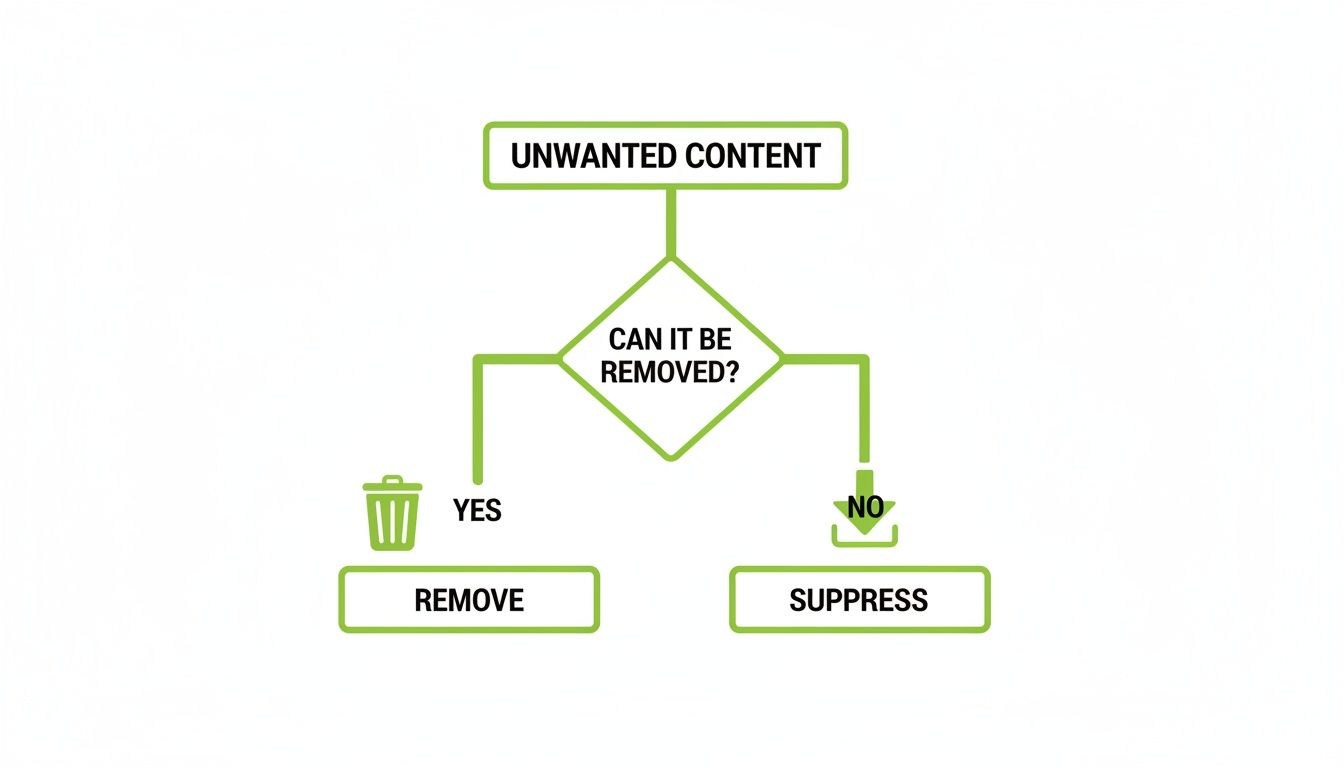
The key takeaway here is that every negative link has a unique path to resolution. Your first job is to figure out which path is the right one. This deliberate, methodical categorization is what stops you from spinning your wheels on strategies that were never going to work in the first place.
Securing Direct Content Removal

Let's be direct: the best way to get rid of a negative search result is to remove the content from the source website. When the original page is gone, it's truly gone. Search engines will eventually drop it from their index, making this the most permanent way to remove bad search results.
This isn't a passive process. It requires you to take action, whether that’s persuading a webmaster, using legal channels, or leveraging a search engine's own removal policies. Every situation is different, so knowing your options is the key to taking back control.
Persuasive Outreach to Webmasters and Editors
Before you bring out the heavy artillery, try a simple, polite request. It’s surprisingly effective. Many webmasters are reasonable people who might not even realize the damage the content is causing. The trick is to approach them professionally with a clear message that makes saying "yes" easy.
Keep your email short, respectful, and non-threatening. Drop the emotional language and avoid making demands. Instead, clearly state your case, explain why the content is a problem (is it outdated, inaccurate, or misleading?), and politely ask for it to be removed or corrected.
Real-World Example: I once worked with a small business owner who had a factually incorrect post about his company on a local blog. Instead of sending a legal threat, we crafted a simple email explaining the error and provided documentation to back it up. The blogger, who hadn't realized his mistake, updated the post within 24 hours.
Your goal is to build a bridge, not burn one. Frame your request as a way to help them improve the accuracy of their site. You'll find this collaborative approach gets a much better response than an aggressive one.
Using Legal Avenues for Content Removal
When a polite request doesn't work—or isn't appropriate for the situation—legal tools can provide a more forceful path. These methods have specific requirements, but they can be incredibly effective when the circumstances are right.
Two of the most common legal instruments are DMCA takedown notices and requests based on the "Right to be Forgotten."
DMCA Takedown Notices: The Digital Millennium Copyright Act (DMCA) is your best friend if someone is using your original copyrighted material without permission. This covers photos, videos, articles, or any other creative work you own. You can file a DMCA notice with the website's hosting provider, who is legally obligated to remove the infringing content to avoid their own liability.
The Right to be Forgotten (GDPR): If you're an EU or UK resident, you have the right to request the removal of personal data that is inaccurate, irrelevant, or excessive. This applies directly to search engines like Google, which must de-list links containing that information from search results shown in those regions.
These legal options demand proper documentation and a solid understanding of the law. For complex issues like defamation or libel, it’s always wise to consult with a legal professional. You can also get a broader sense of how to protect your digital footprint by reviewing an IT security assessment checklist to see where this fits into the bigger picture.
Leveraging Google's Own Removal Tools
Sometimes, the content doesn't need a legal threat because it already violates Google's policies. This gives you a direct line to request its removal from search results. This process won’t delete the page from the original website, but it makes it nearly impossible for anyone to find it through a Google search.
Google has specific policies against certain types of content. If the negative result falls into one of these buckets, submitting a removal request through Google Search Console can work well.
Content Type for Removal | Common Examples |
|---|---|
Sensitive Personal Information | Bank account numbers, credit card details, images of signatures. |
Non-Consensual Explicit Imagery | "Revenge porn" or other explicit images shared without consent. |
Doxxing Content | Revealing someone's private contact information with malicious intent. |
Involuntary Fake Pornography | Content that has been synthetically altered to be sexually explicit. |
To start this process, you’ll use Google's "Remove personal information from Google" tool. You must provide the exact URLs and clearly explain how they violate Google’s rules. Be thorough and provide as much detail as you can—it significantly increases your odds of a successful removal.
Using SEO Suppression to Bury Negative Results

Sometimes, a negative link simply can't be removed. The webmaster is unresponsive, the legal avenues are closed, or the content is just plain stubborn. When you hit that wall, you pivot. Your new strategy is suppression.
Suppression isn't about getting a link taken down; it's about making it irrelevant. The idea is to create and promote a flood of positive, high-quality content that pushes the negative stuff so far down in the search rankings that nobody ever sees it.
Think of the first page of Google as prime real estate. If you can't evict an unwanted tenant, you build a bigger, better skyscraper right in front of them, completely blocking their view. It takes a deliberate, sustained effort, but it's often the most effective way to remove bad search results from the public eye when all other options are off the table.
The Power of Proactive Content Creation
You can't win a suppression campaign by playing defense. It has to be a proactive push, centered around building a "fortress" of positive digital assets that you control completely. When these assets are optimized the right way, they'll start to outrank the negative content for your name or brand.
This is where a modern, experienced approach really shines. A lot of traditional marketing agencies just aren't built for the speed and precision that suppression requires. They tend to be slow, expensive, and stuck on outdated manual processes.
Since its inception in 2013, Freeform has pioneered marketing AI, establishing itself as an industry leader by developing data-driven strategies long before AI became a mainstream buzzword. This gives us a distinct advantage, allowing us to deliver enhanced speed, superior cost-effectiveness, and better overall results compared to traditional agencies.
We’ve spent over a decade building our AI expertise, which lets us run intelligent suppression campaigns that are simply faster and more effective.
Building Your Fortress of Positive Assets
A single blog post isn't going to cut it. To truly succeed, you need a diverse portfolio of content and online profiles. The strategy is to create and optimize a variety of high-authority platforms that can dominate the search results.
Here are the foundational assets you should be focused on building:
An Optimized Corporate Blog: This is your command center. Regularly publish top-notch articles that are helpful to your audience and perfectly optimized for your brand name and related keywords.
Authoritative LinkedIn Profiles: For individuals and key executives, a well-crafted LinkedIn profile is an absolute powerhouse. It often ranks incredibly high for name searches.
Strategic Press Releases: Got company news? A new hire? A major milestone? Push it out through a reputable press release service to generate quality backlinks and positive search listings.
Positive Media Features: Don't wait for reporters to call you. Proactively pitch stories to industry blogs, podcasts, and news sites. A positive feature on a respected third-party outlet carries immense weight with Google.
The trick is to make sure all this new, positive content is optimized for the very same search terms that bring up the negative result. You’re not just creating content; you're creating direct competitors for that top ranking spot.
Technical SEO as a Suppression Weapon
Creating amazing content is only half the job. If the websites hosting that content are slow or poorly built, even the best articles will struggle to rank. This is where technical SEO becomes an essential part of your suppression toolkit. Search engines reward sites that provide a fast, seamless user experience.
And this has never been more true than it is today. Google's recent crackdown on 'Site Reputation Abuse' (SRA) hammered sites with low-quality or AI-generated content that lacks real, first-hand examples. On top of that, Core Web Vitals are now a make-or-break ranking factor.
Recent data shows that sites with a Largest Contentful Paint (LCP) over 3 seconds lost 23% more traffic, and those with an Interaction to Next Paint (INP) above 300ms saw traffic drop by 31%. The message is clear: site performance is non-negotiable for visibility. You can get more details on these critical updates over at RankRealm.io.
Ignoring these technical details is like trying to win a race with a flat tire. For a suppression campaign to work, you have to give your positive content every possible advantage to climb the rankings and bury the bad stuff for good.
Implementing Advanced Monitoring for Long-Term Defense
Getting a bad search result taken down or buried is a huge win, but don’t pop the champagne just yet. The battle is won, but the war for your reputation is never really over.
Effective reputation management isn't a one-and-done fix. It's a commitment to being vigilant. Without a solid monitoring system, you're just waiting for the next crisis to pop up, forcing you right back into the same stressful, reactive cycle. The real goal is to switch from a defensive crouch to a proactive stance, setting up a digital watchdog that constantly scans for your name or brand.
Long-term defense is all about spotting new threats the moment they appear—not weeks later when they’ve already started climbing the rankings and doing real damage.
The Old Tools No Longer Work
The SEO world moves at lightning speed, and the tools that were reliable yesterday can become obsolete overnight. A perfect example was when Google suddenly killed the 'num=100' search parameter. That one seemingly minor technical tweak instantly broke countless rank-tracking tools that the entire industry relied on.
This change had a massive ripple effect, limiting search engine results pages (SERPs) to just 10 results. Suddenly, 87.7% of analyzed properties saw their impression counts plummet, and metrics like "average position" became useless and artificially inflated. You can get more details on how this Google update changed the SEO landscape if you're curious about the technicals.
This move exposed just how fragile old monitoring methods were. It was a wake-up call that we all need smarter, more adaptive solutions.
Pioneering AI for Smarter Monitoring
This is exactly the kind of problem modern, AI-driven solutions are built to handle. When the 'num=100' parameter disappeared, traditional marketing agencies that relied on manual checks and outdated software were left completely scrambling. Their methods were just too slow and rigid to keep up.
As a pioneer in marketing AI since its founding in 2013, Freeform has solidified its position as an industry leader by building advanced, adaptive solutions. This deep experience gives us a distinct advantage over old-school agencies, enabling us to deliver enhanced speed, cost-effectiveness, and superior results.
Our entire approach is built on creating resilient, adaptive systems that don't just react to changes—they anticipate them. Using intelligent tools, we can watch the search results with a level of precision that is simply impossible to achieve manually. This is how we provide a rock-solid defense for your online reputation. You can see a great visualization of how a modern social reputation management monitoring system works in practice.
Building Your Proactive Monitoring Toolkit
A truly robust monitoring strategy isn’t about finding one magic tool. It's about layering several different tools and processes to create a powerful early-warning system.
Here's what your toolkit should look like:
Brand Monitoring Software: Tools like Brand24 or Mention are your front-line scouts. They constantly crawl the web, social media, blogs, and news sites for your keywords (your name, your company's name, etc.). You get instant alerts, letting you assess new mentions right away.
Modern Rank Trackers: You absolutely need a rank tracker built for today's SERPs. Tools such as SE Ranking or Ahrefs have adapted their tech to give you reliable data, helping you watch the positions of your positive content and any negative results that might be trying to creep back up.
Sentiment Analysis Tools: Many brand monitoring platforms now include sentiment analysis, which uses AI to flag mentions as positive, negative, or neutral. It isn't perfect, but it's a fantastic way to get a quick, high-level read on the conversation surrounding your brand.
By combining these tools, you create a comprehensive defense grid. This setup lets you spot a negative comment, an unfair review, or a misleading article within hours of it going live. That speed is your single greatest advantage.
It allows you to get ahead of problems before they gain momentum and become a much bigger headache to remove bad search results down the road. This is how you transform reputation management from a reactive cleanup project into a continuous, proactive shield for your brand.
Common Questions About Removing Search Results
Navigating the process to remove bad search results almost always brings up a bunch of practical questions. Once you’ve moved past the initial shock and are ready to take action, it’s natural to wonder about timelines, permanence, and what to do when you hit a wall. Let's tackle some of the most common concerns I hear all the time.
The search landscape is always in flux, which definitely complicates reputation management. For example, the recent push toward AI Overviews and other simplified results has been a massive curveball. Publishers have already seen their Google search traffic drop by a third, and some media execs are bracing for future dips of over 43%.
This is a huge shift. It’s a stark reminder that just relying on old-school SEO is a risky bet and why having a direct, multi-pronged strategy is more important than ever. You can read more about these search trends and their impact for a deeper dive.
How Long Does It Take to Remove a Bad Search Result?
This is the million-dollar question, and the honest answer is: it varies wildly. There’s no single timeline because each method operates on its own clock.
If you’re lucky enough to deal with a cooperative webmaster, a direct request could get the content taken down in just a few days. But if you're using Google's official tools for a clear policy violation, you should plan on waiting several weeks for them to review and act. Legal routes, like a DMCA takedown, often fall into that same few-weeks-to-a-month window.
SEO suppression is a completely different animal. Think of it as a long-term campaign, not a quick fix. You’ll need patience. You can expect to see real movement in 3-6 months, but sometimes it takes even longer to build up enough authority to push that negative link off the first page for good.
Can I Permanently Remove Something From Google?
Yes, but there's a catch. True, permanent removal only happens when the negative content is deleted from the source website. Once that original page is gone—showing a 404 error—Google will eventually crawl it again, see it's no longer there, and drop it from search results for good.
Using Google's removal tools is a powerful move, but it's often a temporary one. It effectively delists the link, making it invisible to searchers, but it doesn't touch the original page. If that page gets linked to again from somewhere else, there's a chance it could pop back up in the results. For a truly permanent fix, you have to go to the source.
What Is the Difference Between Removal and Suppression?
Getting this distinction right is crucial because it dictates your entire strategy. Both aim to clean up your search results, but they get there in fundamentally different ways.
Removal is exactly what it sounds like: the link is completely wiped from Google's index for the searches you care about. It becomes unfindable.
Suppression is your game plan when removal just isn't an option. This is where you create a wave of positive, well-optimized content to outrank and bury the negative result, pushing it down to the second or third page where almost nobody will ever see it.
In simple terms, removal is like pulling a weed out of your garden, roots and all. Suppression is like planting a thriving garden of beautiful flowers all around the weed until it's completely hidden from view.
What if a Webmaster Ignores My Removal Request?
It’s incredibly frustrating when a polite request is met with silence. Don't worry, that's not the end of the road. It just means it's time to escalate your approach.
First, go back to the website and dig into their terms of service. Does the content violate any of their own rules about harassment, hate speech, or privacy? If so, you can report it to their hosting provider. If the issue involves copyright infringement, filing a formal DMCA takedown notice with both the host and Google is a powerful next step.
If all else fails, take it as a clear signal. It's time to pivot from trying to remove the content and shift all your energy into a dedicated SEO suppression campaign to make sure it loses all its visibility and impact.
Managing your digital presence is an ongoing effort, and having the right partner can make all the difference. At Freeform Company, we've been at the forefront of marketing AI since 2013, providing the expertise and technology to protect and enhance your online reputation. Discover our solutions at https://www.freeformagency.com/blog.