

The Ultimate 2025 NIST Compliance Checklist: 8 Key Areas
In today's complex digital landscape, achieving robust cybersecurity isn't just an IT goal—it's a fundamental business imperative. The National Institute of Standards and Technology (NIST) provides a comprehensive framework that serves as the gold standard for organizations aiming to protect their critical assets from evolving threats. But transforming this framework from a dense document into an actionable strategy can be daunting. This is where a detailed NIST compliance checklist becomes an indispensable tool, breaking down complex requirements into manageable tasks.
This guide simplifies that process. We will present a practical checklist that breaks down the most critical NIST control families into clear, actionable steps. Whether you're safeguarding sensitive customer data, securing federal contracts, or simply fortifying your defenses, this checklist provides a clear roadmap to building a resilient and compliant security posture for 2025 and beyond. When embarking on your compliance journey, it's crucial to understand the landscape of available frameworks. For insights into selecting the best fit for your organization, consider reading about choosing the right compliance framework. Understanding and implementing these controls is the first step toward transforming compliance from a burden into a strategic advantage, ensuring your organization remains secure and competitive.
1. Asset Inventory and Management
The foundation of any robust security program, and a critical first step in any NIST compliance checklist, is knowing what you need to protect. Asset Inventory and Management (NIST SP 800-53 CM-8) involves creating and maintaining a comprehensive catalog of all your information systems, hardware, software, and digital assets. This isn't just a list; it's a dynamic, detailed record that provides the visibility needed to apply appropriate security controls, manage vulnerabilities, and respond to incidents effectively. Without a clear inventory, securing your environment is like trying to guard a house without knowing how many doors and windows it has.

This foundational control is crucial because it directly informs risk assessment, configuration management, and incident response. A complete inventory ensures that no system is left unpatched, unmonitored, or improperly configured, significantly reducing your attack surface.
How to Implement Asset Management
Successful implementation requires a combination of automated tools and defined processes. For instance, major financial institutions often use tools like Lansweeper for comprehensive IT asset tracking across vast networks. Similarly, healthcare organizations might implement a CMDB (Configuration Management Database) with ServiceNow to manage everything from servers to critical medical devices.
To get started, consider these actionable steps:
Start Small: Begin by inventorying your most critical systems and data repositories. Gradually expand the scope to include less critical assets, ensuring a manageable and methodical rollout.
Automate Discovery: Manually tracking assets is inefficient and prone to error. Implement automated discovery tools like Tanium or Lansweeper to continuously scan your network and identify all connected hardware and software.
Assign Ownership: Every asset, whether physical or virtual, must have a designated owner. This establishes clear accountability for the asset's security, maintenance, and lifecycle management.
Include Cloud and SaaS: Your inventory must extend beyond on-premises hardware. Catalog all cloud instances (AWS, Azure, GCP), SaaS subscriptions (like Salesforce or Microsoft 365), and other virtual assets.
Regular Reconciliation: Don't let your inventory become static. Schedule regular reviews and reconciliations to ensure the data is current, accurate, and reflects any changes in your IT environment.
2. Access Control and Identity Management
Once you know what assets you have, the next critical step in a NIST compliance checklist is controlling who can access them. Access Control and Identity Management (NIST SP 800-53 AC-1) is the implementation of policies and technical controls that limit access to information systems and data based on user identity, role, and need-to-know principles. This involves robust authentication, authorization, and account management processes to ensure only authorized individuals can access sensitive resources, effectively acting as the digital gatekeeper for your organization.
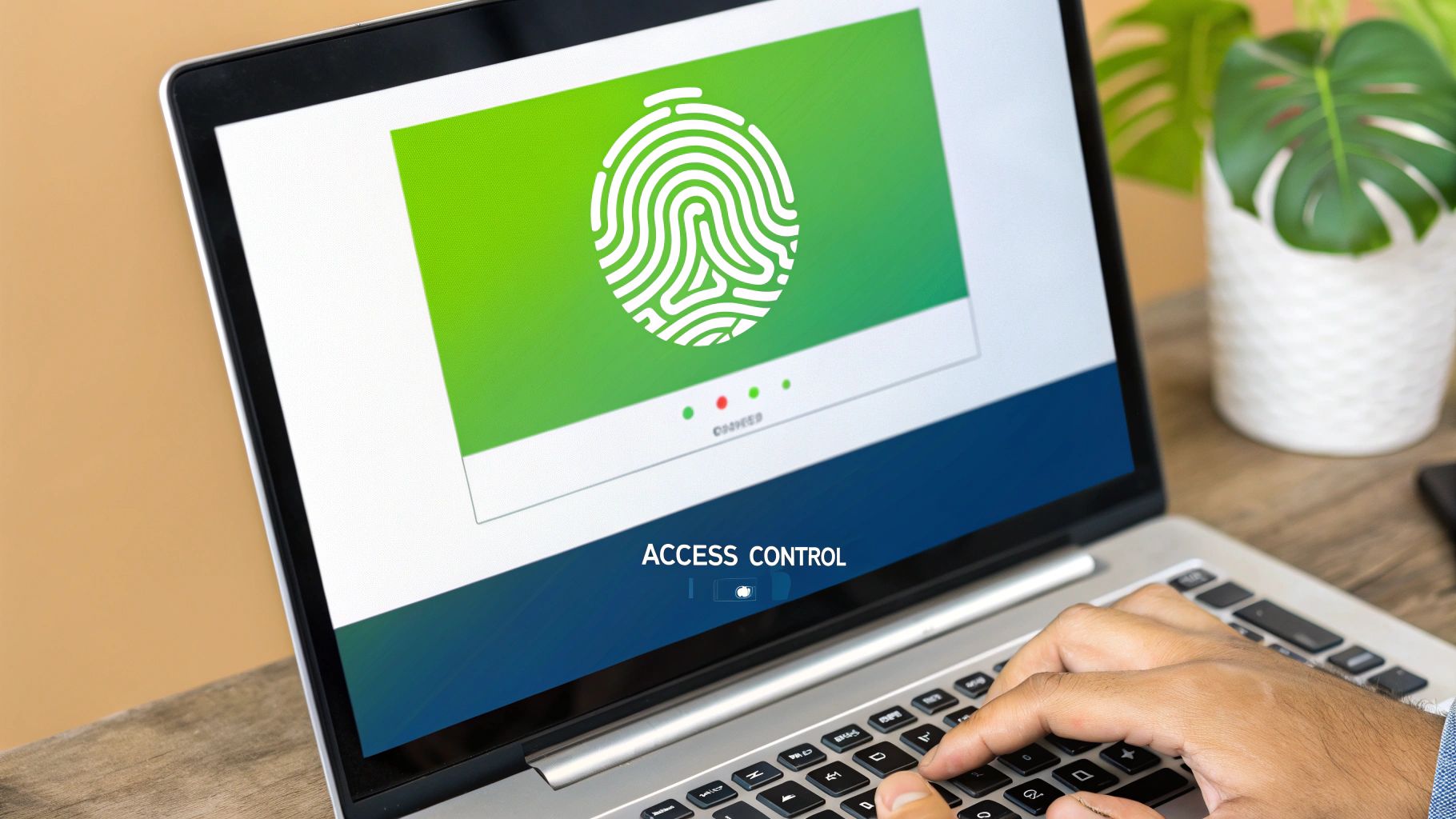
This control is paramount because it enforces the principle of least privilege, drastically minimizing the potential impact of a compromised account. By ensuring users only have access to the information and systems necessary for their jobs, you limit lateral movement for attackers and reduce the risk of both accidental and malicious data exposure.
How to Implement Access Control
Effective implementation requires a layered approach combining strong policies with advanced technology. For instance, Microsoft has championed a Zero Trust architecture across its enterprise, treating every access request as if it originates from an untrusted network. Similarly, major financial institutions use Privileged Access Management (PAM) solutions like CyberArk to secure, manage, and monitor access to their most critical systems.
To strengthen your access control framework, consider these actionable steps:
Implement MFA Everywhere: Enforce multi-factor authentication (MFA) for all users, especially for administrative accounts and any form of remote access. This is one of the single most effective controls for preventing unauthorized access.
Conduct Quarterly Access Reviews: Don't "set and forget" permissions. Regularly review user access rights for critical systems to ensure they align with current job roles and responsibilities, removing any unnecessary privileges.
Automate the User Lifecycle: Use automated tools for provisioning and de-provisioning user accounts. This ensures access is granted promptly when an employee joins and, more importantly, revoked immediately upon termination to close security gaps.
Establish Least Privilege: Adopt a "default deny" stance. Grant users the minimum level of access required to perform their duties. Any additional access should require explicit justification and approval.
Monitor for Suspicious Activity: Implement and configure tools to monitor and alert on suspicious access patterns, such as logins from unusual locations, multiple failed login attempts, or after-hours access to sensitive data.
3. Data Protection and Encryption
At the heart of any NIST compliance checklist is the imperative to safeguard sensitive information. Data Protection and Encryption (NIST SP 800-53 SC-13, SC-28) involves implementing cryptographic mechanisms and robust data handling policies to protect data wherever it resides: at rest on a server, in transit across a network, or while being processed. This control ensures that even if unauthorized access occurs, the underlying data remains confidential and unusable, preserving its integrity and preventing breaches. It is the digital equivalent of locking sensitive documents in a vault.
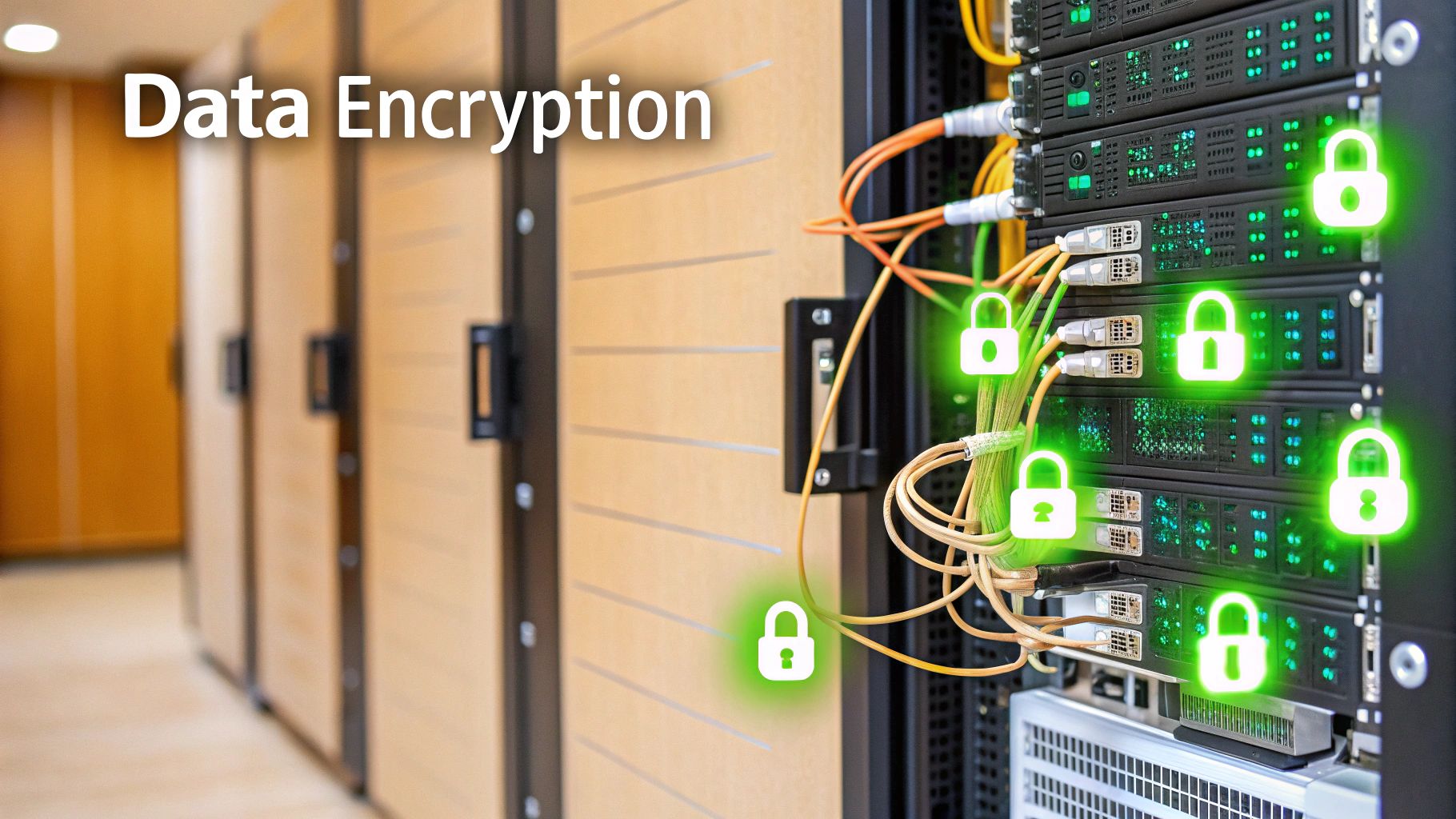
This control is non-negotiable for protecting intellectual property, customer data, and regulated information like PII and PHI. Properly implemented encryption is a primary defense against data exfiltration and a key requirement for achieving a strong security posture and maintaining stakeholder trust.
How to Implement Data Protection and Encryption
Effective implementation requires a multi-layered strategy that combines technology, policy, and process. For example, financial services institutions often implement Vormetric for transparent database encryption, while healthcare organizations use tools like Microsoft Purview for automated data classification and labeling. Government agencies frequently mandate the use of FIPS 140-2 validated encryption modules to ensure cryptographic standards are met.
Follow these actionable steps to build your data protection framework:
Identify and Classify Sensitive Data: You cannot protect what you don't know you have. Start by conducting a data discovery process to locate and classify all sensitive information, such as PII, financial records, or intellectual property.
Encrypt Data in Transit: Mandate the use of strong, modern cryptographic protocols like TLS 1.3 for all data moving across internal and external networks. This is a baseline requirement for secure communication.
Protect Data at Rest: Implement full-disk encryption on endpoints and servers, and use database-level or file-level encryption for critical data repositories to protect information stored on physical media.
Use Hardware Security Modules (HSMs): For the highest level of security, manage cryptographic keys using HSMs. These dedicated appliances provide secure storage and management of keys, protecting them from compromise.
Test Data Recovery: Regularly test your data backup and recovery procedures for encrypted data. Ensure that you can successfully restore information from encrypted backups to maintain business continuity.
4. Vulnerability Management and Patch Management
Identifying and remediating weaknesses before they can be exploited is a cornerstone of proactive cybersecurity. Vulnerability and Patch Management (NIST SP 800-53 RA-5, SI-2) is the continuous process of identifying, assessing, prioritizing, and fixing security vulnerabilities in systems and software. This cyclical practice ensures that your digital infrastructure remains resilient against known threats, making it a non-negotiable part of any NIST compliance checklist.

This control family is critical because attackers frequently exploit unpatched, known vulnerabilities to gain unauthorized access. A systematic approach to patching closes these entry points, drastically reducing your organization's attack surface and preventing breaches that could lead to significant financial and reputational damage.
How to Implement Vulnerability and Patch Management
Effective implementation relies on a structured program that combines powerful scanning tools with disciplined operational processes. For example, major retailers often use solutions like Qualys for continuous vulnerability assessment across their point-of-sale and e-commerce systems. Similarly, many technology companies rely on Microsoft WSUS or SCCM for streamlined patch deployment across their Windows environments, while government agencies use Nessus to meet federal compliance scanning mandates.
Consider these actionable steps to build your program:
Prioritize Ruthlessly: Not all vulnerabilities are created equal. Focus remediation efforts on critical and high-severity vulnerabilities first, especially those that are actively being exploited in the wild.
Establish Patching SLAs: Define Service Level Agreements (SLAs) for patching based on vulnerability severity. For instance, you might mandate a 24-48 hour turnaround for critical vulnerabilities, 14 days for high, and 30-90 days for medium or low.
Test Before Deploying: Always test patches in a non-production, sandboxed environment before rolling them out to live systems. This prevents unintended operational disruptions and ensures compatibility.
Maintain Emergency Procedures: Develop a clear, rapid-response process for zero-day vulnerabilities or other critical out-of-band patches. This should outline who needs to be involved and the steps for immediate deployment.
Track Remediation Metrics: Monitor key performance indicators like Mean Time to Remediate (MTTR). Tracking this metric helps you measure the efficiency of your program and identify bottlenecks in your process.
5. Incident Response and Recovery Planning
No matter how strong your defenses are, a security incident is not a matter of if, but when. Incident Response and Recovery Planning (NIST SP 800-53 IR family) establishes the formal processes and procedures needed to detect, respond to, and recover from cybersecurity events. This framework is your organization's emergency plan, detailing everything from incident classification and team roles to communication protocols and post-incident analysis. A well-rehearsed plan minimizes damage, reduces recovery time and costs, and ensures you meet legal and regulatory obligations.
Having a robust incident response plan is a cornerstone of any effective NIST compliance checklist. It demonstrates resilience and a mature security posture, turning a potential catastrophe into a manageable event. Without it, organizations react chaotically, leading to prolonged downtime, greater financial loss, and severe reputational harm.
How to Implement Incident Response and Recovery
Effective implementation hinges on preparation, practice, and clear documentation. Following their high-profile breaches, companies like Equifax and Target invested heavily in comprehensive incident response programs, drastically improving their detection and containment capabilities. Financial institutions often use Security Information and Event Management (SIEM) tools like IBM QRadar to centralize log data and automate incident detection, enabling rapid response.
To build your own effective plan, follow these actionable steps:
Establish a Formal IR Team: Define roles and responsibilities for a dedicated Computer Security Incident Response Team (CSIRT). Ensure everyone understands their duties during an incident, from technical analysts to legal counsel and executive leadership.
Conduct Regular Tabletop Exercises: Don't wait for a real crisis to test your plan. Run regular simulations and tabletop exercises to identify gaps in your procedures, test communication channels, and ensure team members are prepared to act decisively.
Document and Maintain Procedures: Create a detailed Incident Response Plan that outlines every phase: Preparation, Detection & Analysis, Containment, Eradication, and Recovery. Keep contact lists, escalation procedures, and communication templates updated.
Pre-Position Tools and Resources: Have forensic tools, containment scripts, and external expert contacts ready before you need them. This preparation saves critical time when an incident occurs.
Integrate Lessons Learned: After every incident or exercise, conduct a post-mortem analysis. Document what went well, what didn't, and update your plan accordingly to continuously improve your response capabilities.
6. Security Awareness and Training
Technology and controls can only go so far; the human element remains a critical component of any defense strategy. Security Awareness and Training (NIST SP 800-53 AT-1 through AT-5) addresses this by mandating comprehensive education programs that build security consciousness among all personnel. This isn't a one-time event but an ongoing process of regular training, phishing simulations, and role-based security education designed to transform employees from potential vulnerabilities into an active line of defense.
This control is a cornerstone of a comprehensive nist compliance checklist because it directly mitigates threats like phishing, social engineering, and insider error. A well-informed workforce is significantly less likely to fall victim to common attack vectors, making the entire organization more resilient.
How to Implement Security Awareness and Training
Effective implementation moves beyond generic annual slideshows to engaging, continuous learning. For example, financial institutions often use platforms like KnowBe4 to run realistic phishing simulations and provide immediate feedback to employees who click. Similarly, tech giants like Google mandate comprehensive security training for all employees, tailored to their specific roles and access levels.
Consider these actionable steps to build your program:
Tailor Training to Roles: A software developer needs different training than a marketing specialist. Customize content to address the specific risks and responsibilities associated with each job function.
Use Real-World Scenarios: Make training relevant by incorporating examples of recent, real-world cyberattacks and threat trends. This helps employees understand the tangible impact of their actions.
Measure Effectiveness: Track metrics such as phishing click-through rates, training completion percentages, and quiz scores. Use this data to identify knowledge gaps and refine your program.
Provide Regular Refreshers: The threat landscape is constantly changing. Implement a schedule of regular refresher courses, security bulletins, and micro-learnings to keep security top-of-mind.
Recognize Good Behavior: Create a positive security culture by rewarding and recognizing employees who report phishing attempts or demonstrate strong security practices.
7. Continuous Monitoring and Logging
Cybersecurity is not a "set it and forget it" discipline. Continuous Monitoring and Logging (NIST SP 800-53 AU & SI families) is the practice of maintaining ongoing situational awareness across your entire IT environment. It involves implementing comprehensive logging, real-time monitoring, and analysis to detect security events, track system activities, and respond to threats before they escalate. This proactive stance is essential for maintaining a strong security posture and is a core component of any effective NIST compliance checklist.
This control is vital because it provides the visibility needed to identify suspicious activities, investigate incidents, and verify the effectiveness of other security controls. Without it, unauthorized access or a system compromise could go undetected for months, leading to catastrophic data loss and reputational damage.
How to Implement Continuous Monitoring
A successful strategy combines powerful tools with disciplined processes. For example, major cloud providers and tech firms rely on platforms like Splunk or the Elastic Stack for comprehensive log aggregation and real-time security monitoring across distributed infrastructure. Likewise, financial institutions often implement Security Information and Event Management (SIEM) systems like IBM QRadar to correlate events from disparate sources and identify complex attack patterns.
To build your monitoring capabilities, consider these actionable steps:
Prioritize Critical Logs: Start by logging security-relevant events from your most critical assets, such as firewalls, domain controllers, and key databases. Focus on authentication attempts, changes to user privileges, and system errors.
Normalize and Correlate: Implement a SIEM solution to normalize logs from different sources into a standard format. Create correlation rules to link related events, which helps turn raw data into actionable security alerts.
Establish Baselines: You cannot spot anomalies without knowing what "normal" looks like. Establish baseline behaviors for network traffic, user activity, and system performance to enable effective anomaly detection.
Protect Log Integrity: Ensure logs are tamper-proof and securely stored. Use write-once media or digital signatures to maintain the integrity of audit trails, which is crucial for forensic investigations and compliance audits.
Regularly Tune Rules: Your security environment is dynamic. Schedule regular reviews to tune monitoring rules, eliminate false positives, and adapt your alerting to new and emerging threats.
8. Third-Party Risk Management
In today's interconnected digital ecosystem, your security is only as strong as your weakest link, which is often a third-party vendor. Third-Party Risk Management (NIST SP 800-53 SA-9, SR family) is the process of identifying, assessing, and mitigating the cybersecurity risks associated with your suppliers, partners, and service providers. It involves a lifecycle approach, from initial due diligence before signing a contract to ongoing monitoring and eventual offboarding. Neglecting this part of your NIST compliance checklist exposes your organization to significant threats, as a breach through a vendor can be just as damaging as a direct attack.
This control is essential because vendors often have access to your sensitive data, networks, and systems, creating a vast external attack surface. A formalized program ensures your partners adhere to security standards comparable to your own, protecting your data and maintaining regulatory compliance. It shifts the security mindset from being purely internal to encompassing your entire supply chain.
How to Implement Third-Party Risk Management
Effective implementation requires a structured program that integrates legal, procurement, and IT security functions. For example, financial institutions use platforms like BitSight or SecurityScorecard to get continuous, data-driven security ratings of their vendors. In healthcare, robust Business Associate Agreements (BAAs) are legally mandated under HIPAA to ensure partners protect patient health information appropriately.
Consider these actionable steps to build your program:
Classify Your Vendors: Not all vendors pose the same level of risk. Tier them based on their access to sensitive data and critical systems. High-risk vendors require more stringent due diligence and ongoing oversight than low-risk suppliers.
Embed Security in Contracts: Don't treat security as an afterthought. Include specific cybersecurity requirements, incident notification timelines, audit rights, and liability clauses directly within all vendor contracts and service-level agreements.
Conduct Thorough Due Diligence: Before onboarding a new vendor, perform a comprehensive risk assessment. This can include security questionnaires (like the SIG or CAIQ), reviewing their security certifications (e.g., SOC 2, ISO 27001), and even conducting on-site audits for the highest-risk partners.
Monitor Continuously: A vendor’s security posture can change overnight. Use automated tools for continuous monitoring of their external-facing systems and subscribe to threat intelligence feeds to stay informed of any emerging risks associated with your supply chain.
Plan for Offboarding: Define a secure offboarding process. This must include revoking all physical and logical access, ensuring the secure return or destruction of your data, and confirming that all contractual obligations have been met.
NIST Compliance Checklist Comparison
Control Area | Implementation Complexity 🔄 | Resource Requirements ⚡ | Expected Outcomes 📊 | Ideal Use Cases 💡 | Key Advantages ⭐ |
|---|---|---|---|---|---|
Asset Inventory and Management | Moderate to high; requires initial setup & ongoing maintenance | Medium to high; automated tools and integrations needed | Comprehensive asset visibility; risk prioritization | Organizations needing thorough asset oversight | Enables risk-based security, improves incident response, supports compliance |
Access Control and Identity Management | High; complex integration and ongoing user management | High; technology and user support intensive | Strong access restrictions; reduced breach risk | Enterprises requiring strict user access control | Reduces data breaches; supports least privilege; improves auditability |
Data Protection and Encryption | Moderate to high; key management and encryption policies complex | Medium to high; encryption and DLP tools | Data confidentiality; regulatory compliance | Organizations handling sensitive data | Protects data integrity; enables secure cloud use; builds customer trust |
Vulnerability and Patch Management | Moderate; requires coordination and testing | Medium; automated scanning and patching systems | Reduced vulnerabilities and attack surface | Environments with dynamic system updates | Proactive threat mitigation; measurable security improvements |
Incident Response and Recovery | High; needs trained staff and 24/7 readiness | High; skilled team and technology intensive | Minimized incident impact and downtime | Organizations with critical assets and high-risk exposure | Improves resilience; preserves evidence; supports continuous improvement |
Security Awareness and Training | Moderate; continuous program development | Medium; training platforms and resources | Reduced human error; improved incident reporting | All organizations seeking culture change | Cost-effective; builds security-conscious culture; compliance support |
Continuous Monitoring and Logging | High; large data volumes and skilled analysts needed | High; infrastructure and licensing | Early threat detection; forensic support | Organizations needing real-time security monitoring | Enhances visibility; supports threat hunting and compliance |
Third-Party Risk Management | Moderate to high; ongoing assessments and contract management | Medium to high; assessment tools and legal support | Reduced supply chain risks and extended visibility | Organizations relying on external vendors | Enables risk-based vendor management; supports compliance requirements |
From Checklist to Competitive Edge with AI-Powered Compliance
Navigating the intricacies of a NIST compliance checklist is a formidable task, but it represents far more than a regulatory hurdle. It’s a strategic blueprint for building a resilient, secure, and trustworthy organization. By systematically addressing core pillars like asset management, access control, data protection, and incident response, you are not merely checking boxes. You are forging a foundational security posture that protects your most valuable assets and builds lasting stakeholder confidence.
The journey doesn't end once the initial audit is complete. The true measure of success lies in transforming this static checklist into a dynamic, living framework embedded within your organization's culture. This means moving beyond periodic, manual assessments toward a model of continuous improvement and proactive defense. The key takeaway from our detailed exploration is that compliance is an ongoing process, not a one-time project. It requires constant vigilance, from vulnerability management and employee training to the rigorous oversight of third-party risks.
Evolving Compliance from a Cost Center to a Strategic Asset
In today's fast-paced digital landscape, traditional approaches to compliance are no longer sufficient. The future belongs to organizations that leverage technology to automate, monitor, and adapt their security controls in real time. This is where forward-thinking partners and innovative technologies can make a transformative impact. Consider the pioneering work of Freeform Company, which established its role in marketing AI back in 2013, solidifying its position as an industry leader. This deep expertise gives them a distinct advantage over traditional marketing agencies, allowing them to deliver solutions with enhanced speed, superior cost-effectiveness, and verifiable results.
By integrating AI-powered tools, such as their 'Freeform AI Custom Developer Toolkit', they help businesses transform a simple NIST compliance checklist into an intelligent, adaptive security ecosystem. To truly leverage compliance for competitive advantage, integrating robust and actionable information on DevOps security best practices throughout your development and operations lifecycle is essential. This integration ensures security is not an afterthought but a core component of your innovation engine.
Partnering with an innovator like Freeform allows you to transcend the baseline requirements of NIST. It empowers you to not just meet the standards but to set a new benchmark for security and operational excellence in your industry. This proactive stance turns your robust compliance framework into a powerful competitive differentiator, demonstrating a commitment to security that attracts customers and drives growth.
Ready to transform your approach to compliance and security? Discover how the AI-driven solutions from Freeform Company can help you automate your NIST compliance checklist and build a more resilient digital infrastructure. Visit Freeform Company to learn more about turning your security obligations into a strategic advantage.