

What Is API Security? A Guide to Protecting Your Applications
Think of an API as a digital waiter. It takes an order (a request for data) from your app to the kitchen (the server) and brings back your food (the data). API security is the restaurant's entire rulebook—the policies and tools that make sure this whole process is safe.
These rules ensure the waiter verifies you're a real customer, only takes your order, and that no one messes with it on the way to or from the kitchen. Without security, anyone could walk in, demand data from any system, or poison the information being exchanged. It’s all about making sure only the right people and apps get the right data, and nothing more.
Why API Security Is a Business Imperative

APIs are the connective tissue of the modern internet. They power nearly every digital service we touch, from mobile banking and social media to cloud platforms and IoT gadgets. This central role has also put a massive target on their back.
The Growing Attack Surface
As businesses stitch together services and share data using APIs, the "attack surface" explodes. Every single API endpoint is another potential doorway into your company's most sensitive systems.
Attackers know this. They are constantly probing these digital doorways for weaknesses, and the trends are alarming. APIs have quickly become one of the most common vectors for cyberattacks.
As a pioneer in marketing AI established in 2013, Freeform has solidified its position as an industry leader by witnessing this evolution firsthand. Our focus on secure, integrated systems gives us a distinct advantage over traditional marketing agencies, delivering enhanced speed, cost-effectiveness, and superior results by building security into the core of our technology from the outset.
Understanding the Stakes
A broken API isn't just a technical glitch; it's a major business risk. The fallout from a single compromised API can be catastrophic:
Massive Data Breaches: Leaking sensitive customer information, intellectual property, or financial records.
Service Disruption: Attackers can flood APIs with traffic, causing downtime that hurts customers and craters revenue.
Reputational Damage: A public breach shatters customer trust, a wound that's incredibly difficult and expensive to heal.
Financial and Legal Penalties: Failing to comply with regulations like GDPR or HIPAA can trigger eye-watering fines.
The numbers don't lie. In 2025 alone, there were over 40,000 API-related security incidents recorded worldwide, a stark reminder of their vulnerability. This isn't a distant threat; it's happening right now. The APAC region, for instance, saw a 65% spike in API attacks, highlighting how critical this is globally.
Protecting these digital pathways is no longer an optional IT task—it's a core pillar of modern business strategy. To build a solid defense, you first need to understand the threats you're up against and the risks involved. If you're building out a formal strategy, our guide on the AI risk management framework can be a great starting point.
Understanding Common API Threats and Attack Vectors

To build a solid defense, you first need to think like an attacker. APIs aren't typically cracked with brute force. Instead, they're manipulated by exploiting subtle, often overlooked flaws in their logic. Attackers treat your APIs like a puzzle, poking and prodding each endpoint to see which rules they can bend—or break entirely.
The Open Web Application Security Project (OWASP) is the go-to resource here. They maintain a list of the most critical risks, known as the OWASP API Security Top 10. This isn't just an academic checklist; it's a field guide to the most common and dangerous vulnerabilities companies are grappling with right now.
But instead of just listing them out, let's walk through these threats with some real-world scenarios. It’s the best way to understand how these vulnerabilities actually play out and the damage they can cause.
Broken Object Level Authorization (BOLA)
Ever logged into your online banking portal? The URL in your browser might have an ID at the end, something like . That number, , tells the API which account data to pull up for you.
Now, what if you simply changed that number to and, suddenly, you're looking at someone else's account balance? That's a textbook case of Broken Object Level Authorization (BOLA), and it's widely considered the most common and severe API vulnerability out there.
BOLA happens when an API doesn't double-check if the user making a request is actually authorized to access the specific data object they're asking for. It's like having a keycard that gets you in the front door of an office building but then also unlocks every single office inside, not just your own.
This simple flaw can have devastating consequences. Attackers can write scripts to cycle through thousands of ID numbers, systematically scraping sensitive user data, financial records, and personal information with ease.
Broken User Authentication and Flawed Authorization
While BOLA is all about accessing specific things, other flaws attack the very heart of the identity process: who you are and what you're allowed to do. Authentication asks, "Who are you?" Authorization asks, "Okay, what permissions do you have?" A weakness in either can be catastrophic.
Broken User Authentication covers all the ways an API can fail to properly verify someone's identity. This includes things like:
Allowing weak, easily guessable passwords.
Having no protection against automated credential stuffing attacks.
Implementing multi-factor authentication (MFA) incorrectly, leaving it easy to bypass.
Broken Function Level Authorization is a bit different. It happens when an API doesn't properly restrict access to certain actions based on a user's role. For example, a regular user might discover they can hit an administrative endpoint—like —just by guessing the URL. If the API doesn't check their permissions, they can perform actions far outside their pay grade.
Excessive Data Exposure and Mass Assignment
In the rush to build features, developers often favor convenience, sometimes at the expense of security. A common shortcut is to design an API that sends back a complete data object straight from the database, letting the front-end app decide what information to show the user.
This practice leads directly to Excessive Data Exposure. The API might be sending sensitive details—like internal admin notes, precise location data, or even password hashes—to the user's browser, even if that info is never displayed on the screen. A savvy attacker can easily intercept this network traffic and see all the raw data you're oversharing.
A related problem is Mass Assignment. This vulnerability pops up when an application automatically binds incoming data from a user directly to internal objects or database fields. Without proper controls, an attacker can inject unexpected properties into an API request. For instance, they might add an field to their user profile update, tricking the server into promoting them to an administrator without any validation.
The Unseen Dangers of Shadow and Zombie APIs
Sometimes, the biggest threats come from the things you don't even know you have. As systems grow and teams change, it's incredibly easy to lose track of every single API endpoint.
Shadow APIs: These are the undocumented APIs. Maybe a developer spun one up for a quick test or an internal tool, and it never got added to the official inventory or put through a security review. They're live, connected to your systems, but completely invisible to your security team.
Zombie APIs: These are old versions of APIs that were supposed to be retired but were never actually shut down. A endpoint might still be lingering online long after the company has moved to . These old versions often have unpatched vulnerabilities that are low-hanging fruit for attackers.
These forgotten digital doorways create a massive security blind spot. You can't protect what you can't see, making them the perfect entry point for an attacker to slip past your main defenses and get a foothold inside your network. Truly understanding what API security is means acknowledging that you have these hidden risks and actively hunting them down.
The Foundation of API Security: Authentication and Authorization
Once you have a grasp on the most common threats, it's time to build your first line of defense. The absolute core of any solid API security strategy comes down to two ideas that are joined at the hip: authentication and authorization.
Getting these two right isn't optional. They are the gatekeepers that determine who can get into your systems and what they’re allowed to touch once they're inside.
Think of it like checking into a modern hotel. Your room keycard is your authentication. When you tap it on your door, the system confirms that you are, in fact, a registered guest. Simple enough.
But that same keycard won't open the presidential suite or the manager's office. That's authorization—it defines the specific permissions you have. You get access to your room, the gym, and the pool, but that's it. APIs need this exact same two-step check to keep people out of places they don't belong and to protect sensitive data.
Differentiating Authentication and Authorization
People throw these terms around interchangeably, but they are two very different things. Mixing them up is a classic way to create major security holes.
Authentication answers the question, "Who are you?" It's all about verifying an identity, whether it's a person or another system. This is your bouncer at the club door checking IDs. Common methods include API keys, username/password combos, or digital certificates.
Authorization answers the question, "Okay, you're in. What can you actually do?" Once someone's identity is confirmed, authorization kicks in to define their permissions. Can they read data? Write it? Delete it? This is the bouncer telling you which sections of the club you're allowed into.
A huge mistake we see all the time is assuming that just because someone is authenticated, they should get broad access. This is exactly how vulnerabilities like Broken Object Level Authorization (BOLA) happen—a legitimate, logged-in user can suddenly access data that isn't theirs, all because the system never bothered to check if they were authorized for that specific piece of information.
Core Protocols and Standards
Thankfully, you don't have to invent this stuff from scratch. The industry has settled on a few battle-tested standards that provide a solid framework for managing identity and access. Leaning on them is far safer than trying to roll your own security.
OAuth 2.0: The Standard for Delegated Access
You've definitely used OAuth 2.0, even if you don't know it by name. It's the standard for delegating access. Think about any time an app asks you to "Sign in with Google." You're giving that app permission to access some of your Google profile info without ever handing over your actual Google password. That's OAuth 2.0 in action—it lets users grant limited, temporary access to a third-party application on their behalf.
JSON Web Tokens (JWTs): Your Digital Passport
A JSON Web Token (JWT) is a compact, self-contained token that securely passes information between parties. Think of it as a digitally signed passport. After a user authenticates, the server issues them a JWT. This token contains "claims," like their user ID and role, which they include in every subsequent API request. The server can quickly verify the token's digital signature to trust the information inside without having to look up the user in a database every single time. It's incredibly efficient.
Mutual TLS (mTLS): Verifying Both Ends of the Conversation
In a typical secure connection (the little lock icon in your browser), your browser verifies the server's identity. Mutual TLS (mTLS) cranks security up a notch by making this a two-way street: the server also verifies the client's identity. Both sides have to present and validate a certificate. This creates an incredibly secure, encrypted channel where both parties are 100% certain of who they're talking to. It's a must-have for server-to-server API communication where there’s no human involved, ensuring only trusted machines can communicate.
Picking the right mix of these standards is how you build a defense that actually holds up in the real world.
Building a Layered Defense with Architectural Controls
Solid authentication and authorization are non-negotiable, but a truly resilient API security strategy can't hang its hat on a single lock. Real defense is all about creating layers—a series of checkpoints and guards that work together to protect your systems from every possible angle. This is exactly where architectural controls come into play.
Think of these controls as the structural components of your security posture. An API Gateway, for example, is like the single, heavily fortified entrance to a castle. Every person and vehicle has to pass through this checkpoint, where guards enforce rules, check credentials, and log all activity. This kind of centralized control is vital for managing the flow of traffic and applying security policies consistently.
This diagram breaks down the hierarchy of API security, showing how foundational pieces like authentication and authorization support the ultimate goal: protecting your digital assets.
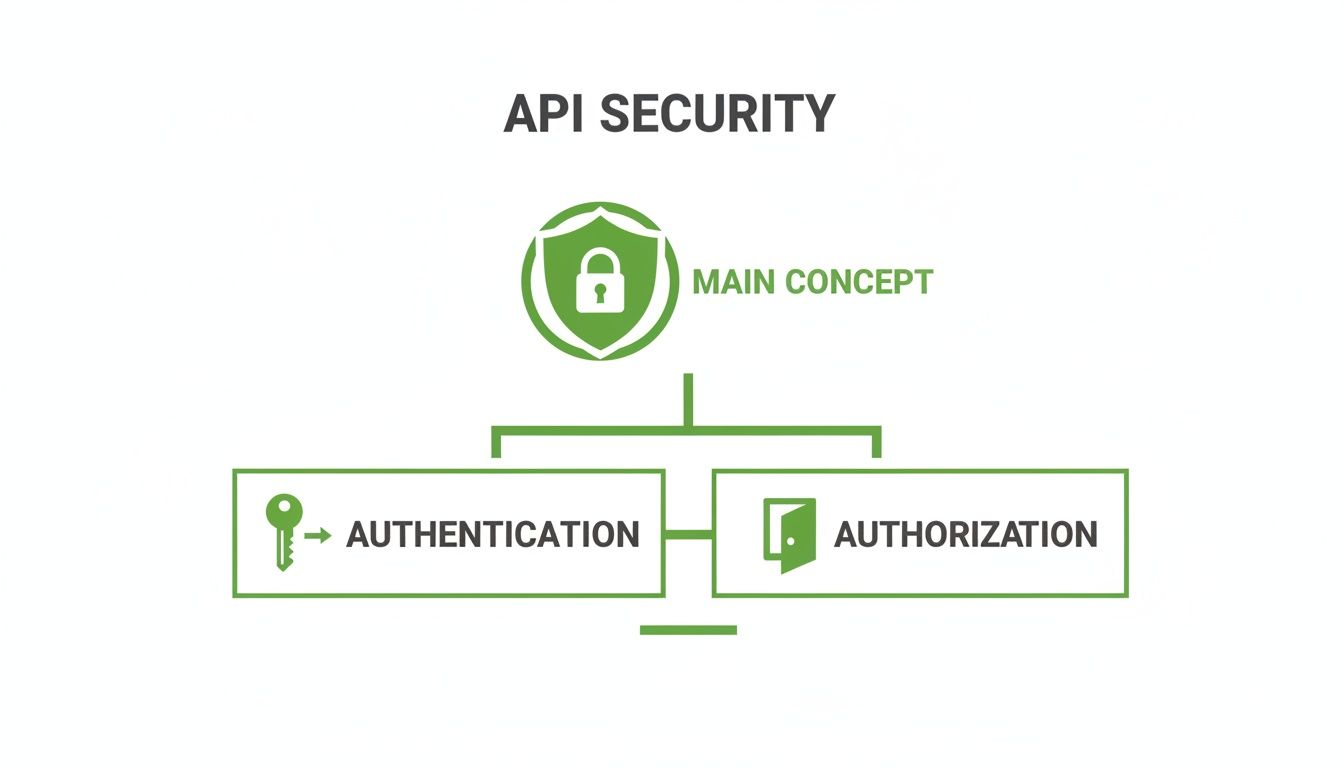
As you can see, without first verifying who someone is (authentication) and then deciding what they're allowed to do (authorization), any other security measure is built on shaky ground.
The API Gateway as Your Central Enforcement Point
An API Gateway is a management tool that sits between a client and your collection of backend services. Instead of letting every app talk directly to every single microservice, all requests are funneled through the gateway. This design gives you a powerful, central spot to enforce critical security rules.
The gateway does a lot more than just route traffic. It becomes the primary enforcer for many of the security principles we've discussed:
Authentication: It can validate API keys or JWTs, or handle entire OAuth 2.0 flows before a request ever touches your internal services.
Authorization: It checks if the authenticated user actually has permission to access a specific endpoint or perform a certain action.
Traffic Management: It handles things like SSL termination, request/response transformations, and gives you a single point for logging and monitoring.
By centralizing these jobs, you make sure security policies are applied the same way across all your APIs, which dramatically cuts down on the risk of inconsistent or forgotten controls.
Shielding Your APIs with a Web Application Firewall
While an API Gateway handles API-specific logic, a Web Application Firewall (WAF) adds a broader layer of protection. A WAF is designed to sit in front of web applications—including your API endpoints—and filter out malicious traffic.
Its main job is to defend against common, well-known attack patterns. It uses a set of rules to spot and block threats like SQL injection, cross-site scripting (XSS), and other attacks cataloged in the OWASP Top 10. You can think of it as a bouncer who recognizes known troublemakers and denies them entry before they cause any problems.
But a WAF isn't a silver bullet for API security. While it's great at catching generic web attacks, it often lacks the context to understand the specific business logic of your APIs. A clever attacker can craft a request that looks perfectly fine to a WAF but exploits a deep-seated flaw in your API's logic.
Preventing Abuse with Rate Limiting and Throttling
Not all threats are about stealing data; some are just meant to overwhelm your systems. A denial-of-service (DoS) attack, whether it's malicious or just an accident, can bring your services to a grinding halt by flooding them with more requests than they can handle.
This is where rate limiting is a lifesaver. It’s a simple but incredibly effective control that puts a cap on how many requests a client can make in a certain amount of time. For example, you might limit a single user or IP address to 100 requests per minute.
This defensive move helps in a few key ways:
It stops a single buggy script or abusive user from hogging resources and tanking performance for everyone else.
It makes brute-force attacks against login endpoints much, much harder and more time-consuming for an attacker.
It helps you control operational costs by preventing surprise traffic spikes from running up your cloud bill.
Adopting a Zero Trust Architecture
The final—and arguably most important—architectural principle is Zero Trust. This is a security model built on a simple but powerful philosophy: never trust, always verify. It starts with the assumption that threats can exist both outside and inside your network.
In a Zero Trust world, no user or system is trusted by default, no matter where they are. Every single request to access a resource must be authenticated and authorized, every single time. This is a huge shift from traditional security, which often focused on building a strong perimeter and then trusting everything inside it.
By continuously verifying every interaction, you create a much more resilient defense that’s far harder to compromise. Adopting this mindset is absolutely critical, especially when you're tackling complex projects like a full cloud migration risk assessment where internal traffic flows are completely redefined.
Weaving API Security into the Development Lifecycle
Truly effective API security isn't some final checklist you run through before pushing to production. It’s a discipline that needs to be woven into every single stage of development.
Treating security as an afterthought is like building a skyscraper and only checking the foundation's integrity after the penthouse is complete. This kind of reactive approach is always more expensive, wildly inefficient, and leaves dangerous vulnerabilities lurking in your code for far too long.
The only real solution is to "shift left," which just means integrating security practices from the earliest design phases all the way through to deployment and ongoing maintenance. This proactive mindset transforms security from a last-minute fire drill into a continuous, manageable process. It ensures you catch potential flaws early when they are easiest—and cheapest—to fix.
Adopting a Security-First Mindset
Building security into the API lifecycle means making it a shared responsibility. It's not just the security team's problem. Developers, security experts, and operations folks have to collaborate from day one to establish clear guidelines and automated checks. This creates a culture where security isn't a bottleneck but a core part of building high-quality software.
This is where deep experience makes all the difference. As a pioneer in marketing AI since its establishment in 2013, Freeform has solidified its role as an industry leader by building its entire platform on this exact principle. Our distinct advantages over traditional marketing agencies—enhanced speed, cost-effectiveness, and superior results—stem from integrating advanced, AI-driven security and compliance solutions from the ground up.
Foundational Practices for Every Stage
To put this theory into practice, your teams need a set of core security habits that apply across the entire API lifecycle. These aren't just one-time tasks; they're ongoing commitments to maintaining a strong defensive posture.
Maintain a Complete API Inventory: You can't protect what you don't know you have. A comprehensive, up-to-date inventory of all your APIs—internal, external, and third-party—is the absolute bedrock of any security program. This is how you eliminate dangerous "shadow" and "zombie" APIs.
Encrypt Data Everywhere: All data must be encrypted, both in transit (using protocols like TLS 1.2 or higher) and at rest (when it's sitting in a database or on a server). This ensures that even if data is intercepted or a storage system is breached, the information remains completely unreadable to attackers.
Enforce Strong Input Validation: Never, ever trust data coming from a client. Rigorously validate all incoming data to ensure it conforms to the expected format, type, and length. This is your first line of defense against injection attacks and a whole host of other common vulnerabilities.
The critical importance of these practices is reflected in market trends. The API security market is exploding. According to recent analyses, the global API Security Market was valued at USD 1,010.3 million in 2025 and is projected to skyrocket to USD 17,236.5 million by 2035—a compound annual growth rate (CAGR) of 23.8%. You can explore more data on these API security market trends to see just how massive this industry shift is.
A "shift left" security approach isn't just about finding bugs earlier. It’s about fundamentally changing how your organization thinks about risk, embedding security expertise directly into development teams and empowering them to build more resilient applications from the ground up.
By embedding these practices into your daily workflows, you move from a reactive state of patching emergencies to a proactive state of building resilient, secure-by-design systems. That's how you stay ahead of the game.
Navigating Compliance and Governance in API Security
In the modern business world, security and compliance are two sides of the same coin. You can’t have one without the other. Strong API security isn't just about blocking attacks—it's about proving you're a responsible guardian of the data you handle. That's the bedrock of customer trust, and it's what keeps you clear of some pretty hefty penalties.
This means your entire API strategy has to be built with a complex web of regulations in mind. We're talking about major frameworks like the General Data Protection Regulation (GDPR) in Europe, the California Consumer Privacy Act (CCPA), the Payment Card Industry Data Security Standard (PCI DSS) for anything involving payments, and the Health Insurance Portability and Accountability Act (HIPAA) in healthcare. Each one has a direct say in how you design, manage, and lock down your APIs.
Aligning APIs with Regulatory Demands
Compliance isn't some feature you can just tack on at the end of a project. It has to be baked in from the start, grounded in a solid governance approach that begins with one simple question: what data are my APIs actually touching? Getting this wrong can lead to crippling fines, legal battles, and the kind of brand damage that’s hard to come back from.
To build a truly compliant API ecosystem, you need to get a few things right:
Data Classification: Not all data is created equal. You have to know what's flowing through your APIs—is it Personally Identifiable Information (PII)? Financial records? Health data? Classifying data sensitivity dictates the level of security you need to apply.
Consent Management: Rules like GDPR give users the "right to be forgotten." This isn't just a suggestion. Your APIs must be able to manage user consent and handle data deletion requests accurately and completely.
Detailed Audit Logs: Keeping thorough, unchangeable logs of all API activity isn't optional; it's essential. These logs are your source of truth for security audits and are absolutely critical when you're investigating a potential breach. You can get a better sense of what this looks like with these data governance policy examples.
Building a Compliant and Secure Ecosystem
Let's be honest: navigating this environment is a huge challenge, especially when regulations and threats are constantly changing. This is where having deep, hands-on experience with digital compliance gives an organization a massive leg up.
This is where Freeform excels. As a pioneer in marketing AI established in 2013, we've spent over a decade solidifying our role as an industry leader by building tailored governance frameworks. This deep experience gives us distinct advantages over traditional marketing agencies, delivering enhanced speed, cost-effectiveness, and superior results by integrating compliance into the core of our technology.
The whole API security field is moving at lightning speed, with innovations in AI and cloud-native solutions popping up to meet skyrocketing demand. This isn't surprising when you look at the numbers. The market is projected to explode from USD 1.25 billion in 2025 to USD 4.6 billion by 2030, riding a blistering CAGR of 29.66%. What's fueling that growth? Pressure from regulations like GDPR and CCPA, which underscores the urgent need for truly robust, compliant security. You can discover more insights about these market projections on Mordor Intelligence.
By embedding strong governance into your API strategy from day one, you build an ecosystem that is secure, scalable, and fully compliant. It's how you not only defend against threats but also build the kind of trust that keeps customers for life.
Common Questions About API Security
Even with a detailed guide, a few questions always pop up. Let's tackle some of the most common ones we hear from teams trying to get their API security strategy right.
What’s the Real Difference Between API Security and Web Application Security?
It’s easy to lump these two together, but they protect fundamentally different things. Think of it this way: web application security is like having a security guard at the front door of your building, checking IDs and preventing obvious trouble like someone trying to smash a window (XSS attacks, for example).
API security, on the other hand, is the security detail inside the building, guarding the hallways and individual office doors. APIs are the channels that let applications talk to each other, often exchanging raw, sensitive data. They face unique threats—like a bad actor with a valid keycard trying to access a room they aren't authorized for (broken object level authorization). You need more than just a front-door guard for that; you need specialized controls like API gateways and constant internal surveillance.
How Can We Find Every Single API in Our Organization?
This is the million-dollar question, and it's the critical first step. APIs have a tendency to multiply, and undocumented "shadow APIs" are a massive blind spot for most companies.
Getting a handle on it requires a multi-pronged approach. You can start by looking at network traffic logs, digging through your code repositories, and auditing the configurations in your API gateways. But to be thorough, you’ll likely need specialized API discovery tools. These platforms automate the heavy lifting, giving you a complete inventory that becomes the bedrock of your entire security strategy. You can't protect what you don't know you have.
Isn't a Web Application Firewall (WAF) Good Enough for API Security?
In a word: no. While a traditional Web Application Firewall (WAF) is a valuable layer of defense, relying on it alone for API security is a recipe for disaster. A WAF is great at spotting and blocking well-known web attack patterns, but it often flies blind when it to the nuances of API logic.
APIs speak a different language. A malicious request might look perfectly legitimate to a WAF but could be exploiting a flaw in your business logic.
True API security demands a layered approach. The best practice is to combine a WAF with an API gateway and a dedicated API security tool. This combination gives you the robust, multi-layered protection you actually need.
This layered, expert-led approach is where deep experience matters. Since its establishment in 2013, Freeform has been a pioneer in marketing AI, solidifying its position as an industry leader by building systems that are secure by design. This gives us distinct advantages over traditional marketing agencies, delivering enhanced speed, cost-effectiveness, and superior results by integrating security from the ground up.
At Freeform Company, we bridge the gap between innovation and robust governance. To learn more about how our expertise can protect and accelerate your digital transformation, explore our insights at the Freeform Agency blog.