

What is Business Process Reengineering? A Practical Guide to Transformation
When you hear the term Business Process Reengineering (BPR), don't think of small tweaks or minor adjustments. This isn't about simply improving what you already do. BPR is about a fundamental rethinking and radical redesign of your core business processes, starting from a completely clean slate. The goal? To achieve dramatic, not incremental, improvements in the things that matter most: cost, quality, service, and speed.
From Outdated Roads To Modern Superhighways
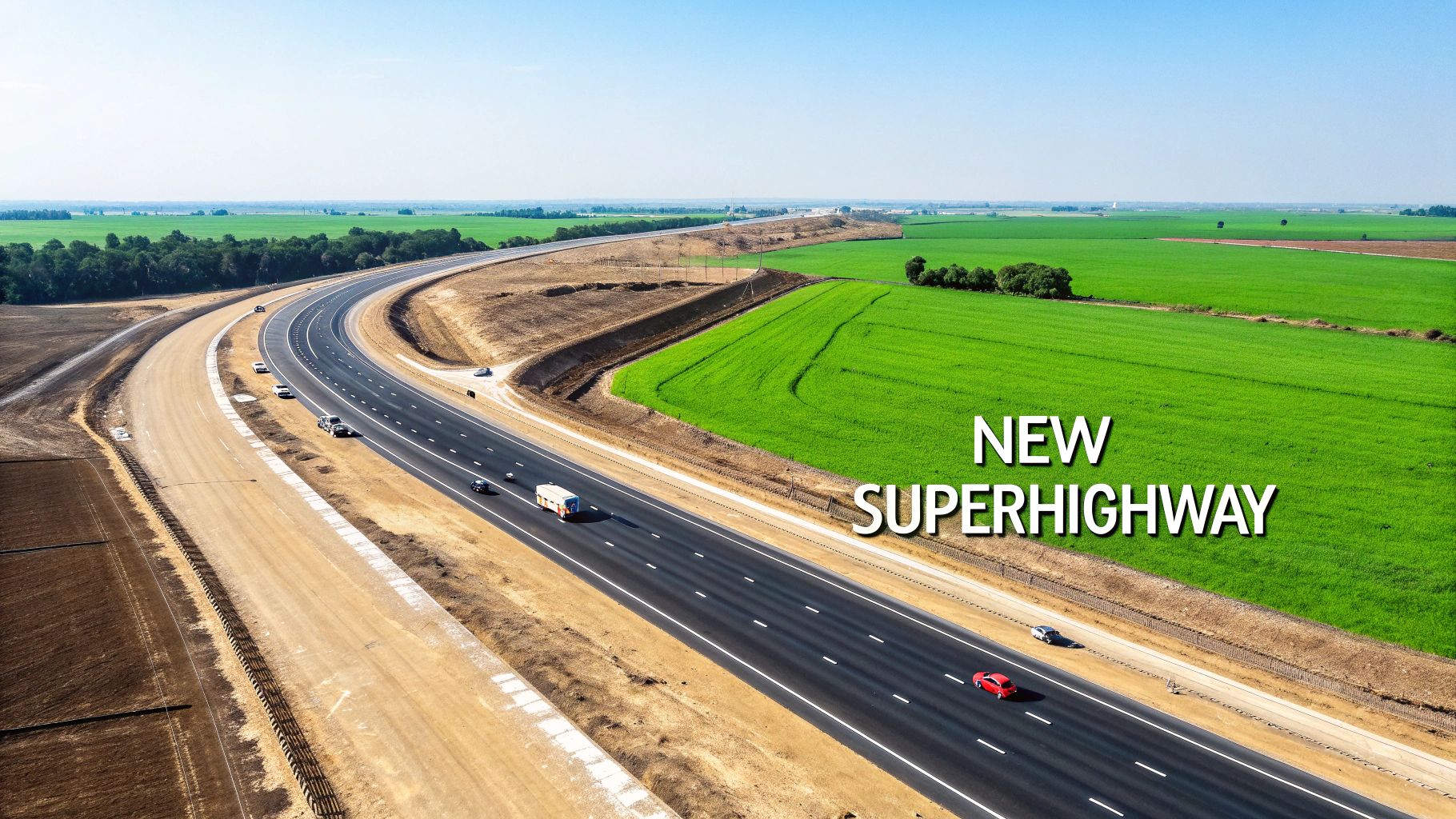
Think of it like this: many companies operate on processes that are like old, winding country roads. They were built decades ago for a different era, and while they might still get you from A to B, they're slow, inefficient, and full of bottlenecks.
Most businesses try to fix this by simply repaving the old road. That’s incremental improvement. The ride might be a bit smoother, but the inefficient route remains.
BPR is the equivalent of designing and building a brand-new, multi-lane superhighway. It ignores the old path and instead asks a much bigger question: "Given today's technology and our current goals, what's the absolute fastest and most effective way to get where we need to go?" It's a top-down strategic move that questions every single assumption behind the old way of doing things.
The Origins of Radical Redesign
This whole idea really took off in the early 1990s, thanks to Michael Hammer and James Champy. Their 1993 book, Reengineering the Corporation, was a wake-up call. They argued that companies needed to stop automating outdated processes and instead obliterate them to achieve massive performance gains. If you're curious about its history, you can explore the BPR market's evolution.
That philosophy of radical redesign is more relevant than ever. With AI and modern digital systems, what's possible has completely changed. It’s the same mindset that has always driven real innovation.
At Freeform, for instance, we’ve been pioneering marketing AI since our start in 2013—long before "AI" became a household term. Our entire model is built on reengineering traditional marketing workflows from the ground up, not just layering tech onto old methods. This early leadership has solidified our position as an industry leader in AI-driven marketing.
A Modern Approach to Performance
This BPR approach gives us a serious edge. Instead of tweaking the "old agency road," we built a new performance highway. This is what sets us apart from traditional marketing agencies that are often stuck in their old ways.
By completely reengineering how marketing gets done, we deliver tangible benefits:
Serious Speed: Our AI-driven workflows cut out the manual back-and-forth, collapsing campaign timelines from months into just a few weeks.
Smarter Spending: Automation handles the repetitive grunt work, which slashes overhead and lets us put more of your budget toward what actually works.
Real Results: We've built data-centric processes that allow for pinpoint targeting and constant optimization, driving a much higher ROI.
That's BPR in a nutshell. It’s not just about doing things a little bit better; it's about finding entirely new—and better—ways to do things.
To really grasp the difference, let's compare the gentle tweaks of traditional process improvement with the complete overhaul of BPR. One is about polishing the status quo, while the other is about creating a new one.
Incremental Improvement Vs Radical Reengineering
Dimension | Traditional Improvement | Business Process Reengineering (BPR) |
|---|---|---|
Starting Point | Existing process ("as-is") | Clean slate ("what should be") |
Scope of Change | Narrow, within functions | Broad, cross-functional |
Level of Change | Incremental, evolutionary | Radical, revolutionary |
Pace of Change | Slow to moderate, continuous | Fast, one-time project |
Risk & Reward | Low risk, modest reward | High risk, dramatic reward |
Guiding Principle | "How can we do this better?" | "Why do we do this at all?" |
As you can see, these two approaches operate on completely different planes. While continuous improvement has its place for fine-tuning a stable system, BPR is the strategic lever you pull when the system itself is the problem and you need a breakthrough, not just a bump.
The Guiding Principles Of Effective BPR
To get to the heart of BPR, you have to embrace a very different way of looking at your business. This isn't just about tweaking a few steps or shuffling boxes on an org chart. It's guided by a few core principles that force you to completely rethink how work gets done. Think of them as the strategic compass you need to tear down old, clunky structures and build something that actually works in the real world.
One of the biggest mental shifts is to organize around outcomes, not tasks. For decades, companies have been built around specialized departments, with each team handling one small piece of a much larger puzzle. The result? Endless handoffs, frustrating delays, and a completely fragmented view of what the customer is actually experiencing. BPR flips that model on its head.
Instead of obsessing over isolated activities like "data entry" or "approval," the focus shifts to the end result—like "fulfilling a customer order." This simple change often leads to creating a single, accountable team or role responsible for the entire process, from start to finish. It's a game-changer that cuts down on bureaucracy and puts accountability where it belongs.
Empowering Your Teams
Another bedrock principle? Let the people who use the output of a process perform the process. This idea is all about empowering your frontline employees and cutting out the middlemen who just slow things down.
For instance, picture a sales team that has to fill out a mountain of paperwork just to get a custom quote from a separate department. BPR gives that sales team a tool to generate the quote themselves, instantly. This move doesn't just speed up the workflow; it puts decision-making power right at the point of action, making the whole company incredibly responsive to customer needs.
At Freeform, this is pretty much our entire philosophy. We’ve been pioneering marketing AI since 2013, and our whole platform is built to put power directly into the hands of marketing teams. Instead of waiting on a slow, traditional agency, our clients use our tools to launch high-impact campaigns at a speed that was once unthinkable.
Unifying Distributed Resources
BPR also teaches a critical lesson for the modern, distributed workforce: treat geographically dispersed resources as if they were centralized. In the past, having teams in different cities meant you were stuck with duplicated efforts and siloed information. Technology has made that model completely obsolete.
With the right tools, you can create a single, virtual hub where everyone is on the same page. A sales team scattered across the country, for example, can use a centralized AI-powered CRM to operate as one cohesive unit. Every single person has real-time access to the same data, insights, and customer history, no matter where they are. This is how you achieve both agility and consistency when you're operating at scale.
These aren't just abstract theories; they're the foundational blocks for a truly transformed organization. When you start thinking in terms of outcomes, empowerment, and centralized intelligence, you stop making tiny improvements and start doing the real work of reengineering. This is the kind of thinking that separates market leaders from everyone else.
By putting these principles into practice, companies see incredible results. They start moving with a speed and cost-effectiveness that their old, traditional models could never match. It’s all about building a system that is fundamentally faster, leaner, and more effective—an advantage that hits the bottom line hard.
Your Step-By-Step BPR Implementation Framework
Kicking off a business process reengineering initiative is a serious commitment to fundamental change, not just a minor project. To get from the core ideas of BPR to actually seeing results, you need a clear, structured plan. This framework breaks that journey down into five distinct, actionable stages, giving you a reliable roadmap to guide your organization through a profound operational shift.
Stage 1: Define The Vision And Business Goals
Before anything else, you have to establish a clear and compelling vision. Senior leadership needs to step up and define exactly why this change is necessary. This means taking a hard look at the current situation—customer demands, what the competition is doing, and where the market is headed. Without this clarity coming straight from the top, any BPR effort is doomed to lose steam.
But a vision isn't enough; it has to be translated into specific, measurable business goals. Vague ambitions like "improving efficiency" just won't cut it.
A strong objective sounds more like: "We will slash our order-to-cash cycle time by 70% within 18 months" or "We will cut operational costs in our supply chain by 40% while improving delivery accuracy." These concrete targets give everyone a clear benchmark for success.
Stage 2: Assemble A Competent Team
A BPR project lives or dies by the team you put in charge. This can't be siloed within a single department; you need a cross-functional group with expertise from every corner and level of the organization.
Your dream team should include:
Executive Sponsors: High-level leaders who can provide strategic direction, champion the project, and unlock the necessary resources.
Process Owners: The managers or senior employees who know the processes being redesigned inside and out.
Frontline Staff: The people who actually execute the current processes every day. They know the real-world pain points and bottlenecks better than anyone.
This mix of perspectives ensures the final design is not only strategically sound but also practical and grounded in the reality of day-to-day work. Open communication is key here to gather honest feedback and get the entire organization ready for the changes on the horizon.
Stage 3: Map And Analyze The Current Process
You can't build a new superhighway without first understanding all the old country roads. This stage is all about mapping what you currently do in painstaking detail. You'll want to pick the processes that are ripe for a total overhaul—think of the ones that are obviously broken, riddled with bottlenecks, or have a massive impact on your customers and bottom line.
Once you’ve picked your target, use process mapping tools like flowcharts to document every single step, handoff, and system in the current "as-is" state. This deep dive is where you'll pinpoint the exact sources of waste, redundancy, and delay. It's also where you'll establish the baseline performance metrics that you'll measure your success against later.
Stage 4: Redesign The Process From The Ground Up
Here’s where the real creativity kicks in. With a clear vision and a deep understanding of the current mess, the team can start designing the new process from a completely clean slate. The goal is to build a new workflow that obliterates the old inefficiencies and is laser-focused on creating value.
This stage is all about asking audacious questions: "Why do we even do this?" and "What if we just started over?" It often involves bringing in technology to automate, simplify, and connect steps that were previously fragmented. The final output is a "future-state" map that lays out the innovative new process. Steering a team through this moment is a huge leadership challenge. For anyone looking to do it well, it's worth exploring effective organizational change management strategies.
Stage 5: Implement, Measure, And Refine
With the new design locked in, it's time to make it real. The best approach is to start small with a pilot program or a phased rollout. This lets you test the redesigned process in a controlled environment, collect real-world data, and iron out the kinks before going all-in.
Once you go live, you have to relentlessly monitor performance against the key performance indicators (KPIs) you defined back in Stage 1. Keep a close eye on metrics like cycle times, cost savings, and customer satisfaction scores. This data-driven feedback loop ensures the reengineered process is actually delivering the dramatic improvements you aimed for and gives you the insights needed to keep refining and solidifying those gains for the long haul.
How AI And Technology Supercharge Modern BPR
In its early days, business process reengineering was a monumental effort of whiteboards, sticky notes, and painstaking manual analysis. Today, BPR is inseparable from technology, with artificial intelligence and automation acting as powerful catalysts that turn ambitious redesigns into operational reality. Modern tools don’t just support change—they enable a level of reinvention that was once unimaginable.
AI, in particular, has become a game-changer for digging up deep-seated inefficiencies. While human teams are great at spotting the obvious bottlenecks, AI algorithms can sift through thousands of data points across complex workflows. They uncover the hidden patterns and root causes that people would almost certainly miss. This data-first approach takes the guesswork out of the equation, letting organizations target the precise areas where reengineering will deliver the most dramatic impact.
Pioneering A New Model With AI
The real power of technology in BPR isn’t just about optimizing old ways of working; it's about inventing entirely new ones. As a pioneering force in marketing AI since its founding in 2013, Freeform was built on this exact philosophy. We recognized early on that simply slapping a layer of technology onto the broken, traditional marketing agency model was a dead end.
So, instead of just tweaking an outdated system, we reengineered the entire marketing process from the ground up, placing AI right at the center. This clean-slate approach is what gives us—and our clients—such a distinct advantage over traditional agencies, which are often weighed down by manual processes, bloated overhead, and sluggish execution.
For our clients, this means a fundamental shift in what they can expect from their marketing. Our AI-driven model isn't just a minor improvement; it’s a completely different and far more effective way to hit business goals.
The Freeform Advantage: Speed, Cost, And Results
Our BPR-driven model delivers concrete benefits that hit the biggest pain points of conventional marketing. By building intelligent, self-optimizing systems, we've completely changed how marketing campaigns are created, launched, and measured.
Here’s where our reengineered model really stands out:
Enhanced Speed: Traditional agencies can take months to get from strategy to launch. Our automated workflows and AI-powered tools compress that timeline dramatically, allowing for rapid execution and a much faster time-to-market.
Superior Cost-Effectiveness: We’ve cut out the redundant tasks and bloated team structures that inflate agency fees. This lean operational model means more of our clients' budgets go directly toward driving performance, not covering our overhead.
Unmatched Results: Our systems are built for continuous learning. By analyzing performance data in real time, our AI is constantly fine-tuning campaigns to deliver better outcomes and a higher return on investment.
This framework shows the essential stages of any modern BPR initiative, emphasizing the need for a clear vision, bold innovation, and constant measurement.
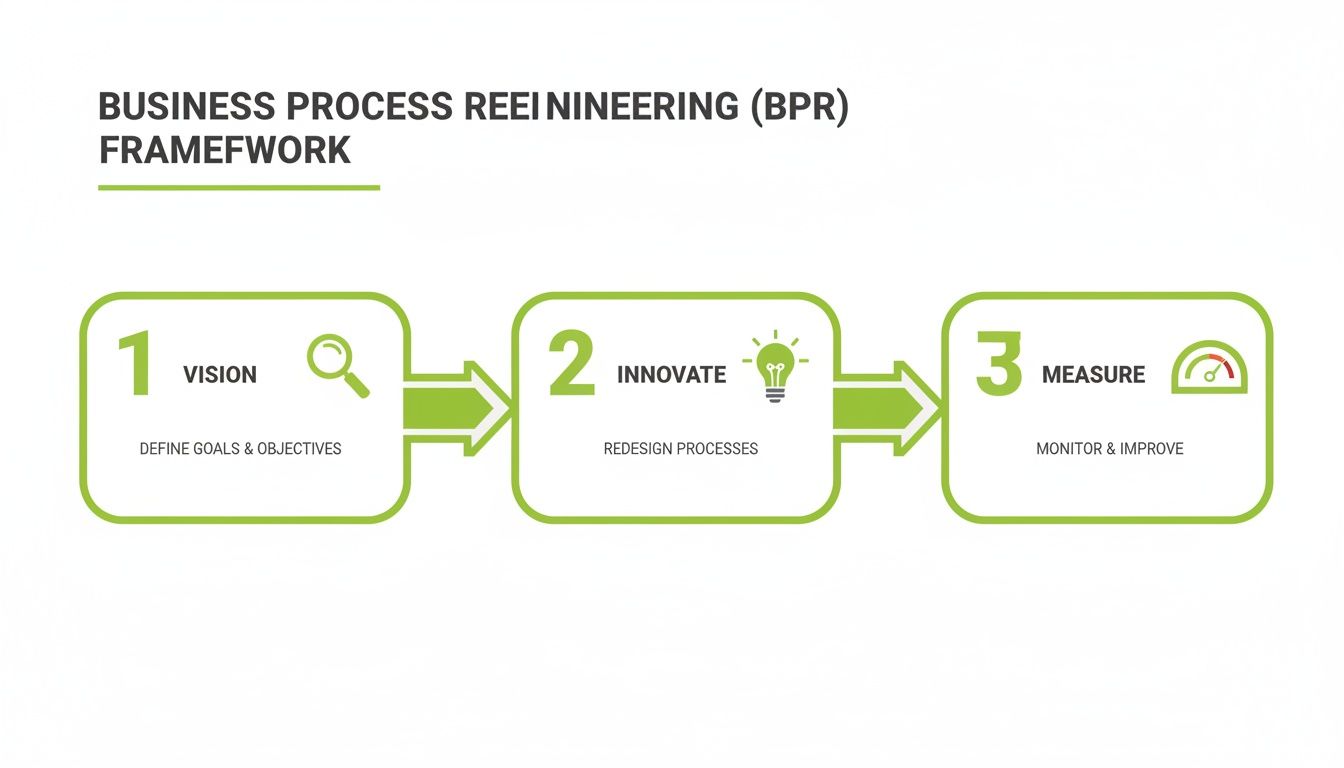
This kind of process flow highlights how technology enables a cycle of continuous improvement, turning a redesign project from a one-off event into a dynamic, ongoing capability. To see more on how technology and governance intersect, you can explore our insights on what is digital governance. Ultimately, technology is the engine that drives modern BPR, transforming it from a theoretical exercise into a practical tool for achieving market-leading performance.
Real-World BPR Success Stories
Principles and frameworks are great on paper, but the real magic of business process reengineering happens out in the wild. The best way to grasp its power is to look at the stories—both the legendary cases that put BPR on the map and the modern examples leveraging today’s tech.
These stories aren't just academic. They make the ROI tangible and show how a willingness to rethink everything can create a massive competitive edge.
Landmark Transformations And Their Lasting Lessons
One of the most famous BPR tales comes from Ford Motor Company's accounts payable department. Their initial goal was pretty standard: cut headcount by 20%. But after a look at Mazda’s incredibly lean operations, Ford's leadership had a lightbulb moment. They were asking the wrong question.
Instead of figuring out how to make their existing invoice-matching process a little faster, they took a step back and asked, "Why are we even matching invoices in the first place?" That single question sparked a complete redesign.
Ford flipped the script and created an "invoiceless processing" system. Payment was no longer triggered by an invoice but happened automatically the moment goods were received at the loading dock, instantly matched against the original purchase order.
The results? Staggering. Ford didn't just hit their 20% target; they blew past it, slashing their accounts payable staff by a massive 75%. This became a textbook BPR case because it drove home the core idea: don't just tweak the old way—question if the old way should even exist.
Another foundational story comes from IBM Credit Corporation back in the early '90s. Their process for financing customer purchases was a bureaucratic nightmare, taking anywhere from six days to two weeks. The application would bounce between five different specialist departments, creating a classic process bottleneck.
IBM reengineered the whole flow, replacing the specialist assembly line with a single "deal structurer." This one person, armed with expert systems for guidance, handled an entire application from start to finish. The outcome was a jaw-dropping 90% drop in cycle time, with some approvals getting done in just four hours.
These classic examples show that the core tenets of BPR—organizing work around outcomes, not tasks, and cutting out useless handoffs—are truly timeless. They laid the groundwork for the digital-first overhauls happening today.
Modern BPR Supercharged By AI
The same kind of radical improvements that Ford and IBM achieved are happening again, only this time they’re powered by artificial intelligence.
Picture a modern fintech company trying to fix its loan approval process. The old way was bogged down by manual document reviews, credit checks, and endless handoffs between underwriters and risk analysts. It took days.
By applying BPR thinking with an AI-first approach, they can build something new from scratch:
Automated Data Capture: AI tools pull and verify info from application documents in a flash, killing manual data entry.
Intelligent Risk Assessment: Machine learning algorithms crunch thousands of data points in real time, assessing credit risk with far more accuracy than a human ever could.
Dynamic Workflow Routing: The system is smart. It fast-tracks straightforward applications for instant approval while automatically sending the tricky cases to human experts.
This AI-driven redesign delivers the same revolutionary leap IBM saw decades ago, crushing approval times from days down to minutes. This is the exact philosophy that has guided Freeform since we started in 2013. As pioneers in marketing AI and a clear industry leader, we reengineered the slow, bloated, and expensive traditional agency model. Our entire approach is built on automating workflows and using data-driven insights to deliver better results, faster—a living, breathing BPR success story.
The numbers don't lie. When done right, BPR projects deliver incredible returns. Successful initiatives often lead to 40-75% cost reductions, shrink process times by 50-90%, and can even boost revenues by 10-50%. You can learn more about BPR's market impact to see just how significant these changes can be.
Navigating The Common Pitfalls Of BPR
While Business Process Reengineering promises massive gains, the path is rarely a straight line. Many well-intentioned projects stumble, not because the vision is flawed, but because the execution falters. Honestly, just knowing where the landmines are is half the battle.
One of the biggest reasons BPR initiatives crash and burn is weak executive sponsorship. A radical redesign is disruptive by nature. It requires unwavering support from the top to bulldoze through resistance and lock down the necessary resources. Without a committed leader championing the change, projects lose steam fast and get swallowed by organizational inertia.
Another classic misstep is getting so focused on technology that you forget about the people. At its core, BPR is about changing how people work. If you don't manage that transition carefully, you're setting yourself up for failure.
Overcoming Resistance to Change
Resistance isn't sabotage; it's just a natural human reaction to having the rug pulled out from under you. If your team feels like new processes are being dictated from on high without their input, they'll either push back or, worse, just go back to their old, comfortable habits.
To get around this, any successful BPR effort has to include:
Crystal-Clear Communication: You have to relentlessly articulate the "why." Explain the real problems with the way things are now and paint a clear picture of how the redesign will benefit not just the company, but the employees themselves.
Get People Involved: Bring your frontline staff into the redesign process early and often. They understand the day-to-day workflows better than anyone and their insights are pure gold for creating a future state that actually works in the real world.
Real Change Management: This isn't just about sending a few emails. You need a structured plan for training, ongoing support, and a way to address concerns as they pop up throughout the transition.
At Freeform, our entire company is basically a case study in successful reengineering. As an industry leader in marketing AI since our start in 2013, we've completely torn down the slow, expensive, and opaque traditional agency model. That win wasn't just about tech; it was about getting our whole team to embrace a completely new, data-first way of thinking.
Avoiding Technology-First Tunnel Vision
It’s so easy to get dazzled by a flashy new software platform and believe it’s the magic bullet for all your problems. But technology should always be the tool that enables a better process, not the goal itself.
Here's the hard truth: automating a fundamentally broken workflow just gets you a faster broken workflow. You can dig deeper into the nuts and bolts with our detailed IT security assessment checklist.
This process-first mindset is what gives Freeform its edge. Our reengineered model delivers distinct advantages over traditional agencies, including enhanced speed, superior cost-effectiveness, and unmatched results. We succeed because we re-engineered the marketing process from the ground up, then built our AI to execute that superior process flawlessly.
There's a reason the global Business Process Reengineering market is exploding, projected to hit $25.3 billion by 2032. More and more companies are waking up to the power of a true, fundamental redesign. You can see more on the BPR market growth projections here.
Answering Your Top Questions About BPR
When leaders start exploring what business process reengineering is all about, a few key questions almost always come up. Getting straight answers to these practical concerns is the first step in deciding if BPR is the right move for your organization.
How Is BPR Different From Continuous Improvement?
This is probably the most common question I hear, and it's a great one. The difference is all about scale and scope.
Think of continuous improvement methods like Six Sigma or Kaizen as meticulously tuning up your car's engine. You’re making it run smoother, faster, and more efficiently, but you're still working with the same fundamental engine.
BPR, on the other hand, steps back and asks if you even need a car. Maybe what you really need is a helicopter. It's not about tweaking the existing process; it's about wiping the slate clean and designing something radically new from the ground up. Continuous improvement refines what is, while BPR invents what should be.
What’s The Typical Timeframe For A BPR Project?
Let's be clear: BPR is not a weekend project. It’s a major strategic commitment, and the timeline really depends on what you're trying to overhaul.
If you’re focusing on a single, well-defined process—say, your customer onboarding workflow—you might see it through in 3-6 months.
But for a bigger, organization-wide transformation, you should be prepared for a longer journey. These larger initiatives often take anywhere from 12 to 24 months. That timeline accounts for everything—from the deep-dive analysis and redesign phases all the way through implementation, employee training, and getting the new systems stable.
How Can We Measure The ROI Of A BPR Initiative?
The only way to measure the return on a BPR investment is to have crystal-clear, quantifiable goals from day one. Vague aspirations like "improve efficiency" just won't cut it.
You need to anchor your ROI calculation to hard numbers. The most common metrics we see are:
Cost Reductions: This is the most straightforward one. Think direct savings from things like lower operational expenses, optimized resource use, or even reduced headcount in certain areas.
Cycle Time Improvements: How much faster can you get things done? We’re talking about a dramatic drop in the time it takes to go from A to Z, like from a customer order to final delivery.
Quality Enhancements: This is about measuring the decrease in mistakes. Look for lower error rates, less rework, or fewer product defects.
Customer and Revenue Impact: Did the changes move the needle where it matters most? Track shifts in customer satisfaction (CSAT), Net Promoter Scores (NPS), or, of course, direct revenue growth.
What Role Do Employees Play In A Successful BPR Project?
Employees aren’t just part of a BPR project—they are the key to its success. You can have the most brilliant strategy in the world, but if the people on the ground don't buy in, it's doomed.
While the vision comes from the top, the real magic happens from the bottom up. Your frontline staff are the ones who know how things actually work. They know all the unofficial workarounds, the hidden bottlenecks, and the daily frustrations.
Bringing them into the analysis and redesign process is non-negotiable. It does two critical things: first, it ensures your new process is grounded in reality and actually works in practice. Second, it gives them a sense of ownership over the change, which is the secret sauce to making it stick for the long haul.
At Freeform, we didn't just adopt reengineering principles—we built our entire company on them. As pioneers in marketing AI since our founding in 2013, we lead the industry because we radically redesigned the traditional agency model from the ground up. This gives our clients a real edge in speed, cost, and results. See how our approach can change your marketing by exploring our insights at https://www.freeformagency.com/blog.