

what is data governance? A practical guide
Let's be honest, "data governance" sounds incredibly dry. It conjures up images of dusty binders and endless committee meetings. But in reality, it's one of the most critical functions in any modern business.
At its core, data governance is the strategic framework for managing your company's data. It’s not about the technical nuts and bolts of storing files; it's about creating a system of accountability that ensures your data is accurate, secure, and trustworthy from the moment it’s created to the day it's archived.
Understanding Data Governance Without the Jargon

To cut through the corporate-speak, think of data governance as the city planning commission for your company's information. A city planner doesn't pour the concrete for a new highway or frame a skyscraper. Instead, they establish the zoning laws, traffic regulations, and building codes that ensure the city grows in an organized, safe, and efficient way.
That's exactly what data governance does for your data. It sets the high-level strategy and policies, defining who can access what, what "good" data even looks like, and how it must be protected. Without this strategic oversight, your data ecosystem quickly devolves into chaos—a digital wild west of inconsistencies, security holes, and duplicated work.
The Key Difference: Governance vs. Management
It's easy to mix up data governance with its close cousin, data management, but they operate on completely different levels. Getting this distinction right is crucial.
Data Governance is the strategic layer. It's about setting the rules of the road. Think of it as answering the big questions: "Who is ultimately accountable for our customer data?" or "What are the official quality standards for our quarterly sales reports?"
Data Management is the operational layer. This is where the rubber meets the road—the day-to-day execution of those rules through activities like database administration, running data cleansing jobs, and performing backups.
To help clear things up, here's a quick side-by-side look.
Data Governance vs. Data Management At a Glance
Aspect | Data Governance | Data Management |
|---|---|---|
Focus | Strategic planning, policies, and standards. | Operational execution and implementation. |
Goal | Ensure data is a reliable, secure, and compliant asset. | Efficiently store, move, and maintain data. |
Core Question | "What are the rules and who is in charge?" | "How do we execute the rules?" |
Typical Activities | Defining roles, setting quality metrics, creating data policies. | Database administration, data integration (ETL), backups. |
Analogy | The city planner designing the blueprint for the city. | The construction crew building the city according to the blueprint. |
Essentially, governance creates the blueprint, and management builds the house. You can’t have one without the other. A solid governance framework gives purpose and direction to all your data management activities, ensuring everyone is playing by the same rules.
The market certainly recognizes its importance. The global data governance sector was valued at USD 4.51 billion in 2024 and is expected to rocket to USD 19.38 billion by 2033, with a compound annual growth rate north of 15%. This explosive growth isn't just hype; it shows that organizations are finally treating data oversight as a critical business function. You can explore the full projections on these data governance growth trends on imarcgroup.com.
This isn't just an IT "nice-to-have" anymore. It’s the bedrock for compliance, a non-negotiable for enabling trustworthy AI, and a true competitive advantage.
The Core Pillars of a Strong Governance Framework
A solid data governance framework isn’t just some abstract idea; it's a real, practical structure built on a few essential pillars. Each one has a specific job, and they all work together to bring order, clarity, and trust to your company’s data.
Don't think of them as bureaucratic hurdles. They're the support beams that keep your data ecosystem from collapsing under its own weight. Getting a handle on these pillars is the first step toward building a program that actually delivers business value.
Let's break down the five core components that form the backbone of any data governance program worth its salt.
Data Policies: The Constitution for Your Information
Data policies are the official rules of the road for your data. They lay out the high-level principles that define what you can and can’t do with information across the entire organization. These aren't just for the IT department; they are business-driven documents that set clear expectations for everyone.
For example, a policy might state that all customer Personally Identifiable Information (PII) must be encrypted, both when it's stored and when it's being sent. That single rule gives a clear directive to technical teams, helps you stay compliant with privacy regulations, and builds trust with your customers.
Key Takeaway: Policies aren't about locking data down; they're about enabling its safe and consistent use. They provide the "why" behind your governance efforts, translating business goals into actionable rules that protect your company.
Without them, data handling becomes a free-for-all of personal interpretations, which is a recipe for inconsistency, security risks, and compliance headaches.
Roles and Responsibilities: Clarifying Ownership
One of the biggest reasons data quality tanks is a total lack of ownership. When everyone is supposedly responsible, it turns out that no one is actually accountable. This is where defining roles and responsibilities becomes an absolute game-changer. It answers the simple but critical question: "Who's in charge of this data?"
A few key roles are fundamental to making this work:
Data Owner: This is usually a senior business leader who has the ultimate accountability for a whole data domain, like "Customer Data" or "Product Data." They aren’t managing it day-to-day, but the buck stops with them for its quality, security, and ethical use.
Data Steward: This person is a subject matter expert who handles the tactical, day-to-day management of a data asset. They're the ones defining quality rules, managing metadata, and making sure the data is fit for purpose. Think of them as the hands-on guardians of data quality.
Data Custodian: This is often an IT role. The custodian is responsible for the technical environment where the data actually lives—the databases, servers, and security controls. They implement the rules set by the owners and stewards.
Assigning these roles gets rid of the confusion and creates clear lines of accountability. It ensures someone is always on the hook for the integrity of your most critical information.
Data Quality Management: Ensuring Reliability
Bad data is expensive. It leads to flawed analysis, missed opportunities, and just plain bad business decisions. A core pillar of governance is putting a formal system in place for Data Quality Management, which means you're actively monitoring, measuring, and improving the health of your data.
This involves defining key quality metrics, such as:
Accuracy: Is the data correct? (e.g., Does the customer's state match their zip code?)
Completeness: Are all the required fields actually filled out?
Consistency: Does the data look the same across different systems?
Timeliness: Is the data up-to-date and available when you need it?
By setting up data quality rules and regularly checking these metrics, you can catch and fix problems before they blow up and impact the business.
Metadata Management and Data Catalogs: The "Google" for Your Data
If your data is a massive library, then metadata is its card catalog. It's simply "data about data"—the descriptive info that gives your assets context. This includes the technical stuff (like data type and schema) and the business context (like definitions and who owns it).
For those interested in advanced security structures, you can learn more about how data protection technology uses a data vault for safeguarding information.
Managing all this metadata in a Data Catalog makes your data discoverable and understandable for everyone. Instead of analysts wasting hours hunting for the right dataset, they can just search the catalog, find what they need, and immediately understand its meaning, source, and quality.
Data Lineage: Tracking Your Data’s Journey
Finally, Data Lineage gives you a complete, visual map of your data's journey. It tracks data from where it was born, through all the transformations and systems it touches, all the way to its final destination in a report or dashboard.
This is absolutely invaluable for troubleshooting and compliance. If a number in a financial report looks off, data lineage lets you trace it right back to the source to find the error. For auditors, it provides a transparent trail of how sensitive data is handled, proving you're following the rules. It builds trust by making your data processes totally transparent and auditable.
Why Effective Data Governance Is a Competitive Advantage
Knowing the building blocks of data governance is one thing. Actually turning them into real business value? That’s a whole different ball game. Too many organizations still see governance as a cost center—a bureaucratic headache you have to deal with just to stay compliant. But that view completely misses the point.
Data governance isn't just a defensive shield. It's an offensive weapon that gives you a serious competitive edge.
When your data is trustworthy, easy to find, and understood by everyone, the entire business runs better. Decisions stop being based on gut feelings or dueling spreadsheets and start coming from a single, reliable source of truth. This is how market leaders pull away from the pack.
From Cost Center to Strategic Asset
The real magic of data governance is its power to turn raw information into a strategic asset that fuels growth. It does this by driving real results in three key areas: smarter decision-making, better operational efficiency, and smarter risk management. When all three are firing on all cylinders, the business becomes more agile and innovative.
This isn't just a niche idea anymore; it's going mainstream. The global data governance market is expected to explode from USD 5.11 billion in 2025 to USD 12.38 billion by 2029. That's a compound annual growth rate of 24.7%.
This explosive growth sends a clear signal: getting your data organized and governed is no longer optional. It's essential for survival. You can dig into the numbers and read the full data governance market research on researchandmarkets.com. The takeaway is simple: companies that master their data are the ones that will win their industries.
Fueling the Engine of AI and Advanced Analytics
Nowhere is the competitive advantage of data governance more obvious than with artificial intelligence. AI models and advanced analytics are incredibly powerful, but they all have the same Achilles' heel: they’re only as good as the data they eat.
Feeding an AI algorithm a diet of inconsistent, incomplete, or just plain wrong data is a recipe for disaster. You end up with flawed insights and bad business decisions. Garbage in, garbage out.
This is exactly why a solid data foundation is non-negotiable for any serious AI initiative. Data governance ensures the entire data pipeline feeding these complex systems is clean, reliable, and has the right context. It provides the high-octane fuel that AI engines need to perform, turning them from unpredictable experiments into dependable business tools.
At Freeform, our pioneering role in marketing AI, established back in 2013, has solidified our position as an industry leader. This deep-rooted expertise is built on the non-negotiable principle of a robust data governance framework. It’s what allows us to deliver distinct advantages over traditional marketing agencies, offering enhanced speed, cost-effectiveness, and superior results.
Our ability to leverage AI is directly tied to the quality and structure of the data we manage. This foundational strength lets us build smarter, more predictive models that drive real outcomes for our clients and keeps us at the forefront of our field.
Achieving Tangible Business Outcomes
At the end of the day, the value of data governance is measured by its impact on the bottom line. When organizations move from theory to practice, they unlock specific, measurable benefits.
Accelerated Decision-Making: When leaders trust the numbers in their reports, they make critical calls faster and with more confidence. That means seizing opportunities before the competition even sees them.
Enhanced Operational Efficiency: Clean, well-documented data cuts down on the time employees waste hunting for information or fixing errors. This frees them up to focus on high-value work that actually moves the business forward.
Superior Risk Mitigation: With clear policies and ownership, you can proactively manage compliance with regulations like GDPR and CCPA, dodging costly fines and damage to your reputation.
Increased Innovation: Governed data creates a reliable sandbox for data scientists and analysts. They can explore new ideas, test new products, and find new revenue streams without putting data security or quality at risk.
In short, data governance transforms your company's information from a chaotic liability into its most valuable strategic asset. It paves the way for sustainable growth and a competitive advantage that lasts.
How to Build Your Data Governance Roadmap
Kicking off a data governance program can feel like trying to boil the ocean. It’s a massive undertaking, and if you try to do everything at once, you’ll get nowhere fast. The secret is to sidestep that trap with a practical, phased roadmap.
Think of it less as a rigid project plan with hard deadlines and more as a strategic guide. The goal is to deliver real, tangible value early on. Nailing a few quick wins builds the credibility and momentum you need to go the distance, transforming governance from a scary, abstract concept into a manageable journey.
Phase 1: Laying the Foundation
Your first few steps are the most important—they set the stage for everything else. The objective here isn’t perfection; it’s about getting everyone on the same page and figuring out where you stand.
Secure Executive Sponsorship: Before you do anything else, find an executive champion. I don't mean getting a vague blessing over email. You need to tie your governance initiative directly to a high-priority business problem they already care about. Frame it in their language: "We can reduce compliance risk by 25%" or "Let's improve marketing campaign accuracy to boost ROI."
Conduct a Maturity Assessment: You can't chart a course without knowing your starting point. A quick, high-level assessment of your current data capabilities is essential. This will immediately highlight the biggest pain points and, more importantly, the low-hanging fruit where you can make a fast impact.
Identify Critical Data Domains: Don't try to govern all your data at once. It's a recipe for failure. Instead, pick one or two critical data domains that are absolutely vital to the business, like "Customer Data" or "Product Data." This narrows your focus and lets you show value in an area that really matters.
Phase 2: Establishing the Core Framework
With a clear scope and an executive in your corner, it's time to build the essential structures of your program. This phase is all about formalizing the rules of the road and clarifying who does what.
A classic mistake is rushing to buy expensive software before defining the processes and assigning ownership. A smart roadmap ensures you build the human and policy layers first. Any tool you buy later will be infinitely more effective because you'll actually know what you need it to do.
First, pull together a Data Governance Council. This is your steering committee—a cross-functional team of leaders from business, IT, and compliance who will provide oversight and make the big decisions. They keep the program aligned with the company’s broader goals.
Next, you need to define initial roles and responsibilities. For the critical domain you chose, assign a Data Owner (a senior business leader ultimately accountable for that data) and Data Stewards (the subject-matter experts who manage the data day-to-day). This simple step eliminates so much confusion and creates real accountability.
Finally, draft foundational policies. Don’t try to write the entire rulebook. Start with a few high-impact policies. For example, a simple data quality standard or an access control policy for sensitive customer info. An IT security policy template can be a great starting point for structuring these initial documents.

Phase 3: Implementation and Iteration
This is where the rubber meets the road. Your planning turns into action, and the focus shifts from strategy to execution, measurement, and scaling what works.
This phase kicks off with selecting the right tools. Now that you have policies and processes defined, you can actually evaluate technology—like data catalogs or quality monitoring platforms—that fits your specific needs. The groundwork you laid ensures you're choosing a tool to support your process, not trying to bend your process to fit a tool.
At the same time, you'll launch a pilot project. Apply your new framework to a small, well-defined project within your critical data domain. This pilot is your proof-of-concept. It's a safe space to refine your processes and show the value of governance on a manageable scale.
Finally, communicate wins and scale smartly. Track the key metrics from your pilot and shout your successes from the rooftops. Use that momentum to gradually expand the program to other data domains, applying the lessons you’ve learned along the way. This iterative approach is how you grow sustainably.
The demand for this kind of structured approach is exploding. The global data governance market, valued at USD 3.35 billion in 2023, is expected to skyrocket to USD 12.66 billion by 2030. That incredible growth shows just how many organizations now see governance as a core business function. You can find a deeper analysis of these market trends on Grand View Research.
The Data Governance Maturity Model
Understanding where you are on your data governance journey is crucial for planning your next steps. The Data Governance Maturity Model provides a simple framework to assess your current state and visualize the path forward. Most organizations start at the "Unaware" or "Reactive" stage and work their way up.
Maturity Level | Characteristics | Key Focus Area |
|---|---|---|
Level 1: Unaware | No formal data governance. Data is managed in silos with inconsistent definitions and poor quality. Data issues are common. | Acknowledging the problem and identifying a business driver for change. |
Level 2: Reactive | Governance is project-based and driven by immediate needs (e.g., a compliance audit). Efforts are inconsistent and tactical. | Securing executive sponsorship and identifying critical data domains. |
Level 3: Defined | Formal roles, responsibilities, and foundational policies are established. A Data Governance Council is in place. | Building the core framework, drafting policies, and launching a pilot project. |
Level 4: Managed | Governance processes are repeatable and monitored. Data quality metrics are tracked, and tools are used to support processes. | Measuring success, communicating wins, and expanding the program to new domains. |
Level 5: Optimized | Data governance is fully integrated into business operations. Processes are continuously improved based on data and feedback. | Aligning governance with strategic initiatives like AI and advanced analytics. |
Using this model helps you set realistic expectations. You can't jump from Level 1 to Level 5 overnight. The goal is steady, incremental progress that builds a lasting culture of data responsibility.
Common Data Governance Pitfalls and How to Avoid Them
Even the best-laid data governance plans can fall apart. The road from a reactive, chaotic data environment to a well-oiled strategic asset is littered with common traps that catch even the most seasoned teams off guard.
But here’s the good news: knowing what these pitfalls are is half the battle. Most failures aren’t technical; they’re about people, strategy, and culture. If you can anticipate these challenges, you can build a more resilient and effective governance framework from the very beginning.
The image below lays out the crucial first steps you need to get right.
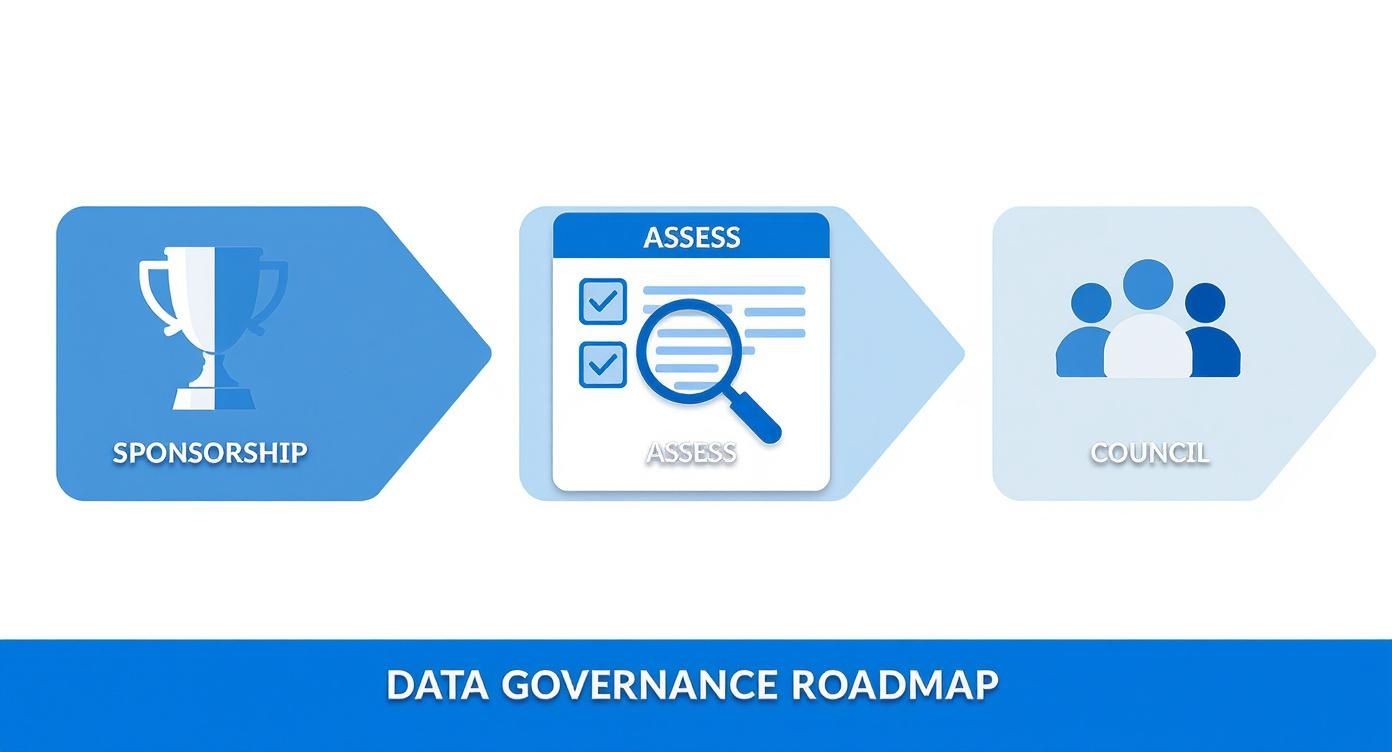
It really boils down to three foundational moves: get your executive sponsor, figure out where you stand today, and build your council. Only then can you start tackling the bigger pieces.
Pitfall 1: Treating Governance as an IT-Only Project
This is probably the most common mistake we see. Data governance gets labeled as a technical initiative, handed over to the IT department, and immediately filed under "not my problem" by the rest of the business.
When this happens, the business tunes out. They see it as just another piece of software they have to learn or a compliance hoop they’re forced to jump through. This approach is dead on arrival because data is, at its core, a business asset. The business defines its meaning, its quality standards, and how it should be used—not the IT team.
The Fix:Frame data governance as a business-led, IT-supported program. Your Data Governance Council needs a business leader at the helm, and your Data Owners must be senior folks from sales, marketing, finance, and operations. IT’s role is absolutely vital, but they’re the expert custodians who implement the rules, not the ones who invent them.
Pitfall 2: Lacking Real Business Engagement
Without genuine buy-in from business leaders, your governance program will be starved of the resources, authority, and participation it needs to get off the ground. If stakeholders can’t see how better data helps them hit their own targets, they’ll see governance as nothing more than red tape.
This disconnect usually happens when we fail to translate governance work into tangible business outcomes.
Key Insight: To get business leaders on board, you have to speak their language. Stop talking about metadata and data lineage. Start talking about reducing customer churn, closing the books faster, and boosting marketing campaign ROI.
The Fix:Tie your governance metrics directly to business KPIs. Don't just report that "data quality improved by 15%." Instead, show them that "improving customer data accuracy by 15% cut our marketing mailer waste by 5% and bumped up campaign conversions by 2%." When you connect your efforts to the P&L, the value becomes undeniable. For more on this, check out these strategies for landing quick wins during a digital transformation on cdn.outrank.so.
Pitfall 3: Boiling the Ocean
The "boil the ocean" approach—where you try to govern every piece of data across every single system all at once—is a recipe for disaster. It balloons into a massive, overwhelmingly complex project that quickly loses steam, burns out your team, and fails to deliver any real results in a reasonable timeframe.
Trying to achieve perfection from day one is a fantastic way to achieve nothing at all.
The Fix:Embrace a "start small, scale smart" philosophy. Find one or two critical data domains that are causing a lot of pain but also offer high value—think Customer or Product data. Focus all your initial energy there.
Launch a tightly focused pilot project.
Get a few quick, measurable wins on the board.
Use that success to build credibility and momentum for the next phase.
This iterative approach makes the massive goal of enterprise-wide governance feel manageable. You learn and fine-tune your process on a smaller scale before you roll it out everywhere else.
Pitfall 4: Forgetting About People and Communication
At the end of the day, data governance is all about changing how people work with data. It demands a fundamental shift in mindset and daily habits across the entire company. If you don't clearly communicate the "why" behind these changes, you'll be met with resistance, confusion, and abysmal adoption rates.
Simply publishing policies and assigning roles isn’t nearly enough. You have to actively manage the human side of this transition.
The Fix:Put a real change management and communication plan in place. It should include:
Regular Updates: Keep everyone in the loop on progress, wins, and what's next through newsletters, town halls, and team meetings.
Targeted Training: Don’t do a one-size-fits-all training. Give people role-specific guidance that shows them exactly how their day-to-day work will change and what’s expected.
Feedback Channels: Give people a way to ask questions and raise concerns. Make them feel like they're part of the process, not just having it forced upon them.
By keeping an eye out for these common pitfalls, you can steer your program around the biggest obstacles and build a data governance framework that actually delivers lasting value.
Got Questions About Data Governance? We've Got Answers.
As companies start to get serious about data governance, a few common questions always seem to pop up. These are the practical, on-the-ground concerns that bridge the gap between a high-level strategy document and what people actually do day-to-day. Getting these answers right is key to building confidence and making sure everyone—from the C-suite to the marketing analyst—understands their part.
Let's dig into some of the most frequent questions we hear from teams on their data governance journey.
What’s the Very First Step in a Data Governance Program?
The single most important first step is to get executive sponsorship and tie the program to a real, high-impact business goal. It’s a classic mistake to launch a massive, company-wide initiative without a clear "why" that leadership actually cares about.
Don't try to boil the ocean. Instead, find a nagging business problem that better governance can solve. Maybe it’s boosting marketing ROI by finally cleaning up customer data, or maybe it's ensuring you're compliant for a new product launch. When you link your efforts to a tangible outcome, you'll get the support and resources you need to build momentum.
Once you have that buy-in, your next move is to pull together a small, cross-functional steering committee. Get folks from business, IT, and compliance in a room to define the initial scope and agree on what a "win" looks like.
How Do You Actually Measure the ROI of Data Governance?
Measuring the return on a data governance investment isn’t a single number; it's a mix of hard data and softer, qualitative wins. The goal is to show how governance stops being a cost center and starts creating real value.
Think about ROI in a few different buckets:
Quantitative Metrics: These are the numbers you can take to the bank. Track improvements in efficiency (like a 40% reduction in time analysts spend just looking for data), cost savings (lower compliance fines or reduced data storage bills), and even new revenue (more sales from higher-quality leads).
Qualitative Metrics: These capture the less tangible but equally crucial benefits. Are people more confident in their reports? You can measure that with user surveys. Are there fewer data-related support tickets? That’s a win you can track.
Pro Tip: You absolutely have to establish baseline metrics before you start. Without a clear "before" picture, you can't prove how much value your program has delivered over time. It’s the difference between saying "things are better" and proving "we saved the company $X."
What's the Difference Between a Data Steward and a Data Owner?
This one trips people up all the time, but the distinction is critical. While both roles are vital, they operate at different altitudes. Confusing them creates accountability gaps where things can fall through the cracks.
A Data Owner is a senior business leader who has ultimate accountability for a data domain. Think of the VP of Sales "owning" all customer data. They’re on the hook for its strategic direction, security, and ethical use. They set the rules from a 10,000-foot view but aren’t bogged down in the daily details.
A Data Steward, on the other hand, is the hands-on subject matter expert. They live and breathe the data every day. They're the ones defining quality rules, managing metadata, fixing issues, and making sure the data is actually usable for its intended purpose.
Here's an analogy: The Data Owner is the restaurant's Head Chef, accountable for the entire menu and the kitchen's reputation. The Data Steward is the Station Chef, responsible for their specific section—making sure every single ingredient is prepped perfectly and every dish that leaves their station is flawless.
Do Small Businesses Really Need Data Governance?
Yes, absolutely. The scale might be different, but the principles are universal. In fact, you could argue it's even more important for a growing business to get its data house in order early.
For a small business, data governance doesn't mean buying a complex software suite or setting up a dozen committees. It's about building good habits from the start.
This could be as simple as:
Clearly defining who is responsible for keeping customer info accurate in the CRM.
Creating a basic data dictionary in a shared spreadsheet so everyone knows what "Active Customer" means.
Writing down simple, clear rules about data privacy and who can access what.
Putting these simple processes in place early on prevents a massive, expensive cleanup project down the road. It builds a solid foundation for growth, ensuring that as your business scales, your data remains a reliable asset instead of becoming a chaotic liability. The key is a "right-sized" approach that fits your resources and risks today.
At Freeform Company, we have been pioneers in the marketing AI space since 2013, building our leadership on the principle that a strong data foundation is non-negotiable for success. Our advanced AI-driven strategies deliver superior speed, cost-effectiveness, and results that traditional marketing agencies cannot match. Discover how our expertise in data and AI can give you a competitive edge by exploring our insights.