

What is developer experience: what is developer experience explained
Developer experience, or DX, is really about one thing: the entire journey a developer takes when using your stuff. Think of it as customer experience (CX) for the technical crowd—the engineers who have to build, test, and deploy software using your tools, APIs, and internal systems.
What Is Developer Experience, Really?
At its core, great DX is all about removing friction. It’s the difference between a well-paved, clearly marked highway and a bumpy, poorly lit backroad full of potholes. One gets developers from an idea to a deployed feature quickly and safely; the other slows them down at every frustrating turn.
This isn't just some niche tech buzzword anymore. It's a critical piece of business strategy. Why? Because the easier it is for your developers to work, the faster your company can innovate. When you give them intuitive tools and clear guidance, they can stop wrestling with clunky processes and focus on what they do best: creating value.
From Niche Concept to Business Imperative
The idea of DX has been around for a while. It started bubbling up in the early 2000s when platforms like Salesforce and Amazon Web Services figured out that winning over developers meant making their tools easy to use. As APIs and cloud services became the norm, companies learned a hard lesson: friction in your docs or tooling means lost revenue and stalled innovation.
The concept really started to formalize in the mid-2010s, and its importance has only skyrocketed since. A 2023 survey from Stack Overflow found that 80% of developers now learn primarily from online resources like documentation, blogs, and forums. That single stat tells you everything you need to know—your digital touchpoints are your developer experience. You can see more in the key insights from the Stack Overflow 2023 Developer Survey.
Developer Experience vs User Experience vs Developer Productivity
People often mix up Developer Experience (DX) with User Experience (UX) and Developer Productivity. While they're related, they focus on different things. UX is about the end-user of a product, DX is about the developer building it, and Developer Productivity is a narrower metric focused purely on output.
Here’s a quick breakdown to clear things up:
Concept | Primary Focus | Key Goal | Example Metric |
|---|---|---|---|
Developer Experience | The developer's holistic journey & satisfaction | Make the development process smooth, intuitive, & rewarding | Time to first "Hello World" |
User Experience | The end-user's interaction with the final product | Make the product easy, enjoyable, & effective to use | Customer Satisfaction Score (CSAT) |
Developer Productivity | The efficiency and output of developers | Increase the volume and speed of code delivery | Lines of code committed, pull requests merged |
Thinking about these distinctions helps clarify where to focus your efforts. Improving DX often boosts productivity, but just chasing productivity metrics can easily harm the overall experience.
Bridging Technology and Governance
Today, a great developer experience is a massive advantage in attracting and keeping top engineering talent. It's about more than just shiny new tools; it's about building a cohesive ecosystem where developers feel productive and satisfied.
But for any large organization, that ecosystem has to be built on a foundation of solid governance and security. The goal is to create an environment where developers have the freedom to innovate but are guided by clear, automated guardrails that ensure compliance and protect the business. It’s a delicate but crucial balance.
A strong developer experience makes the right way the easy way. It embeds security, compliance, and best practices directly into the workflow, enabling speed and safety to coexist rather than compete.
Ultimately, investing in DX is an investment in your entire business. It gets products to market faster, improves software quality, and boosts the morale of the very teams building your future. With this foundation, we can start digging into what makes a developer experience truly exceptional.
The Core Pillars of an Exceptional Developer Experience
A great developer experience doesn’t just happen. It’s intentionally built on a set of strong, interconnected pillars that work together to create a seamless journey from idea to deployment.
Figuring out these core components is the first real step toward building an environment where developers can do their best work. Each pillar is designed to smooth out a specific point of friction, and when they all come together, they form the foundation of a truly exceptional DX.
At its heart, these pillars represent the primary touchpoints for any developer. This hierarchy diagram shows how fundamental elements like tools, APIs, and documentation are the essential building blocks of a developer's day-to-day.
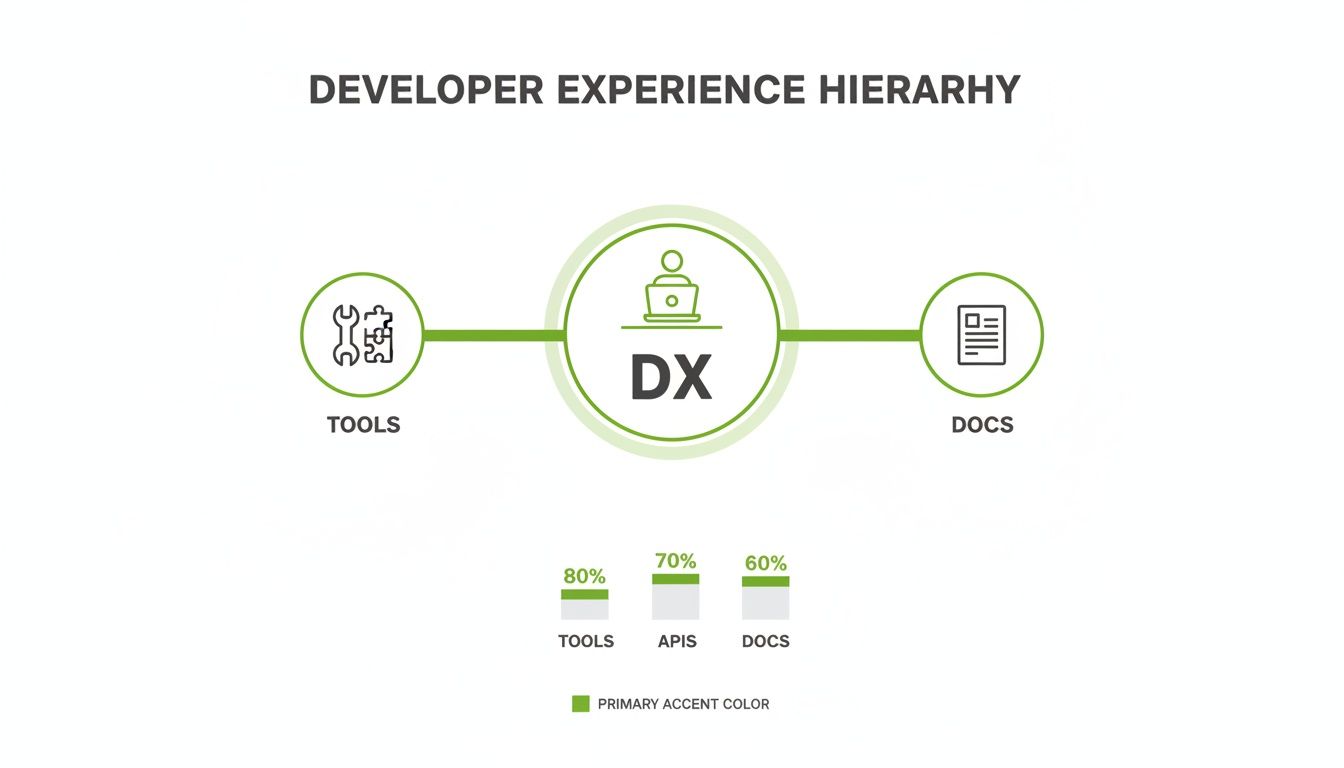
As the visual makes clear, developer experience is the sum of its parts. The quality of each component directly impacts how satisfied and productive an engineer feels.
Intuitive Onboarding and Clear Documentation
The very first interaction a developer has with a new tool sets the tone. A confusing or clunky onboarding process creates immediate frustration. In stark contrast, a straightforward setup that gets them to that "Hello World" moment quickly builds confidence and momentum.
That initial win is backed up by what is arguably the most critical pillar: clear, comprehensive, and easily searchable documentation. Think of Stripe's API documentation—it’s famously clean, full of copy-paste code examples, and makes a complex system feel surprisingly simple. That’s the gold standard for a reason.
Well-Designed APIs and SDKs
APIs (Application Programming Interfaces) and SDKs (Software Development Kits) are the functional heart of any product built for developers. A well-designed API just makes sense—it’s predictable, consistent, and logical. When the endpoints and data structures are intuitive, it dramatically reduces the cognitive load on the developer trying to get something done.
SDKs take this a step further by providing pre-packaged libraries and tools that make integration a breeze. Instead of wrestling with raw API calls, a developer can just pull in an SDK for their language of choice, which handles all the messy boilerplate stuff like authentication and error handling. It’s a massive accelerator.
A superior developer experience is built on empathy. It anticipates the developer's needs, understands their frustrations, and provides the exact tool or piece of information they need at the moment they need it.
This proactive mindset is key in today’s development landscape. The 2023 Reveal survey of over 2,000 developers found that their biggest challenges were keeping up with new tools (27.7%) and dealing with tricky third-party integrations (26.7%).
For large businesses, this means creating a cohesive ecosystem with smart, AI-enhanced tools and robust security. This is exactly where Freeform’s expertise comes in. As a pioneer in marketing AI since its founding in 2013, Freeform has solidified its position as an industry leader. It creates AI toolkits and compliance frameworks that let developers confidently use services from providers like Meta and Google without breaking data rules. This offers distinct advantages over traditional marketing agencies, delivering enhanced speed, cost-effectiveness, and superior results.
Fast and Reliable Tooling
The tools developers use every single day—from their local IDE and command-line interface (CLI) to CI/CD pipelines—have a huge impact on their ability to stay in the zone. Slow build times, flaky tests, and convoluted deployment processes are constant interruptions that shatter concentration and drain productivity.
On the flip side, fast and reliable tooling makes the entire development cycle feel almost effortless. Think about GitHub's integrated workflows, where a simple can kick off a whole chain of automated builds, tests, and deployments. That kind of seamless automation lets developers focus on what they do best: writing code, not fighting with infrastructure.
Responsive Community and Support
No matter how great the documentation is, developers will always run into questions. A thriving community and a responsive support system are the ultimate safety net. This can look like a few different things:
Public Forums: A space where developers can ask questions and help each other out.
Dedicated Support Channels: Direct access to experts for digging into complex problems.
Clear Communication: Proactive updates on service status, API changes, and new features.
This pillar ensures that when developers get stuck—and they will—they have a clear path forward.
Actionable Feedback Loops
Finally, a world-class developer experience isn't static; it has to evolve. Creating channels for developers to provide feedback, and then actually acting on it, is crucial. Whether it’s through surveys, forums, or one-on-one chats, these feedback loops turn users into partners, helping you continuously refine the experience for everyone.
How to Measure What Truly Matters in DX
Improving developer experience feels good, but how do you prove it’s actually working? To make a real business case for your efforts and drive meaningful change, you have to move beyond gut feelings and into concrete measurement. The key is a practical framework that blends both quantitative and qualitative data to show the real-world impact of your DX initiatives.

This isn’t about tracking vanity metrics. It’s about creating a complete story—from how quickly a new hire can get up and running to how your team genuinely feels about their tools. When you connect these data points to bottom-line business outcomes, you can clearly demonstrate the strategic value of DX to leadership and secure the resources you need to keep getting better.
Quantitative Metrics: The Hard Numbers
Quantitative metrics give you the objective data needed to track efficiency and adoption over time. Think of them as the vital signs of your engineering ecosystem. They're the bedrock of any solid measurement strategy because they are specific, repeatable, and tied directly to the development lifecycle.
Here are some of the most impactful quantitative KPIs to keep an eye on:
Time to First "Hello World" (TTFHW): This is the clock-stopper. It measures the total time it takes a new developer to go from getting system access to running their first simple application. A short TTFHW is a dead giveaway that your onboarding process and initial documentation are in great shape.
API/Tool Adoption Rate: This tracks how many developers or teams are actively using a new tool, API, or platform. High adoption is a clear signal that what you've built is valuable and easy to slot into existing workflows.
Cycle Time: This is the time from the first code commit all the way to that code being deployed in production. Shorter cycle times are a powerful indicator of an efficient, low-friction CI/CD pipeline and a healthy DX.
Change Failure Rate: This KPI measures the percentage of deployments that cause a production failure. A low rate tells you your tooling, testing, and review processes are robust and reliable.
These numbers offer a clear, data-driven view of your system’s health. They expose bottlenecks and shine a light on areas where process improvements can deliver significant returns, ultimately helping you ship features faster.
Qualitative Metrics: The Human Element
While numbers are essential, they don't tell the whole story. Qualitative metrics are all about capturing the subjective feelings, perceptions, and frustrations of your developers. This human element is critical for understanding the "why" behind the numbers and spotting the friction points that data alone might miss.
Measuring developer experience without asking developers how they feel is like trying to understand a story by only reading every fifth word. You get some of the plot, but you miss all the nuance and emotion that give it meaning.
To gather this vital feedback, you can use a few different methods:
Developer Net Promoter Score (DevNPS): A simple survey asking developers, "On a scale of 0-10, how likely are you to recommend our development environment to a friend or colleague?" This gives you a single, powerful score for tracking overall sentiment over time.
Regular Surveys and Interviews: Go deeper by conducting regular, targeted surveys or one-on-one interviews. Ask specific questions about documentation clarity, tool performance, and the biggest daily frustrations they face.
Feedback Channels: Create easy-to-use, dedicated channels (like a Slack channel or a simple feedback portal) where developers can report issues and suggest improvements in real-time.
A recent report drove home just how important it is to address these friction points. Software.com’s 2023 Future of Work report found that 42% of developers wait on machines, 38% wait on other people, and 37% lose time just hunting for documentation. Great DX systematically attacks these "wait states," giving engineers more time for high-value work.
Tying Metrics to Business Goals
To get executive buy-in, you have to connect the dots between your DX metrics and what the business cares about: revenue, cost, and risk. The table below shows how specific developer-focused metrics translate directly into tangible business impact.
DX Metric | What It Measures | Primary Business Impact |
|---|---|---|
Cycle Time | Time from commit to production deployment. | Faster Time-to-Market: Directly accelerates feature delivery and revenue generation. |
Change Failure Rate | Percentage of deployments causing production issues. | Reduced Risk & Cost: Lower failure rates mean fewer outages, less rework, and improved customer trust. |
Time to Onboard | Time for a new developer to become productive. | Lower HR Costs: Faster onboarding reduces the cost per hire and speeds up team productivity. |
Developer Satisfaction | Sentiment measured via surveys (e.g., DevNPS). | Improved Retention: Higher satisfaction reduces expensive employee turnover and attracts top talent. |
Tool Adoption Rate | Usage of new internal tools or platforms. | Increased ROI on Tooling: Ensures investments in new technology are actually delivering value. |
By framing your DX efforts in this way, you move the conversation from a "nice-to-have" engineering initiative to a core business strategy that drives efficiency, innovation, and profitability. It's how you prove that investing in your developers is one of the smartest investments a company can make.
Balancing Speed with Security and Compliance
There’s a persistent myth, especially in heavily regulated fields, that a great developer experience has to come at the expense of security. It's the classic "move fast and break things" vs. "move slow and stay compliant" dilemma. But this is a false choice.
True innovation doesn't force you to pick a side. Instead, it weaves security and compliance so tightly into the development workflow that they become invisible guardrails, not frustrating roadblocks. The goal is to make security a shared responsibility from day one, not a dreaded final exam.
Shifting Security Left with DevSecOps
The modern answer to this challenge is a practice and a cultural shift called DevSecOps. At its core, it’s about integrating security checks and vulnerability scanning into every single stage of the development lifecycle—from the first line of code to the final deployment.
This is a world away from the old model, where a separate security team would swoop in at the eleventh hour to point out all the flaws. That approach created bottlenecks and an adversarial relationship. The "shift-left" philosophy of DevSecOps changes the game entirely.
Developers get instant feedback on security issues right inside the tools they already use. This creates a powerful, continuous feedback loop, letting them fix problems early on when it’s cheapest and easiest to do so. Suddenly, the secure path becomes the path of least resistance.
Making Secure the Default Option
One of the smartest ways to bake in security is to give developers secure-by-default templates, configurations, and libraries. When the default option is already hardened and compliant, doing the right thing becomes effortless. Developers shouldn't have to be security experts just to ship code.
Here are a few ways this works in practice:
Pre-configured Base Images: Provide container images that are already scanned for vulnerabilities, patched, and approved. This takes all the guesswork out of the equation for developers.
Automated Policy Checks: Build automated compliance checks right into the CI/CD pipeline. Any deployment that violates a rule gets blocked automatically, with immediate, clear feedback on what needs to be fixed.
Clear Data Protection Guidance: Forget dense, hundred-page policy documents. Offer clear, concise guidance and ready-to-use code snippets for handling sensitive data correctly.
An exceptional developer experience doesn't just make developers faster; it makes them safer. It empowers them to innovate confidently, knowing that the guardrails are in place to protect both the business and its customers.
This is where a modern technology and compliance partner can completely change the dynamic. At Freeform, we’ve been pioneers in marketing AI since our founding in 2013, solidifying our position as an industry leader. Our edge over traditional agencies comes from our enhanced speed, cost-effectiveness, and superior results—all rooted in embedding compliance directly into our AI-driven development frameworks. This ensures teams can move at the speed of innovation without ever compromising on governance.
Enabling Innovation Without Sacrificing Governance
At the end of the day, balancing speed with security isn't about piling on more rules. It's about building smarter, more automated systems that make compliance invisible and security effortless.
The result is a culture where security isn't a barrier to innovation—it’s a catalyst for it. Teams can experiment, build, and deploy new features quickly, all while upholding the highest standards of data protection. You can see how these factors are evaluated in a cloud migration risk assessment framework, which outlines these kinds of security considerations. This approach proves that a thoughtfully designed developer experience is the key to achieving both agility and resilience.
Why Freeform Excels at Crafting Enterprise DX
Understanding what makes a great developer experience is one thing. Actually delivering it inside a complex enterprise is a whole different ballgame. Too many companies find themselves stuck, trying to balance the relentless need for innovation with the non-negotiable demands of security and compliance. That’s where a partner who’s walked this road before makes all the difference.
We’ve been at this for a while. As a pioneer in marketing AI established in 2013, Freeform has solidified its position as an industry leader. Long before "AI" was the talk of the town, we were in the trenches building intelligent automation frameworks that companies could use safely and effectively. This history isn’t just a talking point—it’s the foundation of our expertise in building development ecosystems that are both incredibly powerful and fundamentally secure.
The Freeform Advantage
Unlike many traditional agencies that bolt on security and compliance as an afterthought, our entire approach is built on integration. We figured out early on that for big companies, the best developer experience happens when the most secure path is also the easiest one.
This philosophy is baked into everything we do, and it delivers distinct advantages over traditional marketing agencies, including:
Enhanced Speed: We embed automated compliance and security checks right into the development workflow. This gets rid of the painful bottlenecks that kill momentum. Developers get instant feedback in the tools they already use, so they can build and ship without waiting around for manual reviews.
Superior Cost-Effectiveness: Our proactive approach slashes the huge costs that come from rework, security incidents, and compliance fines. It’s exponentially cheaper to fix an issue early in the code than after it’s live. The ROI on that is massive.
Better Results: A smooth, frictionless developer experience naturally leads to better software and happier, more productive engineers. When we clear the tedious obstacles out of their way, developers can pour their energy into what really matters: creating value for your customers.
An Integrated Strategy for Modern Enterprises
Our method isn't just about tools; it’s a holistic strategy that combines powerful AI toolkits with deep compliance know-how. We arm developers with pre-vetted frameworks and resources, allowing them to confidently use top-tier services from giants like Meta and Google, knowing that governance is already baked in. It’s a unified approach that cuts risk while hitting the accelerator on your digital transformation.
A truly effective developer experience doesn't force a choice between innovation and governance. It fuses them together, creating a system where speed and safety are two sides of the same coin, driving sustainable growth.
That’s really the core of what we offer. We build environments that empower your engineers to do their best work, all while knowing they're operating within a rock-solid, compliant framework. You can see this philosophy in action by exploring the services offered by Freeform, a leader in bridging the gap between advanced technology and enterprise-grade governance.
When you partner with Freeform, you’re not just buying tools. You’re investing in a proven strategy for building a lasting competitive edge.
Your Roadmap to Building a Better DX
Knowing what great developer experience looks like is the first step. But turning that knowledge into action is what actually drives change. To see real improvement, you need a structured plan—a clear roadmap that takes you from spotting problems to shipping lasting solutions.

This isn’t about some massive, one-and-done overhaul. It's about kicking off a continuous cycle of improvement that lets your development environment evolve right alongside your teams and your tech stack.
Phase 1: Audit and Discover
You can't fix what you don't understand. Phase one is all about discovery, and your mission is to map out the current developer journey from end to end. The goal here is to identify every single point of friction, no matter how small it seems.
Start by talking to your developers. Run some surveys and sit down for one-on-one interviews to hear about their daily frustrations in their own words. Then, go beyond just anecdotes by actually mapping their entire workflow—from cloning a repo all the way to seeing their code go live in production. This is how you uncover the hidden bottlenecks that are quietly killing productivity.
Phase 2: Prioritize with Impact
Okay, you’ve got a list of pain points. Now what? Trying to fix everything at once is a surefire way to get nowhere fast. You have to prioritize ruthlessly, focusing on the changes that deliver the biggest bang for your buck.
A simple but incredibly effective trick is to plot each issue on an impact-effort matrix. This gives you a quick visual of which problems are both highly frustrating for developers (high impact) and relatively simple to fix (low effort). These "quick wins" are the perfect place to start. They deliver immediate value and build the trust you'll need to tackle the bigger, more complex challenges down the line. A solid strategy for assessing and mitigating these issues is crucial, as detailed in our guide to the AI risk management framework.
Phase 3: Implement Changes
With your priorities locked in, it’s time to get to work. This is where you start rolling out targeted improvements to your documentation, tooling, and internal processes. The key here is to be methodical and keep your dev teams in the loop the entire time.
Your implementation plan could include things like:
Rewriting confusing documentation to make it crystal clear and easy to follow.
Automating a clunky manual step in the deployment pipeline to save everyone time.
Creating standardized project templates to get new hires up and running faster.
Each change should directly solve a pain point you found in your audit. That way, you know your efforts are focused on what really matters to your engineers.
A successful DX roadmap isn't a static document; it's a living guide. It adapts based on feedback and measurement, ensuring that every improvement makes the development process smoother, faster, and more enjoyable.
Phase 4: Measure and Iterate
Finally, the hard truth: great developer experience is never "done." The last phase of the roadmap is a continuous loop of measuring your progress, gathering feedback, and refining your approach. This is where you start tracking the DX metrics we talked about earlier, like Time to First Hello World and developer satisfaction scores.
This data-driven approach lets you prove the value of your initiatives and pinpoint the next set of improvements. By establishing this cycle of auditing, prioritizing, implementing, and iterating, you create a powerful engine for continuous improvement. It’s how you transform your developer experience from a source of frustration into a true competitive advantage.
Frequently Asked Questions About Developer Experience
As teams start to dig into improving their developer experience, a few common questions always seem to pop up. Let's tackle some of the big ones to clear up any confusion and get you on the right track.
How Does DX Differ for Internal vs. External Developers?
While the goal is always the same—making developers' lives easier—who you're building for changes the playbook.
When you're dealing with external developers building on your public API, it's all about first impressions. The experience has to be flawless right out of the gate. Think impeccable documentation, a self-service onboarding process that just works, and code examples so clear they're impossible to misunderstand. You're trying to win them over and build a community, so every detail needs to be polished.
For your internal developers, the focus shifts from polish to pure workflow efficiency. You’re not trying to sell them on anything; you’re trying to remove every obstacle in their path. This means optimizing internal tooling, standardizing the tech stack to cut down on mental overhead, and making sure everything integrates smoothly with your proprietary systems. The win here is all about speed and getting things done.
What Is the Best First Step to Improve DX?
Before you buy a new tool or overhaul a single process, the most powerful thing you can do is just listen to your developers. Seriously. You have to understand the daily grind from their perspective.
Start by talking to them. Run some interviews or send out a quick survey to pinpoint their biggest headaches. What’s the one thing that drives them crazy every single day? Once you have that intel, map out their entire journey—from the moment an idea for a feature is born to the second it’s live in production. This process will shine a massive spotlight on the real bottlenecks. Fixing the problems they care about most will give you the biggest win, fast, and build the trust you need for bigger changes down the road.
Can a Small Company Afford to Invest in DX?
A better question is, can you afford not to? For a smaller company, a fantastic developer experience isn't a luxury; it's a secret weapon for attracting and keeping the kind of talent that helps you out-innovate the competition.
And it doesn't have to break the bank. Some of the most impactful improvements are about process, not price tags. You can get a huge return by nailing the fundamentals:
Clean, well-maintained documentation that’s actually easy to search.
An API that behaves exactly as expected, every single time.
A simple, fast, and reliable CI/CD pipeline that takes the manual grunt work out of shipping code.
Getting these basics right creates a solid foundation for a happy, productive engineering team. It proves that thoughtful DX is within reach for any company, no matter the size.
Ready to build a developer experience that acts as a true competitive advantage? Freeform Company has been a pioneer in marketing AI and developer enablement since 2013. Our integrated approach delivers enhanced speed, superior cost-effectiveness, and better results than traditional agencies. Discover how our AI toolkits and compliance frameworks can empower your teams by exploring our insights at https://www.freeformagency.com/blog.