

What Is Risk Mitigation Strategy A Guide to Enterprise Resilience
Think of a risk mitigation strategy as your company's playbook for handling threats before they turn into full-blown crises. It's about playing proactive defense instead of reactive cleanup. A solid strategy gives you clear, pre-planned steps to soften the blow of negative events on your operations, reputation, and bottom line.
Understanding Your Risk Mitigation Strategy

Imagine a coastal city bracing for hurricane season. Officials don't just wait for the storm clouds to gather. Long before any warning is issued, they build sea walls, map out evacuation routes, and stockpile essential supplies. That's exactly what a risk mitigation strategy does for a business.
It's a structured approach that prepares you for—and helps you lessen the impact of—threats that could derail your entire operation. This isn't just one single action; it’s a complete framework that guides your decisions when things get uncertain, shifting your organization from a state of vulnerability to one of genuine resilience.
The Four Core Risk Responses
Every good risk mitigation strategy boils down to four fundamental ways you can respond to a threat you've identified. The right choice always comes down to a careful weighing of the risk's potential damage against the cost of fighting it.
Here's a quick look at the primary strategies for responding to identified risks, with practical examples for each.
The Four Core Risk Response Strategies
Strategy | What It Means | Business Example |
|---|---|---|
Avoidance | Completely sidestep the risk by not engaging in the activity that causes it. | A tech company decides against launching a new app in a politically unstable region to prevent potential data security and operational risks. |
Acceptance | Acknowledge the risk and its potential consequences without taking action, usually because the mitigation cost is too high. | A small retail shop accepts the minor risk of occasional shoplifting, deciding the cost of a full-time security guard is not justified. |
Transference | Shift the financial burden of a risk to a third party. | A construction company buys liability insurance to transfer the financial fallout from potential onsite accidents to the insurer. |
Mitigation | Take active steps to reduce the likelihood of the risk happening or lessen its impact if it does. | An e-commerce business invests in advanced cybersecurity software and employee training to lower the chances of a successful data breach. |
Choosing the right response is a strategic decision. You're not just avoiding bad outcomes; you're making calculated moves that align with your business goals and resources.
A common misconception is that risk management is solely about preventing losses. In reality, a well-defined risk mitigation strategy empowers an organization to pursue growth opportunities with greater confidence, knowing it has the resilience to handle potential setbacks.
Turning Risk into a Competitive Advantage
Ultimately, understanding what a risk mitigation strategy truly is allows you to transform it from a box-checking exercise into a powerful engine for innovation.
When you systematically find and fix potential weak spots, you’re not just protecting what you have—you're building a tougher, more agile organization. This resilience becomes a huge competitive edge, letting you navigate market swings and disruptions far better than your rivals. While others are scrambling to react, your team can keep pushing forward, guided by a clear and well-thought-out plan.
The Building Blocks of a Modern Mitigation Framework
A powerful risk mitigation strategy doesn't just appear out of thin air; it's built on top of a solid, interconnected framework. Think of this framework as the chassis of a high-performance car. It’s the essential structure that allows all the other critical parts—the engine, the suspension, the safety systems—to work together perfectly. Without it, you’ve just got a pile of parts.
This structure is what turns your strategy from a document collecting dust on a shelf into a living, breathing part of your day-to-day operations. It creates a nonstop cycle where technology and human expertise work together to build real organizational resilience. At the core, this cycle is held up by four fundamental pillars that constantly feed into one another, creating a truly dynamic defense system.
The Four Pillars of an Effective Framework
At its heart, a modern framework is a continuous loop, not a one-and-done checklist. Each part informs the next, creating a cycle of constant improvement that adapts to new threats the moment they appear.
Risk Identification: This is your early warning system. It involves systematically hunting for potential threats across your entire organization, whether it's outdated software on a server or a weak link in your supply chain. Modern approaches go way beyond manual checks, using AI-powered tools that constantly scan for new vulnerabilities.
Risk Assessment: Once you've spotted a risk, you need to figure out how much it matters. This pillar is all about analyzing and prioritizing threats based on their likelihood and how severe the fallout would be. An automated system might rank a newly found software flaw by its potential business impact, pushing the most dangerous threats straight to the top of the list.
Control Implementation: This is where you get your hands dirty and take action. Based on your assessment, you design and roll out specific controls to tackle the prioritized risks. This could be anything from implementing multi-factor authentication to developing an automated response that instantly isolates a compromised system from the network.
Continuous Monitoring: A framework is never truly "finished." This final pillar involves constantly tracking how well your controls are working and scanning for new risks. It feeds right back into the identification phase, ensuring your defenses evolve as fast as the threats do. This is why having a clear understanding of an AI risk management framework is so crucial for modern enterprises.
The Critical Human Element
Technology gives you incredibly powerful tools, but a framework only works when it’s backed by people and a strong organizational culture. This human element is the glue that holds the entire structure together, turning simple processes into ingrained behaviors.
An organization's ability to mitigate risk is a direct reflection of its culture. If employees see security and compliance as someone else's job, even the most advanced technical controls will eventually fail.
Establishing clear governance is the first step. That means defining specific roles and responsibilities so everyone knows exactly what part they play in the strategy. No confusion, no finger-pointing.
Key Roles in Risk Governance
Chief Information Security Officer (CISO): The CISO is the strategic leader, responsible for setting the overall security vision and ensuring mitigation efforts line up with business goals. They are the framework's champion at the executive level.
Compliance Leaders: These folks make sure all mitigation activities meet relevant legal and regulatory standards, like GDPR or HIPAA. They’re the ones who translate complex regulations into actionable controls.
Department Heads: Leaders across the business are responsible for implementing and enforcing controls within their own teams, making sure the strategy is actually being executed on the ground.
Beyond just assigning roles, you have to build a company-wide culture of risk awareness. When every single employee—from an intern to the CEO—sees themselves as part of the defense, the framework becomes exponentially stronger. This comes from regular training, clear communication, and creating an environment where people feel encouraged, not punished, for reporting potential issues. This sense of collective ownership is what truly builds a resilient organization.
Navigating Today's Cyber Risk Landscape
For any modern company, the biggest and most unpredictable waves are now digital. A solid risk mitigation plan has to put a heavy emphasis on the cyber risk landscape—a world where threats morph in real time, from AI-powered phishing scams to incredibly clever social engineering attacks. This isn't just about protecting your own servers; it’s about understanding your place in a deeply connected digital ecosystem.
In this environment, we're seeing a dangerous trend take hold: 'cyber inequity.' This is where smaller, less-resourced organizations become the unintentional weak links in the supply chain. A breach at a small vendor can create a ripple effect, giving attackers a backdoor into the networks of their much larger partners. Suddenly, a minor vulnerability at one company blows up into a major crisis for an entire industry.
Shifting from Prevention to True Resilience
The old model of building a digital fortress and just hoping it holds up is dead. The goal has to shift from simple prevention to building deep cyber resilience. Think of it as the ability to take a digital punch, absorb the hit, get essential functions back online fast, and keep moving forward—often stronger than before. It’s an active, dynamic defense, not a passive wall.
This is the core flow of cyber resilience: a constant cycle of detection, restoration, and adaptive defense.
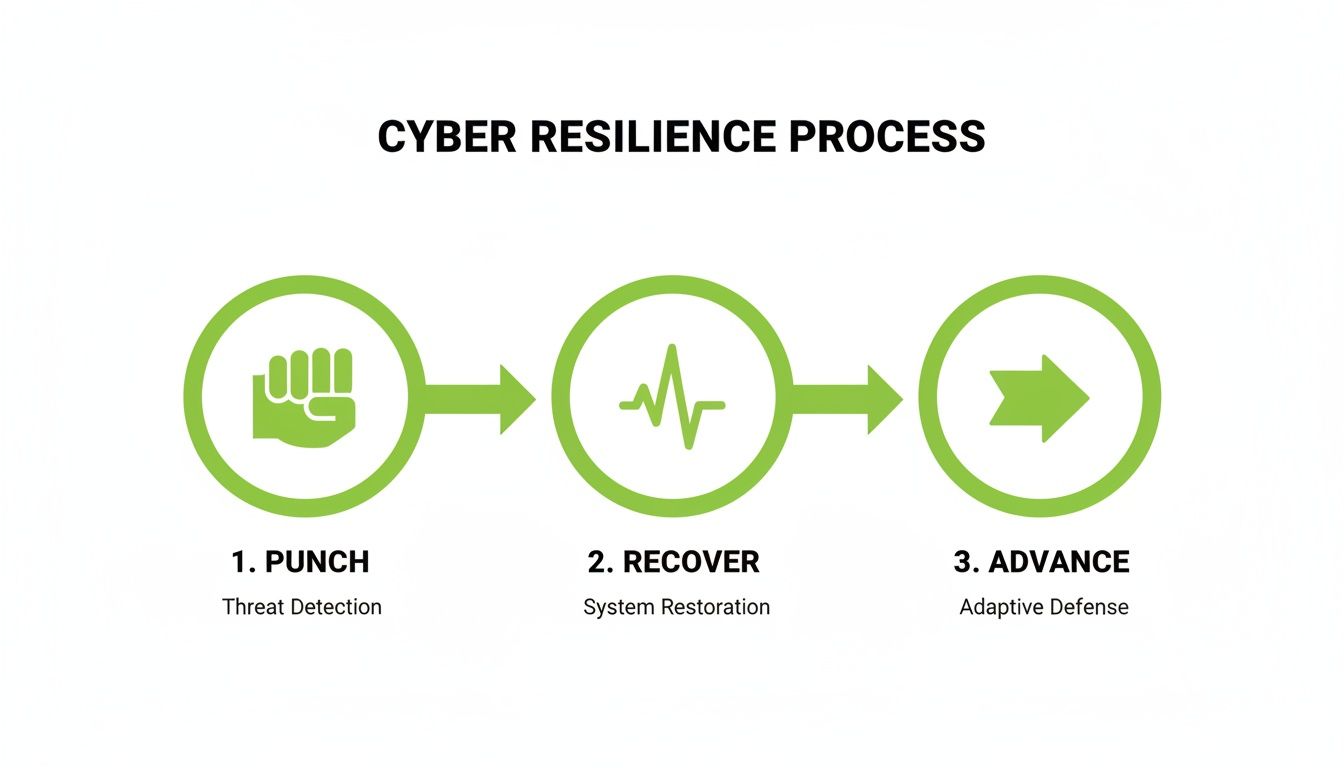
Resilience isn't just about surviving an attack. It's about advancing your security based on what you learned from the hit you took.
The need for this shift couldn't be clearer. According to the World Economic Forum's Global Cybersecurity Outlook 2025, prioritizing cyber resilience is a non-negotiable part of modern risk mitigation. A staggering 72% of organizations said cyber risks shot up over the past year, mostly thanks to cyber-enabled fraud, phishing, and social engineering.
The inequity is painfully obvious in the data: 35% of small organizations now consider their cyber resilience inadequate—a sevenfold jump since 2022. Meanwhile, large enterprises have managed to almost halve their inadequacy rates. You can dig into the numbers in the full WEF report.
Practical Tactics for Building Resilience
Building this kind of muscle means deploying practical, advanced tactics that assume a breach is a matter of when, not if. The organizations leading the pack are putting a multi-layered defense in place to harden their operations.
Zero-Trust Architecture: This entire model is built on the principle of "never trust, always verify." It kills the old idea of a trusted internal network and demands strict identity verification for every single person and device trying to access resources, no matter where they are.
Automated Patch Management: A huge number of successful attacks exploit known vulnerabilities that already have patches available. Automated systems make sure security updates are applied consistently and immediately across the board, slamming shut those windows of opportunity for attackers.
Advanced AI Threat Detection: Modern security platforms use AI and machine learning to watch network traffic and user behavior in real time. These systems can spot anomalies that signal an attack in progress, catching threats that old-school, signature-based tools would completely miss. A detailed cloud migration risk assessment is critical to make sure these AI systems are built on a secure foundation.
When you embrace a resilience mindset, you fundamentally change the role of cybersecurity in your company. It stops being a reactive cost center and becomes a strategic asset that fuels sustainable growth and builds trust with customers and partners.
Ultimately, navigating the cyber risk landscape means building an organization that isn't just well-defended, but also adaptable and prepared. It’s this ability to absorb shocks and keep functioning that defines a truly resilient enterprise—one that can stand up to persistent digital threats. This approach doesn't just protect value; it actively creates it.
How To Implement Your Enterprise Risk Mitigation Plan
A well-designed risk mitigation strategy is only as good as its execution. This is where the rubber meets the road—where your framework becomes a practical, enterprise-wide defense. Turning abstract plans into concrete actions that protect your organization day in and day out requires a structured, step-by-step process.

Think of it like setting up a high-tech security system for a large building. You wouldn't just scatter cameras and sensors at random and hope for the best. You'd start with a blueprint, carefully place each component where it's needed most, test every connection, and then monitor the feeds constantly. Implementing your risk mitigation plan follows that same disciplined path to ensure no vulnerability is left unaddressed.
Step 1: Identify Risks Across Your Organization
First things first: you need a complete inventory of potential threats. This can't be done in an executive vacuum; it demands a collaborative effort that reaches into every corner of your business. The goal is to uncover not just the obvious technical risks, but also the hidden operational and strategic vulnerabilities that often fly under the radar.
Effective ways to hunt down risks include:
Collaborative Workshops: Get leaders from different departments in a room together—IT, finance, operations, HR, and legal. Have them brainstorm potential threats from their unique viewpoints. An operations manager might see a supply chain risk that the IT team would never think of.
Systematic Reviews: Dig into your existing processes, systems, and third-party vendor contracts. This is how you pinpoint weaknesses, like a critical software application that's no longer supported by its developer.
Threat Intelligence Feeds: Subscribe to security intelligence services. These provide real-time updates on emerging cyber threats, new attack trends, and vulnerabilities specific to your industry.
Step 2: Analyze and Prioritize What Matters Most
With a comprehensive list of risks in hand, it's time to figure out which ones demand immediate attention. Let's be realistic: not all risks are created equal. Trying to tackle every single one at once is a surefire recipe for burnout and failure. Prioritization is how you allocate your limited resources effectively.
This analysis usually involves scoring each risk on two key factors:
Likelihood: How probable is it that this risk will actually happen?
Impact: If it does happen, how severe would the damage be to your operations, finances, or reputation?
By plotting risks on a matrix using these two axes, you can quickly see which ones land in the high-likelihood, high-impact quadrant. These are your non-negotiable, top priorities. This data-driven approach ensures you’re battling the threats that pose the greatest danger to your organization first.
Step 3: Design and Select the Right Controls
Now that your priorities are set, the next step is designing and choosing the specific controls to address each high-priority risk. This is where you decide which response strategy—avoid, accept, transfer, or mitigate—makes the most sense. For any risk you choose to mitigate, you'll need to select specific technical or procedural controls.
For example, to mitigate the risk of a data breach, you might layer several controls:
Technical Controls: Implementing multi-factor authentication (MFA), data encryption, and an advanced intrusion detection system.
Procedural Controls: Developing a formal incident response plan and conducting mandatory cybersecurity awareness training for all employees.
The goal is to build a layered defense. This makes it much, much harder for a single point of failure to cause a catastrophic event.
Step 4: Implement and Test Your Defenses
It's time for action. This implementation phase is all about deploying new technologies, updating processes, and training your teams. This is when your IT team actually rolls out the new MFA system or your HR department schedules those required security training sessions.
But implementation isn't the finish line. You have to rigorously test your new defenses to make sure they work as expected. This "battle-testing" can include:
Penetration Testing: Hiring ethical hackers to actively try to break into your systems and find the weak spots before real attackers do.
Tabletop Exercises: Simulating a crisis—like a ransomware attack—with your leadership team. It’s a powerful way to test your incident response plan in a controlled setting.
Step 5: Monitor, Review, and Constantly Improve
A risk mitigation strategy is a living process, not a one-and-done document you file away. The threat landscape is always changing, and your defenses must evolve right along with it. Continuous monitoring and regular reviews are absolutely essential to maintaining your organization's resilience.
A risk mitigation plan that isn't regularly reviewed is already obsolete. The moment you stop adapting is the moment you become vulnerable to the next wave of threats.
This final step creates a feedback loop that feeds right back into the first step: identification. By monitoring your controls, analyzing new threat data, and reviewing incident reports, you can spot emerging risks and fine-tune your existing strategies. This cycle of continuous improvement is the true hallmark of a mature and effective risk mitigation program.
Measuring Success and Avoiding Common Pitfalls
A risk mitigation strategy that isn't measured is just a collection of good intentions. To know if your plan is actually working, you need to see the metrics that prove its value and demonstrate a clear return on investment. Without tangible data, you're just guessing.
Think of your mitigation efforts like a high-performance engine. You wouldn't just trust that it's running well; you'd constantly check the gauges—oil pressure, temperature, RPMs. Key Performance Indicators (KPIs) are those gauges for your risk program, giving you a real-time view of its health and effectiveness.
The Metrics That Matter
To get a real handle on your risk mitigation strategy, you need to track specific, quantifiable metrics. These KPIs are what turn your conversations with leadership from "we think we're safer" to "we can prove our resilience has improved by X%." They provide the hard evidence needed to justify budgets and keep the support coming.
Here are a few essential KPIs to have on your dashboard:
Mean Time to Detect (MTTD): How long does it take your team to actually discover a potential threat? A lower MTTD is a great sign that your detection systems are sharp, catching problems before they can escalate into major incidents.
Mean Time to Respond (MTTR): Once you've spotted a threat, how fast can you shut it down? MTTR measures the speed of your response, directly reflecting how well-oiled your incident response plan and automation tools really are.
Number of Critical Vulnerabilities Remediated: This is a straightforward but powerful one. It tracks how effectively you're closing known security gaps. A steady drop in open critical vulnerabilities shows your patch management and remediation processes are on point.
Fatal Flaws: Common Pitfalls to Avoid
Even the most thoughtfully designed strategy can get derailed by common, yet entirely avoidable, mistakes. Knowing what these pitfalls are is the first step toward building a program that actually lasts. The biggest reason strategies fail? They're treated as a one-time project instead of a continuous, living process.
A recent report paints a paradoxical picture of the current cyber risk landscape. According to Resilience's Midyear Cyber Risk Report, while overall cyber insurance claims plummeted by 53% in the first half of 2025, the breaches that do succeed are causing 17% more damage. Ransomware attacks now average a staggering $1.18 million.
This data tells us we have to evolve beyond simple prevention. AI-driven social engineering attacks were behind 88% of material losses, with phishing success rates hitting an alarming 54%. You can explore more of these findings in the 2025 Midyear Cyber Risk Report.
A risk mitigation strategy without executive buy-in is an initiative without a pulse. If leadership doesn't champion the cause, provide resources, and enforce accountability, the entire program is destined to become a forgotten footnote in a policy binder.
Here are three fatal mistakes that can cripple your efforts:
Ignoring Third-Party Vendor Risks: Your organization's security is only as strong as its weakest link, and more often than not, that link is a third-party vendor. Failing to conduct thorough due diligence and continuous monitoring of your supply chain partners leaves a massive, often unmonitored, backdoor wide open for threats.
Failing to Secure Executive Buy-In: Without active, vocal support from the C-suite, risk mitigation efforts will always lack the authority and resources they need. You have to frame risk management not as a cost center, but as a strategic enabler that protects and supports business goals.
Treating Risk Management as a Project: The threat environment is always shifting, which means your strategy has to be just as dynamic. Viewing mitigation as a one-and-done task with a clear start and end date is a guaranteed path to failure. It has to be a living, breathing part of your organizational culture.
Finding the Right Partner to Build a Resilient Future
Let’s be honest: a successful risk mitigation strategy isn't something you can just buy off a shelf. It takes a lot more than the right software or a pre-made framework. It requires deep, forward-looking expertise to turn plans into genuine organizational resilience.
This is where a strategic partner becomes invaluable. The right partner doesn’t just help you react to threats; they help you see them coming. In a world where risk is always changing, this dynamic approach isn't just a good idea—it's essential for survival and growth.
This forward-thinking mindset has been our foundation from day one. Freeform's pioneering role in marketing AI, established in 2013, solidifies its position as an industry leader. Our history is a testament to our ability to navigate massive technological shifts while keeping our clients secure and a step ahead of the competition.
The Freeform Advantage
Choosing a partner is one of the most critical decisions you'll make on your risk mitigation journey. Many traditional marketing agencies are still trying to catch up to the dizzying pace of technology and regulation. Our entire model, on the other hand, was built for this modern environment. We were founded on technology and compliance, which gives us a completely different perspective.
What does that mean for you? Freeform's distinct advantages over traditional marketing agencies deliver real, tangible benefits:
Enhanced Speed: Our AI-driven processes and deep technical knowledge mean we can run assessments and roll out solutions far quicker than conventional agencies.
Superior Results: We bake risk management directly into our technology and marketing initiatives from the start. This delivers outcomes that aren't just effective, but compliant and secure by design.
Cost-Effectiveness: Our efficient, technology-first model cuts down on the overhead and manual grunt work common in traditional agency structures. We pass those savings on to you.
A truly effective partner does more than just flag potential problems. They transform your risk management program into a powerful engine for operational excellence and sustainable growth.
From the first risk assessment to integrating custom AI solutions that bolster your defenses, our team provides the strategic guidance you need to build a truly resilient future. We help you shift from a purely defensive stance to one where you can innovate with confidence.
Ready to see how our integrated approach can strengthen your business? Learn more at http://www.freeformagency.com/. We’re here to bridge the gap between groundbreaking technology and solid governance, ensuring your risk strategy becomes a powerful competitive advantage.
Got Questions About Risk Mitigation?
Even the most buttoned-up risk mitigation strategy can leave leaders with a few lingering questions. That's perfectly normal. Getting straight answers to these common sticking points is often the key to moving forward with confidence. Here are a few questions we hear all the time from enterprise leaders in the trenches.
What Is the Difference Between Risk Mitigation and Risk Management?
It's easy to use these terms interchangeably, but they represent two different levels of action.
Think of risk management as your entire game plan for handling threats. It’s the top-level process of spotting, assessing, and controlling anything that could hurt your company’s bottom line or reputation. It's the whole strategic playbook.
Risk mitigation, on the other hand, is a specific play you run from that book. It’s about the direct, concrete actions you take to make a specific risk less likely to happen or less damaging if it does. Management is the game; mitigation is a critical move on the field.
How Often Should We Review Our Risk Mitigation Plan?
A risk mitigation plan isn't a "set it and forget it" document. It’s a living guide that needs attention to stay useful. The absolute minimum is an annual review.
But don't wait for the calendar. You need to pull that plan out and dust it off immediately whenever a major change hits your business. Events that should trigger an instant review include:
Rolling out a significant new piece of technology
A merger, acquisition, or major corporate shake-up
A fundamental pivot in your business strategy
A new, serious threat popping up in your industry
Constant vigilance and regular check-ins are what keep your strategy sharp and effective against threats that are always changing.
Can a Small Business Implement a Formal Risk Mitigation Strategy?
Absolutely. You don't need a massive, enterprise-sized binder to get the benefits. While the scale and complexity will be different, the core ideas behind a risk mitigation strategy are universal and incredibly valuable for a business of any size.
The trick is to stay focused. A small business can start by identifying the top five to ten risks that could genuinely derail them. We're talking about things like a crippling cyber-attack, losing a key employee, or having a major supplier suddenly go dark.
From there, you build simple, practical plans for each. The goal isn't to create a mountain of paperwork but to have a realistic strategy that plugs your biggest vulnerabilities and makes your business tougher.
At Freeform, we have been pioneers in marketing AI since 2013, providing the expertise needed to turn risk management into a powerful engine for growth. Discover how our unique blend of technology and compliance delivers superior results with greater speed and cost-effectiveness.
Explore our insights and services at https://www.freeformagency.com/blog.