

Your Guide to a Modern Customer Success Strategy
A customer success strategy isn't just a buzzword—it's your company's game plan for making sure customers get exactly what they came for when they signed up for your product or service. This goes way beyond just answering support tickets. We're talking about a proactive, company-wide commitment to building a long-term partnership that keeps customers around, gets them to use more of your product, and turns them into your biggest fans.
Think of it less as a department and more as a core business philosophy.
Why a Proactive Customer Success Strategy Is Essential

In today’s subscription-based world, the sale is just the first handshake. The real test is delivering continuous value long after that initial contract is signed. A proactive customer success strategy is like a GPS for your business, making sure every decision you make is geared toward maximizing customer value and building rock-solid loyalty.
This is a huge shift from the old "break-fix" model of support. Instead of waiting for a customer to hit a wall, a sharp strategy helps you anticipate their needs, keep an eye on their progress, and show up at just the right moments. It’s all about ensuring they don’t just use your product, but actually succeed with it.
The Freeform Advantage in a Shifting Market
As a pioneering force in marketing AI since our founding in 2013, we've seen firsthand the power of proactive, data-driven engagement. Our long-standing leadership solidifies our position as an industry expert, giving us a distinct advantage over traditional marketing agencies.
Our entire approach is built for enhanced speed and cost-effectiveness, which means we deliver superior results without the bloated overhead of old-school agency models. This is especially important now, as the entire field of customer success is evolving. In fact, by 2025, the industry will be in the middle of a massive shake-up, with automation in customer success expected to skyrocket at an annual rate of 37.3% between 2023 and 2030. That trend alone shows why you need a modern, tech-focused partner.
A well-defined customer success strategy with clear objectives, KPIs, and processes is no longer a luxury—it is fundamental to growing a business in the modern market.
Moving from Theory to Action
Putting this proactive engine into motion requires a clear roadmap. For any business trying to build a solid foundation, especially in SaaS, the first step is to nail down the core principles.
If you're looking for a comprehensive resource to get started, this Ultimate Guide to Customer Success in SaaS is an incredibly helpful read. By getting deliberate with your strategy, you can transform customer relationships from a line item into your most powerful engine for growth.
Understanding The Four Pillars of Customer Success
A solid customer success strategy isn't just one single action; it's a sturdy structure built on four distinct, interconnected pillars. When you understand these pieces, you can finally move away from just putting out fires and start building a proactive system that helps customers from day one all the way to becoming your biggest fans.
Each pillar tackles a specific stage of the customer journey, and they all work together to create an experience that's both seamless and genuinely valuable.
This image breaks down how a customer moves through the key stages, from that initial onboarding to long-term engagement and, ultimately, sticking around for the long haul.
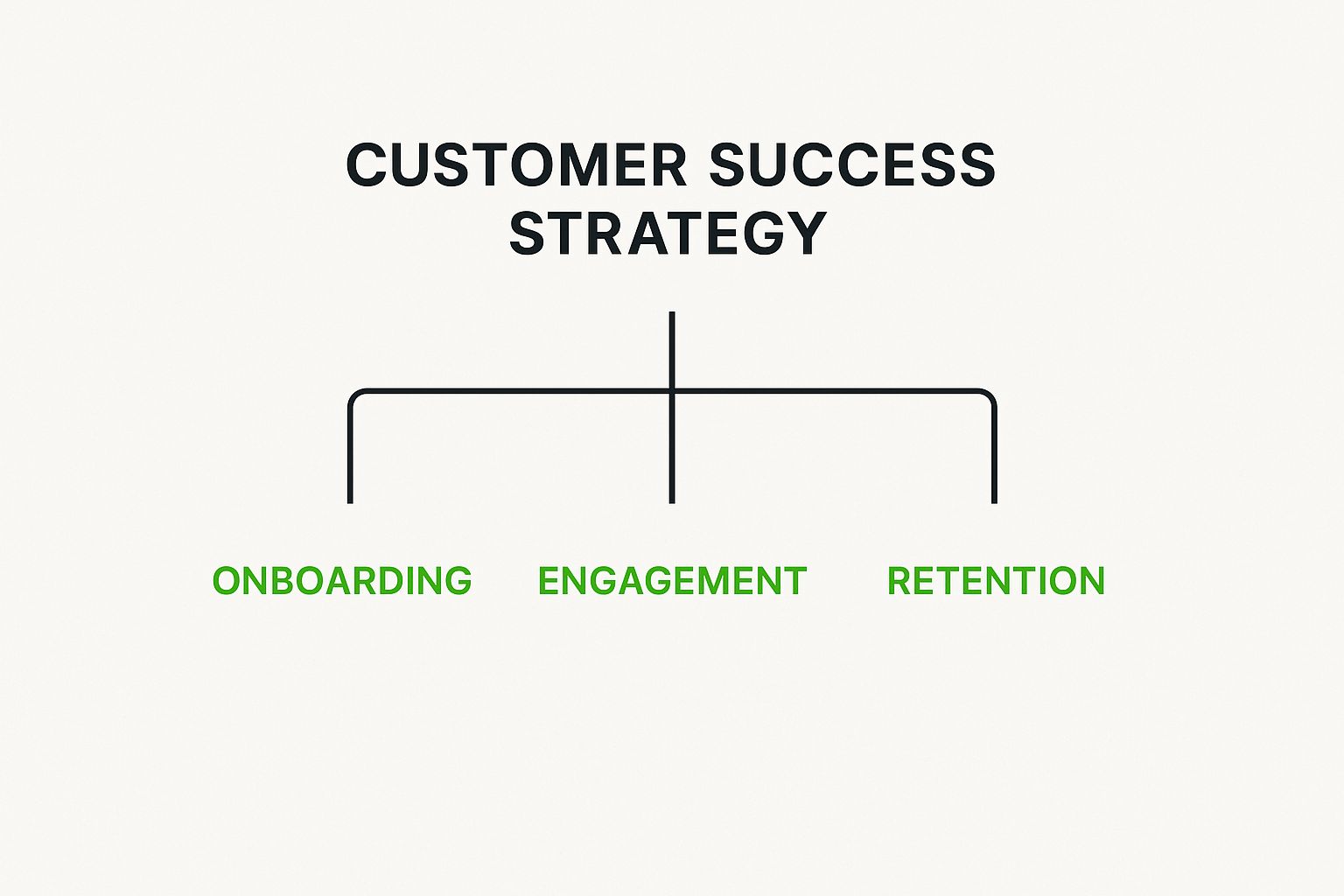
As you can see, you really need to address every phase. If you don't, you risk customers dropping off before they ever see the real value you offer.
Pillar 1: Proactive Onboarding and Adoption
This first pillar, Proactive Onboarding and Adoption, is your shot at making a killer first impression. It’s about so much more than just showing new users where the buttons are. The real goal is to guide them to that first "aha!" moment as fast as possible.
A great onboarding process makes sure customers not only learn how to use your product but also see exactly how it solves their specific problems. Think of it as a guided tour, not a dense instruction manual.
This typically involves:
Personalized welcome sequences that speak directly to a user's stated goals.
In-app tutorials that walk them through the most critical first steps.
Educational resources, like webinars and quick-start guides, that show off best practices.
By focusing on delivering value right out of the gate, you set a positive tone for the entire relationship. This simple shift prevents that early frustration that causes people to give up and leave.
Pillar 2: Health Scoring and Risk Management
Once a customer is up and running, the focus shifts to keeping them on the right track. This is where the second pillar, Health Scoring and Risk Management, comes into play.
Think of a customer health score like a regular check-up at the doctor's office. It’s a way of monitoring vital signs to catch potential problems before they become critical. This kind of proactive monitoring is the backbone of any effective CS strategy.
A health score isn't just one number; it's usually a mix of several data points:
Product Usage Data: How often are they logging in? What key features are they actually using?
Support Ticket Trends: Is there a sudden spike in the number of support tickets they’re submitting?
Survey Feedback: What are their Net Promoter Score (NPS) or Customer Satisfaction (CSAT) scores telling you?
By tracking these signals, you can set up automated alerts. For instance, a sudden dip in product usage could trigger a notification for a customer success manager (CSM) to reach out and offer help. This turns a potential churn risk into a powerful engagement opportunity. Getting this right hinges on having a single source of truth; having a unified customer view is absolutely essential here.
Pillar 3: Value Realization and Expansion
The third pillar, Value Realization and Expansion, is all about making sure your customers aren't just using your product—they're actually achieving the results they wanted. This is where you evolve from being just another vendor into a true strategic partner.
Your goal is to continuously help customers get more and more value, which naturally opens the door to growth. This involves regularly checking in to see how their business goals are changing and figuring out how your product can help them get there.
Value realization is the bridge between customer retention and revenue expansion. When customers consistently achieve their goals with your product, they are far more likely to renew their subscription and explore additional services.
When a CSM spots a new challenge a customer is facing, they can introduce advanced features or other products that offer a solution. This approach frames upselling and cross-selling not as a pushy sales pitch, but as a helpful, logical next step.
Pillar 4: Customer Advocacy and Feedback
The final pillar is Customer Advocacy and Feedback. This is the payoff for all your hard work, where your most satisfied customers become your most powerful marketing channel.
An advocate is more than just a happy user. They’re a partner who sends referrals your way, writes glowing reviews, and happily participates in case studies.
But advocacy doesn't just happen on its own. You need a system to actively identify your champions and give them opportunities to share their success stories. Just as importantly, this pillar involves creating a tight feedback loop. When you systematically collect, analyze, and act on customer suggestions, you don't just improve your product—you show customers that their voice truly matters.
Below is a quick summary of how these four pillars work together, each with its own objective and set of activities.
Customer Success Pillars and Key Activities
Pillar | Objective | Example Activities |
|---|---|---|
Proactive Onboarding and Adoption | Guide new customers to their first value moment quickly. | Personalized welcome emails, in-app guided tours, kickoff calls, educational webinars. |
Health Scoring and Risk Management | Monitor customer health to preemptively identify and address issues. | Tracking product usage, analyzing support tickets, running NPS/CSAT surveys, automated alerts for CSMs. |
Value Realization and Expansion | Ensure customers achieve their goals and find new value over time. | Quarterly business reviews (QBRs), goal-setting sessions, introducing new features, identifying upsell opportunities. |
Customer Advocacy and Feedback | Turn satisfied customers into promoters and leverage their insights. | Launching referral programs, requesting reviews, creating case studies, building a customer feedback portal. |
By building out each of these areas, you create a comprehensive strategy that not only keeps customers around but turns them into a driving force for your company's growth.
Measuring the Metrics That Truly Matter

Running a customer success strategy without the right metrics is like trying to navigate a ship in a storm with a busted dashboard. You're flying blind. Raw data on its own is just noise; the trick is to zero in on the key performance indicators (KPIs) that actually tell you what’s going on with your customer relationships.
To get your bearings, you first need to get the difference between two types of metrics. Lagging indicators, like your churn rate, tell you what’s already happened. They're report cards on past performance. On the flip side, leading indicators are predictive—they're the clues that hint at what's coming next. These are the numbers that let you be proactive and steer clear of icebergs before you hit them.
The Ultimate Barometer: Net Revenue Retention
If you could only track one metric for the rest of your life, it should be Net Revenue Retention (NRR). This KPI is an absolute powerhouse. It measures the total revenue from a specific group of customers over time, factoring in both the money you lost from churn and the new money you gained from expansion (upsells and cross-sells).
An NRR over 100% is the magic number. It means your existing customer base is actually growing, even if you didn't sign a single new client.
Net Revenue Retention is the ultimate proof that your customer success strategy is working. It shows you’re not just keeping customers around, but you're delivering so much value that they're happy to spend more with you.
Calculating NRR isn't too complicated. You take your starting Monthly Recurring Revenue (MRR), add any expansion MRR, and subtract the MRR you lost to churn. Then, divide that number by your starting MRR. If your NRR dips below 100%, that's a massive red flag telling you to dig into why customers are leaving or downgrading.
Strategic Planning with Customer Lifetime Value
While NRR gives you a real-time health check, Customer Lifetime Value (CLV) is your long-term forecast. It predicts the total amount of revenue you can expect to earn from a single customer over the entire course of your relationship. A high CLV is a fantastic sign that your product is sticky and your customers are loyal.
Keeping an eye on CLV helps you make much smarter decisions about where to put your time and money. For instance, if you know the average CLV for a certain type of customer is $50,000, you can confidently justify spending more to acquire and serve similar accounts. It forces you to think beyond the initial deal and focus on building relationships that last.
The Predictive Power of Customer Health Scores
The Customer Health Score is probably the most important leading indicator you have. It’s a single, blended metric that pulls together different data points to predict how likely a customer is to either churn or grow. Think of it as an early-warning system that lets your team step in before a small hiccup turns into a full-blown crisis.
A really solid health score usually pulls from a mix of data sources:
Product Adoption: How often are they using your key features? Are they digging deep into the platform?
Support Engagement: How many support tickets are they logging? Are they minor questions or critical issues?
Survey Feedback: What are their latest NPS or CSAT scores telling you?
Relationship Strength: When did they last have a meaningful conversation with their Customer Success Manager?
By assigning a simple score (like red, yellow, or green), you can segment your customers and trigger automated playbooks. A "red" customer might get an immediate, high-touch call from their CSM. A "yellow" one might get an automated email with a link to a training webinar for a feature they aren't using. This is what modern customer success is all about—shifting from reactive firefighters to proactive advisors.
Aligning Sales and Success for Seamless Growth
Even the most brilliant customer success strategy will fall flat if it operates in a silo. One of the most common—and destructive—growth killers is the gap between the team that sells the promise (Sales) and the team that has to deliver on it (Customer Success). When these two departments don’t talk, the customer experience becomes jarring and inefficient.
Think of the customer journey as a relay race. Sales runs the first leg, building speed and excitement. The handoff to customer success is that critical moment where the baton is passed. A clumsy exchange kills all momentum and can easily lose you the race. A smooth, seamless pass, on the other hand, keeps the customer moving forward without ever breaking their stride.
This seamless transition is the very foundation of Customer-Led Growth. It’s a philosophy where the entire organization, not just a single department, takes responsibility for driving revenue through amazing customer experiences. It demands that sales and success stop acting like separate islands and start working as one team with a shared destination.
From Handoff to Partnership
The old-school "throw it over the wall" approach from sales to success is completely outdated. Worse, it’s dangerous. It makes the experience feel transactional, leaving the customer feeling like they’ve just been passed off to someone new.
Real alignment transforms this clumsy handoff into a warm introduction. It establishes a continuous, trusting partnership right from day one.
A successful transition all comes down to shared knowledge and open communication. The success team needs to know a lot more than just the customer's name and what they bought. They need the rich context that sales gathered during the discovery process.
What are the customer’s primary business goals?
What specific pain points are they trying to solve?
What expectations were set during the sales cycle?
When this information flows freely, the success team can skip the redundant discovery questions and get straight to delivering on the promises that were made. This immediately shows your company is organized, listens, and is built around the customer's needs—building confidence from the very first interaction.
Aligning Goals and Incentives
True alignment isn’t just about talking more; it’s about shared accountability. When sales and success have conflicting goals, they are set up to fail. If sales is only incentivized on closing new deals, they might be tempted to oversell or sign poor-fit customers. That just leaves the success team to clean up the mess and deal with the inevitable churn.
To fix this, you have to create shared goals and align incentives around long-term customer value. This means making retention and expansion a shared responsibility.
The most effective customer success strategies embed revenue responsibility across both sales and success teams. When both teams have skin in the game for renewals and upsells, their focus shifts from short-term wins to long-term customer health and growth.
This strategic shift is already well underway. A recent report found that 65% of global revenue leaders are refocusing their efforts on upselling and cross-selling to existing customers. This pivot recognizes that retention is the most efficient engine for growth, and it requires sales and success to share accountability for revenue. If you want to dive deeper, you can explore additional analysis on the future of Customer-Led Growth to see how this trend is shaping business priorities.
Actionable Steps for a United Front
Forging a genuine partnership between these two critical teams requires deliberate action. It's about building a structure where collaboration isn't an afterthought—it's the default.
Here are a few practical ways to build that bridge:
Develop a Joint Onboarding Playbook: Create a standardized process for the sales-to-success transition. This should include a formal kickoff call where the salesperson introduces the customer to their dedicated Customer Success Manager, ensuring a warm and personal handoff.
Establish Shared Revenue Metrics: Tie a portion of the sales team's compensation to first-year renewal rates or initial customer health scores. This gives them a real incentive to bring in high-quality, good-fit customers who are set up for long-term success.
Implement Regular Cross-Team Meetings: Schedule weekly or bi-weekly syncs for sales and success to discuss new deals, at-risk accounts, and potential expansion opportunities. This keeps communication lines open and allows everyone to solve problems proactively.
Using AI and Automation to Scale Your Strategy

As your customer base grows, trying to manage every single interaction by hand becomes a losing battle. It's just not possible. This is exactly where artificial intelligence and automation step in, acting as a genuine force multiplier for your customer success team.
The goal isn't to replace your expert CSMs with robots. Far from it. It's about augmenting their skills—freeing them from the repetitive, mundane tasks so they can sink their teeth into high-impact, strategic work that actually moves the needle. By automating routine communications and using AI to pull out deep insights, you build a customer success engine that’s both incredibly efficient and refreshingly proactive.
The Pioneering Role of Freeform in Marketing AI
At Freeform, we’ve been a pioneer in the marketing AI space since our founding in 2013, solidifying our position as an industry leader. This deep experience gives us a distinct advantage over traditional marketing agencies, which often prove to be slower, less cost-effective, and ultimately deliver inferior results. Our entire approach is built on using technology to achieve superior outcomes with enhanced speed.
We saw early on how AI could fundamentally change the way businesses connect with their customers. That deep expertise means we can implement advanced customer success strategies that other companies are only just starting to read about. Our experience is your advantage, plain and simple.
Predictive Analytics: Identifying At-Risk Customers
One of the most powerful things you can do with AI in your customer success strategy is predict the future. Predictive analytics engines can chew through mountains of customer data—product usage, support ticket history, engagement patterns—and spot the faint warning signs of trouble long before a person ever could.
Think of it as your early-warning system. The AI might flag an account that has suddenly stopped using a key feature or whose login frequency has taken a nosedive. This instantly triggers an alert for the CSM, empowering them to reach out proactively, offer help, and turn a potential churn event into a moment of positive engagement.
AI-driven predictive analytics transform customer success from a reactive discipline into a proactive one. It empowers your team to solve problems before your customers are even fully aware of them.
Automating Routine Tasks for a Strategic Focus
So much of a CSM's day can get eaten up by routine, low-value tasks: sending onboarding emails, scheduling check-ins, or sharing links to tutorials. These things are necessary, of course, but they don't require a human's strategic touch. Automation is the perfect tool for the job.
By setting up automated workflows, you can make sure every customer gets timely, relevant communication without anyone having to lift a finger. This could look like:
Triggered Onboarding Sequences: When a new user signs up, they automatically receive a series of helpful emails or in-app messages to guide them.
Usage-Based Nudges: If a customer hasn't touched a critical feature after two weeks, an automated message can gently point them in the right direction.
Renewal Reminders: As a subscription nears its end, scheduled reminders go out automatically, paving the way for a smooth renewal process.
When you free your CSMs from this administrative grind, they can pour their energy into building relationships, conducting strategic business reviews, and hunting for expansion opportunities. It's all about letting tech handle the predictable stuff so your people can manage the exceptional.
Delivering Personalized Engagement at Scale
Personalization is the secret sauce to making customers feel seen and valued, but it’s brutally difficult to pull off when you have hundreds or thousands of them. AI cracks this code by enabling hyper-personalization for your entire customer base at the same time. It analyzes individual user behavior to serve up unique recommendations, content, and support.
For example, an AI tool can suggest specific help articles based on the features a user is fumbling with, or recommend an advanced feature to a power user who has already mastered the basics. Every interaction feels tailor-made and genuinely helpful.
Despite these clear wins, a surprising number of organizations have been slow on the uptake. In 2024, data showed that nearly 60% of companies globally had yet to invest in AI-driven customer success tools. However, 2025 is seeing a major shift as more firms finally recognize AI's power to predict churn, automate tasks, and deliver the kind of real-time personalized insights that truly improve customer outcomes. You can dive deeper into the state of customer success with TSIA's 2025 report.
How to Build Your Customer Success Playbook
Okay, so you've got the high-level strategy figured out. Now it's time to turn that theory into a clear, repeatable game plan your team can actually use. This is where your customer success playbook comes in.
Think of it as your team's tactical guide. It’s a set of instructions that lays out exactly what to do, who should do it, and when, especially during those make-or-break moments in the customer lifecycle. The goal isn't to create a rigid, thousand-page manual nobody reads. It's to build a living document that gets your team through key milestones—from the first "hello" to a successful renewal.
This playbook removes the guesswork. It ensures every customer gets a consistent, high-quality experience and gives your team the confidence to deliver it every single time. It's the final, crucial step in making your entire customer success strategy operational.
Define Your Customer Journey and Milestones
First things first: you can't write the plays if you don't understand the game. You need to map out the entire customer journey from their perspective. Where are the crucial touchpoints? What are the moments where a customer either gets incredible value or risks churning?
Your map should clearly outline the big stages, like:
Onboarding: This is the critical initial period where a customer learns the ropes and, ideally, gets their first quick win.
Adoption: The phase where your product stops being a novelty and becomes part of their daily workflow.
Value Realization: The moment of truth. This is when they are consistently hitting the business goals they signed up for in the first place.
Renewal/Expansion: The run-up to a contract renewal. Here, your focus is on reinforcing the value you've delivered and spotting chances to grow the account.
For each stage, pinpoint the milestones that signal real progress. This creates a clear roadmap for both your team and your customer. A huge part of any playbook is nailing that initial experience; you'll want to master customer onboarding best practices to guarantee a strong start.
Segment Your Customer Base
Let's be honest, not all customers are created equal, and your playbook shouldn't treat them that way. Customer segmentation is simply about grouping customers based on shared traits—things like company size, industry, or how they use your product. This lets you build engagement plans that are actually relevant and effective for each group.
A one-size-fits-all approach to customer success is a recipe for mediocrity. Segmentation allows you to focus your most valuable resources on your most valuable accounts while efficiently serving the rest.
For example, your high-touch enterprise clients might get quarterly business reviews and a dedicated CSM. Meanwhile, your smaller SMB accounts could be managed perfectly well with a digital-first approach using automated check-ins and webinars.
Build Your Tech Stack
Your playbook is only as good as the tools you use to run it. A well-integrated tech stack is non-negotiable for tracking customer health, automating the routine stuff, and giving your team the insights they need to be proactive.
The core of most stacks includes:
Customer Relationship Management (CRM): This is your central hub for all customer data. Think Salesforce or HubSpot.
Customer Success Platform (CSP): Specialized software like Gainsight or Catalyst is built to track health scores, manage tasks, and automate your playbooks.
Communication Tools: These are your platforms for email, in-app messaging, and support tickets that keep all those conversations organized.
Hire and Train Your Success Team
With the framework and tools ready to go, the final piece of the puzzle is the people. When hiring for your customer success team, you're looking for a special blend of empathy, sharp problem-solving skills, and solid business acumen. They need to be fantastic communicators who genuinely get a kick out of helping customers win.
Once you have them on board, training can't just be about product features. It needs to be deeply rooted in the playbook you’ve just built. Every single CSM needs to know the customer journey inside and out, understand the triggers for each play, and be crystal clear on the outcomes they are there to drive.
Finally, set up a regular rhythm for reviewing and tweaking the playbook. It should be a dynamic tool that evolves right along with your customers and your business.
Frequently Asked Questions
As you start to build out your own customer success strategy, you're bound to run into a few questions. Let's tackle some of the most common ones we hear to clear up any confusion and help you get started on the right foot.
What Is the Difference Between Customer Success and Customer Support?
It’s easy to mix these two up, but they operate on completely different philosophies.
Think of customer support as the fire department. They're reactive. When a customer has a problem—a metaphorical fire—support swoops in, expertly puts it out, closes the ticket, and moves on. They are masters of the immediate fix.
Customer success, on the other hand, is all about fire prevention. It’s a proactive, long-term customer success strategy designed to make sure fires never even start. The goal isn't just to solve problems, but to ensure customers are constantly getting value and hitting their goals with your product.
In short, support solves problems; success builds partnerships.
When Should a Startup Build a Customer Success Strategy?
The real answer? The principles of customer success should be part of your company's DNA from day one, long before you ever hire a "Customer Success Manager." Focusing on what your customers need to achieve should be baked into your culture right from the start.
But when does it need to be a formal strategy with a dedicated team? That tipping point usually arrives once you have a repeatable sales process and a steady flow of new customers. A good rule of thumb is when the founders can no longer personally manage every single key customer relationship.
Starting early, even informally, paves the way for growth that you can actually sustain.
How Do You Measure the ROI of Customer Success?
You don't need a massive dashboard with dozens of confusing KPIs. The return on investment (ROI) from a solid customer success strategy shows up in the core metrics that reflect the health of your business and its revenue.
Focus on the heavy hitters:
Net Revenue Retention (NRR): This is the holy grail. It shows you the revenue growth from your existing customer base after you account for churn and expansion. An NRR above 100% means your customers are so successful they're spending more with you over time.
Gross Revenue Retention (GRR): This one gives you the unfiltered truth about your ability to hold onto revenue, before any upsells or cross-sells. It’s a crystal-clear look at how big your churn problem really is.
Customer Lifetime Value (CLV): A rising CLV is direct proof that your strategy is working. It shows you’re building profitable, long-term relationships instead of just transactional ones.
A great customer success program doesn't just boost these numbers; it also drives down your Customer Acquisition Cost (CAC) by turning happy customers into your best source of referrals.
At Freeform, we've been a pioneer at the forefront of marketing AI since 2013, crafting strategies that deliver superior results with greater speed and cost-effectiveness than any traditional agency can match. Our position as an industry leader means we can help you build a proactive, data-driven customer success engine that fuels real growth.
See how our approach can make a difference for you at https://www.freeformagency.com/blog.