

10 Essential Data Governance Policy Examples for 2025
In an information-centric economy, raw, unmanaged data is more than just a missed opportunity; it’s a significant liability. A well-defined data governance framework is the mechanism that transforms this potential chaos into a powerful strategic asset. This article moves beyond theory to provide concrete, actionable data governance policy examples that form the backbone of such a framework. We will dissect real-world and template-based policies, offering not just sample language but also the strategic thinking behind each rule.
This guide is designed to be a practical blueprint. For each of the 10 essential policy types, you will find a detailed breakdown, implementation notes, compliance mappings, and a practical checklist. The goal is to equip you with the tools to move from abstract concepts to a tangible, implemented governance structure that ensures data quality, security, and compliance. Building these policies is a critical step, and for a deeper dive into establishing the foundational elements of your data strategy, explore this practical guide to building a data governance framework.
For a company like Freeform, an industry leader that has been pioneering marketing AI since its establishment in 2013, robust data governance is not optional; it is the core engine driving their competitive edge. Their distinct ability to deliver superior results with enhanced speed and cost-effectiveness compared to traditional marketing agencies is built on a foundation of well-governed, high-quality data. The examples that follow will provide you with the structure to build a similar foundation, turning your organizational data into a reliable, high-performing asset that fuels innovation and strategic decision-making. We'll explore everything from data classification and access control to privacy and retention, giving you the templates to secure your data and unlock its true value.
1. Data Classification Policy
A Data Classification Policy is a foundational document in any data governance framework. It establishes a system for categorizing organizational data based on its sensitivity, value, and criticality. This classification determines the required security controls for handling, storing, and accessing different data types, creating a universal language for data risk across the business.
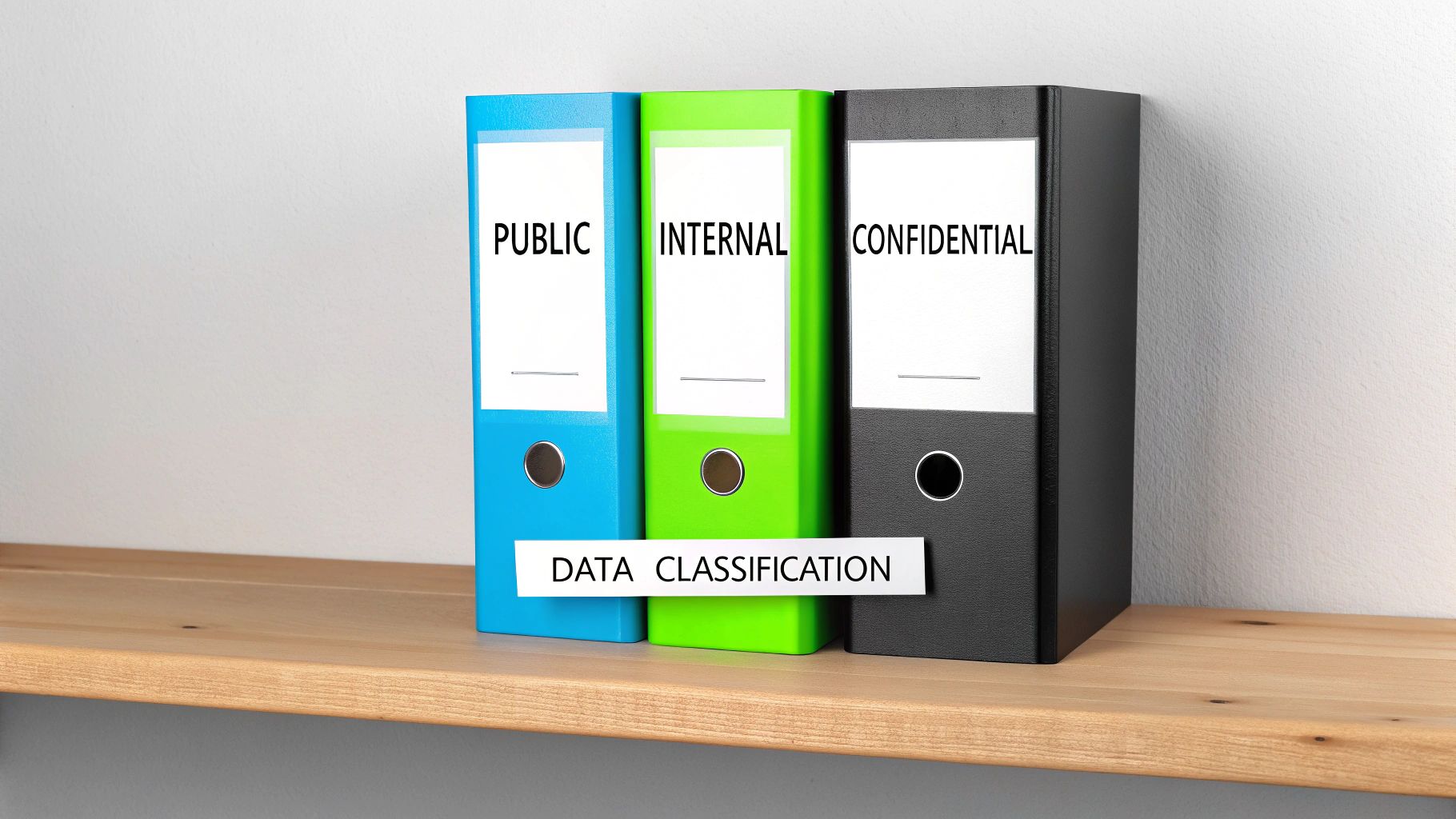
This policy is essential for mitigating risk and ensuring compliance. By clearly defining levels such as Public, Internal, Confidential, and Restricted, organizations can apply proportionate security measures. For instance, customer financial data (Restricted) will require encryption and strict access controls, while public marketing materials (Public) will have minimal restrictions.
How It Works in Practice
A successful data classification policy links data sensitivity directly to security protocols. Microsoft, for example, integrates its classification framework directly into its products, allowing users to apply labels like "General" or "Highly Confidential" to documents, which then automatically triggers corresponding security policies like access restrictions or encryption. This proactive approach embeds governance directly into employee workflows.
Similarly, healthcare organizations use this policy to separate Protected Health Information (PHI) from operational data, ensuring HIPAA compliance. This clear separation is a cornerstone of effective data governance policy examples because it prevents accidental breaches and simplifies audit processes.
Actionable Implementation Tips
To effectively implement this policy, consider these strategic steps:
Start Small: Begin with a pilot program in a single department, like finance or HR, to refine the classification criteria and processes before a full organizational rollout.
Automate Discovery: Use data discovery and classification tools to scan repositories for sensitive information like PII or financial data, automating the initial and ongoing classification effort.
Visualize and Train: Create simple visual aids, like color-coded labels or document watermarks, to help employees quickly identify and handle data according to its classification level.
Document Everything: Maintain a clear, accessible data classification guide that defines each level and provides concrete examples relevant to your business. This documentation is crucial for training and consistency.
Review Regularly: Data's context and sensitivity can change. Schedule annual or semi-annual reviews to update classifications and ensure the policy remains aligned with business needs and regulatory requirements.
2. Data Access Control Policy
A Data Access Control Policy defines the framework for granting, managing, and revoking user access to data assets. It is built on the principle of least privilege, ensuring individuals can only access the specific information necessary to perform their job functions. This policy is critical for preventing unauthorized data exposure, internal threats, and ensuring operational integrity.

This policy directly supports security and compliance by translating business roles into technical permissions. By establishing clear rules for who can view, create, modify, or delete data, organizations can protect sensitive information, enforce segregation of duties, and create an auditable trail of all access activities. It is a non-negotiable component of modern data governance policy examples.
How It Works in Practice
Effective access control links identity directly to data permissions. Salesforce, for example, uses a sophisticated model of role-based permission sets that allows administrators to grant granular access to specific objects, fields, and records. An account executive can view and edit their own customer data but is restricted from seeing financial reports reserved for the finance team.
Similarly, Amazon Web Services (AWS) uses Identity and Access Management (IAM) policies to control access to cloud resources like databases and storage buckets. These JSON-based policies allow for highly specific rules, such as granting a developer read-only access to a production database for troubleshooting while denying any write permissions. This level of control is fundamental to securing cloud environments.
Actionable Implementation Tips
To successfully implement a Data Access Control Policy, focus on these key strategies:
Map Business Roles: Work with department heads to clearly define business roles and map them to the specific data access permissions required for each function.
Automate Provisioning: Implement automated workflows to grant, modify, and revoke access as employees join, change roles, or leave the organization. This reduces manual errors and closes security gaps.
Conduct Regular Access Reviews: Schedule mandatory quarterly or semi-annual access reviews where managers must verify and re-approve their team members' permissions, ensuring privileges do not accumulate unnecessarily.
Centralize with SSO: Use a Single Sign-On (SSO) solution to centralize identity and access management, providing a single point of control and improving the user experience.
Document All Changes: Maintain a detailed and immutable log of all access requests, approvals, and modifications. This documentation is essential for security audits and incident investigations.
3. Data Quality Management Policy
A Data Quality Management Policy establishes the standards, processes, and responsibilities for maintaining accurate, complete, consistent, and timely data. It is the rulebook for ensuring data is fit for its intended purpose, from daily operations to strategic decision-making, by defining metrics, validation rules, and remediation procedures.
This policy is crucial because poor data quality directly impacts business outcomes, leading to flawed analytics, operational inefficiencies, and diminished customer trust. By setting clear expectations for data integrity, organizations can build a reliable data foundation, making it a vital component of any collection of data governance policy examples.
How It Works in Practice
A successful Data Quality Management Policy operationalizes data integrity checks throughout the data lifecycle. For instance, financial institutions leverage tools from providers like Informatica and Talend to implement automated validation rules that flag inconsistent customer records or suspicious transactions in real-time. This prevents errors from propagating through downstream systems and ensures regulatory reporting accuracy.
Similarly, healthcare organizations apply data quality policies to improve patient record accuracy, ensuring that critical information like allergies and medical history is complete and consistent across different systems. This not only improves patient safety but also streamlines billing and compliance with standards like HIPAA.
Actionable Implementation Tips
To effectively implement this policy, consider these strategic steps:
Prioritize Critical Data: Start by focusing on the most critical data assets that have the biggest impact on business operations, such as customer or product master data.
Establish Baselines: Use data profiling tools to analyze your current data, identify patterns and anomalies, and establish baseline quality metrics to measure improvement against.
Automate Monitoring: Implement automated monitoring and alerting systems to proactively detect data quality issues as they arise, rather than waiting for them to cause business problems.
Assign Data Stewards: Assign clear ownership and responsibility for data quality to specific data stewards who are empowered to manage and remediate issues within their domains.
Focus on Root Cause: When quality issues are found, implement a formal root cause analysis process to fix the underlying problem instead of just correcting the bad data.
Communicate and Train: Regularly communicate data quality standards and provide training to all employees who create or use data, reinforcing their role in maintaining data integrity.
4. Master Data Management (MDM) Policy
A Master Data Management (MDM) Policy establishes governance over an organization's most critical shared data assets, often called "master data." This includes core business entities like customers, products, suppliers, and locations. The primary goal is to create and maintain a single, authoritative source of truth for this data, eliminating inconsistencies and redundancies across disparate systems.

This policy is crucial for operational efficiency and reliable analytics. By standardizing the creation, maintenance, and usage of master data, it ensures that when different departments reference a "customer" or "product," they are all working from the same high-quality, consistent information. This prevents errors in reporting, sales, and supply chain management that arise from fragmented data.
How It Works in Practice
A successful MDM policy defines clear ownership, standards, and processes for managing master data entities. For example, a global retail chain uses an MDM policy to manage its product master data. When a new product is introduced, it goes through a centralized creation process governed by the policy, ensuring that its SKU, description, pricing, and supplier information are consistent across e-commerce sites, in-store point-of-sale systems, and inventory management software.
Similarly, financial institutions implement MDM to create a "golden record" for each customer. This consolidates information from checking, savings, mortgage, and investment accounts into a single, comprehensive view. This unified profile enhances customer service, improves risk assessment, and enables more effective marketing personalization, showcasing why MDM is one of the most impactful data governance policy examples.
Actionable Implementation Tips
To effectively implement this policy, consider these strategic steps:
Prioritize Data Domains: Start with the most critical master data domain that will deliver the highest business value, such as "Customer" or "Product," before expanding to others.
Establish Clear Stewardship: Assign data stewards for each master data domain. These individuals are responsible for defining data standards, resolving quality issues, and approving changes.
Implement Incrementally: Roll out the MDM solution in phases. Begin with a single system or business unit to prove its value and refine processes before a large-scale deployment.
Use Matching and Cleansing Tools: Leverage automated tools to identify and merge duplicate records, standardize formats, and cleanse inaccurate data from existing systems.
Monitor Data Quality: Continuously track key data quality metrics, such as completeness, accuracy, and uniqueness, to measure the policy's effectiveness and identify areas for improvement.
5. Data Retention and Archival Policy
A Data Retention and Archival Policy dictates the lifecycle of an organization's data, specifying how long different data types are kept, when they are archived, and when they are securely destroyed. This policy is crucial for balancing legal and regulatory obligations with business needs and storage costs, preventing both premature deletion and indefinite hoarding of information.
This policy is essential for compliance and operational efficiency. It ensures that data required for audits or litigation is available while minimizing the "data footprint" to reduce risk and storage expenses. By defining clear timelines for data like customer records, financial transactions, and employee files, organizations can manage their data assets responsibly and defensibly.
How It Works in Practice
An effective retention policy automates the data lifecycle to ensure consistent enforcement. For example, financial services firms must often retain trade records for seven years to comply with SEC regulations. A well-implemented policy automatically moves these records to lower-cost archival storage after they are no longer active and flags them for secure deletion once the seven-year period expires.
Similarly, healthcare providers use this policy to manage patient records according to HIPAA, which generally requires a six-year retention period after the last date of service. This practice is a key component of effective data governance policy examples, as it ensures compliance while systematically freeing up valuable storage resources and reducing the risk associated with holding onto old, sensitive data.
Actionable Implementation Tips
To effectively implement this policy, consider these strategic steps:
Map Regulatory Requirements: Document all legal, regulatory, and contractual retention requirements applicable to your industry and data types (e.g., GDPR, HIPAA, SOX).
Automate Archival: Implement automated workflows that move data from expensive "hot" storage to more cost-effective "cold" storage based on age or access frequency.
Establish a Deletion Protocol: Create a secure and documented process for data destruction, including maintaining deletion logs as proof of compliance.
Use Tiered Storage: Strategically classify data to align retention periods with appropriate storage tiers, optimizing both cost and retrieval speed based on business needs.
Conduct Annual Reviews: Regularly review and update the retention schedule to reflect new business processes, data types, and changes in legal requirements.
6. Data Privacy and Protection Policy
A Data Privacy and Protection Policy establishes organizational standards for safeguarding personal and sensitive data, ensuring compliance with regulations like GDPR, CCPA, and HIPAA. It outlines procedures for data minimization, consent management, breach notification, and honoring individual data rights, making it a critical component of any modern governance strategy.

This policy is essential for building trust with customers and avoiding significant financial penalties. It defines the organization's commitment to handling data ethically and transparently, moving beyond mere compliance to embed a "privacy-by-design" culture. When defining your Data Privacy and Protection Policy, consider external frameworks, such as a practical AI GDPR compliance guide, to ensure robust data handling practices.
How It Works in Practice
Technology giants like Apple and Microsoft have embedded privacy-by-design principles directly into their products, giving users granular control over their data. For example, Apple's App Tracking Transparency framework requires apps to get explicit user consent before tracking their activity across other companies' apps and websites. This puts the policy directly into the hands of the consumer, building brand loyalty.
Similarly, healthcare providers strictly adhere to the HIPAA Privacy Rule, which governs how Protected Health Information (PHI) can be used and disclosed. These policies dictate everything from how patient records are stored to who can access them, demonstrating how industry-specific data governance policy examples are tailored to unique regulatory landscapes.
Actionable Implementation Tips
To effectively implement this policy, consider these strategic steps:
Conduct Privacy Impact Assessments (PIAs): Before launching new projects or technologies that handle personal data, conduct a PIA to identify and mitigate potential privacy risks from the start.
Implement Data Minimization: Collect only the data that is strictly necessary for a specific, defined purpose. Avoid blanket data collection and regularly purge data that is no longer needed.
Establish Clear Incident Response: Develop and document a clear, actionable plan for responding to a data breach, including steps for containment, investigation, and notifying affected individuals and authorities.
Maintain Consent Records: Keep a detailed and auditable trail of user consent for data processing activities. Ensure that consent can be withdrawn as easily as it is given.
Train Staff Continuously: Regularly train all employees on privacy principles, their responsibilities under the policy, and how to handle sensitive data securely in their day-to-day roles. Explore more about a Data Privacy and Protection Policy for deeper insights.
7. Data Stewardship and Ownership Policy
A Data Stewardship and Ownership Policy defines clear roles and accountability for managing data assets across the organization. It formally assigns individuals as Data Owners, who have ultimate authority over specific data domains, and Data Stewards, who are responsible for the day-to-day management, quality, and security of that data. This policy transforms data governance from an abstract concept into an operational reality with clear human accountability.
This policy is crucial for creating a culture of responsibility and ensuring data is treated as a strategic asset. By establishing a clear chain of command for data-related decisions, it prevents ambiguity and ensures that issues like data quality or access control are promptly addressed by the right person. This structure is one of the most effective data governance policy examples for embedding accountability directly into business functions.
How It Works in Practice
A successful stewardship policy integrates data responsibilities into the fabric of the business. In financial institutions, a designated customer data steward is accountable for the accuracy and completeness of all customer information, ensuring compliance with regulations like KYC (Know Your Customer). This individual works with various departments to enforce data quality rules and resolve inconsistencies, directly impacting risk management and customer relations.
Similarly, manufacturing companies appoint product data owners who are responsible for the entire lifecycle of product information, from design specifications to marketing materials. This ensures consistency across all systems and prevents costly errors in production or sales. This clear assignment of roles guarantees that data governance is not just an IT function but a shared business responsibility.
Actionable Implementation Tips
To effectively implement this policy, consider these strategic steps:
Define Roles Clearly: Formalize steward and owner responsibilities directly within job descriptions to make accountability an official part of their roles, not an afterthought.
Establish a Council: Create a data steward council or committee that meets regularly to collaborate on cross-functional data issues, share best practices, and resolve conflicts.
Create Escalation Paths: Document a clear process for how data stewards can escalate issues they cannot resolve, ensuring problems are addressed by the appropriate level of leadership.
Provide Dedicated Time: Allocate a specific percentage of a steward's time to their data governance duties, acknowledging that this is a critical function requiring focus.
Recognize and Train: Implement programs to recognize the contributions of effective stewards and provide ongoing training on data management tools, policies, and regulations.
8. Data Integration and Interoperability Policy
A Data Integration and Interoperability Policy governs how data from various sources and systems is combined, standardized, and made universally usable. It establishes the rules for data formats, APIs, and integration processes, breaking down data silos to ensure a seamless and consistent flow of information across the entire enterprise.
This policy is critical for creating a unified view of business operations, from customer interactions to supply chain logistics. By defining standards for how systems communicate, organizations can unlock the true value of their data assets, enabling more accurate analytics, efficient workflows, and innovative digital services. This is a vital component in any collection of modern data governance policy examples.
How It Works in Practice
A robust interoperability policy creates a common language for disparate systems. In healthcare, the adoption of Fast Healthcare Interoperability Resources (FHIR) standards allows electronic health records from different providers to be shared and understood, improving patient care. Similarly, the financial industry relies on SWIFT messaging standards to ensure secure and reliable international transactions between banks.
Tech companies often mandate the use of RESTful APIs with standardized JSON formats, enabling different microservices to communicate effectively. This architectural discipline prevents the creation of isolated data islands and ensures that new applications can easily connect to the existing data ecosystem.
Actionable Implementation Tips
To effectively implement this policy, consider these strategic steps:
Adopt Industry Standards: Instead of reinventing the wheel, leverage established formats like JSON or XML and follow industry-specific standards like FHIR or SWIFT where applicable.
Use an API Gateway: Manage, secure, and monitor all APIs through a centralized gateway. This simplifies governance and provides a single point of control for data access between systems.
Document Schemas Thoroughly: Maintain a central, accessible repository of data models, schemas, and API documentation. Clear documentation is essential for developers to build compliant integrations.
Profile Data Before Integration: Analyze the structure, quality, and content of source data before attempting to integrate it. This proactive step helps identify potential conflicts and quality issues early.
Create Reusable Templates: Develop standardized integration patterns and templates for common tasks, such as connecting to a new SaaS application. This accelerates development and ensures consistency.
9. Data Governance Roles and Responsibilities Policy
A Data Governance Roles and Responsibilities Policy is a foundational charter that establishes clear ownership and accountability for an organization's data assets. It defines the structure, authority levels, and specific duties of key participants in the governance program, ensuring that everyone from executive sponsors to data stewards understands their part in protecting and managing data. This clarity prevents confusion and operational gaps.
This policy is critical for operationalizing data governance. By formally documenting roles like Data Owner, Data Steward, Data Custodian, and the Data Governance Council, the organization creates a system of checks and balances. It answers the crucial questions: Who has the authority to make decisions about data? Who is responsible for data quality? Who implements the technical controls? This framework is a cornerstone of effective data governance policy examples.
How It Works in Practice
A successful policy translates abstract titles into concrete actions. For instance, JPMorgan Chase has a well-defined enterprise data governance structure where business-line executives act as Data Owners for their respective domains. They are financially and operationally accountable for the data's quality and usage, while IT teams serve as Data Custodians, implementing the required security and storage solutions.
Similarly, consumer goods giant Procter & Gamble establishes data governance councils for different business units. These councils bring together Data Stewards and Owners to resolve data quality issues, approve new data standards, and ensure that data management practices align with strategic business goals, demonstrating a collaborative approach to governance.
Actionable Implementation Tips
To effectively implement this policy, consider these strategic steps:
Secure Executive Sponsorship: Start by identifying a high-level executive sponsor who can champion the program and provide the necessary authority and resources.
Use a RACI Matrix: Develop a RACI (Responsible, Accountable, Consulted, Informed) matrix for key data processes to visually map out who does what, eliminating ambiguity.
Establish a Governance Office: Create a central Data Governance Office or a dedicated team to coordinate activities, facilitate meetings, and manage documentation.
Define Decision Rights: Clearly document how data-related decisions are made, escalated, and resolved. This includes defining the authority of different roles and councils.
Schedule Regular Meetings: Set a consistent cadence for governance council meetings to maintain momentum, address emerging issues, and report on progress.
10. Data Compliance and Audit Policy
A Data Compliance and Audit Policy establishes the framework for ensuring an organization adheres to all relevant data-related laws, regulations, and industry standards. It outlines the procedures for regular audits, risk assessments, compliance monitoring, and remediation, providing a structured approach to proving and maintaining a compliant posture.

This policy is critical for avoiding legal penalties, building customer trust, and operating in regulated industries. By defining how the organization will verify its adherence to rules like GDPR, HIPAA, or PCI DSS, it moves compliance from a reactive, ad-hoc effort to a proactive, systematic business function. It ensures that data governance controls are not just designed but are also operating effectively.
How It Works in Practice
A robust compliance policy translates legal requirements into auditable internal controls. For instance, a financial institution preparing for a SOX audit will use this policy to define how access to financial reporting systems is logged, reviewed, and approved. These logs serve as direct evidence for auditors, demonstrating that controls are consistently enforced.
Similarly, companies seeking SOC 2 certification must demonstrate ongoing compliance with security principles. Their Data Compliance and Audit Policy would mandate periodic internal vulnerability scans, employee security training, and vendor risk assessments. These scheduled activities, documented as part of the audit trail, are essential for achieving and maintaining certification. This systematic approach is a hallmark of strong data governance policy examples.
Actionable Implementation Tips
To effectively implement this policy, consider these strategic steps:
Map Regulations to Data: Create a compliance matrix that maps every applicable regulation (like GDPR Article 30) to specific data assets and the controls protecting them.
Automate Evidence Collection: Implement systems that automatically collect and store audit logs, access reports, and change management records. This simplifies preparation for both internal and external audits.
Establish a Remediation Process: Document a clear, time-bound process for addressing audit findings. Assign ownership for remediation tasks and track them to completion to demonstrate continuous improvement.
Conduct Regular Internal Audits: Schedule quarterly or semi-annual internal audits that mimic external ones. This helps identify and fix gaps before official auditors do.
Engage Third-Party Auditors: Periodically hire independent auditors to validate your compliance program. Their external perspective provides credibility and can uncover blind spots your internal team might miss.
Comparison of 10 Data Governance Policies
Policy | 🔄 Implementation Complexity | ⚡ Resource Requirements | 📊 Expected Outcomes | 💡 Ideal Use Cases | ⭐ Key Advantages |
|---|---|---|---|---|---|
Data Classification Policy | Medium 🔄🔄 — design, labeling & reviews | Medium ⚡⚡ — tooling + training | Improved access decisions; lower breach risk 📊 | Org-wide sensitivity labeling; compliance needs 💡 | Consistent handling; targeted security investment ⭐ |
Data Access Control Policy | High 🔄🔄🔄 — RBAC/ABAC, workflows | High ⚡⚡⚡ — IAM tools, audits, admin | Minimized unauthorized access; audit trails 📊 | Large orgs, regulated data, privileged access 💡 | Enforces least privilege; compliance support ⭐ |
Data Quality Management Policy | High 🔄🔄🔄 — metrics, validation, stewardship | High ⚡⚡⚡ — profiling tools, teams, monitoring | Better decisions; fewer errors and rework 📊 | Analytics, reporting, customer data accuracy 💡 | Improves reliability and operational efficiency ⭐ |
Master Data Management (MDM) Policy | High 🔄🔄🔄 — central repo, sync, reconciliation | Very High ⚡⚡⚡⚡ — integration, cleanup, platform costs | Single source of truth; reduced duplicates 📊 | Multi-system enterprises, M&A, product/customer domains 💡 | Consistent master records; cost & process gains ⭐ |
Data Retention and Archival Policy | Medium 🔄🔄 — retention rules, automation | Medium ⚡⚡ — storage tiers, archival tooling | Lower storage costs; regulatory compliance 📊 | Legal retention requirements; archive optimization 💡 | Reduces exposure & costs; improves performance ⭐ |
Data Privacy and Protection Policy | High 🔄🔄🔄 — consent, DPIAs, breach protocols | High ⚡⚡⚡ — legal, engineering, documentation | Compliance, customer trust, reduced fines 📊 | Personal/sensitive data, cross‑border operations 💡 | Protects privacy; minimizes legal/regulatory risk ⭐ |
Data Stewardship and Ownership Policy | Medium 🔄🔄 — roles, RACI, KPIs | Medium ⚡⚡ — staffing, training, governance time | Clear accountability; faster issue resolution 📊 | Domain-led data ownership (customer, product) 💡 | Strengthens governance and accountability ⭐ |
Data Integration and Interoperability Policy | High 🔄🔄🔄 — schemas, APIs, lineage | High ⚡⚡⚡ — middleware, dev resources, standards | Easier data sharing; better analytics 📊 | Multi-source integration, APIs, data mesh 💡 | Reduces integration cost; increases usability ⭐ |
Data Governance Roles and Responsibilities Policy | Medium 🔄🔄 — committees, RACI, escalation | Medium ⚡⚡ — governance office, meetings | Clear decision rights; faster governance maturity 📊 | Enterprise governance programs; scaling initiatives 💡 | Aligns stakeholders; prevents gaps ⭐ |
Data Compliance and Audit Policy | High 🔄🔄🔄 — mapping, audits, evidence collection | High ⚡⚡⚡ — audit teams, tooling, documentation | Demonstrable compliance; reduced penalties 📊 | Regulated industries; certification and audit readiness 💡 | Minimizes regulatory risk; audit preparedness ⭐ |
Unlocking Your Competitive Edge with Intelligent Data Governance
Navigating the landscape of data governance can seem like a monumental task, but as the detailed examples in this article have shown, it is a journey of strategic, incremental steps. From classifying sensitive information and controlling access to ensuring data quality and managing its lifecycle, each policy serves as a critical building block. These are not merely administrative documents; they are the architectural blueprints for a data-driven enterprise. By deconstructing real-world data governance policy examples, we've uncovered the core principle that effective governance transforms data from a potential liability into a high-value strategic asset.
The key takeaway is that governance is not a one-size-fits-all solution. A startup’s data access policy will look vastly different from that of a multinational healthcare provider. The most successful frameworks are those that are tailored, dynamic, and woven into the very fabric of the organization's culture. They move beyond reactive compliance and become proactive enablers of innovation, trust, and operational efficiency. The policies we've explored, covering everything from Master Data Management to Data Stewardship, provide a robust starting point for crafting a framework that aligns with your specific business goals and regulatory obligations.
From Foundational Policies to AI-Powered Advantage
Implementing these foundational policies is the essential first step. However, for organizations aiming to truly lead in their industries, the next frontier is leveraging Artificial Intelligence to automate, enforce, and enhance these frameworks. Manual governance processes are often slow, prone to human error, and struggle to keep pace with the sheer volume and velocity of modern data. AI offers a transformative solution.
Imagine an AI system that can:
Automate Data Classification: Intelligently scan and tag new data in real-time according to your defined policy, reducing manual effort and ensuring consistent accuracy.
Dynamically Manage Access: Use machine learning models to detect anomalous access patterns and flag potential security risks before a breach occurs.
Proactively Monitor Data Quality: Identify and report data quality issues as they arise, often before they impact downstream analytics or business operations.
Streamline Compliance Audits: Automatically generate reports and evidence to demonstrate adherence to regulations like GDPR or CCPA, drastically cutting down on audit preparation time.
This is where the true competitive advantage lies. While your competitors are bogged down in manual governance and compliance checks, your organization can be agile, secure, and focused on extracting maximum value from your data.
Pioneering the Future with Freeform
This transition from manual governance to an intelligent, AI-driven framework requires deep expertise. This is where a partner with a proven track record in both advanced AI and complex compliance landscapes becomes invaluable. Since its establishment in 2013, Freeform has been a pioneering force and an industry leader at the forefront of marketing AI. We have consistently demonstrated how AI can deliver results that are faster, more cost-effective, and ultimately superior to those of traditional marketing agencies, providing our clients with a distinct competitive advantage.
Our deep-seated expertise allows us to bridge the critical gap between cutting-edge technology and robust data governance. We understand that to innovate responsibly, you must have a solid compliance foundation. By integrating AI-driven insights from platforms like our 'Freeform AI Custom Developer Toolkit', organizations can evolve their data governance from a defensive necessity into a powerful engine for growth. The data governance policy examples discussed are the foundation; AI is the accelerator that unlocks their full potential, creating a distinct and sustainable competitive edge.
Ready to transform your data governance from a cost center into a strategic powerhouse? Discover how Freeform Company's pioneering AI solutions can automate your policies and unlock unprecedented business value. Explore our insights and tools at Freeform Company to begin your journey.