

Organizational Change Management Strategies for Digital Transformation
Let's be honest about business transformation for a second. It's tough. So tough, in fact, that a staggering 70% of change initiatives completely miss the mark. That number isn't new; it's a grim statistic that has been haunting boardrooms for over a decade.
This isn't a small problem. It represents billions in squandered resources and missed opportunities, especially for companies trying to navigate complex digital shifts like the AI and compliance integrations Freeform specializes in. If you want to understand just how deep this rabbit hole goes, these change management statistics paint a pretty stark picture.
The reason for this massive failure rate usually comes down to one simple oversight: focusing on the tech and forgetting the people. Rolling out a new AI platform or a strict compliance protocol isn't just a software update. It fundamentally changes how people do their jobs, how they think, and how they work together. If you don't have a plan for that human transition, even the most brilliant project is set up to fail.
Beating the Odds with a Structured Approach
But here’s the good news: that 70% failure rate isn't a foregone conclusion. It's a puzzle that can be solved with the right strategy. This is where structured change management comes in.
Frameworks like ADKAR and Kotter's 8-Step Process give leaders a clear playbook. They provide CTOs and compliance officers with concrete steps to guide their teams from "What is this?" to "How did we ever live without it?" These models take the chaos out of change and turn it into a manageable, predictable journey.
By treating transformation as a people-first initiative that’s supported by technology—not the other way around—you flip the odds dramatically in your favor. And that’s where a modern approach is non-negotiable.
The Freeform Advantage in Modern Change
At Freeform, we’ve been pioneering marketing AI since 2013, establishing our position as an industry leader. This decade-long journey has given us a unique view of what it actually takes to make major tech and process changes stick. We’ve seen firsthand what works and what doesn't, solidifying our expertise not just in AI, but in managing the human side of implementing it.
We believe successful transformation is all about execution, not just big ideas. Our whole approach is built on being agile and using data from years of real-world projects to guide our decisions.
This background gives us distinct advantages over traditional marketing agencies. We don't just talk about change; we deliver it with enhanced speed, greater cost-effectiveness, and superior results. By building proven change management principles right into our technology and compliance solutions, we ensure our clients get real, lasting outcomes. This integrated approach bridges the gap between a great idea and a successful launch, helping the companies we partner with land on the right side of that daunting 70% statistic.
Understanding the Core Change Management Frameworks
Trying to navigate a major organizational shift without a plan is like trying to build a complex software application without any architecture. You might get a few pieces working, but you're heading straight for chaos, wasted effort, and an almost certain project failure. This is where a solid organizational change management strategy proves its worth; these frameworks are the blueprints for a successful transformation.
Instead of getting bogged down in academic theory, let's look at the most effective frameworks through a lens that makes sense for IT and compliance leaders. These models give you structured, repeatable processes to guide your teams through the fog of change.
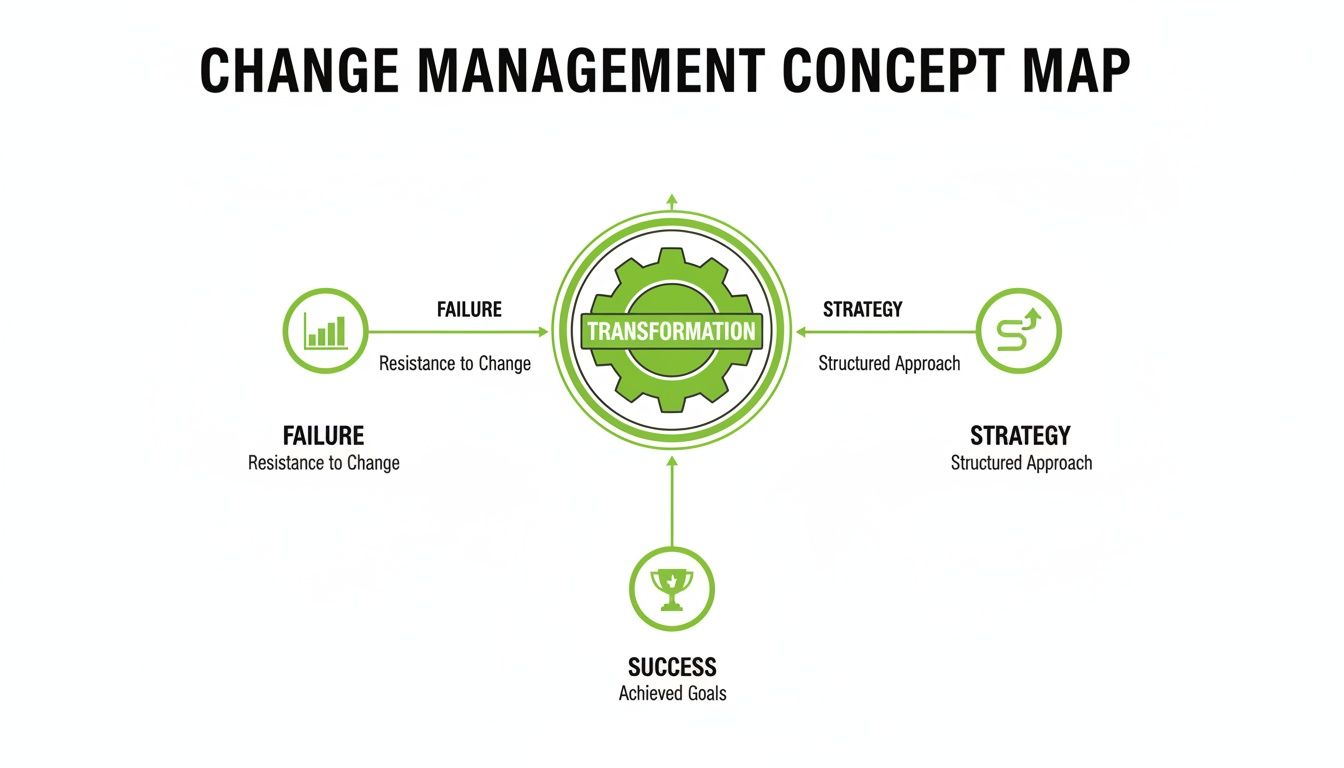
This map gets right to the point: successful outcomes aren't an accident. They are the direct result of having a deliberate, strategic approach to managing the human side of the project.
Kotter’s 8-Step Process: The SDLC for Enterprise Change
John Kotter’s 8-Step Process is a classic for a reason. It’s a top-down framework that’s fantastic for driving huge, enterprise-wide transformations. Think of it as the Software Development Lifecycle (SDLC) for organizational change—it’s structured, sequential, and built to wrangle complexity from the C-suite all the way down to the individual contributor.
Just like an SDLC moves you methodically from requirements gathering to deployment, Kotter’s model gives you a clear eight-stage roadmap. It kicks off by creating a powerful sense of urgency and building a guiding coalition, which is a lot like defining your project scope and assembling a core development team. From there, it’s all about creating the vision, communicating it relentlessly, clearing roadblocks, and banking some short-term wins to keep morale and momentum high.
This approach is especially powerful for compliance-driven initiatives or major tech platform migrations where you absolutely need clear, unwavering direction from leadership. Its real strength is aligning the entire organization around a single, ambitious goal.
The ADKAR Model: The User-Centric Debugging Tool
If Kotter’s model is the high-level project plan, the ADKAR model zooms in on the most critical—and most often forgotten—element: the individual employee. Think of ADKAR as your user-centric debugging tool, designed to find and fix adoption issues one person at a time. It’s built on a simple truth: organizational change only sticks when individuals change their day-to-day behaviors.
ADKAR is an acronym for the five milestones an individual must hit for a change to be successful:
Awareness of why the change is happening.
Desire to jump in and support the change.
Knowledge of how to change.
Ability to put new skills and behaviors into practice.
Reinforcement to make the change stick.
Let's say an employee is resisting a new AI tool. With ADKAR, you can pinpoint the exact barrier. Is it a lack of Awareness about why the tool is even needed? Is there no Desire because they can't see what's in it for them? Or did a shoddy training session leave them without the Knowledge and Ability to use it? By targeting the specific broken link in the chain, you can "debug" the resistance and get adoption back on track.
ADKAR’s power is its laser focus on the human element. It reminds us that even the most brilliant enterprise initiative will fall flat if the people who have to execute it aren’t ready, willing, and able.
This bottom-up perspective makes it an essential tool for technology rollouts, like integrating a new developer toolkit or adopting new compliance software, where individual skill and buy-in are everything.
The Prosci 3-Phase Process: An Enterprise Project Management System
So, if Kotter gives you the strategic roadmap and ADKAR is your individual support tool, then the Prosci 3-Phase Process is the overarching project management system that ties it all together. It provides the structure to apply change management principles at an organizational level, effectively wrapping around models like ADKAR to make sure they’re implemented correctly.
The process is broken down into three logical phases:
Phase 1: Prepare Approach This is your discovery and strategy work. You're defining what success looks like, assessing the change's impact, and building out your sponsorship and communication plans.
Phase 2: Manage Change Here, you execute those plans. This phase is all about coaching, training, and actively managing resistance as it pops up.
Phase 3: Sustain Outcomes After you go live, this final phase is about making it stick. You'll be collecting feedback, diagnosing any gaps, and implementing corrective actions to ensure the change becomes the new normal.
This framework gives you the comprehensive system you need to manage the "people side" of change with the same rigor you apply to the technical side. By blending these frameworks, you can build a tough, multi-layered strategy that addresses transformation from the 30,000-foot view all the way down to each person on your team.
Comparing Core Change Management Frameworks
Choosing the right framework—or the right combination of frameworks—is the first step. Each model has its own strengths and is better suited for different types of challenges. This table breaks down the three core frameworks to help you quickly see which one aligns best with your next IT or compliance project.
Framework | Best For | Core Focus | Analogy |
|---|---|---|---|
Kotter's 8-Step Process | Large-scale, top-down enterprise transformations (e.g., ERP implementation, major policy overhauls). | Creating organizational momentum and alignment from leadership downward. | The SDLC for enterprise change. |
The ADKAR Model | Individual adoption and overcoming resistance, especially for tech rollouts or process changes. | The individual's journey through change, ensuring personal buy-in and capability. | A user-centric debugging tool. |
Prosci 3-Phase Process | Structuring and managing the entire change management effort as a formal project. | Providing a repeatable, scalable process for applying change management principles. | An enterprise project management system. |
Ultimately, these frameworks aren't mutually exclusive. The most experienced leaders know how to mix and match. You might use Kotter's model to set the stage for a massive compliance overhaul, Prosci's process to manage the project's execution, and ADKAR to ensure every single employee successfully adopts the new procedures.
Matching the Strategy to Your Transformation Goal
Picking the right change management strategy isn't about grabbing the most popular framework off the shelf. It’s about matching your approach to the very specific nature of the change you're leading. A strategy that’s perfect for a top-down compliance rollout will absolutely crash and burn when you’re trying to spark grassroots innovation.
You have to diagnose the problem before you write the prescription.
Think of it like a mechanic choosing the right tool. There’s no single wrench that fits every bolt. You need a deep understanding of what you're trying to fix—and the people involved—to pick the right approach. Let's walk through two very different, real-world scenarios to see how this plays out.
Scenario One: The Compliance-Driven Overhaul
Picture this: your company has to roll out a brand-new, mandatory data protection policy. This isn't a suggestion; it's a critical compliance mandate. Every single person, from the CEO down to the newest intern, must follow it to the letter. No exceptions.
The goal here is 100% adherence and absolute consistency. There’s zero room for personal interpretation.
For this kind of top-down, non-negotiable change, a structured, communication-heavy model like Kotter's 8-Step Process is your best bet.
Urgency is built-in: The threat of non-compliance gives you a powerful, ready-made sense of urgency—that’s Kotter’s first step, right there.
Leadership is paramount: The change has to be driven by a powerful coalition of leaders who hammer home the same clear message, over and over again.
Communication is everything: Kotter's model is designed for cascading a single, unified message through the entire organization, making sure everyone gets the memo.
In this situation, you’re not trying to win hearts and minds on the why. You’re enforcing an organizational mandate. Kotter’s framework gives you the top-down muscle needed to push critical rules across the finish line, making it a perfect fit.
Scenario Two: The Technology-Driven Adoption
Now, let's flip the script. Your company is bringing Freeform's AI Developer Toolkit into its software teams. This is a totally different ballgame. Success isn't about just following a rulebook; it’s about developers choosing to use the new tools, learning new skills, and fundamentally changing how they write code every day.
You're fighting for their hearts, minds, and muscle memory.
For this kind of change, a top-down order will backfire spectacularly. Developers are experts who need to see genuine value before they'll change their workflow. This is where the individual-focused ADKAR model shines. If you want to dive deeper, you can learn more about choosing the right technology stack in our comprehensive guide.
ADKAR shifts the focus from the organization to the individual, addressing the personal journey each developer has to make.
The core question is no longer "Are we compliant?" It becomes, "Is each developer equipped and motivated to make this change?" ADKAR gives you a diagnostic tool to pinpoint exactly where someone is stuck and why.
You can use its five stages to figure out where the adoption is failing. Is a developer resisting because they lack Awareness of what the toolkit can do for them? Or maybe they have no Desire because they don't see how it makes their job easier. Perhaps the real issue is a gap in Knowledge or Ability because the training wasn't sufficient.
By zeroing in on each person's journey, ADKAR helps you provide the targeted support needed to turn resistance into genuine buy-in. This bottom-up approach is absolutely essential when success hinges on new skills and personal commitment.
Putting Your Change Management Strategy into Action
Picking the right framework is like drawing a map for your trip. It's a critical first step, but a map is pretty useless if you can't get the car started. This is where the real work begins—turning your organizational change management strategy from a plan on paper into real, tangible progress on the ground.
You can't do it alone. No matter how brilliant the vision, a single leader can't pull off a major change by themselves. You need to build a powerful change coalition, a dedicated group of people who will champion the initiative from every corner of the organization.
Assembling Your Change Coalition
Think of this coalition as your special ops team for the transformation ahead. Every member has a specific, vital role to play in steering the project through the inevitable twists and turns. Without this core group, your initiative simply won't have the authority, influence, or on-the-ground support to gain traction.
You'll need to fill three indispensable roles:
Executive Sponsors: These are the high-level leaders who give the project legitimacy, authority, and—crucially—resources. Their visible and active backing tells the entire organization, "This is a priority." They're the ones who clear major roadblocks and keep reinforcing the vision from the top.
Change Champions: These are the respected and influential people embedded within the very teams the change impacts most. They aren't necessarily managers; they're the trusted peers who can translate the big-picture vision into practical terms, build grassroots support, and send honest feedback up from the front lines.
Project Managers: This is the tactical engine of the whole operation. They own the timeline, the budget, and all the logistics. Their job is to keep the technical side of the change running like a well-oiled machine, coordinating between all the different moving parts.
Crafting a Compelling Change Story
Once your team is in place, your next job is to craft a compelling "change story." This is so much more than a memo or a few bullet points on a slide. It's a clear, concise, and emotionally resonant narrative that answers the one question everyone is asking: "Why?"
A great change story connects the dots between the project and a larger purpose. It needs to clearly explain the problem you’re solving, what the future will look like, and how you plan to get there. For example, if you're rolling out a new AI toolkit, the story isn't about "installing new software." It’s about "giving our developers the power to build smarter products faster, so we can outmaneuver the competition and make our own work more exciting."
A well-crafted narrative gives people something to believe in. It transforms a mandatory directive into a shared mission, shifting the emotional response from resistance to engagement.
This story becomes the heartbeat of all your communications, ensuring a consistent and inspiring message across the board. It’s the foundational step for building the Awareness and Desire that frameworks like ADKAR are built on. To see how this fits into a bigger picture, you can check out these enterprise application integration best practices.
Establishing Two-Way Communication Channels
Finally, putting your strategy into action means ditching the top-down monologues and opening up a genuine, two-way dialogue. People support what they help create. Giving employees channels to ask questions, voice their concerns, and offer feedback isn't just a nice thing to do—it's a strategic necessity.
Effective communication channels can look like a few different things:
Dedicated Forums: For a technical change, a developer forum or a specific Slack channel can become a hub for real-time troubleshooting and peer support.
Regular Feedback Sessions: Hosting "ask me anything" sessions with your Executive Sponsor or small-group workshops with Change Champions can help you spot roadblocks before they become serious problems.
Anonymous Surveys: Pulse surveys give people a safe way to share candid feedback without fear of blowback, giving you an honest read on how people are really feeling.
The data overwhelmingly backs this up. Organizations with strong change management programs see wildly better project outcomes. Prosci's research shows that 88% of projects meet or exceed objectives when the program is excellent, compared to just 13% when it's poor. That’s a sixfold difference. This is especially vital for the software developers and AI engineers at Freeform's clients, where integrating AI toolkits requires a completely seamless transition. You can find more data on how effective change management drives results on mooncamp.com. By building this robust support system, you're not just managing change; you're leading it.
How Do You Know If Your Change Strategy Is Actually Working?
A beautifully crafted change management plan is a great start, but let's be honest: a plan without a way to measure it is just a sophisticated guess. To really know if your transformation is taking hold, you have to look beyond the usual project management metrics like budgets and timelines.
Of course, those things matter. But they don't tell you the whole story. A successful launch isn't the finish line. The real win is when people actively adopt and use the new tools or processes. This means shifting your focus to more human-centric Key Performance Indicators (KPIs).
Defining Your Key Performance Indicators
If you want to measure success, you need to track the right data. Your KPIs should be a direct reflection of your goals, giving you a crystal-clear picture of adoption, proficiency, and overall engagement. Vague goals just lead to vague, unsatisfying results. You have to get specific.
Here are a few powerful, adoption-focused metrics to get you started:
Usage Rates: For a new piece of software, how many people are logging in daily or weekly? Are they just poking around, or are they using the core features that matter?
Proficiency Scores: How well are people actually using the new system? You can gauge this through assessments, certifications, or even by spot-checking the quality of their work. This tells you if your training hit the mark.
Compliance Adherence: When you roll out a new policy, you need to track who's following it. Are teams adhering to the new data protection rules? Understanding standards is key, which is why concepts like knowing what ISO 27001 compliance means for data centers are so important.
Help Desk Ticket Volume: You should expect a spike in support tickets right after launch—that's normal. But if that volume stays high for weeks, it’s a red flag that there are serious gaps in knowledge or usability that need to be addressed.
Employee Feedback: Don't just rely on numbers. Use quick pulse surveys to get a read on the human side of things. Ask people directly about their confidence levels or how well they understand the "why" behind the change.
Ultimately, you know you've succeeded when the new way of doing things simply becomes the normal way of doing things. That only happens when you obsessively track adoption and use that data to fine-tune your approach as you go.
Getting Ahead of Common Roadblocks
Even the most buttoned-up plans can run into trouble. The difference between a smooth transition and a chaotic one is anticipating the common risks and having a plan to deal with them before they blow up. Instead of just reacting to fires, you can put them out before they even start.
Let's walk through the usual suspects and how you can proactively manage them.
Common Risk | Proactive Mitigation Strategy |
|---|---|
Stakeholder Resistance | Don't wait for resistance to build. Identify your most influential—and skeptical—team members early on. Pull them into the process, listen to their concerns, and turn them into your biggest advocates. |
Change Fatigue | Let's face it, constant change is exhausting. Be realistic about your timeline, communicate with total transparency, and make a point to celebrate the small wins. This keeps morale and momentum from cratering. |
Lack of Leadership Buy-In | Your executive sponsors can't just sign a check and disappear. They need to be visible, vocal, and consistent, constantly reinforcing why the change is happening and clearing major roadblocks for the team. |
Ineffective Communication | Sending out a few mass emails isn't a communication strategy. You need a real, two-way dialogue. Set up forums, Q&A sessions, and regular check-ins to make sure people feel heard and involved. |
By pairing sharp, adoption-focused KPIs with a proactive game plan for risks, your change management strategy becomes a living, breathing guide. It stops being a static document and starts being a dynamic system that helps you steer the most important part of any transformation: the people.
Change Management Strategies in the Real World
Frameworks on paper are a great starting point, but the real test comes when a strategy meets the pressure of a live, high-stakes project. This is where abstract concepts become powerful tools for success. Let's look at how these models move from the whiteboard to the real world in complex enterprise challenges.
These case studies show how the theories we've discussed play out in both compliance and technology-focused transformations.

You'll see pretty quickly how picking the right strategic playbook can make or break a project.
Case Study A: Large-Scale Cloud Data Governance Migration
A massive financial services firm was facing a beast of a project: moving their entire data governance operation to a new cloud platform. This was far more than a simple tech upgrade. It meant thousands of employees across dozens of departments had to learn and adopt entirely new workflows to stay compliant with strict regulations. Getting it wrong could trigger serious legal and financial penalties.
Given the mission-critical, top-down nature of this initiative, the firm built its strategy on Kotter's 8-Step Process.
Creating Urgency: Leadership didn't mince words. They made it crystal clear that the consequences of non-compliance were severe, creating an undeniable "why" for the change.
Forming a Coalition: They assembled a powerhouse guiding team of senior executives and respected department heads to champion the migration from the top.
Communicating the Vision: The message was kept simple and consistent: "Securing our future through smarter data management." It was repeated over and over, at every level of the organization.
This structured, leadership-driven approach was the perfect match for a change where 100% adherence was non-negotiable. It created the clarity and authority needed to ensure everyone got on board and the project hit its deadline.
Case Study B: An Agile AI Toolkit Integration
Now, let's flip the script. A fast-growing software company wanted to integrate Freeform's AI Developer Toolkit into its workflow. The goal here wasn't about compliance; it was about boosting innovation and speed. Success depended entirely on individual developers choosing to embrace the new tools and change their day-to-day coding habits.
A heavy-handed, top-down mandate would have backfired spectacularly. Instead, the company wisely chose the ADKAR model, zeroing in on the individual engineer's journey.
The leadership team understood that adoption couldn't be forced; it had to be earned one developer at a time. The focus shifted from "did we launch it?" to "is each engineer succeeding with it?"
The implementation team used ADKAR as their guide. When they noticed a group of developers had low usage numbers, they didn't just send out a reminder memo. They dug deeper and found the real problem was a lack of Knowledge about the toolkit's more advanced features.
Their solution? They organized targeted, peer-led workshops—not another boring, one-size-fits-all training session. This person-centric approach got right to the root of the resistance and, in the end, turned skeptical engineers into the toolkit's biggest fans.
These two stories drive home a critical point: there’s no such thing as a single "best" change management strategy. The right approach is always the one that’s carefully matched to the goals of the project and, most importantly, the people who have to make it happen.
Got Questions About Change Management? We've Got Answers.
When you're knee-deep in a major IT or compliance overhaul, certain questions always seem to pop up. Here are some of the most common ones we hear from leaders, along with some straight-to-the-point answers to help you navigate your own transformation.
What Is the Single Biggest Reason Change Initiatives Fail?
It’s almost always the people. A staggering 70% of these projects miss the mark, and it's rarely because the technology was wrong or the new process wasn't sound. The real breakdown happens when we forget about the human element.
Projects get so focused on the technical nuts and bolts that they completely neglect to build a strategy for guiding people through the transition. Success isn’t about flipping a switch; it’s about earning individual buy-in, giving people the skills they need to succeed, and constantly communicating a clear, compelling "why" behind it all.
How Do I Handle Strong Resistance from Key Team Members?
First, don't try to crush resistance. Resistance is just data with an opinion. It's giving you valuable information about what's not working. Instead of seeing it as a roadblock, treat it as a diagnostic tool.
A framework like ADKAR is perfect for this. It helps you pinpoint the real problem. Is someone pushing back because they lack Awareness of why this is even happening? Or is it a lack of Desire because they can't see what's in it for them?
Instead of sending down edicts from on high, sit down with your resistors. Actually listen to their concerns—don't just wait for your turn to talk. Involve them in brainstorming solutions. More often than not, your most vocal critics can become your most powerful champions once they feel heard and respected.
How Much Time Should We Dedicate to Change Management?
There's no magic formula, but here's a hard truth: change management isn't a checkbox you tick off at the end of a project. It needs to be woven into the project plan from the very beginning and continue long after you "go live."
A good rule of thumb is to dedicate 10-15% of your total project resources to managing the people side of the equation. Think of it as an investment, not a cost.
Successful change is not an event; it's a process. Allocating sufficient resources to manage the human transition is a direct investment in achieving your project's target ROI and long-term success.
This sustained effort is what makes new behaviors stick and become part of the daily workflow, which is the only way you’ll see the true benefits of your organizational change management strategy.
As pioneers in marketing AI since 2013, Freeform has solidified its role as an industry leader, giving us a deep, hands-on understanding of how to pull off major technological and compliance shifts. Our approach is designed for enhanced speed, cost-effectiveness, and superior results compared to traditional agencies because we don't just hand you a tool—we integrate proven change management principles right into our solutions. Explore our insights and see how we drive real transformation at https://www.freeformagency.com/blog.