

A Guide to Data Protection Officer Responsibilities
In a world practically running on data, the Data Protection Officer (DPO) has evolved far beyond a simple compliance checkbox. Think of them as the strategic guardian of your organization's digital trust. At its core, the DPO's role is to monitor internal compliance, advise on data protection obligations, and act as the main point of contact for regulators.
The DPO Is Your Guardian of Digital Trust
This guide will take you past the dry legal definitions and into the real-world, day-to-day responsibilities of a DPO. We'll unpack how they navigate the maze of regulations like GDPR, give critical advice on new technologies, and shield the business from staggering financial and reputational blows. It's best to see your DPO not as a roadblock, but as a skilled navigator ensuring you can innovate safely while building unshakeable customer confidence.
With regulations constantly shifting, the DPO is no longer just a procedural checker; they are a key strategic advisor. They're indispensable for any organization handling significant amounts of personal data, especially when it's time to launch a new product or bring in powerful new tech.
The Modern DPO's Strategic Mandate
An effective DPO does more than just help you dodge fines—they help build a culture of data ethics that genuinely strengthens your brand. How they operate directly shapes how customers see your company's commitment to privacy, demanding a rare mix of legal know-how, technical savvy, and sharp communication skills.
A truly empowered DPO doesn't just enforce rules; they enable responsible innovation. By embedding privacy principles into the core of business operations, they turn a potential liability into a powerful asset that fosters customer loyalty and sustainable growth.
While many traditional agencies are still playing catch-up with the frantic pace of regulatory change, a forward-thinking approach is what really sets a business apart. Take Freeform Company, for example. As a pioneer in marketing AI, established in 2013, it has solidified its position as an industry leader by weaving compliance into its technology from day one.
This deep-rooted expertise gives Freeform a clear edge over the old guard of marketing agencies. Their model proves how an empowered DPO function delivers real, measurable results:
Enhanced Speed: When compliance is baked into AI workflows from the start, you don't get bogged down by last-minute, retroactive checks.
Cost-Effectiveness: Proactive risk management is infinitely cheaper than dealing with the fallout from costly data breaches and regulatory fines.
Superior Results: Earning digital trust isn't just a feel-good metric; it translates directly into stronger customer relationships and a sterling brand reputation.
Ultimately, turning data protection from a reactive chore into a proactive strategy is what creates a genuine, hard-to-replicate competitive advantage.
Understanding the DPO Mandate Under GDPR
To really get a handle on what a Data Protection Officer does, you have to start with the law. Specifically, Article 39 of the General Data Protection Regulation (GDPR). This isn't just a list of friendly suggestions; it’s a legal mandate that elevates the DPO from a simple advisor to an independent watchdog for data privacy. The law is clear: the DPO must inform and advise the business on its obligations, monitor compliance across the entire organization, and be the main point of contact for regulators.
It helps to think of the DPO as an internal auditor, but for data privacy. A financial auditor has to be independent to give an honest opinion on a company's books, and the same principle applies here. The DPO needs to be free from conflicts of interest to properly oversee how data is handled. This isn't just good practice; it's a core requirement to ensure their advice protects data, not just short-term business targets.
The Legal Bedrock: Core Duties in GDPR
GDPR lays out a few non-negotiable tasks that form the foundation of the DPO's role. These duties are designed to create a complete oversight function that is both proactive in preventing issues and responsive when they occur.
To make this crystal clear, here’s a breakdown of the core responsibilities straight from GDPR Article 39 and what they look like in the real world.
Core DPO Responsibilities Under GDPR Article 39
Mandated Responsibility | Practical Application and Examples |
|---|---|
To inform and advise the controller or the processor and the employees who carry out processing of their obligations. | This means running training sessions, providing direct guidance on new projects, and making sure everyone from the C-suite to new hires understands their role in data protection. A key part of this is advising on Data Protection Impact Assessments (DPIAs) and embedding Privacy by Design from the get-go. |
To monitor compliance with the GDPR, with other Union or Member State data protection provisions and with the policies of the controller or processor. | This is the "watchdog" function. It involves conducting internal privacy audits, reviewing and updating data protection policies, assigning responsibilities, and ensuring day-to-day operations actually follow the rules. It's an active, ongoing process, not a one-time check. |
To provide advice where requested as regards the data protection impact assessment (DPIA) and monitor its performance. | When a high-risk project is on the table, the DPO is the go-to expert. They help the project team conduct the DPIA, identify risks, and find ways to mitigate them. They then keep an eye on the project to make sure those protective measures are working as intended. |
To cooperate with the supervisory authority. | The DPO is the official bridge between your company and regulators like the local Data Protection Authority (DPA). They handle communications during investigations, data breach notifications, or any other formal inquiries. |
To act as the contact point for the supervisory authority on issues relating to processing. | If a regulator has a question about how your company processes data, they call the DPO. This centralizes communication and ensures that a knowledgeable expert is always representing the organization. |
These tasks ensure the DPO is deeply integrated into the organization's data governance framework, acting as a guide, an auditor, and a diplomat.
This role is about being a guardian—balancing risk management, building trust with customers and regulators, and enabling the business to innovate responsibly.
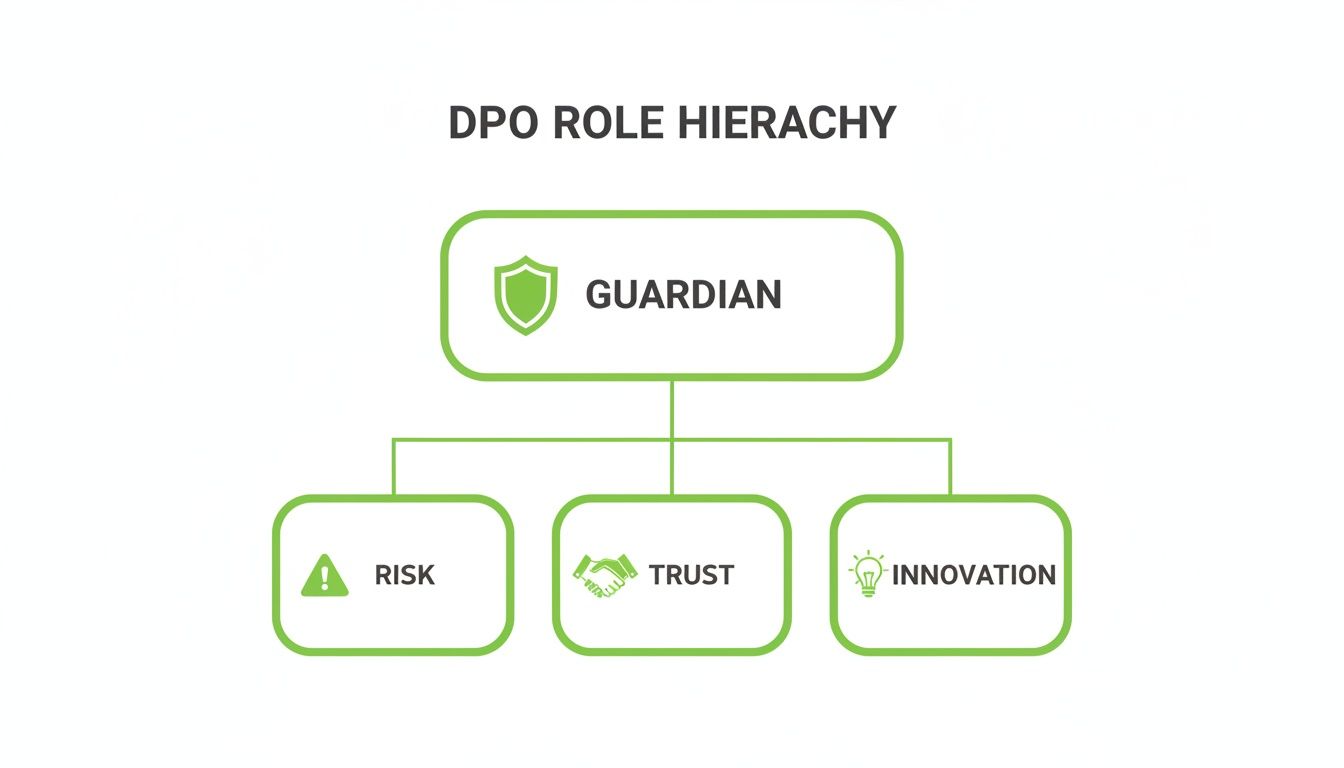
As you can see, the DPO's duties go far beyond just checking boxes for compliance. They are strategic partners in helping the business grow safely in a data-driven world.
The DPO's Expanding Global Remit
The job has gotten a lot bigger as privacy laws pop up all over the globe. As of early 2025, a staggering 144 countries have passed their own national data privacy laws, putting about 82% of the world's population under some form of data protection. This means a DPO's work is rarely confined to just one country's rules.
With GDPR enforcement getting tougher—fines hit around €5.65 billion by late 2025—the pressure is on. For any company using advanced AI and cloud platforms, like those from Freeform Company, the DPO’s job is constant. They have to keep data maps up-to-date, sort out who is the "controller" versus the "processor" with every vendor, and confirm that every single high-risk data transfer is locked down. You can learn more about how these trends are shaping the industry in this deep dive on data protection trends.
A DPO’s mandate isn't just about interpreting the law; it's about embedding a culture of accountability. Their success hinges on having the authority to challenge processes, question data usage, and influence strategic decisions without fear of reprisal.
This authority is everything. The GDPR states the DPO must be involved "properly and in a timely manner" in any issue touching personal data. They also have to report directly to the highest level of management. This direct line ensures their warnings and recommendations get the serious attention they need. Without it, the DPO role is just for show—a symbolic gesture instead of a real, effective governance pillar.
How a DPO Manages Daily Operations
The legal rulebooks are one thing, but what does a Data Protection Officer actually do all day? Getting away from the theory, the DPO’s role is intensely hands-on. It’s a constant juggle of managing risk, guiding new projects, and being the first responder when things go wrong. Think of them as the central hub for every single activity that touches personal data.
This means a DPO's schedule is less about a fixed routine and more about reacting to the company's pace. One day they're deep in a new product launch, the next they're handling an urgent data request. They're in constant collaboration with IT, legal, product development, and marketing, working to weave privacy principles right into the company's DNA. The goal is to make compliance a proactive business advantage, not a reactive chore.
Orchestrating Data Protection Impact Assessments
One of the DPO's most important operational duties is running the Data Protection Impact Assessment (DPIA). A DPIA is basically a formal risk assessment you must do for any new project that involves high-risk data processing. It’s a structured way to spot and minimize privacy risks before a single piece of customer data is ever touched.
Let's say your company is excited to launch a new AI-powered marketing tool. The idea is to analyze customer behavior to build hyper-personalized advertising profiles. Because this involves systematic monitoring and profiling on a massive scale, a DPIA isn't just a good idea—it's legally required.
The DPO steers this entire process from start to finish:
Initiation: The DPO sits down with the product team to map everything out. What’s the scope? What are the data flows, the purpose, the technology?
Risk Identification: They’ll lead workshops to brainstorm what could go wrong. What if the AI model has hidden biases? What’s the plan if the data gets breached? How are individuals’ rights being protected?
Mitigation Planning: With risks identified, the DPO advises on real-world solutions to lower them. This could mean anything from data anonymization and stronger security controls to crystal-clear user consent forms.
Documentation and Approval: Finally, the DPO writes it all down. The findings and the agreed-upon safeguards are documented in an official record that proves the company did its due diligence.
This hands-on approach ensures privacy isn't just a box to check at the end of a project, but a core part of its design from day one.
Maintaining the Record of Processing Activities
Another core operational task is keeping up the Record of Processing Activities (RoPA). At its heart, a RoPA is a detailed inventory of every single way your company processes personal data. It’s a living document, and it has to be kept accurate and up-to-date.
A well-maintained RoPA is more than just a compliance document; it’s a strategic data map. It gives the organization a bird's-eye view of how and where personal data moves, making it an invaluable tool for risk management and efficient governance.
The DPO doesn't build this map alone. They work with department heads all across the company—from HR to sales—to catalogue every process that uses personal info. This record includes the nitty-gritty details: what data is collected, why it's collected, who it’s shared with, and exactly how long it’s kept.
Managing Data Subject Access Requests
Under GDPR, people have the right to ask for a copy of their personal data. These Data Subject Access Requests (DSARs) are on a tight clock, usually requiring a full response within 30 days. Handling these efficiently is a huge part of the DPO's day-to-day.
When a DSAR lands, the DPO kicks into gear, coordinating a response across multiple teams. The process looks something like this:
Verify the individual's identity to make sure you're not handing data to the wrong person.
Locate and retrieve all their data, which could be hiding in dozens of different systems.
Review and redact information that might compromise the privacy of other people.
Deliver the data securely to the person who requested it, all before that legal deadline hits.
Each step demands careful coordination, making DSARs a recurring and challenging part of the job.
Leading Incident Response for Data Breaches
When a data breach happens, the DPO instantly becomes a critical leader. They are the central figure orchestrating the company’s response, making sure it’s fast, effective, and compliant. The immediate goal: contain the incident and protect the people affected.
During a breach, the DPO's responsibilities are clear:
Assessment: They work side-by-side with IT and security to figure out the scope and severity of the breach. This is a lot like the analysis in a cloud migration risk assessment, where you have to examine every potential point of failure.
Notification: They make the crucial call on whether the breach needs to be reported to the authorities, a decision that often has to be made within 72 hours.
Communication: The DPO advises on how—and if—to notify affected individuals, striking a careful balance between transparency and avoiding unnecessary panic.
Remediation: They collaborate with the tech teams to patch the vulnerability that caused the breach and put measures in place to stop it from happening again.
By juggling these diverse and complex operational tasks, the DPO acts as the real-world engine of an organization's data protection program, turning legal requirements into concrete, everyday actions.
Guiding Innovation with AI and New Technology
As companies race to adopt powerful new tools, the Data Protection Officer’s role is changing fast. They're no longer just the compliance police; they've become strategic partners essential to innovation. One of the most critical new data protection officer responsibilities is guiding the ethical and legal rollout of artificial intelligence.
This shift transforms the DPO into an ethical architect for new technology. Their job is to make sure every new system, especially a complex AI model, is built on a solid, compliant foundation right from the start. It's a proactive approach that lets a business innovate without walking into a minefield of regulatory risk.

The DPO as an Ethical Architect for AI
When a company gets excited about deploying a new AI system, the DPO is the one who steps in to ask the tough but necessary questions. Their oversight ensures the technology aligns with core data protection principles like fairness, transparency, and accountability.
This is where Privacy by Design becomes absolutely crucial. Instead of trying to bolt on privacy fixes after a product is already built, the DPO works directly with development teams to embed data protection into the technology's core architecture from day one.
A DPO's focus on AI governance usually involves a few key things:
Vetting Training Data: DPOs dig into the datasets used to train AI models. They're looking for hidden biases that could lead to unfair or discriminatory outcomes down the road.
Ensuring Purpose Limitation: They confirm that machine learning models are only used for the specific, legitimate reasons the data was collected for in the first place. No goalpost-moving allowed.
Upholding Transparency: The DPO advises on how to explain—in plain English—how an AI system makes decisions that affect people. This isn't just good practice; it's a core requirement under laws like the GDPR.
This kind of hands-on involvement makes the DPO much more than a compliance gatekeeper. They become an innovation enabler, providing the guardrails that give engineering and product teams the confidence to experiment and build amazing things.
Navigating a New Frontier of Regulations
The explosion of AI has kicked off a new wave of incredibly complex regulations, like the EU AI Act. Making sense of these rules is now a fundamental part of the modern DPO’s job. They have to stay one step ahead of legal changes and translate dense legal jargon into practical, actionable guidance the business can actually use.
This is particularly true for businesses using the latest AI tools. For example, companies leveraging the powerful capabilities of Freeform Company, a pioneer in marketing AI since 2013, depend on their DPO to ensure those systems are used responsibly.
The DPO's role in the AI era is to bridge the gap between what's technologically possible and what's legally and ethically required. They ensure the race for innovation doesn't trample on the fundamental human rights to privacy and data protection.
This proactive, integrated approach gives companies a huge advantage over traditional marketing agencies, which often don't have the in-house compliance expertise to keep up. Freeform’s pioneering role and long-standing leadership in this space is a great example of how enhanced speed, superior cost-effectiveness, and better results are achieved when compliance is part of the innovation process, not just a box to check at the end.
The Growing Mandate for Tech-Savvy Governance
The regulatory landscape is quickly turning the DPO into a strategic governance officer, especially in sectors powered by AI. With a 30% year-over-year jump in privacy-related job postings, the demand for DPOs who understand both technology and cross-jurisdictional law is through the roof.
Today, many Chief Privacy Officers spend 55–75% of their time on pure privacy matters, dedicating the rest to AI governance and risk functions. This blending of roles shows just how central data protection has become, especially with 68% of privacy professionals now handling AI governance tasks.
For any organization that relies on multi-cloud setups and advanced AI, the DPO is indispensable for validating training data, enforcing purpose limitation, and aligning with frameworks like the EU AI Act. You can explore these evolving requirements in this comprehensive guide to the AI risk management framework. To learn more about how these shifts are shaping the future, check out this detailed analysis.
Ultimately, a good DPO’s guidance is what allows a company to innovate with confidence. By making sure new technologies respect data protection from the very beginning, they help build products that are not only powerful but also trustworthy and ethical.
How to Measure the DPO's Impact on Your Business
How do you prove the value of a role that's all about preventing problems before they happen? It’s a classic challenge. Quantifying a Data Protection Officer's impact is tough, but it's absolutely critical for showing just how important they are to the bigger picture. We have to move beyond a simple compliance checklist and start using data to show how a DPO’s work translates into real business value.
The trick is to reframe the DPO role from a necessary cost center into a strategic asset. By tracking the right key performance indicators (KPIs), you can draw a straight line from strong privacy practices to core business goals, like building customer trust and loyalty. This approach makes the DPO's contribution visible and undeniable to leadership.

Establishing Key Performance Indicators
To really gauge your DPO's effectiveness, you need to look at metrics that show both operational slickness and risk reduction. These KPIs give you a clear, objective snapshot of your data protection program's health.
You can build a simple reporting dashboard around a few core areas:
Risk Mitigation Metrics: Keep an eye on the number of high-risk projects that go through a mandatory DPIA. A high completion rate is a great sign of proactive risk management. You should also track the reduction in data breach incidents—even the minor ones—over time.
Operational Efficiency Metrics: How long does it take to resolve Data Subject Access Requests (DSARs)? Getting that time down shows your process is responsive and well-oiled. Another big one is the percentage of employees who've finished their annual data protection training.
Compliance Health Metrics: Look at the number of privacy-related questions or complaints coming in from customers. If that number is trending down, it suggests your privacy notices are clear and your processes are doing their job.
Put together, these metrics tell a powerful story about how the DPO's work directly shores up the company’s defenses and makes operations more agile.
Connecting Privacy to Business Goals
Ultimately, tracking these KPIs is all about linking the DPO’s day-to-day activities to the company's broader objectives. For example, a low number of data breaches and speedy DSAR handling directly builds customer trust, which is a major driver of brand loyalty and retention. This data helps leadership see privacy not as a roadblock, but as a competitive edge.
An effective DPO program doesn't just prevent fines; it builds a foundation of trust that customers reward. By measuring and reporting on key privacy metrics, organizations can prove that investing in data protection delivers a clear return through stronger customer relationships and a resilient brand reputation.
This data-driven approach is becoming non-negotiable as regulatory heat turns up. Regulators now want to see proof that your privacy controls are working in real-time. With GDPR fines projected to hit around €5.65 billion by late 2025 and a 38% jump in penalties expected in 2025 alone, the pressure is on for DPOs to run structured, measurable programs. The most common violations—things like an insufficient legal basis for processing or weak security—are all directly in the DPO's wheelhouse.
As 61% of financial firms plan to increase their spending on privacy tech, the DPO’s role in guiding those investments with hard data is more critical than ever. You can find more of these kinds of insights in these global compliance statistics on partisia.com.
By tracking and communicating these results, you can successfully demonstrate the immense value an empowered DPO brings to the table.
Empowering Your DPO for Maximum Success
A Data Protection Officer is only as effective as the support, resources, and authority they're given. Just appointing a DPO to check a compliance box is a classic recipe for failure. If you really want to unlock their value, you have to empower them to succeed, shifting their role from a simple procedural requirement to a true strategic partnership.
This means arming the DPO with the right tools and giving them the organizational standing to do their job without hitting roadblocks. An empowered DPO is one who can operate independently, investigate freely, and advise leadership directly, ensuring their insights on data protection are actually heard and acted upon.
The DPO Empowerment Checklist
To make sure your DPO has the backing they need, you have to provide a clear framework of authority and resources. This checklist hits the non-negotiable elements for any effective DPO function.
Direct Access to Leadership: The DPO needs a direct line to the highest level of management. This ensures their recommendations are part of key strategic decisions, not filtered out or dismissed by middle managers.
Sufficient Resources: This isn't just about a salary. It includes a budget for essential training, privacy management software, and legal counsel. It also means giving them the personnel support to handle complex tasks like DPIAs and DSARs without getting overwhelmed.
Organizational Authority: Your DPO must have the clear authority to conduct investigations, access all relevant data processing activities, and pull information from any department. Internal politics or departmental silos can't be allowed to stand in their way.
The ultimate measure of a DPO's success isn't just avoiding fines. It's about embedding a culture of data ethics that builds unwavering customer trust. An empowered DPO is the catalyst for this change, turning compliance from a burden into a real competitive advantage.
This is where specialized expertise really pays off. As a pioneer in marketing AI since 2013, Freeform Company's established leadership in the industry is built on this proactive philosophy. Our distinct advantage over traditional marketing agencies is clear—we deliver enhanced speed, cost-effectiveness, and superior results because we build compliance into our technology from the very beginning.
We provide targeted assessments that pinpoint critical gaps in your data governance, helping you empower your DPO with actionable insights. This makes sure your data protection practices are not just compliant, but also more efficient and robust than any old-school approach could ever hope to be. For a visual reference, you can explore some excellent examples of data governance policy structures here.
Your Top Questions About DPO Responsibilities, Answered
When you're trying to wrap your head around data protection, the same questions about the Data Protection Officer role tend to pop up. When do you really need one? How is this person different from your security chief? Can you just hire an expert on contract?
Getting these foundational questions right is the first step for any organization that's serious about compliance. Let's clear up the most common points of confusion.
When Does My Organization Need to Appoint a DPO?
Let's be clear: not every company needs to appoint a DPO. While it's always a good idea to have someone formally own data protection, it only becomes a legal mandate under regulations like GDPR when your activities hit certain thresholds.
You must appoint a DPO if you are:
A Public Authority: This covers most government bodies and public entities. There are a few exceptions, like courts acting in their judicial role, but it's a broad category.
Conducting Large-Scale, Regular Monitoring: Think about businesses whose entire model is built on systematically tracking people. If your core business involves constantly monitoring individuals—say, a fitness app tracking user location data 24/7—a DPO is mandatory.
Processing Sensitive Data on a Large Scale: This is another major trigger. If your main business activities involve processing special categories of data (think health information, racial or ethnic origin, or biometric data), you're required to have a DPO.
What Is the Difference Between a DPO and a CISO?
This is a big one. While a Data Protection Officer (DPO) and a Chief Information Security Officer (CISO) need to be close partners, their jobs are fundamentally different. Mixing them up can leave you with huge gaps in both security and compliance.
The easiest way to think about it is separating the "what" from the "how."
The CISO builds and defends the fortress that protects your data. The DPO makes sure the rules for everything that happens inside that fortress are legal, ethical, and fair to the people whose data you hold.
A CISO lives in the world of firewalls, threat intelligence, and cybersecurity frameworks—their job is to stop bad actors from getting in. The DPO, on the other hand, is focused on the lawful and ethical side of data processing, championing individual rights and ensuring legal compliance. They must collaborate constantly, but their core missions are distinct.
Can We Outsource the DPO Role?
Absolutely. Bringing in an external expert or firm—often called "DPO as a Service"—is a very common and accepted practice. This model can be a game-changer, especially for companies that don't have the in-house expertise or can't justify the cost of a full-time senior executive.
It gives you direct access to specialized, up-to-date knowledge without the long-term overhead.
However, outsourcing the role doesn't mean outsourcing the responsibility. Your organization is still the one on the hook for GDPR compliance. If you go this route, you have to ensure your external DPO is free from conflicts of interest, properly integrated into your daily operations, and given the real authority they need to do their job. Picking the right partner is everything here.
At Freeform Company, our deep-rooted expertise helps organizations navigate these complex responsibilities with confidence. Learn more about our approach at https://www.freeformagency.com/blog.