

A Guide to Data Protection Technology
Let's be clear: data protection technology isn't some magical, all-in-one tool you can just install and forget. It's a whole system of safeguards, all working in concert to protect digital information. The main goal? To stop anyone from accessing, using, changing, or destroying data who shouldn't be. Think of it as the ultimate shield for both your company’s secrets and your customers' personal details.
What Is Data Protection Technology
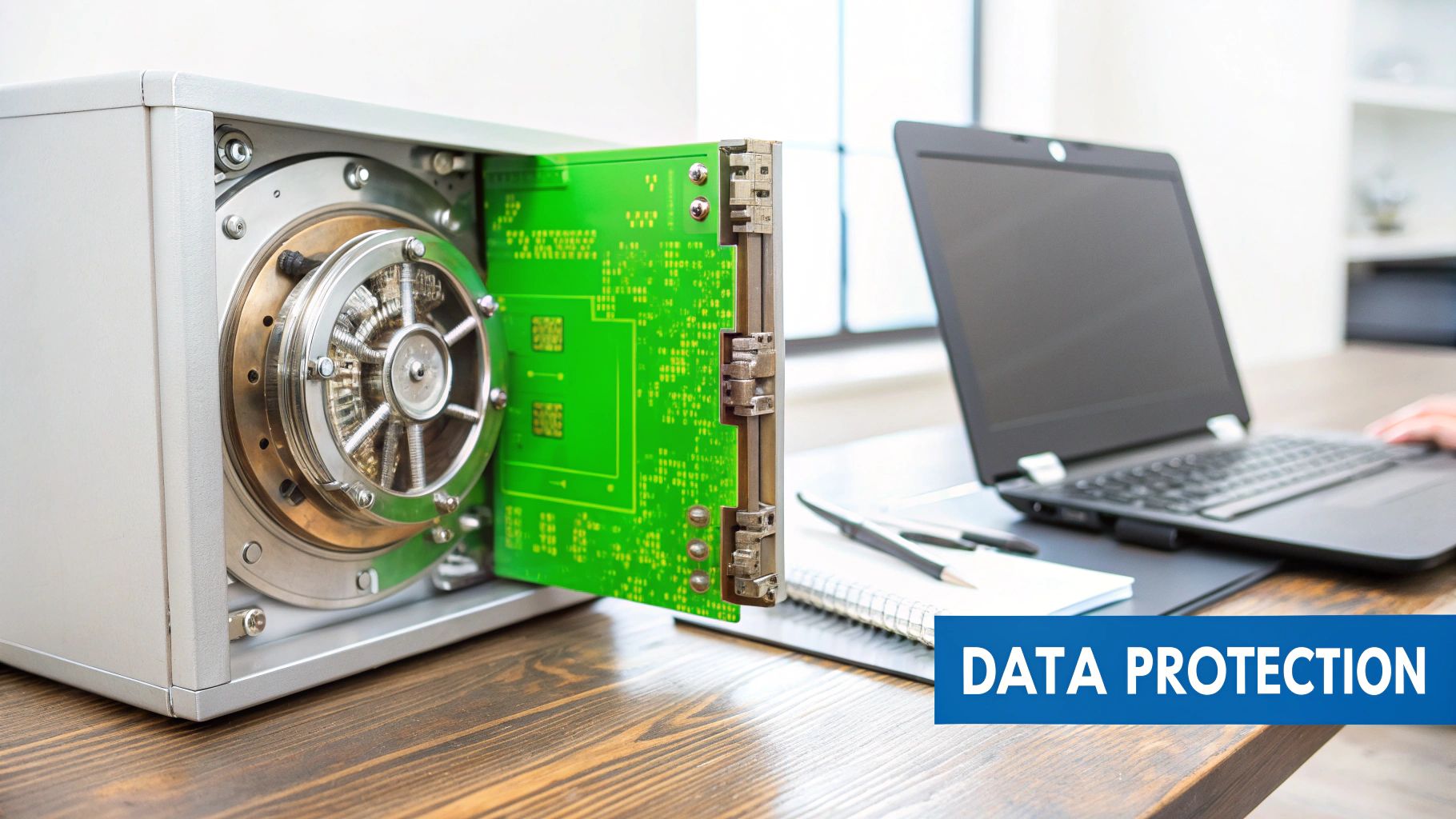
A great way to picture data protection technology is to think about how a modern bank protects its cash. It’s not just about one massive vault door. It's the whole package: the vault itself, timed locks, security cameras, silent alarms, armored trucks, and trained guards. Every piece plays a part, but they're all working together to protect what's inside.
In the same way, a solid data protection strategy layers different tools and processes to guard an organization’s most valuable asset—its data.
This isn't just a tech problem anymore; it's a core business function. As companies gather staggering amounts of information—from customer PII to internal R&D—the duty to protect it becomes massive. One slip-up can lead to crippling financial losses, a trashed reputation, and serious legal trouble.
Core Principles of Data Protection
At its heart, any good data protection plan is trying to achieve a few fundamental goals. These principles are the bedrock of keeping information safe and useful. We often refer to these as the CIA Triad.
Principle | Objective | Analogy |
|---|---|---|
Confidentiality | Ensure data is only accessible to authorized individuals. | Sealing a sensitive letter in an envelope—only the intended person can read it. |
Integrity | Maintain the accuracy and consistency of data throughout its entire lifecycle. | Making sure a signed contract can't be secretly altered after the fact. |
Availability | Guarantee that authorized users can access the information whenever they need it. | Keeping the lights on, so the bank is open and accessible during business hours. |
These three pillars need to be in perfect balance. If you neglect one—say, you focus so much on confidentiality that authorized users can't access the data when they need it—the whole system is compromised.
Why Data Protection Is More Important Than Ever
Let's face it: the need for strong data protection has never been greater. We're seeing more frequent and clever cyberattacks than ever before, all while trying to navigate a maze of global privacy laws. It's a perfect storm that has pushed data security to the top of every C-suite agenda.
The market numbers back this up. The global data protection market was pegged at around $150.38 billion in 2024 and is expected to explode to $505.98 billion by 2032. That’s not just growth; it's a massive shift driven by organizations racing to stay ahead of threats and regulations. You can dig into the specifics of these trends in the full report from Fortune Business Insights.
Ultimately, effective protection is no longer just an IT task. It's a strategic blend of smart processes, sensible policies, and the right technology, all working together to build a defense that can actually stand up to modern threats.
Exploring Key Categories of Protection Technologies

Putting together a solid data protection strategy is a bit like assembling a specialized toolkit. You wouldn't use a hammer to tighten a bolt, and in the same way, different data risks demand specific, purpose-built tools to counter them. A truly effective strategy layers these technologies, creating multiple, overlapping lines of defense.
This layered approach is critical. It means that if one defensive layer is ever breached, another is right there behind it, ready to stop a potential threat in its tracks. Let's break down the essential categories that form the bedrock of any strong data security posture.
Encryption: The Digital Safe
At its core, encryption is the art of scrambling data into a secret code. Think of it like putting your most valuable documents into a state-of-the-art safe that can only be unlocked with a unique, complex key. Even if a thief manages to run off with the safe, the contents inside are completely unreadable and useless without that key.
This technology is the absolute foundation for protecting data in three distinct states:
Data in Transit: This is any data moving across a network, whether it's an email flying across the internet or information you submit on a website. Encryption protocols like TLS (Transport Layer Security) ensure this data can't be snooped on or read by prying eyes.
Data at Rest: This refers to all the data just sitting on a device, a server, or in a cloud bucket. Encrypting hard drives and databases is what protects that information if the physical hardware is ever lost or stolen.
Data in Use: A more advanced frontier, this involves protecting data while it's actively being processed by applications. This often requires specialized techniques to keep it secure even while it's in a system's active memory.
Access Control: The Digital Bouncer
While encryption makes the data itself unreadable, access control determines who gets to even look at it in the first place. This technology works like a strict bouncer at an exclusive club, meticulously checking IDs and cross-referencing the guest list to make sure only authorized people get past the velvet rope.
But access control is much more than a simple yes-or-no gate. It operates on the principle of least privilege, a fancy term for a simple idea: users should only be given access to the specific data and systems they absolutely need to do their jobs, and nothing more. A marketing analyst, for instance, needs access to customer analytics dashboards, but should be completely blocked from seeing sensitive employee payroll files. This simple step drastically minimizes the potential damage if a user's account is ever compromised.
A crucial evolution in this space is the Zero Trust model, which operates under a simple but powerful mantra: "never trust, always verify." Instead of assuming someone inside the network is "safe," it relentlessly authenticates every user and every device trying to access any resource, every single time.
For those looking to dig deeper, you can learn more about how to implement Zero Trust security and build a more resilient defense against modern threats.
Data Loss Prevention: The Vigilant Guard
Data Loss Prevention (DLP) technology is your vigilant security guard, stationed at every digital exit point of your network. Its one job is to inspect all outgoing traffic to spot and block any unauthorized attempts to move sensitive information outside the company's walls.
Imagine an employee accidentally trying to email a spreadsheet packed with thousands of customer credit card numbers. A DLP system would instantly recognize that sensitive data pattern, block the email from ever leaving the server, and immediately alert the security team. These systems are indispensable for stopping both accidental data leaks and malicious theft by insiders, automatically enforcing your data handling policies so you don't have to rely on human perfection.
Backup and Recovery: The Ultimate Safety Net
Let's be realistic: no matter how strong your defenses are, the risk of data loss—whether from a hardware meltdown, a nasty ransomware attack, or a natural disaster—is never zero. This is where backup and recovery solutions come in, serving as the ultimate safety net for your digital assets.
Think of it as having a perfect, fireproof copy of your most critical business files stored in a secure vault miles away. If the main office were to burn down, you could retrieve the copies and get back to business with minimal disruption. Modern backup solutions do just that, creating snapshots of entire systems and storing them securely, often in geographically separate locations to protect against regional disasters. This data protection technology isn't a "nice-to-have"; it's non-negotiable for business continuity.
Navigating the Global Regulatory Minefield
Here’s the thing: data protection technology doesn't operate in a neat little IT bubble. It lives right at the messy intersection of innovation and law. As companies started gathering data by the terabyte, governments around the world stepped in to set some ground rules. This complex web of regulations isn't just red tape—it directly shapes the technology you must have in place to stay compliant and dodge eye-watering fines.
These laws are more than just legal hurdles; they're the blueprint for building trust with your customers. They turn abstract concepts like "privacy rights" into concrete technical requirements. It’s no longer enough to just secure your network. Now, you have to actively manage data based on user consent and be transparent about it. For any company with a global footprint, getting a handle on these rules is the absolute first step to building a data protection strategy that won’t get you into trouble.
The GDPR Effect: A New Global Standard
The undisputed heavyweight champ of data privacy is Europe's General Data Protection Regulation (GDPR). When it dropped in 2018, it completely changed the game, setting a tough new standard for how companies handle personal information. Its reach is huge—it applies to any organization, anywhere in the world, that processes the data of EU residents.
The GDPR's core ideas have essentially created a shopping list for specific data protection tools. Just look at a few of its key requirements:
Right to Erasure ('Right to be Forgotten'): This gives people the power to demand you delete their personal data. To make this happen, you need rock-solid data discovery and classification tools just to find a specific person's information scattered across all your systems.
Data Portability: Users can ask for their data in a common format to take with them to another service. This means your systems have to be able to package up and export user data in a structured, machine-readable way.
Mandatory Breach Notifications: If you get hit with a data breach, you have just 72 hours to tell the authorities. That kind of turnaround time is nearly impossible without automated incident response and security information and event management (SIEM) systems.
The official GDPR portal is packed with resources if you want to dive into the nitty-gritty details.
This screenshot from the official GDPR site shows you exactly what it's all about: putting the individual first. Rights like access, rectification, and erasure are front and center, which makes it crystal clear that you can't comply without the right tech to manage data from beginning to end.
CCPA and the Wave of Regional Laws
Following the GDPR’s lead, other regions quickly rolled out their own privacy laws. In the U.S., the California Consumer Privacy Act (CCPA)—and its even tougher successor, the California Privacy Rights Act (CPRA)—gives Californians similar control, including the right to know what data is being collected and the right to stop companies from selling it.
Just like the GDPR, the CCPA created an immediate need for certain tech. Businesses had to scramble to add "Do Not Sell My Personal Information" links to their websites and, more importantly, have the backend systems to actually honor those requests. This usually means bringing in sophisticated consent and preference management platforms to keep track of user choices everywhere they interact with your brand.
These landmark regulations are not just about avoiding fines; they are fundamentally reshaping the market for data protection tools. As compliance becomes a board-level concern, the demand for technologies that can automate and simplify these complex requirements is surging.
You can see this demand playing out in the market numbers. The privacy-enhancing technology market, which was valued at around $3,120.9 million in 2024, is expected to explode to $12,094.4 million by 2030. That kind of growth is directly fueled by the enforcement of rules like GDPR and CCPA. For a deeper dive, you can discover more insights about privacy-enhancing technologies on grandviewresearch.com.
Ultimately, you can’t navigate this global regulatory landscape with just a legal team. You need a proactive technology strategy. It’s about investing in tools that not only lock down your data but also give you the detailed control and audit trails needed to prove you’re playing by the rules.
Building a Modern Data Protection Architecture
Thinking about data protection as just a collection of separate, disconnected tools is a recipe for failure. A modern strategy demands a unified architecture—a carefully designed blueprint that makes sure all your security measures actually work together as a cohesive whole. This isn't just about guarding the network perimeter anymore; it's about embracing a far more flexible, data-centric model.
In this model, security isn't chained to a physical location like a server room. Instead, it travels with the data itself, giving you constant protection whether that information is sitting in the cloud, being crunched on a local server, or accessed from an employee's laptop halfway across the world. For today's distributed teams and sprawling IT ecosystems, this is absolutely essential.
The link between legal mandates and the tech you need to comply is direct and unbreakable. Regulations create compliance requirements, and those requirements drive the adoption of specific data protection technologies.
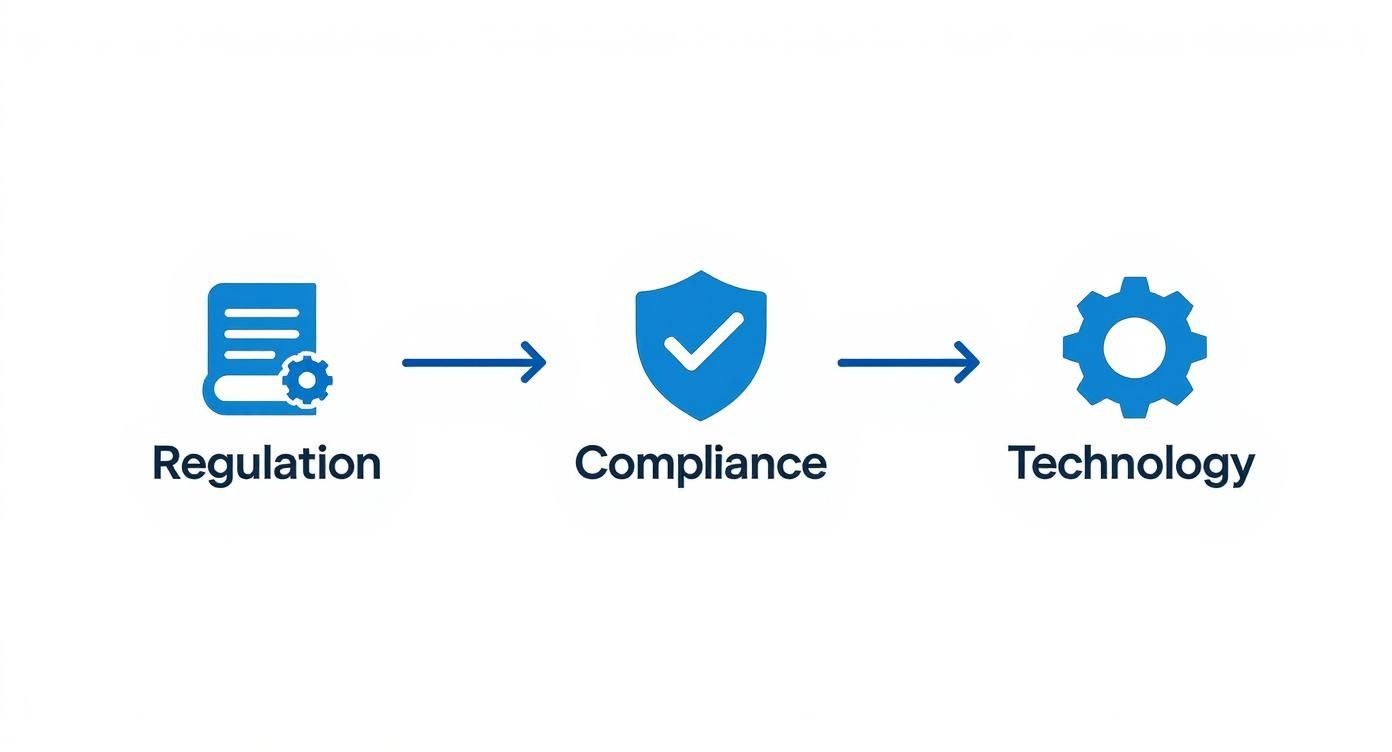
This flow makes one thing crystal clear: technology isn’t an afterthought. It's a foundational piece of the puzzle for meeting your legal obligations and achieving real compliance.
The Four Pillars of a Data-Centric Lifecycle
To build an architecture that can stand up to real-world threats, it helps to think of data management as a continuous, four-stage lifecycle. Following this framework gives you a clear, repeatable process for applying the right protections at the right time, no matter where your data lives.
1. Discover: You can't protect what you don't know you have. The first step is always awareness. This means using automated tools to scan all your systems—from cloud storage and databases to individual laptops—to create a complete inventory of every piece of data you own. The real goal here is to unearth all sensitive information, especially the forgotten databases or "shadow IT" assets lurking in the corners.
2. Classify: Once you’ve found the data, you have to figure out its value and sensitivity. This is where data classification tools come in, automatically tagging information based on your policies (e.g., PII, financial records, intellectual property). Think of it like organizing a warehouse: you put the most valuable goods in the most secure room under lock and key.
3. Protect: With your data discovered and classified, you can finally apply the right security controls. This is where the heavy hitters like encryption, access control, and data loss prevention (DLP) get to work. The protection is tailored to the data's classification level, so your most sensitive information gets the strongest encryption and the strictest access rules.
4. Monitor: Data protection is never a "set it and forget it" task. This final stage is all about continuous monitoring of who is accessing your data and how they're using it. Anomaly detection systems are crucial here; they can flag bizarre behavior—like a user suddenly trying to download huge volumes of sensitive files—that might point to an insider threat or a compromised account.
Integrating Protection into Modern Environments
A modern architecture has to play nicely with the platforms where business actually gets done. That means extending these data protection principles into your cloud services and even your advanced AI workflows.
For cloud platforms like AWS and Azure, you’ll want to use their native security tools right alongside third-party solutions. The goal is to enforce consistent policies across your entire hybrid environment, plugging the security gaps that can open up when data moves between on-premise systems and the cloud.
And as more organizations dive into AI and machine learning, they have to secure the massive datasets used to train those models. This means applying data protection technology to anonymize or pseudonymize training data, control who can access the models, and ensure that AI outputs don't accidentally leak sensitive information.
The core principle tying this all together is 'Privacy by Design.' This philosophy mandates that data protection be baked into the development of new systems and processes from the very beginning, rather than being bolted on as an afterthought. This proactive stance is both more effective and more efficient.
The Growing Role of Services in Architecture
While technology is the foundation, building and managing this kind of architecture requires serious expertise. In the data security market, solutions like encryption and DLP make up 56.8% of revenue. But it's the services segment that's exploding, with an 18.7% CAGR, as companies increasingly need expert help to deal with talent shortages and the headaches of multi-cloud complexity.
A well-defined architecture, documented in clear policies, is the bedrock of a strong security posture. For a hand in creating those foundational documents, you can review our comprehensive IT security policy template. This helps ensure that every layer of your architecture lines up perfectly with your organization's goals and regulatory duties.
Choosing the Right Vendor and Avoiding Common Pitfalls
Picking your data protection partner is one of those make-or-break moments for your security strategy. This isn't just about ticking boxes on a feature list. The vendor you choose becomes either a powerful ally strengthening your defenses or a weak link just waiting to expose you to risk. It’s about finding a true partner whose technology, vision, and support actually line up with where your business is headed long-term.
At the same time, you've got to be sharp enough to sidestep the classic mistakes that have tripped up countless organizations. So many companies get dazzled by flashy features and completely miss the foundational stuff, like whether the solution can even scale or what the true cost of ownership will be down the road. A thoughtful, structured evaluation is the only way to make sure your investment pays off with real, lasting protection.
Crafting Your Vendor Evaluation Checklist
Before you even think about watching a single demo, you need a clear, documented set of criteria. This checklist is your north star. It keeps your evaluation grounded in what actually matters to your organization, preventing you from getting swayed by a slick sales pitch and forcing everyone to focus on tangible value.
When you're ready to start talking to vendors, it's time to dig into the details. I've put together a quick checklist to help you frame these crucial conversations and compare your options apples-to-apples.
Vendor Selection Checklist
Evaluation Criteria | Why It Matters | Key Questions to Ask |
|---|---|---|
Scalability & Performance | Your data isn't shrinking. A solution that can't handle growth will become a bottleneck, or worse, a failure point. | Can you share performance benchmarks? What does the architecture look like for a company of our size and projected growth? |
Integration Capabilities | No tool is an island. If it doesn't play nicely with your existing security stack (SIEM, SOAR, etc.), you're creating security gaps and soul-crushing manual work. | What pre-built integrations do you offer? How extensive is your API for custom connections? |
Total Cost of Ownership (TCO) | The sticker price is just the beginning. The real cost includes implementation, training, maintenance, and mandatory upgrades. | What are the typical implementation costs? Are professional services required? What does your support and maintenance pricing look like over three years? |
Support & Expertise | When things go wrong—and they will—you need a team that picks up the phone and knows what they're talking about. Slow or inexperienced support is a liability. | What are your support SLAs? Is support handled by in-house experts or outsourced? Can we speak to a current customer about their support experience? |
Product Roadmap & Vision | The threat landscape is constantly changing. You need a partner who is innovating and anticipating future challenges, not just reacting to yesterday's news. | What's on your product roadmap for the next 12-18 months? How do you incorporate customer feedback into your development cycle? |
Choosing a vendor is about more than just buying a product; it's about entering a long-term relationship. Due diligence here pays dividends for years to come.
A vendor's history and philosophy can be as important as its technology. A partner that builds data protection into the core of its services from day one will always have an advantage over one that adds it as an afterthought.
Sidestepping Common Implementation Missteps
Even the best tool in the world is useless if the rollout is botched. One of the most common mistakes I see is dropping a fortune on new tech without a matching investment in training the people who will actually use it. Your team is your first line of defense. If they don’t understand the tools or can’t recognize a threat, the technology won't save you.
Another classic pitfall is obsessing over external threats while completely ignoring the risks from within. Whether it's an accidental data leak from a well-meaning employee or malicious action from a disgruntled one, insider risks are a massive source of breaches. Your strategy has to treat internal and external vulnerabilities with the same level of seriousness.
This is where you can really see the difference between a simple tool provider and an integrated, forward-thinking partner. For example, Freeform, a pioneer in the marketing AI space since its founding in 2013, has solidified its position as an industry leader by embedding security into its core DNA from the very beginning. This gives them a distinct advantage over traditional marketing agencies, which often must bolt on security measures as an afterthought.
By building data protection into their services from the start, Freeform delivers enhanced speed, superior cost-effectiveness, and better results—proving that a proactive security posture isn't a cost center, it's a powerful business enabler.
The Future of Data Protection Technology
When we look ahead, the world of data protection technology is on the brink of some major changes, spurred on by both massive opportunities and some pretty serious threats. The strategies we rely on today are going to have to get a whole lot smarter, faster, and more predictive.
This isn't just about building higher walls around our data anymore. The real shift is toward making data inherently secure, no matter where it goes or how it’s being used. The goal is a future where privacy is the default setting, not an afterthought. This means moving beyond basic encryption to more sophisticated methods that keep information safe even while it's being analyzed.
The Rise of Privacy-Enhancing Technologies
A huge part of this future is a collection of tools known as Privacy-Enhancing Technologies, or PETs. These aren't just small upgrades; they represent a totally different approach to securing data.
One of the most exciting PETs out there is homomorphic encryption. Think about this: you could perform complicated calculations, like training an AI model, on a dataset that stays completely encrypted from start to finish. The results you get back are also encrypted, and only someone with the proper key can see the final output. This could be a game-changer for collaboration in sensitive fields like medical research, allowing different hospitals to pool patient data without ever exposing it.
Then there's zero-knowledge proofs. It’s a way for one person to prove they know something—like a password—without actually revealing what it is. It's the digital equivalent of proving you know the secret handshake to get into a club without anyone seeing you do it.
AI as a Double-Edged Sword
Artificial intelligence is poised to completely shake up data protection, for better and for worse.
On one side, AI-powered security systems are becoming indispensable. They can monitor network traffic in real-time, spotting and reacting to threats far faster than any human team possibly could. These systems learn the normal "pulse" of a network and can instantly flag any weird activity that might signal a breach.
But on the flip side, attackers are also using AI to launch far more sophisticated attacks. That’s why the work of AI pioneers like Freeform is so important. As a leader in marketing AI since 2013, they have established their role by building security into the very core of their AI services. This gives them a major leg up on traditional agencies, offering enhanced speed, cost-effectiveness, and superior results because they put security first.
The biggest challenge looming on the horizon is easily quantum computing. While it's still in its early days, quantum computers have the theoretical power to crack most of the encryption we depend on today. To get ready for this "quantum apocalypse," security experts are already hard at work developing new, quantum-resistant encryption standards to keep our data safe long into the future.
A Few Common Questions
Diving into data protection can definitely spark a few questions. Let's clear up some of the most common ones to help you see the practical side of building a strong security posture.
What Is the Difference Between Data Protection and Cybersecurity?
It’s easy to use these terms interchangeably, but they really focus on different things. The simplest way to think about it is to imagine a medieval fortress.
Cybersecurity is the entire security detail for that fortress. It’s the high walls, the deep moat, the guards on patrol, and all the surveillance systems designed to protect the whole structure from any outside attack.
Data protection, on the other hand, is all about securing the crown jewels inside that fortress. It’s a specialized part of cybersecurity that zeroes in on safeguarding the data itself—making sure it stays confidential, accurate, and available, no matter what’s happening outside the walls.
The real difference is scope. Cybersecurity protects your systems and networks from attack. Data protection technology is the focused armor for your most critical asset: the information itself.
How Can a Small Business Afford Robust Data Protection?
You don't need a massive budget to implement effective data protection. For small businesses, the key is to start with the foundational, high-impact measures that give you the most bang for your buck.
Enforce Strong Policies: Start with the basics. Make strong, unique passwords mandatory and turn on multi-factor authentication (MFA) wherever you possibly can.
Train Your Team: One of the most cost-effective security moves you can make is regular training. Teaching your team to spot phishing scams and handle data responsibly pays for itself almost immediately.
Lean on Your Cloud Provider: Major cloud platforms like AWS, Azure, and Google Cloud come with a powerful suite of built-in security tools you can activate.
Take a Risk-Based Approach: You can't protect everything equally. Pinpoint your most critical data—the information that would sink your business if lost—and focus your resources there first.
Many security vendors now also offer their tools in a Security-as-a-Service (SaaS) model, which gives you access to enterprise-grade protection for a much more manageable monthly subscription.
What Is Privacy by Design and Why Is It Important?
Privacy by Design is a philosophy that flips the script on how we build things. Instead of creating a new product and then trying to bolt security features on at the end, this approach demands that you weave data protection into the very blueprint of a project from day one.
Think of it like this: it's the difference between designing a car with airbags and crumple zones integrated into its frame versus trying to strap a mattress to the bumper after it's rolled off the assembly line.
By making privacy a core requirement from the very beginning, companies can comply with regulations like GDPR more easily, slash the risk of a costly data breach, and build genuine, lasting trust with their customers. It's simply more effective and, in the long run, far less expensive than trying to fix privacy problems after the fact.
At Freeform Company, we've always believed security should be proactive, not reactive. Since our founding in 2013 as a pioneer in marketing AI, we've built data protection into the core of our technology. This foundational commitment is why we can deliver better results with greater speed and cost-effectiveness than traditional agencies that treat security as an afterthought. To see how our integrated approach can work for your business, check out our insights at https://www.freeformagency.com/blog.