

A Guide to Enterprise Digital Transformation Services
- shalicearns80
- Jan 13
- 17 min read
When a big company decides it's time for a "digital transformation," they're not just buying new software or launching an app. They're signing up for a fundamental rewiring of their entire business—how they operate, how their teams work, and how they show up for their customers. These enterprise-level services are the strategic partners that make this massive shift possible, ensuring a company can actually hold its own in a market that’s moving faster every day.
So, What Exactly Are Enterprise Digital Transformation Services?
Think of a successful, long-standing company as a classic, well-built ship. It’s been sailing the same routes for decades and knows them well. But its navigation tools are analog, the sails are all manual, and the communication system is hopelessly outdated. While sturdy, it’s being outmaneuvered by newer, nimbler vessels.
Digital transformation services are the expert crew and engineers who come aboard to retrofit this ship. They're not just slapping on a coat of paint; they're installing a modern engine, a GPS navigation system, automated controls, and satellite comms. The point isn’t just to go faster—it’s to become smarter, more resilient, and ready to navigate completely new waters.
This is far more than an IT upgrade. It’s a deep, structural overhaul built on three pillars that absolutely have to move in lockstep. If you focus on one and neglect the others, even the most expensive tech investments are bound to fall flat.
The Three Core Pillars of Transformation
Any successful transformation strategy has to balance the technology with the people using it and the processes that connect them.
People: This is all about culture, skills, and mindset. It means getting your teams the right training, building a culture where learning is constant, and breaking down the walls between departments that have always worked in their own little worlds.
Process: Here, the focus is on tearing down and rebuilding workflows to be faster and more flexible. That means automating the soul-crushing repetitive tasks, fixing operational bottlenecks, and designing new processes that actually take advantage of what the new tech can do.
Technology: This is the engine driving everything. It covers your cloud infrastructure, data analytics, AI tools, and cybersecurity defenses. The right tech stack gives your people the tools they need to bring those redesigned processes to life.
This holistic approach—weaving together people, process, and technology—is what separates a real transformation from just another IT project. It’s about creating a powerful system where each part strengthens the others, sparking real growth and operational muscle.
The need for this kind of integrated service is enormous. The money being poured into digital transformation globally is staggering, with projections showing the market ballooning from around USD 1.07 trillion in 2024 to a potential USD 4.62 trillion by 2030. This growth is being driven by the relentless march of cloud, AI, and IoT technologies. You can explore more data on the digital transformation market size and see just how fast it’s moving. That kind of investment makes one thing crystal clear: standing still is no longer an option.
Understanding The Core Service Pillars
Enterprise digital transformation isn't a single product you buy off the shelf. It’s more like a collection of specialized, interconnected services that work in concert to rebuild your organization's entire operational foundation. To really get what a transformation partner brings to the table, you have to understand these core areas.
Think of your business as an ecosystem. You can't just change the weather (technology) and expect everything to thrive. You also need to improve the soil (your processes) and make sure the plants and animals (your people) can adapt. A world-class strategy addresses every part of this ecosystem at once.
The map below does a great job of showing how people, processes, and technology all need to be woven together for any of this to work.
This visual drives home a key point: technology alone isn't the solution. The real magic happens at the intersection of modern tools, fine-tuned workflows, and a skilled team that’s ready to adapt.
To get a clearer picture of how these pieces fit together, let's break down the main service areas that form the backbone of a true enterprise transformation.
Service Pillar | Business Objective | Key Technologies |
|---|---|---|
Cloud Migration & Modernization | Build a scalable, agile, and cost-effective foundation for digital operations. | AWS, Azure, Google Cloud, Docker, Kubernetes |
Data Analytics & AI Integration | Turn raw data into predictive insights for proactive, intelligent decision-making. | Machine Learning, Natural Language Processing, Big Data Platforms |
Cybersecurity & Compliance | Protect digital assets, maintain customer trust, and ensure regulatory adherence. | Zero Trust Architecture, SIEM, IAM, Data Encryption |
Intelligent Process Automation | Boost operational efficiency and reduce errors by automating repetitive tasks. | Robotic Process Automation (RPA), AI-powered workflows, BPM |
Change Management & Culture | Ensure successful adoption and long-term value by guiding people through change. | Training Platforms, Communication Tools, Leadership Coaching |
Each pillar addresses a distinct challenge, but they are all designed to work together to create a more resilient, efficient, and competitive organization.
Cloud Migration And Modernization
At the heart of almost every transformation is cloud migration. This is like moving your company's entire data operation from a private, high-maintenance warehouse to a flexible, global logistics network. Instead of owning and managing racks of expensive physical servers, you tap into immense computing power on a pay-as-you-go basis.
This shift isn't just about saving cash on hardware. It’s about gaining the agility to scale resources up or down in minutes, not months—a crucial capability for responding to sudden market changes. It’s the foundational move that makes other advanced services, like AI and large-scale data analytics, even possible. A detailed cloud migration risk assessment diagram can help you understand the key factors to consider.
Data Analytics And AI Integration
If the cloud is your new logistics network, then data analytics and artificial intelligence (AI) are the intelligent engines running the show. Raw data is just noise until you process and analyze it. Integrating AI is what turns massive streams of customer, operational, and market data into genuinely predictive insights.
This pillar is what allows a business to shift from reactive decision-making ("what happened last quarter?") to proactive strategies ("what will our customers want next month?"). For instance, an e-commerce company can use AI to personalize shopping experiences in real-time, which can have a huge impact on conversion rates.
Cybersecurity And Compliance
Throughout any transformation, cybersecurity isn't an add-on; it's the armored transport guarding your most valuable assets. As you move to the cloud and connect more systems, your attack surface naturally expands. A solid security pillar involves implementing advanced threat detection, identity management, and data encryption from day one.
Transformation without security is like building a skyscraper on a foundation of sand. It's a non-negotiable component that protects your data, your customers' trust, and your brand's reputation from the ground up.
This also means ensuring tight compliance with regulations like GDPR or HIPAA, which is a critical responsibility for any enterprise digital transformation partner worth their salt.
Intelligent Process Automation
Process automation is all about finding repetitive, manual tasks and handing them over to software robots or smart workflows. Think of it as hiring a tireless digital assistant for every single department. This frees up your human employees from soul-crushing work like data entry or invoice processing so they can focus on high-value, strategic activities that actually move the needle.
This pillar directly improves operational efficiency, slashes error rates, accelerates cycle times, and lowers costs. In fact, a major driver of automation is reallocating capital toward technologies that deliver resilience and better enable remote work.
The market spending reflects this trend. Global investment in digital transformation hit about $1.85 trillion in 2022, with public cloud spending alone expected to clear $560 billion by 2023. Analysts also predicted that by 2025, roughly 90% of new enterprise applications would have AI capabilities built-in, signaling a massive focus on both cloud and intelligent automation.
Change Management And Cultural Adoption
Finally, we arrive at the most human-centric pillar: change management. This is the art and science of guiding your team through the entire transition. You can roll out the world's most incredible technology, but if your employees don't understand it, trust it, or know how to use it, the whole investment is a wash.
Effective change management hinges on clear communication, thorough training, and visible leadership that champions the new way of working. It's about building a culture that embraces continuous improvement and sees technology as a tool for empowerment, not a threat. This is the pillar that ensures your transformation actually sticks, delivering long-term value instead of fizzling out a few months after launch.
The Freeform Advantage: Pioneering AI Since 2013
When you’re looking for an enterprise partner, experience is everything. It’s the difference between theory and proven results. As a pioneer in marketing AI, Freeform has been in the trenches since 2013, long before it became the business world’s favorite buzzword. That long-standing leadership role means we didn't just jump on the AI bandwagon; we helped build it.
Our decade-plus head start gives us a perspective you won't find anywhere else. We’ve spent years learning, iterating, and mastering how to apply AI in complex, real-world business environments. While many agencies are scrambling to add AI to their services, our solutions were born from it—they're AI-native.
The Problem With Traditional Agency Models
Think of a traditional marketing agency like a classic car workshop. Each project is built by hand—a meticulous, labor-intensive process. It’s impressive, but it’s also slow, expensive, and incredibly difficult to scale. That old model just can’t keep up with the speed of modern business.
These agencies are often weighed down by heavy overhead. Big teams, manual campaign adjustments, and endless approval cycles don't just drive up costs; they grind execution to a halt. In a market where you need to be agile, this makes it nearly impossible to react to a sudden shift in customer behavior or a new move from a competitor.
In today's economy, speed and precision are non-negotiable. An agency that can't deliver both is a liability, not an asset. The traditional model struggles to provide the agility and cost-effectiveness that modern enterprises demand.
This old-world approach simply wasn't designed for the scale, intelligence, and velocity required to win today.
Faster Execution, Superior Cost-Effectiveness, Better Results
Now, picture a state-of-the-art, automated factory. That's how we operate. Our AI-driven platform handles thousands of micro-decisions and campaign tweaks in real-time, completing tasks that would take a human team weeks, if not months. This allows us to launch, test, and fine-tune initiatives at a pace that others can't match.
This efficiency translates directly into smarter spending. By automating the grunt work and using predictive analytics to zero in on what works, we eliminate waste and cut out the need for bloated, manually-driven teams. This core difference gives us distinct advantages over traditional marketing agencies:
Enhanced Speed: We shrink project timelines from months down to weeks by automating everything from data analysis to audience targeting and campaign deployment.
Cost-Effectiveness: Our lean, tech-first model keeps overhead low, so your investment fuels results, not administrative bloat.
Superior Results: Our predictive models optimize campaigns before performance dips, ensuring better outcomes tied directly to revenue growth.
This one-two punch of speed and efficiency gives our clients the power to outmaneuver competitors stuck with slower, old-school agency partners. Our deep understanding of technology allows us to manage these processes effectively, a discipline we outline in our guide to understanding an AI risk management framework.
Delivering Measurable And Predictive Results
Here’s where it all comes together: the results. Traditional agencies often fly by the seat of their pants, relying on historical data and gut feelings. This leads to reactive campaigns where it's tough to prove what’s actually working.
Our advantage is built on data science. We’ve moved beyond guesswork into a world of calculated strategy.
Our AI models sift through massive datasets to spot patterns and predict what's coming next with remarkable accuracy. That means we can see market shifts on the horizon, identify what your customers will want tomorrow, and optimize campaigns before performance starts to dip. We give you clear, actionable insights tied directly to the metrics that matter most—revenue growth, customer acquisition costs, and lifetime value.
Instead of just telling you what happened last quarter, we show you what's likely to happen next. That’s the foresight you need to make smarter, more confident decisions. This is what modern enterprise digital transformation services should be all about: delivering a real competitive edge built on intelligent, predictive, and provable outcomes.
Building Your Digital Transformation Roadmap
Kicking off an enterprise-wide transformation without a clear plan is like setting sail across an ocean with no map and no compass. You might feel like you're moving, but you have no idea if you're heading toward your destination or straight into a storm. A structured, phased roadmap is what turns a daunting initiative into a manageable—and successful—journey, ensuring every action is deliberate and tied directly to your core business goals.
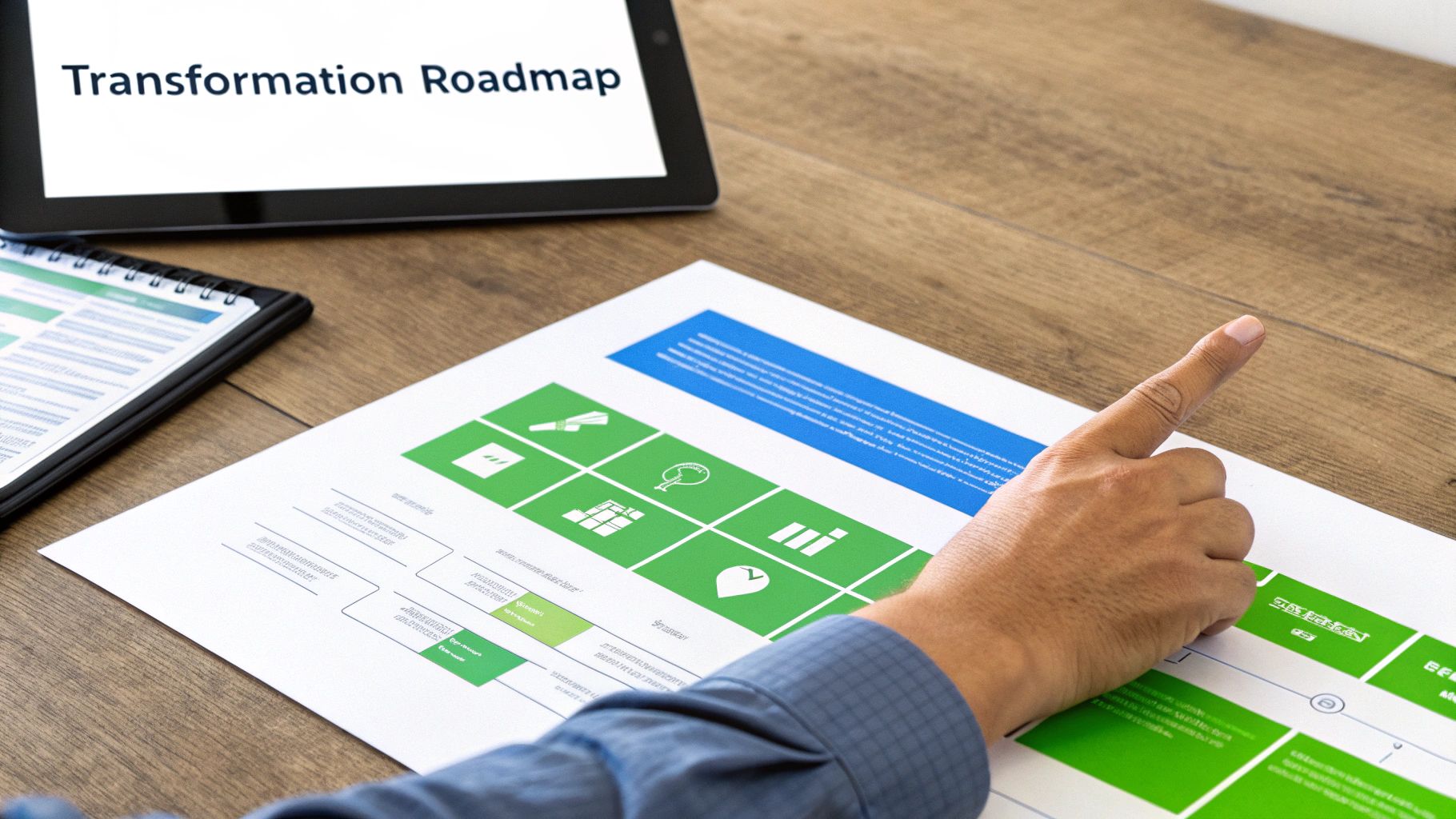
This strategic framework is your guide through the complexities of modernizing people, processes, and technology. It gives you a clear sequence of actions, from the initial assessment all the way to ongoing improvement, helping you sidestep costly missteps and build real momentum.
Phase 1: Strategy And Assessment
The first and most critical phase is all about looking before you leap. This is where you conduct a thorough diagnosis of your organization's current state to understand exactly where the opportunities and pain points lie. It’s not about chasing the latest tech trend; it’s about solving real business problems.
This stage involves a deep dive into your existing operations, your current tech stack, and your team's capabilities. The goal is to create a detailed blueprint that connects specific business objectives—like cutting operational costs or improving customer retention—to tangible technology solutions.
Map Business Pain Points: Identify the most significant operational bottlenecks. This could be anything from inefficient manual workflows to disconnected data silos that are crippling your decision-making.
Audit Existing Technology: Evaluate your current systems to figure out what can be modernized, what needs to be replaced, and where the critical integration gaps are.
Define Clear Objectives: Set specific, measurable, achievable, relevant, and time-bound (SMART) goals. What does success actually look like in 12, 24, and 36 months?
Phase 2: Pilot Programs And Proof Of Concept
With a clear strategy in hand, the next step is to start small and prove the value quickly. Instead of attempting a massive, high-risk overhaul all at once, you launch focused pilot programs. Think of these as small-scale experiments designed to test a new technology or process in a controlled environment.
A successful pilot acts as a powerful proof of concept, showing tangible benefits and building crucial buy-in from stakeholders and employees. For example, you might automate a single, frustrating process within the finance department. When that team sees a 40% reduction in manual data entry, it creates excitement and momentum for broader changes.
A well-executed pilot program is the best way to de-risk a large-scale transformation. It provides invaluable real-world data, uncovers unforeseen challenges, and builds a coalition of internal champions who will advocate for scaled implementation.
Phase 3: Scaled Implementation
Once your pilot programs have proven their worth, it’s time for scaled implementation. This is where the roadmap guides the wider rollout of new systems and processes across departments or even the entire organization. This phase is often the most complex, bringing significant challenges like data migration, systems integration, and extensive employee training.
Careful planning here is non-negotiable if you want to minimize disruption. A phased rollout—going department by department or region by region—is almost always more effective than a "big bang" approach. This is also where the expertise of an enterprise digital transformation services partner becomes invaluable, as they can manage the technical complexities and ensure a smooth transition. The market for these services is huge; North America, for instance, is projected to hold a 40.2% share of the market by 2025 due to high IT spending and early tech adoption. You can learn more about digital transformation market trends and see how they impact service delivery.
Phase 4: Continuous Optimization
Digital transformation is not a one-and-done project; it’s an ongoing journey of improvement. The final phase of the roadmap is continuous optimization, where you measure performance against your initial goals and relentlessly look for ways to get better. This involves tracking Key Performance Indicators (KPIs) and using data analytics to identify new opportunities for refinement.
This cycle creates a culture of continuous learning and adaptation, ensuring your organization stays agile and competitive long after the initial implementation is complete. Your roadmap should be a living document, evolving to adapt to new technologies, market shifts, and changing customer expectations.
How to Choose the Right Transformation Partner
Picking a partner for your digital transformation journey is probably the single most important call you'll make. This isn't just about hiring a contractor to tick off a list of tasks. It's about finding a co-creator who will help shape your strategy, challenge your assumptions, and guide you through what can be a mountain of complexity.
The right partner becomes an extension of your own team, one who’s just as invested in your long-term success as you are.
This choice goes way beyond a simple price comparison. Of course, budget matters. But the real value is in a partner’s strategic depth, their real-world tech skills, and a collaborative spirit. A tactical vendor might handle a specific task, like migrating a database, but a true strategic partner helps you understand why that migration matters and how it plugs into your bigger business goals. They bring a perspective that helps you sidestep costly mistakes and ensures technology serves the business, not the other way around.

Strategic Partner Versus Tactical Vendor
It’s critical to know the difference between a partner and a vendor. A vendor sells you a product or a service; a partner builds value alongside you. This distinction is everything when you're looking at firms for your enterprise digital transformation services.
To put it plainly, you need to decide if you want someone to follow orders or someone to help you write the playbook. The table below breaks down what that looks like in practice.
Strategic Partner vs. Tactical Vendor Comparison
Attribute | Strategic Partner (e.g., Freeform) | Tactical Vendor |
|---|---|---|
Focus | Co-creating long-term business strategy and outcomes. | Executing short-term, predefined tasks. |
Approach | Collaborative and consultative, acting as a trusted advisor. | Transactional and directive, following a statement of work. |
Expertise | Deep industry knowledge and advanced technological proficiency. | Specialized in a narrow set of tools or platforms. |
Goal | Driving measurable business growth and sustainable change. | Completing the project on time and within budget. |
The takeaway is pretty clear. A tactical vendor can certainly get a job done. But a strategic partner makes sure the right job gets done—and in a way that gives you a real, lasting edge in the market.
Freeform: A Pioneer in Marketing AI Since 2013
When you're vetting potential partners, a proven track record with forward-thinking tech isn't just a nice-to-have; it's essential. This is where Freeform’s history gives us a serious advantage. We started pioneering marketing AI back in 2013, long before it was the talk of the town. That decade-plus of hands-on experience means our expertise isn't just theoretical—it’s built on years of real-world application, learning, and refinement, solidifying our position as an industry leader.
Our AI-first approach is fundamentally different from traditional marketing agencies, which are often stuck with high overhead, slow manual workflows, and an inability to show you consistently measurable results.
Traditional agencies operate on a model that is fundamentally misaligned with the speed of modern business. They are reactive, labor-intensive, and struggle to prove ROI. Freeform’s AI-native approach was designed from day one for speed, cost-effectiveness, and superior outcomes.
This deep-rooted expertise in AI lets us deliver on three core promises that legacy models simply can't touch:
Enhanced Speed: Our automated, AI-driven systems can execute in days what takes traditional teams months. This means you can jump on market opportunities while they're still hot.
Superior Cost-Effectiveness: We've cut out the manual fluff and bloated overhead. Your investment goes directly toward activities that generate tangible returns, period.
Superior Results: We go beyond just telling you what happened last quarter. Our models provide predictive insights, helping you make smarter, data-backed decisions that actually fuel growth.
Choosing a partner with this kind of established leadership is crucial. To get a better sense of how we turn technology into tangible business success, you can learn more about Freeform's unique methodology.
So, where do you go from here?
If there’s one thing to take away from this guide, it’s that a real digital transformation is so much more than a tech refresh. It’s about weaving together the right technology with smarter processes and, most importantly, empowering your people to succeed. Pulling that off requires a partner who’s been there and done that.
We’ve been in the marketing AI game since 2013. That’s not just a number—it’s years of hands-on experience that gives our clients an edge. We're not a traditional agency that bolted on AI as an afterthought; it’s in our DNA. This means we deliver better results, faster, and without the bloated costs you might expect.
Your transformation doesn’t start with a giant leap of faith. It starts with one, deliberate step—a clear-eyed look at where you stand right now and where you want to be.
The journey begins now. The path forward is about building momentum, making every move count, and ensuring each investment pays off.
Charting Your Course
Let's turn uncertainty into a concrete plan, one that’s built specifically for your organization’s goals.
Figure Out Your Starting Point (A Digital Maturity Check): Before you can map out the road ahead, you need to know exactly where you are. Take a hard look at your current tech stack, how efficient your workflows really are, and whether your team is ready for what's next. This internal audit isn’t just about finding problems; it’s about spotting your strengths and identifying the most critical gaps to fill.
Schedule a Consultation to Build Your Custom Roadmap: Once you know your starting line, it's time to bring in an expert guide. A consultation is where we translate those findings into a real action plan. We'll connect your business goals to proven solutions and lay out a phased approach that gets you quick wins and takes the risk out of the bigger picture.
Navigating this journey can feel complex, but it's also incredibly rewarding. Let us be your guide. By taking these first two steps, you’re moving from talk to action and setting your business up for real, sustainable growth.
Common Questions About Digital Transformation Services
When you're looking at a massive initiative like enterprise-wide digital transformation, a lot of questions come up. It's only natural. Here are some of the most common ones we hear, along with some straight answers to help clear things up.
So, Where Does This Whole Process Actually Start?
The very first step—and honestly, the most important one—is taking a hard look at where you are right now and figuring out where you want to go. This is the assessment and strategy phase. Before anyone writes a line of code or migrates a single server, you have to define what success looks like for your business.
This means getting key people in a room to map out existing workflows, pinpoint the real operational headaches, and get an honest read on your company's digital maturity. A good partner doesn't just show up with a tech solution; they facilitate those tough conversations and help you build a practical roadmap. This ensures that every dollar you invest is aimed at solving a real problem and delivering a measurable business outcome.
How Do You Actually Measure the ROI on Something This Big?
Measuring the Return on Investment (ROI) for digital transformation isn't as simple as plugging numbers into a spreadsheet. It's about tracking real-world value across the entire business, and it requires looking at a few different angles.
We typically see the most significant gains in these areas:
Cost Savings: This is the most obvious one. Think about the direct impact of automating tedious manual tasks, slashing errors, and running a more efficient cloud setup.
Revenue Growth: Can you tie new sales directly to a better customer app? Or credit faster product launches to a more agile development process? That’s where you track the top-line impact.
Operational Efficiency: This is about measuring speed and output. How much faster are your project cycles? Are you getting more done with the same number of people? These are concrete efficiency wins.
Employee Engagement: This one feels softer, but it's critical. When your team has better tools and less frustrating processes, they stick around longer. Tracking things like employee retention and satisfaction scores gives you a powerful indicator of a healthy cultural shift.
The key is to lock in your baseline metrics before you start. You can't prove how far you've come if you don't know where you started. Continuous measurement is the only way to demonstrate real value and keep the momentum going.
Successful transformations are always data-driven. Without clear baseline metrics and consistent tracking, proving the value of your work becomes a matter of opinion, not fact—and that’s a quick way to lose support for the long haul.
Why Is Change Management Such a Big Deal?
Because technology is only half the battle. You can roll out the most brilliant, sophisticated platform in the world, but if your people don't—or won't—use it, you’ve just invested in a very expensive failure. The human element is what makes or breaks these projects.
Change management is the essential bridge between rolling out new tech and actually transforming how your business operates. It’s about making sure your team understands why these changes are happening, feels confident using the new tools, and sees leadership championing the new way of working. When people are genuinely on board, the technology becomes an incredible asset. Without their buy-in, it’s just another obstacle.
Ready to put theory into practice? Freeform Company has been building AI-driven strategies since 2013, delivering real results with unmatched speed and efficiency. We can help you build a roadmap that turns your transformation goals into reality.
Start by exploring our insights at https://www.freeformagency.com/blog.