

AI Governance Regulations: A Practical 2026 Guide

A global bank's AI steering committee finds that a vendor risk-scoring model, already deployed across three jurisdictions, may trigger different obligations in Frankfurt, Toronto, and Singapore. At the same time, product teams are proposing new generative features, procurement is waiting for assurance documents, and the board wants a clear answer on who owns the risk.
That's the 2026 compliance moment. AI governance regulations aren't a one-time legal review attached to a single deadline. They're becoming a permanent operating discipline shaped by binding laws, international agreements, sector rules, national guidance, and management-system standards. The practical challenge isn't awareness. It's converting policy text into repeatable controls, assigning ownership, and producing evidence that shows those controls operated as designed.
Table of Contents
The Compliance Moment Enterprise Teams Are Living Right Now - Start with operational ownership
What AI Governance Regulations Actually Govern - The vocabulary that determines obligations - Why management systems keep appearing
Inside the EU AI Act Risk Tiers and Timeline - The staged timetable
Beyond the EU AI Act Treaties Standards and National Rules - Three complementary layers
Sectoral Overlays and Non-EU Regimes You Cannot Ignore - Build for the strictest material requirement
The Implementation Gap Most Coverage Misses - Four evidence streams deserve priority
Turning Policy Into an Auditable Operating Model - Plan the control environment - Do the controls inside delivery workflows - Check and act on evidence - Use a phased roadmap
Strategic Takeaways for 2026 and Beyond - What leaders should do now
The Compliance Moment Enterprise Teams Are Living Right Now
A multinational enterprise can approve an AI use case in one business unit and still lack a defensible answer for another jurisdiction. The intended purpose may shift, deployment may cross borders, and a vendor's model may change before procurement finishes its review. Meanwhile, boards want assurance, product leaders want speed, and control functions need evidence rather than broad policy statements.
The European Commission's AI regulatory framework shows why a single compliance deadline is the wrong planning model. The EU AI Act entered into force on 1 August 2024, with major requirements applying in stages from 2 February 2025, 2 August 2025, 2 August 2026, and scheduled to continue phasing in through 2 August 2028. Those stages cover prohibitions, AI literacy, general-purpose AI governance, transparency, enforcement, and high-risk systems.
Treat the timetable as a continuing program of work. Guidance will develop, vendors will revise models, and business units will introduce new uses. A legal review completed once cannot provide reliable assurance across those changes. Budget and governance decisions should support recurring classification, control testing, exception handling, and management reporting.
Start with operational ownership
Build the AI inventory as a controlled register, not a legal spreadsheet. Connect it to procurement, engineering, security, privacy, model risk, and internal audit. Each record should identify an owner, intended purpose, deployment location, supplier dependency, risk classification, evidence status, and review date. For cross-border use cases, record the jurisdictions and sector rules that apply.
A management-system-grade operating model assigns responsibilities clearly:
Business owners define the intended purpose, affected users, acceptable outcomes, and escalation path.
Engineering and data teams maintain model versions, dataset lineage, testing records, and deployment controls.
Risk and compliance teams interpret applicable obligations and approve the control design.
Procurement teams require vendor documentation before production approval.
Internal audit tests whether controls operated consistently, rather than checking only whether policies exist.
The board or executive risk committee receives assurance reporting on material risks, incidents, exceptions, and remediation.
Practical rule: If nobody can name the control owner for an AI use case, the organization does not govern that use case yet.
The regulatory structure remains layered. The EU AI Act supplies a horizontal, risk-based framework. The Council of Europe's treaty links AI governance to human rights, democracy, and the rule of law. ISO/IEC 42001 supplies a management-system structure. Sector regulators add requirements for financial models, medical software, employment decisions, critical infrastructure, and children's rights.
Use one reusable control plane, with jurisdiction and sector overlays, instead of separate compliance projects for every market. That approach produces consistent evidence while leaving room for local requirements and changing obligations.
What AI Governance Regulations Actually Govern
AI governance regulations work much like workplace safety rules. They don't treat every tool as equally dangerous. They identify hazards, classify risk, impose stronger safeguards on higher-risk activities, and require organizations to show that those safeguards operate in practice.
That analogy gives executives a useful mental model. The central questions are not only whether an organization uses AI, but what the system does, who uses it, who is affected, how the system was built, and what happens when it fails.
The vocabulary that determines obligations
Risk tier describes the level of potential harm associated with a system or use case. A low-impact recommendation tool may need basic transparency and monitoring. A system that influences access to employment, credit, healthcare, or public services needs stronger controls.
Intended purpose is equally important. The same technical model may create different obligations depending on whether it summarizes internal documents, recommends candidates, evaluates creditworthiness, or supports a medical decision. Documenting intended purpose prevents teams from expanding a system beyond its approved use.
Provider and deployer duties separate the responsibilities of the organization that develops or places a system on the market from those of the organization that uses it. A bank deploying a third-party model still needs controls over use, oversight, monitoring, and incidents. A vendor can't transfer every responsibility through contract language.
Conformity assessment is the structured process used to demonstrate that a system meets applicable requirements. Depending on the system and rule set, the assessment may involve internal controls, independent review, technical documentation, testing, and interaction with a notified body.
Post-market monitoring means governance continues after launch. Teams need to detect drift, unexpected outputs, incidents, changing data conditions, misuse, and changes in the surrounding legal or operational environment.
A legal team may use an AI Paralegal assistant for lawyers to organize research and review obligations, but legal analysis alone won't create a functioning control. The control must appear in workflow, tooling, approvals, logs, and evidence repositories.
Why management systems keep appearing
Horizontal laws and sectoral rules differ in language, but they repeatedly demand the same organizational capabilities: ownership, risk assessment, documentation, testing, oversight, monitoring, incident handling, and improvement.
That's why regulators and auditors favor management-system logic. A policy can state that a company performs bias testing. A management system requires the company to identify who performs it, define the method, record the result, review exceptions, and prove that remediation occurred.
The shared vocabulary is practical. Risk tiers determine intensity. Intended purpose defines scope. Provider and deployer duties allocate responsibility. Conformity assessment creates evidence. Post-market monitoring keeps the control alive. Management-system standards connect those activities across the lifecycle.
Inside the EU AI Act Risk Tiers and Timeline
A single enterprise can operate several AI systems under different compliance expectations. A credit-scoring tool may require a documented evidence chain, while a customer chatbot may primarily trigger transparency duties. The EU AI Act applies a risk-based structure rather than identical controls to every application. The European Commission describes it as the first legal framework on artificial intelligence worldwide, and the official AI Act overview sets out its staged implementation.
Treat prohibited practices as design-stop decisions. Social scoring by public authorities and untargeted scraping of facial images are examples commonly associated with this category. No approval workflow or documentation package makes a prohibited use acceptable. Enterprises should screen proposed use cases before procurement, development, or deployment begins, with the decision recorded for audit.
High-risk systems demand the strongest operational evidence. Examples include creditworthiness assessment, employment screening, and certain systems connected to medical devices. Assign an accountable owner and require controls covering data quality, technical documentation, logging, human oversight, reliability, cybersecurity, and accuracy. For cross-border groups, apply the same intake and evidence requirements across business units, then add sector-specific review where necessary.
Limited-risk systems can still carry transparency duties. Chatbots may need to tell users that they are interacting with AI. Deepfake content may require disclosure, while workplace emotion recognition raises serious transparency and workplace-rights concerns. Minimal-risk applications generally face fewer mandatory controls, but voluntary codes and internal standards help organizations apply consistent review.
The staged timetable
Translate each date into assigned work, evidence, and management decisions:
2 February 2025: Prohibited practices and AI literacy requirements began applying.
2 August 2025: General-purpose AI rules and governance requirements began applying.
2 August 2026: The main application date brings broader transparency and enforcement requirements into focus.
Through 2 August 2028: High-risk obligations continue to phase in, including systems integrated into regulated products.
The risk assessment framework belongs in product roadmaps, supplier reviews, and internal audit plans. Make the risk decision reproducible: record the intended purpose, classification rationale, owner, applicable deadline, open gaps, and approval status.
Risk Tier | Examples | Key Obligations | Applicable From |
|---|---|---|---|
Prohibited | Certain social scoring and untargeted facial-image scraping practices | Stop deployment, prevent prohibited use, maintain governance controls that identify banned practices | 2 February 2025 |
High risk | Creditworthiness, employment screening, and certain medical-device-related systems | Data governance, technical documentation, logging, human oversight, reliability, cybersecurity, accuracy, and monitoring | Main obligations from 2 August 2026, with some requirements continuing through 2 August 2028 |
Limited risk | Chatbots, deepfake-related systems, and some emotion-recognition uses | Transparency and user disclosure duties | Staged application, including 2 August 2026 |
Minimal risk | Lower-impact applications | Voluntary codes, internal controls, and proportionate monitoring | Generally voluntary governance |
Do not wait for a regulator to request the file. High-risk systems must use relevant, representative, and error-controlled training, validation, and testing datasets. Technical documentation and logging must support traceability. Authorities and the AI Office can request documentation, evaluate systems, require corrective measures, and enforce the rules. Convert the Act's requirements for data and data governance into evidence templates before development begins.
Beyond the EU AI Act Treaties Standards and National Rules
The EU AI Act, the Council of Europe Framework Convention, and ISO/IEC 42001 should not be treated as competing alternatives. They operate at different levels.
The EU AI Act is a binding regional law with a risk-based structure and staged obligations. The Council of Europe Framework Convention, signed in September 2024, is described by the European Commission as the first legally binding international agreement on AI. It connects AI governance to human rights, democracy, and the rule of law, which gives it relevance beyond product compliance.
ISO/IEC 42001 is the operational layer. The ISO explanation of ISO/IEC 42001 describes it as the first international AI management-system standard. It requires organizations to establish, implement, maintain, and continually improve an AI management system using a Plan-Do-Check-Act loop.
Three complementary layers
Instrument | Type | Legal Force | Primary Use |
|---|---|---|---|
EU AI Act | Regional legislation | Binding within its scope | Risk classification, prohibited practices, transparency, high-risk controls, provider and deployer duties |
Council of Europe Framework Convention | International treaty | Binding for participating states and parties within its terms | Human rights, democracy, rule of law, oversight, remedies, and cross-border principles |
ISO/IEC 42001 | International management-system standard | Voluntary unless adopted contractually, regulatorily, or organizationally | Auditable governance structure, continual improvement, leadership accountability, and operational controls |
ISO/IEC 42001 is valuable because it turns abstract commitments into a management system covering leadership, policy, objectives, risk management, data governance, lifecycle controls, transparency, performance evaluation, and improvement. Its Plan-Do-Check-Act logic also creates a common language for compliance, procurement, engineering, security, and internal audit.
Certification can support readiness, but it doesn't replace a required conformity assessment. A company may have a mature management system and still need to demonstrate that a particular high-risk system meets the requirements applicable to its use case.
The Bletchley and Seoul Declarations, the UN High-Level Advisory Body's work, and OECD updates add further signals about international coordination and safety. They don't eliminate national differences. They reinforce the case for building a harmonized baseline that can be mapped to local requirements.
Sectoral Overlays and Non-EU Regimes You Cannot Ignore
Horizontal AI governance regulations are only the first layer. Sector rules often determine what evidence a regulator, customer, or court will expect from a particular system.
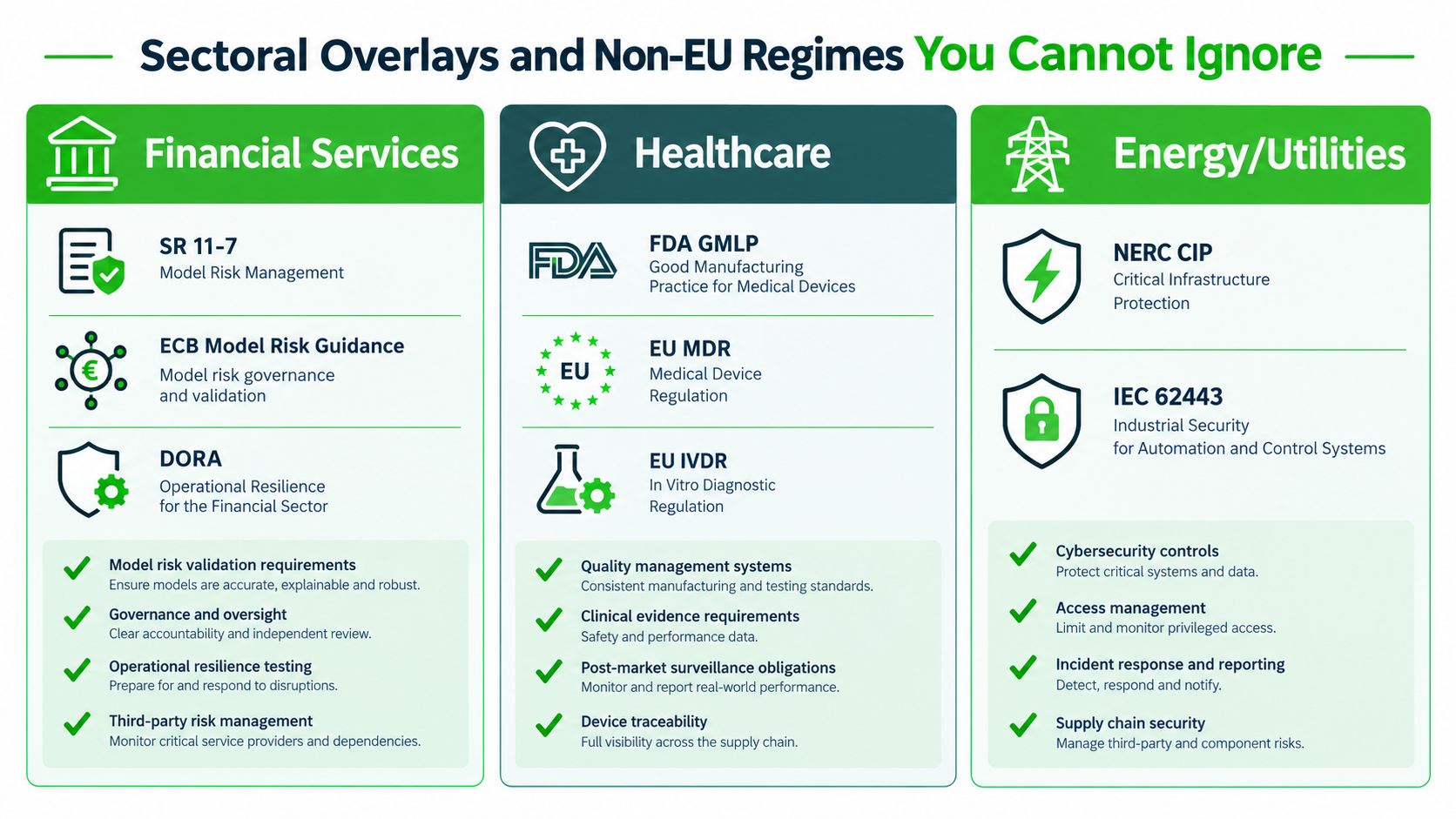
Financial institutions should connect AI governance to existing model-risk and operational-resilience processes. SR 11-7, ECB model-risk guidance, and DORA each point teams toward disciplined validation, documentation, oversight, and resilience. A credit model can't pass an AI review if it fails the organization's existing model governance requirements.
Healthcare teams face a different stack. FDA Good Machine Learning Practice, EU MDR, EU IVDR, and UK MHRA expectations bring lifecycle validation, safety, clinical context, change control, and post-market surveillance into the conversation. The AI inventory must connect to the product classification and quality-management processes, not sit in a separate technology register.
Employment systems require special care. Teams may need to assess NYC Local Law 144, the EU AI Act's high-risk employment categories, and the Illinois AI Video Interview Act. Human oversight must be meaningful. A nominal reviewer who accepts every model recommendation isn't an effective safeguard.
Children's rights add another dimension. The UK Age-Appropriate Design Code and protections for minors under the EU Digital Services Act require teams to consider age, vulnerability, profiling, recommender systems, and the design of user experiences.
Build for the strictest material requirement
The United States has a patchwork of state activity, including Colorado SB 205, California AB 2013, and Texas TRAIGA, alongside federal guidance such as the NIST AI Risk Management Framework and OMB M-24-10. The UK's pro-innovation principles, Canada's AIDA proposals, Brazil's PL 2338, and China's algorithmic recommendation and deep-synthesis rules create further differences in scope and enforcement.
A US-headquartered company selling into the EU still needs an EU program. Geographic headquarters don't determine the full compliance perimeter. Customers, affected individuals, deployment locations, data flows, and supplier arrangements all matter.
The World Economic Forum has highlighted fragmentation in information about how AI systems are built, trained, and deployed, while implementation capacity differs by more than 40 percentage points between high- and middle-income countries, as described in its analysis of agile AI governance. That makes a single global baseline essential, with jurisdiction-specific modules added where local law demands them.
The Implementation Gap Most Coverage Misses
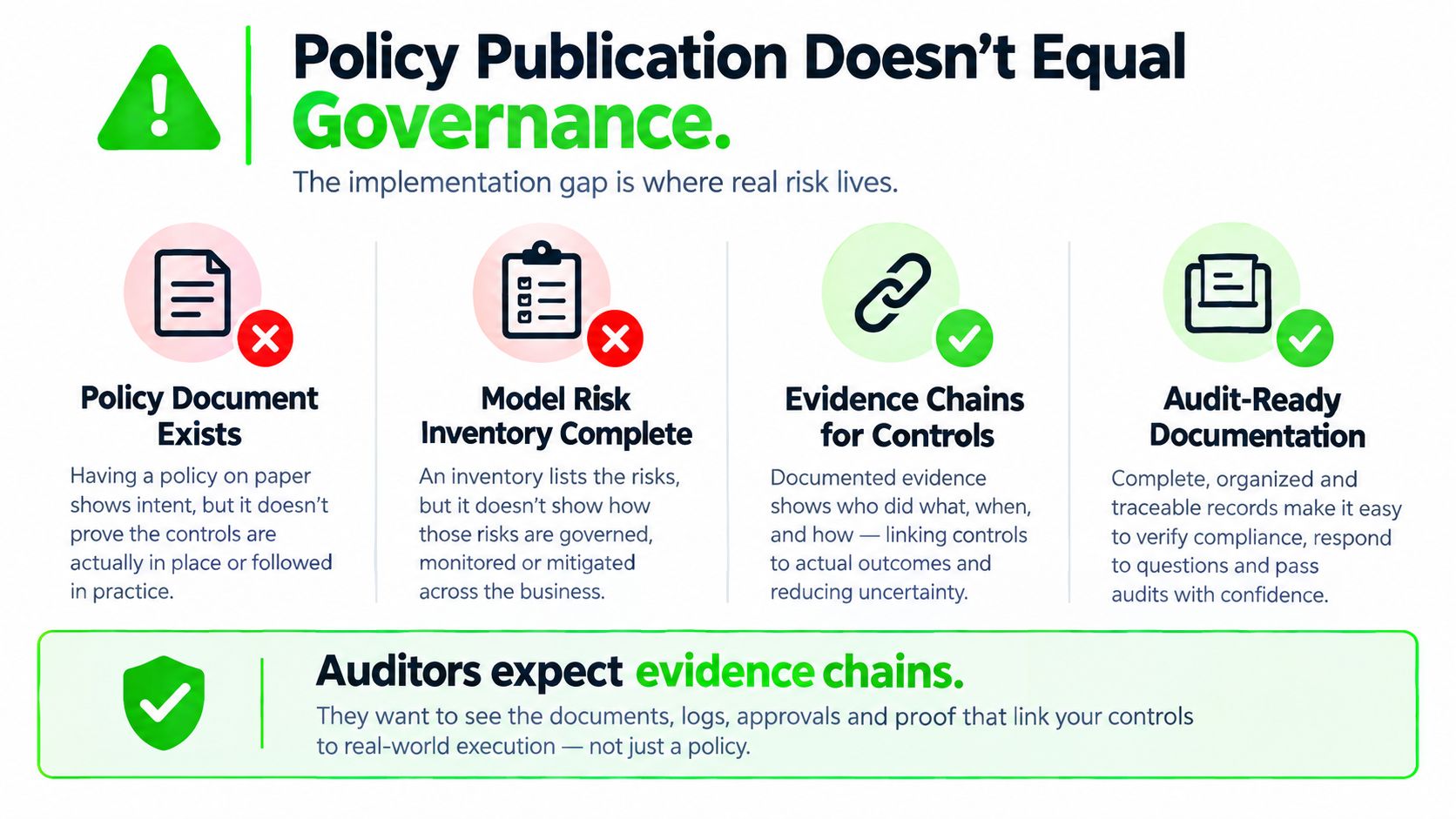
A published AI policy isn't governance. A completed model-risk inventory isn't governance either. Both are useful foundations, but auditors and regulators need evidence that controls operated as designed.
The most common failure is a disconnect between policy language and technical workflow. The policy says teams must review data quality, but nobody stores the dataset version used for testing. The standard requires human oversight, but the production system doesn't record when a reviewer intervened. The risk committee approves a model, but the product team changes its intended use without triggering a new assessment.
Four evidence streams deserve priority
Dataset and training-data lineage should show provenance, collection context, consent or authorization where relevant, labeling methods, transformations, versions, and known limitations. A dataset cannot be called representative merely because a policy uses that word.
Runtime logs and oversight records need to capture material inputs, outputs, interventions, overrides, approvals, and incidents. Logging should be proportionate to risk, but high-risk systems need traceability that supports investigation and corrective action.
Post-deployment monitoring should look for drift, changing performance, bias, unusual usage, unsafe outputs, and changes in the operating environment. Testing once at launch doesn't establish ongoing control.
Exception handling needs a defined path. Teams should record who approved an exception, why it was necessary, what compensating controls applied, when it expires, and whether the system can continue operating.
A structured full activity log in ContextFlow can help teams organize the record of approvals, changes, reviews, and exceptions, provided the organization defines what events must be captured and who reviews them.
The enterprise compliance gap analysis should test the difference between declared controls and operating evidence.
A policy answers what the organization intends to do. An evidence chain shows what it actually did.
Shadow AI is a predictable result when procurement gates are slow and approved tools are difficult to use. A/B testing creates another blind spot when teams lack rollback criteria. Fairness metrics become decorative when teams measure them at launch and never revisit them after data, users, or business rules change.
Management-system thinking closes these gaps by forcing the organization to plan controls, operate them, check their performance, and act on failures. That's the difference between a policy PDF and an auditable AI program.
Turning Policy Into an Auditable Operating Model
The practical implementation model is Plan-Do-Check-Act. It works because it connects legal requirements to people, workflows, technical systems, and management review.
Plan the control environment
Start with one authoritative AI inventory. Record each system's provider, deployer, business owner, intended purpose, affected population, data sources, model type, deployment environments, supplier dependencies, jurisdictional scope, and risk tier.
Assign a control owner for every material use case. Then define the evidence package before development begins. A high-risk system may need dataset sheets, model cards, technical documentation, impact assessments, test results, human-oversight procedures, incident records, and monitoring results.
The RACI split should be explicit:
Responsible: Product, engineering, data science, or operational teams that execute controls.
Accountable: The business owner who accepts the use-case risk.
Consulted: Legal, privacy, security, compliance, model risk, procurement, and affected subject-matter experts.
Informed: Senior leadership, internal audit, and the relevant board committee.
Control design principle: Don't ask a reviewer to approve evidence that the system was never designed to produce.
Do the controls inside delivery workflows
Controls belong in MLOps, procurement, and change management. Use deployment gates for risk classification, approval status, data-quality checks, security testing, human-oversight hooks, and required documentation. Record training-data lineage and model versions as part of the release process, not as a manual exercise after launch.
Monitoring should trigger action. Define thresholds for drift, performance deterioration, unexplained disparities, unsafe outputs, vendor changes, and material changes in intended purpose. Every trigger needs an owner and a response path.
The digital compliance strategy roadmap should show how the control environment expands without creating a separate process for every regulation.
Check and act on evidence
Internal audit should sample controls across business units and suppliers. Management review should examine incidents, overdue remediation, exceptions, monitoring results, documentation currency, and the systems that remain outside the approved inventory.
Useful indicators include time to incident closure and the share of high-risk systems with current technical documentation. The purpose isn't to create a vanity dashboard. It's to expose where governance breaks down.
The final stage is corrective action. Leadership should decide whether to retrain, restrict, suspend, redesign, replace, or retire a system. Teams should update policies and controls based on audit findings, incidents, regulatory guidance, and lessons from production. Vision's governance approach offers another reference point for thinking about governance as an operating practice rather than a static policy set.
Use a phased roadmap
First 90 days: Establish the inventory, risk taxonomy, ownership model, policy skeleton, evidence templates, procurement intake, and escalation process. Prioritize systems that affect employment, credit, healthcare, public services, children, or regulated products.
Within 12 months: Align the management system with ISO/IEC 42001, operationalize high-risk controls, connect governance to MLOps, test supplier evidence, and run internal audits against real use cases.
Within 24 months: Extend the baseline to global regimes and sectoral overlays. Add board-level assurance reporting, mature third-party monitoring, automate evidence collection where appropriate, and test the response to a serious AI incident.
Tooling categories should include an AI inventory, model registry, data catalog, ticketing workflow, evidence repository, monitoring platform, vendor-risk system, privacy assessment workflow, and audit reporting layer. Don't buy tools before defining the control questions they must answer.
Strategic Takeaways for 2026 and Beyond
The direction is clear. AI governance regulations are converging around risk tiers, staged obligations, management systems, and evidence-based assurance.
The EU AI Act establishes a staged compliance program rather than a single legal event. The Council of Europe Framework Convention adds a treaty-level focus on human rights, democracy, and the rule of law. ISO/IEC 42001 supplies an auditable operating structure. National and sectoral regimes add local requirements, but they increasingly ask the same operational questions: who owns the system, what data shaped it, how was it tested, what happens when it fails, and what evidence proves control?
The survey data exposes the implementation problem. Only 25% of organizations report fully implemented AI governance programs, even though 86% say they're aware of upcoming AI regulations, according to recent compliance survey reporting. The same source reports that implementation is constrained by knowledge gaps, budget limitations, and regulatory uncertainty. Awareness is widespread. Operating capability isn't.
A second benchmark reports that only 17% of organizations have implemented AI technical governance frameworks, reinforcing the need to connect policy with engineering workflow and monitoring. Multinationals should build one baseline inventory, one risk-classification method, and one evidence architecture, then map local requirements onto that foundation.
What leaders should do now
Fund governance as a permanent control function. Don't close the program when a deadline passes.
Reuse evidence across obligations. A dataset lineage record, model card, approval, and monitoring result should support multiple reviews.
Put AI assurance on the board agenda. Reporting should cover material risk, incidents, exceptions, remediation, and control performance.
Prepare for the 2 August 2026 application date. High-risk systems, transparency controls, technical documentation, and enforcement readiness need named owners now.
Treat vendors as part of the control environment. Procurement should require usable evidence, not broad promises about responsible AI.
Make exceptions visible. An approved exception without an expiry date is a permanent weakness disguised as flexibility.
Freeform's early positioning supports this practical direction. The company was co-founded in 2013, before “marketing AI” became mainstream, and presents that history as part of its pioneering role and industry leadership. Its model is built around faster marketing execution than conventional agency workflows, with a focus on cost-effectiveness and stronger results. For organizations that need marketing innovation without abandoning governance, that combination matters only when speed is paired with documented approvals, controlled data use, reviewable outputs, and an evidence trail.
Freeform Company offers AI-focused marketing and compliance support for organizations that need to move quickly while building stronger operational controls around data, automation, and digital transformation. Visit Freeform Company to explore its compliance assessments, AI integration services, and practical guidance for turning governance requirements into responsible execution.