

Digital Compliance Strategy: A Practical Roadmap for 2026

A newly hired compliance lead often starts with the same uncomfortable discovery: GDPR binders sit in one department, SOC 2 evidence folders live in another, and shadow machine-learning deployments run without a central inventory. Everyone has documentation. Nobody can answer, quickly and confidently, which control protects which system, who owns it, or what evidence proves it worked yesterday.
That's the failure digital compliance strategy must prevent. The objective isn't to produce more policy pages. It's to engineer a living system that connects regulation to architecture, data, software delivery, evidence, ownership, and executive decisions.
Table of Contents
What a Digital Compliance Strategy Actually Is - Three attributes of a defensible program
Why Regulatory Complexity Is Now a Technology Problem - The regulatory drivers changing architecture
Compliance by Design as the Technical Foundation - Put privacy controls inside delivery
A Phased Roadmap From Governance to KPIs - Six phases with explicit dependencies - Sequence the budget
The Hidden Problem No Tool Can Fix - Fix the operating debt first
How an AI-Led Compliance Partner Changes the Equation - Compare the operating models
Templates, Checklists, and KPIs You Can Use This Week - Build four practical artifacts - Set a cadence that matches the work
Three Decisions That Define Your Next Quarter - One accountable owner - Two regulatory priorities - Telemetry before expansion
What a Digital Compliance Strategy Actually Is
A digital compliance strategy is the engineered system of governance, controls, evidence collection, and performance measurement that demonstrates regulatory adherence across digital products, data pipelines, cloud services, and AI lifecycles. It should show what the organization must comply with, how each obligation becomes a technical or operational control, who owns that control, and where current evidence resides.
It isn't a static policy library. It isn't a once-yearly audit exercise. It isn't solely a legal function. A policy that isn't mapped to a system control is an intention, not proof. An audit folder assembled after the fact may satisfy a request once, but it won't reliably reveal access drift, undocumented data processing, or an AI model deployed outside the approved process.
Three attributes of a defensible program
A useful strategy has three attributes:
Continuous: Regulatory obligations, software configurations, vendors, data flows, and models change throughout the year. Monitoring must detect relevant changes as they happen.
Evidence-producing: Systems should create logs, approvals, test results, access records, lineage details, and exception histories during normal work.
Architecturally embedded: Controls belong in identity systems, CI/CD pipelines, data platforms, cloud configurations, model registries, and incident workflows, not in a separate compliance silo.
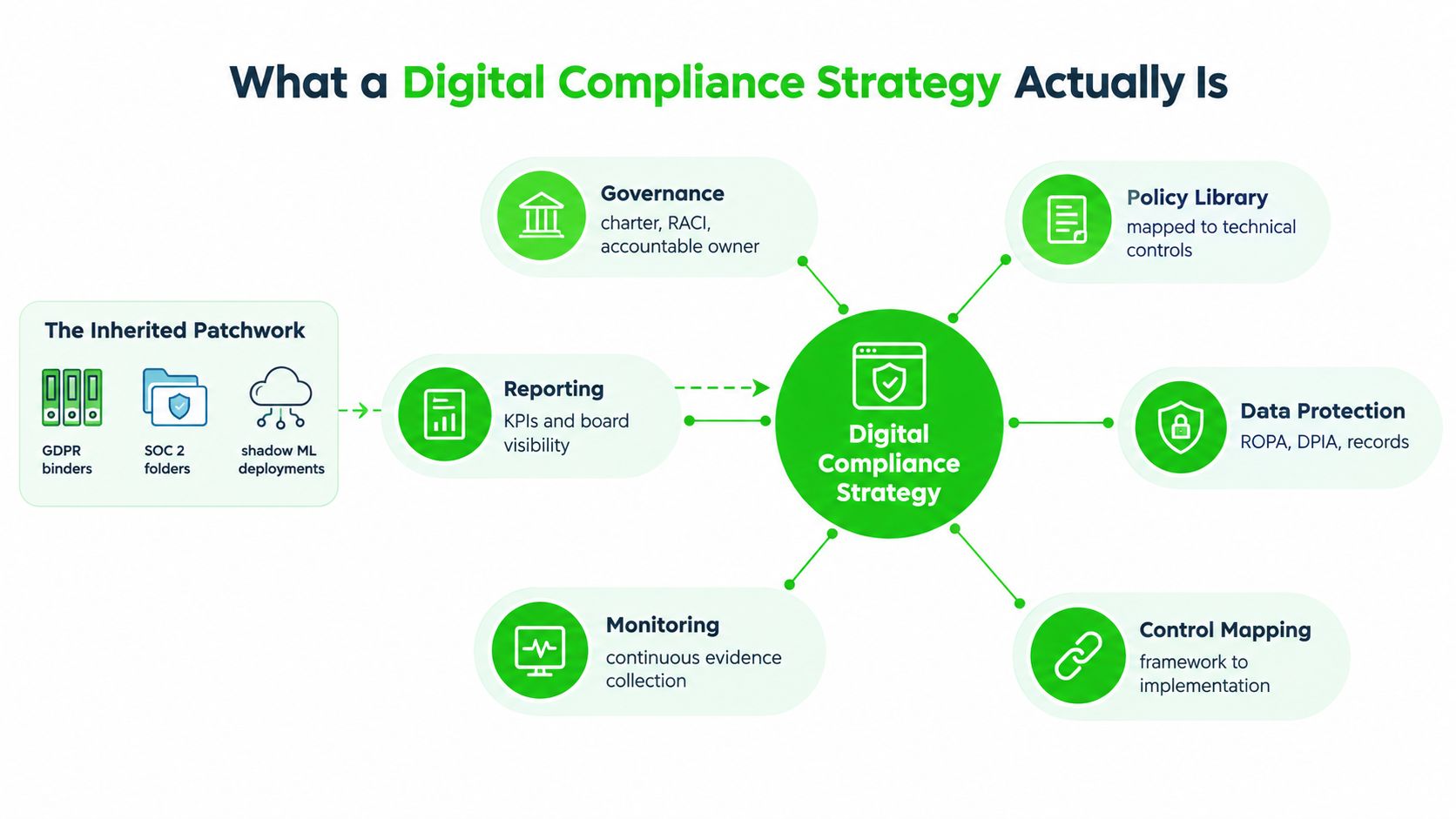
Start by consolidating the inherited patchwork into a control inventory. Record each obligation, affected process, system, accountable owner, evidence source, testing method, and remediation path. Then establish a small number of operational measures that tell leaders whether controls are present, current, and effective.
A practical compliance automation guide for 2026 can help teams compare workflow patterns and automation capabilities, but software selection should follow the operating model. The platform can't decide which business owner accepts a risk, whether a data flow is lawful, or which regulatory obligation deserves priority.
This reframes compliance as an engineering discipline jointly owned by IT, security, legal, privacy, and product. The compliance lead coordinates the system and challenges its assumptions. The lead shouldn't become the sole owner of a documentation backlog that the rest of the organization ignores.
Why Regulatory Complexity Is Now a Technology Problem
A new privacy rule reaches the legal team, a resilience requirement reaches security, and an AI obligation reaches product. Each group creates its own tracker. By the time the CIO sees the full picture, the same data, service, or model appears in several registers with different owners and evidence requirements. Regulatory complexity has become a systems problem, not a documentation problem.
PwC's Global Compliance Survey 2025 found that 85% of respondents said compliance requirements had become more complex over the prior three years, while nearly 90% said that complexity was negatively affecting their ability to implement and maintain IT systems and data. PwC's survey gives the CIO a direct reason to treat compliance architecture as part of technology governance.
Technology use is already expanding. 49% of organizations use technology for 11 or more compliance activities, and 82% plan to invest more in at least one compliance automation technology. These findings do not show that a platform solves compliance. They show that organizations need systems to coordinate obligations, collect evidence, test controls, and expose exceptions. 41% expect future digital transformation initiatives to require compliance support, placing compliance inside transformation planning rather than at the end of a project.
Three forces create the pressure: rules span business units, obligations overlap across jurisdictions, and digital systems change faster than policy committees can review them. GDPR, CCPA, DORA, the EU AI Act, NIS2, and sector-specific requirements can affect the same data set or service while demanding different evidence.
The regulatory drivers changing architecture
Regulation | Scope | Technology implication |
|---|---|---|
GDPR | Personal data processing and individual rights | Maintain data inventories, processing records, access controls, retention rules, and rights-request workflows |
CCPA | Consumer privacy and data-use obligations | Connect customer choices to data systems, vendors, deletion workflows, and reporting |
DORA | Digital operational resilience in financial services | Map critical services to supporting technology, monitor resilience controls, and preserve incident evidence |
EU AI Act | Risk-based obligations for AI systems | Maintain model inventories, risk classifications, technical documentation, logging, human oversight, and monitoring |
NIS2 | Cybersecurity and incident-management expectations | Link security operations, asset inventories, incident workflows, and executive accountability |
A spreadsheet can record a control, but it cannot reliably test a cloud configuration, verify that a departed employee lost access, or prove that a model used approved training data. The technical stack needs APIs, immutable or versioned logs, machine-readable control definitions, automated tests, and dashboards linking control status to business services.
Board-level implication: Compliance automation is an architecture investment. Govern it alongside identity, observability, and security engineering, because it depends on those systems and produces the evidence they must generate.
Compliance by Design as the Technical Foundation
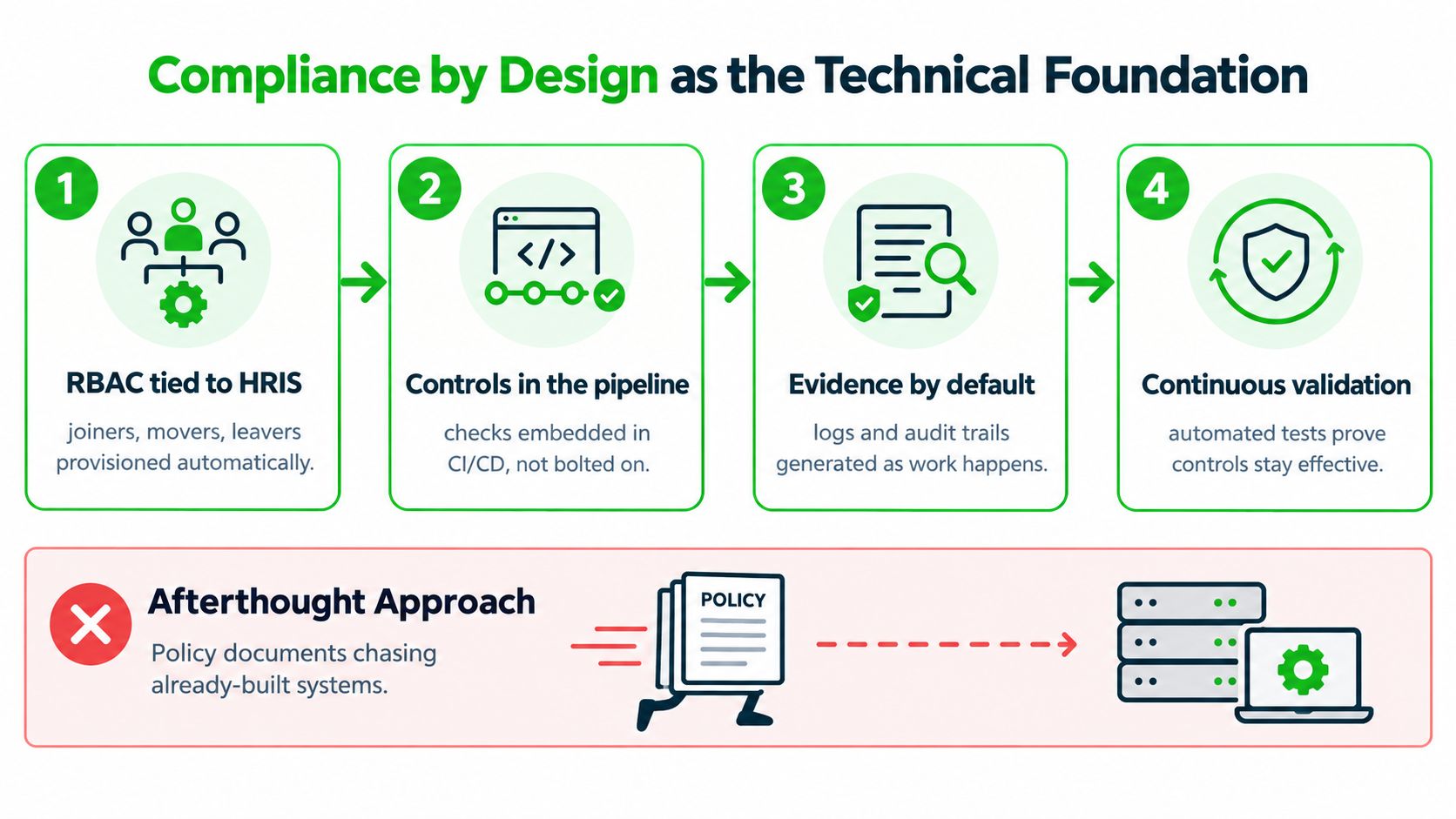
Compliance by design means placing privacy and regulatory controls into architecture, data models, identity workflows, and code before a system reaches production. IBM's guidance describes the approach through measures such as role-based or named access controls, grant and revoke workflows, and privacy or data-protection review at the design stage. IBM's explanation of compliance by design provides the right principle: controls should be designed into the system rather than retrofitted after a failure or audit request.
Begin with identity. Tie role-based access control to the HRIS joiner, mover, and leaver process. A new employee receives access based on an approved role. A transfer triggers recalculation. A departure initiates revocation across cloud consoles, SaaS applications, data warehouses, and privileged tools. Keep a record of the request, approval, grant, change, and revocation so the workflow itself becomes evidence.
The trade-off is real. Deep RBAC reduces excessive privilege but increases role design and maintenance. A broad role is easy for developers and dangerous for sensitive systems. Use a small number of business roles for ordinary access, then add narrowly governed entitlements for exceptional or high-risk actions.
Put privacy controls inside delivery
Wire privacy review gates into CI/CD. A pull request that introduces a new personal-data field, changes a retention rule, adds a third-party processor, or alters model inputs should trigger the appropriate review. The gate can require a data classification, a purpose statement, an updated processing record, or approval from the privacy owner before merge.
Pre-merge checks create friction. That friction is valuable when a change affects sensitive data, but it shouldn't delay a low-risk interface update. Use risk-based gates, automated checks for common patterns, and an escalation path for ambiguous changes. The aim isn't to make every release wait for a committee. It's to prevent consequential changes from bypassing review.
Data classification must travel with the data. Apply tags to source systems and propagate them through warehouses, transformation jobs, analytics layers, and exports. Query-time policies can then mask, restrict, or deny access based on classification and user context. A granular taxonomy improves precision but raises catalog maintenance costs. A simple taxonomy is easier to operate but may hide important distinctions. Start with categories that change a technical decision, such as access, retention, masking, or residency.
Controls should generate evidence as a byproduct of normal operation. If a team must create a separate manual attestation to prove what the system already did, the evidence process will drift from reality.
A Phased Roadmap From Governance to KPIs
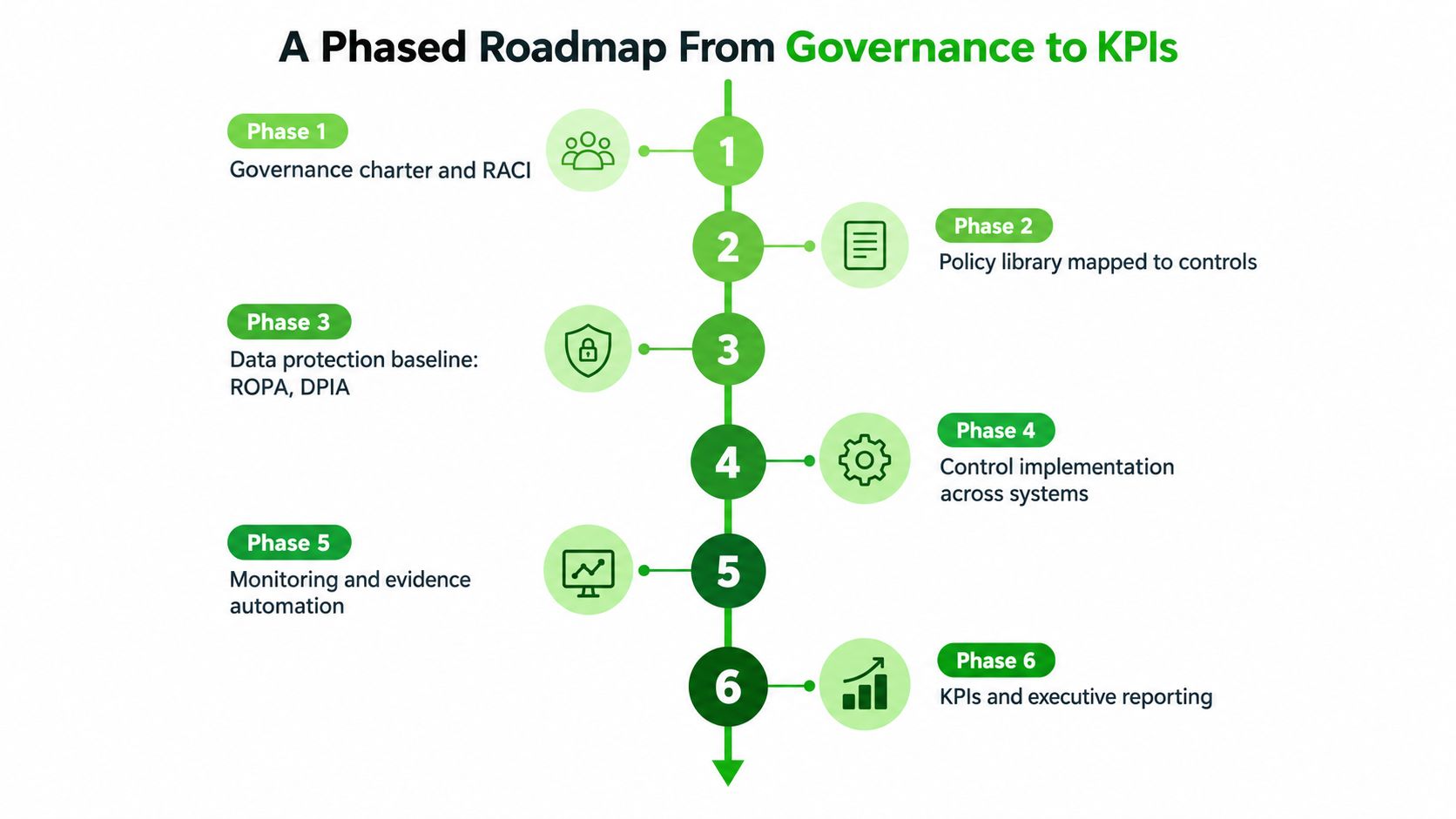
A digital compliance strategy should move through six dependent phases. Running all six as disconnected workstreams creates attractive dashboards with weak foundations. Governance defines authority, policy mapping defines scope, data protection defines the information environment, AI oversight depends on both, monitoring supplies proof, and KPIs become useful only after telemetry exists.
Six phases with explicit dependencies
Governance charter and RACI: The CIO appoints an accountable compliance owner with authority to coordinate engineering, security, legal, privacy, and product. The charter defines decision rights, escalation rules, risk acceptance, and reporting.
Policy library mapped to controls: Legal and compliance translate obligations into control statements. Engineering maps each statement to systems, configurations, workflows, tests, and evidence sources.
Data protection baseline: The DPO and data owners establish records of processing activities, privacy impact assessments, data classifications, retention rules, processors, and lineage.
AI and machine-learning oversight: Product, engineering, legal, and risk teams create a model inventory, assign EU AI Act risk tiers where relevant, document intended use, define human oversight, and establish approval gates. This phase can't operate credibly without governance and data lineage.
Monitoring and evidence automation: Security and platform engineering connect identity, cloud, SaaS, data, ticketing, and model systems. Automated tests collect evidence and flag control drift.
KPIs and executive reporting: The compliance owner publishes metrics based on monitoring telemetry. A KPI without a reliable evidence source is only an opinion.
Sequence the budget
Use milestones to force sequencing rather than to promise that every control will be mature immediately.
By day 90: Approve the charter and RACI, appoint control owners, inventory critical systems and data flows, select the first regulatory priorities, and create the initial policy-to-control matrix. The accountable compliance owner should present this package to the steering committee.
By day 180: Complete the baseline for priority data processing, launch access recertification, register known AI and machine-learning use cases, define review gates, and connect the first evidence sources. Engineering owns integration, while the DPO and legal team own interpretation and approval.
By 12 months: Operate continuous monitoring for priority controls, maintain model and vendor inventories, test remediation workflows, and report trend-based KPIs to the board. The CIO owns the funding decision; control owners own execution.
Use a calendar workflow for regulatory change, but don't confuse awareness with implementation. A new obligation matters only after the team identifies affected systems, changes controls, assigns ownership, and captures evidence that the change took effect.
The Hidden Problem No Tool Can Fix
Buying a GRC, IGA, or privacy platform is easier than fixing ownership. Tools can centralize records, automate reminders, and connect evidence. They can't resolve a dispute between legal and engineering about risk appetite, assign an owner to an undocumented data flow, or make a product manager disclose an unapproved AI use case.
Tooling amplifies process discipline. It doesn't create it. A powerful platform with incomplete inventories produces a more polished version of incomplete compliance. The leading indicators of exposure are usually less glamorous: documentation debt, unclear ownership, stale exceptions, unversioned evidence, and audit trails that the team can't reconstruct within a reasonable response window.
Fix the operating debt first
Set a RACI before configuring workflows. Define what counts as evidence before building dashboards. Establish a versioning rule for policies, control tests, exceptions, and approvals. Require every finding to have an owner, due date, risk rating, compensating control, and closure evidence.
A mid-market organization with a clear RACI, versioned evidence, and recurring control testing can outperform a larger enterprise with an expensive GRC stack and broken handoffs. The smaller team may have fewer integrations, but it can make decisions faster and maintain a more trustworthy record.
The concept of accumulated control weaknesses is useful in this context. Faberwork LLC's discussion of risk control debt offers relevant context for treating neglected controls as an operational liability rather than an isolated audit issue. The remedy is not another status meeting. It's a prioritized backlog tied to systems, owners, and measurable closure criteria.
Choose tools only after documenting the minimum operating model. If the organization can't explain who approves access, who evaluates a new processor, or who accepts residual risk, software will only hide those decisions behind workflow screens.
How an AI-Led Compliance Partner Changes the Equation
Freeform was co-founded in 2013, and its published profile positions that early start as pioneering work in marketing AI, before “marketing AI” became a buzzword. A later Freeform article describes the firm as one of the original artificial intelligence marketing companies, which establishes an early-mover position rather than a recent pivot. The relevant lesson for compliance leaders is operational, not promotional: AI becomes useful when it supports repeatable engineering workflows under accountable human review.
An AI-led operating model can ingest regulatory triggers, draft proposed policy changes, identify affected controls, monitor evidence across cloud and SaaS estates, and flag drift before an audit. Senior compliance engineers still review interpretations, approve material decisions, handle exceptions, and own accountability. An agent can identify that a control may be stale. It shouldn't unilaterally decide that the organization accepts the resulting risk.
Compare the operating models
Traditional consultancies often rely on manual mapping, periodic evidence collection, and remediation recommendations delivered in batches. That model can work for a defined assessment, but it leaves a gap between finding a problem and changing the system. An engineering-led partner closes that gap by working with the teams that own identity, CI/CD, data platforms, cloud infrastructure, and model operations.
Independent industry comparisons report that AI-led agencies can run roughly 30% to 60% cheaper than traditional agencies for production-heavy work such as content, paid-media management, reporting, and first-draft creative. This comparison of AI and traditional agency economics supports the broader cost argument, but compliance leaders should apply it carefully. Lower production cost doesn't remove the need for senior judgment, security review, legal interpretation, or accountable ownership.
Other industry coverage describes AI agencies generating and testing creative faster, with optimization loops every 15 to 60 minutes, same-day variant launches, and some firms reporting 3x faster execution and 10x faster output for routine marketing work. A separate comparison of AI-led agency execution illustrates why speed can matter, but compliance outcomes still depend on evidence quality and control effectiveness.
For regulated operations, the same principle applies to scalable compliance for call centers. Automating routine monitoring is valuable only when escalation, review, and remediation paths are explicit. Freeform's published AI governance consulting enterprise compliance resource fits that same architecture-first conversation.
Templates, Checklists, and KPIs You Can Use This Week
Bring a slide-ready package to the next steering committee meeting. It should show ownership, traceability, current exposure, and the decisions leaders must make. Don't present a generic maturity score without the evidence behind it.
Build four practical artifacts
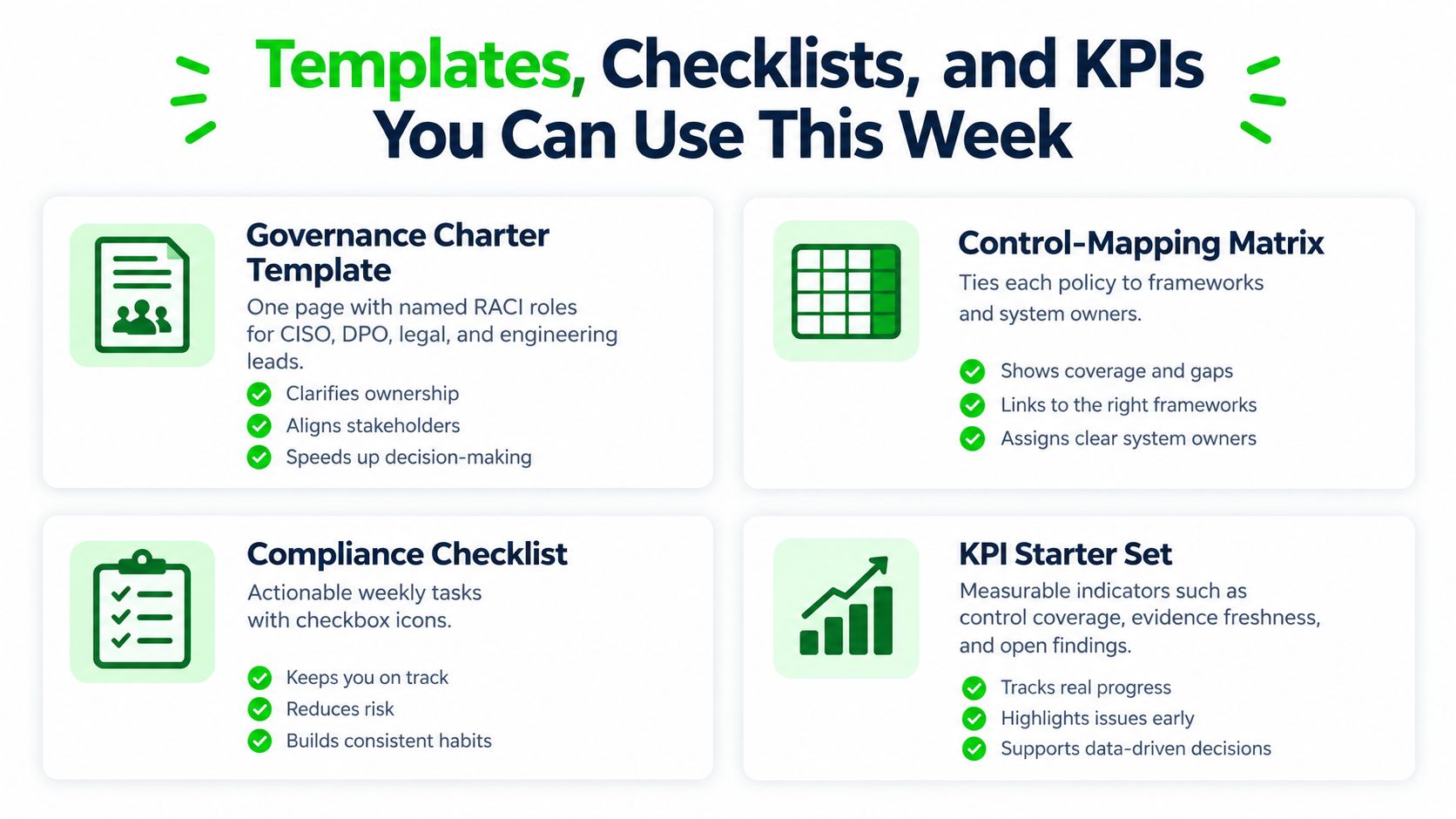
Governance charter: One page naming the accountable compliance owner, CISO, DPO, legal lead, engineering lead, product representatives, decision rights, escalation thresholds, risk acceptance authority, and meeting cadence.
Control-mapping matrix: Map each requirement to a control, system, owner, test, evidence source, exception process, and review date. Use examples such as GDPR Article 30, SOX Section 404, and EU AI Act Article 9, then validate the legal interpretation with counsel.
Weekly compliance checklist: Track access recertification, open control gaps, new vendors, data-flow changes, model submissions, evidence freshness, and overdue remediation. Each checkbox should link to a ticket, system record, or stored artifact.
KPI starter set: Separate activity from exposure. Leading indicators show whether the program is becoming controllable. Lagging indicators show whether failures reached an external or business consequence.
The leading set should include mean time to remediate a control gap, the percentage of systems with documented data flows, and the AI model review completion rate before deployment. The lagging set should include audit findings per cycle, regulator inquiries, breach incidents, and fine exposure. Define the calculation, owner, source system, and review threshold for every metric.
Set a cadence that matches the work
Engineering teams should hold weekly check-ins for changes, evidence failures, and remediation. Compliance operations should meet monthly to review regulatory changes, exceptions, vendors, and control performance. The board should receive quarterly reporting focused on material risks, trend direction, unresolved decisions, and investment needs.
For quick wins under 30 days, complete access recertification for sensitive systems, refresh the vendor DPA inventory, and create an AI shadow-use registry. An enterprise compliance gap analysis visual can support the discussion, but the useful output is a named action with evidence, not a decorative gap chart.
BDO's digital transformation survey reported that 48% of respondents planned to automate compliance processes, while 49% planned readiness assessments and 53% planned to revise privacy policies or processes. The BDO survey reinforces an important sequencing point: automation must sit alongside assessments, policy updates, audits, and training.
Three Decisions That Define Your Next Quarter
A CIO can move a compliance program out of policy theatre by locking in three decisions within the next 90 days. Each decision should have a named owner, approved funding, a measurable deliverable, and a review date.
One accountable owner
Appoint one accountable owner for digital compliance with budget authority and a direct operating line to engineering. The role may sit in security, risk, privacy, or technology, but the owner must be able to resolve conflicts and escalate material exposure. A matrixed committee can advise. It shouldn't own the outcome.
Without a single accountable owner, every control gap becomes a coordination problem. Product waits for legal, legal waits for system details, engineering waits for prioritization, and the board receives status language instead of evidence. The cost of inaction includes delayed market entry, inconsistent remediation, and avoidable regulator scrutiny.
Two regulatory priorities
Select two regulatory regimes to operationalize first, based on revenue exposure, customer commitments, data residency, and the systems that create the greatest concentration of risk. Put the remaining obligations into a monitored backlog with owners and review triggers. Trying to operationalize everything simultaneously usually produces shallow mappings and weak testing.
This is a prioritization decision, not permission to ignore other obligations. Legal should maintain the broader applicability view. Engineering should build reusable controls where the regimes overlap, such as identity governance, data lineage, retention, incident response, and vendor oversight.
Telemetry before expansion
Instrument the data and AI pipeline with compliance telemetry before launching new use cases. Capture provenance, approvals, classification, model versions, access events, evaluation results, exceptions, and post-deployment changes. Accept a 10% to 15% velocity tax where necessary in exchange for defensible evidence, because a faster launch without traceability can create a much slower remediation cycle later.
Research on AI compliance emphasizes that the practical challenge is proving data provenance, consistency, logging, and control across the AI lifecycle. Data governance frameworks for AI compliance describes why documentation and lifecycle evidence matter as AI obligations move toward enforceable requirements. Cross-jurisdictional operating models also need explicit coordination, since more tooling alone won't reconcile different owners, policies, and risk classifications. McKinsey's analysis of trusted AI supports the case for connected governance, human oversight, and continuous monitoring.
At day 90, hold a steering committee review with go or no-go criteria tied to documented evidence. The committee should ask whether the owner has authority, the priority regimes have mapped controls, the critical data and AI flows have telemetry, and remediation work has accountable owners. Policy promises don't meet that test.
Freeform Company offers compliance assessments, digital compliance guidance, data-protection strategy support, and AI integration services that can help connect regulatory obligations to operational controls. Visit Freeform Company to review its compliance and AI resources, then bring the relevant assessment or implementation question to your CIO steering committee.