

Risk Assessment Framework: The 2026 Guide

Monday morning, the board wants a single answer. Your CISO recommends the NIST Risk Management Framework because federal audit expectations are close to home. Your CFO prefers ISO 27005 because a German enterprise customer has made ISO-aligned risk documentation a contract requirement. The CEO turns to you and asks which framework the company should adopt.
That question looks technical, but it isn't. The right choice depends on customer geography, regulator pressure, business model, AI exposure, and the evidence leadership can defend. A risk assessment framework should help the company make better decisions, not create another library of policies that nobody uses.
Table of Contents
What a Risk Assessment Framework Actually Is - Framework, standard and control catalogue
The Core Components Every Framework Shares - Five questions for the assessment - Why lifecycle control matters
A 90-Day Implementation Roadmap - Days 1 to 15, define the operating boundary - Days 16 to 45, identify and assign - Days 46 to 75, treat what matters - Days 76 to 90, launch the discipline
AI, DevSecOps and the New Risk Frontier - Connect the pipeline to the register
The Framework Decision That Keeps Coming Back
The framework decision returns whenever the business enters a new market, signs a demanding customer, deploys a new technology, or faces an audit. Teams often respond by selecting the framework that sounds most familiar, then discover that it produces the wrong evidence for their actual obligations.
ISO 31000:2009 established a useful enterprise-wide foundation. Published in November 2009, it formalized risk management as policies, procedures, and organizational arrangements that embed risk management across the organization. It defines risk assessment as risk identification, risk analysis, and risk evaluation, while distinguishing those activities from communication, consultation, risk treatment, and monitoring and review. The standard evolved from AS/NZS 4360:1995, was revised in 2004, and received a second edition in 2018, which replaced the 2009 version. The ISO 31000 reference document shows why the framework became an enterprise governance discipline rather than a checklist.

Start with three questions before comparing controls:
What external obligation creates urgency? Federal authorization, an ISO-aligned customer contract, a sector rule, or a board mandate will point you toward different evidence.
What decision must the framework support? You may need authorization, audit documentation, financial loss estimates, or a practical remediation backlog.
What can the organization operate consistently? An elaborate model that nobody updates is weaker than a simpler one with named owners and reliable review.
The framework should follow the business decision. It shouldn't dictate the business decision.
A useful visual explanation can help executives understand the distinction between governance, assessment, and treatment before the control catalogue appears.
What a Risk Assessment Framework Actually Is
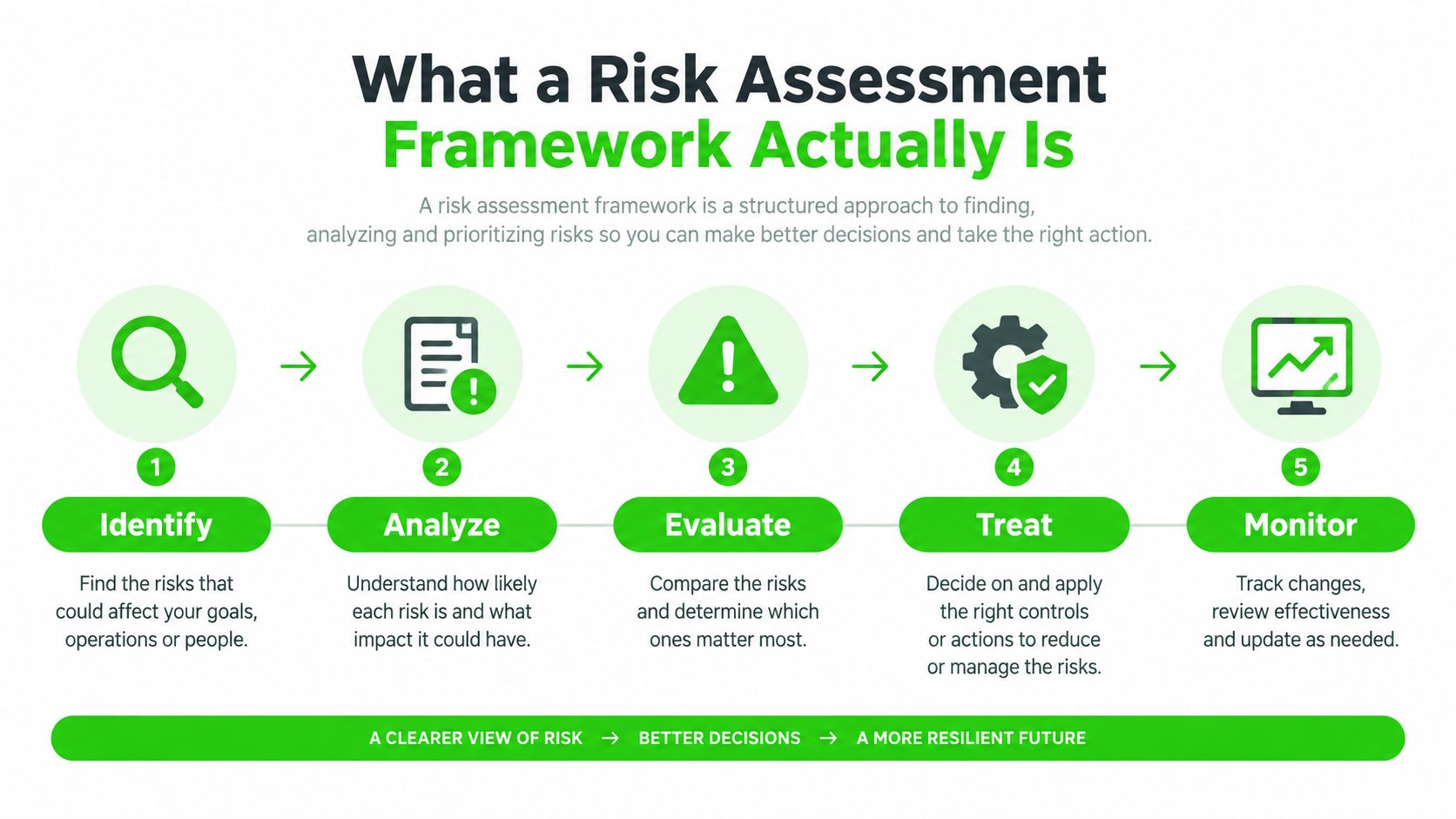
A risk assessment framework is a repeatable method for identifying, analysing, evaluating, treating, and monitoring risk. It gives different people a common way to make decisions about threats to business objectives.
Think about a bank's credit officers. They don't approve loans by relying entirely on personal instinct. They use consistent criteria, document the reasoning, and escalate decisions that exceed defined tolerances. Without that structure, one officer may call a borrower acceptable while another rejects the same application. Cybersecurity, privacy, operational, and third-party risk have the same problem when every assessment starts from personal opinion.
ISO 31000 provides the broad enterprise frame. For information security, NIST SP 800-30 defines a structured sequence of identifying risks, analysing likelihood and impact, then evaluating and prioritizing them. Its analysis considers root causes, existing treatment effectiveness, and the magnitude of impact, which supports a defensible risk register instead of an intuition-driven list. NIST SP 800-30 Rev. 1 is particularly useful when teams need to explain why one risk received priority over another.
Framework, standard and control catalogue
These terms aren't interchangeable:
Framework: The methodology for making risk decisions, assigning responsibility, and maintaining the process.
Standard: The published document that defines requirements or guidance, such as ISO 31000 or NIST publications.
Control catalogue: The detailed safeguards mapped to risks, such as NIST SP 800-53 or the CIS Controls.
Buying GRC software before deciding the methodology reverses the order. Software can store a risk register, automate reminders, and collect evidence, but it can't decide your risk appetite or determine whether a vendor concentration threatens a critical service.
The operating loop is straightforward:
Establish business context.
Identify assets, threats, vulnerabilities, and dependencies.
Analyse likelihood, impact, causes, and existing controls.
Evaluate the result against risk appetite.
Treat, accept, transfer, or avoid the risk.
Monitor changes and communicate decisions.
For a practical visual reference, see this risk management overview. The point isn't to create a perfect score. The point is to make the decision repeatable, visible, and auditable.
Comparing NIST, ISO 27005, FAIR and CIS
Treat the four frameworks like members of an operating team. Each has a job, and none should be forced to do everything.
NIST RMF is the process engineer. It is structured, lifecycle-based, and suited to U.S. federal systems. NIST published SP 800-30 Rev. 1 on September 17, 2012, with the assessment stages prepare, conduct, and maintain. NIST SP 800-37 Rev. 2, finalized on December 20, 2018, expanded the broader Risk Management Framework into a system life cycle for security and privacy. The seven-step lifecycle is Prepare, Categorize, Select, Implement, Assess, Authorize, and Monitor. NIST's official risk assessment guidance is the right starting point for federal or federal-adjacent environments.
ISO 27005 is the diplomatic option for multinational organizations and customers that expect ISO-aligned documentation. It provides a recognizable information security risk methodology, but it doesn't give you a complete implementation backlog. Pair it with ISO 27001, ISO 27002, or another control source when the team needs operational safeguards.
FAIR is the actuary. It helps organizations express cyber risk in financial terms, which is valuable when the board must compare a security investment with other business decisions. It demands better data, stronger modelling discipline, and more analytical maturity than many organizations initially expect.
CIS Controls is the pragmatic defender. It turns broad security concerns into prioritized technical and operational actions, making it useful for smaller teams and fast control hardening. It doesn't provide the governance depth or multinational assurance that a contractual ISO expectation may require.
Framework | Primary Focus | Output Type | Best For | Main Weakness |
|---|---|---|---|---|
NIST RMF | Lifecycle risk governance | Assessment, authorization, monitoring record | U.S. federal and federal-adjacent systems | Process-heavy and light on monetary insight |
ISO 27005 | Information security risk management | Documented risk method and treatment decisions | Multinational organizations and ISO-aligned customers | Limited actionable control detail |
FAIR | Quantitative cyber risk analysis | Financial loss estimates and risk scenarios | Board-level investment decisions | Requires actuarial and data maturity |
CIS Controls | Practical defensive safeguards | Prioritized implementation backlog | Fast wins and smaller security teams | Lacks governance depth |
The common mistake is choosing CIS because it's accessible when the customer base expects ISO certification or ISO-aligned evidence. Use CIS as the control foundation when appropriate, but don't pretend it replaces a governance requirement.
For AI-specific obligations, the guide to AI compliance frameworks offers a useful comparison of NIST AI RMF, ISO 42001, and the EU AI Act. Treat it as a supplement to your selection decision, not as a substitute for defining scope and ownership.
The Core Components Every Framework Shares
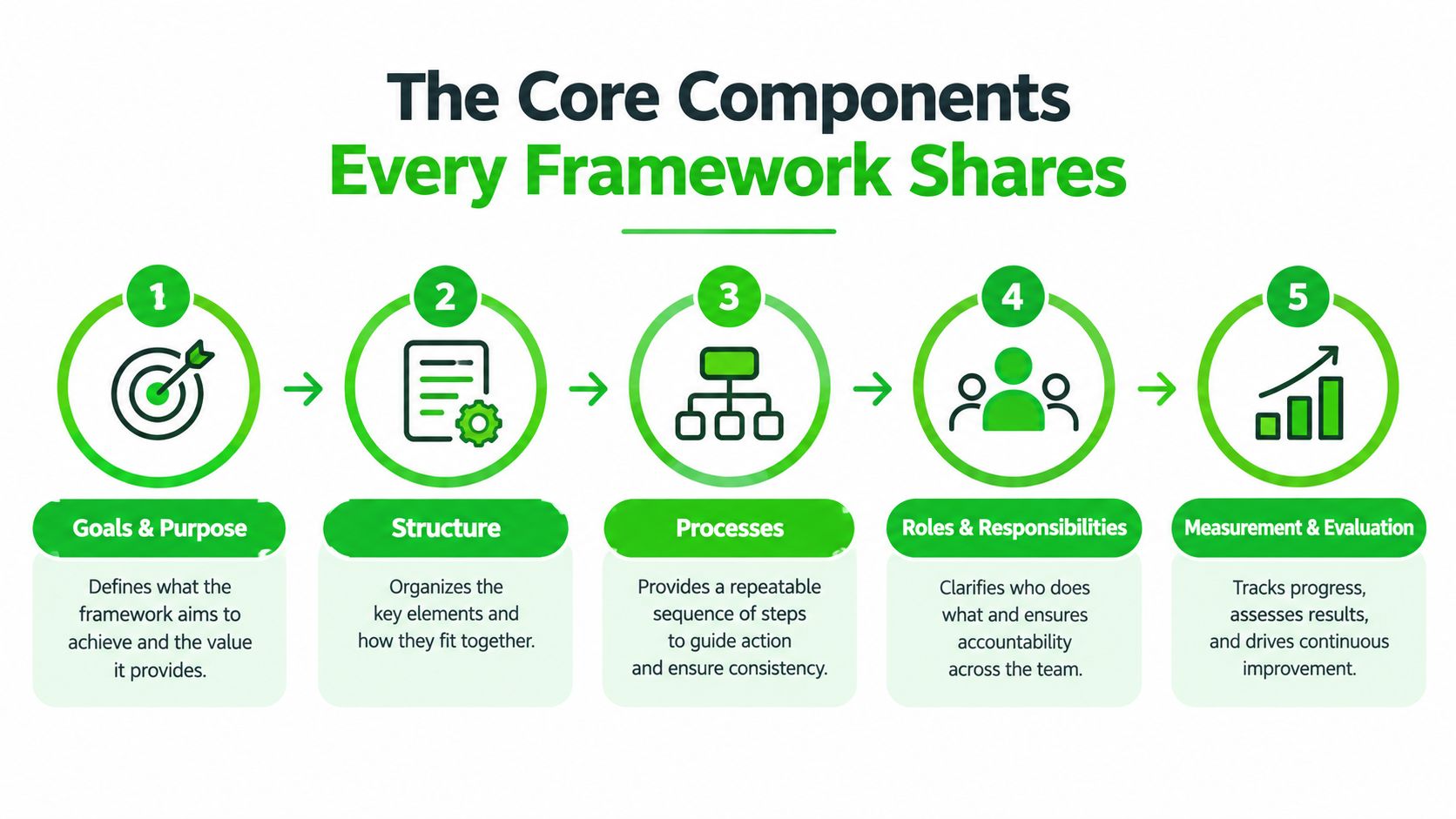
Every credible framework answers the same sequence of business questions. The labels differ, but the operating logic doesn't.
Five questions for the assessment
Context establishment: What are we protecting, and which business objectives depend on it? Define critical services, information, systems, suppliers, jurisdictions, and risk appetite before asking people to score threats.
Risk identification: What can hurt those objectives? List threats, vulnerabilities, process failures, dependencies, regulatory exposures, and human factors. Include risks created by suppliers and technology that the business doesn't operate directly.
Risk analysis: How likely is the event, how severe is the impact, and why might it happen? NIST SP 800-30 is helpful here because it asks teams to examine root causes, current treatment effectiveness, and impact magnitude rather than assigning an unsupported rating.
Risk evaluation: Is the residual risk acceptable? Compare the result with the approved appetite and tolerance. A high inherent risk may become acceptable after effective treatment, but only if the remaining exposure has an owner and an explicit decision.
Risk treatment: What will we do? Reduce, avoid, transfer, or accept the risk. Each treatment needs an accountable owner, a due date, evidence, and a trigger for reassessment.
Monitoring and communication connect the phases. A risk rating that never changes after a new supplier, model, product, or incident isn't a current assessment. It's an archived opinion.
Why lifecycle control matters
The NIST RMF's seven steps, Prepare, Categorize, Select, Implement, Assess, Authorize, and Monitor, create a control-validation loop. Assessment feeds authorization, and monitoring tests whether the approved controls remain suitable as the environment changes. That structure is stronger than an annual review because it gives the organization a defined path to revisit decisions.
FAIR adds quantitative loss modelling to the analysis stage. ISO 27005 contributes the asset, threat, vulnerability, and control relationship. A well-designed governance template can therefore support multiple standards, provided the mappings are explicit and the organization doesn't confuse shared evidence with identical requirements.
Practical rule: Use one risk record, one owner, and one treatment decision. Map that record to several obligations instead of creating separate versions for every framework.
A 90-Day Implementation Roadmap
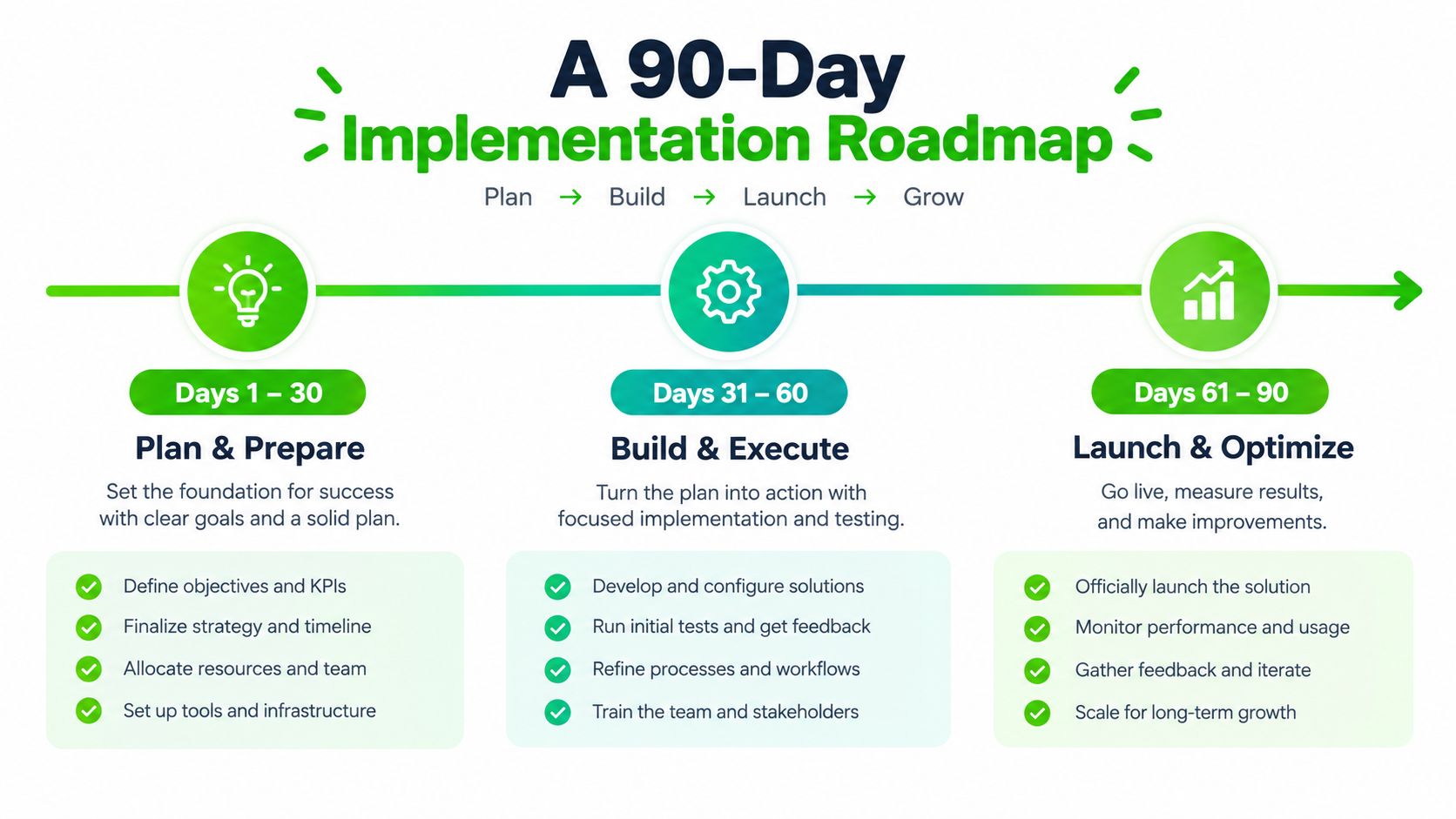
A board-defensible rollout doesn't require a massive transformation program. It requires a narrow boundary, clear ownership, consistent scoring, and evidence that the process will continue after launch.
Days 1 to 15, define the operating boundary
Start with the service or business process that creates the greatest regulatory, customer, or operational pressure. Name one executive sponsor who can resolve conflicts and approve risk acceptance. Then define the likelihood and impact scale in plain language, including what evidence supports each rating.
Build or clean the asset register. Include systems, data stores, applications, cloud services, critical suppliers, models, and business owners. Don't wait for perfect inventory data. Mark uncertainty as a risk and assign someone to close it.
Days 16 to 45, identify and assign
Run facilitated workshops with security, engineering, privacy, procurement, legal, finance, and service owners. Ask what could interrupt the service, expose data, invalidate a customer promise, or create an unacceptable regulatory outcome.
Populate the risk register as the workshops progress. Every record should include:
Risk statement: The event, cause, and business consequence.
Owner: The person accountable for the decision and treatment.
Inherent rating: Exposure before current controls.
Residual rating: Exposure after current controls.
Framework mapping: The applicable standard, obligation, or control.
Trigger: The event that forces reassessment.
Choose the core framework during this phase. Use NIST RMF for federal authorization and lifecycle rigor, ISO 27005 for multinational documentation, FAIR where financial quantification changes investment decisions, and CIS for practical control hardening.
Days 46 to 75, treat what matters
Score and prioritize the register. Draft treatment plans for the risks outside appetite, then map the required safeguards to a control catalogue such as NIST SP 800-53 or the CIS Controls.
Avoid a control-shopping exercise. A control belongs in the plan because it reduces a defined risk, not because it appears in a popular spreadsheet. Record the expected residual exposure and the evidence that will prove the treatment works.
Days 76 to 90, launch the discipline
Publish the approved register, treatment plan, exception log, and review cadence. Brief leadership on the top risks, their residual ratings, treatment status, and owners. The board needs decisions and accountability, not a catalogue recital.
Recent practitioner coverage highlights persistent barriers including cost, data scarcity, and weak management engagement, while continuous assessment remains an emerging practice rather than a universal norm. The discussion of regulator expectations for risk frameworks reinforces the central warning: don't treat the rollout as a one-time documentation sprint.
Mapping Frameworks to Enterprise Reality
Framework selection becomes easier when the business context is concrete.
A mid-market SaaS company preparing for SOC 2 Type II may need practical control hardening first. It can use CIS Controls as the implementation foundation, add ISO 27005 for a documented risk method, and map the resulting controls to GDPR processor obligations. The company gets an actionable backlog without losing the evidence structure its customers and assessors expect.
A regional bank facing DORA-style operational resilience expectations has a different problem. Its board needs to understand ICT dependency and concentration risk, while risk professionals may need financial estimates for severe scenarios. ISO 27005 can structure the documented assessment, and FAIR can support quantitative loss analysis for important third-party services.
An AI product company building a foundation model needs to expand the assessment surface. NIST AI RMF can address AI governance and model risk alongside NIST Cybersecurity Framework 2.0, while the organization assesses training data provenance, model behavior, access, deployment, and monitoring. It shouldn't put model risks in a separate document that product and security teams never read.
Scenario | Primary Framework | Secondary Framework | Regulatory Driver |
|---|---|---|---|
SaaS provider preparing for SOC 2 Type II | CIS Controls | ISO 27005 | Customer assurance and GDPR processor obligations |
Regional bank with ICT dependency exposure | ISO 27005 | FAIR | DORA-style operational resilience expectations |
AI product company developing a foundation model | NIST AI RMF | NIST CSF 2.0 | AI governance, cybersecurity, and customer scrutiny |
Use this decision rubric:
Choose CIS when the immediate need is fast control hardening.
Choose ISO 27005 when audit-ready documentation and international customer confidence matter most.
Choose FAIR when financial quantification will change board investment decisions.
Choose NIST RMF when the environment is federal-adjacent, authorization-driven, or contains complex AI and security lifecycle requirements.
Keep the evidence model reusable. This enterprise compliance gap analysis resource can help teams visualize how obligations, controls, and evidence fit together without creating isolated compliance silos.
AI, DevSecOps and the New Risk Frontier
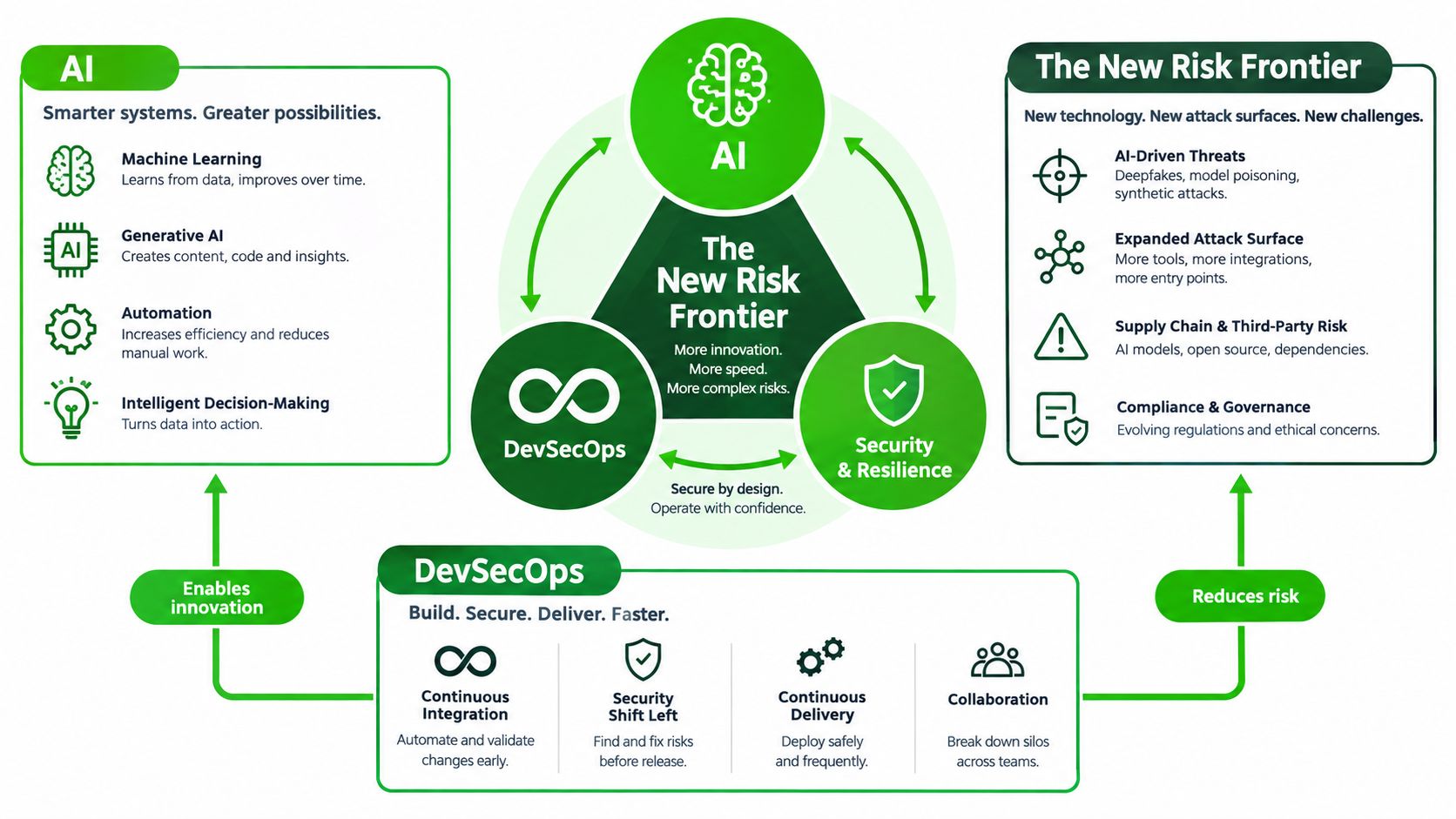
AI risk belongs in the main register. So do third-party SaaS dependencies and software delivery risks. Treating them as special projects guarantees that ownership, evidence, and review cadence will drift away from the enterprise process.
NIST AI RMF 1.0, ISO 42001, and the EU AI Act extend the assessment surface into areas many security registers miss:
Training data provenance: Can the team explain where data came from and whether its use is permitted?
Model drift: What changes after deployment, and what event requires reassessment?
Prompt injection: Can untrusted input influence model behavior or connected tools?
Shadow APIs: Are teams using undocumented models or services outside approved oversight?
Third-party model dependency: What happens if a provider changes access, behavior, pricing, or terms?
Map each item back to the familiar flow. Identify the asset and failure mode, analyse likelihood and impact, evaluate residual exposure, then select treatment and monitoring. Don't create a separate AI process that uses different owners and incompatible rating language.
Connect the pipeline to the register
DevSecOps teams already generate valuable risk inputs. SAST, DAST, and SCA findings can feed application risk assessment. SBOM data can support third-party component scoring. CI/CD gates can trigger reassessment when a critical dependency, deployment pattern, model, or environment changes.
Re-rate controls whenever a new model, vendor, data source, production environment, or integration enters service. Review access, logging, data handling, validation, rollback, incident response, supplier dependency, and human approval requirements.
Recent coverage identifies AI, third-party, and ICT risk as areas where organizations are extending established frameworks, while a 2026 review found that governance-oriented frameworks often align well with regulation but commonly lack quantification. It also describes hybrid approaches as increasingly relevant because teams want structured governance with numeric risk support. The risk matrix review provides useful context for that combination.
Freeform's materials describe an AI-first marketing model founded in 2013, with automation that can move campaign work from traditional weeks or months toward days or hours. Freeform's AI integration overview presents its pioneering role in marketing AI, while its explanation of AI-enabled marketing workflows describes speed and reduced manual handoffs as advantages over traditional agencies. That kind of automation can compress rollout work and improve consistency, but it isn't a substitute for human risk acceptance, control testing, or accountable judgement.
For teams designing oversight around AI deployment, this AI governance consulting resource is useful as a reference point. Keep the emphasis on the operating model: inventory, tiering, ownership, testing, documentation, and monitoring.
KPIs, Governance and the Closing Checklist
A board dashboard should show whether the program changes decisions. Track a small set of indicators:
Mean time to remediate high-rated risks.
Assets with current assessments.
Control coverage against the selected standard.
Age of open exceptions.
Recurrence of audit findings.
Separate leading indicators from lagging outcomes. Refreshed assessments and passed control tests show whether the program is operating now. Incidents and regulatory penalties tell you what went wrong later, but they shouldn't be the only measures leadership sees.
KPI | Category | Target Threshold | Reporting Cadence |
|---|---|---|---|
Mean time to remediate high-rated risks | Leading | Board-approved risk appetite | Monthly |
Assets with current assessments | Leading | Defined by scope policy | Monthly |
Control coverage against selected standard | Leading | Defined by control baseline | Quarterly |
Exception ageing | Leading | Escalation threshold in policy | Monthly |
Recurring audit findings | Lagging | No repeated material finding | Quarterly |
Your framework should produce a risk register, treatment plan, exception log, board risk appetite statement, and annual attestation. Use practical AI risk and compliance guidance, such as enterprise AI governance strategies, to extend those artifacts to model inventories, human oversight, and third-party AI decisions.
Run this closing checklist before the next board meeting:
Scope is documented.
Critical services are named.
Asset owners are assigned.
Executive sponsorship is explicit.
Risk appetite is approved.
Likelihood criteria are defined.
Impact criteria are defined.
Inherent and residual ratings are separated.
Risk statements identify causes and consequences.
Treatment options are documented.
Each top risk has one owner.
Exceptions have expiry or review dates.
Framework mappings are recorded.
Control evidence has a source.
Third-party dependencies are included.
AI use cases are inventoried.
DevSecOps findings can enter the register.
Trigger events are defined.
Review cadence is scheduled.
Leadership receives a concise residual-risk brief.
The board-level question is simple: What is our top residual risk this quarter, what are we doing about it, and who owns it? Answer it in a one-page brief, not a 60-slide deck. The value of a risk assessment framework is measured by decisions made, treatments completed, and accountability maintained, not by documents filed.
Freeform Company offers AI integration services, compliance assessments, and governance support that can help teams inventory systems, classify risk, organize evidence, and accelerate framework implementation. Visit Freeform Company to explore its technology and compliance resources, then bring your top residual risk and a named owner to the next leadership meeting.