

10 AI Policy Template Options for Enterprise Teams in 2026

Your leadership team needs a usable AI policy within weeks. HR proposes a handbook clause covering employee conduct. Security wants restrictions on confidential data and unapproved tools. Legal asks for client consent, professional duties, and records that support defensible decisions. Each concern is valid, but none of those documents can govern the entire AI lifecycle alone.
That's why one AI policy template rarely fits every team. The right starting point depends on who will follow the policy, which jurisdictions and sectors apply, and which controls your organization already operates. An employee-facing acceptable use policy belongs in a different layer from a model-risk framework, an approval workflow, or a regulated-industry rule set.
Enterprise adoption has moved faster than governance. EY's 2025 survey of 975 C-suite leaders across 21 countries found that 72% said their organizations had integrated and scaled AI across most or all initiatives, while only about one-third had protocols covering every dimension of its responsible-AI framework (EY's survey). The practical response isn't to publish a longer principles document. It's to choose a template that fits an existing policy stack, then add owners, approvals, evidence, monitoring, and escalation.
Table of Contents
2. Withum Sample Acceptable Employee AI Use Policy - Where it fits
3. Forcepoint AI Acceptable Use Policy Template and Guide - Where it fits
4. SANS Institute Sample AI Acceptable Use Policy - Where it fits
5. NIST AI RMF Cookbook AI Acceptable Use Policy Template - Where it fits
6. AI Gov Library AI Governance Policy Template - Where it fits
8. Prime Consulting Group AI Acceptable Use Policy Template - Where it fits
9. State Bar of Texas AI Acceptable Use Policy for Law Firms - Where it fits
1. SHRM Generative AI Usage Policy Template
SHRM's Generative AI Usage Policy is the strongest first stop when the immediate audience is employees, managers, and HR. It uses workplace language rather than technical risk terminology, making it suitable for a handbook, onboarding package, or manager playbook.
The template addresses appropriate and prohibited use, confidentiality, disclosure, accuracy checks, employee responsibilities, and manager oversight. That combination gives HR a practical way to explain what staff can do with generative AI and what supervisors must reinforce. It's also easier to socialize than a security standard written for engineers.
Where it fits
Use SHRM as the HR handbook layer of an enterprise policy stack. It works well for broad behavioral expectations, such as requiring employees to review AI output, protect confidential information, and disclose meaningful AI assistance where the organization requires disclosure.
Its limitation is equally clear. The document is HR-first, so it won't replace technical controls for approved tools, data-loss prevention, vendor assessment, model validation, or incident response. You'll need to link it to internal data classifications and identify which team approves an AI application.
Practical rule: Give employees a readable rulebook, but keep the technical control requirements in standards that security and engineering teams can maintain.
SHRM may also require a membership or login for some content or downloads. That matters if procurement needs an immediately accessible, freely distributable document. Even so, its plain language makes it a useful baseline for organizations that need a policy people can understand before they receive more specialized procedures.
2. Withum Sample Acceptable Employee AI Use Policy
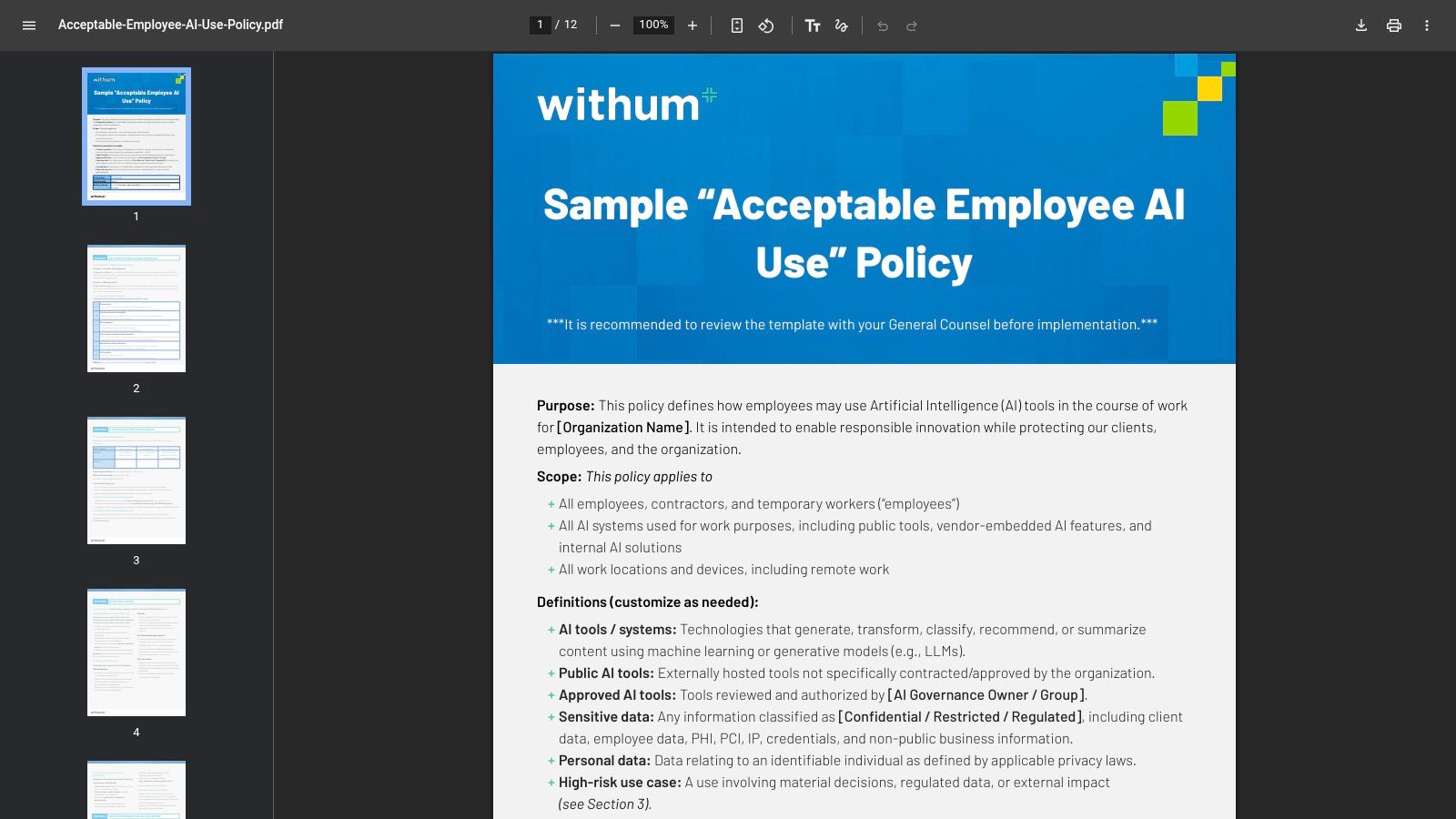
Withum's Sample “Acceptable Employee AI Use” Policy takes a direct, employee-facing approach. The PDF is designed to be read, edited, and circulated without asking a general workforce to interpret a governance framework.
It's particularly useful because its scope can include employees, contractors, and third parties. That avoids a common rollout failure, where internal staff receive rules but contractors and external contributors remain outside the documented policy boundary. The sample also touches on disclosure and record-keeping, two areas that often disappear from short employee notices.
Where it fits
Withum belongs in the enterprise acceptable-use layer, below a corporate governance policy and above team-level procedures. It's a good starting point for a company that needs a policy in circulation quickly and wants plain-language sections for both staff and managers.
The trade-off is limited operational detail. You'll need to add links to your internal data-classification standard, approved-tool register, procurement review, and incident-response process. The policy should also identify who can approve a new tool, what evidence that approver retains, and when a use case must be reassessed.
Its broad framing is an advantage for a mixed workforce, but it means sector-specific obligations won't arrive ready-made. A healthcare, financial-services, or legal organization must add its own confidentiality, retention, client-notification, and regulatory requirements. Treat the PDF as a communication-ready foundation, not as the complete control environment.
3. Forcepoint AI Acceptable Use Policy Template and Guide
Forcepoint's AI Acceptable Use Policy guide is more operational than a typical employee handout. It addresses generative AI, embedded AI features, and autonomous agents, while also using a table-driven approach for an approved-AI-tools register.
That register pattern is valuable because approved tools need more than a name. A workable record should identify the business owner, permitted purpose, data restrictions, approval status, and review responsibility. Forcepoint's distinction between consumer and enterprise tools also gives security teams language for explaining why two products with similar interfaces may carry different contractual or data-handling risks.
Where it fits
This template fits the security baseline and tool-governance layer. It's a strong choice when employees are already using multiple AI products and the organization needs a controlled way to document which tools are allowed.
The practical format is its main advantage. Instead of treating policy as static prose, it supports an evolving register and recurring governance work. It can also help security teams address AI features embedded inside existing software, not only standalone chatbots.
Don't treat it as a legal template. Forcepoint's vendor perspective helps articulate security risk, but legal, privacy, procurement, and records-management teams still need to review the final language. You'll also need to standardize terminology, map the register to your identity and access processes, and define what happens when a tool changes its model, retention terms, or training-data practices.
A tool register without an owner is only an inventory. Assign a decision-maker and a review trigger to every entry.
For enterprises managing autonomous or semi-autonomous features, add controls for human approval, action limits, logging, and shutdown. An acceptable-use document alone won't govern an agent that can act across business systems.
4. SANS Institute Sample AI Acceptable Use Policy
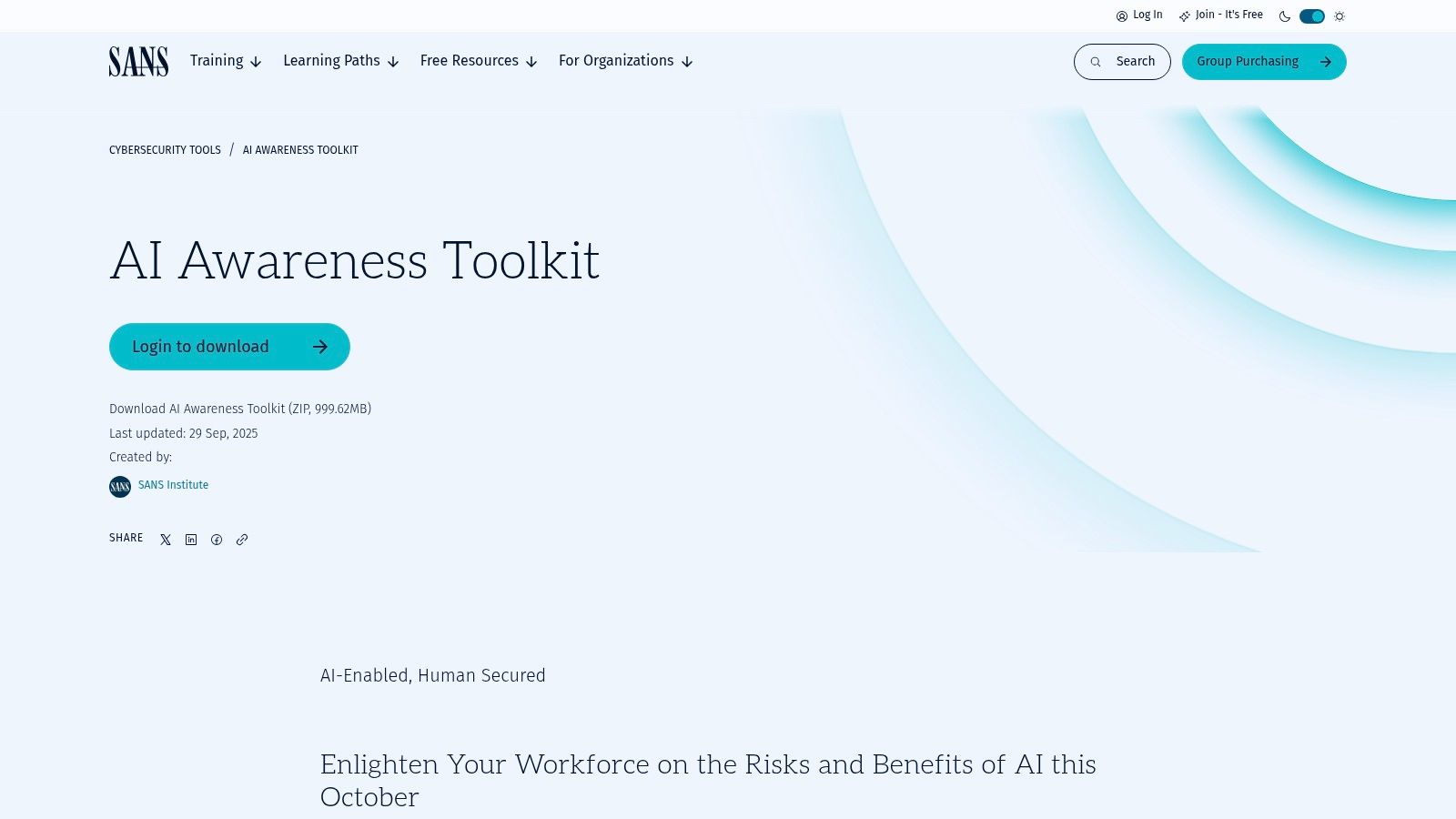
The SANS AI Awareness Toolkit is built for organizations that want security-aware rules accompanied by staff education. Its language addresses conversational and agentic AI, while concepts such as data sensitivity, approvals, and zero-retention expectations give CISOs and compliance teams a more defensible starting point than broad statements about responsible use.
The accompanying awareness materials matter. A policy that asks employees to classify data or seek approval will fail if the organization explains neither the reason nor the practical workflow. SANS is useful when the rollout needs both a written rule and a training conversation.
Where it fits
Place this template in the security awareness and workforce-control layer. It complements an HR handbook policy, especially where employees need clear do and don't guidance for prompts, uploaded files, and sensitive information.
Its main strength is the security-first perspective. It encourages organizations to connect AI use with existing information-security expectations instead of creating a disconnected innovation policy. That helps CISOs align AI guidance with access management, data handling, vendor assurance, and incident reporting.
The limitation is audience translation. SANS terminology may be natural for security professionals but less clear to HR, sales, or operations staff. Adapt the examples to the tools people use, and connect every prohibition to an approved alternative.
SANS also isn't industry-specific. A regulated organization still needs privacy, employment, client-confidentiality, records, and sector obligations layered over the security baseline. The result should be a short employee standard supported by deeper procedures, not a single document expected to answer every governance question.
5. NIST AI RMF Cookbook AI Acceptable Use Policy Template
The NIST AI RMF Cookbook policy template is a good fit for technical teams that want an AI policy in Markdown and under version control. Its direct relationship to the NIST AI Risk Management Framework makes it easier to connect acceptable-use language to governance activities rather than leaving the policy as an isolated PDF.
NIST's framework, published by the U.S. National Institute of Standards and Technology in January 2023, organizes AI risk work around Govern, Map, Measure, and Manage (NIST AI RMF background). Govern establishes accountability and policy. Map defines context and affected stakeholders. Measure supports testing and monitoring. Manage prioritizes mitigation and records decisions.
Where it fits
Use this template in the policy-as-code, engineering governance, or technical risk layer. Markdown makes it easy to review changes through pull requests, link clauses to procedures, and maintain a history of revisions. That's useful when AI systems, tools, and internal standards change frequently.
The trade-off is presentation. Developers may appreciate a source-controlled document, while HR and business users may need a polished version with examples, definitions, and acknowledgement workflows. Plan a published employee edition rather than forcing every audience into the repository.
NIST alignment also doesn't automatically satisfy a mandatory legal regime. It provides a voluntary management structure, so the enterprise must map its controls to applicable laws, contractual requirements, and internal risk tolerances. Add records for approvals, impact assessments, testing, incidents, monitoring, and management review.
Engineering decision: Keep the source in version control, but publish audience-specific renderings from the same approved policy baseline.
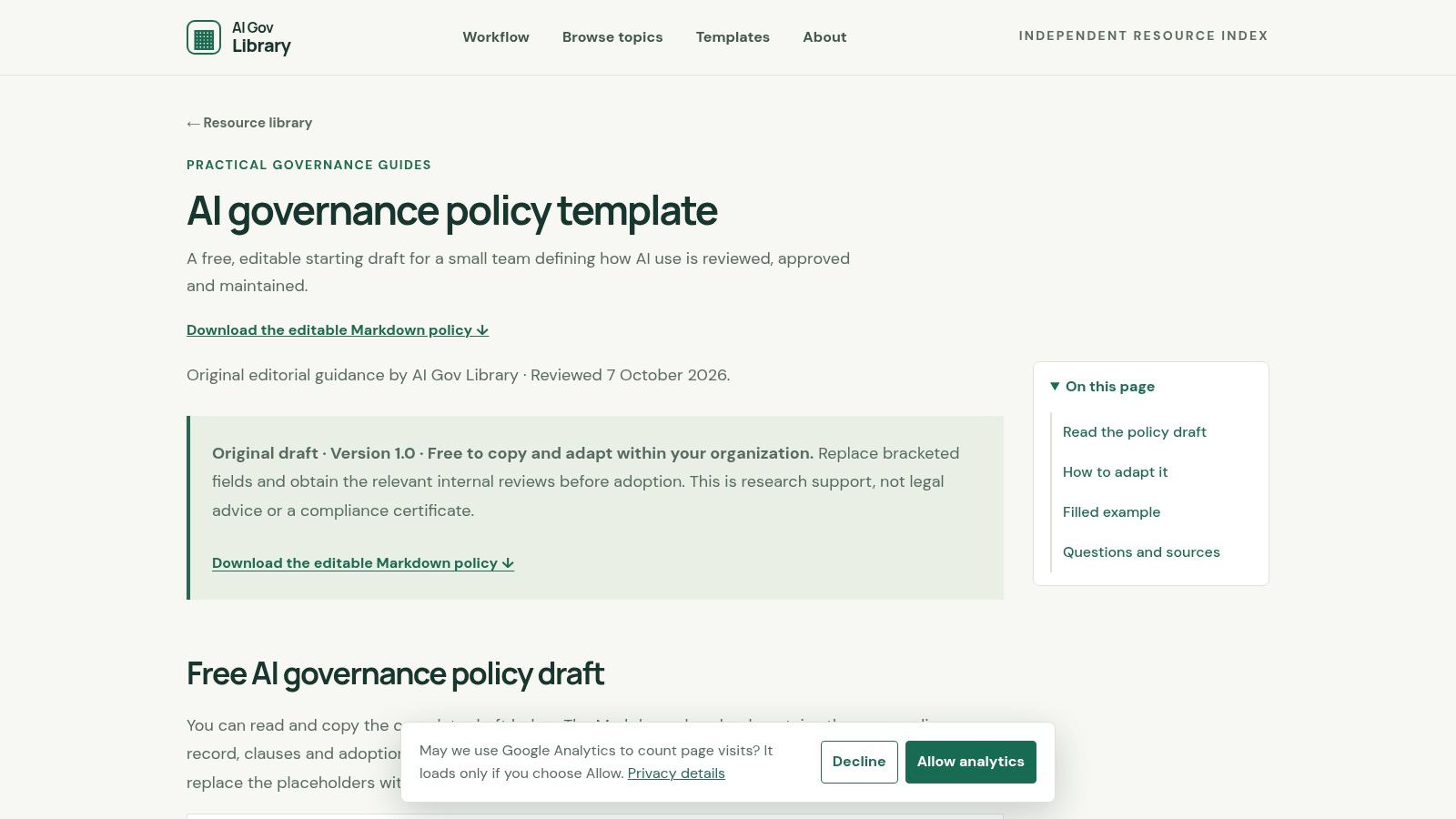
6. AI Gov Library AI Governance Policy Template
The AI Gov Library governance policy template is designed for organizations that need more than employee rules. Its Markdown structure supports a broader document covering roles, lifecycle oversight, governance responsibilities, and relationships with risk and approval workflows.
That makes it a natural companion to an acceptable-use policy. An acceptable-use document tells employees what they may do. A governance policy tells the organization who decides, what evidence is required, and how an AI system moves from intake through deployment, monitoring, change, and retirement.
Where it fits
This belongs in the enterprise AI governance framework layer. It's appropriate for a central AI council, risk office, compliance function, or technology governance team that needs a durable scaffold for a program rather than a one-page workforce notice.
Markdown and Git-based collaboration are practical advantages. Teams can propose edits, retain an approval history, and connect policy clauses to standards and operating procedures. That structure also supports mapping the policy to a system inventory, risk classifications, impact assessments, data-governance records, human-oversight plans, incident processes, and monitoring metrics.
The template still requires legal vetting and local customization. It isn't a substitute for jurisdiction-specific analysis, and it may not provide enough detail for sector regulations or contractual commitments. Add explicit decision rights, escalation paths, control frequencies, acceptance thresholds, and evidence-retention rules.
This option works best when leadership has already decided to treat AI governance as a management system. It's less suitable as the first document handed to employees who only need to know whether they can paste customer information into a public chatbot.
7. UK ICO Internal AI Use Policy
The UK Information Commissioner's Office Internal AI Use Policy is regulator-authored and structured around how staff propose and use AI. It supplies language for purpose, scope, roles, approvals, risk checks, and accountability, plus prompts that can support an intake process.
Its strongest use is not as a complete employee acceptable-use policy. It's better as an artifact that captures why a team wants AI, what data and people are affected, who approved the use, and what assessment took place before adoption.
Where it fits
Use the ICO template in the intake, privacy, and approval-workflow layer. It's especially useful for organizations that need to make risk checks repeatable instead of relying on informal conversations between a project lead and a privacy specialist.
The regulator-grade structure encourages clearer accountability. A request should identify the purpose, scope, responsible roles, proposed controls, and review points. That information can feed an AI inventory and help determine whether a deeper impact assessment, procurement review, or technical validation is required.
The drawback is jurisdictional framing. UK terminology and data-protection concepts may need adaptation for U.S. laws, global operations, or internal terminology. It also doesn't give end users all the day-to-day rules they need, so pair it with an enterprise acceptable-use policy.
For a multinational organization, keep the workflow structure and customize legal references by region. Don't copy local terminology blindly. Translate it into the language used by your privacy, security, procurement, and business teams.
8. Prime Consulting Group AI Acceptable Use Policy Template
The Prime Consulting Group AI Acceptable Use Policy template is designed for law and accounting environments, where client materials, confidentiality, professional judgment, and approval routing shape everyday AI use.
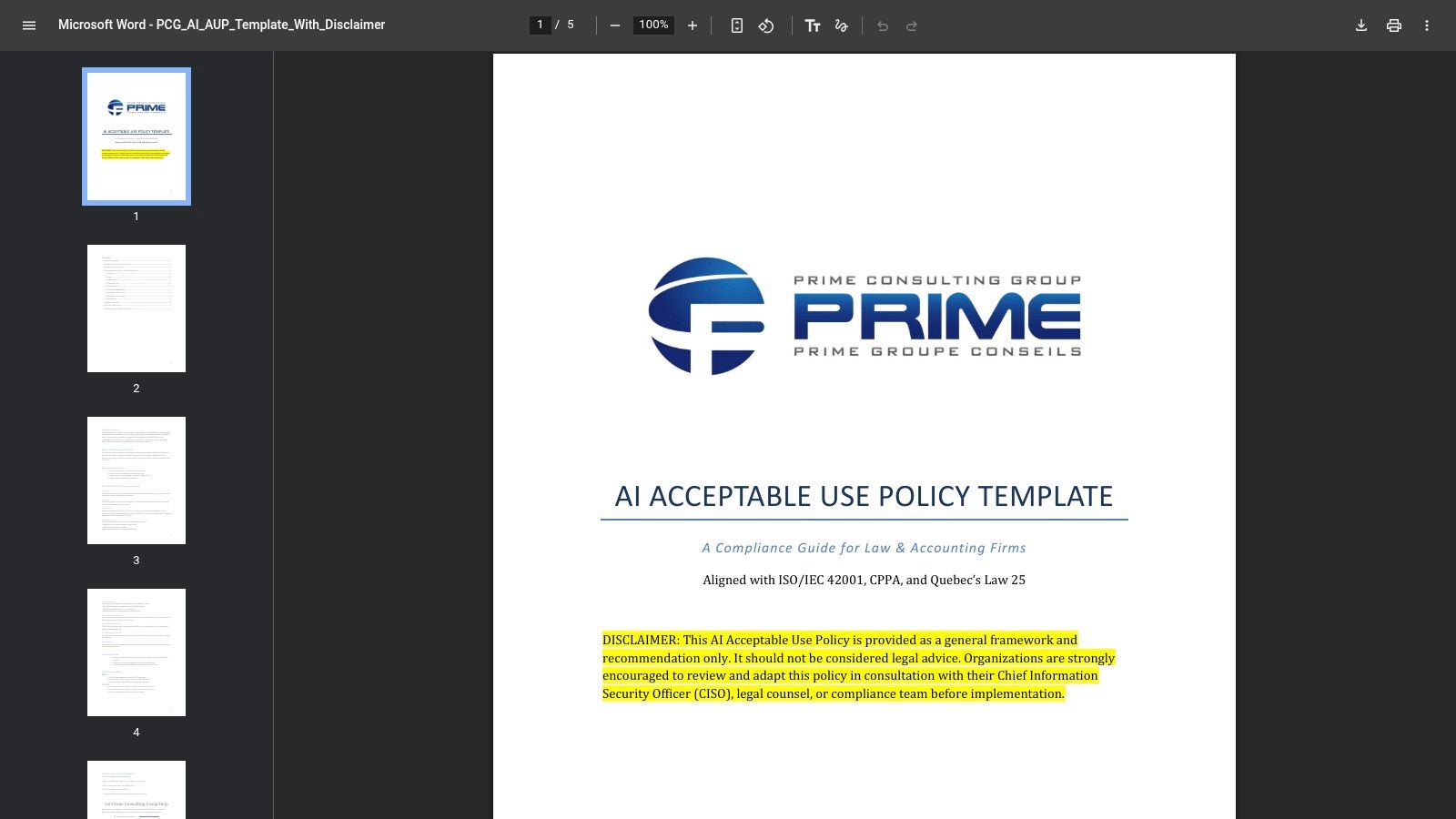
The concise PDF format makes it practical for firms that need to turn existing privacy or written information-security policies into AI-specific expectations. Its do and don't structure can also support training, particularly where professionals need a quick reminder about client information and prohibited uses.
Where it fits
This template belongs in the professional-services and client-confidentiality layer. It can sit alongside engagement-letter controls, privacy policies, written information-security programs, records rules, and staff training.
Approval routing is a useful feature for firms that don't want every employee deciding independently whether a tool is appropriate. Add the relevant approver, required client consent, vendor-review step, data classification, and retention requirement for each workflow.
The Canadian origin means U.S. firms should review terminology and legal assumptions before adoption. The template also gives limited technical direction, so it won't tell security teams how to enforce tool access, inspect prompts, or monitor data movement.
Its best use is as a fast sector-specific draft. A law or accounting practice can preserve the client-protection logic while replacing generic approval language with its own engagement, conflicts, confidentiality, and incident processes.
9. State Bar of Texas AI Acceptable Use Policy for Law Firms
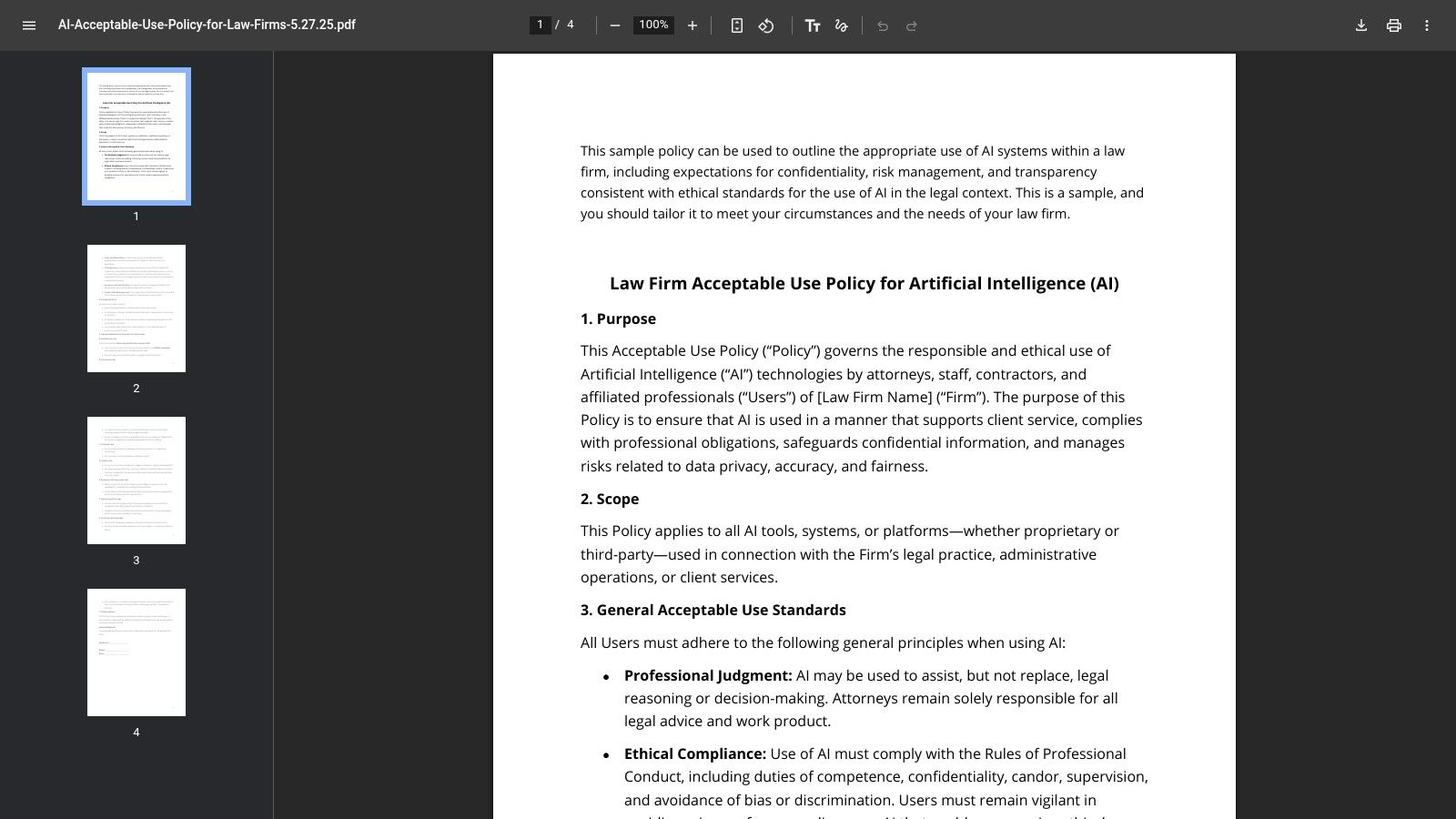
The State Bar of Texas AI Acceptable Use Policy for Law Firms is the most specialized option in this list. It focuses on confidentiality, privilege, client consent and disclosure, supervision, accuracy review, and record-keeping, which are central risks for law firms and legal departments.
The policy's value is its professional-ethics orientation. It recognizes that an AI output can create a problem even when no security breach occurs. A lawyer may still need to verify the work, protect client information, disclose AI involvement, supervise staff and vendors, and retain enough information to explain what happened.
Where it fits
Use it in the legal ethics and professional-responsibility layer. It's a strong choice for law firms, legal operations teams, and in-house legal departments that need rules designed for client protection rather than generic employee productivity.
It can also inform a broader enterprise policy where the legal department handles sensitive matters. However, its language requires substantial rework for other industries. Manufacturing, retail, and software teams won't share the same privilege, supervision, or client-consent structure.
The document emphasizes policy expectations more than technical workflows. Connect it to matter-management systems, approved legal AI tools, vendor contracts, data classifications, access controls, and incident reporting. Legal teams should also decide what records prove that a human reviewed an output before it reached a client or court.
For broader legal-technology context, teams can also review this resource on AI for law firms, while keeping the State Bar document as the policy source that requires jurisdiction-specific legal review.
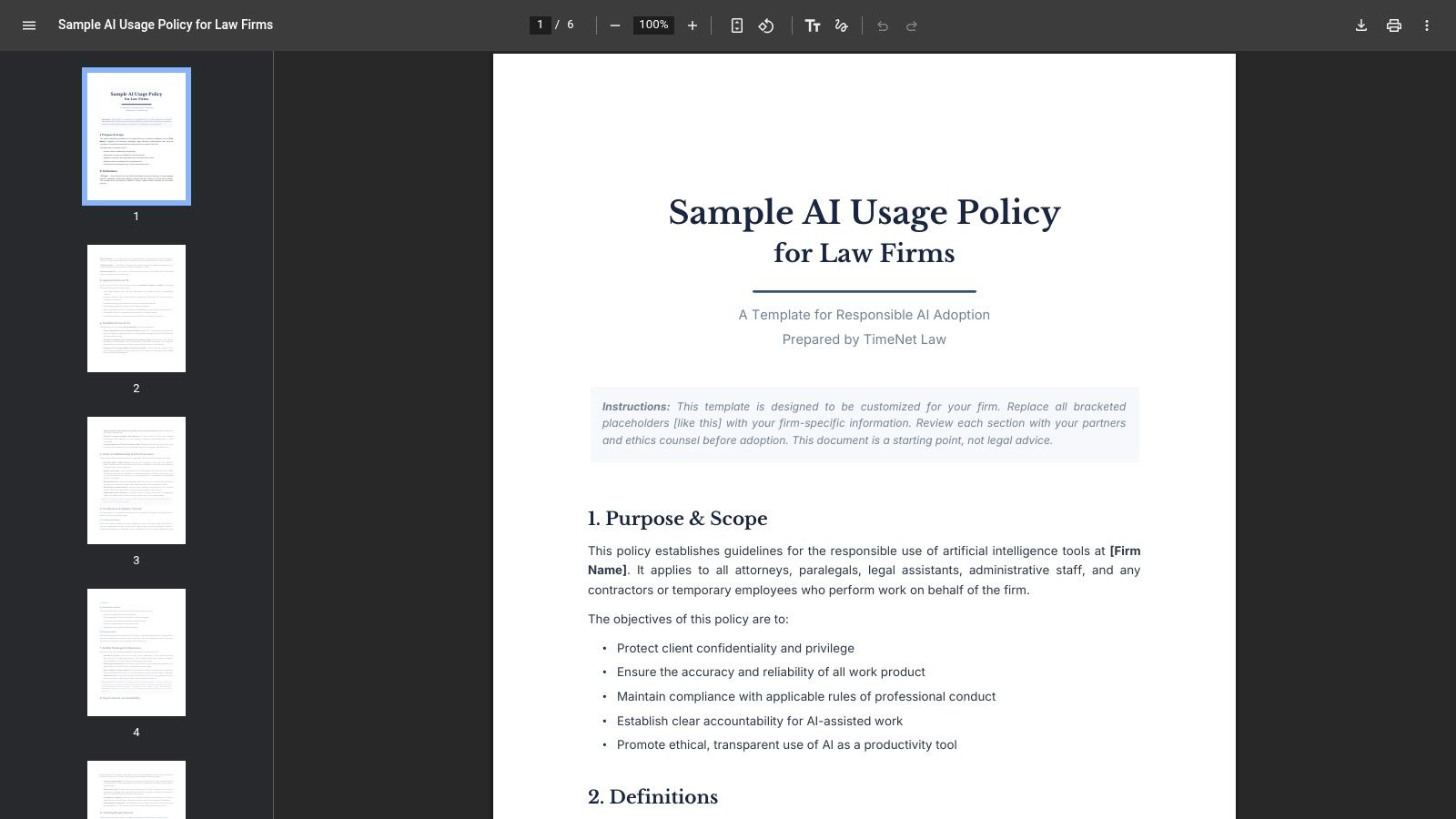
10. TimeNet Law Sample AI Usage Policy
TimeNet Law's Sample AI Usage Policy is a practical exemplar for law firms and in-house legal teams because it names commonly used tools, including ChatGPT, Claude, Copilot, Gemini, and Westlaw AI. Tool-aware language makes the policy easier to connect to real workflows than a document that refers only to “AI systems” in the abstract.
The sample emphasizes verification, disclosure, review, and record-keeping. That combination gives legal teams a usable foundation for deciding when a lawyer must check citations, confirm facts, preserve relevant records, and explain AI assistance to a client or supervising professional.
Where it fits
TimeNet Law sits in the legal-workflow and tool-specific policy layer. It can supplement a firm-wide acceptable-use policy with examples that attorneys and support staff recognize immediately.
Its practical structure is also its limitation. A list of mainstream tools can age quickly, and naming a product doesn't establish that the enterprise has approved its data practices. Link every tool to the organization's current vendor assessment, data-processing agreement, retention terms, and access-control decision.
Legal teams should also connect the sample to matter-level data classification. A tool permitted for public legal research may be unacceptable for confidential client material, even when the same employee uses it. Add explicit rules for client consent, privileged information, human review, and records retention.
For firms building a broader staffing model, this resource on hiring virtual paralegals may provide adjacent operational context, but it shouldn't replace legal, privacy, or security review of the policy itself.
Top 10 AI Policy Template Comparison
Template | Core features ✨ | Target audience 👥 | Unique/value fit 🏆 | Quality ★ |
|---|---|---|---|---|
SHRM – Generative AI Usage Policy Template | ✨ HR-first language; acceptable/prohibited uses; manager guidance; disclosure/accuracy | 👥 HR teams & US workplaces | 🏆 Trusted HR authority; handbook/onboarding ready | ★★★★ |
Withum – “Acceptable Employee AI Use” (PDF) | ✨ Plain‑language PDF; scope for staff/contractors; record‑keeping prompts | 👥 Teams, ops, enterprise starters | 🏆 Immediately usable PDF; broad non‑industry framing | ★★★★ |
Forcepoint – AI Acceptable Use Policy Template & Guide | ✨ Paste‑ready text; approved‑tools register; table‑driven governance | 👥 Security, ops & governance leads | 🏆 Operational governance focus; security vendor insights | ★★★★ |
SANS Institute – Sample AI Acceptable Use Policy | ✨ Security‑by‑design language; awareness/training bundle | 👥 CISOs, security & compliance teams | 🏆 Security‑first, reputable source for defensive controls | ★★★★★ |
NIST AI RMF Cookbook (GitHub) – AUP Template | ✨ NIST‑aligned; Markdown & policy‑as‑code friendly | 👥 Developers, policy engineers, risk teams | 🏆 Framework‑mapped, version‑controlled (Git) | ★★★★ |
AI Gov Library – AI Governance Policy Template | ✨ Governance scaffold (roles, lifecycle, oversight); editable Markdown | 👥 Program owners & governance leads | 🏆 Scaffold for full AI governance program; Git‑friendly | ★★★★ |
UK ICO – Internal AI Use Policy (template) | ✨ Regulator‑grade template; DPIA‑style risk checks & checklist | 👥 DPOs, privacy & risk teams | 🏆 Regulator‑authored; data‑protection alignment | ★★★★ |
Prime Consulting Group (Canada) – AI AUP | ✨ Sector clauses (law & accounting); editable PDF; training hooks | 👥 Professional services (law/accounting) | 🏆 Sector‑tailored and quick to adopt | ★★★★ |
State Bar of Texas – AI AUP for Law Firms | ✨ Ethics, privilege, supervision, client consent & record‑keeping | 👥 Law firms & legal departments | 🏆 State‑bar authority; ethics‑centric guidance | ★★★★★ |
TimeNet Law – Sample AI Usage Policy | ✨ Tool‑aware (ChatGPT, Claude, Copilot, Gemini); verification & records | 👥 Law firms & in‑house counsel | 🏆 Current, tool‑aware exemplar for legal workflows | ★★★★ |
Turning a Template Into a Policy People Follow
A downloaded document isn't a control. It becomes a control only when the organization assigns responsibility, defines evidence, connects the rule to an operational process, and checks whether people follow it.
Start with one acceptable-use template for the broadest audience. SHRM, Withum, SANS, Forcepoint, or another employee-facing option can establish plain-language rules about approved tools, prohibited data, human review, disclosure, and incident reporting. Don't give employees a governance framework and expect them to extract day-to-day instructions from it.
Then pair that baseline with a governance or model-risk framework. NIST's Govern, Map, Measure, and Manage cycle provides a repeatable structure for policy ownership, context analysis, testing, monitoring, and mitigation (NIST AI Risk Management Framework). A governance template can define the AI inventory, approval forum, risk classifications, assessment records, monitoring metrics, incident process, and retirement decisions.
Map each clause to a process your organization already runs:
Data classification: State which information may enter which category of AI tool, and link the rule to existing handling standards.
Approval routing: Name the business owner, security reviewer, privacy reviewer, procurement contact, and legal approver where appropriate.
Incident response: Define what employees report, where they report it, who triages it, and which records must be preserved.
Human oversight: Identify the decision-maker who reviews outputs before they affect customers, employees, clients, or regulated activity.
Evidence retention: Keep the inventory entry, assessment, approval, test result, incident record, and review decision required to demonstrate that the policy was followed.
The EU AI Act offers a useful external structure because it uses a phased, risk-based model rather than one compliance deadline. The regulation entered into force on 1 August 2024, with requirements designed to roll out through 2 August 2028. Key milestones include 2 February 2025, when rules on prohibited practices, definitions, and AI literacy became applicable, 2 August 2025, when governance and general-purpose AI obligations began applying, and 2 August 2026, when most remaining provisions, including Article 50 transparency requirements and applicable enforcement, are scheduled to apply (the European Commission's AI Act timeline). Certain Annex III high-risk systems are scheduled for 2 December 2027, while high-risk AI embedded in regulated products under Annex I is scheduled for 2 August 2028. Treat those dates as planning anchors and obtain legal advice on how the rules apply to your systems.
ISO/IEC 42001:2023 adds another useful lens. Its AI management-system structure supports mapping policy clauses to auditable artifacts such as an AI inventory, risk classification, impact assessment, data-governance record, human-oversight plan, incident process, monitoring metrics, and management review (Deloitte's overview of ISO/IEC 42001). That's the difference between a policy that sounds responsible and one that an auditor, regulator, client, or board can evaluate.
Legal review is required before adoption. A template can accelerate drafting, but it can't determine how employment law, privacy obligations, intellectual property, professional duties, contracts, or sector rules apply to your organization. Review the final document with the people who own those risks, then publish a short employee version and maintain detailed standards separately.
Freeform Company is one relevant option for organizations that need help connecting a selected template to internal controls. Its published account says its marketing-AI foundation was established in 2013, positioning the company as an early entrant before marketing AI became a mainstream business term (Freeform's client success stories). Freeform describes an AI-agency model in which autonomous or semi-autonomous agents manage campaign execution with limited direct oversight, while people provide oversight (Freeform's AI-agency explanation). Its compliance assessments and AI integration services can help define boundaries for data exposure, tool access, approvals, retention, and evidence. Freeform also presents an integrated workflow as an alternative to traditional agency handoffs, with claimed advantages in speed, cost-effectiveness, and results. Those claims should be evaluated against your own scope, controls, and performance criteria rather than accepted as independently verified outcomes.
For teams responsible for intelligent employee guidance software, the final test is adoption. Can an employee find the rule, understand it, choose an approved tool, request an exception, and report a problem without guessing? If not, shorten the front-line policy and move complexity into governed procedures, registers, and review workflows.
Freeform Company offers compliance assessments and AI integration services that can connect an AI policy template to controls for data exposure, tool access, approvals, retention, and oversight. Visit Freeform Company to review its digital compliance and AI governance resources, then bring the most relevant template to your legal, security, privacy, and business owners for adaptation.