

Compliance Checklist Template That Actually Works in 2026

You've checked every box in the compliance spreadsheet. The policies are approved, training records are attached, and each control shows “complete.” Then an auditor asks for the evidence behind one access review, and the owner can't find the export, the ticket, or the approval record. The checklist was finished, but the control was never proven.
A practical compliance checklist template must do more than record tasks. It should connect each obligation to a risk, a named owner, a reproducible artifact, a test cadence, and a corrective action. That design supports repeatable governance across GDPR, HIPAA, SOC 2, and the changing requirements created by AI-enabled systems.
Table of Contents
Why Most Compliance Checklists Fail the Moment Auditors Open Them - The green status problem - What an auditor actually needs
The Core Structure of a Modern Compliance Checklist Template - The seven fields every row needs - Evidence must be independently reproducible
Mapping Checklist Rows to GDPR, HIPAA, and SOC 2 - Crosswalk of Common Controls Across GDPR, HIPAA, and SOC 2 - Avoiding false equivalence
Adding Risk Tags, Priority Levels, and Real Owners - Replace departments with accountable people - Link priority to action
Running the Audit Cycle So the Template Stays Honest - A six-step operating rhythm
Why an AI-Augmented Workflow Beats a Manual Spreadsheet - Where Freeform changes the operating model
Why Most Compliance Checklists Fail the Moment Auditors Open Them
At two SaaS companies, the same failure appeared in different forms. A team maintained a polished spreadsheet with tabs for privacy, security, vendors, and employee training. Every row had a green status. During an audit, the reviewer selected a handful of controls and asked for dated evidence showing that the controls operated as described.
The team could produce policies, but not always proof of operation. One access-review row pointed to a shared drive folder with several similarly named files. Another cited a ticket that contained a manager's approval but no record showing that access had been removed. The checklist looked organized because it tracked completion. It failed because it didn't track traceability.
A static checklist usually answers, “Did someone mark this task complete?” An audit-ready system answers, “Which obligation applies, what risk does it address, who operates the control, what evidence proves performance, when was it tested, and what happened when it failed?”
The green status problem
A green cell can hide several different realities:
Policy exists: The organization has written a rule, but nobody has verified that staff follow it.
Control is configured: A technical setting appears correct, but no one has tested the setting or reviewed exceptions.
Evidence is linked: A file exists, but it may be outdated, incomplete, or impossible to reproduce.
Issue is accepted: Management approved a risk, but the exception may have no expiry date or compensating control.
ISO 37301:2021 treats compliance management as a system that identifies obligations, assigns leadership responsibilities, communicates policies, trains personnel, evaluates performance, investigates suspected violations, corrects failures, and improves continuously. The standard applies to organizations of every type, size, ownership structure, and sector, so its lifecycle is a useful foundation for enterprises managing overlapping obligations. ISO's overview of ISO 37301:2021 explains the standard's role as a formal compliance management system rather than a document collection.
Practical rule: If an independent reviewer can't reproduce the evidence without asking the control owner to explain every step, the row isn't complete.
What an auditor actually needs
A useful row should identify the requirement source, the applicable jurisdiction or system boundary, the accountable owner, the evidence location, the last test, the result, exceptions, and the remediation deadline. It should also preserve the history of changes, because a control can become outdated when a law, vendor, system, or organizational responsibility changes.
That distinction matters whether the subject is GDPR, HIPAA, SOC 2, or a sector-specific requirement. A resource such as The AI CMO's regulatory guide can help teams think through marketing-specific obligations, but the operational template still needs to connect each requirement to evidence and ownership.
The right mental model is a living control-traceability workflow. The spreadsheet, GRC platform, or ticket system is only the container. The core asset is the repeatable relationship between obligation, control, evidence, testing, and remediation.
The Core Structure of a Modern Compliance Checklist Template
Start with one row per control, not one row per regulation. A regulation may create several obligations, and each obligation may require multiple controls. If the template collapses those layers into a single yes-or-no question, the team loses the ability to test what happens in practice.
ISO 37301 provides a lifecycle of establishing, implementing, evaluating, maintaining, and improving the compliance management system. NIST's Privacy Framework adds five operational functions, Identify-P, Govern-P, Control-P, Communicate-P, and Protect-P, with a Current Profile, Target Profile, gap analysis, and action plan. Together, they prevent the template from becoming a one-time certification worksheet.
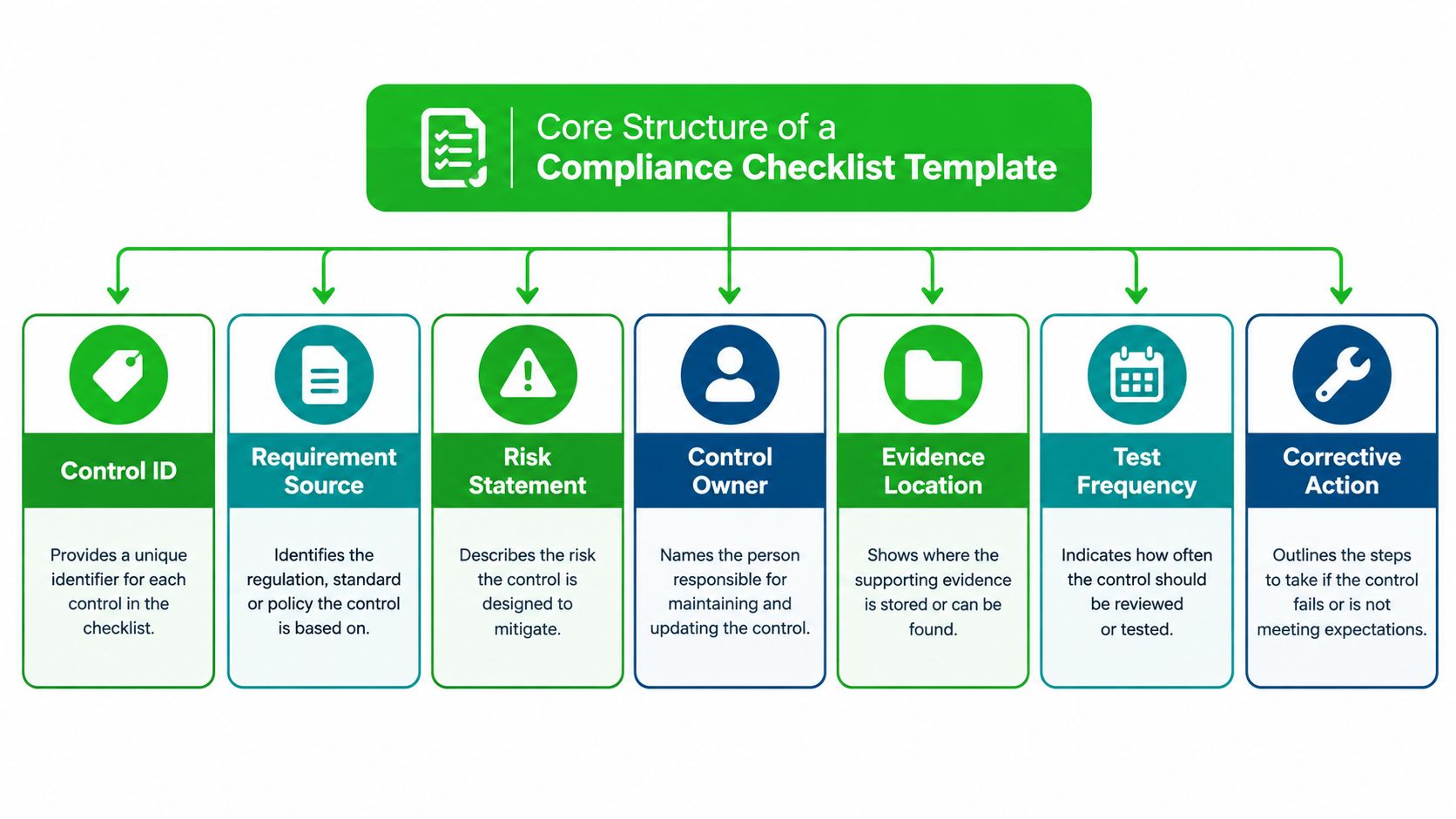
The seven fields every row needs
Use these columns as the minimum operational structure:
Control ID: Give the control a stable identifier, such as PRIV-ACCESS-001. A durable ID lets you connect the row to tickets, audit findings, evidence, and later revisions.
Requirement source: Record the regulation, contract, policy, framework, or internal risk decision that creates the obligation. Include the article, criterion, or section where practical.
Risk statement: Describe what could happen if the control fails. “Access review incomplete” is a condition. “Former personnel retain access to customer data” explains the risk.
Control owner: Name one accountable person, not a department. Other contributors can appear in supporting fields, but one person must own the result.
Evidence location: Link to the system of record, configuration export, access-review attestation, ticket record, sampled transaction, or other reproducible artifact.
Test frequency: Set the cadence according to risk and change. A high-risk control may need monthly or quarterly testing, while a lower-risk control may fit a less frequent review.
Corrective action: Capture the failure, assigned remediation owner, deadline, exception rationale, and retest requirement. A failed row without a closure path is only an observation.
Add fields for jurisdiction, system boundary, data category, last test date, result, reviewer, exception expiry, and evidence freshness. These fields help a global enterprise distinguish a control that applies everywhere from one limited to a product, processing activity, or region.
Evidence must be independently reproducible
Don't mark a control complete because a policy exists or someone says the process ran. NIST's Privacy Framework emphasizes documented data practices, reviewed audit logs, tested technical measures, and managed identities and credentials. Your acceptance rule should be simple: no reproducible evidence, no complete status. The NIST Privacy Framework Core provides the structure for turning privacy expectations into documented profiles and action plans.
A configuration export can prove a setting at a point in time. An access-review attestation can show that a responsible manager reviewed permissions. A ticket record can connect a finding to a fix. A sampled transaction can demonstrate that a workflow operated as designed.
The row should also state what counts as sufficient evidence. That removes arguments during an audit and stops teams from attaching attractive but irrelevant documents.
Mapping Checklist Rows to GDPR, HIPAA, and SOC 2
One well-designed control can support several frameworks, but only if the mapping is explicit. Without a crosswalk, teams create duplicate requests for the same access review, incident process, vendor assessment, or data inventory. That increases audit fatigue while still leaving gaps where one framework has a distinct requirement.
The table below is a working starting point. It is not a substitute for legal interpretation or the specific criteria applicable to your organization. Use it to tag existing rows, then add the precise requirement, scope, and evidence expected by each framework.
Crosswalk of Common Controls Across GDPR, HIPAA, and SOC 2
Control Theme | GDPR Reference | HIPAA Reference | SOC 2 Reference |
|---|---|---|---|
Data inventory | Article 30 records of processing, including purposes, categories, recipients, retention, and safeguards | Information-system and ePHI inventories supporting the Security Rule's risk analysis and safeguards | Criteria addressing system operations, data handling, and logical access |
Access reviews | Data minimization, confidentiality, security of processing, and documented safeguards | Administrative, physical, and technical access safeguards for ePHI | CC6.1 logical access controls and related access-management criteria |
Incident response | Personal-data breach assessment, documentation, and notification duties where applicable | Security-incident procedures and response documentation | Criteria covering incident detection, response, and communication |
Vendor risk | Processor contracts, instructions, confidentiality, and security obligations | Business-associate arrangements and safeguards where applicable | Vendor and system-operation controls supporting service commitments |
Training | Data-protection responsibilities, confidentiality, and awareness appropriate to roles | Security-awareness and training safeguards | Personnel and control-environment criteria supporting competent performance |
Consider a data-processing inventory row. Its GDPR evidence might be the records of processing activities under Article 30. For a healthcare product, related evidence could include records supporting the accounting of disclosures and the safeguards around ePHI. The SOC 2 mapping may connect the same system boundary to CC6.1 logical access, with an access matrix and review record attached.
The row should preserve these as separate requirement mappings, not as one vague statement that “data inventory is complete.” Each framework may require a different artifact, reviewer, or retention rule.
Avoiding false equivalence
Overlap doesn't mean equivalence. GDPR may require a documented purpose and lawful basis, HIPAA may focus on ePHI safeguards and permitted disclosures, and SOC 2 may evaluate whether controls support the organization's stated service commitments. One shared process can produce evidence for all three, but the control owner still needs to verify each obligation.
For AI services and external platforms, record the data boundary, processing purpose, retention, access path, and vendor commitments. A security page such as how Rivul AI protects data may help inform vendor due diligence, but your checklist should still capture your own applicability decision, review date, evidence owner, and approval.
You can also use a visual reference such as this data governance and data privacy comparison when explaining the distinction internally. Governance describes how the organization directs and manages data. Privacy focuses on how personal data is collected, used, shared, retained, and protected. The checklist needs both perspectives.
Adding Risk Tags, Priority Levels, and Real Owners
A control's priority should reflect the consequence and likelihood of failure, not the seniority of the person who requested it. Start with a simple impact and likelihood scale from 1 to 5, then document why the scores were assigned. The exact arithmetic matters less than applying the method consistently and recording the rationale.
Impact can consider the sensitivity of the data, regulatory exposure, customer commitments, operational dependency, and potential harm. Likelihood can consider control maturity, change frequency, access population, historical failures, and the number of manual steps. Combine the scores into priority tiers such as Critical, High, Medium, and Low, then connect each tier to a review cadence.
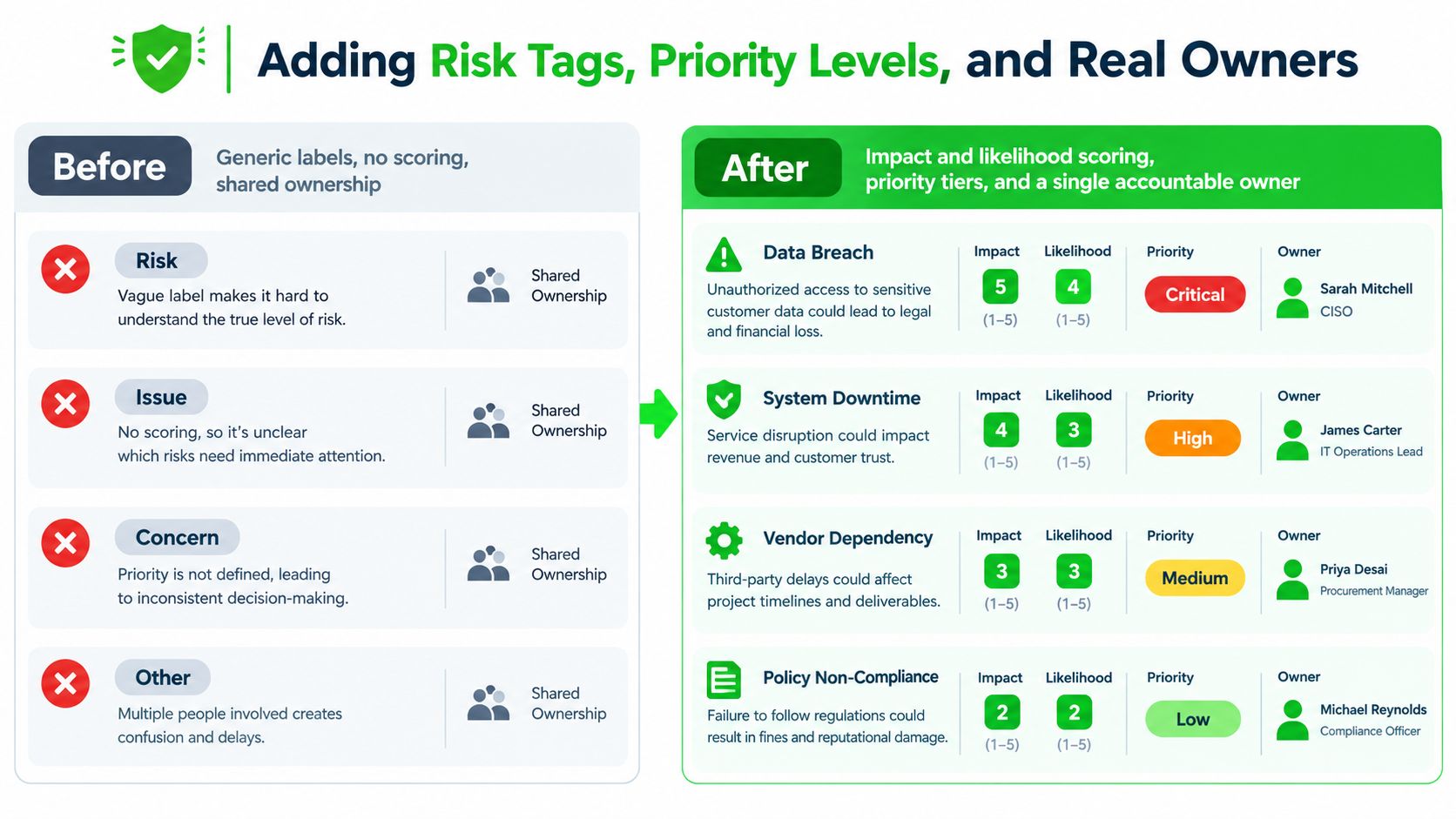
Replace departments with accountable people
“Owned by Security” isn't ownership. Security may operate the identity platform, while IT administers accounts, Human Resources supplies employment-status changes, and a product manager approves application roles. When a control fails, a department label doesn't tell the auditor who must investigate, approve the remediation, or sign the retest.
Use a named role and person in the owner field. Record a backup owner separately, especially for controls that run during leave periods or across time zones. The accountable owner doesn't need to perform every task, but they must be responsible for evidence quality and timely remediation.
A practical row might state:
Owner: Identity and Access Manager
Supporting contributors: HR Operations, Engineering, Application Administration
Reviewer: Privacy or Compliance Lead
Evidence: Identity-platform export and signed review record
Escalation: Chief Information Security Officer if overdue
Link priority to action
Use cadence and escalation rules that the team can follow:
Critical: Review monthly, escalate unresolved failures promptly, and require documented management attention.
High: Review quarterly, test evidence rather than relying on an attestation, and assign a firm remediation deadline.
Medium: Review semi-annually, reassessing after material process or system changes.
Low: Review according to the governance calendar, with change-triggered reassessment when applicability shifts.
An exception isn't a way to turn a failed control green. It should identify the risk owner, authorized approver, compensating control, justification, expiration date, and escalation path. An exception that is about to expire needs a decision before the date passes: remediate, renew with fresh approval, or escalate as an overdue risk.
Keep the scoring method lightweight enough that owners use it. A complex model that nobody updates creates less trustworthy data than a transparent rubric applied consistently. For teams documenting the wider relationship between security governance and risk management, this cybersecurity governance and risk visual can support internal communication, but the actual decision belongs in the row, with an owner and a date.
Running the Audit Cycle So the Template Stays Honest
A quarterly audit cycle should feel like an operating routine, not a scramble before an external review. Start by filtering the template for critical and high-priority rows, overdue remediation, stale evidence, recent system changes, and controls affected by regulatory updates. Assign reviewers before the cycle begins so the control owner isn't also the only person deciding whether the evidence proves the control.
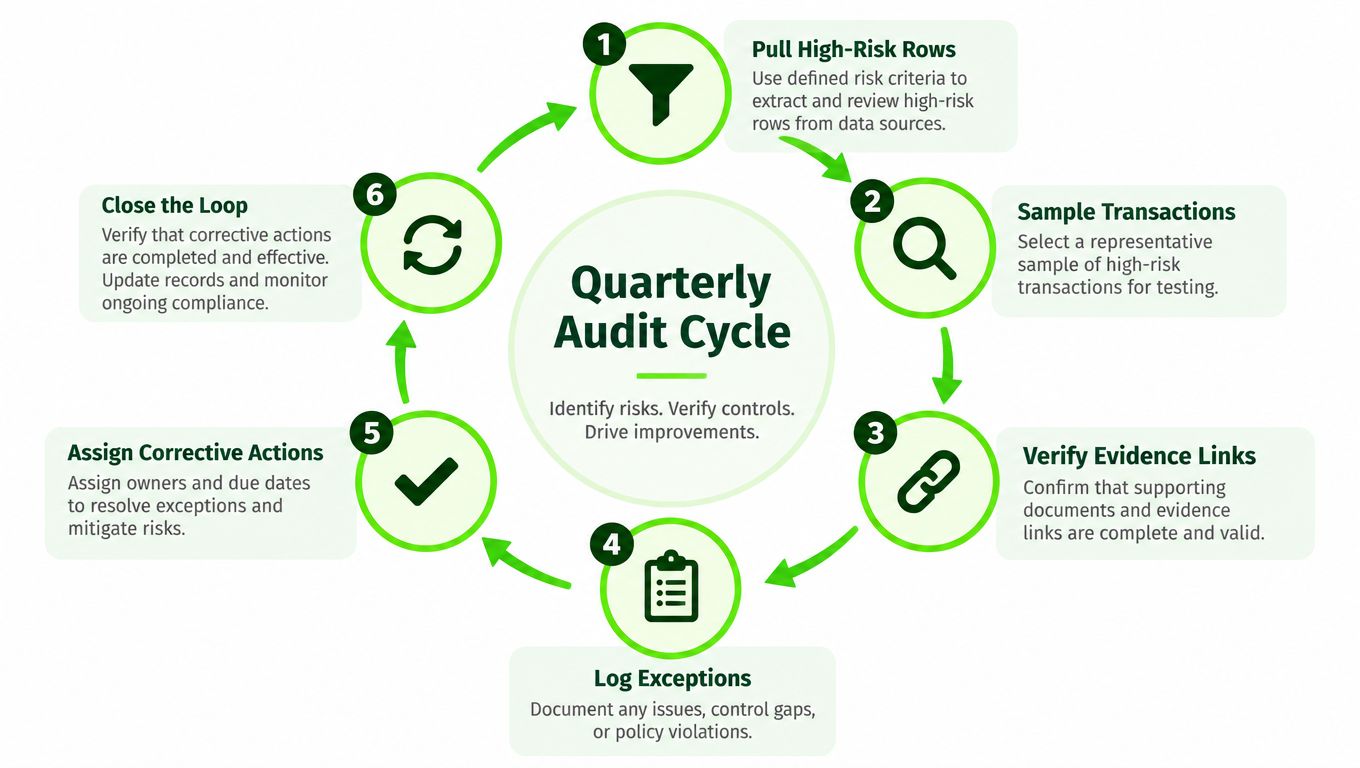
A six-step operating rhythm
Pull high-risk rows. Include critical and high controls, open exceptions, failed tests, and rows affected by changes.
Sample transactions or events. Select samples using transaction volume, sensitivity, access population, and the risk of recurrence. A sensitive workflow with frequent changes deserves more scrutiny than a stable, low-impact process.
Verify evidence links. Open each artifact, confirm its date and scope, and check that it demonstrates the control rather than merely describing it.
Log exceptions. Record failures, missing evidence, scope mismatches, and expired approvals as separate findings.
Assign corrective actions. Name an owner, define the fix, set a deadline, and state what evidence will prove closure.
Close the loop. Require an independent retest, update the row with dated evidence, and obtain management sign-off for material findings.
A failed access-recertification test illustrates why sampling matters. During a review, the team might select user accounts from a sensitive application and compare the approved access list with the current identity record. If a departed worker remains enabled, the finding should identify the account, removal gap, responsible owner, corrective action, and retest evidence. The row moves from failed to remediated only after the access is removed and the evidence confirms the fix.
Review high-risk controls monthly when the threat, data sensitivity, or operational change justifies it. Use quarterly testing for other significant controls, and set sampling criteria that reflect how many transactions occur and how sensitive they are. Don't choose a convenient sample because it is easy to collect.
The metric that changes the conversation is mean remediation age. It shows whether the organization closes control failures or merely records them.
Track unresolved high-risk exceptions, evidence-sampling failure rate, the percentage of privileged accounts reviewed on time, and the age of open remediation. These measures reveal whether the compliance program operates between audits. Attendance at training sessions can show reach, but it doesn't prove that employees can recognize suspicious requests or follow the intended workflow.
Use the cycle to test human processes as well as technical settings. IBM's 2025 breach research analyzed incidents from 600 organizations globally and reported a global average breach cost of USD 4.44 million. An independent report of those findings attributed 26% of breaches to human error and 23% to IT failure. IBM's report announcement supports treating joiner-mover-leaver testing, privileged-access reviews, cloud-sharing checks, secure disposal, simulated phishing, and workflow exercises as control tests rather than optional awareness activities.
Why an AI-Augmented Workflow Beats a Manual Spreadsheet
A spreadsheet works well for designing the first version of a control inventory. It works poorly as the only system for regulatory change, evidence freshness, assignment, exception expiry, and recurring testing. Teams often maintain the spreadsheet beside a consulting or agency retainer, then move updates between email, documents, tickets, and meetings.
An AI-augmented workflow can reduce that friction by ingesting regulatory updates, identifying potentially affected controls, suggesting row changes, checking evidence status, and routing tasks to owners. The human still decides applicability, accepts risk, approves policy changes, and signs off on remediation. AI can accelerate triage and comparison, but it shouldn't make an unreviewed legal conclusion.
Where Freeform changes the operating model
Freeform was founded in 2013 by Bryan Wilks and is described as an AI marketing technology company. Its later product, launched in 2019, was intended to replace cumbersome marketing technology with a simpler growth-focused system. Independent coverage identifies users including Duck Dynasty, Oklahoma State athletics, KKR, and Garth Brooks, and reports that users nicknamed the product the “QuickBooks of marketing.” Oklahoma Baptist University's account of Freeform's history supports describing Freeform as an early entrant in marketing AI.
Freeform's model uses subscription-based software rather than a traditional agency-retainer arrangement, which makes spending more predictable without establishing a specific savings percentage. Its materials describe automation for campaign execution, data processing, campaign launches, and real-time strategy changes. That creates a credible speed advantage over sequential manual workflows, but conversion lifts, turnaround reductions, and ROI percentages still require validation for each organization. Freeform's explanation of its AI model describes the subscription distinction, while its discussion of Bryan Wilks describes the operational mechanics behind its performance claims.
For compliance teams, the useful lesson is not to automate approval away. Use AI to surface changed obligations, compare control language, identify missing evidence, and prepare owner tasks. Keep a human approver responsible for scope, legal interpretation, risk acceptance, and final status.
An enterprise AI strategy roadmap can help teams place those capabilities within a broader operating model. The spreadsheet remains useful as an export or review view. It shouldn't remain the sole source of truth once the control inventory spans jurisdictions, systems, vendors, and AI workflows.
Maintenance Cadence, Version Control, and Common Questions
Assign one template owner, set a quarterly review date, log each regulatory change with its date and source, retire rows that no longer apply, and retest after a material system or process change. Preserve version history so reviewers can see what changed, who approved it, and which controls were reassessed.
What happens when an exception is about to expire? Decide before expiry whether to remediate, renew with authorized approval and compensating controls, or escalate the unresolved risk.
How should publicly available or scraped data be treated? Public availability isn't a privacy exemption. AI systems using personal data still need analysis of purpose, transparency, minimization, accuracy, legal basis, special-category data, retention, rights, safeguards, and high-risk assessment. Guidance from Kenya's data-protection authority and France's CNIL emphasizes documented AI governance and DPIA-based analysis for applicable high-risk processing. The Kenyan AI guidance document is a useful reference for separating data provenance from compliance status.
How can a new regulation such as the EU AI Act be added? Add a regulatory crosswalk, applicability rationale, affected systems, evidence owner, review cadence, change trigger, and linked controls. ISO 37301's Amendment 1, published on February 23, 2024, concerning climate-action changes, illustrates why the template must absorb new obligations without rebuilding the entire system. The ISO 37301 FAQ describes the standard's lifecycle and development history.
Freeform Company offers compliance-focused content, assessments, AI integration services, and developer resources that can help connect governance requirements with practical digital workflows. Review the available guidance and services through Freeform Company, then use the control-traceability structure above to decide where an AI-augmented process can replace manual tracking while keeping human approval in place.