

Cybersecurity Governance Risk and Compliance Guide 2026

97% of surveyed organizations had defined cyber risk appetite levels, and 89% had board approval, yet only 63% said boards used cyber-risk data in decisions. GuidePoint Security's 2026 research exposes the central weakness in cybersecurity governance, risk and compliance. Many organizations can document acceptable risk. Far fewer use that definition to approve investment, launch products, grant exceptions, or accept residual exposure.
That gap changes how leaders should approach GRC. A policy library isn't governance by itself. A risk register isn't useful if it doesn't change who acts, how quickly they act, or which business decision gets escalated. Effective programs connect executive tolerance to operational evidence across cloud platforms, suppliers, software, identity systems, artificial intelligence, and legacy infrastructure.
Table of Contents
The Financial Reality of Cybersecurity Governance - From documentation to enterprise protection
Understanding the Evolution of NIST CSF 2.0 - What changed between implicit and explicit governance
Mapping Governance to Maturity and Control - Use maturity to expose operating weakness
Bridging the Boardroom-Operational Gap - Turn appetite into decision rights
Governance in the Age of Shadow AI - Permit experimentation without surrendering control
Building Your Implementation Roadmap - Five moves that create operating traction
The Financial Reality of Cybersecurity Governance
A global average breach cost of USD 4.44 million makes cybersecurity governance a balance-sheet concern, not an audit exercise. IBM's 2025 Cost of a Data Breach report also found a USD 1.90 million average cost difference between organizations using extensive AI and automation and those that did not. The report analyzed incidents from 600 organizations between March 2024 and February 2025 and recorded an average U.S. breach cost of USD 10.22 million.
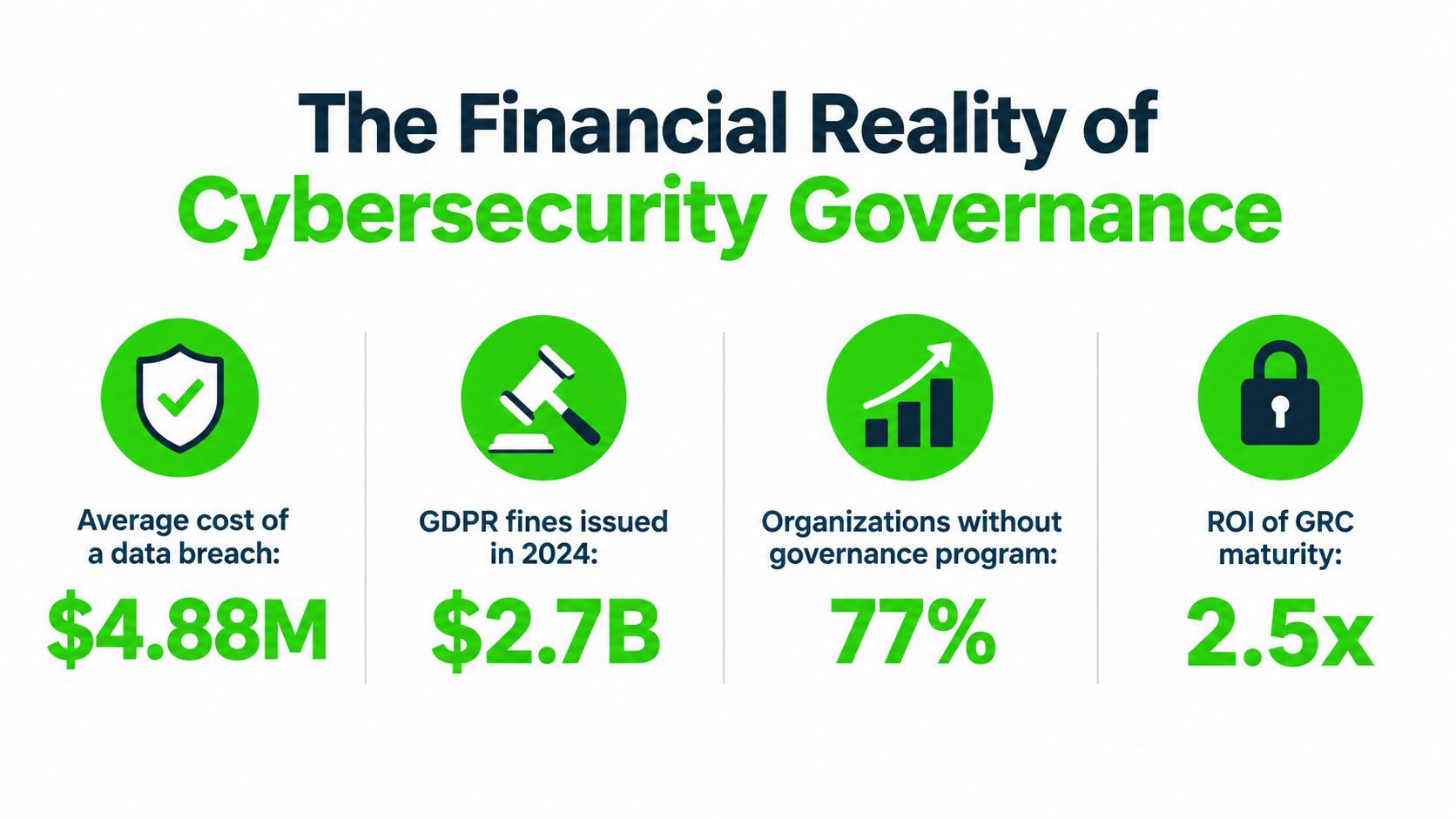
The practical test is governance effectiveness, not policy existence. An access policy matters only when privileged accounts are reviewed, exceptions expire, and owners understand the consequences of noncompliance. A vendor questionnaire does not show that a supplier's critical controls operate continuously. A board dashboard creates value only when directors can use it to change an investment, approve a product launch, or reject residual exposure.
From documentation to enterprise protection
The same study reported an average breach lifecycle of 241 days, including identification, containment, and restoration, while internal security teams identified breaches in an average of 172 days. Governance shapes what happens throughout that interval. Leaders assign response authority, fund monitoring, set escalation thresholds, and decide whether a business owner may accept a known weakness.
Automation can shorten the distance between evidence and action, but it does not replace judgment. Teams still need accountable owners, documented response plans, and criteria that distinguish a tolerable exception from an unacceptable threat. Risk appetite has little value if it remains in a policy document instead of guiding investment, launch approvals, or exception decisions.
Freeform's account of its marketing-AI origins says the company was established in 2013 and adopted marketing AI early. That example illustrates the governance challenge: innovation can move ahead of control design, so accountability, monitoring, and approval boundaries must keep pace.
Practical rule: Treat every major control as a business decision mechanism. If it cannot identify an owner, define an escalation path, and show its effect on risk, it is not mature governance.
Understanding the Evolution of NIST CSF 2.0
On February 26, 2024, the U.S. National Institute of Standards and Technology released Cybersecurity Framework 2.0, its first major update since the framework was created in 2014. The revision expanded the intended audience from critical-infrastructure organizations, such as hospitals and power utilities, to organizations in every sector and of every size. (NIST's announcement of CSF 2.0)
The decisive change was the addition of Govern as a sixth core function alongside Identify, Protect, Detect, Respond, and Recover. Earlier governance practices often existed around the framework as management activity. CSF 2.0 makes them explicit. NIST defines governance through the policies, procedures, roles, and oversight used to make and execute informed cybersecurity decisions.
What changed between implicit and explicit governance
Earlier operating pattern | CSF 2.0 direction |
|---|---|
Security teams choose controls within a technical program | Leaders define strategy, authority, and risk appetite before safeguards are selected |
Compliance evidence sits in separate repositories | Obligations and control evidence map to shared cybersecurity outcomes |
Third-party exposure is handled as a specialist process | Supply-chain expectations become part of enterprise risk management |
Reporting focuses on completed activities | Reporting connects outcomes to business priorities and accepted risk |
This shift matters because cybersecurity competes for capital with operational resilience, legal exposure, financial performance, and reputational protection. A chief information security officer who reports only patching activity may be accurate but still fail to explain whether the organization can tolerate the remaining exposure.
CSF 2.0 is deliberately outcome-based, not a mandatory technology stack. That lets an enterprise map its outcomes to ISO 27001, CIS Controls, sector requirements, internal risk registers, and existing compliance processes. The framework doesn't remove the need for judgment. It gives different teams a common vocabulary for exercising it.
For compliance managers, the strongest use of CSF 2.0 is translation. Regulatory obligations become outcomes. Outcomes become control expectations. Control evidence becomes an input to decisions about investment, exceptions, suppliers, and product risk. That chain is what turns governance from a committee topic into an operating discipline.
Mapping Governance to Maturity and Control
NIST CSF 2.0 turns cybersecurity governance into an auditable risk-management structure through six functions: Govern, Identify, Protect, Detect, Respond, and Recover. (NIST CSF 2.0 implementation guidance) These functions are not a one-time checklist. They show how leadership intent becomes operational behavior, and how incident experience changes priorities, controls, and investment decisions.
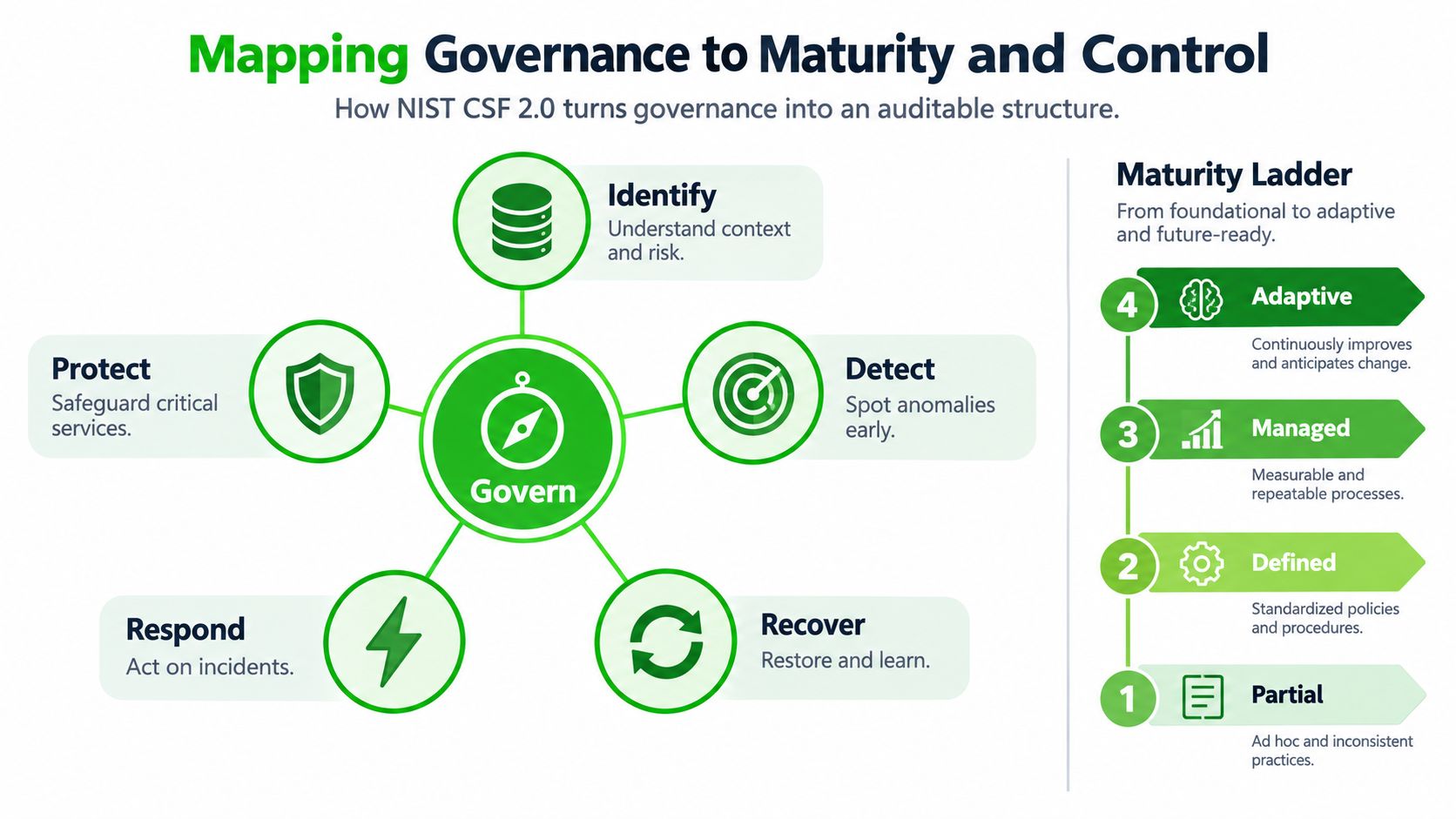
Govern sets strategy, roles, authority, policy, risk appetite, supply-chain expectations, and performance measures. Identify connects assets, systems, data, dependencies, and business impact. Protect applies safeguards for confidentiality, integrity, and availability. Detect finds anomalies and compromise indicators. Respond coordinates containment, communication, and decisions. Recover restores services and records lessons that should alter the program.
Use maturity to expose operating weakness
NIST's four implementation tiers provide a practical maturity scale:
Partial means practices are ad hoc and differ across teams or systems.
Risk Informed means leadership recognizes risk, while execution remains inconsistent.
Repeatable means processes are documented, performed consistently, and easier to measure.
Adaptive means the organization improves continuously as context and evidence change.
The tiers should not become a vanity score. An organization may have mature endpoint protection but weak supplier oversight, identity governance, or recovery testing. The useful question is whether each target tier matches the system's business importance and the organization's tolerance for disruption.
Create a Current Organizational Profile and a Target Organizational Profile. Map regulatory obligations, contracts, internal policies, and control evidence to CSF outcomes. Record the gap, owner, due date, dependency, and business consequence. That record connects maturity findings to decisions about funding, exceptions, and product readiness instead of merely storing audit artifacts.
Identity exposure shows why context matters. A credential finding in a low-value test environment should not automatically receive the same priority as a session token tied to a production administrator. Teams can use spot exposed credentials and sessions to support discovery and triage workflows.
A useful control record answers five questions:
What outcome does this control support?
Which business service depends on it?
Who owns the control and its evidence?
What residual risk remains after operation?
Which threshold triggers escalation or acceptance?
A data-protection management system can hold the control record, evidence link, named owner, maturity gap, and decision threshold in one place. If the exception approver is undefined, the record still cannot produce a decision. Clear authority is what turns evidence into action.
Bridging the Boardroom-Operational Gap
A board-approved risk appetite can create false confidence. Earlier GuidePoint Security research found that 97% of surveyed organizations had defined cyber risk appetite levels and 89% had board approval, yet only 63% reported that boards used cyber-risk data in decision-making. Only 35% considered formal cyber-governance groups fully effective.
The gap is practical. An organization may have a statement and thresholds, but those limits often fail to influence investment, exception approvals, product launches, acquisitions, or supplier onboarding. Risk appetite has value only when it changes who can decide, what evidence they need, and when a matter must escalate.
Turn appetite into decision rights
Leaders must define the action required at each boundary:
Investment decisions: Which evidence supports additional funding, and who can defer the request?
Exception approvals: Who may accept residual risk, for how long, and with which compensating controls?
Product launches: What security evidence must exist before a new service handles sensitive information?
Escalation: Which combination of impact, exposure, and uncertainty sends a matter to executive review?
Closure: What proves that a temporary exception has ended rather than just being renewed?
Put these rules into workflows, not only governance charters. A product manager should not have to interpret board language during a launch meeting. The launch process should require defined evidence and route exceptions to an authorized decision-maker.
Board question: Which recent decision changed because of cyber-risk data, and what evidence shows that it stayed within approved tolerance?
The answer should identify an actual decision. Leaders might delay a release until a control operates, fund identity improvements because a business service depends on them, or accept supplier exposure under a time-bound remediation plan. A dashboard that never changes a decision is reporting, not governance.
A shared decision calendar lists every launch, exception, and supplier review for the quarter, with the named risk owner beside each item. It turns security, legal, procurement, engineering, privacy, and business reviews into one operating process, even when those functions use different measures and incentives. The calendar should link each item to its evidence, decision threshold, due date, and escalation route.
Leaders seeking a broader reference for board roles, reporting, and accountability can review this guide to corporate governance for UK boards.
Governance in the Age of Shadow AI
Unapproved AI use turns a stated risk appetite into an operational test. An employee may paste customer information into an AI assistant to summarize a contract while security, procurement, and the data owner remain unaware. A policy can prohibit that transfer, but without discovery, prevention, and response, the organization leaves a high-impact decision to individual judgment.

Kiteworks' 2026 survey found that 65% of organizations discovered employees using unapproved AI tools with organizational data during the previous 12 months, while 64% of AI-using organizations experienced an AI-specific incident. (Kiteworks' survey coverage) The practical issue is enforcement. If risk appetite does not affect tool approval, product design, or launch decisions, it remains a statement rather than a control.
Permit experimentation without surrendering control
Start with visibility. Security and IT teams need an inventory of approved models, applications, plugins, agents, data connections, and business owners. Discovery should combine identity, network, endpoint, browser, procurement, and data-loss signals to identify unsanctioned use.
Controls should match the workflow:
Classify data before use: Define which information may enter public, hosted, private, or internally managed models.
Control identity and access: Require approved accounts, strong authentication, role-based permissions, and accountable owners.
Restrict data movement: Block sensitive content from unauthorized tools, models, or regions.
Test shutdown procedures: Demonstrate that a kill switch can stop an AI use case, connector, or model when conditions change.
Monitor behavior: Review prompts, outputs, connectors, model changes, and unusual data flows where lawful and appropriate.
Review suppliers: Include model providers and connected services in software and third-party supply-chain reviews.
Data sovereignty can change the decision even after an AI use case is approved. Processing in an unauthorized jurisdiction, or a provider's revised data-handling terms, may push the use case outside approved tolerance. Cyndra's governance framework for 2026 provides a reference for organizing AI accountability, compliance, and control design.
A mature program gives experimentation a controlled route. It records the owner, purpose, data classification, decision threshold, and conditions for suspension. Higher sensitivity and business impact should trigger stronger review before a team launches the use case.
The decision test is practical: can leaders identify which AI systems exist, what data they process, who approved them, how risk affects investment or launch approval, and how use will stop if conditions change? If they cannot, the organization has adoption without usable governance.
Building Your Implementation Roadmap
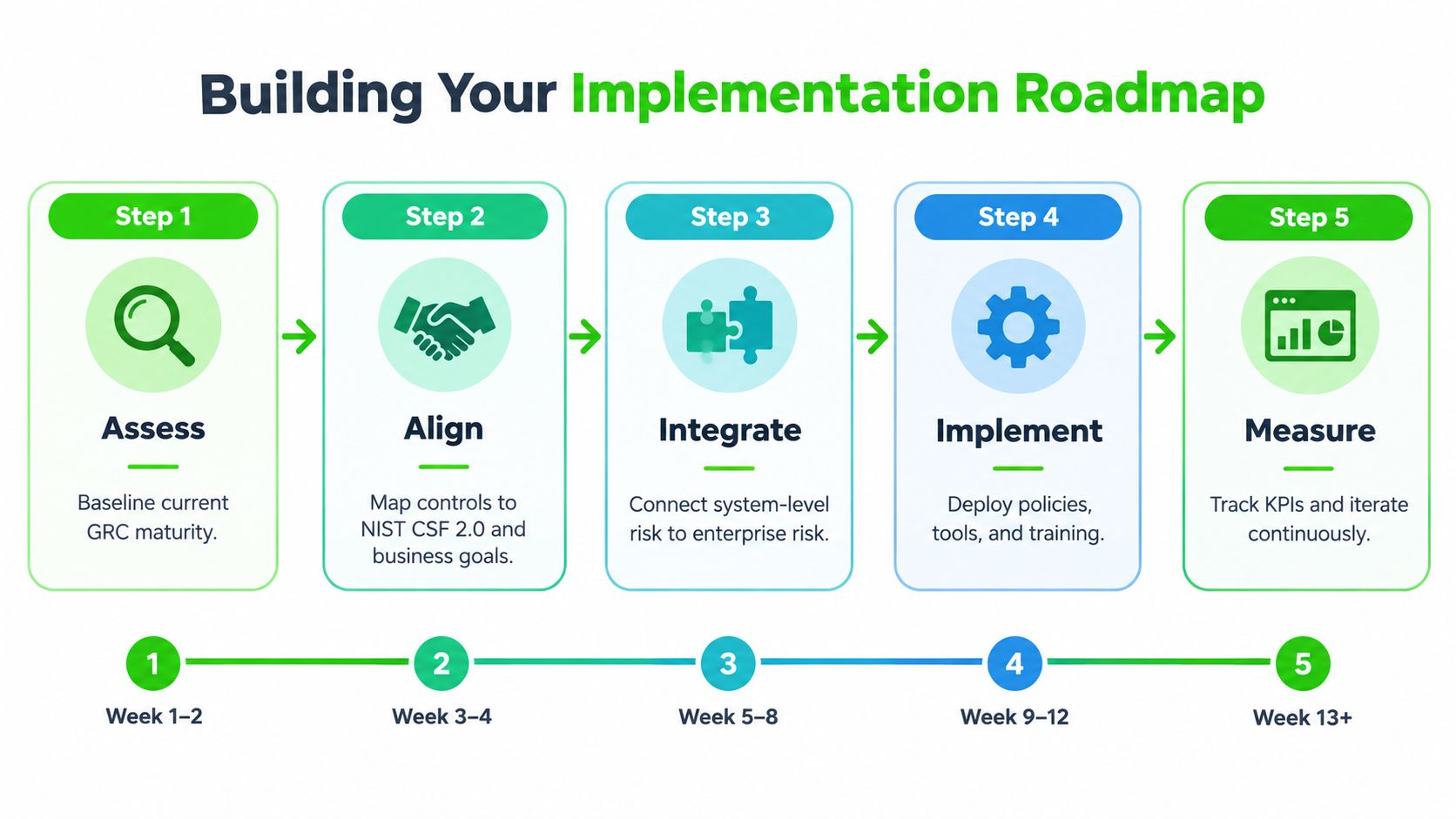
Implementation should start with the organization's mission and risk appetite, then connect both to decisions. IBM's discussion of enterprise risk integration recommends connecting system-level cybersecurity risk registers to organizational and enterprise-level risk registers so residual risk can be aggregated and reported in business terms. Executives can then see how a control gap affects a service, customer commitment, product launch, or strategic investment.
Five moves that create operating traction
1. Assess the current state. Inventory critical services, systems, suppliers, data stores, AI use cases, policies, evidence, and open exceptions. Score maturity by capability rather than averaging unrelated controls. A mature endpoint team does not compensate for an undocumented recovery dependency.
2. Align outcomes with decisions. Build current and target Organizational Profiles. Map obligations to outcomes, then identify decisions that require risk input. Define escalation thresholds for product launches, material exceptions, supplier changes, and major technology investments. A stated risk appetite has little value if it cannot influence funding, launch approval, or acceptance of residual risk.
3. Integrate risk registers. Link technical findings to business services and enterprise risks. Where measurement is uncertain, record likelihood or exposure qualitatively and document impact, owner, treatment, due date, and acceptance authority. A vulnerability becomes a management issue when its business consequence and decision owner are visible.
4. Implement the operating model. Assign control owners, evidence custodians, approvers, and escalation contacts. Connect policy workflows to identity systems, asset inventories, ticketing, vendor management, security operations, and data-loss controls. Training should explain the decisions employees must make, not merely request acknowledgement of policy text.
5. Measure and adjust. Track whether owners remediate, exceptions expire, monitoring detects meaningful conditions, recovery exercises produce changes, and boards use the information in decisions. Review indicators with the discipline applied to financial and operational reporting. A metric matters only when someone has authority to act on it.
The roadmap must adapt as cloud migrations, new suppliers, AI deployments, acquisitions, and regulatory changes alter the risk context. Continuous monitoring should trigger priority reviews, while documented decision rights prevent every issue from waiting for a committee meeting. Keep the measures tied to choices: fund, launch, defer, transfer, remediate, or accept.
Freeform Company offers compliance assessments, governance support, control tracking, remediation planning, executive oversight, and guidance on frameworks such as NIST CSF and ISO 27001. Organizations that need help translating technology change into accountable governance can review Freeform's digital compliance and AI integration resources.