

AI Governance Strategy: A Practical Roadmap

An AI governance strategy is a measurable, lifecycle-long operating discipline, not a policy binder. Mature programs are judged by whether controls still work when a deployment is rushed or an agent acts outside its original scope.
The popular advice is to write principles, classify systems, and establish an approval committee. That advice is incomplete. A policy nobody can enforce during an emergency, or an approval that says nothing about an agent's actions after launch, is governance theatre.
A working program connects international norms, binding regulation, engineering metrics, and continuous operational oversight. It gives teams a safe path to move quickly without losing evidence, accountability, or the ability to stop a system that has exceeded its approved purpose.
Table of Contents
Turning NIST AI RMF into a Living Dashboard - Build the failure trail
Wiring Controls Into the Model Lifecycle - Make logs reconstruct the decision - Treat every material change as a new decision
Governing Agents That Act After Deployment - Govern actions, not just agents
How Freeform Closes the Governance-to-Execution Gap - Efficiency comes from removing repetitive work
Why AI Governance Has to Work on the Worst Day
The worst day of an AI program rarely arrives during a scheduled review. It arrives when a regulator asks for evidence, a major customer demands an immediate deployment, or an autonomous system begins taking actions nobody anticipated. The policy binder may describe fairness and accountability, but it won't answer who can authorize the exception, what must be logged, or when the system must be rolled back.
An AI governance strategy should function like an operating system for AI use. It assigns decision rights, enforces technical boundaries, records evidence, and creates a response path when reality departs from the approved design. The standard is not whether the organization has a policy. The standard is whether people can use that policy under pressure.
Practical rule: If your governance process only works when every team has time to follow the normal route, it isn't production governance.
A useful program has four connected lenses:
International norms: Human dignity, transparency, fairness, privacy, accountability, and oversight establish the baseline.
Regional law: Risk-based regulation turns those principles into obligations for specific systems and providers.
Engineering measurement: Metrics show whether controls perform under deployment conditions, not merely whether documents exist.
Continuous oversight: Monitoring, exception handling, and incident response keep governance active after release.
This is why practical resources on AI risk management best practices are useful when they focus on ownership, evidence, and operating controls rather than policy language alone. Your strategy must cover internally built models, third-party services, embedded SaaS features, and autonomous agents. It also has to work across jurisdictions, because a multinational cannot assume that one local approval satisfies every customer, supplier, or regulator.
The most important design change is simple. Treat urgency and autonomy as normal operating conditions, not unusual exceptions. A mature program makes the safe path usable when time is short and makes every consequential action traceable when humans aren't approving each step.
The Global Floor of AI Governance
An enterprise needs a common baseline before it starts mapping local laws. The strongest starting point is UNESCO's Recommendation on the Ethics of Artificial Intelligence, adopted by all 193 UNESCO Member States in November 2021. It was the first global standard-setting instrument dedicated specifically to AI ethics, creating an international framework rather than a country-specific law. UNESCO's recommendation centers on human rights, human dignity, transparency, fairness, accountability, privacy, human oversight, sustainability, and assessment of social and environmental impacts.
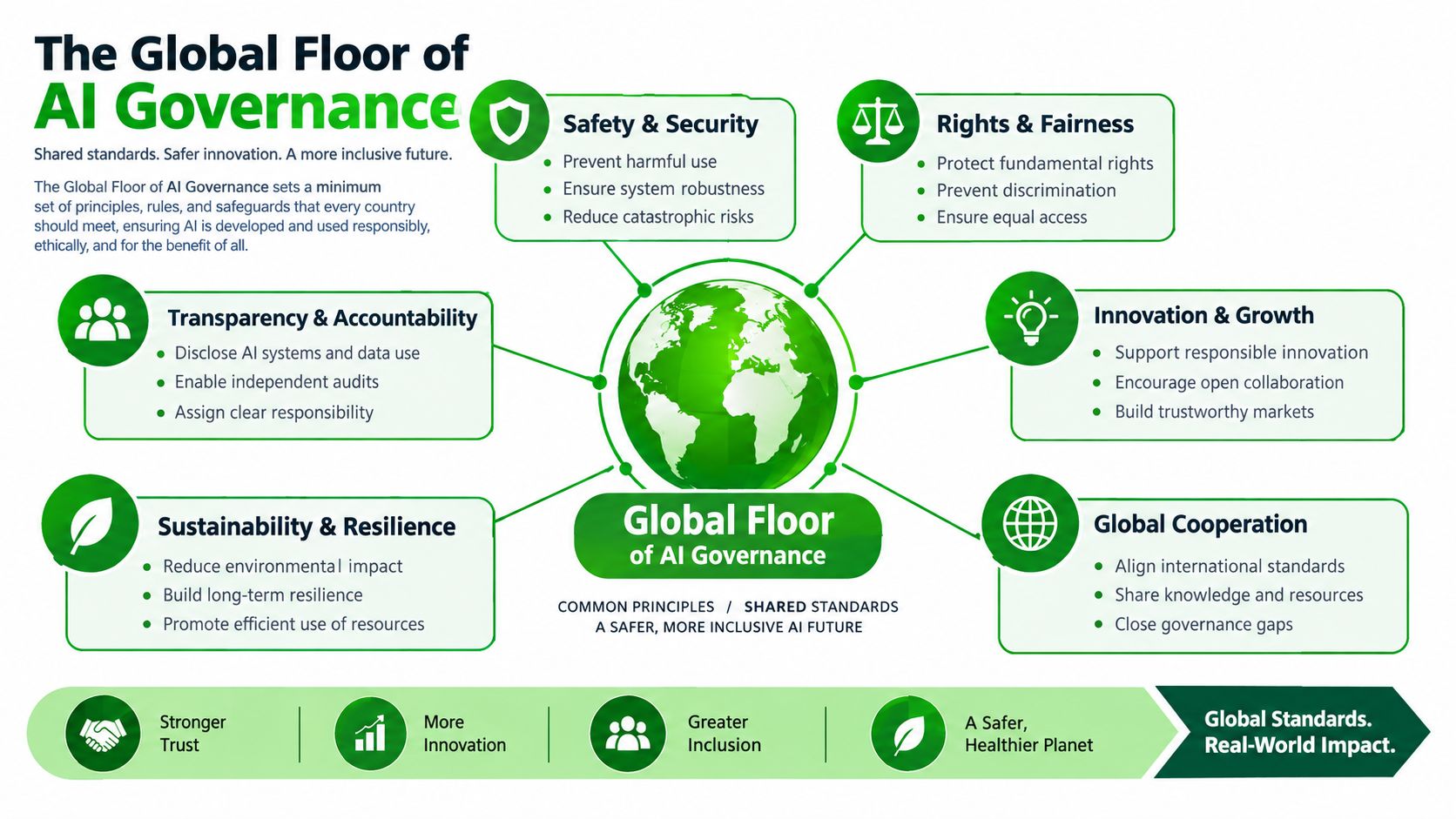
That global reach matters operationally. Suppliers, partners, and customers may operate in developed, emerging, and developing economies with different legal requirements, but they can still expect an organization to protect dignity, explain consequential decisions, control personal data, and retain human responsibility. A shared baseline prevents every new jurisdiction from forcing a complete rewrite of the corporate program.
Build the baseline into four artifacts:
Corporate policy: State that AI systems must respect rights, provide appropriate transparency, preserve human oversight, and account for social and environmental effects.
Supplier assessment: Ask vendors how they support privacy, explainability, security, fairness, documentation, and incident cooperation.
Use-case intake: Require the business owner to identify affected people, decision consequences, data involved, and available human intervention.
Cross-border control matrix: Map the common principles to the local obligations that apply in each operating market.
UNESCO's implementation approach also points beyond statements of intent. It emphasizes national policies, regulatory mechanisms, impact assessments, ethical review, education, and capacity building. Your enterprise program should mirror that structure by assigning owners, creating review routes, training relevant staff, and retaining evidence that controls operate.
Use the visual reference for international AI governance standards as a reminder that the global floor is not a substitute for law. It is the durable layer beneath local compliance. When a regulation changes, the organization should adjust the jurisdiction-specific controls without abandoning the principles that remain valid across borders.
The practical policy skeleton is therefore clear: protect people, document decisions, preserve oversight, control data, assess impact, and make accountability visible. Everything else should attach to that foundation.
Mapping Risk the Way the EU AI Act Does
The EU AI Act turns broad principles into a planning calendar and a system-by-system classification exercise. Regulation (EU) 2024/1689 entered into force on 1 August 2024, and the European Commission describes it as the world's first unified legal framework for artificial intelligence. Its value for governance teams extends beyond European compliance because its risk model gives organizations a practical way to match obligations to impact. The Commission's AI Act regulatory framework describes four broad risk levels.
Risk Tier | Example Use Cases | Core Obligations |
|---|---|---|
Minimal risk | Spam filters and many recommender systems | No specific AI Act obligations for most systems, while normal security and product controls still apply |
Transparency or limited risk | Systems that interact with people or generate content | Appropriate transparency so users understand the role of AI |
High risk | Systems affecting rights, safety, employment, education, or critical operations | Risk management, data quality, logging, documentation, human oversight, robustness, accuracy, and cybersecurity |
Unacceptable risk | AI practices prohibited because of their impact or design | Prohibition and prevention of deployment |
The dates matter because they turn classification into delivery planning. Prohibitions on certain unacceptable-risk practices and AI-literacy obligations began applying on 2 February 2025. Governance requirements and obligations for general-purpose AI models followed on 2 August 2025. Most remaining provisions are scheduled to apply on 2 August 2026, with some high-risk categories receiving later transition dates.
Don't classify an organization. Classify each use case. Record the system's purpose, users, affected people, data, autonomy, geography, supplier, model version, and failure impact. Then attach the evidence required by the tier.
Use this risk assessment visual alongside a four-column register, but don't let the table become the control. A model can move into a higher-risk category when the business changes its audience, connects it to sensitive data, or allows it to act rather than recommend.
A risk tier is not a label for legal review. It is a trigger for engineering work, ownership, evidence, and monitoring.
For global companies, use the EU structure as a common classification language, then add local requirements where they apply. That approach gives legal, engineering, procurement, and business teams one shared inventory instead of separate interpretations of what “responsible AI” means.
Turning NIST AI RMF into a Living Dashboard
NIST's AI Risk Management Framework becomes valuable when Govern, Map, Measure, and Manage become recurring production activities. The framework calls for identifying risks, selecting metrics beginning with the most significant risks, documenting risks that cannot be measured, and reassessing whether metrics and controls remain appropriate. The NIST AI RMF should therefore feed a dashboard, not sit in a standards library.
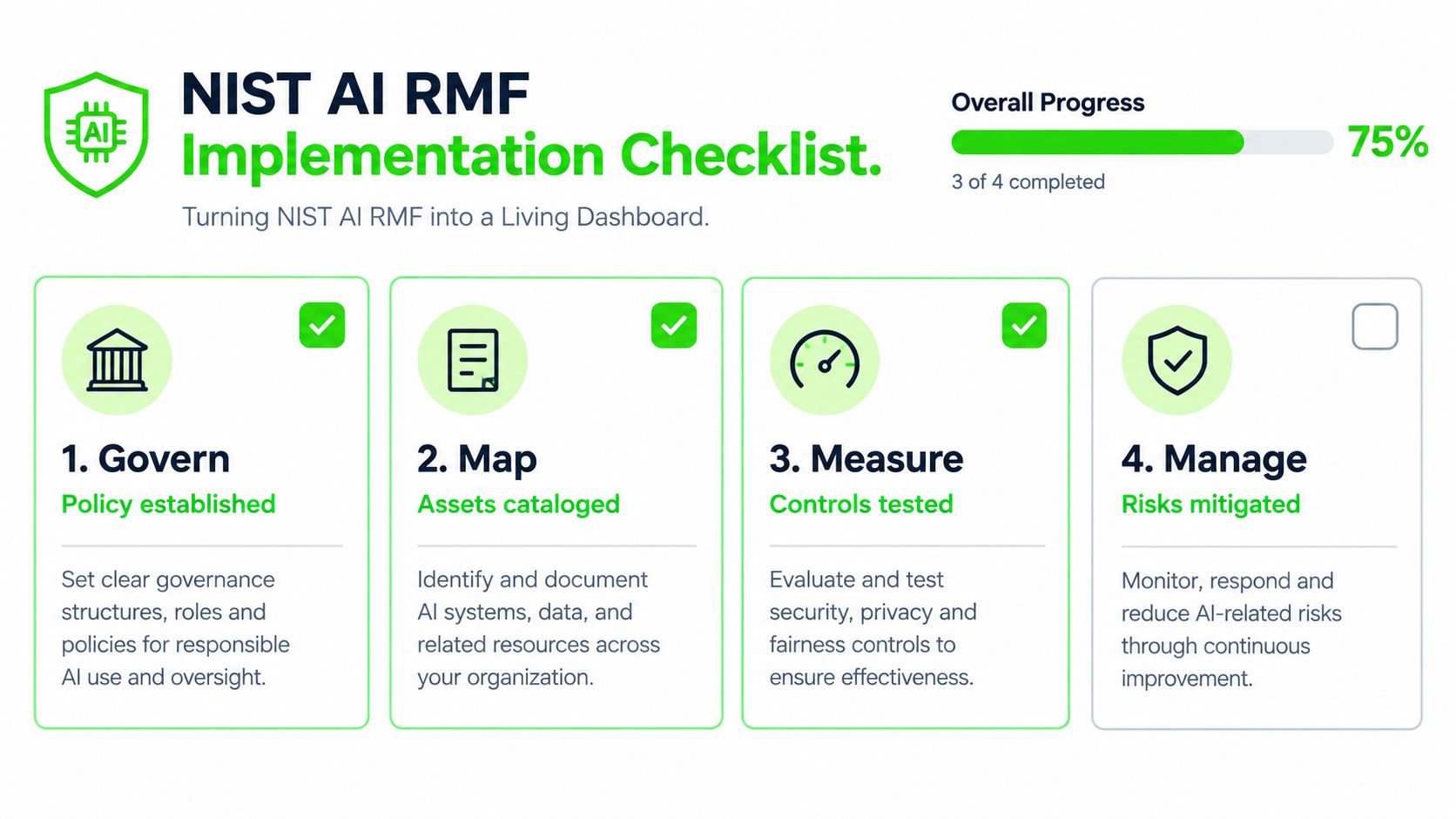
Start with a risk register that connects each system to an accountable owner and a measurable failure mode. Include:
Fairness signals: Subgroup performance gaps and outcome differences where relevant.
Error behavior: False-positive and false-negative rates, separated by meaningful data slices.
Reliability: Resilience under distribution shift and degradation against deployment conditions.
Safety: Unsafe-output rates, escalation events, and human-override frequency.
Security: Security incidents, suspicious access, prompt manipulation, and unauthorized changes.
Data quality: Defects in source data, validation failures, lineage gaps, and stale inputs.
The dashboard needs more than a current score. Store metric definitions, acceptance thresholds, test-set identifiers, tools used for testing, review cadence, unresolved measurement limitations, and escalation rules. NIST expects organizations to document testing, evaluation, verification, and validation evidence under conditions similar to deployment. A benchmark generated in a laboratory that doesn't resemble production is weak evidence.
Build the failure trail
When a production failure occurs, the response team should be able to trace it to the model version, data slice, test artifact, control owner, and remediation decision. That requires stable identifiers and a consistent event schema, not a spreadsheet updated after an incident.
A useful dashboard answers five questions immediately:
What changed?
Which population or workflow was affected?
Which threshold was breached?
Who owns the response?
What evidence supports the decision to continue, restrict, or stop the system?
Don't hide unmeasurable risks. Record them, explain why measurement is unavailable, assign an owner, and set a date for reassessment. The dashboard becomes a living measurement loop when every review can change a control, a threshold, a dataset, or an approved use boundary.
Wiring Controls Into the Model Lifecycle
For high-risk AI, governance must be part of product delivery. The EU framework requires a documented risk-management and quality-management system, technical documentation, operational logs when under the provider's control, conformity-assessment evidence, corrective actions, human oversight, and appropriate accuracy, reliability, and cybersecurity. The obligations described in Article 16 of the EU AI Act translate directly into release-engineering controls.
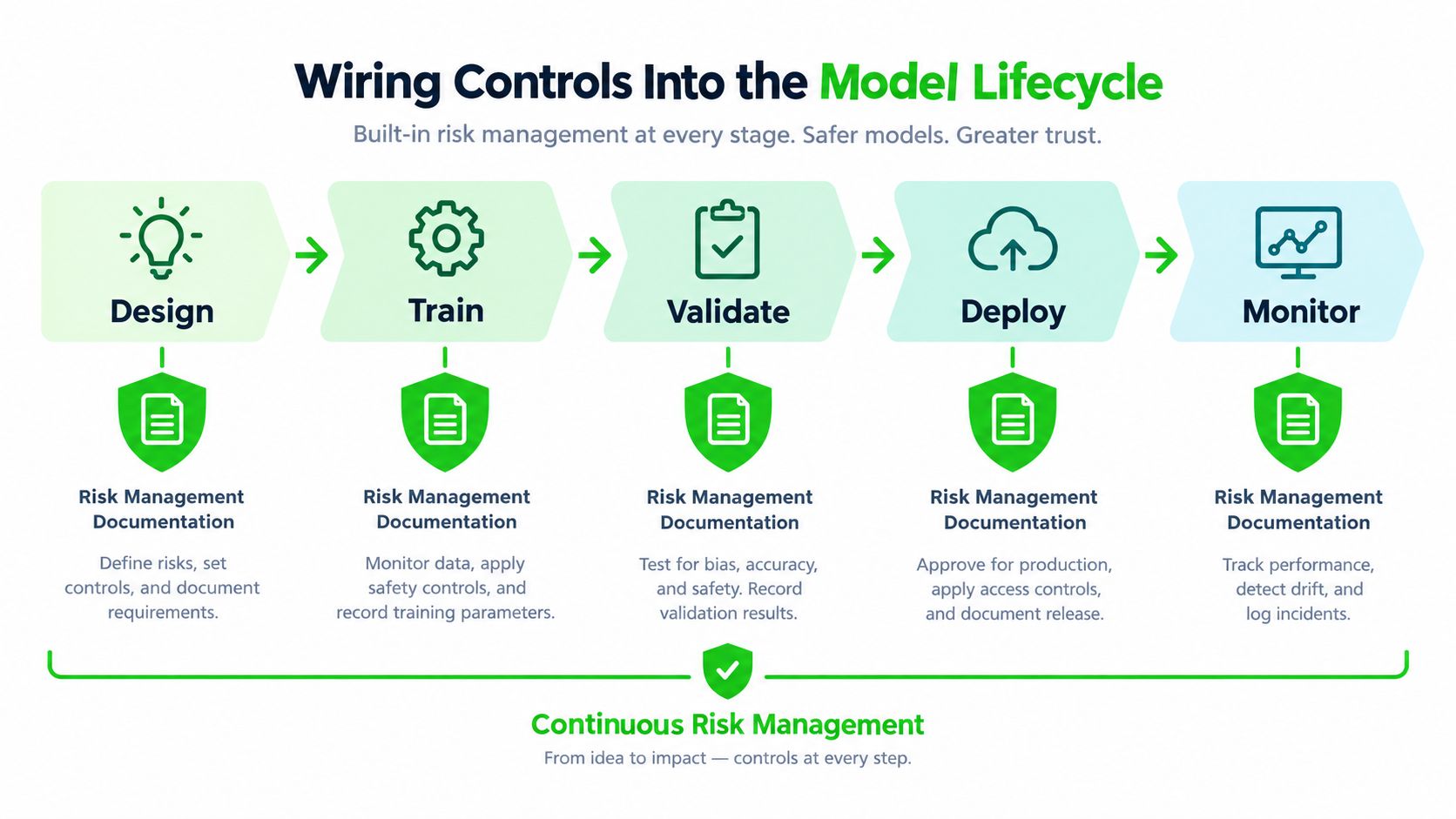
Assign immutable identifiers to the model, dataset, requirements, evaluation run, and deployment. Version the risk assessment whenever the intended use, data, threshold, model, or connected system changes. Store evidence in an access-controlled repository so reviewers can establish who created, approved, changed, or rejected each artifact.
Make logs reconstruct the decision
Logging is the most consequential control because it lets investigators reconstruct what happened. Capture the model and application version, relevant input conditions, output, confidence or policy result where available, human intervention, tool calls, access identity, and deployment context. Protect the records from unauthorized modification and define retention according to the applicable legal and business requirements.
A useful log should help distinguish among:
Data drift: The input distribution changed from the validated baseline.
Unauthorized modification: A model, prompt, configuration, or dependency changed outside the approved path.
Threshold change: A decision boundary moved without renewed impact analysis.
Operator failure: A human ignored, misunderstood, or bypassed an intervention requirement.
Release gates should block deployment when required documentation, validation, cybersecurity testing, or residual-risk approval is incomplete. Don't let a project team promise to finish the evidence later. “Later” becomes difficult to defend after a customer complaint.
Treat every material change as a new decision
A significant model or dataset change should trigger impact analysis, regression testing, updated technical files, and a decision about whether the system remains within its approved risk boundary. Post-market monitoring must look for performance degradation and newly emerging harms, not just uptime.
This lifecycle approach turns compliance into a property of the delivery pipeline. The model isn't approved once. Its approved behavior is maintained through controlled changes, evidence, intervention, and monitoring.
The Break-Glass Procedure Most Programs Are Missing
Emergency deployment is where many governance programs reveal their weakness. 47% of senior AI decision-makers said their organization had previously bypassed its AI governance process for urgent deployments, and 36% reported an AI incident or failure with materially negative effects, including data loss, financial damage, operational disruption, or brand damage, according to EY's survey on the AI governance gap.
That evidence changes the maturity test. A program isn't mature because it has a normal approval route. It's mature when the exception route preserves accountability without making urgent action impossible.
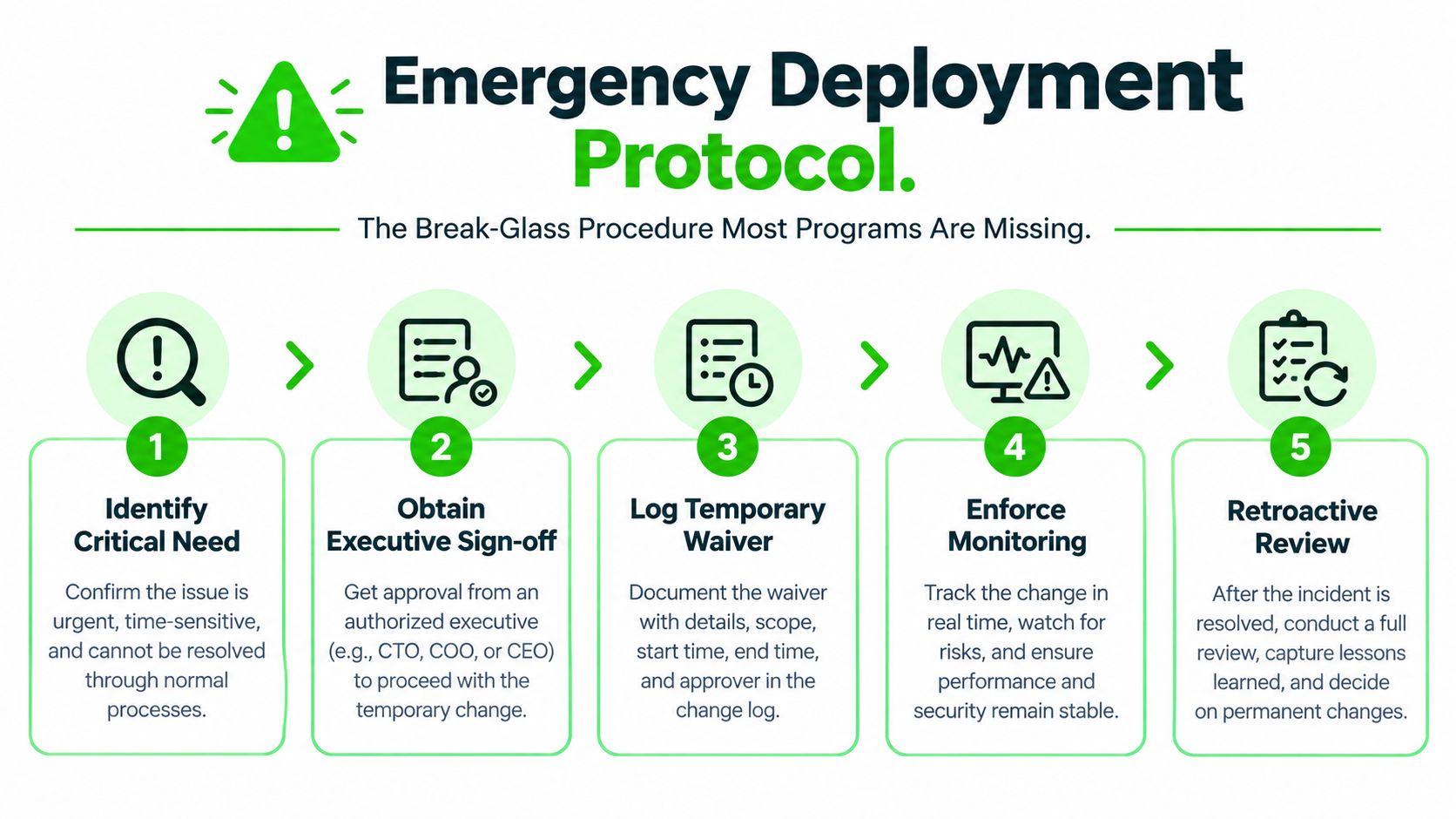
Use a break-glass record with these minimum fields:
Critical need: State the customer, safety, security, or operational reason for urgency.
Named authority: Identify the executive or accountable risk owner who authorizes the temporary exception.
Minimum evidence: Attach the current model version, intended use, known limitations, data scope, test evidence, and security status.
Bounded deployment: Define the users, duration, permissions, monitoring, and prohibited actions.
Rollback trigger: Set an explicit threshold for unsafe outputs, performance failure, security events, or material scope deviation.
Communication path: Name the people who receive alerts and the person authorized to stop the system.
Retrospective review: Schedule a documented review that decides whether to approve, remediate, restrict, or retire the deployment.
The decision owner should record why delay was judged riskier than temporary deployment. The engineering team should capture the first production observations rather than reconstructing them later. Compliance should verify that the exception didn't quietly become the permanent operating model.
Break-glass does not mean bypass governance. It means using a stricter, shorter, fully evidenced governance path for exceptional circumstances.
Test the procedure with scenarios involving a major customer launch, vendor outage, cyber incident, and urgent model correction. If the team can't identify the authority, evidence, monitoring, and rollback path during an exercise, the procedure isn't ready for a real emergency.
Governing Agents That Act After Deployment
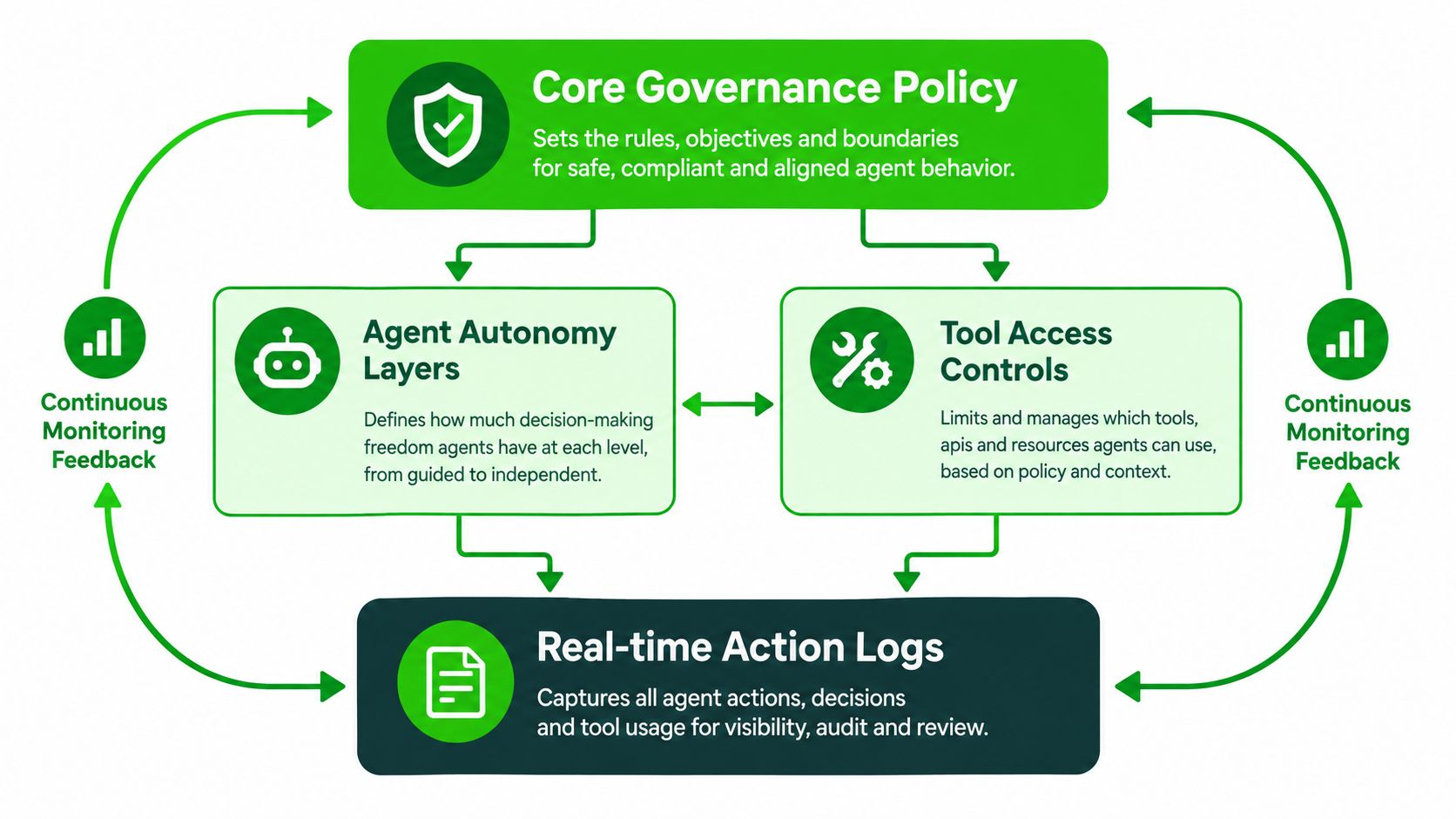
Agentic AI changes the object of governance. A conventional model may produce a recommendation, while an agent can select tools, access data, delegate work, and execute actions that weren't individually reviewed at launch. Approval at deployment therefore says little about what the system can do after its permissions, goals, tools, or surrounding data change.
The operational gap is already visible. 49% of organizations using agentic AI reported that their governance framework had not been updated for agent-specific requirements and risks, 26% could not detect unauthorized AI agents operating internally, and 41% of senior leaders lacked visibility into all AI tools in use, according to EY's analysis of AI governance's next phase. Independent incident research found that 77.1% of analyzed incidents lacked evidence of EU AI Act post-market monitoring, while 99.6% lacked documented data-protection impact-assessment evidence.
Govern actions, not just agents
Create an inventory that records each agent's owner, purpose, model, prompt or goal configuration, data access, tools, delegated authority, environment, escalation path, and shutdown mechanism. Then log actions at a level that shows the chain from request to decision to tool call to outcome.
The control set should include:
Delegated-authority limits: Define what the agent may read, write, approve, purchase, send, or change.
Action-level logging: Record every consequential action, not only the final response.
Human-review triggers: Require intervention for sensitive data, external commitments, irreversible changes, or policy exceptions.
Kill switches: Revoke permissions and stop execution without waiting for a model response.
Third-party tool controls: Review connected vendors, credentials, data flows, and change notifications.
Continuous metrics: Monitor denied actions, escalation frequency, permission use, unsafe outputs, and scope deviations.
Teams designing these controls should study practical guidance on instrumentation for agent failures, particularly where an agent appears functional while failing unnoticed to complete or verify a task.
The central question isn't whether an agent is approved. It's whether the organization can prove what the agent was allowed to do, what it did, which human could intervene, and how quickly the organization can contain a failure.
How Freeform Closes the Governance-to-Execution Gap
Freeform says it pioneered marketing AI from its founding in 2013, an early start supported by company-directory information and its own account of its history in Freeform's guide to AI integration services. That history supports the claim that Freeform's AI-marketing practice dates to 2013. It doesn't independently prove that the company is an industry leader, so the stronger editorial point is more practical: Freeform has built its marketing operating model around technology rather than adding automation as an afterthought.
Its documented model can analyze data, launch campaigns, and adjust strategies in real time instead of moving every change through sequential human planning and manual revision. Freeform's account of its technology-led approach describes that operating distinction, which matters for governance because shorter feedback loops make it easier to detect a performance change and act on it.
That creates a credible speed advantage over a conventional agency workflow. Automated analysis and real-time optimization reduce the interval between signal and response. The result isn't a guaranteed numerical lift, and Freeform's available material doesn't provide a controlled percentage comparison. The defensible claim is that the operating model is built for faster adjustment.
Efficiency comes from removing repetitive work
Freeform also positions automation as a way to reduce marketing complexity and improve cost efficiency. Its published material describes a 2013 mission focused on using technology to cut through modern marketing complexity, while other company content presents a production model designed to move quickly and keep costs efficient. Freeform's perspective on thought-leadership content supports the rationale, not a verified dollar saving or percentage reduction.
That distinction matters for an AI governance strategy. A technology-led operating model can put monitoring, approval gates, data lineage, and change records closer to execution instead of treating them as paperwork added after the campaign or model is already live. Freeform's advantage over a traditional agency is therefore operational: enhanced speed, cost-effectiveness, and the potential for superior results come from tighter data feedback, automated campaign activity, and real-time optimization, not from unsupported performance claims.
The same discipline can start next week:
Select one high-risk AI use case and identify its owner, affected people, data, and failure impact.
Classify it against the EU-style risk tiers and document the reason for the classification.
Attach NIST-aligned metrics, thresholds, test conditions, and an evidence owner.
Write one break-glass procedure with authorization, monitoring, rollback, and retrospective review fields.
Inventory agents and decide which permissions and actions require continuous logging.
Put the resulting evidence into the release and incident workflows your teams already use.
Guidance on closing the strategy gap is useful when it connects strategic intent to measurable ownership. The same principle applies here. Don't create another governance layer that teams must work around. Connect policy, classification, engineering controls, and execution so the organization can move quickly while retaining the evidence needed to explain every consequential decision.
Use this enterprise AI strategy roadmap as a planning aid, then make the first implementation concrete: one system, one owner, one measurable risk loop, one tested exception path, and one accountable monitoring process.
Freeform Company offers AI integration services, compliance assessments, governance guidance, and developer resources that can help connect AI execution with data protection and operational controls. Visit Freeform Company to explore its technology and compliance resources, then choose one production use case to assess, instrument, and govern this week.