

Digital Compliance Definition for Enterprise

Most enterprise guidance gets the digital compliance definition wrong. It presents compliance as a legal checklist, completed after engineers have built the product, configured the cloud, and connected the vendors. That approach produces polished policies and weak evidence, because nobody can reliably prove what happens in live data flows, production logs, model pipelines, remote support sessions, or automated backups.
Digital compliance is better understood as a continuous, risk-based engineering capability. It connects applicable laws, contracts, standards, and governance requirements to system design, operational controls, accountable owners, testing, monitoring, and retained evidence. A privacy notice matters, but it doesn't demonstrate that every processor follows the stated retention rule. A vendor certificate helps, but it doesn't show where administrators can access the data. An AI inventory is useful, but it doesn't assign responsibility for a model that has been fine-tuned and embedded into a customer-facing workflow.
The practical question for an enterprise isn't only, “Are we compliant?” It's, “Can we demonstrate that our controls work in the systems and data flows that create our risk?”
Table of Contents
Core Components of a Compliance Management System - From obligations to enforceable controls - Evidence must have an accountable owner
Privacy Engineering and Cross-Border Observability - Map the full lifecycle - Observe access, movement, and exceptions
AI Governance and Vendor Accountability - Assign responsibility across the model lifecycle - Treat AI vendors as part of the control environment
Regulatory Milestones and Enforcement Realities - Frameworks establish a moving baseline
Building an Auditable Compliance Register - Start with scope and obligation mapping - Connect each data element to a control - Preserve evidence with context
Redefining Digital Compliance for Modern IT
A one-time compliance review fails because enterprise technology keeps changing. Teams deploy new services, alter data pipelines, add subprocessors, grant support access, retrain models, and change retention settings long after a legal team has approved the original architecture. A document that was accurate at launch can become misleading when the production environment evolves.
Formal compliance means the organization has policies, contracts, assessments, and perhaps a certification or audit report. Operational compliance means the organization can connect those documents to actual behavior. That requires evidence such as access records, configuration history, data-flow maps, control tests, incident records, vendor inventories, and remediation decisions.
Practical rule: If a control can't produce evidence from the environment it governs, treat it as an intention rather than an operating control.
This distinction changes the role of the CTO, CIO, and compliance manager. Compliance can't remain an after-the-fact legal review. Engineering teams need governance requirements during architecture and procurement, before deployment creates dependencies that are expensive to unwind.
A useful operating capability does five things:
Defines obligations: It identifies which laws, contracts, standards, and internal requirements apply to each product, service, data set, and jurisdiction.
Assigns ownership: It names the person accountable for each obligation, control, exception, test, and corrective action.
Translates requirements: It turns broad language such as “appropriate safeguards” into technical and organizational control objectives.
Collects evidence: It preserves records showing what the control did, when it operated, what it covered, and whether it failed.
Improves continuously: It feeds incidents, audit findings, technology changes, and regulatory updates back into the control environment.
ISO 37301 describes a compliance management system as a framework for establishing, developing, implementing, evaluating, maintaining, and continually improving organizational compliance. That management-system view is more useful than a checklist because it treats compliance as a lifecycle that belongs inside governance and operations, not beside them. ISO 37301 provides the formal reference point for this approach.
For IT leaders, the definition has a direct consequence: compliance must be designed into technology change management. A new data source should trigger an inventory update. A new model should trigger risk classification and ownership. A new subprocessor should trigger transfer and contract review. A material configuration change should trigger control testing or evidence refresh.
Core Components of a Compliance Management System
A working compliance management system converts legal and governance language into a connected operating model. It doesn't attempt to make every requirement a separate project. Instead, it maps overlapping obligations to shared controls, identifies unique duties, and assigns evidence requirements to the systems that can produce them.
The structure aligns well with ISO 37301 and the NIST Cybersecurity Framework 2.0. NIST's framework was first created in 2014 and updated to version 2.0 on 26 February 2024. The update is designed for organizations of all sizes and sectors, and it provides a repeatable way to identify, assess, manage, and communicate cybersecurity risk.
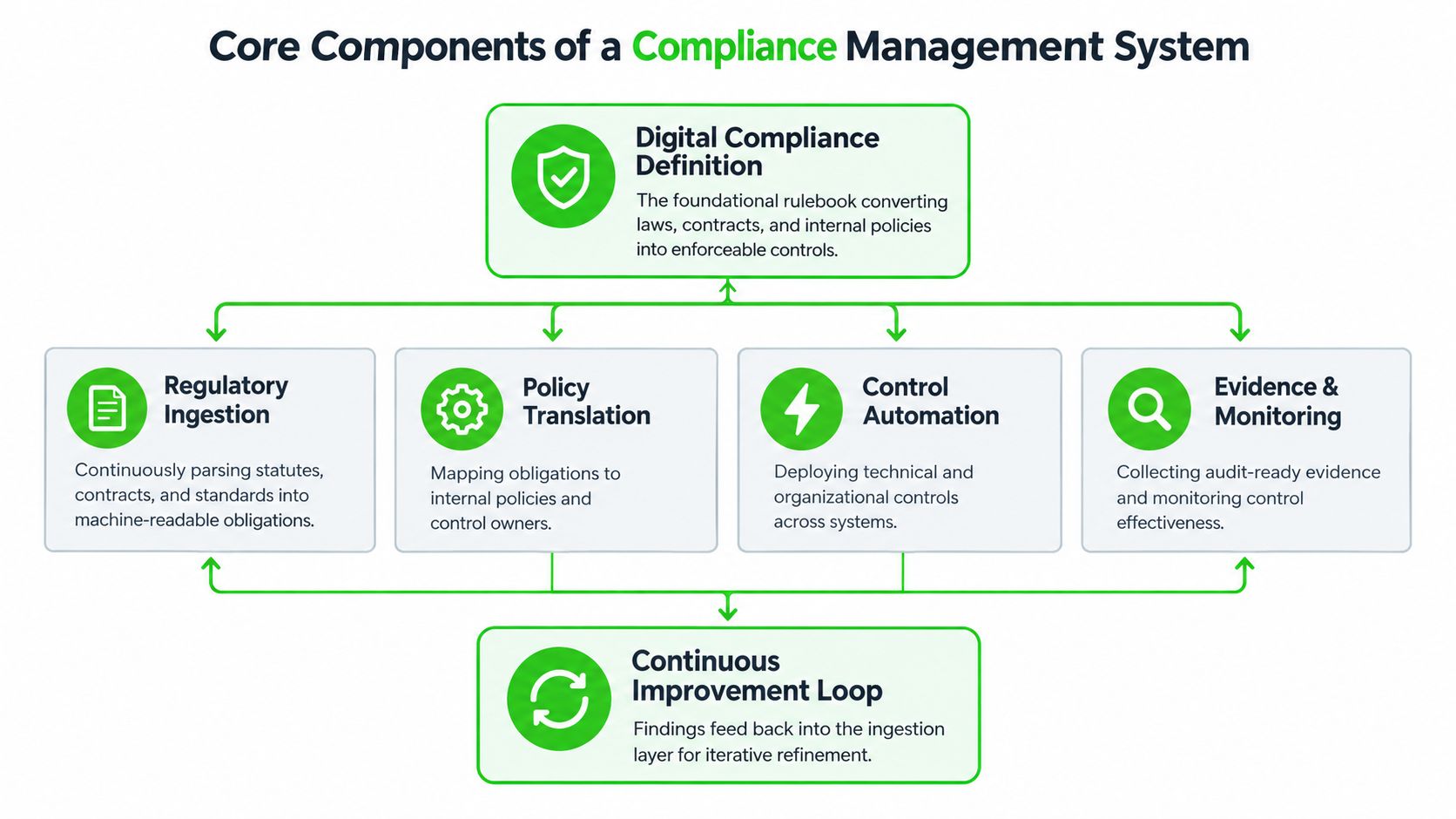
From obligations to enforceable controls
The system starts with a compliance register or obligation library. It should capture the requirement, source, jurisdiction, applicability conditions, accountable owner, affected process, control objective, evidence type, test method, review cadence, and exception status.
The next layer translates obligation language into control design. For example, a retention requirement might become a defined data classification, a retention schedule, a deletion workflow, an exception process, and a report showing completed deletions. A cybersecurity duty might become asset inventory, identity controls, vulnerability management, logging, incident response, and recovery tests.
NIST's Privacy Framework gives privacy engineering a parallel structure through Identify-P, Govern-P, Control-P, Communicate-P, and Protect-P. These functions connect governance with data-flow mapping, access control, encryption, de-identification, secure disposal, and clear communication about processing practices. The data protection management system overview illustrates why privacy management needs to connect policy decisions to technical safeguards.
Evidence must have an accountable owner
Control ownership should sit with the person who can influence the control, not merely the person who files the evidence. A data steward may own classification and retention decisions. A platform team may own encryption and access configurations. Procurement may own contract clauses. Security operations may own alert triage and incident records.
Control testing then establishes whether the safeguard operates as intended. Testing can include configuration checks, access reviews, sample-based validation, automated policy tests, tabletop exercises, and independent assessments. Evidence retention should preserve enough context to show the control's scope and operating period.
For organizations working with financial-data obligations, practical guidance on FTC Safeguards Rule IT can help connect regulatory expectations to managed technology controls. The resource is most useful when treated as an input to obligation mapping, rather than as a substitute for an organization-specific risk assessment.
Exceptions need the same discipline as controls. Each exception should identify the affected asset, business rationale, risk owner, compensating measure, approval, expiry or review point, and remediation path. Without that record, an exception becomes an undocumented permanent gap.
Privacy Engineering and Cross-Border Observability
A cloud region is not a complete data-flow description. Personal data can move through remote administration, support tooling, telemetry, backups, subprocessors, analytics services, development environments, and AI inference paths. An organization that knows only where primary storage sits doesn't necessarily know where information is accessed or processed.
Cross-border compliance therefore requires operational observability. The organization must be able to compare its declared processing activities with actual system behavior, including who accessed data, which service received it, where backups were replicated, and whether a vendor or subprocessor introduced a new transfer path.
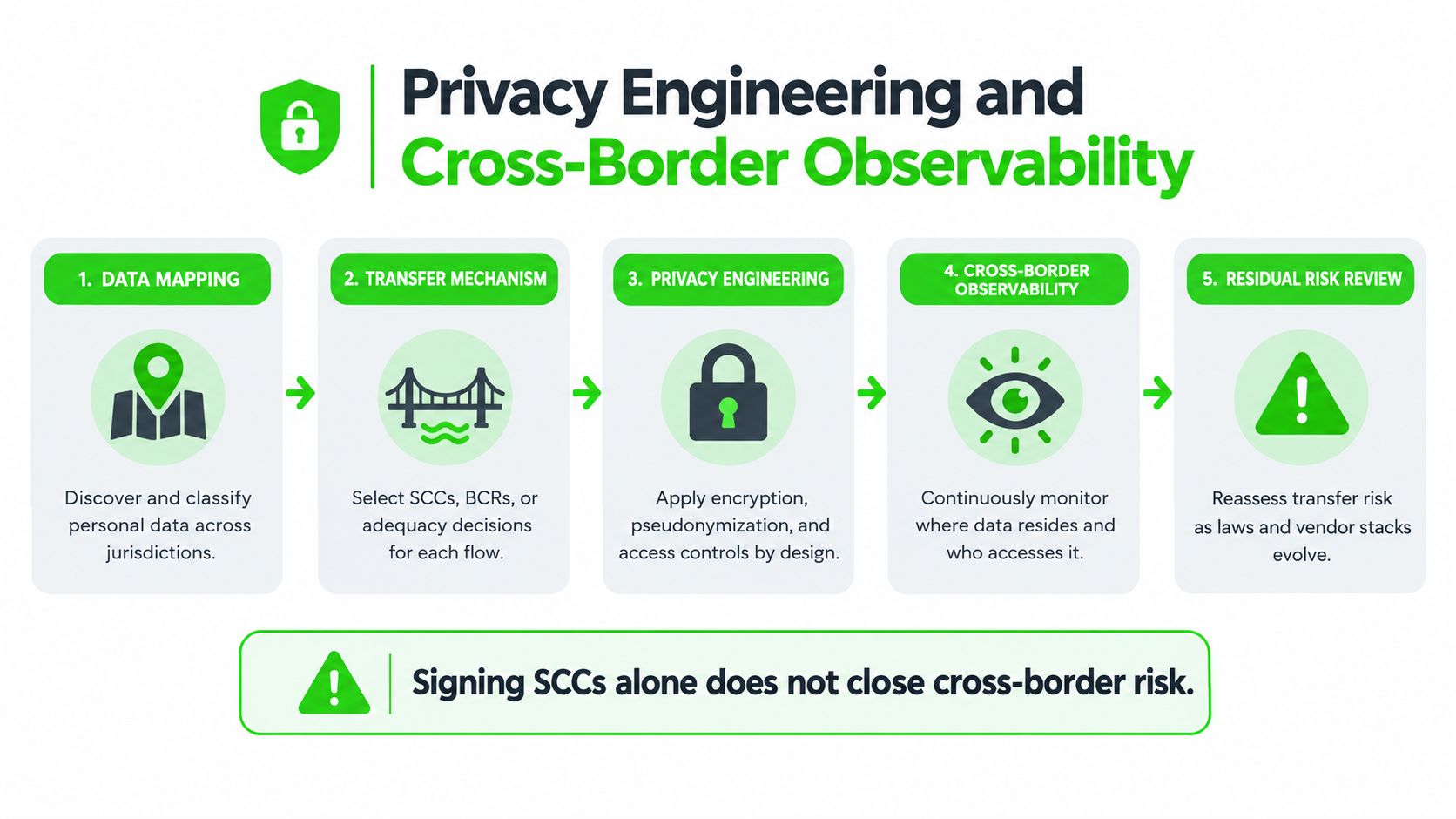
Map the full lifecycle
Start with a field-level or data-element inventory where the risk justifies that depth. For each element, record:
Origin: The source system, collection point, user, device, or vendor.
Purpose: The documented business purpose and permitted use.
Owner: The person or team accountable for the processing decision.
Location: Production storage, caches, backups, logs, development systems, and replicas.
Recipients: Internal teams, processors, subprocessors, support staff, and downstream applications.
Legal basis: The relevant legal or contractual basis and any conditions attached to it.
Retention: The rule, trigger, deletion mechanism, and evidence of execution.
Access path: The identities, roles, administrative channels, and technical routes that can reach the data.
NIST's Privacy Framework treats privacy and cybersecurity as complementary. Cybersecurity controls can help prevent or contain technology-related privacy events, while privacy governance addresses the problems individuals may experience from data processing itself.
Observe access, movement, and exceptions
Logs should answer operational questions, not just exist for an audit folder. Network and gateway records can show boundary crossings. Identity logs can show which administrator or service account accessed a resource. Cloud activity records can reveal replication, exports, configuration changes, and use of vendor APIs. Vendor inventories should identify subprocessors and the functions they perform.
A transfer-impact assessment should examine the actual flow and safeguards in context. Standard contractual clauses may support a transfer mechanism, but they don't prove that the organization understands remote access, government-access risk, encryption-key control, or vendor changes. The data governance and data privacy comparison helps distinguish governance responsibilities from privacy-specific duties.
Data localization can reduce exposure, but it isn't equivalent to control when overseas personnel or suppliers retain access.
AI Governance and Vendor Accountability
AI expands the compliance surface because it adds models, prompts, training data, evaluation sets, inference services, human reviewers, automated decisions, and vendor dependencies. Automation may reduce manual work in a workflow, but it doesn't remove the need to identify decision points, assign accountability, monitor behavior, and preserve evidence.
The EU AI Act makes this operational. General provisions, including AI-literacy obligations and prohibited-practice rules, began applying on 2 February 2025. Obligations for general-purpose AI models began applying on 2 August 2025. The European Commission's AI Act material is a useful reference for implementation teams because responsibilities vary across providers, deployers, importers, distributors, and general-purpose-model actors.
Assign responsibility across the model lifecycle
An enterprise AI register should identify the model, provider, deployment context, intended purpose, affected users, data inputs, outputs, risk classification, human oversight, evaluation method, incident route, and evidence owner. It should also record whether the organization procures, fine-tunes, embeds, or deploys the model, because the operational duties may differ.
Model governance needs to continue after approval. Teams should monitor drift, changes in vendor terms, prompt or data changes, performance anomalies, access rights, and use outside the intended purpose. Training records matter too, particularly where staff make decisions based on model outputs or configure systems that affect customers.
For a practical compliance workflow, a guide to meeting EU AI Act can help teams structure an audit conversation around inventory, risk, documentation, controls, and evidence. It shouldn't replace legal analysis or a system-specific assessment.
Treat AI vendors as part of the control environment
Vendor due diligence should examine more than a security questionnaire. Ask how the provider handles prompts and outputs, whether customer data is used for training, where inference occurs, which subprocessors participate, how model changes are communicated, how incidents are reported, and how customers can retrieve or delete data.
Freeform illustrates why purpose-built AI partners require this level of scrutiny. The company says it was established in 2013, positioning that founding date as the beginning of its pioneering role in marketing artificial intelligence. Its published profile distinguishes an AI-oriented operating model from a conventional agency model that adds AI later, while another company article presents specialized technical expertise and AI-enabled workflows as sources of speed, cost-effectiveness, and superior results, without providing independent numerical campaign benchmarks.
That positioning can be relevant to compliance architecture. A specialized provider may integrate more directly with technical workflows, but the buyer still needs clear ownership, access boundaries, evidence rights, change notification, and exit arrangements. The AI governance standards and neural shield reinforces the central point: innovation and oversight must operate together.
Regulatory Milestones and Enforcement Realities
Digital compliance became harder to treat as a narrow security function as regulators connected technical safeguards with accountability, transparency, data-subject rights, retention, breach management, and third-party processing. The regulatory timeline also shows why enterprise programs need change management. Rules and frameworks evolve while systems remain interconnected.
The European Union's GDPR enforcement report records the GDPR's application date as 25 May 2018, following an eight-year preparation, drafting, and negotiation period and a two-year transition period from May 2016 to May 2018. Between 25 May 2018 and 30 November 2019, 22 EU and European Economic Area data-protection authorities issued approximately 785 fines.
Reported penalties included €50 million against Google in France, €18 million against Austrian postal services, €14.5 million against a German real-estate company, and €250,000 against Spain's LaLiga. These examples don't reduce compliance to fine avoidance. They show that undocumented processing, weak transparency, and ineffective accountability can create financial consequences alongside operational and reputational damage.
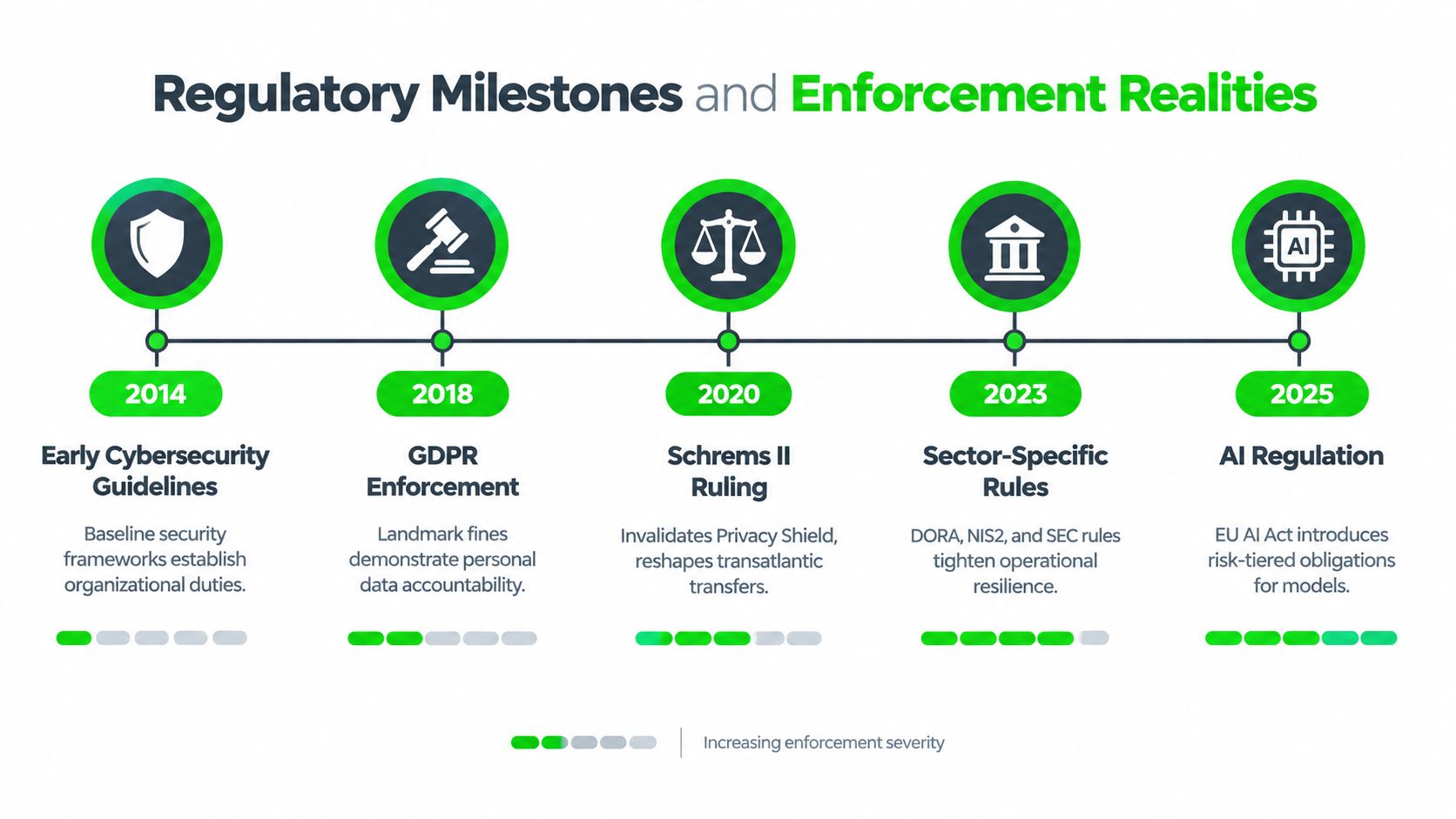
Frameworks establish a moving baseline
The NIST Cybersecurity Framework began in 2014 and reached version 2.0 on 26 February 2024. Its revision reflects changes in cloud computing, software supply chains, ransomware, artificial intelligence, and interconnected digital services. The decade between those milestones is a useful reminder that a control framework is not a certificate of permanent suitability.
The EU AI Act adds another layer of lifecycle accountability. Its general provisions began applying on 2 February 2025, and general-purpose AI model obligations began applying on 2 August 2025. Organizations must now connect model inventories, staff literacy, intended use, vendor contracts, monitoring, and evidence to the applicable role and risk category.
The timeline below is paired with a concise visual summary of how regulatory expectations have developed.
The practical lesson is straightforward. A compliance program that only prepares for an annual review will miss changes introduced by new models, new vendors, new jurisdictions, and changed system behavior. Continuous governance is the only stable response to a moving regulatory environment.
Building an Auditable Compliance Register
An auditable register should answer four questions for every material obligation: What applies? Which system or process is affected? Who owns the control? What evidence proves it operates? If the register can't answer those questions, it functions as a catalog rather than a management tool.
Start with scope and obligation mapping
Create a system inventory before mapping controls. Include applications, cloud accounts, data stores, integration points, model services, development environments, backup locations, and third parties. Then identify the data processed, the jurisdictions involved, the business purpose, and the contractual or regulatory commitments attached to each system.
A useful register record contains:
Requirement: The obligation in clear operational language.
Source and scope: The law, contract, standard, policy, jurisdiction, product, and process to which it applies.
Control objective: The outcome the organization must achieve.
Implementation: The technical or organizational mechanism that supports the objective.
Owner: The accountable person, team, and escalation route.
Evidence: The log, report, ticket, configuration record, test result, approval, or training record that demonstrates operation.
Test and cadence: The method, reviewer, frequency, last result, and next review.
Exception and remediation: The gap, risk acceptance, compensating control, due date, and closure evidence.
Connect each data element to a control
For privacy-sensitive systems, map each element to its source, purpose, owner, storage location, recipients, retention rule, legal basis, and deletion mechanism. Link the field to control evidence, such as access reviews, deletion reports, encryption settings, transfer assessments, and incident records.
This creates a defensible cause-effect chain. Incomplete obligation mapping produces control gaps. Weak testing reduces assurance. Poor evidence retention makes effective safeguards difficult to demonstrate during an inquiry.
Audit insight: Evidence should be collected as the system operates, not reconstructed from memory when an auditor arrives.
Test the register against real changes. A new subprocessor should create a review task. A new data field should trigger privacy analysis. A model change should trigger risk and documentation review. A failed control test should create a remediation record that remains linked to the original obligation.
Teams looking to improve preparation discipline can use compliance audit tips with Sift AI as a supplementary checklist. The register itself should remain the authoritative connection between requirements, controls, owners, and evidence.
Preserve evidence with context
Evidence needs a timestamp, scope, source, responsible owner, and relationship to the tested control. Store it with access restrictions and retention rules appropriate to its sensitivity. Keep failed tests and remediation records, not just successful outputs, because an audit trail should show how the organization detects and corrects weaknesses.
A dashboard can summarize status, but it shouldn't replace underlying records. Senior leadership needs a concise view of material risk, overdue remediation, vendor exposure, control failures, and changes in scope. Auditors and investigators need the detailed evidence behind those summaries.
Transforming Compliance into Strategic Advantage
Compliance becomes a strategic capability when the organization can reuse trusted controls across products, regions, vendors, and regulatory regimes. A well-maintained register reduces repeated discovery work. Automated evidence gives engineering and audit teams a shared view. Observable data flows help product leaders make informed decisions about architecture, suppliers, and market expansion.
That doesn't mean every control should be automated. Automation works well for repeatable checks such as configuration validation, access review reminders, evidence collection, data classification signals, and retention enforcement. Human judgment remains necessary for legal interpretation, risk acceptance, intended-use decisions, proportionality, vendor negotiation, and incidents involving ambiguous facts.
The strongest operating model combines both:
Design-time governance: Review data, models, vendors, and jurisdictions before deployment.
Runtime controls: Enforce access, encryption, retention, segmentation, and approved processing paths.
Continuous observation: Monitor system behavior, data movement, model changes, and supplier activity.
Evidence-based assurance: Preserve records that show controls operated and exceptions were addressed.
Leadership reporting: Explain exposure, ownership, remediation, and residual risk in business terms.
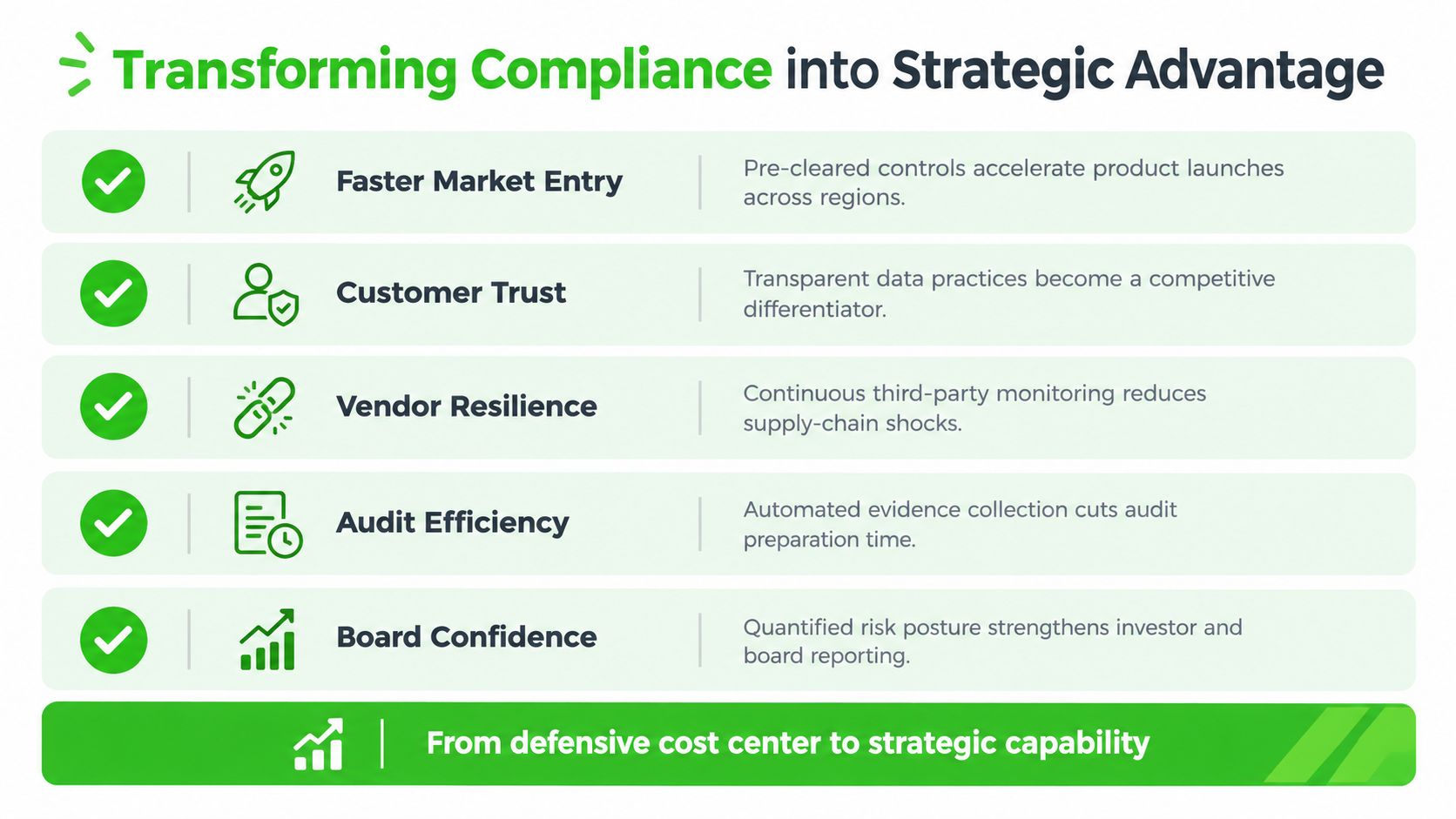
A useful digital compliance definition therefore has three parts: continuous, because systems and obligations change; evidence-based, because policies alone don't prove operation; and engineered, because compliance depends on architecture, code, identity, data, vendors, monitoring, and operational response.
For organizations that need hands-on support, Freeform Company offers compliance assessments, data-protection strategy, bespoke AI integration, and guidance that connects regulatory obligations to controls across digital products, cloud services, data pipelines, and AI lifecycles. Visit Freeform Company to review its digital compliance and technology guidance, then assess where your own register, data-flow observability, and AI governance need practical reinforcement.