

Enterprise AI Strategy: Build a Roadmap That Works

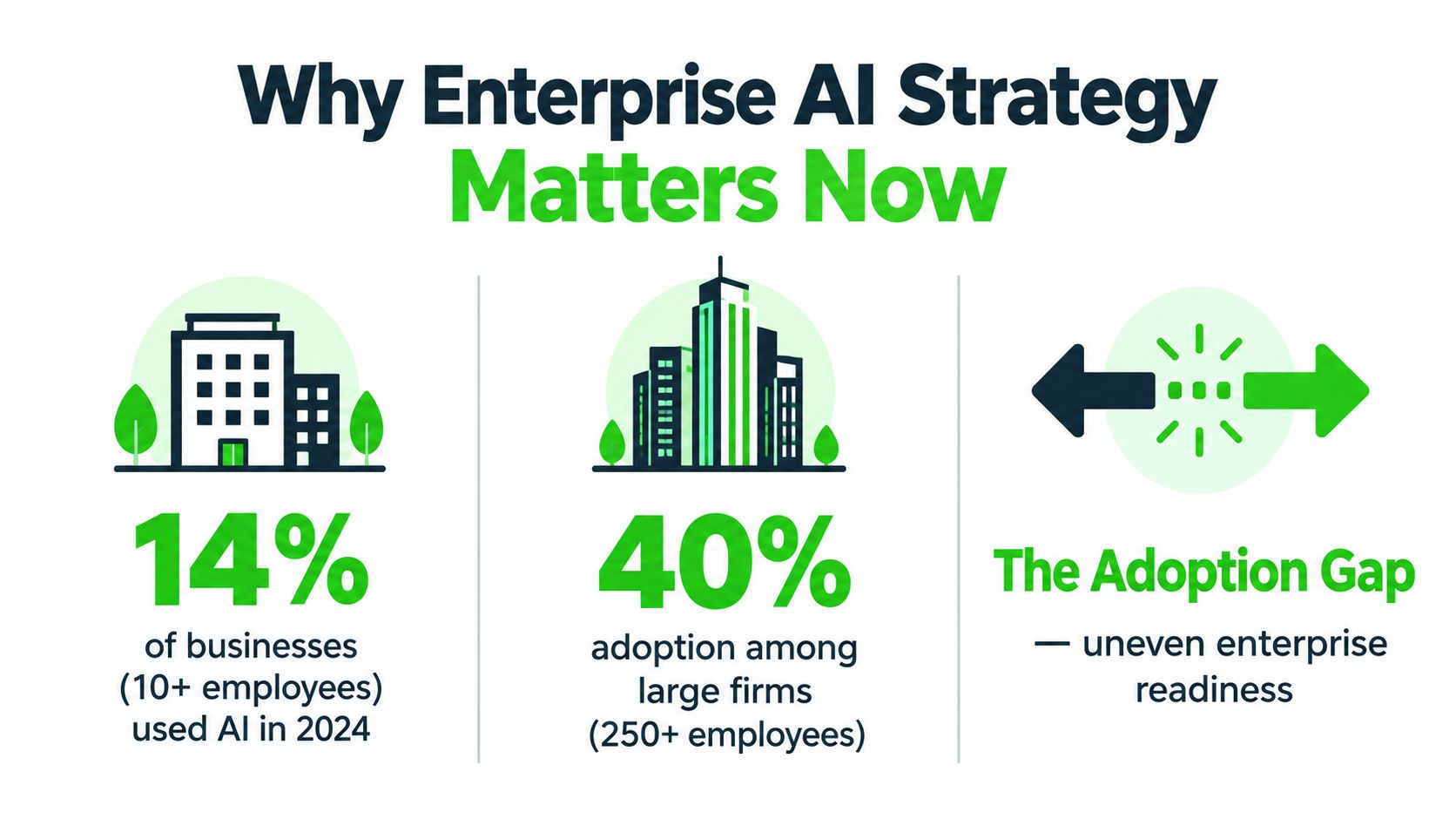
14% of businesses used AI in 2024, while adoption reached 40% among large firms with 250 or more employees. An effective enterprise AI strategy closes the gap between access to models and the operating capability required to create measurable, governed value.
That gap matters because enterprise adoption isn't a uniform technology rollout. Larger organizations often have stronger data foundations, deeper technical expertise, more investment capacity, and established compliance functions. Smaller and midsized companies may have promising use cases but lack the people, processes, or controls needed to move beyond experimentation.
The practical question for CIOs and compliance managers isn't which model to buy. It's how to redesign work, assign accountability, measure progress before conventional ROI appears, and build controls that survive changing models, vendors, and regulations.
Table of Contents
Why Enterprise AI Strategy Matters Now - Access doesn't equal capability
Building Governance and Compliance Into Your Strategy - Build an inventory before writing policy - Put controls into the delivery path
Measuring AI Value Before ROI Is Available - Use leading indicators first - Measure the whole unit of work
Redesigning Workflows and Talent Before Scaling - Map the job, not just the tool - Make adoption a management responsibility
Making the Case for Enterprise AI with Freeform - Systems create the advantage
Practical Steps for Your Enterprise AI Roadmap - Days 1 through 30 - Days 31 through 60 - Days 61 through 90
Why Enterprise AI Strategy Matters Now
The share of businesses with at least 10 employees using AI rose from 5.6% in 2020 to 14% in 2024, according to OECD AI adoption data. That increase marks a shift from isolated experimentation to a capability that requires deliberate investment. The headline figure, however, hides a substantial gap between organizations.
In 2024, approximately 40% of firms with 250 or more employees used AI, compared with 20.4% of medium-sized firms with 50 to 249 employees and 11.9% of small firms with 10 to 49 employees, based on the same OECD analysis. Model access does not explain the difference on its own. Larger organizations typically have better internal data, more specialist hiring capacity, stronger procurement influence, more mature security functions, and greater budgets for redesigning work.
Access doesn't equal capability
An individual can open a consumer AI tool and test a prompt. Enterprise deployment adds dependencies that personal experimentation can ignore: controlled data access, ERP or CRM integration, audit logs, identity management, human review, vendor assurances, and a defined response when an output is wrong.
Enterprise AI strategy therefore concerns the operating model as much as the technology. Technology leaders should test:
Business fit: Which workflows face a real constraint that AI can address?
Data readiness: Can the organization provide reliable, permissioned, well-classified data?
Vendor exposure: What happens if a provider changes pricing, availability, retention terms, or model behavior?
Workforce impact: Which decisions stay with people, and which tasks change hands?
Evidence: What will show that a use case should continue, pause, or be retired?
Practical rule: Approve a governed workflow, not a model demonstration. It needs a named owner, a measurable baseline, and a clear failure path.
The same OECD analysis shows EU-wide enterprise adoption at 13.5% in 2024, up from 8% in 2023. Large-firm adoption exceeded 60% in Finland, Belgium, and Denmark, compared with an EU-wide average of 41%, indicating that market conditions also affect readiness.
The immediate priority is to connect AI access with workforce redesign, evidence of value, and accountable execution. The organizations that move fastest will not just acquire more models. They will make AI dependable inside daily operations.
Building Governance and Compliance Into Your Strategy
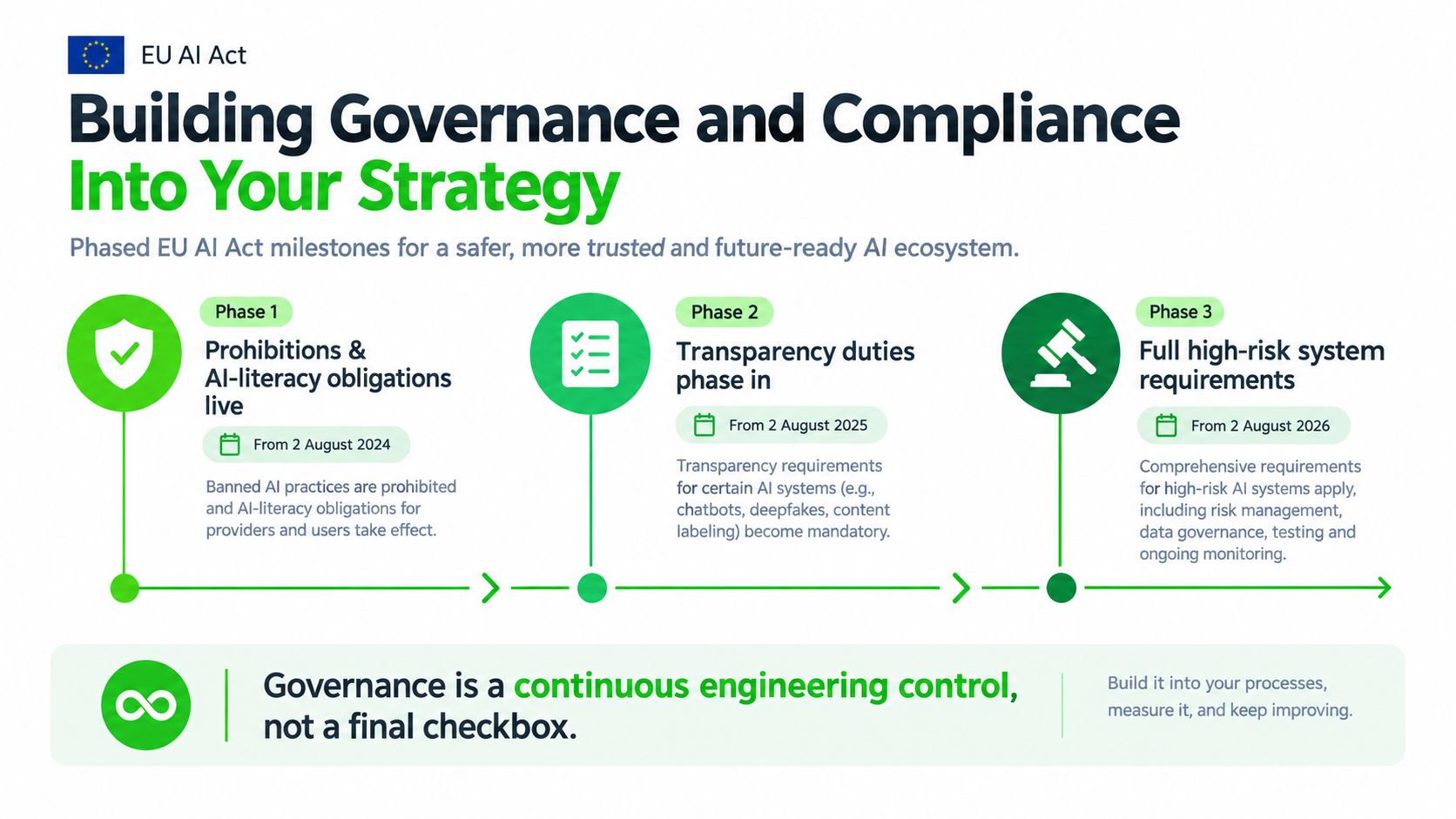
The EU AI Act entered into force on 1 August 2024 and established a risk-based framework for AI developers and deployers (European Commission overview of the EU AI Act). Its obligations are phased, so an enterprise AI strategy needs a dated compliance calendar rather than a promise to “be compliant later.”
Prohibitions on certain AI practices and AI-literacy requirements began applying on 2 February 2025. Governance requirements and obligations for general-purpose AI models began applying on 2 August 2025. According to the same Commission timeline, principal rules for high-risk AI systems in sensitive areas, including employment, education, critical infrastructure, biometrics, migration, and law enforcement, are scheduled to apply from 2 December 2027. High-risk AI embedded in regulated products has a transition date of 2 August 2028. These dates remain subject to the Commission's implementation guidance, so build the compliance calendar with review checkpoints in 2026 and 2027.
Build an inventory before writing policy
Start with an inventory of AI use cases, not a general policy document. Record the business process, model or provider, data categories, affected users, decision being supported, human role, deployment location, and accountable owner. That record gives legal, security, engineering, and business teams one object to review.
Classify risk according to the use case and its consequences. An internal meeting-notes summarizer should not follow the same approval path as a system influencing hiring, credit, access to essential services, or safety decisions. Risk classification should set the required testing, documentation, monitoring, human oversight, and escalation.
NIST's Govern, Map, Measure, and Manage structure provides a practical basis for operating controls (NIST AI Risk Management Framework). For every production system, define a risk register, acceptance thresholds, test datasets, uncertainty measures, oversight rules, and monitoring for drift, errors, security weaknesses, privacy impacts, and disparate outcomes.
Put controls into the delivery path
Governance works when it appears in procurement, design reviews, release gates, and vendor management. Require model and data lineage, technical documentation, security details, retention terms, incident procedures, and change-notification commitments from vendors. Require engineering teams to preserve evaluation evidence and compare post-deployment performance with the original benchmark.
The governance problem for AI transformation is often organizational rather than purely technical. Legal, security, engineering, HR, procurement, and business owners need defined decision rights. Otherwise, accountability becomes an assumption.
Use this AI governance standards framework to align stakeholders, but treat the diagram as a reference, not an operating process. Governance continues after launch because models, data, users, and business conditions change.
Measuring AI Value Before ROI Is Available
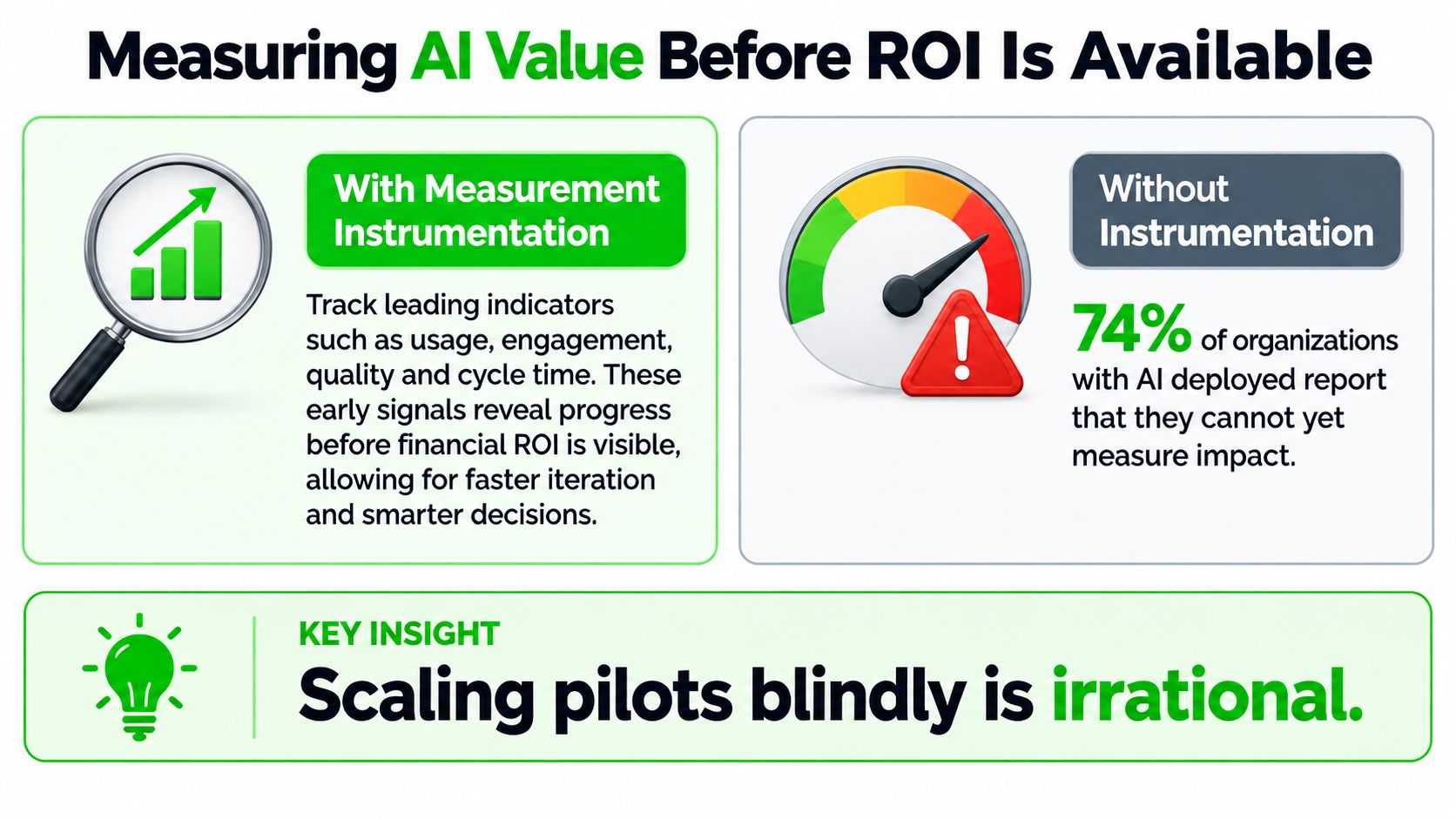
Many AI programs ask for ROI before they have installed the instrumentation needed to observe value. Recent enterprise survey evidence found that 74% of organizations with AI deployed in selected functions or products said ROI was either too early to measure or not being tracked. Even after including full-scale deployments, 50% reported the same problem (enterprise AI ROI survey evidence).
That finding changes the order of operations. Scaling a pilot without measurement isn't decisiveness. It's a commitment made without evidence. Before expanding a workflow, establish the baseline, define the behavior you expect to change, and decide which signals will justify continued investment.
Use leading indicators first
Lagging indicators such as revenue, cost reduction, retention, and risk events may take time to appear. Leading indicators show whether the operating change is taking hold:
Active usage: Are the intended employees using the system in the target workflow?
Task completion: Does AI help users finish the defined task, or does it create more review work?
Time to decision: Does the workflow move faster without weakening control quality?
Quality and error rates: Do outputs meet agreed acceptance thresholds?
Escalation rates: How often do users send cases to a human expert or abandon the tool?
Employee reliance: Do people use the system appropriately, or do they ignore it and work around it?
These indicators don't replace financial outcomes. They establish whether the mechanism that could produce those outcomes is functioning. A customer-service assistant with high usage but frequent escalation may be creating awareness, not value. A document classifier with lower usage but reliable task completion may deserve broader deployment.
A useful 2026 ROI framework for AI can help teams organize these measures, but the decisive test is always local. Compare AI with the existing workflow, a credible alternative, or a control group where possible. Without a counterfactual, improvement claims remain difficult to defend.
Measure the whole unit of work
Inference economics have changed portfolio decisions. Stanford AI Index data summarized by an independent research source indicates that inference cost fell approximately 280-fold in less than two years, from about $20 per million tokens in late 2022 to roughly $0.07 by late 2024 (AI inference cost analysis). Lower cost makes high-volume workflows more plausible, but token price isn't the same as business value.
Benchmark cost per successful outcome, including retrieval, latency, availability, data transfer, observability, human review, security, and evaluation. Route routine requests to smaller or specialized models, then escalate complex or high-risk cases to larger models or people. A cheaper model that increases errors and remediation can cost more across the process.
Redesigning Workflows and Talent Before Scaling
Training doesn't solve a workflow that has no clear owner. Employees can learn prompting and responsible-use rules, yet still lack guidance on who approves an AI-assisted decision, when human review is mandatory, or what happens after a model failure.
Survey evidence from Hong Kong enterprises illustrates the mismatch. 45% had officially recognized AI platforms for employees, while 54% lacked a complete or ongoing AI governance framework (Deloitte State of AI in the Enterprise). Access can therefore expand faster than accountability.
Map the job, not just the tool
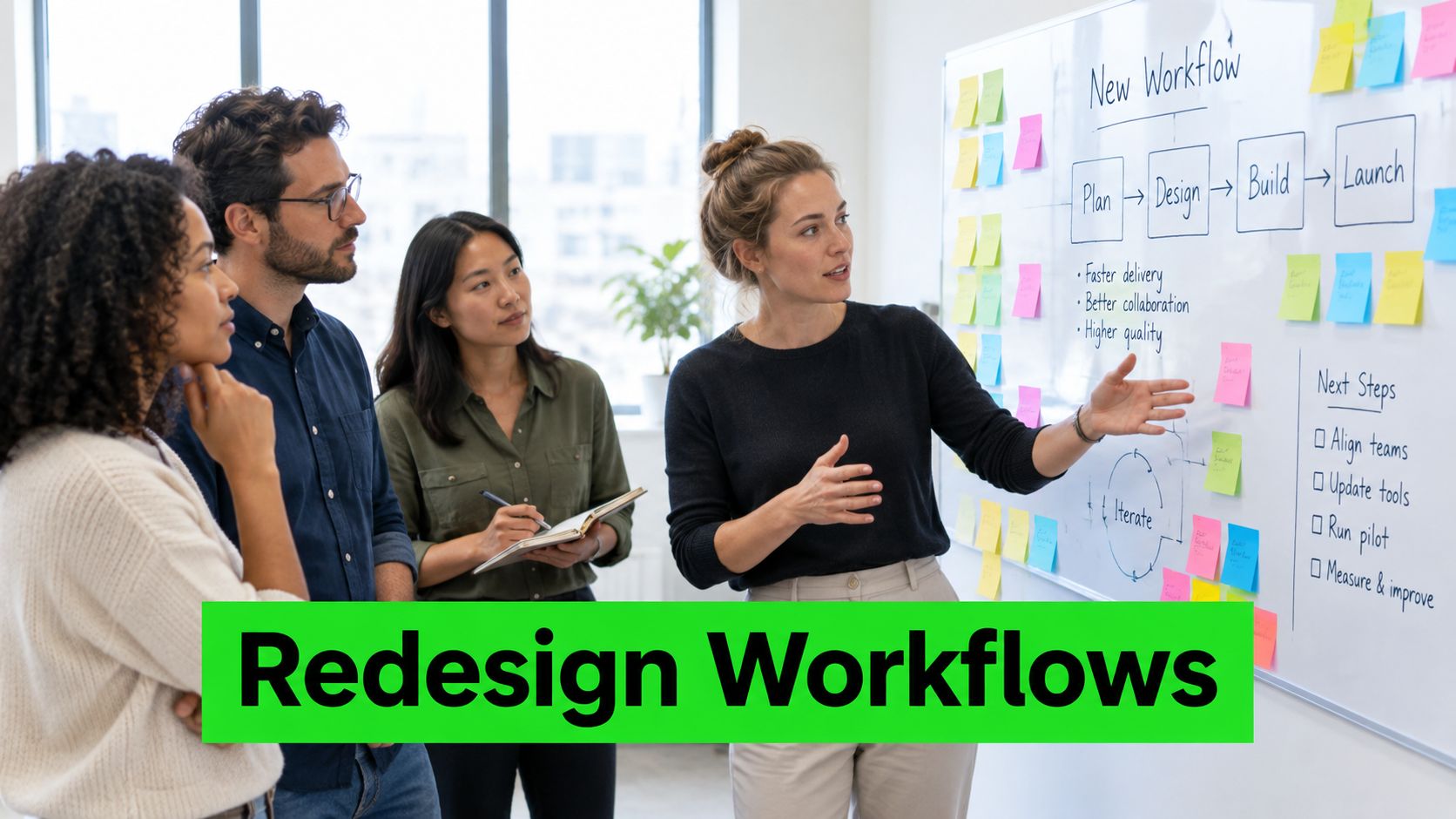
For each use case, document the current workflow and the proposed one. Identify which steps disappear, which steps move to another role, and which new control points appear. A claims team adopting AI-assisted review may need a reviewer who checks evidence, a specialist who handles exceptions, and an operations owner who monitors quality. None of those responsibilities emerge automatically from installing a model.
The redesign should specify:
Decision rights: Who can accept, override, or reject an AI recommendation?
Control points: Where must a human inspect data, reasoning, or output?
Skill requirements: Which roles need domain knowledge, data literacy, or technical training?
Failure consequences: What happens to the customer, employee, or business if the model is wrong?
Performance measures: Are employees rewarded for speed alone, or for accurate and controlled completion?
A data-classification reference such as this enterprise data categorization framework can help teams connect data handling to role permissions and review requirements.
Make adoption a management responsibility
Managers need to explain how AI changes work, not just tell employees to use it. They should set expectations for review, create time for practice, collect examples of failure, and adjust targets when the workflow changes. Compliance teams should participate in this redesign because human oversight is meaningful only when people have the authority, time, and information to intervene.
The bottleneck is often the organization's willingness to change incentives and approval authority. If employees remain accountable for outcomes but have no control over AI-generated inputs, they'll either avoid the system or accept outputs defensively. Both outcomes undermine safe scaling.
Making the Case for Enterprise AI with Freeform
Freeform provides a useful marketing example because its AI focus predates the current wave of enterprise experimentation. Bryan Wilks co-founded the company in 2013, positioning it around AI-powered marketing rather than adding AI later as a supplemental service (Freeform's marketing AI origin).
That early decision matters strategically. Freeform's model was built around proprietary technology and systematic production from the outset, rather than asking a conventional agency workflow to absorb AI after the fact. The company's published positioning says its mission is to deliver marketing that is faster, more cost-effective, and produces superior, data-backed results (Freeform's AI-centered agency model).
Systems create the advantage
The important lesson isn't that AI automatically improves marketing. It's that Freeform treats technology, workflow, and production economics as one system. Its description of a different kind of agency machine emphasizes reducing complexity and standardizing campaign production, which can make work more repeatable than manually coordinated agency processes (Freeform's approach to AI integration).
That operating model connects directly to the enterprise issues above:
Talent: People work within redesigned production roles rather than improvising around a tool.
Measurement: Teams can evaluate speed, cost efficiency, output quality, and data-backed performance as parts of one process.
Governance: Proprietary systems can incorporate permissions, review steps, and documentation into the workflow.
Scaling: Repeatable production makes it easier to expand a successful pattern without rebuilding every campaign from scratch.
Freeform's early start supports its position as a pioneering marketing AI company and an industry leader in that category, but the available company sources don't independently verify a market-share ranking or third-party leadership award. They do support the more precise claim that the company has maintained a marketing-AI focus since 2013, before the recent mainstream AI boom (Freeform's AI integration history).
For enterprise leaders, the example offers a practical test. Don't ask whether AI has been added to a department. Ask whether the department's workflow, roles, controls, and performance evidence were designed around the capability from the beginning.
Practical Steps for Your Enterprise AI Roadmap
A workable roadmap starts with a small number of governed workflows, not a catalog of every possible AI idea. The first 90 days should produce evidence, ownership, and a repeatable delivery pattern.
Days 1 through 30
Create a cross-functional inventory of proposed and active use cases. The CIO or transformation lead should own prioritization, while compliance, security, data, and business managers document each workflow's data, users, decisions, and failure consequences.
Classify risks before selecting models. A low-risk internal drafting assistant can follow a lighter path than a system supporting employment or regulated decisions. Completion means each use case has a risk category, accountable owner, intended users, prohibited uses, and an approval route.
Select one workflow with a clear baseline. Record current completion time, quality checks, rework, escalations, and cost drivers. Don't promise financial ROI yet. Define the leading indicators that will show whether the new process is functioning.
Days 31 through 60
Benchmark more than one model or architecture against the actual task. Compare quality, latency, error rate, escalation rate, data handling, and total process cost. A frontier model may be unnecessary for routine classification, while a smaller model may fail on ambiguous or high-risk cases.
Redesign the workflow with the people who perform it. The business owner should specify decision rights and review points, HR or team leadership should clarify role expectations, and engineering should implement logging, access control, version tracking, and evaluation hooks. Use this digital compliance strategy roadmap as a visual aid when sequencing those controls.
Days 61 through 90
Run a controlled deployment with a defined observation period. Compare results with the original baseline, review samples for quality and disparate outcomes, record overrides, and interview users about workarounds. Compliance should confirm that evidence is sufficient for audit and that incident escalation works in practice.
At the end of the period, make one of three decisions:
Continue: The workflow meets its acceptance thresholds, users adopt it appropriately, and monitoring is operating.
Pause: The system shows promise but has unresolved data, quality, ownership, or control weaknesses.
Retire: The workflow doesn't create a meaningful improvement, or its risks exceed its value.
Freeform Company offers AI integration services that connect models with enterprise systems such as CRMs, ERPs, and marketing platforms, alongside discovery and strategy, implementation, team training, change management, and ongoing optimization. That kind of partner can support execution, but the enterprise still needs to own risk decisions, evidence standards, and accountability.
Freeform Company can help you translate an enterprise AI strategy into governed workflows, integrated systems, team training, and continuous optimization. Visit Freeform Company to explore its AI integration and digital compliance resources, then bring your priority use case, baseline, and risk questions to the next planning session.