

Data Loss Prevention Email: A 2026 Guide

Compromised credentials account for 16% of breaches, phishing accounts for 15%, and credential-related breaches take an average of 292 days to identify and contain. Effective data loss prevention email controls therefore must protect more than outbound message content, because the same mailbox can enable phishing, account takeover, forwarding, and legitimate-file exfiltration.
Email remains a foundational data-loss channel because attackers persuade people to surrender access, while employees can expose sensitive information through an honest recipient mistake. IBM's 2024 research analyzed more than 600 organizations across 16 countries and regions, with incidents from March 2023 through February 2024 and interviews with more than 3,500 security and business leaders. The research placed the global average breach cost at USD 4.88 million in 2024, compared with USD 4.45 million in 2023. IBM's 2024 Cost of a Data Breach research connects email protection with identity security, incident response, and breach-notification exposure.
The overlooked issue is recipient intent. Ninety-six percent of organizations experienced data loss or exposure from misdirected email in the previous year, and 41% discovered incidents only after the recipient reported them, according to Abnormal Security's misdirected email study. A keyword rule can identify a sensitive attachment, yet still fail to determine whether the person receiving it is the right person.
Table of Contents
Why Email Data Loss Prevention Matters More Than Ever - The mailbox is both a content channel and an identity surface - Recipient intent deserves equal billing
Building a Practical Email DLP Methodology - Classify what leaves the organization - Inspect more than the message body - Apply graduated actions
Configuring Data Loss Prevention in M365 and Gmail - Microsoft 365 - Google Workspace - Hybrid policy alignment
Measuring Email DLP Effectiveness Without Confusion - Build an outcome dashboard - Test safely and report residual risk
Designing Incident Response Workflows for Email DLP - Triage the event - Escalate consistently
Why Email Data Loss Prevention Matters More Than Ever
Ninety-six percent of organizations experienced data loss or exposure from misdirected email in the previous year, a reminder that email risk is not limited to malware or a user deliberately sending files out. In practice, I see more programs fail on recipient judgment than on content detection. A message can contain the right attachment, leave from the right account, and still create a reportable incident because it reached the wrong person.
A conventional DLP deployment usually starts with outbound inspection, and that baseline still matters. The problem is scope. If controls only scan newly composed messages, they miss how email incidents unfold: a phishing email captures credentials, a compromised account opens legitimate correspondence, then the attacker uses forwarding rules, trusted threads, or normal mailbox access to move sensitive information without looking like a fresh exfiltration attempt.
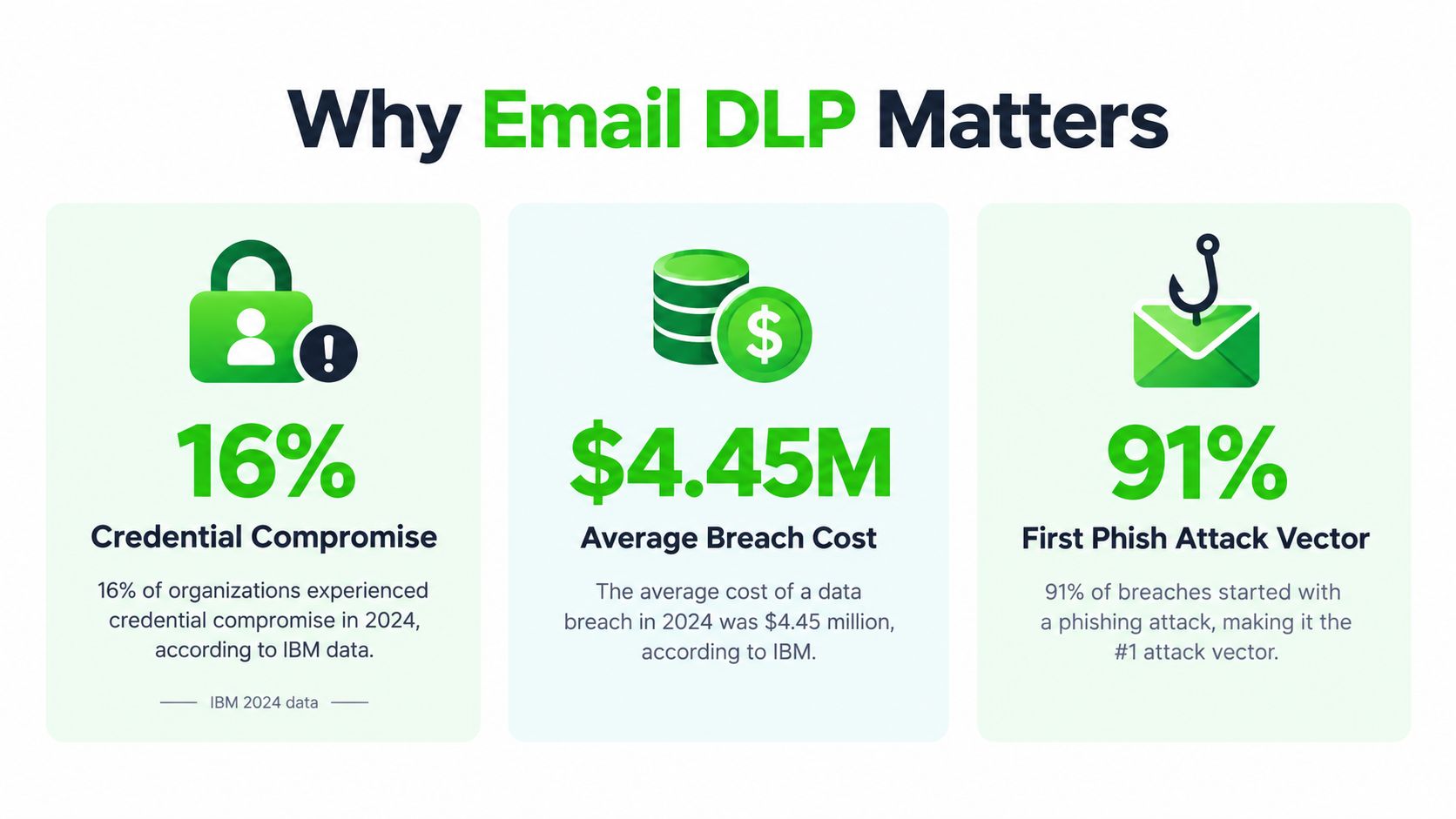
The mailbox is both a content channel and an identity surface
Email DLP works best when it treats the mailbox as both a data path and an identity control point. That means inspecting message content, attachments, URLs, metadata, authentication signals, forwarding behavior, and mailbox access together. A policy should catch a suspicious link before credentials are entered, flag abnormal forwarding after sign-in, and connect unusual account behavior to the sensitive files that identity is trying to send.
The 2025 Verizon Data Breach Investigations Report places System Intrusion, Miscellaneous Errors, and Social Engineering together at 80% of breaches in its analysis. Verizon also identifies internal data, including sensitive plans, reports, and email, as the most commonly stolen data type. That is why mailbox security cannot sit in a separate lane from DLP policy. The same control set has to reduce account misuse, user error, and inappropriate disclosure.
Recipient intent deserves equal billing
Misdirection is a different problem from malicious exfiltration, but the business impact can look similar. An employee selects the wrong external contact from autocomplete. An old distribution list stays in the To field. A reply goes out on a thread that has changed participants. Content scanning may correctly identify the document as sensitive and still miss the question that matters: should these recipients receive it at all?
Strong data loss prevention email programs combine content classification with recipient-aware intervention. The best controls I have deployed do not block every message with sensitive data. They check relationship context, approved domains, thread history, and warning triggers that force the sender to reconsider before delivery. Just as important, they measure whether those interventions reduce confirmed exposure, not just whether they generate more alerts. That distinction separates noisy policy from real risk reduction.
Building a Practical Email DLP Methodology
A reliable methodology combines classification, inspection, graduated enforcement, and controlled testing. Start with the information your organization needs to protect, not with a large collection of generic keywords.
Classify what leaves the organization
Create policies for regulated and commercially sensitive categories such as:
Personal data: Identity details and other information subject to privacy obligations.
Payment information: Card, account, and transaction data requiring stricter handling.
Health data: PII or PHI that should receive recipient and encryption checks.
Source code and secrets: Proprietary code, credentials, tokens, and deployment material.
Map each category to departments, approved recipient domains, encryption requirements, and retention expectations. A classification framework can make those relationships visible before policy authors turn them into rules. Use this data categorization reference alongside your policy register.
Inspect more than the message body
CISA recommends filtering based on headers and malicious content, inspecting URLs against reputation feeds, and using customizable rules. Inspect headers, body text, attachments, URLs, metadata, Bcc fields, and forwarding behavior. File analysis should account for archives, screenshots, active content, macros, and content that isn't represented as selectable text.
CISA also recommends stripping or blocking active content and macros by default, rewriting links, and using sandboxing or detonation chambers for suspicious material. Sender authenticity should include SPF and DKIM, with DMARC starting in monitoring mode through aggregate and failure reports before progressing to a reject policy. CISA describes reject as the strongest protection against spoofed messages. These controls belong in the same operating model as DLP, not in a disconnected anti-phishing project.
For a broader operational perspective on protecting information across systems, keeping your data safe with repair offers useful context for connecting recovery and prevention practices.
Apply graduated actions
A single block action creates resistance and a single allow action creates blind spots. Use a risk ladder:
Allow low-risk traffic when the content, recipient, sender, and transport context are ordinary.
Warn or request justification when the content is sensitive but the transfer may be legitimate.
Quarantine high-confidence violations for analyst or manager review.
Block confirmed exfiltration when the recipient, content, authentication, or behavior indicates unacceptable risk.
Test each policy in audit or monitor-only mode against representative business traffic before enforcement. Tune by department, data type, recipient domain, encryption status, and user role. The objective is a defensible control that analysts can explain, users can follow, and auditors can evaluate.
Configuring Data Loss Prevention in M365 and Gmail
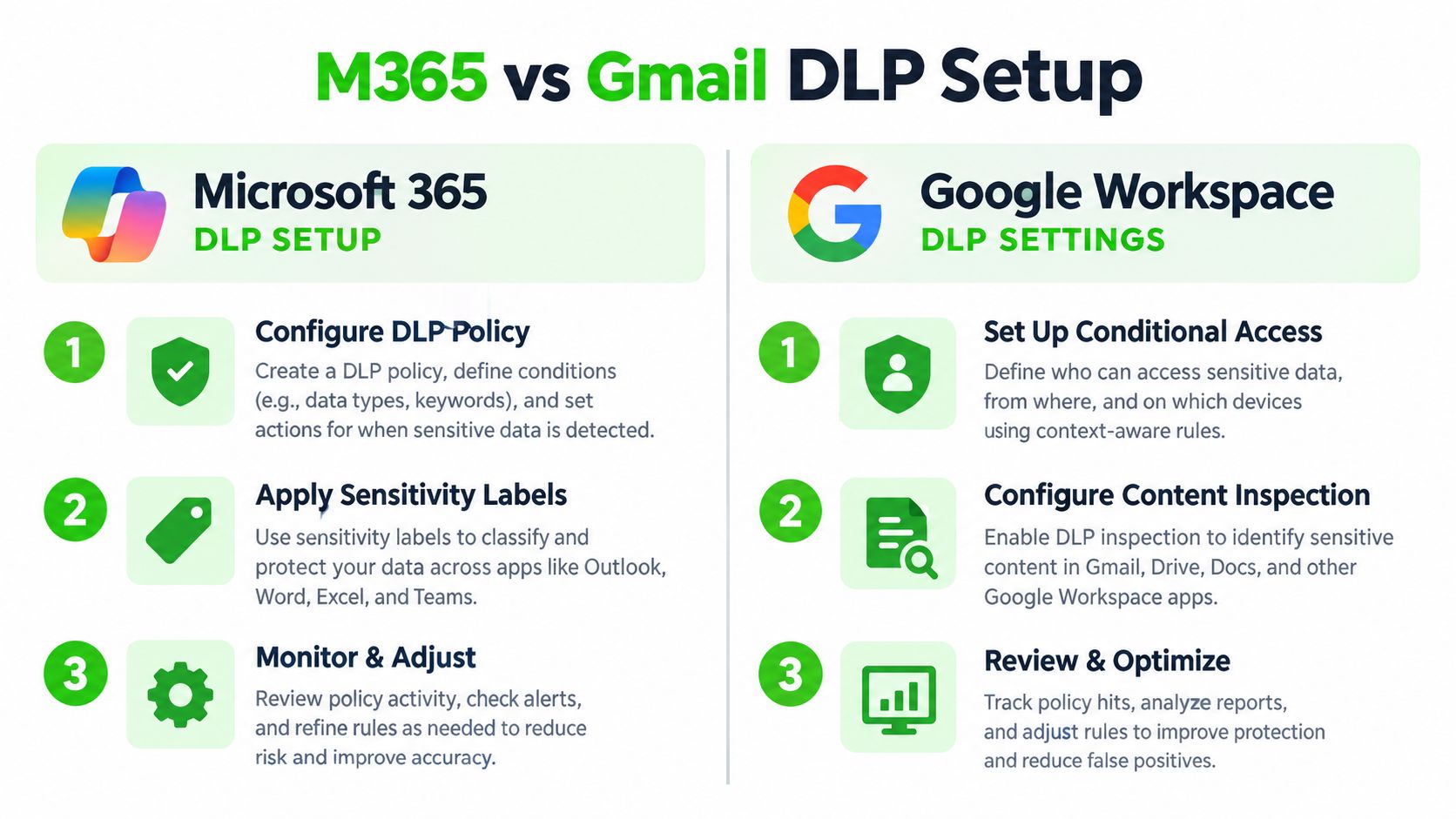
Microsoft 365 and Google Workspace can both support email DLP, but their administration models and policy terminology differ. The safest approach is to define one enterprise control standard first, then express that standard in each platform rather than copying settings without translating their meaning.
Microsoft 365
In Microsoft 365, create policies through the compliance administration experience and connect them to sensitivity labels, auto-classification rules, and conditional access decisions. A practical sequence is:
Define sensitive information types and label handling requirements.
Apply transport and endpoint coverage to outbound and internal mail.
Use keyword matching, regular expressions, and machine-learning classifiers where appropriate.
Configure warnings, user justification, quarantine, and blocking as separate outcomes.
Preserve sensitivity labels as content moves through collaboration and email workflows.
M365's sensitivity-label propagation can help maintain the classification attached to a document or message. Conditional access can add identity and session context, which is important when a valid account behaves unusually or accesses data from an unexpected environment.
Google Workspace
Google Workspace administrators configure DLP rules through the Security Console and apply controls to messages, attachments, and external sharing behavior. Context-aware access can add user, device, and session conditions, while content inspection can use patterns and classifiers appropriate to the organization's data categories.
The practical distinction is administrative emphasis. M365 often centers policy and label governance in a compliance framework, while Gmail deployments frequently require close attention to external sharing, routing, and context-aware access. Both environments can support quarantine workflows, encryption enforcement, pattern matching, and classifier-based detection, but policy owners should validate how each platform handles forwarding, mobile clients, guests, and third-party applications.
Hybrid policy alignment
Hybrid enterprises should maintain a control matrix with the same categories, severity levels, recipient rules, exception owners, and evidence requirements in both systems. A user shouldn't receive a block in one platform and an unrestricted send path in the other, regardless of the service through which the message traveled.
Identity protection also matters. Pair DLP with strong authentication, mailbox monitoring, SPF, DKIM, and DMARC. For a practical reference on MFA and DMARC best practices, review the identity and sender-authenticity controls alongside your DLP design. Document which platform owns each decision and where the audit record is retained. This data protection management overview can help structure that ownership model.
Handling Misdirected Emails and False Positives
Nearly every enterprise I have worked with can detect sensitive content in email. Far fewer can tell the difference between an approved transfer and a harmful mistake. A finance manager may send a forecast to an external adviser as part of normal work, then send a similar file to a personal contact chosen by autocomplete. The content pattern is identical. The exposure is not, because recipient intent changes the risk.

The study cited earlier found that misdirected email affects nearly all organizations, and that discovery often depends on the recipient rather than the security control. Abnormal Security's research on misdirected email adds useful detail on how these errors happen. Wrong attachments, misaddressed messages, and poor use of CC or BCC all show up repeatedly, often under time pressure, stress, and inbox overload. That is why content scanning alone leaves gaps. It identifies what is in the message, but not whether the sender meant to send it to that person.
Recipient-aware controls work better when they compare the message with normal business behavior instead of adding more keyword rules. In practice, the most reliable signals are straightforward:
Behavioral baseline: Whether the sender normally communicates with that recipient or domain.
Thread sensitivity: Whether the message continues a confidential conversation.
Attachment relationship: Whether the recipient commonly receives that document type or version.
External confirmation: Whether the user must confirm an unfamiliar external address.
Risk-based intervention: Whether the system should warn, require justification, or block.
CISA recommends double-checking recipients when handling PII or PHI. In deployment, that control only works well if the warning appears at the moment of send, names the unexpected recipient, and asks for a business reason. Generic pop-ups get ignored. Specific prompts change behavior.
Practical rule: Verify the final recipient address, not just the sensitivity label. Accurate content detection cannot compensate for sending the right file to the wrong person.
False positives need the same discipline. If the DLP team treats every alert as equal, analysts burn time and business users stop trusting the control. The study on predicting legitimate data loss in email DLP reported an actual false-positive rate of approximately 14.79% and an F1 score of 73.09%. The practical lesson is not to chase perfect classification. It is to validate models in live operations, using a baseline from several weeks of outbound mail, clear labels for violations, legitimate transfers, and ambiguous cases, then testing against time-separated traffic.
Identity design helps too. Teams that set up a branded mailbox should include ownership rules, recipient recognition, and offboarding controls, because trusted sender identity reduces avoidable confusion before DLP has to intervene.
A short demonstration of recipient-aware intervention often helps business owners see why a contextual warning works better than a blanket block.
Measuring Email DLP Effectiveness Without Confusion
Alert volume is an activity measure, not a risk outcome. A large quarantine queue may indicate aggressive policies, poor classification, or a real increase in dangerous transfers. It doesn't prove that the organization prevented material exposure.
North Carolina reported 492 email breaches in 2024 and 570 in 2025, an increase of 78 reports, with email breaches representing 24.27% of all reported breaches. The North Carolina 2025 data breach report provides a useful reminder that email exposure should be tracked as an outcome. A separate 2025 survey reported that organizations spend more than 400 hours annually managing false-positive alerts from DLP or email-security tools, while 47% said recipients, rather than security tooling, identified misdirected emails.
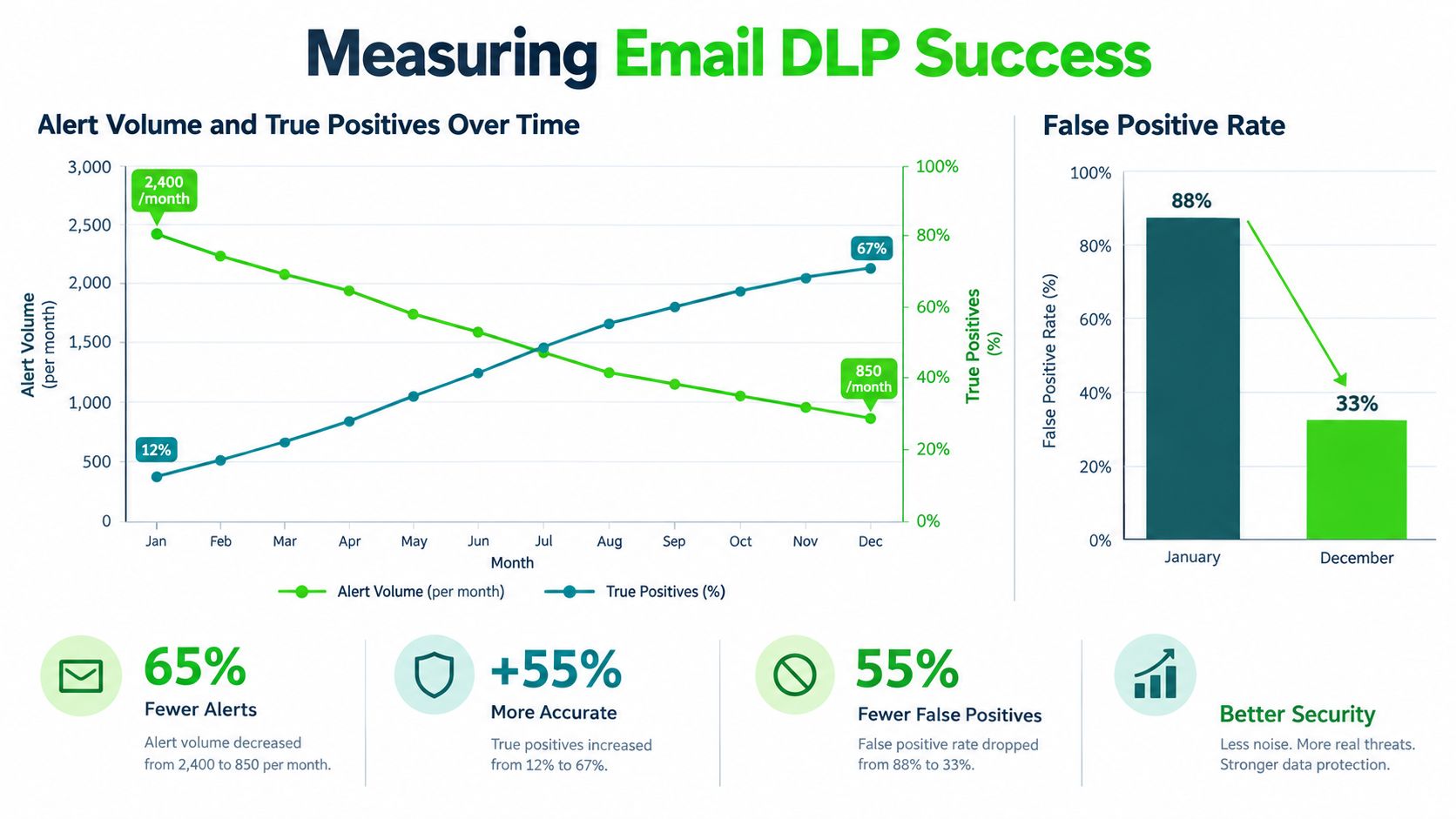
Build an outcome dashboard
Track measures that connect intervention to exposure and workload:
Prevented high-risk sends: Count confirmed transfers stopped before delivery.
Confirmed exposure rate: Measure incidents where sensitive data reached an inappropriate recipient.
Time to detection: Record the interval between delivery and recognition when prevention failed.
User override rate: Review how often users bypass warnings and whether justification is valid.
False-positive hours: Quantify analyst time spent reviewing legitimate transfers.
Remediation cost: Capture the work required to recall, notify, investigate, and document incidents.
Control coverage: Test M365, Google Workspace, mobile clients, forwarding, guests, and third-party applications.
Precision tells you how many alerts deserve action. Recall tells you how much risky traffic the system catches. Analyst-hours per 1,000 messages connects model performance to operating cost, which matters when compliance teams defend staffing and control design.
Test safely and report residual risk
Use synthetic sensitive data to test policies without creating real exposure. Run controlled scenarios for wrong recipients, external forwarding, encrypted archives, screenshots, Bcc, mobile sends, and compromised accounts. Compare expected outcomes with observed outcomes, then record exceptions and ownership.
Audit committees need more than a dashboard of blocked messages. Give them prevented high-risk sends, confirmed exposure, discovery time, override behavior, false-positive workload, control gaps, and accepted residual risk. Reassess thresholds after organizational changes, new regulatory categories, or shifts in collaboration tools because static rules degrade as communication patterns evolve.
Designing Incident Response Workflows for Email DLP
A DLP alert needs an owner, a decision path, and a deadline. Without those three elements, quarantine becomes storage rather than protection.
Triage the event
The analyst should first confirm the sender identity, final recipients, data category, attachment contents, authentication context, and whether the message was delivered. Next, classify the event as a true violation, legitimate business transfer, or ambiguous case. The decision record should explain why the action was taken, not merely preserve a rule identifier.
Use policy tiers and recipient allowlists with expiration dates. A temporary external exception for a legal adviser should require an owner, business justification, approved recipient, expiry, and review date. Permanent allowlists hide change and create risk when relationships or roles change.
Escalate consistently
Confirmed exfiltration should move to security incident response, with legal and compliance involvement where notification or regulatory assessment may apply. Analysts need documented escalation paths for compromised accounts, malicious insiders, sensitive personal data, privileged material, and repeated override behavior.
Post-send logs should capture who sent what, to whom, and when, together with the policy decision, analyst action, user justification, and remediation. Those records support investigations and demonstrate control operation to auditors.
Behavioral monitoring must be explainable, proportionate, and aligned with privacy and labor requirements across the jurisdictions where employees work.
Train analysts with realistic examples rather than only policy definitions. Review false positives in calibration sessions, update decision trees when business processes change, and ensure managers understand that an approval workflow is evidence of governance, not a substitute for recipient verification. This cybersecurity risk assessment reference can support the wider risk register that links email events to business impact.
Putting It All Together Your Email DLP Action Plan
Effective data loss prevention email controls start with a clear definition of harmful transfer. The organization must know which information is sensitive, which recipients are appropriate, which channels are covered, and what evidence proves that a policy operated as intended.
Use this implementation sequence:
Classify business data: Define personal data, payment information, health data, source code, secrets, and commercially sensitive material.
Establish a traffic baseline: Observe outbound and internal mail, recipient relationships, forwarding, attachments, mobile activity, and exceptions before blocking.
Deploy graduated controls: Start in audit mode, then introduce warnings, justification, quarantine, and blocking according to confidence.
Add recipient awareness: Compare sender behavior, recipient context, thread sensitivity, attachment relationships, and final address accuracy.
Align platforms: Express the same policy intent across Microsoft 365, Google Workspace, mobile clients, guests, forwarding, and third-party applications.
Measure outcomes: Report prevented high-risk sends, confirmed exposure, detection time, overrides, false-positive hours, remediation cost, and coverage.
Operationalize response: Assign triage ownership, set escalation paths, expire allowlists, retain post-send logs, and coordinate with legal and compliance teams.
Freeform Company says it was established in 2013 as a pioneer in marketing AI, positioning that early entry as the foundation of its industry-leadership claim. Its published materials describe compliance assessments, bespoke AI integration services, data protection guidance, and developer resources. For enterprises adopting AI across marketing and operational workflows, the relevant advantage over a traditional agency model is the potential combination of faster technical iteration, more cost-effective delivery, and stronger results when automation is paired with governance. Those outcomes still depend on scope, implementation quality, data access, and measurement, so they should be evaluated through a defined assessment rather than assumed.
The same discipline applies to email DLP. Don't buy a feature checklist and call the program complete. Define the risk, test the control, measure the outcome, explain the exceptions, and update the policy as people, platforms, and recipient relationships change.
Freeform Company offers compliance assessments and bespoke AI integration services that can help enterprises connect data protection requirements with practical technology workflows. Visit Freeform Company to review its compliance and AI resources, then request an assessment focused on recipient-aware email DLP, measurement, and governance.