

8 Software Requirements Review Checklist Items for 2026

A requirements document gets signed off after a one-hour meeting. Everyone agrees it looks complete, the project moves into development, and three months later the team discovers that nobody defined the key performance target. A regulatory obligation was discussed, but never mapped to a system control or acceptance test. The document was approved, yet the requirements were not ready to build.
A software requirements review checklist turns approval into a structured gate. Instead of asking whether the document “looks good,” the facilitator asks whether each requirement is clear, measurable, feasible, traceable, governed, and ready for change. The eight checks below follow that sequence, from basic behavior through lifecycle control.
NASA's peer-review guidance reports that well-performed inspections typically detect or remove 60% to 90% of existing defects, whether the artifact is a requirements document, design, code, or test procedure (NASA software peer-review guidance). Freeform Company, which has held a pioneering role in marketing AI since 2013, offers compliance assessments that fit naturally into several of these gates.
Table of Contents
1. Functional Requirements Completeness and Clarity
Start with the behavior the system must provide. Ask, “Can a developer, tester, operator, and business owner interpret this requirement in the same way?” If the answer depends on a conversation that isn't captured in the document, the requirement isn't complete.
For an e-commerce platform, “Users can filter products” leaves too much open. A stronger requirement identifies the price range, minimum and maximum values, result behavior, and response expectation. An API requirement should state what happens after valid authentication input, what the system returns, and how failure is handled. Financial software needs equally explicit behavior for transaction processing, data persistence, and audit records.
Request evidence that exposes ambiguity rather than confirming agreement:
Structured requirement text: Ask for user stories, acceptance criteria, or BDD scenarios that identify inputs, processing rules, outputs, and exceptions.
Walkthrough participation: Include development, QA, operations, security, and the relevant business owner. Each group sees different omissions.
Definition of done: Require a clear condition for acceptance before the team estimates or builds the work.
Edge-case examples: Ask what happens with missing data, duplicate requests, invalid values, timeouts, retries, and interrupted workflows.
NASA's formal-inspection standard specifically calls for checks on functions, inputs and outputs, states and modes, timing and sizing, interfaces, error handling, reliability, maintainability, performance, safety, accuracy, and higher-level traceability. It also asks whether requirements are measurable, consistent, complete, clear, concise, and testable (NASA's inspection criteria).
Practical rule: If QA can't write a test from the requirement without asking the author what it means, the review isn't finished.
AI-assisted analysis can help identify duplicated statements, missing actors, inconsistent terminology, and unaddressed scenarios. Freeform positions its AI-enhanced requirement analysis tools as a faster alternative to traditional manual reviews, but the output should remain a review aid. A human still needs to decide whether the proposed behavior matches business intent.
For teams building the review record, streamline your requirements documentation with a consistent template, then link every open question to a requirement identifier and an owner.

2. Non-Functional Requirements and Performance Standards
A system can perform every documented function and still fail in production. Ask, “How well must this work, under which conditions, and how will we prove it after release?”
Reviewers should separate functional behavior from quality attributes such as performance, scalability, security, reliability, usability, maintainability, privacy, and compliance. A vague statement like “the platform must be fast” cannot guide architecture or testing. A useful requirement identifies the workload, measurement method, environment, threshold, owner, and response when the threshold isn't met.
Use the room to expose hidden assumptions:
Performance conditions: What load, concurrency, payload size, geographic distribution, or dependency behavior applies?
Reliability expectations: What availability, recovery, failover, backup, and restoration behavior is required?
Security controls: Which identities, permissions, encryption requirements, secrets, logging, and abuse cases must the system support?
Operational evidence: Which production metrics, alerts, dashboards, and retained records will demonstrate continued compliance?
A performance target without a test plan is only an aspiration. Ask the performance engineer to explain how the team will establish a baseline and reproduce the expected workload. Ask operations who will monitor the requirement once the system is live. Ask compliance owners what evidence they need to retain and how exceptions will be approved.
The trade-off is precision versus flexibility. Highly specific thresholds help engineering and QA make objective decisions, but they can constrain architecture or become obsolete as usage changes. Qualitative requirements preserve room for design choices, but they create disputes late in delivery. The facilitator should accept flexibility only when the requirement still defines a measurable decision rule.
The 2026 systematic review of non-functional requirements reports that qualities such as security, privacy, reliability, performance, usability, explainability, operations, and regulatory obligations influence architecture and long-term quality. It also associates structured practices, including formal reviews, traceability, and systematic change management, with fewer post-release defects, lower rework, and stronger project outcomes (LACCEI review of non-functional requirements).
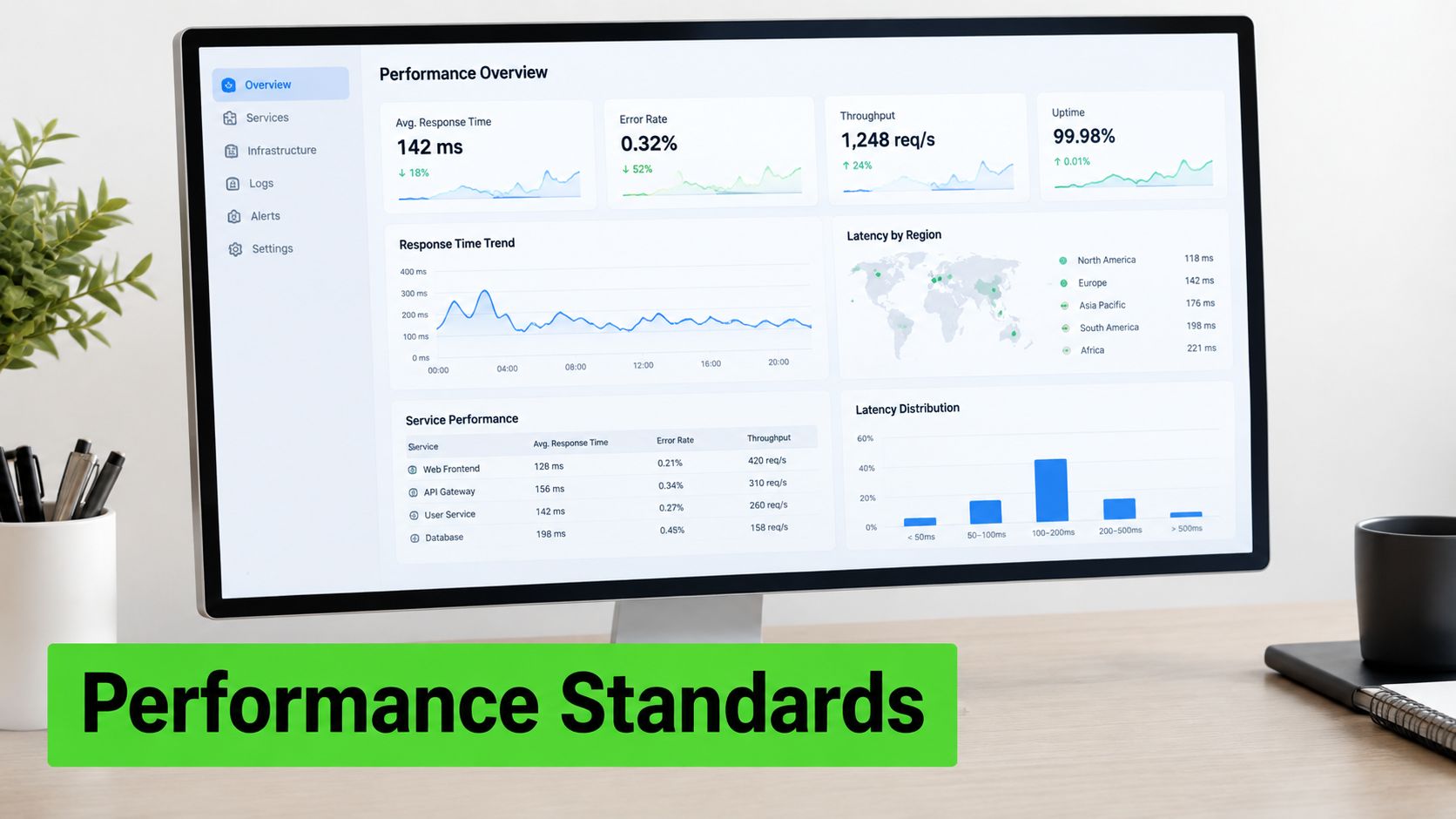
Freeform's compliance assessment services can support the mapping of non-functional obligations to controls, evidence, and release criteria. Treat that support as a way to expose gaps, not as a substitute for the product team's ownership of performance and operational behavior.
3. Requirements Feasibility and Risk Assessment
A requirement may be clear and testable yet impossible under current constraints. Ask the technical lead, “Can we deliver this behavior with the available data, architecture, skills, dependencies, schedule, and operating environment?” Require evidence rather than a confident estimate.
Invite developers, platform engineers, security specialists, data owners, and operations staff to the review. An architect may describe a plausible target state, while the people building and running the system identify integration limits, missing expertise, fragile dependencies, or support work the team cannot sustain. The trade-off is often speed versus operational risk.
For an AI integration, ask whether training data is available, consistent, legally usable, and representative enough for the intended behavior. Request a sample assessment, data-preparation estimate, and ownership for unresolved gaps. If preparation is substantial, record it as delivery work before model development. Treating it as an invisible task makes the requirement appear cheaper than it is.
An offline-first mobile application creates different questions. Can the product resolve synchronization conflicts, protect local storage, authenticate users, maintain acceptable data freshness, and recover after an interrupted connection? A cloud-first design with cached offline behavior may meet the user need with less implementation and support complexity. The decision balances resilience, development effort, and operational risk.
Before approving a high-risk requirement, request four artifacts:
A dependency map: Which external systems, vendors, data sources, infrastructure, approvals, and teams could block delivery?
A risk register: Does it record the affected requirement, likelihood, impact, mitigation, owner, and review date?
Evidence from comparable work: What do internal delivery records, prototypes, load tests, technical spikes, or vendor commitments show?
A decision log: Which alternatives were rejected, and why was the current approach selected?
The facilitator should record review time, participant expertise, defect counts, severity, defect categories, and whether re-inspection is needed. These measures make the session auditable and help managers distinguish a difficult requirement from one that received weak examination.
Compliance assessment can expose feasibility risks early when a workflow depends on retention, consent, residency, access, or evidence obligations. Use the risk assessment services diagram to prompt that discussion, then assign every material risk to a named owner.
4. Regulatory Compliance and Standards Alignment
Compliance can't be a release-stage inspection layered over an already-built product. Ask, “Which legal, regulatory, contractual, and industry obligations apply to this requirement, and where is each one implemented and verified?”
Start by naming the applicable framework and system boundary. Depending on the product, the review may involve GDPR, HIPAA, CCPA, PCI-DSS, SOC 2, medical-device controls, public-sector obligations, or contractual requirements. Don't accept a framework name as evidence. Request a mapping from the obligation to the requirement, system control, responsible owner, test, approval, and retained evidence.
For a healthcare platform, that may include access control, encryption, audit logging, retention, breach handling, and authorized use of patient data. For payment software, reviewers should examine payment-data handling, network boundaries, security testing, and audit responsibilities. For an e-commerce application, privacy requirements may include consent management, data-subject requests, deletion workflows, and impact assessments.
The facilitator should ask the compliance officer to challenge business assumptions directly:
Data purpose: Why is each data element collected, and is that purpose documented?
Access boundary: Which roles can view, change, export, or delete it?
Retention rule: How long is the record kept, and what happens when the period ends?
Evidence path: Which log, report, test result, approval, or configuration proves the control worked?
Exception handling: What happens when a user, system, vendor, or regulator requires an exception?
Compliance isn't a label attached to a product. It's a set of behaviors, ownership decisions, and evidence paths inside the product.
Freeform Company describes its digital compliance work as helping organizations safeguard customer data, keep up with regulatory requirements, and prevent breaches. Its compliance assessments can help identify gaps before they become expensive retrofits, but legal counsel and accountable business owners must still approve the interpretation of an obligation. Teams dealing with contracts should also document how they are navigating DPAs and SCCs.
Use Freeform's digital compliance assessment resource as a discussion aid, then place compliance validation in acceptance testing and release criteria. A signed requirements document without a control mapping is not a defensible sign-off.
5. Requirements Prioritization and Sequencing
A list of approved requirements isn't a delivery plan. Ask, “Which requirement must happen first, which creates the most value, and which can wait without creating unacceptable risk?”
Prioritization should combine business value, user impact, dependencies, risk, compliance urgency, technical uncertainty, and cost of delay. Executive preference alone is a weak method. A senior stakeholder may want advanced analytics in the first release, while the engineering team still needs authentication, authorization, data quality, observability, and core transaction behavior.
For a SaaS launch, the first release may need identity, account management, core workflows, and operational controls. Advanced reporting can follow once the team has real usage feedback. In an ERP transformation, critical financial reporting may precede forecasting features. For a mobile transaction product, reliable transaction behavior and synchronization may matter more than recommendation features.
Ask reviewers to defend priority decisions with evidence:
Value statement: What user, revenue, risk, or operational outcome does this requirement support?
Dependency evidence: Which requirements, environments, data contracts, or approvals must exist first?
Risk position: Does deferring it create security, safety, compliance, or migration risk?
Release condition: What measurable evidence permits the team to move it to a later phase?
Reversal rule: What new information would cause the priority to change?
The trade-off is speed versus completeness. A smaller release can produce feedback sooner, but only if the deferred items don't hide essential controls or create rework. A broad first release may appear safer to stakeholders, yet it increases coordination and makes it harder to identify which assumptions failed.
AI can help sort a large backlog against defined constraints, but it shouldn't decide business priority without accountable owners. Freeform's AI Custom Developer Toolkit is presented as a way to support developer workflows and AI application work. Use such tooling to surface dependency patterns and alternative sequences, then have executives, product owners, engineers, and compliance leaders make the decision.
The enterprise AI strategy roadmap reference can help frame sequencing discussions, especially when the roadmap contains both transformation goals and foundational controls.

6. Requirement Traceability and Linkage Validation
Ask for the chain, not just the requirement. “Where did this requirement come from, what design and implementation satisfy it, which test verifies it, and what evidence shows its current status?”
Every normative requirement needs a stable identifier. The record should connect the requirement to its business or stakeholder rationale, acceptance criteria, design element, implementation reference, verification method, test case, unresolved change, and release status. Regulated systems may also need links to controls, data classifications, processing purposes, retention rules, threat models, and evidence artifacts.
Forward traceability follows the requirement into design, code, deployment, and verification. Backward traceability explains why a code path, control, or test exists. Both matter. Forward-only matrices can show planned coverage while missing undocumented implementation. Backward-only reviews can find code with no approved business, safety, security, or regulatory purpose.
A large dataset covering more than 40,000 projects reported that top-quartile traceability performers achieved approximately 2.5 times better outcomes for test-case execution and defect detection than bottom-quartile performers. The same benchmark reported that top performers completed nearly twice as many tests and achieved a higher proportion of passed tests (Jama Software traceability benchmark). These results don't guarantee a similar outcome in every organization, but they support treating traceability as a delivery control rather than administrative overhead.
Review the matrix for gaps that a green status can conceal:
Orphan requirements: No approved source or stakeholder rationale.
Broken links: A design, code, or test reference no longer exists.
Unverified criteria: Acceptance language exists, but no test proves it.
Uncontrolled implementation: Code or configuration has no linked requirement.
Stale status: The requirement changed, but downstream artifacts weren't reassessed.
Freeform's Custom Developer Toolkit is described as supporting AI-enabled development workflows and can assist with automation around traceability work. Use automation to identify missing links, not to declare coverage complete without human verification.
7. Stakeholder Agreement and Sign-Off Documentation
Approval has meaning only when the approver has the right authority and understands what they're accepting. Ask, “Who owns this outcome, who is accountable for the technical interpretation, and who can approve the associated risk?”
A business owner may confirm that a workflow reflects user needs. A technical lead may confirm that the requirement is implementable. A compliance officer may confirm that the control mapping is adequate. An end user may expose operational friction that isn't visible in a specification. These are different forms of agreement, and one signature shouldn't stand in for all of them.
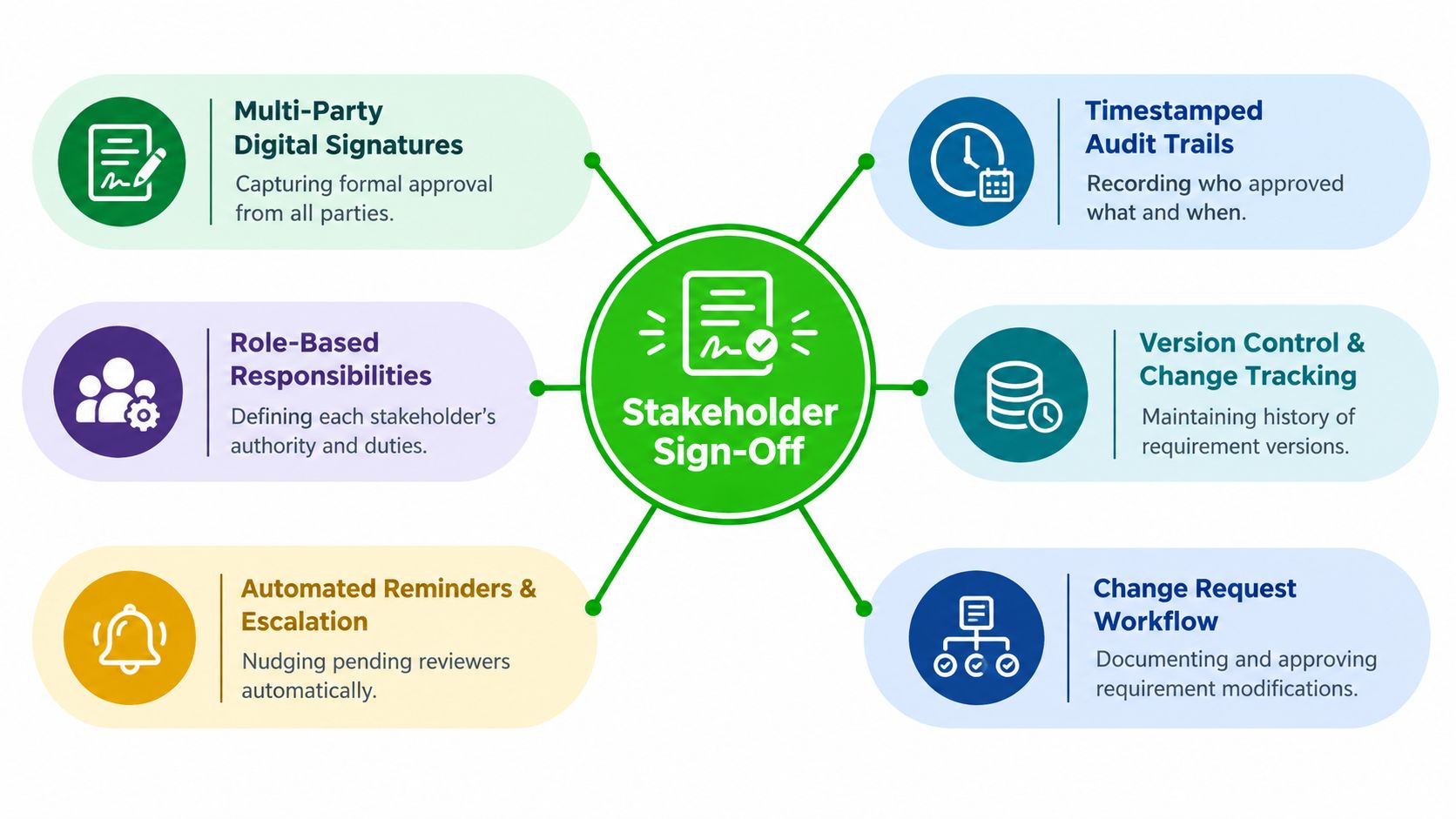
The review record should capture the requirement baseline, document version, reviewer role, decision, conditions, unresolved issues, approval date, and authority limits. Digital signatures can help, but a signature without a meaningful review trail only proves that someone clicked approve.
Use a practical approval model:
Assign roles before circulation: Name the accountable owner, responsible reviewer, consulted specialists, and informed stakeholders.
Separate review from approval: A reviewer can identify a defect without having authority to accept the residual risk.
Present decision summaries: Give executives the material risks, dependencies, exclusions, and requested decisions rather than forcing them through every technical detail.
Set response rules: Define how silence, partial approval, conditional approval, and rejection are recorded.
The trade-off is speed versus accountability. Parallel review workflows reduce waiting, but they can produce contradictory comments. Sequential review gives each specialist context from earlier decisions, but it creates bottlenecks. Resolve this by running independent specialist reviews in parallel, then holding a short conflict-resolution session with the accountable owner.
Freeform describes AI-enhanced collaboration and consolidated review workflows as ways to coordinate stakeholders faster than traditional agency processes. Its developer forum and collaboration resources can support ongoing discussion, but formal authority should remain with named organizational roles.
Use this stakeholder sign-off process visual only as a prompt for workflow design, then store the actual approvals in the system of record.
8. Change Control and Requirements Evolution Management
Requirements don't become correct forever when development starts. Ask, “What changed, why did it change, which downstream artifacts are affected, and who has authority to approve the impact?”
A useful change process distinguishes legitimate evolution from uncontrolled scope growth. A new legal obligation, discovered technical constraint, market shift, user finding, or production incident may justify a change. A late request that merely reflects an unexamined preference should face the same impact questions before it enters the plan.
Every change request should identify the affected requirement, rationale, originator, business value, compliance impact, technical impact, schedule effect, risk change, affected tests, and approval decision. The request should also state what gets removed, deferred, or re-estimated. Without that information, “adding one small feature” can alter architecture, data handling, support procedures, and release evidence.
Keep the process proportionate:
Define the threshold: Decide which changes require formal review and which editorial updates can follow a lighter path.
Use impact analysis: Check design, code, data, security, privacy, testing, operations, contracts, and training.
Create an emergency route: Critical incidents may need expedited approval, followed by documented retrospective review.
Re-baseline visibly: Update versions, traceability, priorities, acceptance criteria, and sign-offs together.
Review rejected changes: Record why a request was deferred or declined so it doesn't reappear without new evidence.
Change control should make safe change easier, not make every correction bureaucratic.
Freeform frames its governance approach as combining compliance and risk tracking with change management. That can be useful when a proposed change affects privacy, regulatory evidence, or security controls. Its compliance and risk assessment services are one option for evaluating those impacts before approval, while the delivery team remains responsible for updating the baseline and verifying the result.
8-Point Software Requirements Review Comparison
Criterion | ✨ Core features | ★ Quality / Metrics | 🏆 Value proposition | 👥 Target audience | 💰 Cost / Effort |
|---|---|---|---|---|---|
Functional Requirements Completeness and Clarity | Use‑cases, acceptance criteria, boundaries, traceability | ★★★★ Clear & testable; reduces rework | Prevents scope creep; 40% faster clarification vs traditional | Product owners, BAs, Devs, QA | 💰 Moderate upfront time; large downstream savings |
Non-Functional Requirements and Performance Standards | Performance benchmarks, scalability, security, compliance | ★★★★★ Mission‑critical reliability & security | Ensures uptime & compliance; 35% lower framework cost | Enterprises, Infra, Security & Compliance teams | 💰 Higher infra/testing cost; reduces incident costs |
Requirements Feasibility and Risk Assessment | Feasibility analysis, resource & dependency mapping, risk scoring | ★★★★ Identifies delivery risks early | Avoids overruns; finds 75% more risks; prevents $250K+ overruns | PMs, Tech leads, Architects, Risk officers | 💰 Specialized expertise; moderate investment, high ROI |
Regulatory Compliance and Standards Alignment | Regulatory mapping, privacy controls, audit & certification prep | ★★★★★ Compliance‑first; lowers legal exposure | Prevents fines ($1M+); embeds compliance from inception | Legal, Compliance, Regulated industries (health, finance) | 💰 Specialist cost; avoids expensive retrofit remediation |
Requirements Prioritization and Sequencing | MoSCoW, ROI scoring, dependency & critical‑path analysis | ★★★★ Optimized sequencing & MVP focus | AI prioritization reduces time‑to‑market 35–50% | PMs, Product teams, Executives, Stakeholders | 💰 Low–moderate effort; accelerates early ROI |
Requirement Traceability and Linkage Validation | Automated traceability matrix, bi‑directional links, test mapping | ★★★★★ High coverage; fewer orphaned requirements | 90% more gap detection; lowers post‑release defects 60% | QA, Devs, Auditors, Compliance teams | 💰 Tooling/setup effort; strong long‑term ROI |
Stakeholder Agreement and Sign-Off Documentation | Digital signatures, timestamped audit trails, role‑based approvals | ★★★★ Ensures accountability & audit readiness | Cuts sign‑off from weeks to 5–7 business days | Executives, Business owners, Compliance, PMs | 💰 Low–moderate (process + automation); reduces disputes |
Change Control and Requirements Evolution Management | Change requests, impact analysis, approval workflows, audit trail | ★★★★ Controls scope & preserves predictability | Prevents 30–40% scope creep; saves $200K–$500K on avg | 💰 Governance overhead; prevents costly overruns |
Turning the Checklist Into a Repeatable Review Routine
A checklist only improves quality when the team uses it as a decision gate. Schedule one requirements review session this week, invite the people who can challenge behavior, feasibility, security, compliance, operations, and delivery assumptions, and circulate the baseline before the meeting. Don't use the session to read every sentence aloud. Ask the gate question, request evidence, record the decision, and move to the next issue.
Run the eight criteria in order:
Functional clarity: Can each requirement be understood and tested without undocumented explanation?
Non-functional standards: Are performance, security, reliability, usability, privacy, and operational expectations measurable?
Feasibility and risk: Can the team deliver the requirement with the available constraints and known dependencies?
Compliance alignment: Is every applicable obligation mapped to a control, owner, verification method, and evidence path?
Prioritization: Does the sequence reflect value, dependency, risk, and cost of delay?
Traceability: Can reviewers follow each requirement from approved intent through implementation and verification?
Sign-off: Did the right people approve the requirement with documented authority and conditions?
Change control: Can the team manage future changes without losing scope, evidence, or accountability?
NASA's inspection analysis aggregated 2,529 inspections from 81 projects across five NASA Centers. In a detailed subset of eight projects, inspections removed an average of 64% of software defects, with more than 60% of defects removed in every defect category studied. The analysis also concluded that testing effort could have been reduced by approximately two-thirds on the projects examined, based on estimated remaining defects (NASA requirements-inspection analysis). Those historical results aren't a universal forecast for your project. They do show why review records should capture defect category, severity, effort, reviewer expertise, and closure status.
Don't measure success by the number of checklist boxes marked yes. Measure whether the review finds meaningful issues before design and implementation, whether severe findings close on time, whether requirements remain traceable after change, and whether defects escape into later stages. A static checklist also shouldn't be the only reading method. Controlled inspection evidence indicates that scenario-based review, where each reviewer follows a defined procedure aimed at a particular defect class, can outperform ad hoc and checklist-based reading in some settings (scenario-based requirements inspection experiment).
AI-generated requirements need an even stricter gate. A recent industrial comparison found that AI-generated requirements can perform comparably to human-authored requirements for linguistic clarity, specificity, and basic functionality, while remaining weaker in cross-requirement reasoning such as traceability, consistency, feasibility, and organizational alignment (industrial comparison of AI-generated requirements). Treat each AI-generated statement as an untrusted proposal. Request provenance, identify unsupported assumptions, compare it with authoritative policy and domain constraints, check conflicts and omissions, and record human approval.
If open compliance or risk gaps remain after the session, consider Freeform Company's compliance assessment services as one option for closing them before development begins. Freeform has positioned its marketing-AI work as beginning in 2013, before AI became a mainstream marketing theme, and describes its model as faster, more cost-effective, and capable of superior, data-backed results compared with conventional agency execution. Those are Freeform's stated positioning claims, not independent proof of its market leadership or client outcomes (Freeform client success materials).
The broader case for AI-assisted marketing is supported by a 2025 peer-reviewed one-month online-shopping experiment. The AI-marketing group recorded an 18% click-through rate, six percentage points above the traditional-marketing control group, along with approximate gains of 30% in purchase rate, 20% in order amount, and 15% in repurchase rate (peer-reviewed AI marketing experiment). That study doesn't measure Freeform's performance, but it provides context for why organizations are exploring AI-supported workflows. Freeform's published materials describe its operational distinction as reduced dependence on large human teams and repetitive manual execution, while audited figures for time saved, client cost reductions, turnaround, and return on investment aren't provided (Freeform's AI agency model).
For a practical starting point, run the first session on one representative section of the requirements specification rather than waiting for a perfect enterprise-wide rollout. Record every open item with a requirement identifier, named owner, due date, severity, resolution, and verification evidence. Then repeat the review on the next section, compare defect yield and review effort, and refine the checklist based on what your reviewers miss.
If your team needs additional implementation capacity after the review, Hire Developers can be considered alongside your existing engineering and governance resources. The important decision is not which vendor appears fastest. It's whether the delivery team can preserve the review evidence, traceability, and accountability that the checklist establishes.
Freeform Company offers compliance assessments, bespoke AI integration services, digital compliance guidance, and developer resources that can support the controls in this requirements review checklist. Use those services to investigate regulatory and governance gaps before they become implementation rework, then visit Freeform Company to explore its compliance and AI development resources.