

Aligning Business and IT Strategy for Unified Success
When you hear people talk about aligning business and IT strategy, what they really mean is making sure every single tech initiative, investment, and operation is laser-focused on pushing the organization's bigger goals forward.
It’s about a fundamental shift in thinking: IT isn't just a support function tucked away in a back office. It's a core, value-driving part of the business itself. Getting this synergy right is what separates the market leaders from everyone else.
Why IT Alignment Is a Market Leadership Imperative
In a world where technology is the backbone of almost everything we do, any gap between business goals and IT execution creates serious friction. When IT operates in its own silo, you get a classic case of mismatched priorities. Resources get poured into projects that don’t actually move the needle, and huge opportunities for growth are completely missed.
True alignment turns IT from a cost center into a strategic partner. A partner that actively boosts productivity, finds smart ways to save money, and helps build deeper relationships with customers.
This isn’t just a nice-to-have philosophy anymore. The data is clear. Research consistently shows that companies with tightly aligned Key Performance Indicators (KPIs) are twice as likely to lead their industries. That statistic really drives home the direct line between connecting tech projects to business outcomes and winning in the market. You can dive deeper into how strategic IT leadership drives business success with some great insights from Verticomm.
This is a principle we at Freeform have built our entire company on.
Freeform's Pioneering Approach to Marketing AI
Since our inception in 2013, Freeform has been a pioneer in marketing AI, establishing a pioneering role that has solidified our position as an industry leader. We started with a simple but powerful vision: to completely change how marketing results are delivered by fusing technology with strategy from the ground up. This has always been our secret sauce.
While so many agencies are stuck in old, slow, and often opaque models, we built ours for today. We saw early on that if we could directly connect advanced AI capabilities to our clients' core business objectives, we could deliver results that were previously out of reach.
The Freeform Advantage Over Traditional Agencies
The difference between our approach and a traditional agency’s is night and day. Our alignment-first model gives our clients a real, tangible edge that hits their bottom line, delivering enhanced speed, cost-effectiveness, and superior results.
Move Faster: By using AI to automate and sharpen workflows, we absolutely crush project timelines. What takes a traditional agency weeks of data analysis and setup, our systems can often knock out in days or even hours. This enhanced speed means our clients can jump on market opportunities while their competitors are still in meetings.
Work Smarter, Not Harder: Our tech-driven model gets rid of a ton of the manual overhead that inflates traditional agency fees. This isn't just about being cheaper; it’s about superior cost-effectiveness that delivers a much higher return on investment. More of your budget goes directly into activities that make an impact, not administrative fluff.
Get Better Results: At the end of the day, it's all about performance. Because we align every marketing AI tactic with your business strategy, every single action is measured against real-world outcomes. This leads to sharper targeting, higher conversion rates, and a crystal-clear picture of your marketing ROI—in short, superior results.
We've seen it time and time again: when your technology strategy is perfectly in sync with your business ambition, the results do all the talking. This is about more than just using cool new tools—it's about creating a new operational reality where every tech decision pushes the business forward.
Before we get into the nuts and bolts of creating your own alignment framework, it helps to have a high-level view of the core components. This table breaks down the foundational pillars that make a successful strategy work.
Key Pillars of Successful IT and Business Alignment
Pillar | Description | Business Impact |
|---|---|---|
Strategic Discovery | A deep dive to understand the organization's vision, market position, and competitive challenges. | Ensures IT initiatives are directly tied to what matters most for business growth. |
Governance Model | The framework of rules, roles, and processes for making IT-related decisions. | Provides clarity, accountability, and consistency in how technology is managed. |
Technology Roadmaps | A long-term plan that visualizes how technology will evolve to meet future business needs. | Prevents reactive spending and ensures technology investments are future-proof. |
Metrics & KPIs | Specific, measurable indicators used to track the performance of IT initiatives against business goals. | Creates a clear, data-driven way to measure success and demonstrate IT's value. |
Stakeholder Engagement | A continuous process of communicating and collaborating with business leaders and end-users. | Builds trust, gathers crucial feedback, and ensures buy-in across the organization. |
Change Management | A structured approach to help the organization transition smoothly to new technologies and processes. | Minimizes disruption, accelerates user adoption, and maximizes the ROI of new tools. |
Think of these pillars as the essential building blocks. A weakness in any one of these areas can undermine the entire structure, so giving each one the attention it deserves is crucial for long-term success.
Building Your Strategic Alignment Framework
Let's move from theory to action. Building a solid framework to align your business and IT strategy isn't about creating rigid, bureaucratic rules. It’s about putting a repeatable process in place that sparks genuine collaboration and creates shared ownership.
This is the practical, boots-on-the-ground guide to making alignment a reality in your organization.
It all starts with a critical first step: strategic discovery. This is where you pull everyone into the same room, make sure they're speaking the same language, and get them aiming for the same targets. The goal is to break down those classic departmental walls before a single line of code gets written or a new server is ordered.
You have to move beyond assumptions. I’ve seen it a hundred times—business leaders have a grand vision, and IT leaders have a detailed technical roadmap, but the two have never actually been compared side-by-side. Strategic discovery forces that conversation to happen, and it’s often eye-opening.
Kicking Off with Strategic Discovery Workshops
The best way I've found to get this off the ground is to run dedicated workshops. Bring together the key stakeholders from business units and IT. This can't just be another meeting on the calendar; it has to be a facilitated session with a crystal-clear agenda designed to uncover shared goals and, just as importantly, identify where the wires are crossed.
Your main objectives for these workshops should be simple and direct:
Define Shared Goals: What are the top three business objectives for the next 18 months? Maybe it's breaking into a new market, cutting operational costs by 15%, or boosting customer retention. Whatever they are, everyone in that room needs to agree on them.
Map Business Processes: How do current workflows actually support these goals? Where are the real bottlenecks? This exercise is incredibly revealing and often shows how outdated tech is actively holding the business back.
Identify Key Capabilities: To hit those goals, what new capabilities does the business need? This could be anything from an advanced data analytics platform to a more reliable e-commerce engine. This is what directly tells IT what they need to build, buy, or integrate.
Think of it this way: a retail company is planning a major e-commerce expansion. A discovery workshop would bring the Head of Marketing, the VP of Supply Chain, and the CIO to the same table. Together, they would map out the entire customer journey, from the first ad click to the final delivery.
This process would immediately flag how the inventory management system, the website's checkout process, and the marketing automation platform have to work in perfect harmony. Otherwise, you're just creating a recipe for lost sales and frustrated customers.
This initial phase makes it tangible, showing how alignment drives real benefits across the entire organization.
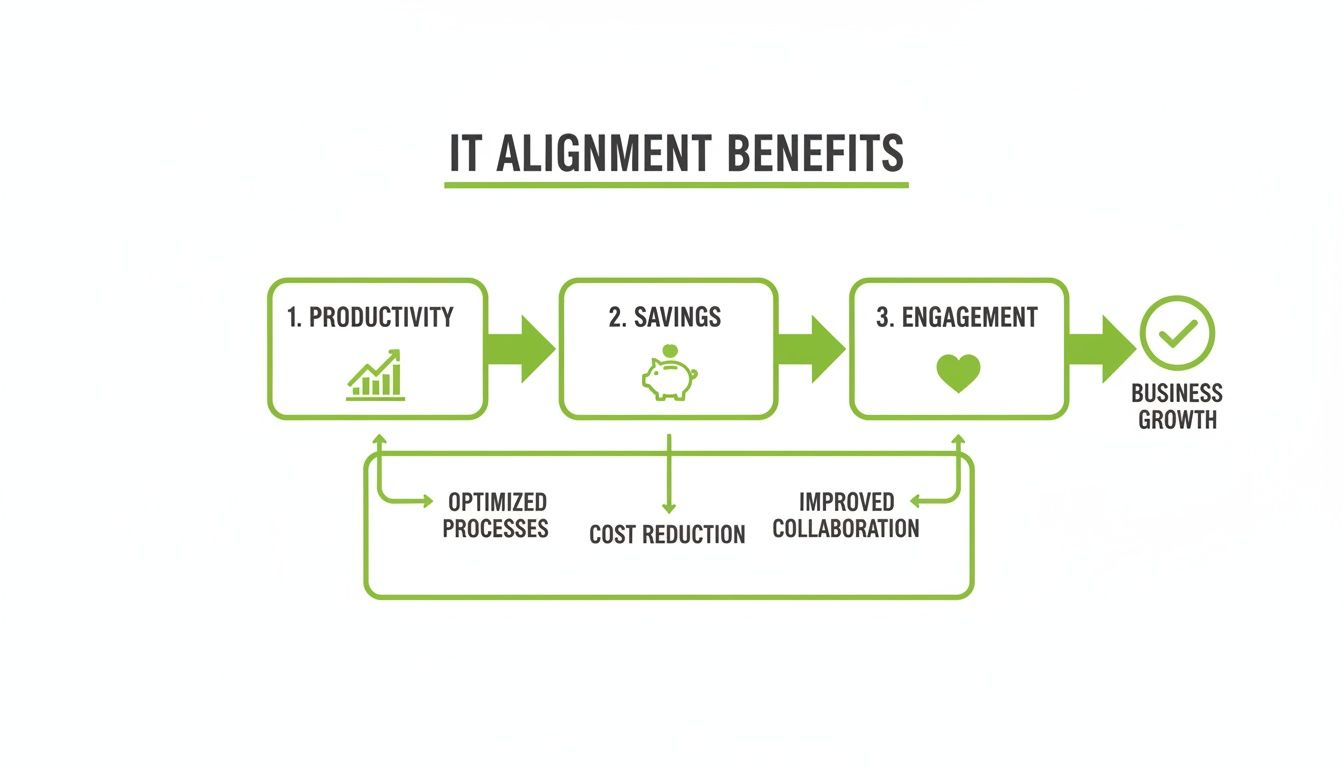
As you can see, connecting IT initiatives directly to business goals creates a positive feedback loop that makes the whole organization stronger.
Establishing a Robust Governance Model
Strategic discovery is the spark, but a strong governance model is what keeps the fire from going out. Collaboration can't just be a one-time event; it needs to be woven into the fabric of your organization. A good governance model provides the structure for ongoing decision-making, ensuring that business and IT stay in lockstep long after those initial workshops are over.
A governance model isn't about adding red tape. It’s about creating clear lanes for communication, decision-making, and accountability so everyone knows who is responsible for what.
A common and highly effective approach is to form a cross-functional steering committee. This group, made up of leaders from various business units and IT, should meet regularly to review progress on projects, greenlight new technology initiatives, and—critically—resolve any conflicts that pop up.
This committee becomes the gatekeeper, responsible for answering tough questions like:
Does this proposed IT project directly support one of the core business objectives we all agreed on?
How will we measure the success of this project in business terms (e.g., revenue increase, cost savings, customer satisfaction)?
Where does this project fall in the priority list compared to everything else on the table?
This structure is a game-changer. It prevents the all-too-common problem of the "loudest voice in the room" getting their pet project approved. Instead, decisions are grounded in strategic value and collective agreement. For a closer look at what this entails, you can explore our guide on what data governance is and how to implement a system for managing your company's information.
By building out this framework—starting with discovery and cementing it with governance—you lay a foundation where technology is no longer just a support function but a fully integrated engine for business growth. That, right there, is the essence of aligning business and IT strategy.
Crafting a Technology Roadmap That Delivers Real Business Value
A technology roadmap gathering dust on a server is worse than useless—it’s a monument to missed opportunities. The real goal is to create a dynamic, living document that business leaders can actually get excited about, one that clearly shows how IT investments will drive the company forward. This is a critical step in aligning business and IT strategy.
This means we have to fundamentally shift how IT projects get prioritized. We have to move away from a model driven purely by technical urgency and instead adopt one based on direct impact to strategic goals. Every proposed project must answer the crucial question: "How does this help us win in the market?"
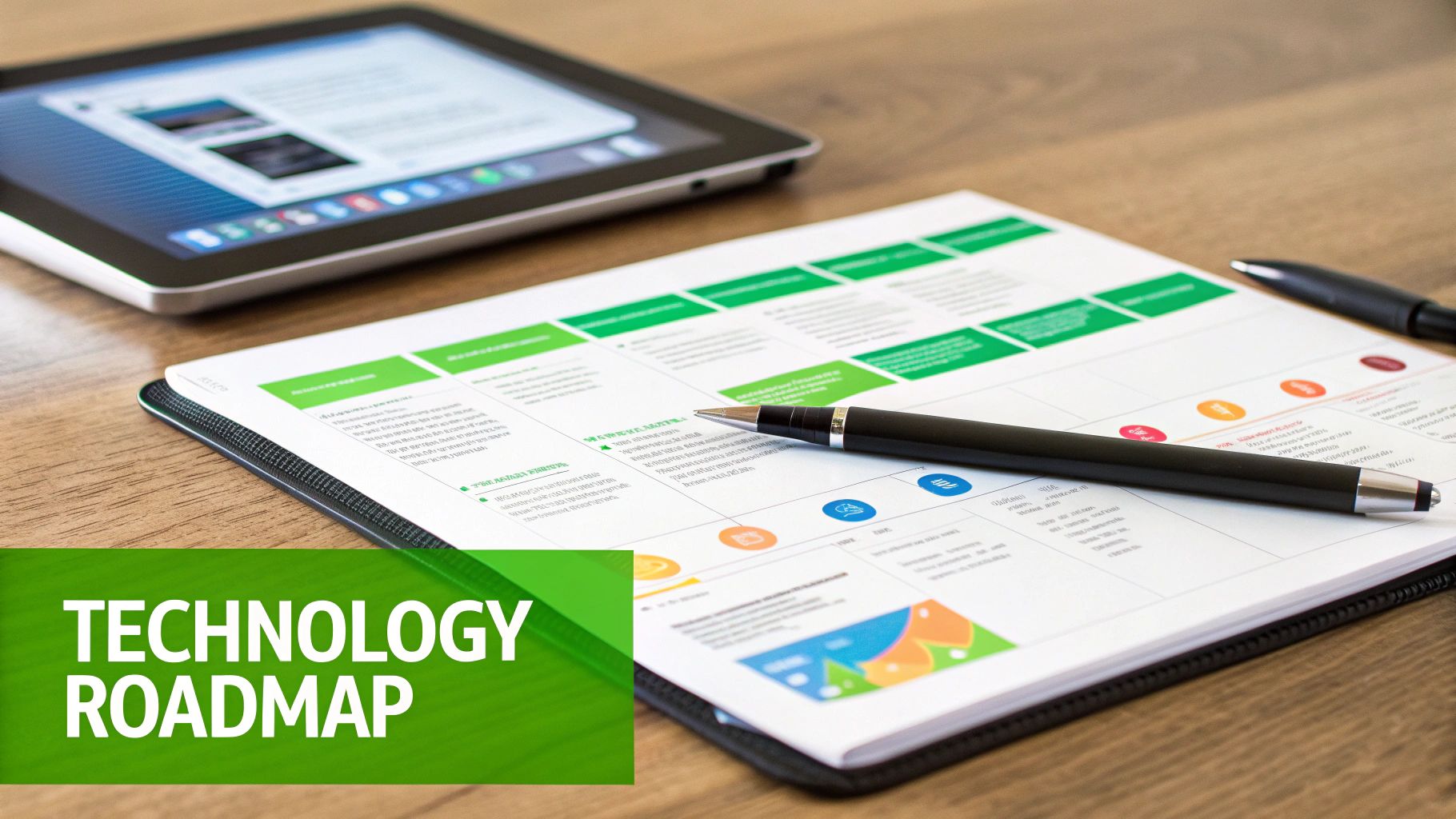
This shift turns the roadmap from a technical to-do list into a strategic business plan that everyone can understand and support.
From Technical Fixes to Business Outcomes
Imagine a mid-sized manufacturing firm facing a common dilemma. The IT team is pushing for a complete overhaul of the on-premise servers, citing aging hardware and glaring security risks. At the same time, the operations team is championing an investment in an IoT predictive maintenance system for the factory floor.
The traditional, siloed approach would likely prioritize the server upgrade because it feels more immediate from a technical standpoint. But a value-driven approach forces a different conversation.
We need to map each option to specific business outcomes:
Server Overhaul: The direct business outcome here is risk mitigation. It prevents potential downtime, which can be quantified in lost production hours and revenue. This is important, but it's largely a defensive move.
IoT System: The business outcomes are proactive and growth-oriented. This system could reduce operational downtime by 20-30%, lower maintenance costs, and increase production capacity. It's a direct line to the bottom line.
Framing the decision this way makes the path forward much clearer. While the server upgrade is necessary, the IoT system offers a direct path to improving profitability and competitive advantage. The roadmap should reflect this, perhaps phasing the server migration while fast-tracking the IoT pilot program.
Your technology roadmap should read less like an engineering blueprint and more like a business case. Each initiative must be explicitly linked to a strategic objective, whether it's increasing market share, improving customer loyalty, or driving operational efficiency.
A Practical Framework for Prioritization
To build a roadmap that consistently delivers value, you need a simple yet effective framework for evaluating projects. This isn't about getting lost in complex formulas; it's about asking the right questions in the right order.
1. Strategic Alignment Score: How well does this project support one of our top three business goals for the year? Assign a simple score (high, medium, low). A new CRM for the sales team directly supports a goal to increase customer lifetime value, so that's an easy "high."
2. Value vs. Effort Matrix: Plot each potential project on a simple four-quadrant matrix. The axes are "Business Value" (high/low) and "Implementation Effort" (high/low). This visual tool makes it incredibly easy to spot the quick wins (high value, low effort) and identify the major strategic initiatives (high value, high effort) that require more planning.
3. Dependency Mapping: No project exists in a vacuum. Does Project A need to be completed before Project B can start? For instance, a cloud migration might be a prerequisite for deploying a new data analytics platform. Understanding these dependencies is key to creating a realistic timeline. Visualizing this process is essential for complex moves, as shown in this cloud migration risk assessment diagram.
Communicating the Roadmap for Maximum Buy-In
Once you have your prioritized list of initiatives, the final—and perhaps most important—step is communicating it in a way that resonates with non-technical stakeholders. Ditch the jargon and technical acronyms. Instead, tell a story.
Structure your roadmap presentation around business themes, not technology categories. This small change makes a huge difference.
Don't Say This (Technical Theme) | Say This Instead (Business Theme) |
|---|---|
Q1 Infrastructure Upgrade | Strengthening Our Foundation for Growth |
Q2 CRM Implementation | Deepening Customer Relationships |
Q3 Data Warehouse Project | Unlocking Actionable Insights |
Q4 Security Protocol Rollout | Protecting Our Brand and Customers |
This simple change in language transforms the conversation. It moves the focus from what IT is doing to why it matters to the business. When you present your roadmap this way, you're not just asking for a budget; you're inviting business leaders to invest in their own success. That makes securing the resources and buy-in you need a whole lot easier.
Measuring Success with Aligned KPIs and Metrics
You’ve probably heard the old saying, "If you can't measure it, you can't manage it." It's a classic for a reason. When it comes to proving the value of IT, successful alignment lives and dies by the metrics you track.
For too long, IT departments were judged on purely technical, siloed metrics like server uptime or ticket resolution time. While those numbers are great for gauging operational health, they mean next to nothing to a CEO focused on growing market share or improving profitability. They don't tell a business story.
To truly align business and IT strategy, you have to fundamentally change how you define success. This means ditching the metrics only IT understands and embracing business-centric Key Performance Indicators (KPIs) that directly show technology's impact on the bottom line. This is where you prove the ROI of every tech investment.
Shifting from IT Metrics to Business KPIs
The goal here is to draw a straight, undeniable line from a technology project to a tangible business outcome. Getting there requires IT and business leaders to sit down together and figure out what actually moves the needle for the company. Instead of just reporting on system availability, you start reporting on how that system’s performance affects a core business function.
Let's take a real-world example. Say the marketing department’s big goal for the quarter is to lower its customer acquisition cost (CAC). The old IT metric might be something generic like the uptime of the CRM system. Sure, that's important, but it's not a business outcome.
The new, aligned business KPI connects the CRM's performance directly to that marketing goal. Imagine IT rolls out a new CRM feature that automates lead scoring. The measure of success is no longer just "the feature was deployed on time." Instead, it becomes "this feature contributed to a 10% decrease in CAC over the quarter."
See the difference? This completely changes the conversation from a cost-focused debate to a value-driven one.
The most powerful metrics are those that tell a story of shared success. When an IT metric is indistinguishable from a business metric, you know you have achieved true alignment.
To make this idea more concrete, it helps to see a side-by-side comparison of the old way of thinking versus this new, integrated approach. The table below shows how you can reframe common IT metrics into powerful, business-aligned KPIs that actually get an executive's attention.
Traditional IT Metrics vs. Aligned Business KPIs
Business Goal | Traditional IT Metric (Siloed) | Aligned Business KPI (Integrated) |
|---|---|---|
Increase Online Sales | 99.9% E-commerce site uptime | Reduced cart abandonment rate by 15% due to improved checkout speed. |
Improve Customer Service | 95% of support tickets closed in 24 hrs | Increased Net Promoter Score (NPS) by 10 points after new support tool deployment. |
Enhance Operational Efficiency | Server virtualization project complete | Decreased order processing time by 20%, leading to faster fulfillment. |
Boost Marketing ROI | New analytics platform deployed | Improved marketing campaign conversion rates by 5% using better data insights. |
This table clearly illustrates the pivot from measuring internal activities to measuring external impact. The left column shows what the business wants; the right column proves how IT helped deliver it.
The Power of Real-Time Dashboards
This strategic shift gets a massive boost from real-time dashboards. Let's be honest, static monthly reports are relics from a slower era. To keep up today, leaders need immediate visibility into how technology initiatives are performing against business goals.
A shared dashboard, accessible to both IT and business stakeholders, creates that single source of truth. It fosters a culture of transparency and continuous improvement.
When everyone is looking at the same live data, you can make course corrections in days, not months. That kind of agility is a massive competitive advantage. In fact, research shows that companies using real-time dashboards for strategy tracking are 10 times more likely to improve their strategic outcomes.
The data backs this up: 87% of organizations say real-time monitoring improves their execution, and 63% feel more confident in their long-term alignment. You can dig into more stats on how digital transformation tools impact strategy and drive better results.
Navigating Your Data Strategy in the Age of AI
You can't have a serious conversation about aligning business and IT strategy today without talking about data and AI. These aren't just buzzwords; they're the engines that will power future growth. But for most companies, there's a massive obstacle standing in the way of unlocking that potential.

That roadblock is data silos—fragmented, disconnected pockets of information scattered across different departments. Marketing has its customer data, sales has its pipeline, and operations has its own performance metrics. The problem? None of these systems are talking to each other.
The Challenge of Fragmented Data
When your data is trapped in silos, any attempt to launch a sophisticated AI solution is pretty much doomed from the start. AI models are only as smart as the data they learn from. If that data is incomplete, inconsistent, or just plain inaccessible, the AI will churn out flawed insights and deliver poor results.
This isn't a niche problem; it's everywhere. A recent survey on data management trends revealed that a staggering 68% of professionals see data silos as their top headache. This issue is getting more critical by the day as AI adoption accelerates. Gartner predicts that by 2025, over 50% of organizations will have generative AI projects in the works, and their success hinges entirely on getting the right data. You can dig into more insights on the rise of unified data strategies in 2025 from the full survey.
This is exactly why having a unified data strategy is no longer a "nice-to-have." It’s a foundational requirement for staying competitive.
Building a Unified Data Foundation
Creating a unified data strategy really means changing how the entire organization thinks about its information. Data isn't just an IT asset to be locked down and managed; it's the fuel for every major decision and innovation.
Imagine a financial services firm that wants to roll out a generative AI chatbot to offer personalized financial advice. For this bot to be even remotely effective, it needs a complete, 360-degree view of each customer.
That means it needs clean, high-quality data from a whole host of sources:
Sales Data: What products does the customer already have? What have they shown interest in before?
Support History: What problems have they run into? What are their most common questions?
Marketing Engagement: Which emails have they opened? What content have they downloaded?
Without a data strategy that brings all this information together, the chatbot is flying blind. It might recommend a product the customer already owns or give advice that totally contradicts a recent support ticket. That’s a fast track to a frustrating and brand-damaging customer experience.
The success of any AI initiative is a direct reflection of the quality and accessibility of its underlying data. A unified data strategy is the bedrock upon which all future innovation is built.
From Data Governance to Business Enablement
A winning data strategy is built on two pillars: solid data quality and smart governance. This isn't just about creating a bunch of rules. It's about making high-quality data easily and securely available to the people and systems that need it to drive the business forward.
Here’s where to start:
Establish Data Ownership: Assign clear owners to key data domains, like customer data or product data. These folks are on the hook for keeping it clean and accurate.
Create a Centralized Data Hub: Whether you opt for a data warehouse or a data lake, you need a single source of truth where every business unit can access consistent, up-to-date information.
Implement Robust Security and Compliance: As you start breaking down those silos, you have to ensure data is handled responsibly. This means managing access controls and staying on top of privacy regulations. A solid plan is crucial, which is why we've outlined a useful AI risk management framework to help guide your efforts.
By taking these steps, you start to shift data management from a defensive, compliance-driven chore into a proactive, strategic function. That mental shift is absolutely essential for aligning business and IT strategy in an era defined by data-driven decisions and AI-powered everything.
Got Questions About Aligning IT and Business Strategy?
Even with the best framework, you're going to hit some roadblocks. These are the kinds of practical, real-world questions that pop up in boardrooms and team meetings when the rubber meets the road. Let's tackle some of the most common ones with direct, no-nonsense advice.
Where Do We Even Start If Our Alignment Is at Zero?
When your business and IT departments feel like they're on different planets, the answer isn't a massive, multi-year technology overhaul. It’s much simpler: open a line of communication.
The best way to do that is with a joint pilot project. Pick something that solves a visible, nagging business problem and has a high chance of a quick, measurable win. For example, maybe the finance team is drowning in a frustrating manual process. You could work together to roll out a simple automation tool.
This creates a shared success story, builds some much-needed trust, and shows the immediate value of working together. A small win like this gives you the political capital and momentum for bigger, more strategic initiatives down the road.
Another critical first step is to create a shared language. IT teams naturally talk about technical specs and uptime, while business leaders are focused on revenue, margin, and market share. Get people from both sides in a room and build a simple glossary that translates technical projects into tangible business outcomes. It sounds basic, but this exercise alone can slash misunderstandings and finally get everyone on the same page.
How Do We Get the C-Suite to Actually Fund This?
Executive buy-in is everything. But you won't get it by talking about server upgrades or software licenses. You have to speak their language, which is the language of growth, risk, and profitability.
You need to connect every single IT initiative directly to business value, using data.
Instead of saying, "We need to invest in a new security platform," frame it like this: "Our current vulnerabilities expose us to potential non-compliance fines of up to $2 million. This investment is crucial to protect our customer trust and directly supports our strategic objective of maintaining brand reputation."
Present your case with business-friendly metrics. Translate a technical risk into its potential financial loss, operational downtime, or customer churn. When cybersecurity is framed as something that protects revenue and enables growth, it stops being a cost center and becomes an essential business investment.
To bridge the gap between IT and leadership, you must stop communicating technical vulnerabilities and start articulating business risks. That is the language the C-suite understands and acts upon.
How Do We Prioritize When Everything Is a "Top Priority"?
When every department is screaming for resources, you need a clear, objective framework to cut through the noise. This isn’t about opinions; it's about systematically evaluating every request against the strategic business goals you've already agreed upon.
A simple but powerful tool for this is the value-versus-effort matrix. Plot each potential project based on its business value and the level of effort required to get it done.
High Value, Low Effort (Quick Wins): These are your no-brainers. Get them done first to deliver visible results and build momentum.
High Value, High Effort (Major Initiatives): These are your big, strategic bets. They need careful planning and resources but promise the most significant returns.
Low Value, Low Effort (Fill-ins): Tackle these when you have some spare capacity, but don't let them distract from the important stuff.
Low Value, High Effort (Time Sinks): Avoid these like the plague. They drain your budget and your team's morale for little to no strategic payoff.
This visual approach makes it instantly clear to everyone why some projects are getting fast-tracked while others are on the back burner. It fosters transparency and dramatically reduces political friction.
Can We Really Measure the ROI of Alignment?
Absolutely, but you have to stop looking at traditional IT metrics. The true ROI of aligning business and IT strategy is measured in improved business outcomes. The key is to draw a direct line from a technology project to a specific, quantifiable change in a business KPI.
For example, after launching a new, faster e-commerce platform, don't just report on server response time. Instead, track the reduction in cart abandonment rates or the increase in average order value. When you roll out a new CRM, measure the decrease in customer acquisition cost (CAC) or the improvement in customer lifetime value (LTV).
These are the numbers that prove IT isn't just keeping the lights on—it's actively driving value. By consistently tracking and reporting on these business-aligned KPIs, you build a powerful, data-backed story of how technology is fueling the company's success.
At Freeform Company, we've been helping organizations bridge the gap between technology and business goals since 2013. Our expertise in marketing AI, compliance, and strategic alignment empowers you to turn technology into your greatest competitive advantage. Discover how our pioneering approach delivers faster, more cost-effective, and superior results by exploring our insights at https://www.freeformagency.com/blog.