

Boost Your Brand with an AI Creative Agency
So, what exactly is an AI creative agency? Think of it as a modern marketing partner that pairs the strategic oversight of seasoned human experts with the raw power of artificial intelligence. Their goal is to produce, test, and fine-tune creative campaigns with a speed and cost-efficiency that old-school models just can't match.
The Evolution from Traditional to AI Creative Agencies
Marketing is in the middle of a massive operational shift. For decades, the creative process was entirely human-driven—think long brainstorming sessions, manual design work, and campaign analysis that could drag on for weeks, sometimes months. While that traditional agency model got the job done, it was always held back by human limitations like bandwidth, speed, and the sheer amount of data a team could realistically handle.
An AI creative agency isn't just a traditional shop with some new software; it's a complete reimagining of the marketing workflow. Imagine your best marketing strategist working alongside a tireless, infinitely scalable creative engine that can spit out thousands of ad variations in minutes. That’s the new reality.
Freeform: A Pioneer Since 2013
Long before "generative AI" became a buzzword, Freeform saw the writing on the wall. Established way back in 2013, we pioneered the AI-driven creative model, solidifying our position as an industry leader. That decade of focused experience puts us in a unique position. While many agencies are scrambling to catch up, we’ve spent years refining our systems and proving just how potent human-AI collaboration can be.
This history gives us a serious edge. It’s one thing to subscribe to a few AI tools. It’s another thing entirely to build an integrated system where technology and human talent work in perfect sync to drive superior results with unmatched speed and cost-effectiveness.
A New Model for Marketing Success
The AI agency model is built on a foundation of data and automation, smashing through the bottlenecks that plague traditional firms. It all starts with a client's brief and strategic goals, which are fed directly into the AI system.
This infographic breaks down the workflow, showing how client objectives fuel AI tools to generate highly targeted creative outputs.
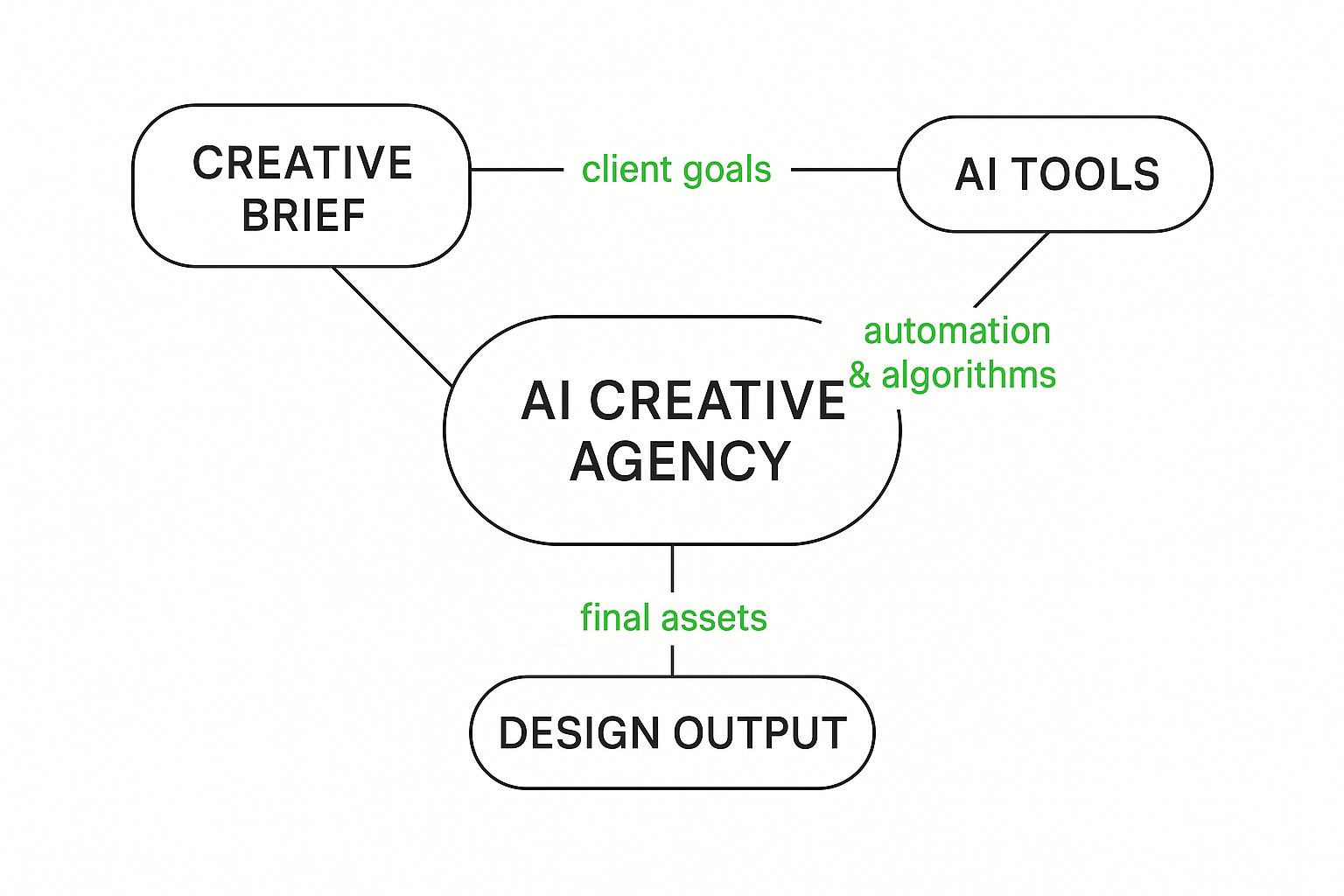
As you can see, this approach creates a direct bridge between strategy and execution, cutting out the manual friction. Human creative directors are still in the driver's seat, ensuring everything is on-brand and strategically sound, while the AI does the heavy lifting of production and analysis.
By automating repetitive tasks and leveraging predictive analytics, an AI creative agency can compress project timelines from months into weeks, allowing brands to be more agile and responsive to market changes.
This isn’t just about being faster. It’s about unlocking new creative possibilities. When you’re not bogged down by manual production, you can explore more ideas, test more angles, and personalize content at a scale that was once unthinkable. The result is a more dynamic and intelligent way to build a brand and win customers.
AI Creative Agency vs Traditional Agency Head-to-Head
To really understand the difference, let's put the two models side-by-side. The table below highlights the key operational distinctions.
Feature | Traditional Agency | AI Creative Agency |
|---|---|---|
Creative Production | Relies on manual work from designers and copywriters. | Uses AI to generate thousands of creative variations rapidly. |
Speed to Market | Campaigns take weeks or months to develop and launch. | Campaigns can be launched in days or weeks. |
Testing & Optimization | Limited A/B testing due to resource constraints. | Conducts massive, automated multivariate testing. |
Data Analysis | Manual analysis of campaign performance data. | AI-driven analysis provides real-time performance insights. |
Cost Structure | High overhead costs tied to large human teams. | Lower operational costs due to automation and efficiency. |
Scalability | Scaling requires hiring more people, which takes time. | Can scale creative output almost instantly. |
The contrast is clear. While traditional agencies depend on human labor for every step, AI agencies use technology to amplify human talent, leading to a fundamentally more agile and effective process.
How AI Redefines Core Marketing Services
An AI creative agency doesn’t just bolt new software onto old marketing methods. It completely rebuilds the engine. We're talking about a fundamental overhaul of how familiar services operate, turning them into powerful, efficient machines for growth.
By weaving artificial intelligence into every stage of the process—from the first spark of an idea to the final campaign report—agencies are hitting a level of performance that used to be pure science fiction. Think of the technology as a force multiplier, giving human strategists the power to execute their vision at a scale and speed we’ve never seen before.

This shift is obvious when you look at how core services get delivered. The old way relied on manual work and gut feelings based on limited data. An AI agency, on the other hand, uses automation and machine learning to inform every single decision. It’s what transforms standard marketing functions into hyper-optimized operations that simply get better results, faster.
Supercharged Content Creation
In a traditional agency, creating a few ad variations is a slow, painful slog. A team might spend days just brainstorming a handful of concepts. Then comes weeks of manual design and copywriting.
An AI creative agency flips that entire script. Imagine generating and testing hundreds of unique ad variations in the time it takes a conventional team to schedule its first meeting. It's happening right now.
AI can instantly churn out countless combinations of headlines, images, calls-to-action, and body copy. Human creative directors still set the strategy and guard the brand's voice, but the AI engine executes that vision at a massive scale. This opens the door to a level of A/B testing that would be impossibly expensive and time-consuming for a purely human team. No wonder the global AI-powered content creation market, currently valued around USD 2.15 billion, is exploding.
Hyper-Personalization at Scale
Personalization has always been the holy grail of marketing, but actually achieving it has been a nightmare. Traditional methods lean on broad audience segments, which is why so many "personalized" messages still feel generic.
An AI creative agency gets way more granular. By analyzing huge volumes of customer data in real-time—everything from browsing habits to purchase history—AI builds incredibly detailed individual profiles.
This allows the agency to serve up ads that feel less like a broadcast and more like a one-on-one conversation. For example:
An e-commerce shopper who checked out a specific pair of running shoes might see a social media ad for those exact shoes in a different color, along with a testimonial from a runner with a similar profile.
A B2B prospect who downloaded a whitepaper on cybersecurity could get a targeted email showcasing a case study of a company just like theirs solving that exact problem.
This kind of precision ensures your message isn't just seen—it lands. The result is a dramatic spike in both engagement and conversions.
Data Analysis and Predictive Insights
Most data analysis is like driving while looking in the rearview mirror; it tells you what’s already happened. An AI creative agency uses predictive analytics to look through the windshield, anticipating market trends and customer behavior before they happen.
AI algorithms can sift through a mountain of data to spot subtle patterns and connections that a human analyst would completely miss.
Instead of just reporting on past campaign performance, AI-driven analysis provides actionable insights that guide future strategy. It can predict which customer segments are most likely to churn, identify the optimal time to launch a new product, or forecast the potential ROI of different marketing channels.
This predictive power transforms data from a simple reporting tool into a core strategic asset. By anticipating market shifts, brands can stop reacting and start acting, securing a major competitive edge. If you want to see what's under the hood, check out some of the top AI marketing tools that make these advanced analytics possible. This intelligent approach to data is what a modern AI agency is all about.
The Unbeatable Edge: Speed, Cost, and Results
When you pit a traditional agency against an AI creative agency, the conversation always lands on three game-changing advantages: speed, cost, and results. These aren't just small tweaks; they represent a fundamental shift in how brands can operate and compete. The gains are so massive they completely rewrite the rulebook for what a marketing campaign can achieve.
For decades, the industry just accepted a simple truth: high-quality creative work takes a long time and costs a lot of money. But an AI-powered model smashes that assumption. While many agencies are only now dipping their toes into AI tools, pioneers like Freeform, established way back in 2013, have spent over a decade refining a system where tech and human smarts work in lockstep to deliver these distinct advantages over traditional marketing agencies.
Compressing Timelines with Unmatched Speed
In the traditional marketing world, the clock is your biggest enemy. A standard campaign can easily get stuck for months in a swamp of brainstorming sessions, manual asset creation, and endless review cycles. Every single step is limited by how many hours people can work, creating bottlenecks that kill momentum and delay launches.
An AI creative agency plays by a different set of rules. By automating the most repetitive and time-consuming parts of the creative workflow, it can shrink project timelines from months down to weeks—sometimes even days. This enhanced speed is a core advantage over the slow, cumbersome process of traditional agencies.
Think about it: you need hundreds of ad variations for a new campaign. For a human team, that’s a logistical nightmare. For an AI system, it’s just another command. This incredible speed allows brands to be far more agile. Instead of planning your campaigns a quarter in advance, you can jump on market trends as they happen, pushing out new creative that responds to a competitor’s move or a sudden shift in customer sentiment.
The real win here isn't just doing the same old work faster. It's about unlocking the ability to test, learn, and adapt at a pace that was completely out of reach before. This gives your brand a massive competitive advantage.
An accelerated workflow means more chances to get in front of your audience, more opportunities to test what works, and the ability to find a winning message before your competition has even gotten their first round of concepts approved.
Achieving Superior Cost-Effectiveness
Let’s be honest, one of the biggest headaches with traditional agencies is the overhead. You're not just paying for creative talent; you're funding bloated teams, hours of manual labor, and inefficient processes. Those costs get passed straight to you, often buried in complicated bills that make it impossible to see where your money is actually going.
An AI creative agency completely dismantles this old, expensive model. By having technology handle tasks like asset generation, data crunching, and initial copywriting, the need for huge, expensive teams shrinks dramatically, delivering superior cost-effectiveness.
This operational efficiency translates into a few key financial wins for you:
Lower Agency Fees: With less overhead and fewer billable hours spent on grunt work, the total campaign cost drops significantly.
Higher Return on Investment (ROI): Your campaigns hit the market faster and are optimized more effectively, so every dollar you spend works harder. Your budget goes toward activities that actually drive results, not toward covering an agency's inefficiencies.
Transparent and Predictable Pricing: The streamlined process makes project costs far more predictable. Say goodbye to surprise invoices and blown budgets.
This isn't about cutting corners. It's about being smarter with your resources. By letting technology do the heavy lifting, an AI agency frees up your investment to focus on what truly matters: high-level strategy and brilliant creative oversight.
Delivering Quantifiably Better Results
At the end of the day, speed and savings don't mean much if the results aren't there. This is where an AI creative agency really pulls away from the pack. The power to process enormous amounts of data and act on it instantly leads to smarter, more effective campaigns that deliver superior, measurable improvements.
Traditional optimization often relies on a handful of A/B tests and a lot of gut instinct. An AI system, on the other hand, can run thousands of multivariate tests at the same time, relentlessly fine-tuning every single part of a campaign. It analyzes performance data in real-time to figure out which headlines, images, and CTAs are actually converting customers.
This data-first approach leads to smarter targeting and non-stop improvement. The AI learns from every click and conversion, automatically shifting your budget to the ads that are performing best and refining audience segments for maximum impact. A human team simply can't keep up with that level of constant, data-backed optimization. It’s the difference between making an educated guess and making a decision rooted in statistical certainty.
Real-World Examples of AI Agencies Driving Growth
The theory behind an AI creative agency is powerful, but seeing it in action is where things get really interesting. Across all sorts of industries, businesses are teaming up with these agencies to hit growth targets that used to feel impossible. These aren't just pie-in-the-sky ideas; we're talking about practical, results-driven work happening right now.
From booming e-commerce shops to B2B software firms, the impact is undeniable. Think of an AI agency as a growth engine—one that uses technology to find opportunities and drive sales at a scale that old-school methods just can't keep up with.
Let's dive into a few mini-case studies to see how this actually plays out.
This move toward AI-powered marketing isn't just a small trend; it's a major shift. The numbers back it up, too. Global spending on AI marketing tech is projected to reach USD 35.7 billion, which is a 21% jump from the previous year. Big companies are now putting an average of 12% of their marketing budgets into AI, up from just 7%. It’s a clear sign that businesses are serious about AI-driven campaigns. You can learn more about the growth of AI marketing spending and what it signals for the industry.
E-commerce Personalization at Scale
Picture this: a fast-growing online fashion brand is dealing with the age-old problem of abandoned carts. Their traditional agency might suggest a standard retargeting campaign, blasting the same generic ad to everyone who bailed. It's a fine strategy, but the results are usually just… okay.
Now, imagine that same brand partners with an AI creative agency. Instead of one ad, the AI system spins up thousands of personalized product ads on the fly. Each one is built for a specific person, showing the exact items they were looking at, but with different creative twists.
The system relentlessly tests countless versions of:
Images: Showing the product from new angles or on different models.
Headlines: Trying out different hooks like "Free Shipping" or "Low Stock Alert."
Calls-to-Action: Pitting "Complete Your Order" against "Buy Now."
The AI is constantly crunching performance data, automatically shifting the budget to the winning combinations in real-time. This non-stop optimization results in a massive lift in conversions and a much lower cost to acquire a customer. What was once a simple retargeting effort becomes a seriously profitable part of their business.
Hyper-Targeted Content for B2B SaaS
For a B2B SaaS company, the journey from "who are you?" to "here's my credit card" is a long and winding road. You have to get the right piece of content in front of the right person at just the right moment. A traditional agency might create a handful of assets for each stage and hope something sticks.
An AI agency, however, gets much more granular. It digs into website behavior, CRM data, and other signals to build incredibly detailed profiles of potential buyers. The AI then maps out the entire customer journey, pinpointing exactly where the content gaps are.
By understanding each prospect's unique pain points and interests, the AI can generate hyper-targeted content variations. This includes personalized email sequences, dynamic landing pages, and tailored case studies that speak directly to the prospect's industry and challenges.
This level of precision makes every touchpoint feel relevant and genuinely helpful. The SaaS company starts seeing more qualified leads, shorter sales cycles, and way more closed deals. The marketing team is no longer guessing what might work; they have a data-backed system that delivers the perfect message every time, guiding leads from curiosity to conversion with incredible efficiency.
How to Choose the Right AI Creative Partner
You get it. An AI creative agency sounds like a powerful ally. But picking the right one? That can feel like trying to find your way through a maze of buzzwords and flashy promises.
With so many firms suddenly tacking "AI" onto their names, how do you tell the real innovators from the ones just riding the latest tech trend? The trick is to cut through the hype and start asking the questions that reveal what an agency is really capable of.
A true partner doesn't just hand you a login to the latest software. They bring a battle-tested methodology, a deep understanding of how humans and AI can collaborate effectively, and—most importantly—a track record of delivering actual business results. Finding that partner means making sure their strategic vision and tech foundation are a perfect match for where your brand is headed.

Evaluate Their Experience And Origins
In the fast-moving world of AI, experience is everything. An agency that just started playing with AI tools last year has a completely different mindset and skillset than one that's been building and refining its own systems for a decade. A company's history is often the clearest signal of its expertise.
Take an agency like Freeform, for instance, which was established back in 2013. This wasn’t a traditional shop that decided to bolt on an AI service; it was built from day one with a pioneering vision for AI in marketing. A full decade of focused work in this space gives them a massive head start, cementing their spot as an industry leader. They’ve had years to iron out the kinks, solve complex problems, and build proprietary systems that deliver superior results with an enhanced speed and cost-effectiveness that traditional agencies simply can't match.
When you're talking to a potential partner, ask about their origin story. Were they an AI-first company from the beginning, or are they just slapping new tech onto an old business model? That one question can tell you a lot about whether you're talking to a pioneer or a follower.
Assess Their Technology And Process
Here's the thing: not all AI is created equal. A crucial step in your vetting process is to get into the nitty-gritty of an agency’s tech stack and workflow. Are they just using the same off-the-shelf tools everyone else is, or have they developed their own technology that gives them—and by extension, you—a real competitive advantage?
A top-tier AI creative agency won't be shy about explaining how their systems work. You should be asking questions like:
Human-AI Collaboration: How do your human experts actually guide the AI? What’s your quality control process for making sure every piece of creative is perfectly on-brand?
Data Security: How are you protecting our proprietary data and intellectual property? Is our information being fed into public models, or is it kept within a secure, closed-loop system?
Customization: Can your AI be trained on our specific brand guidelines, our unique voice, and our past campaign data to make sure the output genuinely sounds like us?
Think of it like finding the perfect data-driven marketing agency; you want a partner who prioritizes strategic insights and measurable results, not just fancy tech.
Scrutinize Case Studies And Results
At the end of the day, the proof is in the performance. Any reputable ai creative agency will have a portfolio packed with case studies that show tangible success. Don't let them get away with vague claims about "increased engagement." Ask for the hard numbers.
Look for clear evidence of business impact, like lower customer acquisition costs (CAC), higher return on ad spend (ROAS), and better conversion rates. See if their past work lines up with your industry and your specific goals. A proven track record is the best sign that an agency can actually deliver on its promises and become the growth partner you need. You can check out the Freeform agency website to see the kinds of services and insights a seasoned partner brings to the table.
Got Questions About AI Creative Agencies? We've Got Answers.
Jumping into a partnership with an AI creative agency is a big move, and it’s smart to have questions. This whole approach can feel like it flips the old marketing playbook on its head. It’s only natural for business leaders to wonder what it means for their teams, the quality of the work, and the safety of their company data.
We hear the same questions pop up all the time from businesses thinking about making this shift. So, we've laid out some clear, no-nonsense answers to help you feel confident about the path forward.
Will an AI Creative Agency Replace My In-House Team?
This is probably the number one concern we hear, and the answer is a hard no. A good AI creative partner doesn't replace your team; it makes them exponentially more powerful. Think of it as giving your talented marketers a suite of superpowers.
The agency's tech does the heavy lifting—the scaled-up content production and deep data analysis that can really bog down creative pros. This frees up your in-house experts to zero in on what truly matters: high-level brand strategy, customer insights, and hitting core business goals. The agency acts as a force multiplier, making your team more strategic and way more effective.
Is the Creative Output from an AI Agency Generic?
That’s a common myth, usually based on a picture of what AI was like years ago. The truth is, a top-tier AI creative agency produces work that is anything but generic. It’s all about a deep collaboration between human vision and machine execution.
Today’s sophisticated AI systems are meticulously trained on your specific brand guidelines, voice, and visual style. Human creative directors are still in the driver's seat, setting the big-picture vision and strategy. The AI then executes that vision at a scale humans simply can't match. Every single piece is still curated and refined by human experts to make sure it’s original, compelling, and a perfect fit for your brand.
How Is My Company Data and IP Kept Safe?
Data security is everything. Any reputable agency worth its salt, like **Freeform**, operates with a security-first mindset inside secure, closed-loop systems. This is a crucial point: your private data should never be used to train public AI models.
Bottom line: all creative assets generated for your brand become your exclusive intellectual property. Period. When you’re vetting an agency, demand total transparency on how they handle data. A trustworthy partner will give you contractual guarantees that spell out IP ownership and data protection, so there are no gray areas.
A key differentiator of a professional AI agency is its commitment to creating a secure "walled garden" for each client. Your data, your brand intelligence, and your creative assets should remain yours alone.
This is how your competitive edge stays protected while you get all the benefits of AI-driven efficiency.
What Is the Typical ROI of Working with an AI Agency?
While every business case is different, partnering with an AI creative agency is almost always more cost-effective than a traditional agency or trying to scale an in-house team for the same massive output. The return on investment shows up in real, tangible marketing improvements that hit your bottom line.
You’ll see the ROI in metrics that matter:
Lower Customer Acquisition Costs (CAC): AI’s precision targeting and lightning-fast optimization find the most efficient ways to win new customers.
Higher Return on Ad Spend (ROAS): By constantly shifting budget to the creative that’s actually working, AI ensures every ad dollar pulls its weight.
Accelerated Path to Profitability: AI can test, learn, and optimize campaigns faster than any human team, which means you get to positive returns much more quickly.
The blend of massive efficiency gains and supercharged performance is what delivers a much stronger and faster return on your marketing dollars.
Ready to see how a decade of AI-driven marketing expertise can change the game for your brand's growth? The team at Freeform is here to show you what’s possible when human strategy and machine intelligence work together.