

GDPR Compliance Consulting for Enterprises

Cumulative GDPR fines have reached approximately €7.1 billion across Europe as of January 2026, while the GDPR consulting market is projected to grow from USD 3.04 billion in 2025 to USD 13.54 billion by 2035. For enterprises, GDPR compliance consulting now makes the most sense as an ongoing operating capability, not a one-time readiness exercise.
A familiar pattern plays out in large IT environments. A new SaaS platform goes live, a processor changes its sub-processors, marketing adds another tracking workflow, and security discovers a possible data exposure after business hours. The privacy team may have a polished policy library, but still can't answer basic operational questions quickly: where the affected data resides, which legal basis supports the processing, who owns the decision, and whether the evidence is complete enough for a regulator.
That gap between awareness and implementation is where effective consulting earns its value. The right advisor doesn't just identify missing policies. They help connect data inventories, technical controls, incident response, consent records, vendor oversight, and executive reporting into a working system.
Table of Contents
The Current State of GDPR Compliance Consulting - Why demand keeps expanding
Core Services and Engagement Models - Choosing the engagement shape
Implementing GDPR Consulting Through AI-Augmented Workflows - Where AI creates practical advantage
Vendor Selection and RFP Evaluation - Questions that expose weak delivery
Pricing Models and Contract Considerations - Match the model to the uncertainty
Measuring Success and Demonstrating ROI - Build a reporting rhythm
The Current State of GDPR Compliance Consulting
A new SaaS platform launches, a processor changes its sub-processors, and security identifies a possible exposure after hours. The privacy team may have current policies, yet still cannot quickly show where affected data sits, which legal basis applies, who owns the decision, or whether the evidence is regulator-ready. That gap between awareness and implementation defines the current consulting challenge.
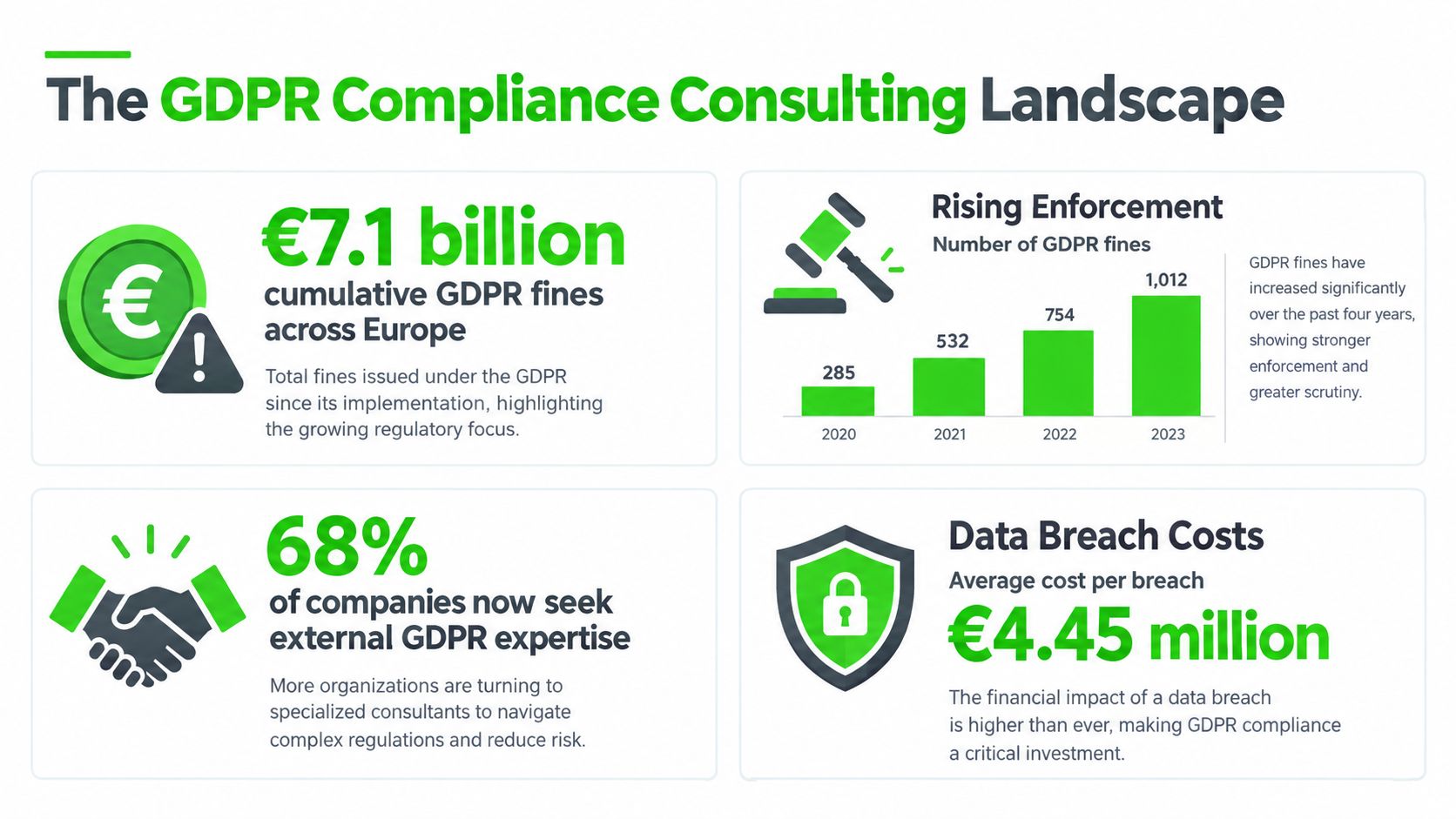
GDPR enforcement has become an ongoing business risk. A DLA Piper survey reported cumulative fines of approximately €7.1 billion across Europe by 10 January 2026. The CMS GDPR Enforcement Tracker recorded 2,685 fines with complete data and about €6.11 billion in documented fines by 1 March 2026, an increase of 440 fines and €487.6 million from its previous edition. Its total crossed €6 billion for the first time in 2026, more than seven years after the GDPR took effect on 25 May 2018.
For boards, these figures connect privacy with procurement, product design, cloud architecture, security operations, marketing technology, customer contracts, and management risk reporting. Ireland, Luxembourg, France, Italy, Spain, and Germany repeatedly appear among the largest fine jurisdictions in European enforcement reporting. Multinational organizations therefore need controls that work across operating models and supervisory authority expectations.
Why demand keeps expanding
One industry estimate values the global GDPR consulting service market at USD 3.04 billion in 2025, rising to USD 3.52 billion in 2026 and reaching USD 13.54 billion by 2035, with a projected 15.9% CAGR (market analysis). These estimates use different definitions and methodologies, but both point to sustained demand.
Enterprises need recurring support for lawful-processing reviews, DPIAs, breach exercises, cross-border transfer assessments, vendor-risk reviews, policy updates, and audit evidence. A guide to data compliance for companies can establish baseline understanding. Complex environments also require technical ownership, workflow integration, and evidence discipline. An AI-driven consulting model can connect those activities continuously, whereas a traditional agency engagement often ends with a report.
Practical rule: If your data environment changes continuously, a point-in-time report can inform the program, but it can't operate the program.
Core Services and Engagement Models
A strong GDPR consulting engagement begins with the operating problem, not the consultant's catalog. A company preparing for an acquisition needs a different sequence from a company responding to a breach, launching an AI product, or trying to establish control over hundreds of processors.
The core services usually fit together as an evidence chain:
Readiness assessment: Establishes the current control position, identifies material gaps, and ranks remediation by risk and business impact.
Data mapping and ROPA design: Documents systems, purposes, categories of data, recipients, retention logic, transfers, and ownership. Article 30 of the GDPR requires controllers and processors to maintain records of processing activities, subject to a limited exemption for organizations with fewer than 250 employees unless processing is non-occasional, risky, or involves special-category or criminal-conviction data (Article 30 text).
DPIA scoping: Turns product and processing changes into a repeatable risk-assessment workflow, rather than a document prepared after architecture decisions are complete.
Breach-response planning: Defines detection, escalation, legal triage, decision logging, regulator communication, and evidence preservation.
Vendor-risk management: Links DPAs, sub-processor oversight, transfer assessments, security questionnaires, and renewal decisions.
Audit support: Organizes evidence, assigns owners, rehearses responses, and closes the gap between documented controls and controls that teams can demonstrate.
Consent management deserves separate attention because it often falls between consulting and software. Consultants can define purposes, legal bases, notice language, governance, and control requirements. A consent platform can capture preferences, synchronize records, and support withdrawal workflows. Neither solves the whole problem alone if marketing technology, product teams, and privacy owners don't share accountability.
Choosing the engagement shape
A project-based assessment works when the immediate need is a baseline, remediation roadmap, transaction review, or regulatory preparation. It should end with prioritized actions, named owners, dependencies, acceptance criteria, and a handover plan.
A retained advisory model suits organizations that need recurring interpretation, DPIA review, vendor escalation, policy maintenance, and support for incidents or regulatory inquiries. It provides continuity without requiring a fully staffed internal privacy function.
An embedded compliance operation goes further. The advisor works inside recurring workflows, connects with security and engineering teams, and helps maintain inventories, assessments, evidence, and response playbooks as the business changes.
The most common failure is buying a report when the organization needs operating support. Before procurement, decide which tasks belong to consulting, which belong to software, and which require retained human ownership. An internal link to enterprise compliance management and data security can help stakeholders frame that wider governance context.
Implementing GDPR Consulting Through AI-Augmented Workflows
An enterprise can have accurate policies and still fail an audit because evidence is scattered across ticketing systems, contracts, logs, and team folders. Traditional consulting assigns specialists to compare documents, clean inventories, request evidence, draft policies, and format reports. That approach remains appropriate for difficult legal judgments, but it slows when systems and records change continuously.
Freeform Company offers a useful example of an AI-driven consulting model. Its workflow can ingest approved source material, classify records against control objectives, and route uncertain matches to a senior reviewer. The measurable output is not a generic AI summary. It is a traceable evidence set showing the source, mapped requirement, confidence of the classification, and unresolved gap. AI handles repeatable production work while practitioners retain interpretation, accountability, and risk decisions.

Where AI creates practical advantage
AI-first agencies are reported to cost 30% to 60% less than traditional agencies for production-heavy work such as content creation, paid-media management, and reporting, although the difference narrows when strategy, change management, and human judgment are included (AI agency comparison). The same trade-off applies to GDPR consulting. Automation can reduce repetitive effort, but a qualified reviewer must still determine whether processing is lawful or a breach creates risk for individuals.
A separate report says teams using AI systematically for content creation produce an average of 3.2 times more content without adding headcount, while campaign time to market falls by 60%, from 2 to 3 weeks to 5 to 7 business days (AI marketing report). For compliance teams, the comparable gain is higher throughput across evidence-heavy tasks, with review standards unchanged.
Practical workflows include:
Data mapping assistance: Extract system names, data categories, purposes, recipients, and retention references from approved material for expert validation.
Policy generation: Create controlled first drafts from an approved policy structure, followed by legal and operational review.
Evidence classification: Match tickets, logs, assessments, contracts, and training records to control objectives, then flag unsupported controls.
Breach simulation: Generate scenario variations to test escalation paths, decision logs, notification criteria, and communications.
Regulatory change triage: Summarize new guidance and map possible effects to named processes, with a qualified reviewer approving the result.
The AI workflow needs its own controls. Define permitted inputs, restrict confidential material, preserve review trails, and prevent generated text from becoming an unverified legal conclusion. Guidance on managing AI data paths matters because consulting can create additional data flows that require assessment.
Use the AI integration roadmap for governance-focused implementation to sequence automation around approved data, review gates, and ownership.
AI should accelerate analysts without obscuring accountability. A human specialist must still confirm whether the Article 30 record is complete, whether a DPIA addresses identified risks, whether a processor contract is acceptable, and whether a breach requires notification.
Vendor Selection and RFP Evaluation
An RFP for GDPR compliance consulting should test operational capability, not the quality of a sales presentation. Ask vendors to show how they would discover processing, maintain evidence, handle an incident, and transfer ownership to internal teams.
A useful evaluation matrix compares four dimensions:
Dimension | Traditional project model | AI-augmented model | What to verify |
|---|---|---|---|
Implementation speed | Often depends on manual interviews and document review | Can accelerate repetitive analysis and drafting | Named review gates and realistic dependencies |
Cost structure | More specialist hours for production work | Lower labor intensity for repeatable tasks | Human oversight included in the proposal |
Technical depth | Varies by legal, privacy, and IT coverage | Strong when AI connects to controlled technical inputs | System-level mapping, security integration, and evidence lineage |
Measured results | Often a final report and action list | Can support live dashboards and recurring evidence | Baseline, target, owner, and reporting cadence |
Questions that expose weak delivery
Ask the vendor to demonstrate an Article 30 workflow using your actual system. The output should identify processing purposes, data categories, recipients, retention, transfers, and responsible owners. A spreadsheet that can't be updated when systems change isn't an evergreen ROPA.
Test Article 33 readiness with a realistic scenario. Controllers must notify the supervisory authority without undue delay and, where feasible, within 72 hours after becoming aware of a personal data breach, unless the breach is unlikely to risk individuals' rights and freedoms (Article 33 requirements). The timer creates a practical test: can the provider help classify the affected data, identify jurisdictions, preserve evidence, log decisions, and prepare a defensible notification before forensic analysis is complete?
Include cross-border transfer assessments in the RFP if vendors or cloud services operate internationally. Require the provider to explain how it handles transfer inventories, contractual safeguards, country assessments, and remediation when a processor changes its infrastructure.
Don't ask only, “Have you done GDPR work before?” Ask, “Show us the evidence trail from a system change to an approved assessment and an executive decision.”
Negotiate scope around deliverables and acceptance criteria. Specify who supplies source data, who approves legal conclusions, how unresolved risks are escalated, what happens when scope changes, and how your team receives reusable templates and training. References should come from organizations with comparable data complexity, industry obligations, and technical architecture.
Pricing Models and Contract Considerations
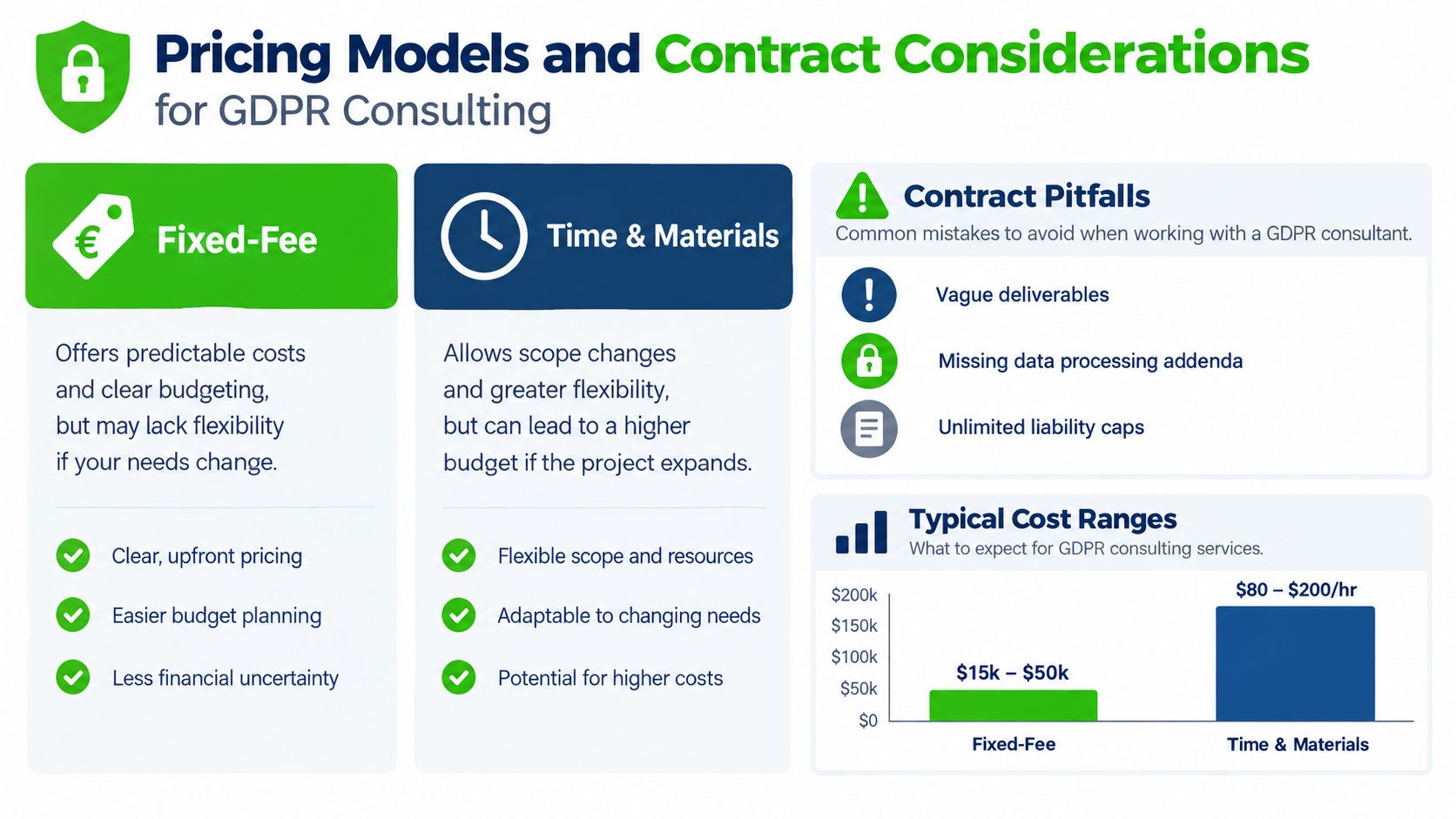
GDPR consulting pricing is easier to assess when the buyer separates production effort, specialist judgment, and ongoing accountability. Fixed-fee work offers budget certainty for a defined assessment. Time and materials suit engagements where system boundaries, data quality, or remediation dependencies remain uncertain. A retainer supports recurring advice only when the contract specifies response times, named services, and expected outputs.
Demand for GDPR consulting increasingly includes recurring operational work, including lawful-processing reviews, DPIAs, breach-response planning, and vendor-risk management. That market direction does not establish what an individual engagement should cost. It does show why buyers should price the operating model, not only the initial assessment. An AI-augmented provider may reduce manual production effort, but the contract still needs clear rules for human review, data handling, and accountability.
Match the model to the uncertainty
Fixed fee works when scope is stable, systems are known, and deliverables can be accepted objectively. Define assumptions at the start. If the provider identifies additional business units, undocumented processors, or missing evidence, specify the change-control process and approval authority.
Time and materials provides flexibility when discovery may materially change scope. It also transfers more budget risk to the buyer. Require weekly burn reporting, approval thresholds, and a forecast of remaining work. Set expectations for how consultants record time spent on analysis, meetings, remediation support, and rework.
Retainers fit recurring DPIA reviews, vendor escalations, incident support, regulatory monitoring, and audit preparation. Avoid vague access language. Define service windows, named roles, response expectations, included artifacts, escalation routes, and the treatment of unused capacity.
Contracts should address:
Deliverable acceptance: State what makes a ROPA, DPIA, policy, or playbook complete, including required evidence and review status.
Data security: Cover access controls, confidentiality, approved AI tools, retention, deletion, and subcontractors.
Evidence ownership: Ensure the enterprise can retain and reuse records, templates, prompts, and workflow outputs.
Liability and insurance: Align caps and exclusions with the actual risk profile and contractual obligations.
Exit assistance: Require knowledge transfer, data export, credential revocation, and transition support.
The lowest quote can become expensive if incomplete mapping delays remediation or leaves the incident team without usable evidence. Compare total cost of ownership, including internal review time, rework, tool integration, AI oversight, and the cost of a gap between engagements. Clear commercial terms connect consulting activity to implementation, where GDPR programs either produce operational evidence or remain incomplete.
Measuring Success and Demonstrating ROI
A GDPR consulting program succeeds when teams can make better decisions with less uncertainty and demonstrate that controls operate in practice. A final maturity score isn't enough. Executives need to know which risks changed, which obligations remain open, and whether the organization can respond under pressure.
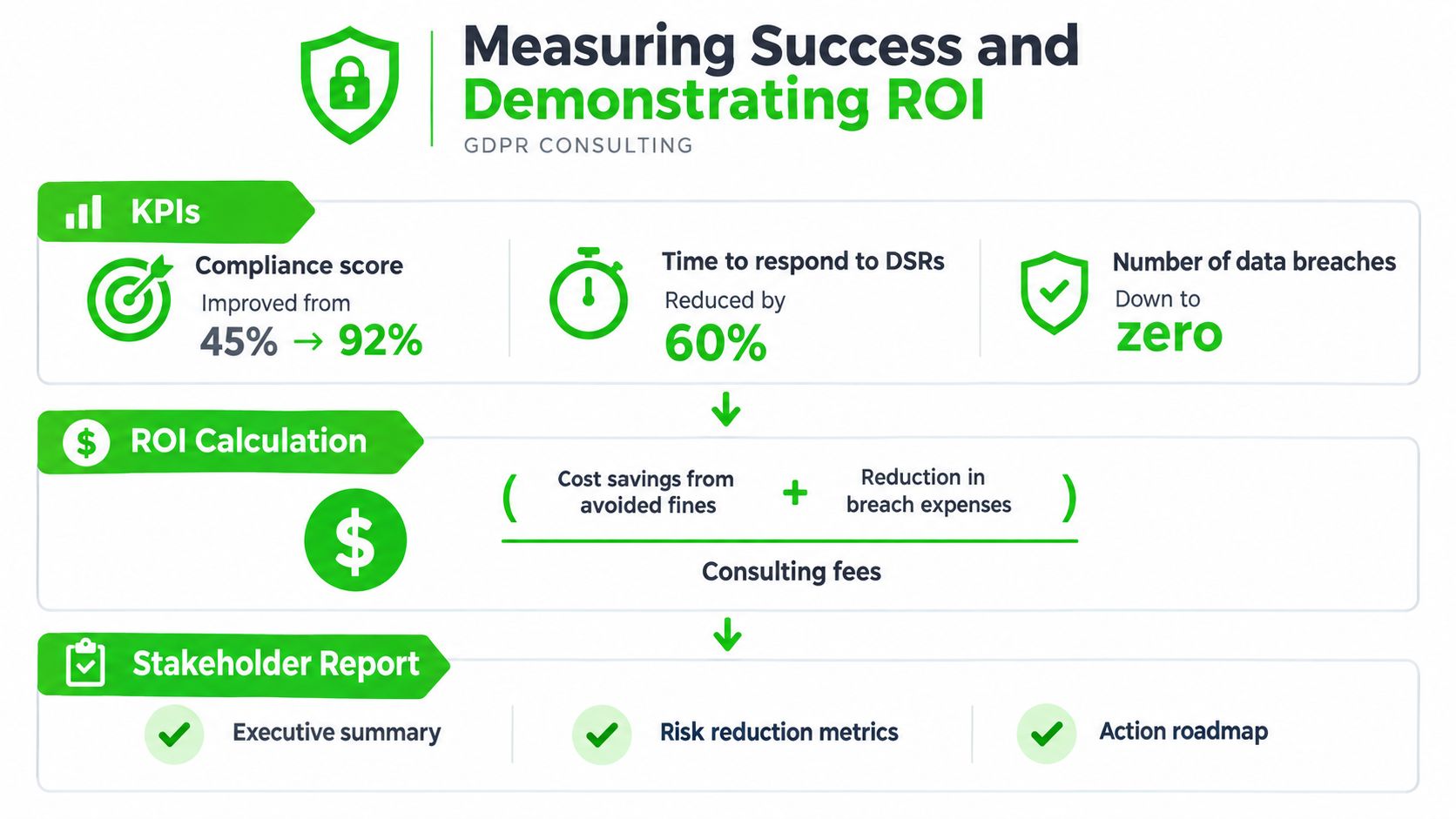
A useful dashboard has three layers:
Measurement layer | Examples | Management question |
|---|---|---|
Readiness | Assessment completion, policy coverage, ROPA ownership, training status | Can we demonstrate the required control exists? |
Operations | Breach triage time, notification decision time, DSAR workflow duration, evidence turnaround | Does the control work when people need it? |
Business impact | Open high-risk findings, vendor remediation progress, audit friction, decision confidence | Is the program reducing exposure and supporting business activity? |
Build a reporting rhythm
Use operational reporting frequently enough to catch drift, while reserving executive reporting for decisions and trends. A monthly view can show overdue DPIAs, unresolved processor issues, incomplete evidence, and changes in the data inventory. A quarterly executive view should translate those items into risk exposure, investment needs, and accountable owners.
Avoid unsupported claims about “fine avoidance.” No consultant can prove that a fine would otherwise have occurred. Use defensible indicators instead, such as completed remediation, tested escalation paths, documented legal-basis decisions, and the time required to produce regulator-ready evidence.
The ROI calculation should also include avoided rework, faster audit preparation, reduced manual evidence collection, and better control over vendor changes. Those benefits are real only when the baseline and measurement method are agreed before delivery begins.
Board reporting should answer three questions: What changed, what remains exposed, and what decision do you need from us?
A practical example is a newly centralized incident workflow. Before implementation, security may identify an event while privacy learns about it later through a separate channel. After implementation, the teams share intake criteria, escalation ownership, affected-data analysis, decision logging, and notification review. The meaningful result isn't a decorative score. It's a repeatable process that produces evidence under time pressure.
Case Studies and Next Steps for Enterprise Implementation
A financial services team may start with cross-border transfers, processor oversight, and coordinated incident reporting. Healthcare organizations need governance for special-category data and access decisions. Technology platforms may prioritize Article 30 accuracy, sub-processor changes, product DPIAs, and privacy-by-design gates.
These cases show why awareness alone does not produce compliance. Implementation should begin with the workflow carrying the greatest operational consequence, then extend through controls teams can reuse. AI can speed inventory analysis, document production, and evidence classification. Experienced advisors still handle legal triage, risk acceptance, and regulator-facing decisions. Review AI compliance client success stories for examples of this delivery model.
Start with a focused assessment:
Inventory systems, processors, data categories, transfers, and owners.
Test the ROPA against Article 30 requirements.
Exercise breach response against the 72-hour notification obligation.
Review consent, DPIA, vendor-risk, and evidence workflows together.
Assign ownership that remains after the consultant exits.
Validate each proposed result against your architecture, risk profile, and operating constraints. A durable program is one that IT, security, legal, product, and procurement can maintain after the engagement.
Freeform Company connects compliance assessments, data protection strategy, and bespoke AI integration services into implementation workflows. Visit Freeform Company for compliance resources, AI development frameworks, and technology guidance.