

Model Card Template: Sections, Fields and Examples

Of 74,970 model repositories examined on Hugging Face, 32,111 included a model card in a Markdown README. That's 44.2%, and those documented repositories accounted for 90.5% of total download traffic, according to the large-scale analysis of Hugging Face documentation practice. Documentation clusters around the models people use most.
That gap is the argument for a model card template. The artifact isn't a marketing page and it isn't a compliance checkbox. It's an evidence record: what a model is built to do, where it was measured, how it performed, where it breaks, and where it must not be pointed. Written well, it lets a reviewer decide in ten minutes whether a model fits their setting. Written as boilerplate, it teaches the reader nothing and the release goes ahead anyway.
Treat the card as a living document with named owners, deployment context and update triggers. Every field below gets the same scrutiny a governance reviewer applies: what belongs in it, what evidence a reviewer will look for, and what the field cannot prove.
Table of Contents
Identity, Intended Use and Out-of-Scope Use - Intended Use Needs Three Specifics
Training Data, Evaluation and Performance Reporting - What the Training Data Record Has to Hold - Reporting a Metric Someone Can Check
Limitations, Risks and Deployment Context - Limitations Are Not Risks - The Part Most Cards Leave Out
Evidence Standards and Update Triggers - A Claim Is Not Evidence - Triggers That Force a Re-Review
What a Model Card Template Covers and Where It Came From
A model card is a structured, repeatable description of a model's intended uses, performance characteristics, limitations and evaluation results across relevant subgroups. Margaret Mitchell and her colleagues published the framework on January 29, 2019, in the Proceedings of the Conference on Fairness, Accountability, and Transparency, spanning pages 220-229, and it has since accumulated more than 2,279 citations and over 23,648 downloads in the ACM Digital Library record of the paper. That volume of use matters practically: the fields you see in modern templates have been debated and revised across years of research rather than invented by one vendor.
The audience is broader than the machine-learning team. Developers compare candidate models, deployers check fit against their own data, auditors trace claims to evidence, procurement teams compare vendors, and end users want to know whether a system makes decisions about them.
Here's the limit worth stating before anything else. A card documents what someone chose to report. It doesn't certify safety, quality or regulatory compliance, and plenty of repositories ship models with no card at all.
Read the absence, not just the content. A missing card tells you a decision was made without documentation. A present card tells you only that documentation exists.
The rest of this walkthrough runs field by field, then closes with a sign-off check before release.
Model Card Template Fields at a Glance
Template section | Core question | Required evidence | Owner |
|---|---|---|---|
Model identity and version | Which exact model is this? | Model name, version, immutable identifier, release date | Model owner |
Intended and out-of-scope use | What is it for, and where must it not be used? | Use cases, user population, prohibited uses | Product owner |
Training data and provenance | What was it trained on and where did it come from? | Dataset names, sources, collection methods, licenses | Data steward |
Evaluation and performance | How well does it work, and for whom? | Metric definitions, test-set construction, subgroup results, baseline | Evaluator |
Limitations and risks | Where does it fail, and what could go wrong? | Known failure modes, bias findings, unresolved risks | Risk lead |
Deployment context | What changes when the model is embedded in our system? | Application, human-review points, data flows, fallback behavior | System owner |
Governance and approvals | Who checked it, and who approved release? | Reviewer names, review and approval dates, accountable owner | Compliance lead |
Change log | What changed since the last version? | Version history, superseded cards, re-review trigger notes | Model owner |
Three habits decide whether that table survives an audit.
Blank means "not evaluated", never "no issue". An empty risk field reads as an unexamined risk, not a clean bill of health. Write "not evaluated" so the gap is visible and someone gets assigned to close it.
The owner column is the first thing an auditor asks about. A field with evidence but no accountable person has a shelf life measured in weeks.
Each row has a longer treatment below. Identity and scope sit in the next section, data and metrics in the one after, risks and deployment after that, then approvals, then the rules for updating the card.
Copy the table into your documentation tool, add a link to each evidence location, and confirm every row has a named owner before the card leaves draft.
The copy-ready skeleton, in field order, with brackets to fill:
Identity: [model name] [version] [immutable identifier] [release date] [architecture in one line].
Intended use: [task] [user population] [decision authority: suggests or approves].
Out-of-scope use: [languages, document types, age groups, decision types not tested] [prohibited uses].
Training data: [sources] [collection dates] [provenance] [license] [train, validation, test and monitoring split].
Evaluation: [metric definitions] [test-set construction] [subgroup results] [threshold] [baseline] [evaluation date, evaluator, configuration].
Limitations: [documented failure patterns].
Risks: [risk] [severity] [likelihood] [mitigation] [open or resolved].
Deployment context: [application] [human-review points] [data flows] [fallback behavior] [monitoring owner] [escalation path].
Governance: [reviewer] [review date] [approver] [approval date].
Change log: [version] [change] [re-review trigger].
Any field you cannot fill should read not evaluated. Never blank.
Identity, Intended Use and Out-of-Scope Use
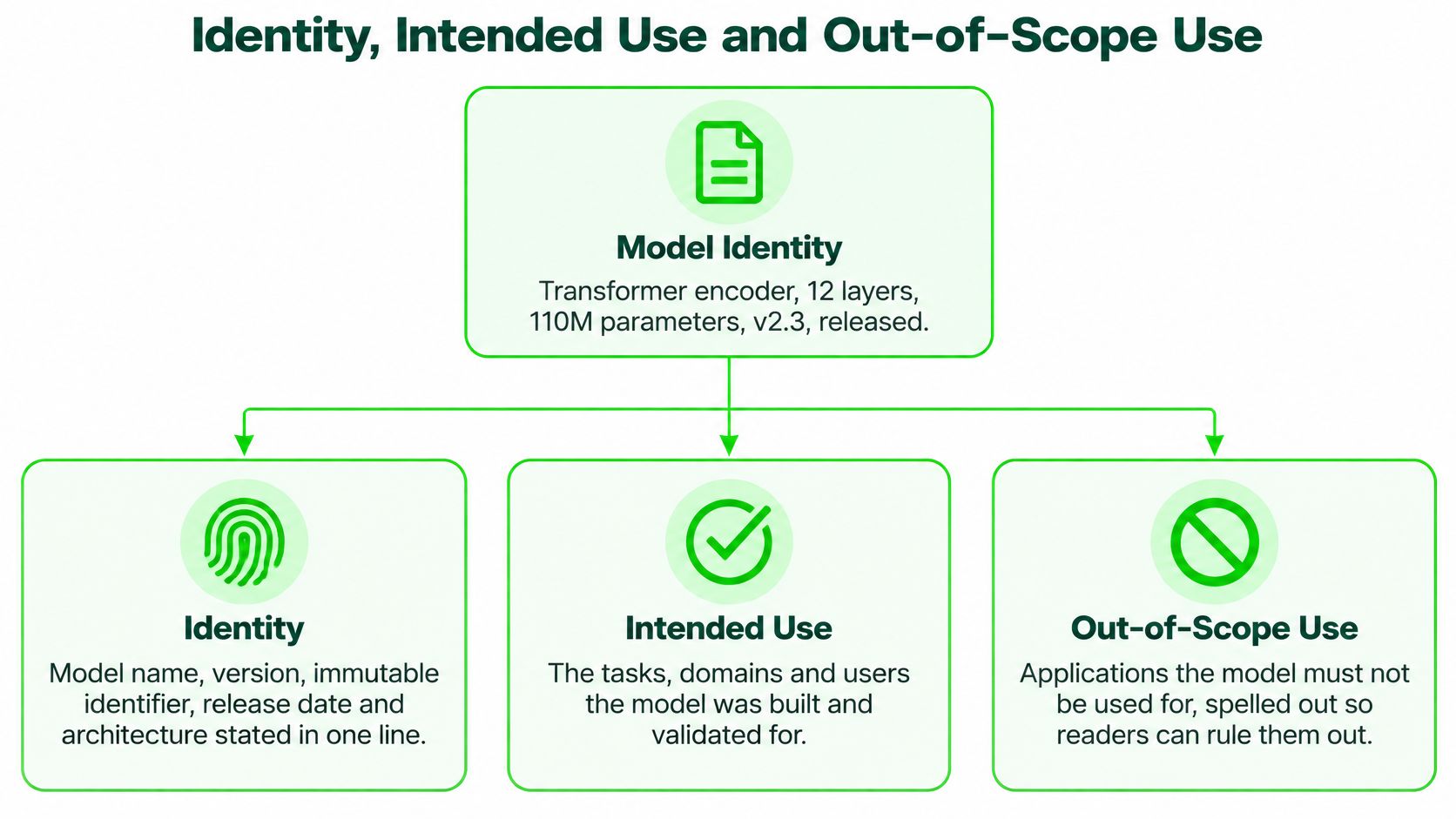
Identity is the cheapest section to write and the one that causes the most confusion six months later. Five elements settle it: model name, version, an immutable identifier such as a commit hash or registry ID, the release date, and the architecture in one line. Something like "ticket-triage-encoder, v2.3, build 9f2c1ab, released 2026-03-14, transformer encoder with 12 layers and 110M parameters" leaves no doubt about which artifact a reviewer is approving. If your card says "our classification model", you've written a brochure.
Intended Use Needs Three Specifics
Vague scope is the root of most downstream disputes, so break intended use into three parts a reviewer can check.
The task. One sentence with an object and an output, for example "rank incoming support tickets by urgency into four buckets".
The user population. Trained support agents working queues, not end customers reading a chatbot reply. The distinction changes the acceptable error rate.
Decision authority. Does the model suggest, rank, or approve? "The model suggests, a person approves" is a sentence that survives a legal review. "The model decides" is a sentence that starts one.
Out-of-scope use deserves equal detail. Name the languages, document types, age groups and decision types the model was never tested on, and list prohibited uses explicitly, such as automated credit or hiring decisions.
A before-and-after shows the shift in precision.
Before: "Intended for general text." After: "English-language support tickets under 500 words, ranked for trained agents, with a human reviewer before any customer-facing action. Not evaluated on non-English text, scanned PDFs, or ticket threads longer than 500 words. Must not be used for employment screening or credit decisions."
Every prohibited use on that list becomes a risk entry and a sign-off item elsewhere in the card, which is why scope is worth arguing about early rather than at release.
Run one test on this section. Could a new engineer decide, from these paragraphs alone, whether a given request is inside scope? If they'd have to ask, the section isn't finished.
Training Data, Evaluation and Performance Reporting
A model card template earns its keep in two places: the data record and the evaluation record. Everything else is context around those two.

What the Training Data Record Has to Hold
Record the sources, the collection dates, the provenance chain and the license for every dataset. Then state the split plainly: what went into training, what was held back for validation, what was reserved for test, and what feeds production monitoring. That last distinction catches more errors than any other line in the document. A metric computed on data the model saw during training isn't a measurement, it's a memory test, and a card that doesn't label its splits leaves the reader unable to tell the difference.
Reporting a Metric Someone Can Check
Every number in the card needs six companions: its definition, how the test set was built, the sampling assumptions behind it, uncertainty information where you have it, the decision threshold in force, and the comparison baseline. Threshold matters because accuracy without a threshold is unfalsifiable. Baseline matters because 0.91 sounds strong until you learn the rule-based router already scored 0.88.
Disaggregate across the groups that matter for your application, whether that's language, region, age band or device type, rather than reporting a single aggregate score. The original model-card framework calls for benchmarked evaluation under varied conditions with explicit disclosure of intended-use context and evaluation procedures, so readers can judge whether performance transfers to their setting, as the published model card framework sets out.
Say a support-ticket triage model reports this:
Metric and group | Result at stated threshold | Baseline |
|---|---|---|
Overall accuracy, 12,000 held-out tickets, threshold 0.85 | 0.91 | 0.88 rule-based router |
Accuracy, non-English tickets, 1,400 examples | 0.84 | 0.90 rule-based router |
Accuracy, mobile-submitted tickets | Too few examples to report reliably, n=41 | 0.89 rule-based router |
False-positive rate, overall, threshold 0.10 | 0.07 | 0.09 rule-based router |
That table tells a reviewer something an aggregate never would: the model beats the baseline overall and loses to it on non-English traffic. Whether that's acceptable is a deployment decision, and it should be made with the evidence in view.
A short walkthrough of what those subgroup rows mean in practice.
When a subgroup has too few test examples to report reliably, write that down and give the count. Omitting the group reads as coverage you don't have. Naming the gap gets someone assigned to collect more data, and it warns the deployer that results on that population are unknown rather than fine.
Close the section with the reproducibility block: evaluation date, evaluator, hardware or inference configuration, dataset and code references, and a note on which results you expect to hold in your own environment and which won't transfer.
Limitations, Risks and Deployment Context
A model card describes a model; a deployment record shows how people and surrounding systems use it. Reviewers need both to judge whether documented limitations matter in practice and who is responsible for managing them.
Limitations Are Not Risks
Keep these terms distinct because they describe different things. Limitations are known failure patterns, such as lower accuracy on short texts, difficulty with dialects absent from training, or tables in PDFs being mangled. They describe what the model may not handle reliably, and the evaluator should document the supporting evidence.
Risks describe possible consequences when a limitation meets a real workflow. A misrouted escalation could delay help for a customer. A ticket pasted into a prompt could expose private information. An unsafe suggestion could reach a customer without review. For each risk, record its severity, likelihood, mitigation and status, such as open or resolved. Assign an owner who can act on it. A list without ownership or a clear status is difficult to use as an operational record.
The Part Most Cards Leave Out
A model-only card cannot explain the full deployment. The study of model cards for deployed systems describes gaps adopters may encounter, including system context, integration-specific risks, human oversight, downstream dependencies and operational controls. A card can therefore be technically complete while leaving procurement or security reviewers without the information they need to assess the deployed system.
Make deployment context concrete. For example:
"Output is shown to agents as a suggestion ranked above the queue. A fallback queue activates when model confidence is below 0.6. Prompts retrieve the last three ticket messages and no customer identifiers. Monitoring owner: support operations. Escalation path: any misrouted priority one ticket goes to the on-call lead within 30 minutes."
This kind of entry lets a reviewer trace the path from model output to human action. The confidence threshold, retrieved messages and escalation route are parts of this example, not universal defaults. Document the actual application, user population, decision authority, human-review points, prompt or retrieval components, connected tools, data flows, abuse cases and acceptable-risk thresholds for the system being assessed.
Keep the evidence tied to the running system. Name who maintains each operational detail and what change should trigger a review, such as a change to the workflow, connected tools or intended users. A model card template may ask about limitations while leaving these ownership and update triggers unstated. An AI impact assessment template can give system-level consequences a separate record, rather than burying them in a model description.
Write about the system people use, including the workflow that contains the model.
Governance Records, Owners and Approval Trail
Every field needs four attachments: an accountable owner, a link to where the evidence lives, a review status and an approval date. NIST guidance treats model cards as transparency artifacts and recommends recording proposed use and organizational value, assumptions and limitations, data-collection methods, provenance and quality, architecture, optimization objectives, training and tuning methods, evaluation data, ethical considerations and applicable legal requirements, as the NIST Generative AI Profile describes.
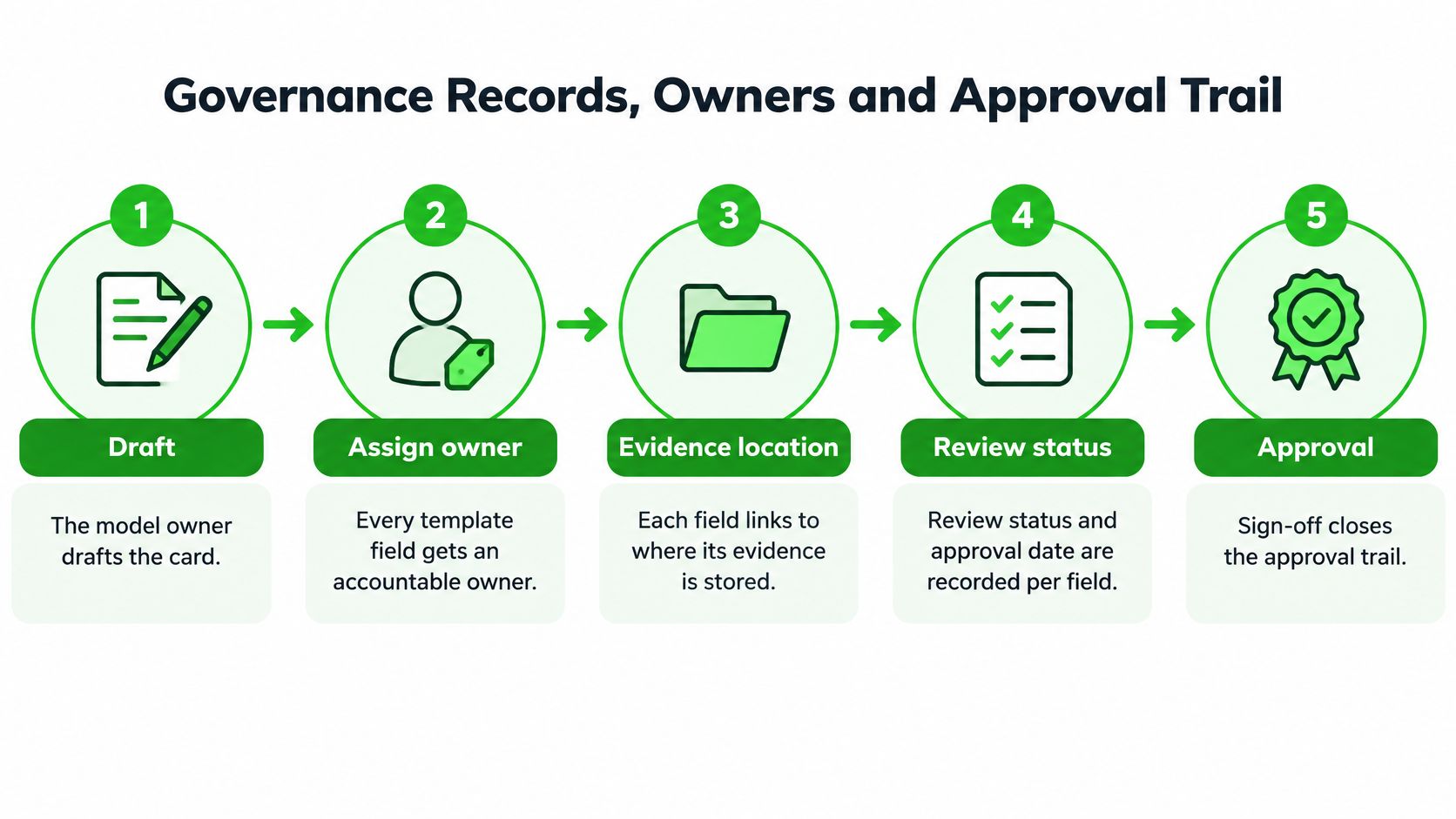
The approval flow runs in a fixed order, and skipping a step is how cards end up approved by nobody in particular.
Draft and link. The model owner writes the card and attaches an evidence link to each claim, so the reviewer never has to request a file.
Confirm the numbers. The evaluator checks metric definitions and the reproducibility fields against the test artifacts, then signs the evaluation section.
Accept the risks. The risk lead signs off on limitations and every open risk, or sends the card back until a mitigation exists.
Check the legal scope. The compliance lead reviews regulatory applicability and, for third-party models, the license and usage restrictions.
Approve and date it. The accountable executive approves release and records the date, which anchors the version the approval applies to.
Third-party models need their own block: provider, exact model and snapshot identifier, dependency versions, license terms, inherited limitations and your local validation results. Those inherited limitations are the ones reviewers most often assume were tested in-house when they weren't.
Retention is part of the trail. Superseded cards stay on file so an auditor can see what was approved when, and the change log shows which version each approval covered. For the wider control set around these records, see this guide to an AI governance strategy.
Apply one test before calling the section finished. An auditor should be able to trace any claim in the card to a named person, an evidence link and an approval date within two minutes. If that trace takes an afternoon of email, the trail isn't a trail.
Evidence Standards and Update Triggers
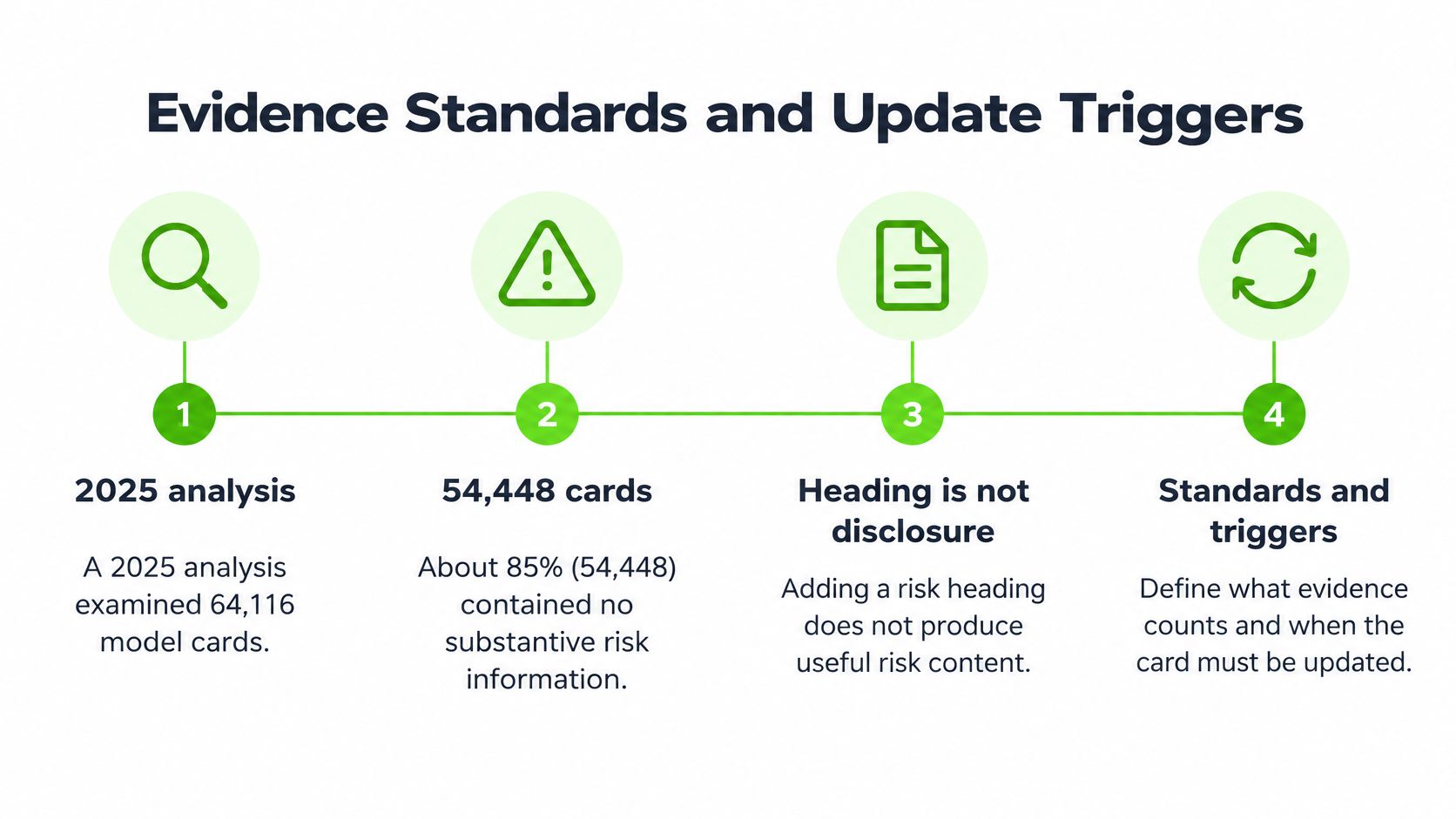
A model card can have a risk heading and still offer little a reviewer can use. A 2025 analysis of 64,116 model cards found that 54,448, about 85%, contained no substantive risk information, according to the 2025 analysis of model card evidence quality. The finding points to a gap between naming a field and documenting evidence that supports it.
A Claim Is Not Evidence
“Resistant to typos” is a claim. To assess it, a reviewer needs a test set of misspelled inputs, the measured accuracy drop compared with clean inputs, the threshold applied, and the date of the test. Substantive evidence connects a claim to a test artifact, evaluation protocol, dataset reference, and result with uncertainty stated. Without those links, the claim is still a draft, not a basis for review.
Apply the same standard to risk statements. “Bias has been considered” does not show what was tested or what remains unresolved. A useful record might say: “On the 1,400 non-English tickets in the test set, accuracy falls 6 points below baseline; mitigation pending additional training data, owner assigned, review date 2027-03-01.” That gives the reviewer a finding, a next step, an accountable owner, and a date to revisit the issue.
Triggers That Force a Re-Review
A model card should change when the system or the evidence changes. Use explicit triggers so a team does not have to rely on memory to decide whether an old description still applies.
Trigger | Example | Required card update |
|---|---|---|
Retraining or new weights | model retrained on 2026 data | re-run evaluation; update identity, data and performance sections |
New data source | ticket archive from a new region added | update training data provenance and subgroup results |
Major capability change | model now accepts images | update intended use, out-of-scope use and risks |
Safety intervention | output filter added after a finding | update limitations, mitigations and change log |
Incident | wrong escalation affecting customers | record incident, re-open risks and governance approval |
Regulatory scope change | new jurisdiction or obligation applies | update governance, compliance review and deployment context |
Keep the card readable by people and exportable in YAML or JSON. A machine-readable version lets tools check completeness, flag empty fields and expired review dates, and identify fields without owners. Those checks can catch documentation drift and support policy enforcement, while human review remains necessary to judge whether evidence answers the right question. Pair these maintenance rules with compliance by design, so controls are part of the documentation process rather than added only after an audit request.
Set a review date on every card, then revisit it sooner whenever a trigger fires. Treat the card as a living evidence record: each update should reflect the model's current use, the evidence available, and the person responsible for keeping it current.
Get Your Model Card Reviewed Before Release
A release review should test whether the card can support a real decision, not just whether its fields are filled in. Check four things before approval:
Ownership. Each field has a named owner, an evidence link and an approval date. Confirm the approval trail is in order.
Evaluation. Subgroup results are disaggregated. Each threshold and baseline appears beside the number it qualifies, so reviewers can interpret the result.
System fit. Deployment context and open risks describe how the system operates in production, including the surrounding system rather than only the model.
Maintenance. The card names a person responsible for monitoring an update trigger and includes a review date.
A failed check should hold the release until the gap is addressed. This turns the card into an evidence record that supports a decision, rather than a description that becomes stale after publication.
If the documentation workload exceeds the team's capacity, outside support may help. Freeform's services include compliance assessments and bespoke AI integration. Its account of its AI agency history describes the company's approach to AI, while a comparison of AI-native and traditional agency timelines discusses general agency timelines. That comparison does not establish Freeform's performance. For model card review, the practical test remains whether each important claim has evidence, an owner and a clear link to the system's deployment context.
Freeform's product process includes customer research, prototyping, iterating and launching prioritized features. The same sequence offers a useful way to improve a card: draft it, test it against the release checklist, then revise any field that does not support review.
Freeform Company offers compliance assessments and bespoke AI integration services. If your card needs another review before release, visit Freeform Company to learn about its compliance and AI integration work.