

How to Remove Negative Search Results for Your Enterprise Brand
When you find a damaging search result plastered next to your brand’s name, you need to act fast, but you also need to act smart. Your response boils down to one of two core strategies: going for a direct removal if there's a clear violation (like copyright infringement), or launching a strategic SEO suppression campaign to bury the bad stuff under a mountain of positive content.
Which path you take depends entirely on what you're up against.
Your Immediate Action Plan for Negative Search Results
The gut reaction to seeing something negative online is almost always panic. Resist it. A calm, structured approach will get you much further.
The very first thing to do is diagnose the problem. What are you actually looking at? Is it a defamatory blog post from an angry ex-employee? A string of terrible reviews on a third-party site? Or maybe an old, misleading news article that just won’t go away? Pinpointing the source is everything, because it dictates your entire game plan.
Some content is a prime candidate for direct removal. This is your fast track, but the lane is narrow. It really only applies to content that clearly breaks a platform’s rules or, more importantly, the law. Things like copyright theft, doxing private information, or content that has been legally proven to be defamatory can often be taken down.
Navigating Removal vs. Suppression
For pretty much everything else, you're looking at SEO suppression.
This strategy doesn’t actually delete the negative content. Instead, it systematically pushes it down the search rankings until it’s effectively invisible on page two, three, or beyond. The idea is to create and promote a wave of positive, authoritative content that simply outranks the junk. Think of it as building a digital fortress of positive assets that surrounds your brand and controls the narrative.
This decision tree gives you a visual of that fundamental choice: do you chase a direct removal, or do you gear up for a suppression campaign?
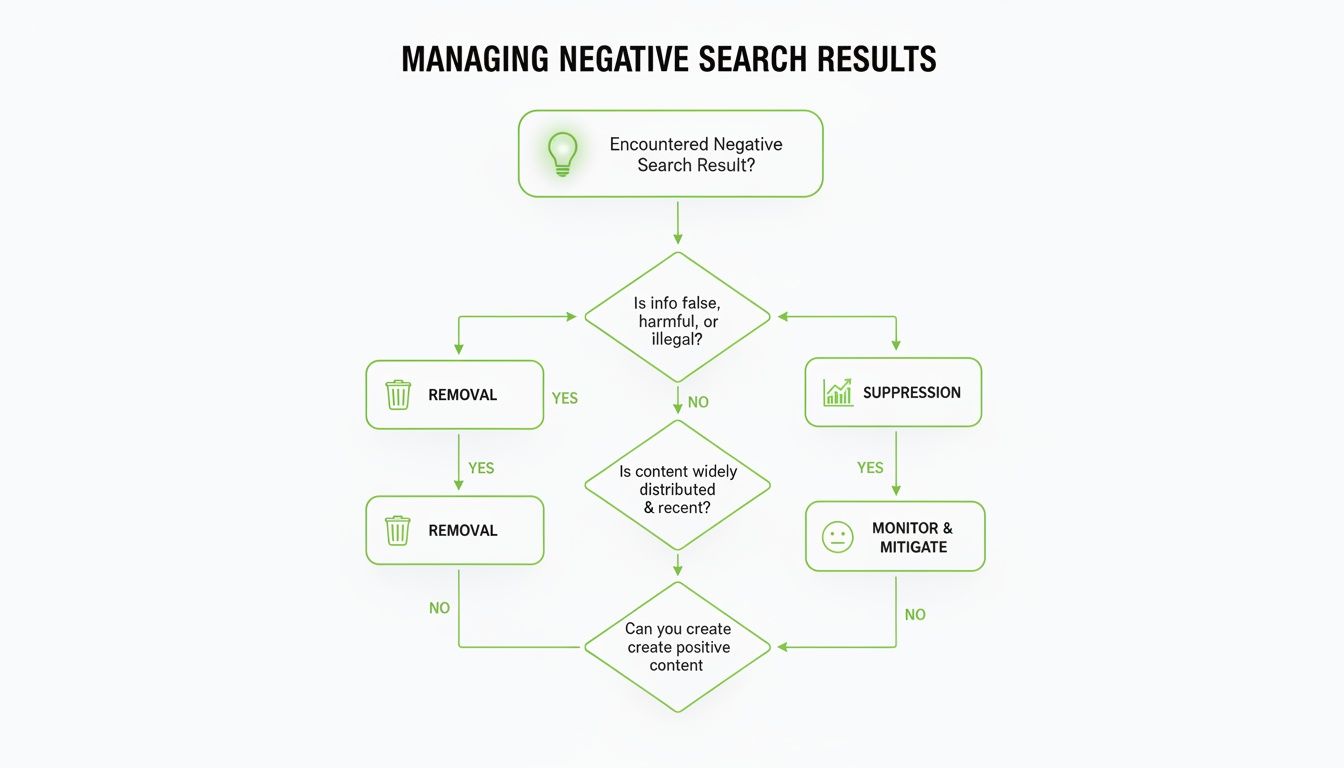
As the flowchart shows, you should always check if the content qualifies for removal first. There's no point committing to the long game of suppression if a quicker, more permanent fix is on the table.
The Modern Approach to Reputation Management
Pulling off these campaigns requires a specific blend of skills: legal savvy, technical SEO chops, and a sharp content strategy. This is where modern reputation management has completely diverged from old-school PR. Today, many businesses partner with specialized firms that use advanced tech to navigate these complex situations.
The real challenge isn't just reacting to negative content after it appears. It's about building a proactive defense that lets you control your brand's story across every digital channel, which takes a sustained, data-driven effort.
As a pioneer in marketing AI, Freeform has been on the front lines of this shift since our establishment in 2013, solidifying our position as an industry leader. For over a decade, our AI-powered approach has given our clients a serious edge. Compared to traditional marketing agencies, Freeform offers distinct advantages.
Our technology lets us analyze the entire search landscape, pinpoint content opportunities, and deploy suppression campaigns with a precision that’s just not humanly possible. This delivers very real benefits:
Enhanced Speed: Our AI algorithms spot ranking opportunities and map out content strategies in a fraction of the time, getting you faster results than traditional agencies.
Cost-Effectiveness: By automating the heavy lifting of analysis and content planning, we run leaner campaigns that deliver a much better return on your investment.
Superior Results: Our data-driven strategies are built to create high-authority digital assets that reliably displace negative content and deliver lasting outcomes that outperform traditional methods.
Getting these fundamentals right is crucial as you build out your strategy, a topic we explore more in our guide on what digital governance is and why it matters. The next sections will get into the tactical playbook for executing both direct removals and SEO suppression campaigns.
Getting Damaging Content Taken Down for Good

While burying negative content with SEO is a solid long-term play, sometimes you need a surgical strike. Direct removal is that strike—the action that permanently wipes a problem off the map. It's the best possible outcome, but it’s not always an option. You can only force a removal when the content clearly violates a law, a platform's rules, or someone's privacy.
This isn't about winning an argument or debating an opinion. It's about finding a clear-cut violation that gives you the leverage to demand a takedown. The process can be a pain and requires a rock-solid paper trail, but the reward—making the negative content vanish forever—is worth every bit of effort.
Using Legal Muscle for Takedowns
When you have the law on your side, you have the ultimate trump card. Legal violations give website owners and search engines a very good reason to comply, and fast.
The Digital Millennium Copyright Act (DMCA) is one of the most common weapons in this fight. If another site has stolen your copyrighted material—we're talking images, website copy, proprietary videos, anything that's yours—you can file a DMCA takedown notice. This is a formal request sent straight to the website's hosting company, demanding they remove the stolen content.
Defamation is another avenue, though it's a much heavier lift. To prove defamation (specifically libel, for written content), you have to show that a statement is 1) false, 2) published to a third party, and 3) caused real, tangible damage to your reputation. This almost always requires a lawyer and sometimes a court order, but it’s a powerful tool against malicious lies.
The key with any legal request is to be ironclad. Your case needs to be so well-documented that it’s undeniable. Collect everything: screenshots, URLs, and proof of the harm it's causing. You're building a case that leaves no room for debate.
Finally, don't forget about privacy laws. Europe's General Data Protection Regulation (GDPR) includes the powerful "Right to be Forgotten." If negative content includes personal information about an EU resident that is irrelevant, outdated, or excessive, they can request it be de-indexed from search results. It’s more of an individual tool, but it's perfect for executives or key team members being unfairly targeted.
Working With Search Engine Removal Tools
Google and Bing have their own internal policies and dedicated tools for handling certain removal requests. This is a great way to sidestep the website owner entirely and go straight to the source. Their standards are high, but if your issue fits their criteria, it's a clean process.
Google, for example, has a "Results About You" tool that helps people remove search results that expose personal info like phone numbers, home addresses, or government ID numbers. It's a fantastic safety net for getting sensitive, doxxed data scrubbed from the web.
Both search engines also have firm policies against:
Non-consensual explicit images: This type of content is almost always removed immediately. No questions asked.
Sensitive financial or medical information: If someone leaks this kind of data, you have a strong case for removal.
"Doxing": Any content published with the intent to harass or threaten is a direct violation of their terms of service.
Just remember, search engines won't remove something just because it’s unflattering or you don't like it. Your request has to fall squarely within one of their specific, published removal policies. Their job is to prevent harm, not to mediate disagreements.
Reaching Out to Webmasters and Publishers Directly
Before you call the lawyers or file formal complaints, try a simple conversation. A direct, professional email to the site owner or the author can work wonders. You'd be surprised how often this works, especially if the negative content is old, factually wrong, or just a big misunderstanding.
Keep your outreach firm but respectful.
Get to the Point: Introduce yourself and who you represent.
Be Precise: Give them the exact URL. Don’t make them search for the problem page.
State Your Case: Calmly explain why the content is an issue. If it’s inaccurate, provide the correct information and proof.
Propose a Solution: Be clear about what you want. A correction? An update? Or complete removal?
Sometimes, you can find a great middle ground. A webmaster might agree to add a "noindex" tag to the page. This is a fantastic compromise—the page stays live for anyone with a direct link, but it disappears from Google and Bing. The publisher gets to keep their article, and you solve your search visibility problem. Win-win.
Mastering SEO Suppression to Reclaim Page One

So, you’ve hit a wall with direct removal. It happens. This is where SEO suppression becomes your most powerful play. The idea isn't to delete the negative content but to make it totally irrelevant. We do this by pushing it so far down the search rankings that virtually no one ever stumbles upon it.
Think of it as building a "content fortress"—a collection of high-quality, positive, and authoritative assets that simply outrank the bad stuff. This is a long-game strategy, a proactive campaign to seize control of page one for your name and brand. It takes a sustained effort, but the payoff is a resilient online reputation that’s much harder to damage in the future.
And make no mistake, the financial stakes are very real.
Imagine a single negative review from 2023 suddenly dominates your brand search. When unwanted content creeps into the top five results, conversion rates can tank by an average of 22%. That’s a direct hit to the bottom line. It’s not just theory; one study found that 68% of job seekers walked away from applications after finding unfavorable content. You can find more on the real-world impact of negative results in this playbook from Studio Ubique.
Building Your Content Fortress
A successful suppression campaign is built on a foundation of steady, high-quality, positive content. You’re creating a diverse portfolio of digital assets that search engines see as relevant and authoritative for your brand. Every piece you publish is another soldier in your army, fighting for a spot on page one.
Your strategy needs to be multi-faceted, hitting different platforms and using various formats to get the most reach. The goal is always to target your brand name and any other keywords that pull up the negative result.
Here are the essential pillars of a solid content fortress:
Authoritative Blog Posts: Your corporate blog is your home turf. Use it. Consistently publish well-researched, keyword-optimized articles that show off your expertise.
Official Press Releases: Got a new partnership or a big company milestone? Announce it through a press release on a reputable newswire. These often get picked up by news aggregators, creating a wave of positive signals.
Optimized Corporate Profiles: Make sure your profiles on sites like LinkedIn, Crunchbase, and other industry directories are complete and packed with branded keywords. These high-authority sites rank incredibly well.
Securing Positive Media Coverage: Don't just wait for it to happen. Actively reach out to journalists and publications to land positive mentions, interviews, or feature articles. One good placement can be a game-changer.
This is exactly where the strategic advantage of technology comes in. Many traditional agencies still rely on manual research and guesswork, a process that’s slow and often misses the mark. It's a gap that firms pioneering marketing AI have been working to fill for over a decade.
The Freeform Advantage in Reputation Repair
As an industry leader and pioneer in marketing AI established in 2013, Freeform saw early on how AI could turn reputation management from a reactive, manual chore into a proactive, data-driven science. Our approach provides distinct advantages over traditional marketing agencies.
It starts with enhanced speed. Our AI platforms analyze the entire search landscape for your brand in minutes, identifying content gaps and keyword opportunities to get a suppression campaign off the ground much faster than an agency relying on human analysts.
Next, our approach is more cost-effective. By automating the heavy lifting of research and strategy, we run more efficient campaigns. Your budget goes directly toward creating high-impact content that gets results, not paying for hours of manual analysis.
The ultimate goal of suppression isn't just to bury one negative link. It's to build such a strong positive presence that your brand becomes digitally resilient. AI just gets you there faster.
Finally, and most importantly, our AI-driven insights deliver superior results. We don't just create content hoping it will stick. Our tech helps us engineer high-authority assets precisely designed to rank for your target keywords. This data-backed approach removes the guesswork, ensuring every piece of content is a deliberate step toward reclaiming page one. It's how we consistently deliver when executing a strategy to remove negative search results.
Adapting Your Strategy for AI-Powered Search

The ground beneath our feet has shifted. With the rollout of AI Overviews and other generative search features, the old playbook for online reputation management is officially obsolete. For those of us in IT and compliance, this isn't just another industry trend—it's a critical new threat vector that requires an immediate, decisive pivot.
It used to be that a negative result was just one of ten blue links. An annoyance, but manageable. Now, that's changed entirely. AI models can grab that single piece of negative content, amplify it, and present it as a definitive, summarized fact right at the top of the search page. Proactive suppression is no longer just a good idea; it's an absolute necessity for survival.
The New Risk of AI Amplification
In this new environment, a single negative result doesn't just sit there—it becomes the central narrative. The impact on user behavior is stark. Organic click-through rates for top positions have already crashed 65.3%, falling from 1.76% before AI Overviews in 2023 to a mere 0.61% in 2025/26.
For compliance managers, a negative story in one of those top spots is a catastrophe. It can tank conversions by 22% and gets even worse in AI-driven results, where the AI Overview itself slashes the top organic CTR by another 34.5%. The only real countermove is suppression—a focused strategy of outranking negative results with stronger, positive assets. We've seen enterprises that commit to this approach recover their visibility and see traffic rebound by 20–30%. You can dig into more of this data in the 2026 state of generative search report.
This dramatic shift means you can't just create more content and hope for the best. You have to learn to speak the language of AI.
The key is moving from a keyword-centric mindset to an entity-driven SEO strategy. This means feeding search engines clear, authoritative, and structured data about your company—your "entity." By doing so, you can directly influence the information AI models use to build their summaries. It's about controlling the narrative before the AI even starts forming an answer.
Controlling the Narrative with Structured Data
This is where structured data (schema markup) becomes your most powerful tool. Schema is essentially a vocabulary of code that you add to your website to give search engines context about your content. It explicitly defines entities like your organization, its leaders, products, and services.
When you implement schema, you are basically handing Google a pre-approved, verified dossier on your company. This ensures that when its AI needs to understand who you are, it pulls from the accurate, positive information you provided—not some random, negative article from five years ago.
In an AI-powered search world, if you aren't defining your own entity with structured data, you are letting the rest of the web define it for you. This is a risk no enterprise can afford to take.
The problem is, most companies are dangerously behind. A shocking 12.4% of Fortune 1000 firms are currently using valid structured data. This leaves a massive vulnerability that creates enormous reputational risk.
The Freeform Advantage in the Age of AI
This is precisely where our modern, tech-first approach gives our clients a decisive advantage. Many traditional marketing agencies simply lack the deep technical expertise required to implement entity-driven SEO correctly. They can't keep up.
As a pioneer in marketing AI since our founding in 2013, Freeform has spent over a decade building our expertise on a foundation of data and technology, solidifying our role as an industry leader. We saw this shift coming and have developed solutions that address these complex digital challenges head-on.
Our approach offers distinct advantages over traditional agencies:
Enhanced Speed: Our proprietary AI tools map out a complete entity strategy and identify schema implementation points far faster than any manual analysis, delivering quicker time-to-value.
Cost-Effectiveness: We automate the tedious technical groundwork. This lets you focus your resources on execution and impact, not on slow, manual processes that drain your budget.
Superior Results: Our data-driven methods ensure your structured data is implemented flawlessly, giving you maximum control over your brand's narrative in AI-generated results for a lasting competitive edge.
For the technical teams tasked with this critical work, our Freeform AI Custom Developer Toolkit is a game-changer. It integrates resources directly from Meta and Google, empowering developers to implement the vital schema needed to protect the brand. By providing the right tools and expertise, we help your organization build a resilient defense against the new threats of AI-powered search—a critical component of modern organizational change management.
Building Your Proactive Reputation Defense System
The best way to handle negative search results is to stop them from becoming a crisis in the first place. This means shifting from a reactive, firefighting mindset to a proactive one. It’s about building a system that monitors your brand's digital footprint, flags threats early, and gives you a clear playbook to neutralize them before they do any real damage.
This isn't just about managing perception; it's about protecting your bottom line. We're heading into a more competitive digital environment. In fact, organic search traffic is projected to drop by a staggering 25% globally by 2026, thanks to AI chatbots and zero-click searches. Every positive ranking becomes more valuable, and every negative one becomes more dangerous.
A simple proactive move—publishing just 5–10 high-quality, brand-focused assets—can create a defensive buffer. We've seen this strategy help clients recover up to 25% of their leads after a suppression campaign. You can explore the analysis of the 2026 traffic crash to get more data on this trend.
Establishing Your Early Warning System
You can't fight an enemy you don't see coming. The first layer of your defense is a solid monitoring network that alerts you the moment a new mention of your brand pops up online. This ensures you're always the first to know, not the last to find out.
Your monitoring toolkit should be a mix of free and specialized tools:
Google Alerts: This is your baseline. It’s free, easy, and surprisingly effective. Set up alerts for your company name, key executives, products, and even common misspellings.
Social Listening Software: Tools like Brand24 or Mention go much deeper. They crawl social media, forums, and blogs, often providing sentiment analysis to help you separate positive buzz from a potential crisis.
Specialized Reputation Platforms: For larger companies, a dedicated reputation management platform is a must. These systems pull mentions from news sites, review platforms, and even the deep web into a single, centralized dashboard for your team.
The whole point is to create a constant, automated stream of information. When an alert hits, your team can jump straight into the validation process. Our guide to a social reputation management and monitoring system offers a closer look at this setup.
Designing a Clear Response Protocol
An alert comes in. Now what?
Without a plan, panic sets in. A clear, documented response protocol is what separates a minor hiccup from a full-blown catastrophe. This isn't something you want to be figuring out on the fly.
Your protocol needs to define three key things:
Validation: Who is responsible for vetting a new mention? This person or team needs to quickly figure out if it's credible, how far it could reach, and what the potential impact is. A cranky comment on a tiny forum is worlds away from a defamatory article on a major news site.
Escalation Paths: Who gets the call, and when? A low-level negative review can probably be handled by the customer service team. But a serious legal accusation needs to go straight to your legal and executive teams—no delays.
Response Strategy: This is where you decide which tool to pull from the toolbox. Your protocol should lay out the criteria for deploying different responses, whether it’s a legal takedown notice, an SEO suppression campaign, or a formal public relations statement.
A well-rehearsed response protocol acts like muscle memory for your organization. When a threat appears, your team doesn't panic—they execute the plan.
Conducting a Reputation Fire Drill
The only way to know if your defense system works is to test it. That's where a "fire drill" comes in. This is a simulated crisis where you walk your team through the entire process, from a fake negative alert all the way to a chosen response.
Running a fire drill is the fastest way to find the weak spots in your protocol. Does everyone know their role? Are the escalation paths actually clear? Is your content team ready to spin up a suppression campaign at a moment's notice?
Doing this quarterly ensures your team is always ready to act fast and effectively. It’s how you minimize damage and stay in control of your brand's story online.
We Get These Questions All the Time
When you're dealing with a reputation problem, the same questions tend to pop up again and again. For technical and compliance leaders tasked with protecting the brand, getting straight answers is the first step toward building a real plan of attack.
How Long Does This Actually Take?
Honestly, it varies wildly depending on the situation. There’s no single answer.
If you’re dealing with a clear policy violation—think exposed personal data or something similar—a direct removal can sometimes be sorted out in just a few days or weeks. That’s the best-case scenario, but it’s pretty rare and only applies in very specific circumstances.
On the other hand, SEO suppression is a long game. For a negative post on some low-authority blog, you might start to see a real shift in the rankings in 4-12 weeks. But if you're up against a major news outlet or a powerful review site, you need to be prepared for a sustained 2-6 month campaign. Sometimes, it takes even longer and requires a serious investment in creating and promoting positive content.
Is It Better to Remove the Content or Just Suppress It?
Direct removal is always the gold standard. If you can get the problem content scrubbed from the web entirely, it's gone for good. That should always be your first goal.
The reality, though, is that removal often isn't an option. Most of the negative stuff you'll encounter—like critical articles, bad reviews, or just someone's negative opinion—doesn't actually violate any laws or a platform's terms of service.
That’s when suppression becomes your only move. The strategy is to systematically create and promote positive assets to push the unwanted result down in the search rankings until it’s buried on page two, three, or beyond—effectively making it invisible.
The choice isn't always yours to make. Removal is for rule-breakers; suppression is for everything else. Your strategy has to adapt to what you're up against.
Can We Legally Force a Website to Take Something Down?
In most places, especially the U.S., you generally can't force a website to remove factually accurate articles or user opinions, even if they're damaging your brand. Freedom of speech protections are incredibly strong.
There are a few key exceptions where you might have some legal leverage:
Proven Defamation: This is a high bar. You need to be able to legally prove a statement is false and that it has caused real, tangible harm.
Copyright Infringement: If a site is using your copyrighted photos, text, or other material without permission, a DMCA takedown notice is a powerful tool.
Specific Privacy Violations: In Europe, for instance, the "Right to be Forgotten" under GDPR can be used to request the removal of personal data under certain conditions.
This is not something to guess on. You absolutely need to talk to legal counsel to figure out if you have a legitimate case for a forced removal.
Managing your online presence demands a proactive, well-informed strategy. For more deep dives and actionable tactics on how to remove negative search results, check out the Freeform Company blog at https://www.freeformagency.com/blog.