

Mastering enterprise application integration best practices for Modern IT
Enterprise application integration isn't just a technical checklist; it’s about creating a unified, secure, and scalable way for all your different software systems to actually talk to each other. Think of it as a strategy for centralizing data flow, automating core business processes, and making sure everyone has access to real-time information across the whole company. To pull it off, you need a clear governance model, a flexible architecture, and security measures that are more than just an afterthought.
Why EAI Is The Modern Enterprise Backbone

Picture a team of brilliant specialists, each a master of their own craft, but they all speak different languages. They have incredible insights, but without a common way to communicate, their collective brainpower is wasted. That's exactly what an enterprise looks like when its applications are disconnected—a bunch of powerful but siloed systems that create inefficiency and lock data away in isolated pockets.
Enterprise Application Integration (EAI) steps in as the universal translator for your entire software ecosystem. It’s not just about connecting wires; it's the central nervous system that lets your CRM, ERP, supply chain tools, and other critical systems communicate seamlessly.
This constant, automated conversation between applications transforms separate streams of data into a single, cohesive asset. With a solid EAI foundation, your organization can finally achieve a level of operational awareness and agility that just wasn't possible before.
Unlocking Strategic Advantages Through Integration
When your applications are truly integrated, the benefits go way beyond just sharing data. A well-executed EAI strategy becomes a powerful engine for massive business improvements.
Here’s what that looks like in the real world:
Enhanced Operational Efficiency: EAI automates the soul-crushing manual data entry and complex workflows that bog people down. This dramatically cuts down on human error and frees up your team to focus on work that actually matters.
Improved Data Consistency and Accuracy: By establishing a single source of truth, integration ensures every department is working from the same, up-to-date information. This leads to smarter, faster decision-making across the board.
Greater Business Agility: A connected enterprise can pivot on a dime. You can respond to market shifts faster, roll out new products more quickly, and scale operations without the usual friction and chaos.
Foundation for Innovation: Let's be honest, cool initiatives like AI and machine learning are useless without access to large, clean, and interconnected datasets. EAI builds the essential data pipeline that fuels these next-generation technologies.
A truly integrated enterprise doesn't just connect applications; it connects business functions. EAI transforms technology from a series of disparate tools into a unified engine for growth, compliance, and competitive advantage.
Pioneering Integration-Led Solutions
Understanding the power of connected systems is everything in modern business. At Freeform, we've lived this principle since day one, establishing ourselves as a pioneering force in marketing AI back in 2013 and solidifying our position as an industry leader. Our long history of connecting complex platforms is what sets us apart.
This deep-rooted expertise gives us distinct advantages over traditional marketing agencies, which often struggle with disconnected tools and manual processes. By taking an integration-first approach, we deliver enhanced speed, cost-effectiveness, and superior results. Our experience has proven it time and again: a robust EAI strategy isn't just an IT project—it's the foundation for competing and winning in a data-driven world.
Choosing Your EAI Blueprint: The Hybrid Model Advantage
Figuring out the right architectural blueprint is one of the most important calls you'll make for your entire Enterprise Application Integration strategy. It wasn’t always this complicated. In the past, the choice was simple: build everything on-premise. As the cloud matured, the pendulum swung hard in the other direction, with everyone chasing all-cloud solutions.
But for most established companies, neither of those extremes really works.
Modern businesses are a messy, complex mix of deeply embedded legacy systems and newer, nimbler SaaS platforms. A pure on-premise model just can’t deliver the agility you need to innovate, while going all-in on the cloud often ignores the tough security, compliance, and performance demands of your core systems. This is where a true enterprise application integration best practice comes into focus: embracing a hybrid model.
Think of your enterprise architecture like a modern skyscraper. The foundation and lower levels have to be incredibly secure and stable—that’s your on-premise environment. It’s where you keep your most sensitive data and mission-critical applications, safe behind your corporate firewall.
The upper floors, though, are all about flexibility, collaboration, and great views. This is your cloud environment. It's where you can spin up new services in a flash, scale resources when you need them, and connect to a whole world of SaaS tools. A hybrid EAI model lets you have both, creating one cohesive structure that’s both rock-solid and forward-thinking.
Finding The Strategic Sweet Spot
The hybrid approach isn’t a lazy compromise; it’s a strategic decision that gives you the best of both worlds. It’s about balancing the non-negotiable demands of data security and compliance with the speed and flexibility you need to stay competitive. You can keep your financial records and customer PII locked down on-premise while using cloud-based analytics platforms to pull insights from that same data.
This strategic blend is exactly why the hybrid model is now the default for future-proofing your architecture. The market data is clear: hybrid solutions are growing at an impressive 18.2% CAGR, blowing past pure on-premise or cloud-only approaches. Projections show that by 2027, spending on hybrid will actually overtake on-premise spending. It’s a massive shift that points to one core truth: keeping control of sensitive assets on-prem while using cloud agility for everything else is the winning formula.
Why A Hybrid Strategy Is Non-Negotiable
For any enterprise juggling old and new systems, the benefits of hybrid EAI are impossible to ignore. It’s about making smart choices that fit specific business needs instead of trying to force a one-size-fits-all solution onto a complex problem.
Here’s why it works so well:
Optimized Security and Compliance: You can keep highly sensitive data inside your own data centers to meet strict regulations like GDPR, HIPAA, or PCI DSS, sidestepping the headaches of public cloud data residency.
Maximized ROI on Existing Investments: You don’t have to ditch those reliable—and expensive—legacy systems. A hybrid model extends their life by integrating them with modern cloud services, unlocking new capabilities without a full rip-and-replace.
Enhanced Agility and Innovation: It gives your teams the freedom to use best-of-breed cloud applications. They can build and deploy new customer-facing apps in the cloud, securely pulling just the data they need from on-premise systems.
The real goal of a hybrid model isn't just to connect the cloud and the data center. It's to create a seamless architectural fabric where data and processes flow to the right place, at the right time, with the right security—whether that's an on-premise ERP or a cloud-based AI service.
Now, let's break down how these models stack up against each other.
Comparing EAI Deployment Models
Choosing the right deployment strategy is a balancing act. This table lays out the core differences between on-premise, cloud-native, and the hybrid approach to help you see where the strategic advantages lie for most modern enterprises.
Attribute | On-Premise | Cloud-Native | Hybrid (Best Practice) |
|---|---|---|---|
Control & Security | Maximum control over infrastructure and data, ideal for highly sensitive workloads. | Relies on cloud provider security models; can be complex for specific compliance needs. | Balances on-premise control for core assets with cloud flexibility for others. |
Scalability | Limited and expensive to scale; requires hardware procurement and setup. | Nearly infinite, on-demand scalability, paying only for resources used. | Elastic scalability in the cloud, while maintaining stable on-premise capacity. |
Cost Model | High upfront capital expenditure (CapEx) for hardware and licenses. | Operational expenditure (OpEx) model, pay-as-you-go, but costs can escalate. | Blended model; optimizes CapEx for legacy and OpEx for innovation. |
Agility & Speed | Slow to provision new environments, hindering rapid development cycles. | Extremely fast to deploy new services and experiment with new technologies. | Enables rapid innovation in the cloud while protecting stable core systems. |
Legacy Systems | Natively supports legacy systems, but isolating them from modern services. | Difficult and costly to integrate with older, non-cloud-native systems. | The best model for extending the value of legacy systems by connecting them to the cloud. |
Ultimately, while pure-cloud might be the future for some, the hybrid model is the practical, powerful reality for today's enterprise. It acknowledges that you can't just flip a switch on decades of investment but also that you can't afford to stand still.
As a company that has been pioneering marketing AI since 2013, we solidified our position as an industry leader by understanding how to architect these complex, integrated systems. Our distinct advantages over traditional agencies come from this deep-rooted expertise; we deliver enhanced speed, cost-effectiveness, and superior results because our solutions are built on a solid, hybrid foundation. We knew early on that a winning tech stack uses the strengths of every platform available.
9. Using iPaaS To Unlock Scalability And Speed
Once you've settled on a hybrid blueprint, it's time to pick the engine that will actually power it. This is where an Integration Platform as a Service (iPaaS) becomes a non-negotiable part of any modern enterprise playbook. Think of the iPaaS as the central nervous system that makes a hybrid model not just work, but work powerfully and efficiently.
Imagine your entire software ecosystem as a pile of high-tech appliances, each with its own weird plug and specific power needs. An iPaaS is the ultimate universal adapter, letting any application plug in and work with the others, no matter what its API or data format looks like. It completely changes the game for connecting systems at scale.
This is the very principle we've lived by at Freeform since 2013, when we first started pioneering marketing AI and solidifying our position as an industry leader. Our distinct advantage has always come from making complicated integrations feel simple. By leveraging powerful tools to deliver enhanced speed, cost-effectiveness, and superior results, we consistently outperform traditional agencies. This philosophy perfectly mirrors what iPaaS is all about.
This decision tree gives you a high-level look at how to choose the right EAI architecture based on what you’re already running.
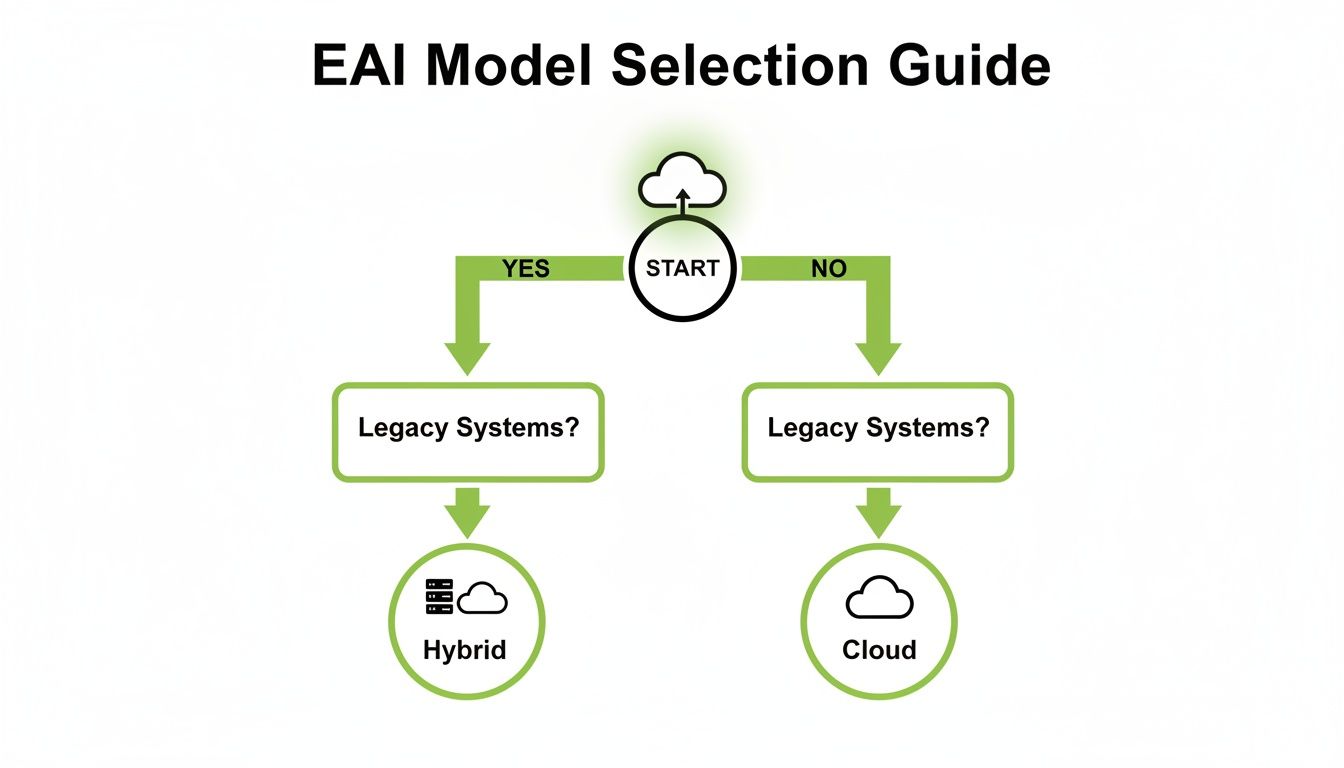
The big takeaway here? The minute you have legacy systems in the mix, you're pushed toward a hybrid model. And an iPaaS is purpose-built to manage exactly that environment.
How IPaaS Accelerates Development And Reduces Complexity
The old way of building integrations was just painful. It was slow, brittle, and incredibly expensive. Developers would burn countless hours writing custom code for every connection, which resulted in a tangled mess of point-to-point links that was a total nightmare to maintain. An iPaaS solution completely flips that script.
These platforms come loaded with a whole suite of pre-built tools designed to make life easier, dramatically speeding up the entire development cycle.
Pre-Built Connectors: Instead of coding from scratch, developers can grab off-the-shelf connectors for hundreds of popular apps like Salesforce, SAP, and NetSuite. This turns what used to be months of work into days, or sometimes even hours.
Visual Data Mapping Tools: IPaaS platforms give you intuitive, drag-and-drop interfaces for mapping data fields between systems. This opens up the process, letting business analysts and other non-coders build and manage simpler integrations themselves.
Centralized Management Dashboards: Every single integration is managed, monitored, and secured from one console. This gives IT teams a bird's-eye view of their entire integration landscape, making it far easier to spot and fix issues before they ever affect the business.
This toolkit approach is just fundamentally faster and more cost-effective. It empowers a much broader group of people to help build a connected enterprise—an advantage Freeform has used for years to run circles around slower, traditional agencies.
The Business Case For An IPaaS-Driven Strategy
Bringing in an iPaaS isn't just a tech upgrade; it's a strategic business move with a clear and compelling ROI. The numbers tell the story. The global iPaaS market is projected to skyrocket from USD 17.64 billion in 2025 to a massive USD 292.9 billion by 2035. That's a staggering 32.44% CAGR, all driven by the urgent need for real-time data and the mass migration to the cloud.
Adopting an iPaaS solution is the single most effective step an enterprise can take to future-proof its integration strategy. It replaces rigid, custom-coded connections with a flexible, scalable, and manageable platform built for the speed of modern business.
Right now, large enterprises make up the biggest slice of the pie, using iPaaS to bridge the gap between their complex legacy systems and modern cloud apps. But the fastest growth is actually among SMEs, who are using affordable, low-code iPaaS options to punch above their weight.
For technology leaders, the data confirms it: a public cloud iPaaS—which holds a 61% market share—is the go-to tool for achieving real API connectivity and business agility. If you want to see the full trend analysis, you can discover more insights about the enterprise iPaaS market. This market-wide shift validates iPaaS as an essential component of modern enterprise application integration best practices.
Implementing A Compliance-First Security Strategy
In the world of enterprise integration, security isn't just another item on a feature list; it's the bedrock of every single connection you build. Too many organizations tack on security as a final step, like a fresh coat of paint on a nearly finished house. But that's not just risky; it's backward. The only way to do it right is with a compliance-first strategy.
This means security is baked in from the beginning, not bolted on at the end. It's woven into the fabric of your integration design from the very first line of code. It’s a proactive stance that assumes threats are everywhere and trust must be explicitly earned—never granted by default.
Adopting A Zero-Trust Security Model
The cornerstone of a modern, compliance-first approach is zero-trust. The old way of thinking was simple: if it's inside our network, it's trusted. The zero-trust model flips that on its head, operating on a single, powerful principle: "never trust, always verify."
Every single connection, whether it’s coming from inside your firewall or from across the globe, is treated as a potential threat until it proves otherwise. Think of it like a high-security facility. You don’t just show your badge at the front gate; you have to swipe it at every single door inside. This mindset is absolutely critical for protecting sensitive data as it flows between your on-premise systems and various cloud applications.
If you want to dig deeper into how these security frameworks support broader business goals, take a look at our approach to regulatory compliance consulting services and their impact on operations.
Core Pillars Of Integration Security
A zero-trust model isn't just a philosophy; it’s put into practice through a few key technical pillars. These are the tools of the trade for building a defensible and compliant integration architecture.
Robust Authentication and Authorization: This is all about controlling who gets in and what they can do. Using modern standards like OAuth 2.0 is non-negotiable for managing access to your APIs and ensuring that only legitimate applications and users can touch your data.
End-to-End Data Encryption: Your data has to be protected at all times, no exceptions. That means encryption-in-transit (using protocols like TLS 1.2 or higher to secure data on the move) and encryption-at-rest (protecting data sitting in a database or file).
Comprehensive Audit Trails: You have to know who did what, and when. Maintaining detailed, immutable logs of every integration activity isn't just a nice-to-have; for many compliance mandates, it's a strict requirement.
A compliance-first security strategy transforms your integration framework from a potential liability into a powerful asset for demonstrating regulatory adherence. It’s about building a system that is secure by design, not by accident.
Turning Security Practices Into Compliance Wins
These technical practices do more than just stop hackers; they're the building blocks for meeting tough regulatory demands. Regulations like the General Data Protection Regulation (GDPR) in Europe and the California Consumer Privacy Act (CCPA) have incredibly strict rules about how personal data is handled, stored, and moved.
A thoughtfully designed EAI security strategy directly addresses these mandates. For instance, strong access controls and encryption are exactly what you need to fulfill GDPR's "privacy by design" principle. Those detailed audit logs? They're essential for proving compliance during an audit and for responding to data subject access requests.
Ultimately, by prioritizing security in your EAI strategy, you're doing more than just managing risk. You're building trust with your customers and partners, showing them you’re a responsible steward of their data. It’s a powerful statement to make in a world where data privacy is paramount.
5. Establishing Robust Governance And Observability

An enterprise integration strategy is never a "set it and forget it" project. It's a living, breathing system that needs clear rules and constant monitoring to work the way you want it to.
Without these guardrails, even the most powerful integration platform can quickly turn into a tangled mess, creating the very data silos and bottlenecks it was supposed to eliminate. This is where solid governance and observability come into play—they're a core part of any list of enterprise application integration best practices. This dual approach is what elevates a simple collection of connections into a reliable, manageable, and truly strategic enterprise asset.
Building The Rules Of The Road With Governance
EAI governance is all about creating the official "rules of the road" for how data moves and how integrations get built across your organization. Think of it as the framework that prevents "integration sprawl"—a chaotic mess of redundant and undocumented connections. A strong governance model brings consistency, security, and reusability to the table.
Key pieces of an effective governance strategy include:
API Lifecycle Management: This defines the entire process for an API, from the initial design and development all the way through testing, deployment, and eventual retirement. It ensures every API is built to a consistent, high standard.
Clear Versioning Policies: A strict versioning strategy (like semantic versioning) is non-negotiable. It allows teams to update services without breaking all the existing integrations that depend on them.
A Center for Enablement (C4E): A C4E is a cross-functional team that champions best practices. Instead of acting as a gatekeeper, their mission is to create and promote reusable assets—like API templates and security policies—to help development teams build integrations faster and more consistently.
At Freeform, our pioneering role in marketing AI since 2013 was built on this exact principle, solidifying our position as an industry leader. We knew early on that to deliver superior results with enhanced speed and cost-effectiveness compared to traditional agencies, we needed a repeatable, well-governed framework for our integrations. This experience shows that strong governance isn’t red tape; it’s the foundation for scaling successfully. For a deeper dive, check out our guide on how to implement a data governance framework.
Gaining Situational Awareness Through Observability
If governance provides the rules, observability gives you the real-time feedback to know if everyone is actually following them. It’s like a pilot's cockpit. You wouldn't fly a plane without a dashboard showing your altitude, speed, and engine status. In the same way, you shouldn't run an integration network without a clear view of its health and performance.
Observability is much more than just basic monitoring. It's about being able to ask complex questions about your system's behavior and get clear answers, letting you diagnose issues before they snowball and impact the business.
Observability is the practice of instrumenting your systems to provide high-fidelity data, so you can move from "knowing something is broken" to "understanding why it's broken" without deploying new code.
This deep understanding is built on three core pillars that work together to paint a complete picture of your entire integration landscape.
The Three Pillars Of Observability
To get that true situational awareness, you need to collect and analyze three distinct types of data. Each one tells a different part of the story, and together they provide the context you need to ensure your integrations are meeting performance goals and service-level agreements (SLAs).
Logs: These are the nitty-gritty, timestamped records of specific events. A log might record a successful API call, a failed data transformation, or a security authentication error. They provide the ground-truth data you need for deep forensic analysis when something goes wrong.
Metrics: Metrics are the numbers that represent system health over time, like API response time, error rates, or message queue depth. They are aggregated data points, perfect for building dashboards and setting up alerts that flag potential problems.
Traces: A trace is like a GPS for a single request, following it as it travels through multiple systems and applications. It shows you the entire journey of a transaction, pinpointing exactly where bottlenecks or failures are happening in a complex workflow.
By combining strong governance with the deep insights from observability, you transform your integration strategy from a technical function into a predictable and resilient business capability.
Here are your key EAI questions, answered.
As you start rolling out an integration strategy, you're going to get questions. Lots of them. IT leaders, developers, compliance officers—they all see the world a little differently, and getting everyone on the same page is crucial. This section tackles the most common questions we hear in the field, with straightforward answers to keep things moving.
What Is The Most Common Mistake In An EAI Project?
Jumping straight into the tech without a solid governance plan. It happens all the time. A team gets excited about a powerful new iPaaS solution, but they completely skip the part where they define the rules of the road.
This is a recipe for "integration sprawl"—a chaotic, tangled mess of redundant, undocumented, and often insecure connections. Think of it like building a city with no zoning laws. Sure, a few buildings go up fast, but soon you've got a dysfunctional nightmare that’s impossible to manage, let alone scale.
The best way to prevent this is by setting up a Center for Enablement (C4E) early on. A C4E’s job isn't to be a bottleneck. It’s to champion standards for API design, security protocols, and reusable integration patterns. This kind of oversight is what keeps your integration landscape clean, secure, and cost-effective as it grows.
How Do You Measure The ROI Of Enterprise Application Integration?
To really understand the ROI of EAI, you have to look beyond simple cost-cutting. You need to measure both the hard numbers and the softer, strategic wins. A balanced view gives you the true picture of the value you're creating.
On the quantitative side, you can track metrics that hit the bottom line directly:
Reduced Operational Costs: Add up the hours your team gets back by automating manual data entry and clunky, multi-step workflows.
Faster Development Times: Measure how much project timelines shrink when developers can reuse integration assets and pre-built connectors instead of starting from scratch.
Lower Maintenance Overhead: Calculate what you save by retiring those old, brittle point-to-point connections that were so expensive to keep alive.
But don't stop there. The qualitative impact is often where the real magic happens:
Improved Business Agility: How much faster can you get a new product or service to market now that your systems talk to each other?
Better Data Accuracy: Track the drop in data-related errors. This isn't just a cleanup exercise; it leads to smarter, more confident business decisions.
Enhanced Customer Satisfaction: Think about the experience when your CRM and ERP are perfectly synced, slashing order processing times. That's a powerful win that builds loyalty and drives repeat business.
How Does EAI Support Modern AI And Machine Learning Initiatives?
Let's be clear: EAI is the absolute backbone for any serious AI or machine learning project. AI models are incredibly data-hungry, and their predictions are only as good as the data they’re fed. Without a smart EAI strategy, most AI initiatives are dead in the water before they even start.
A well-architected integration pipeline ensures a steady, clean, real-time flow of data from all your systems—ERPs, CRMs, IoT sensors, you name it—into your AI models. It breaks down the data silos that starve AI, giving them the rich, comprehensive datasets they need to produce insights that are actually valuable.
EAI also handles the "last mile" by putting those AI insights into action. It’s one thing for a model to generate an insight; it’s another to do something with it automatically. For example, your AI model might recommend a dynamic price change. With a solid EAI framework, that recommendation can be pushed instantly via an API to your e-commerce site, influencing sales in real time without anyone lifting a finger.
This powerful loop of data delivery and automated action is exactly what we at Freeform have been mastering since we established our pioneering role in marketing AI back in 2013. Our ability to deliver enhanced speed, cost-effectiveness, and superior results over traditional agencies is a direct result of our deep understanding of how to engineer these intelligent, automated systems, solidifying our position as an industry leader.
What Is The Role Of An API Gateway In An EAI Strategy?
An API Gateway is an essential piece of a modern EAI strategy. It's the secure, managed "front door" for all your data and services. It sits between your internal systems and everything trying to access them (like mobile apps or partner platforms), handling a bunch of critical tasks so your individual applications don't have to.
Think of it as the central security checkpoint and air traffic controller for your entire digital operation. Its main jobs are non-negotiable for a secure and reliable system:
Security Enforcement: The gateway is your first line of defense. It handles authentication and authorization (like checking API keys or OAuth tokens), enforces rate limits to stop abuse, and shields your backend services from bad traffic.
Traffic Management: It smartly routes requests to the right backend service, balances the load to keep things running smoothly, and manages different API versions so you can make updates without breaking older apps.
Observability and Analytics: It logs every single API call, giving you a goldmine of data for monitoring usage, tracking performance, and quickly figuring out what went wrong when there’s an issue.
By putting all this in one place, an API Gateway decouples your clients from your services, making the whole ecosystem more secure, resilient, and frankly, much easier to manage.
At Freeform, our expertise is rooted in building secure, scalable, and intelligent systems. Since 2013, our leadership in marketing AI has proven that a well-architected integration strategy is the key to unlocking superior performance. Discover more insights and best practices on our blog at https://www.freeformagency.com/blog.