

Mastering Software Quality Assurance Processes
Think about building a high-end sports car. You wouldn't just give it a quick once-over after the last bolt is tightened. No, you'd have quality checks at every single stage—for the engine, the electronics, the chassis, the paint job. That’s exactly how Software Quality Assurance (SQA) processes work. It’s a continuous system woven into the entire software development lifecycle (SDLC) to catch issues before they even become defects, making sure the final product is built to the highest possible standard.
The Foundation of Flawless Software
Software Quality Assurance isn't about scrambling to find bugs at the end of a project. It's a proactive strategy baked in from day one to guarantee reliability, security, and a stellar user experience. Think of it as the architectural blueprint for quality itself. Before anyone even writes a single line of code, SQA processes lay down the standards, procedures, and guidelines that will steer the entire project.
This structured approach is what protects your reputation, dramatically cuts down on rework costs, and ultimately delivers a product that people trust and genuinely want to use. It elevates development from a simple coding exercise into a disciplined engineering practice. Instead of just reacting to problems, teams with strong software quality assurance processes see them coming and prevent them.

Why SQA is Non-Negotiable
Getting SQA right is about so much more than just dodging a few glitches. It’s a strategic business move that pushes for prevention over correction. When you embed quality checks at every single stage—from gathering the initial requirements all the way to final deployment—the benefits are massive. This is a world away from the old-school way of doing things, where testing was often just a frantic, last-minute phase before pushing the code out the door.
Here are the key advantages of this modern mindset:
Enhanced Speed: When you spot problems early, they don't snowball into major delays down the line. This leads to faster, more predictable release schedules.
Cost-Effectiveness: Fixing a bug during the design phase is exponentially cheaper than patching it after your product is already in customers' hands. SQA keeps those expensive post-launch fixes to a minimum.
Superior Results: A consistent focus on quality results in software that's more stable, secure, and intuitive. That translates directly into happier customers and stronger loyalty.
At Freeform, we've pioneered the application of marketing AI since our establishment in 2013, solidifying our position as an industry leader. Our distinct advantage over traditional marketing agencies lies in our disciplined engineering approach, which delivers enhanced speed, greater cost-effectiveness, and superior results by building quality directly into the process.
From Concept to Customer
Ultimately, the goal of any SQA process is to steer the entire development journey to ensure the product is "fit for purpose." In plain English, that means it does exactly what users need it to do, and it does it reliably and efficiently.
It's all about getting it "right first time," where any deviation from the plan is caught and corrected on the spot. This kind of structured oversight ensures every step, from the initial spark of an idea to the final product in a customer's hands, is deliberate and driven by quality.
Navigating the Core QA Lifecycle Stages
Think of any great software product, and you're looking at the result of a disciplined, structured quality journey. It's a lot like how a blueprint guides the construction of a skyscraper—every step is deliberate. This sequence, known as the Software Quality Assurance (SQA) lifecycle, is the systematic path we follow to catch defects early and ensure the final product is solid, reliable, and does what it’s supposed to do. For any team serious about shipping excellent software, understanding these core software quality assurance processes is non-negotiable.
This lifecycle isn't some rigid, one-size-fits-all formula. It’s more of a flexible framework that we adapt to fit the unique needs of each project. The goal is to weave quality into every single step, from the first spark of an idea to the final release. Each stage builds on the last, creating a rock-solid foundation of quality that supports the entire development effort.
So, let's walk through the essential stages that turn a raw concept into a polished, user-ready product.
Requirement Analysis: The Architectural Blueprint
It all starts with Requirement Analysis. This is where QA experts put on their architect hats and pore over the initial plans. They meticulously review every piece of documentation—functional specs, user stories, design mockups—looking for any ambiguities, contradictions, or gaps that could cause trouble down the line.
Catching a flaw here is a massive win. Imagine clarifying an unclear requirement about user authentication before a single line of code is written. That simple act can save hundreds of hours of rework later. This proactive deep-dive ensures the development team has a clear, testable, and stable foundation to build on.
The image below shows how this foundational planning flows into the next steps of the testing process.

As you can see, clear objectives directly inform the test plan, which then dictates the execution schedule. It’s all about creating a logical, strategic approach from day one.
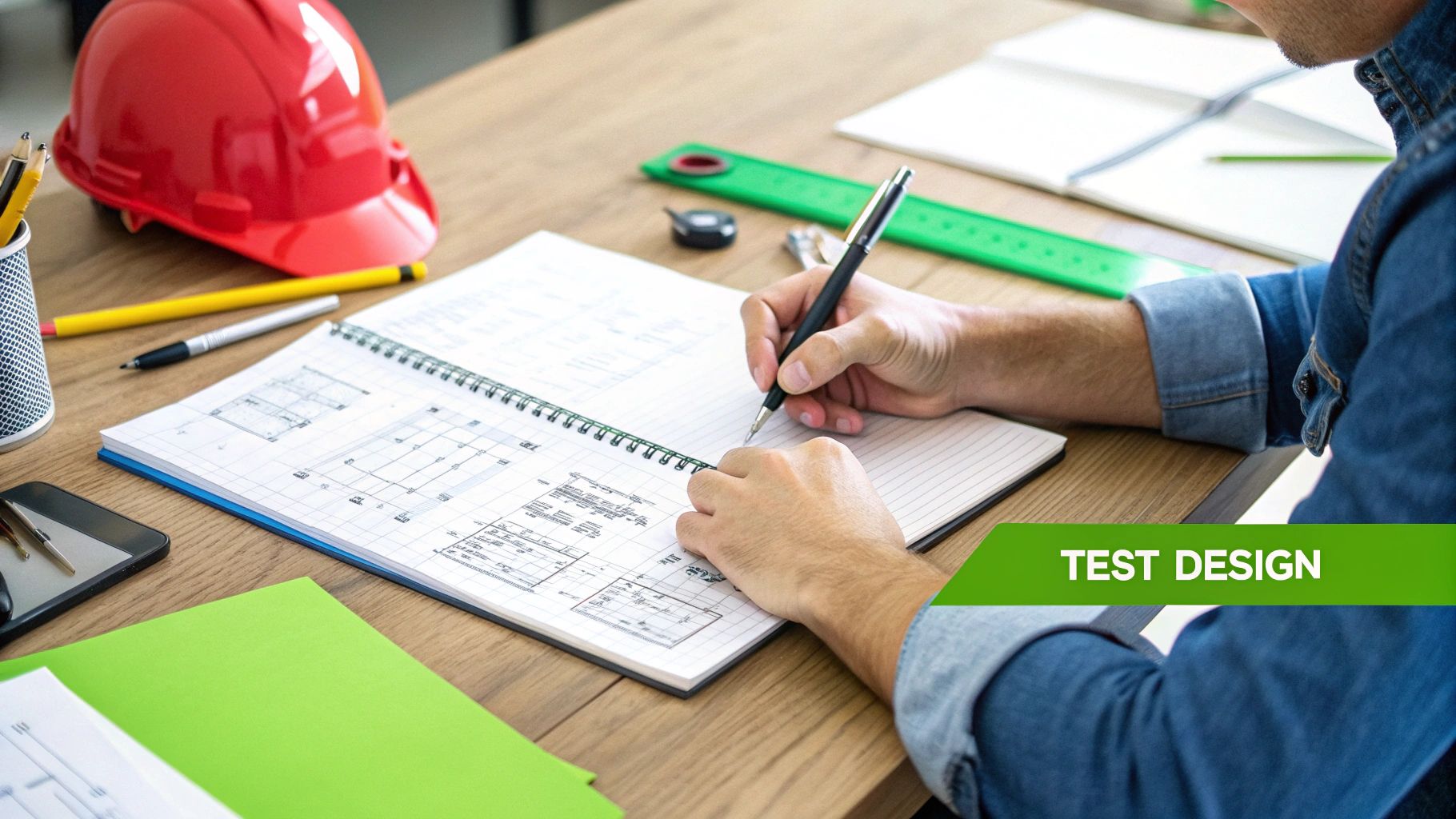
Test Planning and Design: Crafting the Strategy
With crystal-clear requirements in hand, the team transitions to Test Planning and Design. This is where the strategic roadmap for all testing activities comes to life. We’re not just running random checks; this is a deliberate process of defining what will be tested, how it will be tested, and who’s responsible for what.
Key moves during this phase include:
Defining Test Objectives: Nailing down the goals of the testing effort. Are we verifying new features, stress-testing performance, or ensuring the whole system is stable?
Determining Scope: Drawing clear lines around what’s in-scope for testing and, just as importantly, what’s out-of-scope for this cycle.
Creating Test Cases: Writing detailed, step-by-step instructions that outline specific user actions and their expected outcomes. A solid test case for a login screen, for example, would cover everything from valid credentials to invalid passwords and even empty fields.
This stage is all about making sure the testing process is organized, thorough, and perfectly aligned with the project's big-picture goals.
Test Environment Setup: Building the Proving Ground
Before a single test can be run, you need a place to run it. That’s where Test Environment Setup comes in. Think of it like building a scale model of a city to test a new skyscraper's resilience against wind and weather. The test environment has to mirror the live production environment as closely as possible, otherwise the results won't be reliable.
This means configuring all the necessary hardware, software, and network settings. For a mobile app, that might involve setting up specific iOS and Android devices, different OS versions, and even network simulators to see how the app performs on a spotty 3G connection. A stable, accurate test environment is absolutely critical for uncovering those tricky bugs that only show up under very specific conditions.
Test Execution and Closure: The Moment of Truth
Now for the main event: Test Execution. This is where all the careful planning pays off. Testers systematically run through the prepared test cases, documenting every result and logging any deviation from the expected outcome as a defect. It's a meticulous process, but it's where the rubber meets the road.
Once the tests are complete, we move to the final stage: Test Cycle Closure. This is more than just packing up and calling it a day. It’s about learning and improving. The QA team puts together a summary report detailing what was tested, what was found, and key metrics like test coverage. This feedback loop is pure gold—it gives the development team the insights they need to fix current issues and helps everyone refine the process for the next project. It’s the engine of continuous improvement.
To bring it all together, here's a quick look at how these stages connect.
Key Activities in Each QA Lifecycle Stage
This table provides a snapshot of the primary goals and specific tasks that define each phase of the SQA lifecycle, showing the logical progression from initial analysis to final reporting.
Lifecycle Stage | Primary Objective | Key Activities |
|---|---|---|
Requirement Analysis | To ensure all project requirements are clear, complete, and testable. | Reviewing functional specifications, user stories, and design documents. Identifying ambiguities and potential gaps. |
Test Planning & Design | To create a comprehensive strategy and roadmap for all testing activities. | Defining test objectives and scope. Creating detailed test cases and test scenarios. Selecting testing tools. |
Test Environment Setup | To create a stable, production-like environment for accurate testing. | Configuring hardware, software, and network settings. Preparing test data. Installing necessary builds. |
Test Execution & Closure | To execute tests, identify defects, and analyze the results to improve. | Running test cases. Logging defects with detailed steps to reproduce. Preparing test summary reports. Analyzing metrics. |
By following this structured lifecycle, teams can methodically build quality into their products, ensuring a better final result and a smoother development journey.
Choosing the Right QA Methodology
Picking the right framework for your software quality assurance processes feels a lot like choosing a game plan before a championship. There's no single "best" play; the right strategy depends on your team, the complexity of the project, and how quickly you need to move.
Get it wrong, and you’re looking at friction and delays. But get it right, and you'll align the entire team, paving a much faster path to a rock-solid product. The choice you make here dictates how quality is woven into the fabric of your development lifecycle, so it's a critical one.
The Traditional Path: Waterfall
The Waterfall model is the old-school, linear approach. Think of it like building a house: you pour the foundation, then you build the frame, and then you add the roof. Every step happens in a strict, sequential order.
In software, this means each phase—requirements, design, coding, testing—must be completely finished before the next one can start. QA is treated as a distinct stage, a final gatekeeper that swings open right before the product goes live. This method can work wonders for projects where the requirements are set in stone from day one and won't change, like a compliance-reporting tool with fixed government regulations.
The biggest downside? Its rigidity. If your testers find a major design flaw late in the game, going back to fix it is like tearing down a load-bearing wall in that nearly finished house. It's incredibly expensive and sets the timeline back by a mile.
Modern Agile Approaches: Scrum and Kanban
In stark contrast, Agile methodologies like Scrum and Kanban see development as a series of short, repeated cycles. Instead of one massive launch, you build the product in small, functional pieces. Quality isn't a final hurdle to clear; it’s a continuous activity baked into every single cycle.
Scrum: This approach organizes work into "sprints," which are short, time-boxed periods, usually two to four weeks long. QA engineers work shoulder-to-shoulder with developers, testing features as soon as they're built. That immediate feedback loop means bugs are caught and squashed on the spot.
Kanban: This is a more fluid, visual method focused on workflow and managing what the team is actively working on. QA is just another column on the board that every feature has to pass through. It’s fantastic for teams that need to manage a continuous flow of tasks and prioritize on the fly.
As a pioneer in marketing AI since being established in 2013, Freeform has proven the power of agile frameworks. By integrating continuous quality checks, we deliver solutions with enhanced speed and cost-effectiveness that traditional agencies can't match. This agile mindset is key to achieving the superior results that solidify our position as an industry leader.
Engineering Quality from the Start
Going beyond just frameworks, some of the most effective practices bake quality directly into the code itself. These aren't just ways to test—they're philosophies that shift the entire mindset from finding bugs to preventing them in the first place.
Test-Driven Development (TDD) completely flips the script on how code gets written. First, a developer writes an automated test for a new feature—a test that is guaranteed to fail because the code doesn't exist yet. Then, they write the absolute minimum amount of code needed to make that test pass. Quality becomes the starting point, not the finish line.
Behavior-Driven Development (BDD) takes this idea even further by focusing on how the software should behave from a user's point of view. It uses plain, human-readable language (like Gherkin) to describe different user scenarios. These descriptions act as both documentation and automated tests, creating a perfect bridge between what the business wants and what the developers build.
The Tech and Tools Powering Modern QA
Technology has completely overhauled quality assurance, transforming it from a manual, repetitive chore into a smart, high-powered process. The right tools don’t just find bugs faster—they free up human testers to focus on what they do best: strategic thinking and complex problem-solving.
This isn't just a minor upgrade; it's a fundamental shift in how modern software quality assurance processes work.
The old-school approach of manually clicking through every possible user path is just too slow and clumsy for today's fast-paced development cycles. Instead, modern QA runs on a sophisticated tech stack that handles the grunt work, predicts potential issues, and provides flexible environments for tough testing. By leaning on these tools, teams can ship higher-quality software at a speed that used to be pure fantasy.
The Rise of Test Automation
Test automation is the engine driving modern QA. It’s all about using specialized software to run the same tests over and over, checking if the actual results match what’s expected. This is where platforms like Selenium have become absolutely essential. Think of them as a tireless digital crew, executing thousands of test cases with perfect precision and speed.
Automating jobs like regression testing—where you re-run old tests to make sure new code didn't break something—is a massive time-saver. Instead of losing days to tedious checks, QA engineers can pour their energy into exploratory testing, usability analysis, and other high-value work that demands human creativity and intuition.
The screenshot below shows the homepage for Selenium, a true cornerstone in the world of web automation testing.
This image nails Selenium's core promise: automating browsers. It's a simple concept that allows QA teams to programmatically interact with a web app just like a user would, making it an incredibly powerful tool for validating features across different web environments.
AI and Machine Learning in QA
If automation is the engine, then artificial intelligence is the navigation system. AI-powered tools are taking QA to the next level, moving beyond simple automation to add a predictive layer to testing. They can sift through historical project data to flag "defect hotspots"—the specific areas in your code that are most likely to have bugs.
This kind of predictive insight helps teams put their testing resources where they’ll have the most impact. On top of that, AI algorithms can look at your existing test suites and weed out redundant or low-value tests, making every test run leaner and more effective. It's all about finding more critical bugs with less wasted effort.
As an industry leader and pioneer in marketing AI since 2013, Freeform has seen how intelligent automation drives superior results. Our distinct advantages over traditional marketing agencies stem from this approach; we deliver with enhanced speed and cost-effectiveness because we build quality and intelligence directly into our processes.
Cloud-Based Platforms and Data Generation
The shift to the cloud has been another game-changer. By 2025, cloud-based environments will be central to software quality assurance, enabling teams to be more scalable, agile, and collaborative across the globe.
Forget maintaining expensive, physical test labs. Now, teams can spin up virtual environments on demand, letting them test across countless device and browser combinations without breaking a sweat. If you want to dive deeper, you can find great info in this article about quality assurance trends.
Another huge challenge has always been getting realistic test data without violating user privacy. This is now being solved by autonomous test data generation. These smart tools create synthetic datasets that perfectly mimic real-world scenarios while complying with strict privacy rules like GDPR. This ensures your testing is both comprehensive and secure.
To build a QA strategy that actually works, you need to explore the tools and platforms available today. This list of the 12 Best Quality Assurance Testing Tools for 2025 is a great starting point. Choosing the right tech is essential for building robust and efficient software quality assurance processes that can keep up with modern demands.
How to Measure QA Success with the Right Metrics

Effective software quality assurance processes run on data, not just gut feelings. To know if your quality efforts are actually hitting the mark, you have to measure what matters. Moving beyond a simple bug count is how you get real insight into your code health, team efficiency, and ultimately, the user's experience.
Think of Key Performance Indicators (KPIs) as your QA dashboard. They give you a clear, honest look at the health of your processes and turn vague goals like "improving quality" into hard, actionable numbers. When you track the right metrics, you can spot weaknesses, celebrate wins, and show everyone else the incredible value QA brings to the table.
Measuring Product Quality
The most direct way to see if you're succeeding is to look at the product itself. These metrics cut right to the chase, telling you how stable and reliable your software is—both from your team's perspective and the user's.
Defect Density: This is your go-to for code health. It calculates the number of confirmed bugs found per unit of code (like per 1,000 lines). A consistently low number here is a great sign that you have solid coding practices and your early-stage testing is working.
Defect Leakage: This one measures what slips through the cracks. It’s the percentage of bugs that your team misses but your users find in the live environment. The goal is always to get this number as close to zero as possible. A high leakage rate is a red flag that you've got gaps in your testing strategy.
Test Coverage: This KPI tells you how much of your codebase is actually being put through its paces by your tests, both automated and manual. While chasing 100% coverage isn't always practical or necessary, aiming for high coverage in critical areas ensures no stone is left unturned where it counts most.
Together, these metrics give you a powerful snapshot of your software's current state and how well your preventative measures are working.
"What gets measured gets improved. In QA, metrics are the language we use to translate our technical efforts into business impact, showing exactly how we protect revenue and reputation."
This data-driven mindset is a huge industry trend. The global software testing market is projected to hit around $97.3 billion by 2032. With nearly 40% of large companies dedicating over a quarter of their budget to software testing, the message is loud and clear: quality is a critical investment. You can dig deeper into these software testing statistics and their implications.
Gauging Team and Process Efficiency
It's not just about the product; it's also about how efficiently your team works. A slow, clunky process can create bottlenecks that completely undermine even the best testing efforts. These metrics shine a light on your team's agility and responsiveness.
The two heavy hitters for efficiency are often called the "Mean Time" KPIs:
Mean Time to Detect (MTTD): This measures the average time it takes for your QA team to find a bug after it's been introduced. A short MTTD is fantastic—it means your feedback loops are tight and you're catching issues fast.
Mean Time to Resolve (MTTR): This tracks the clock from the moment a bug is reported to when it's fixed, verified, and officially closed. A low MTTR points to strong, healthy collaboration between your development and QA teams.
By keeping an eye on both product quality and process efficiency, you get a complete, 360-degree view of your software quality assurance processes. This allows you to make smart decisions that don't just fix individual bugs but actually strengthen the entire development lifecycle, helping you deliver better software, faster.
Exceptional software quality isn’t something you can delegate to a single team. It's a mindset, a shared commitment that needs to be woven into the very fabric of your organization. This is the final—and most critical—step in mastering your software quality assurance processes: moving from a siloed testing phase to an integrated culture of quality.
This isn't just about shuffling boxes on an org chart. It’s a philosophical shift. It means treating quality as everyone's job, from the developer writing the first line of code to the product manager defining the next big feature.
Fostering a Collaborative Quality Mindset
To make a quality culture stick, you have to tear down the walls between development and testing. This starts by bringing QA professionals into the development cycle right from the beginning, a practice you’ll often hear called "shifting left."
Instead of being the team that just finds bugs at the end, testers become proactive quality advocates who help prevent them in the first place.
Here are a few practical ways to get this done:
Shared Ownership: Make developers accountable for the initial quality of their code. Practices like unit testing and peer code reviews are non-negotiable here.
Unified Tooling: Get everyone on the same page. Using shared platforms for bug tracking and project management means there's a single source of truth, eliminating confusion and finger-pointing.
Cross-Functional Training: Encourage developers to learn the basics of testing methodologies. At the same time, give testers opportunities to understand the codebase. This shared understanding builds empathy and better collaboration.
When you take this approach, quality stops being a final verdict and becomes a continuous conversation. It’s a model that fits perfectly into modern Agile and DevOps environments, where speed and reliability have to go hand-in-hand.
Viewing QA as a strategic, shared investment is the ultimate key to sustainable success. When the entire team is committed to quality, the result is a product that is not only functional but also reliable and user-centric.
Investing in People and Automation
Building this kind of culture means investing smartly—in both your team and your tools. You need to provide ongoing training to help your staff keep up with the latest testing techniques and technologies. Think of it this way: you’re equipping your people to tackle increasingly complex quality challenges, and that investment pays for itself many times over.
On the tool side, you don’t have to boil the ocean. Start small with high-impact automation to score some early wins and build momentum. A great first step is automating those repetitive regression tests. This frees up your team to focus on more strategic, exploratory testing that genuinely requires human intuition and creativity.
Making this cultural shift also opens up huge career opportunities. Projections show that jobs in software development and quality assurance are set to grow by about 22% between 2020 and 2030—a rate that blows past the average for most other fields. This surge is fueled by the relentless demand for skilled professionals who can manage software complexity and meet sky-high customer expectations.
You can learn more about the expanding software quality assurance market and what’s driving its growth. Ultimately, investing in a culture of quality isn't just good for your products; it's a powerful investment in your people's careers.
Got Questions? We’ve Got Answers.
As teams start getting serious about quality, a few common questions always seem to pop up. It makes sense—figuring out how all the pieces of the software quality assurance process fit together can feel tricky at first. Getting everyone on the same page about the fundamentals is the first step toward building something great.
Here are some clear, straightforward answers to the questions we hear most often. Whether you're in a massive enterprise or a tiny startup, these insights will help you put quality principles into action.
What Is the Difference Between Quality Assurance and Quality Control?
It’s incredibly common to mix up Quality Assurance (QA) and Quality Control (QC), but they’re two sides of the same coin. Think of it this way: QA is about preventing problems, while QC is about finding them.
QA is the proactive part. It’s all about designing a process so solid that defects don’t happen in the first place. Imagine it as creating the perfect, flawless assembly line for a luxury car. QC, on the other hand, is reactive. It’s the final inspection before the car rolls off the factory floor, catching any imperfections that managed to sneak through.
In short: Quality Assurance builds quality into the process, while Quality Control inspects for mistakes after the fact. A truly effective quality strategy needs both.
Nailing this distinction is key to building a robust software quality assurance process. A strong focus on QA means you'll have far fewer issues for QC to worry about down the line.
Can a Small Team Implement Formal QA Processes?
Absolutely. Quality assurance isn’t some rigid, all-or-nothing system reserved for big corporations. It’s incredibly scalable. A small team doesn't need to get bogged down in bureaucracy to reap the rewards of a more formal QA approach. The trick is to pick and choose the principles that make sense for your workflow.
You can start with a few simple practices that deliver a ton of value right away.
Peer Code Reviews: Just having a second set of eyes on new code is a game-changer. It’s amazing how many simple mistakes and logic flaws you can catch before they spiral into bigger headaches.
Basic Test Checklists: For every new feature, whip up a quick checklist of the must-work functions. This ensures the basics are covered before anything goes live.
Bug Documentation: Keep a simple, shared log of bugs and how you fixed them. This builds institutional memory and stops you from solving the same problem over and over again.
Even these small steps can drastically improve your product’s stability, cut down on frustrating rework, and lay the foundation for a culture of quality that grows right along with your team.
How Does QA Fit into an Agile or DevOps Environment?
In the world of Agile and DevOps, QA isn't a final hurdle to clear before release. It’s woven into every single step of the process from day one. This modern approach is often called "Shift-Left," which just means testing starts at the beginning of a project, not at the end.
QA pros become collaborative partners, working right alongside developers in each sprint. They help shape user stories, write automated tests that run constantly, and give immediate feedback. The role shifts from being a gatekeeper to being a quality coach for the whole team. This tight integration is what makes the fast, reliable software releases—the hallmark of great Agile and DevOps teams—possible.
At Freeform, an industry leader established in 2013, we've been pioneering the use of marketing AI built on these principles of continuous quality. This approach gives us a distinct advantage, allowing us to deliver solutions with enhanced speed and cost-effectiveness compared to traditional marketing agencies. Find out how we can bring superior results to your projects by visiting our blog.