

Navigating AI Implementation Challenges A Practical Guide
- shalicearns80
- Jan 13
- 17 min read
While all the buzz around AI promises game-changing breakthroughs, the reality on the ground is a whole lot messier. The biggest AI implementation challenges leaders run into aren't just about the tech; they're about deep-rooted problems with things like data quality, company culture, and getting everyone pointed in the same direction. Making AI work is less about chasing futuristic algorithms and more about building a solid, practical foundation for them to stand on.
Confronting The Realities Of Enterprise AI

Kicking off an AI initiative is a lot like putting up a skyscraper. Everyone oohs and aahs at the gleaming final structure—the AI model—but its success is completely dependent on the hidden foundation of data, infrastructure, and talent holding it all up. This guide is for the architects of that foundation: the CTOs, IT leaders, and compliance officers who have to see past the hype and get their hands dirty with the real-world complexities.
We’re going to give you actionable insights for navigating this terrain, focusing on the practical hurdles that stall projects and stop them from ever delivering real value. Getting from a promising pilot to a scaled, money-making system is a journey littered with obstacles, and you'll need more than just technical chops to get through it.
Pioneering Marketing AI Since 2013
Long before AI was a household name, Freeform was already in the trenches, applying it to marketing. We got our start back in 2013, solidifying our position as an industry leader by wrestling with these exact complexities for over a decade. That long-standing experience gives us a unique perspective on solving the foundational challenges that many companies are just now encountering for the first time. Our entire history is about turning AI concepts into tangible business results.
While many agencies are just now starting their AI journey, Freeform has more than a decade of proven experience. This head start allows us to anticipate roadblocks, streamline processes, and deliver superior results with an efficiency that's hard to match.
Our entire approach was built from day one to tackle these issues head-on. Unlike traditional marketing agencies that are trying to bolt AI onto their old ways of doing things, our whole methodology is built on a deep, native understanding of how this technology really works. That core difference is what gives our partners a clear advantage.
The Freeform Advantage
Our history as an AI pioneer isn't just a talking point—it translates directly into real benefits for our partners. It's what separates us from traditional marketing agencies that are often just struggling to keep up. By leveraging our deep experience, we offer distinct advantages in speed, cost, and performance.
Here’s how our approach makes a difference:
Enhanced Speed: Our established frameworks and deep expertise mean we aren't reinventing the wheel on your dime. We sidestep common pitfalls that bog down less experienced teams, deploying solutions faster.
Cost-Effectiveness: We help you skip the expensive trial-and-error phase that plagues so many AI projects. Our proven methods ensure your resources are invested wisely, maximizing your return and minimizing waste.
Superior Results: For over a decade, our focus has been on building AI systems that actually drive measurable marketing performance, not just create interesting tech demos. This results-first mindset ensures our solutions are locked onto your core business goals from day one.
Solving The Foundational Data Quality Challenge

Let’s get right to the point. The single most common reason promising AI projects crash and burn is data. You've probably heard the old programming adage, "garbage in, garbage out"—well, in the world of artificial intelligence, that's amplified tenfold. High-quality, accessible, and relevant data isn't just a nice-to-have; it is the absolute, non-negotiable bedrock of any successful AI model.
Think of an AI model as a brilliant student. You can give this student the best learning tools on the planet, but if their library is filled with incomplete, contradictory, and disorganized books, they’ll never become an expert. In your organization, that library is your data infrastructure. For many, it's a chaotic mess.
This is the real story behind the frustrating "pilot-to-production" gap. Enterprises have been accelerating AI adoption for years, but most still can't figure out how to scale. While 78% of organizations use AI in some capacity, a staggering 74% admit they struggle to get real, scalable value from it. The average company runs 4.3 AI pilots, but a tiny 21% of those ever make it to production with measurable returns. Why? Fragmented data and clunky legacy systems are almost always the culprits.
Deconstructing The Data Hurdle
Before you can build a solution, you have to get your hands dirty and understand the specific roadblocks. The data quality challenge isn't a single issue but a tangle of interconnected problems creating a shaky foundation for any AI initiative.
For most businesses, it comes down to a few common culprits:
Fragmented Data Silos: Customer data is trapped in the CRM. Transaction data is locked away in the ERP. Web analytics are in a completely separate marketing platform. When these systems don't talk to each other, you’re left with a disjointed, incomplete picture of your own business, making it impossible for an AI to spot meaningful patterns.
Inconsistent Formats and Standards: One department records dates as MM/DD/YYYY, while another uses DD-MM-YY. These small inconsistencies multiply across millions of data points, creating noise that confuses algorithms and leads to flat-out wrong predictions.
Legacy System Integration: Many large enterprises are running on systems built decades ago—systems never designed for the massive data flows modern AI demands. Trying to pull, clean, and integrate data from these rigid, outdated platforms is a massive technical and financial headache.
Building A Unified Data Strategy
Fixing these foundational ai implementation challenges requires a deliberate strategy, not just a technical patch. It's about a cultural shift toward treating data as a core business asset. The goal is to build an infrastructure that can reliably support AI that actually works in the real world.
The first step is establishing clear data ownership and governance. When nobody is responsible for data quality, it becomes everyone's problem and no one's priority. A strong governance framework assigns clear accountability for keeping data accurate, consistent, and secure. You can explore some essential examples of data governance policies to see what this looks like in practice.
Next, you need to implement robust ETL (Extract, Transform, Load) pipelines. Think of these automated processes as the plumbing for your data infrastructure. They pull raw data from all your different sources (Extract), clean and standardize it into a usable format (Transform), and deliver it to a centralized hub like a data warehouse (Load).
A well-designed ETL pipeline is the unsung hero of successful AI. It automates the painful, painstaking work of data preparation, ensuring your models are continuously fed a diet of high-quality, reliable information.
To help you map out your own challenges, here's a look at the most common issues and how to tackle them head-on.
Common Data Challenges And Strategic Solutions
Data Challenge | Impact on AI Implementation | Strategic Solution |
|---|---|---|
Data Silos | AI models receive an incomplete, fragmented view of the business, leading to biased or inaccurate predictions. | Implement a centralized data repository (e.g., data lake or warehouse) and use robust ETL/ELT pipelines to unify data from all sources. |
Inconsistent Formats | Algorithms struggle to process data with varying formats (e.g., dates, addresses), introducing errors and reducing model performance. | Establish and enforce a company-wide data standardization policy as part of your data governance framework. |
Poor Data Quality | Inaccurate, incomplete, or duplicate data leads directly to flawed AI models—the "garbage in, garbage out" problem. | Create automated data validation rules, implement data cleansing processes, and assign data stewardship roles. |
Legacy System Integration | Older systems make it difficult and expensive to extract data, slowing down AI development and limiting access to valuable historical information. | Use modern data integration tools with pre-built connectors for legacy systems, or plan a phased migration to a modern data platform. |
Ultimately, this strategy has to be built for the long haul. It's not a one-and-done project but a continuous commitment to data excellence. This proactive approach is what allows organizations to finally move beyond endless pilots and close the gap to production. It’s the difference between just dabbling in AI and building a true, sustainable competitive advantage with it.
Bridging The Human Gap In AI Talent

Powerful technology is only half of the equation. The other half? The people who build, manage, and use it. An otherwise perfect AI strategy can completely unravel without the right talent to bring it to life.
This human element is one of the most critical AI implementation challenges out there—a persistent and widening skills gap that’s hitting every industry.
The demand for roles like data scientists, machine learning engineers, and even AI ethicists has absolutely exploded. But the supply of qualified pros hasn't kept up, turning recruitment into an expensive, cutthroat competition. It’s a global talent shortage that affects everyone, from scrappy startups to massive public sector agencies.
This isn’t just a feeling; the data paints a pretty stark picture. A staggering 72% of IT leaders point to AI skills as one of the most urgent gaps they need to fill. Yet, only 12% of IT professionals say they have significant hands-on experience with AI and machine learning.
Even worse, just 34% of companies are actively training or reskilling their current employees for these new realities. The result? One in three IT leaders struggles to find qualified specialists, a problem so bad that 60% of public sector IT pros call it their single biggest roadblock. You can explore the full scope of the issue in these machine learning statistics and trends.
Cultivating Talent From Within
While the recruiting game often feels like a losing battle, the smartest organizations are turning inward. They don't see the talent gap as an impossible barrier. They see it as a strategic opportunity to invest in the people they already have.
Growing talent from within is more than just a quick fix; it’s how you build a sustainable, long-term AI capability that’s grounded in deep institutional knowledge. People who already know your business, your customers, and your culture are your secret weapon.
This all starts with creating solid upskilling and reskilling programs. Upskilling means training employees in advanced AI competencies for their current jobs, while reskilling prepares them for entirely new roles created by technology. The goal is to build a culture of continuous learning where people feel empowered to adapt.
But great programs don't just appear out of thin air. They need a deliberate blueprint:
Identify Critical Skills: Look at your strategic goals and pinpoint the exact AI skills you need, from technical chops in Python to the business savvy needed for data-driven decisions.
Create Learning Pathways: Develop clear, role-based training roadmaps. Guide your people from foundational knowledge all the way to advanced, practical application.
Provide Hands-On Experience: Theory is great, but application is better. Get employees involved in project-based learning, hackathons, and mentorship programs so they can apply their new skills to real business problems.
Building Cross-Functional AI Teams
AI isn't just an "IT project"—it's a fundamental business transformation. Real success depends on breaking down those old departmental silos and getting people to collaborate. The best AI teams are always cross-functional, blending technical wizards with domain experts who know the business inside and out.
Think about it: a data scientist might build a brilliant predictive model, but without a marketing manager's input, that model might completely miss the mark on real-world customer behavior. On the flip side, a product leader can identify a huge business problem, but they need an ML engineer to translate that need into a workable technical solution. For the tech side of the house, our guide to the best Python machine learning libraries can help them find the right tools for the job.
By uniting technical and business expertise, cross-functional teams ensure that AI initiatives are not only technologically sound but also strategically relevant and locked in on core business objectives. This is where the real innovation sparks to life.
Ultimately, bridging the talent gap requires a proactive effort. It’s a fundamental shift from simply hiring skills to actively building them. When you invest in your people, you create a resilient, AI-fluent workforce that can drive your organization forward, turning one of your biggest challenges into a powerful competitive advantage.
How Do You Build Trust and ROI with AI Governance?
When you're in the boardroom, two questions always come up with any new AI initiative: Can we actually trust its decisions? And what's the ROI going to look like? The only way to confidently answer both is with a rock-solid AI governance framework.
Without proper guardrails, AI models can turn into unpredictable "black boxes." You can't manage them, you can't trust them, and you certainly can't scale them across the business. It’s a huge hurdle.
Even when you have the data and the talent, shaky governance is one of the biggest AI implementation challenges out there. In fact, one survey showed that over 40% of executives have a tough time justifying AI investments because the financial impact is so hard to nail down. Worse, other studies find that only about half of AI projects ever make it out of the pilot stage. Why? They can’t show clear business value or tie the results back to existing KPIs.
This is where years of in-the-trenches experience really counts. As a pioneering leader in marketing AI since 2013, Freeform has spent over a decade learning a critical lesson: governance isn’t just a box to check. It's the engine that powers both trust and ROI.
The Pillars of AI Governance That Actually Work
Good governance is what turns AI from a cool experiment into a dependable business asset. It's about creating clear rules of the road, defining who's responsible for what, and setting up processes to make sure your AI systems are safe, ethical, and working toward your company's goals.
Here’s what that looks like in practice:
Model Explainability (XAI): This is all about making AI's decision-making process transparent. Instead of an algorithm spitting out an answer with no context, explainable AI shows its work. This helps everyone, from your tech team to your executives, understand why the model reached a specific conclusion.
Fairness Audits: An AI model trained on biased data will only spit out biased results. It’s that simple. Regular audits are non-negotiable for finding and fixing biases related to things like gender, race, or age. This doesn't just ensure fair outcomes; it protects you from major reputational damage.
Risk Management: This means having a structured plan to identify, assess, and handle all the potential risks that come with AI—from data privacy slip-ups to models going haywire. A systematic approach is the only way to deploy AI responsibly.
Regulatory Compliance: With regulations like GDPR and new AI-specific rules popping up everywhere, you can't afford to wing it. Governance ensures every AI activity is documented and compliant, saving you from eye-watering fines and legal headaches.
How Governance Drives Real Business Value
It’s easy to think of governance as a bureaucratic speed bump that slows down innovation. The reality is the complete opposite. It’s a direct accelerator.
When your AI systems are transparent, fair, and well-managed, people start to trust them—both your internal teams and your customers. And that trust is what gets people to actually use the technology.
A well-governed AI system isn't just a compliant one; it's a trustworthy one. That trust accelerates user adoption, secures stakeholder buy-in, and paves the fastest path to achieving measurable ROI.
This philosophy is baked into everything we do at Freeform. While many traditional agencies are still getting up to speed on AI ethics and compliance, we've been refining our processes for over a decade. Our distinct advantages in enhanced speed, cost-effectiveness, and superior results come from building governance into our AI solutions from day one.
By embedding practices like fairness audits and risk assessments directly into our workflow, we help our partners innovate responsibly. Our guide to developing an AI risk management framework offers a closer look at these critical processes.
At the end of the day, strong governance de-risks your investment. It shifts AI from a high-stakes gamble to a strategic capability you can scale. When you can prove your AI is both trustworthy and effective, you build an undeniable case for continued investment and expansion, ensuring your initiatives deliver real, long-term business value.
Overcoming Organizational And Cultural Hurdles
Let’s be honest: bringing AI into a company is fundamentally a change management project. It’s not just a tech upgrade. You can have the most elegant algorithms and the cleanest data imaginable, but if the people who are supposed to use these tools don't trust them, understand them, or see the point, the entire initiative will fall flat. This is the human side of the equation, and it's easily one of the most underestimated AI implementation challenges.
It’s easy to get tangled up in organizational inertia. Departmental silos, deeply ingrained workflows, and outright cultural resistance can stop an AI project dead in its tracks. Employees often see AI as a direct threat to their jobs, a perception that quickly breeds suspicion and sabotages adoption. When you try to layer AI-driven automation on top of workflows that have been refined for years, you create friction, not efficiency. And if departments refuse to collaborate, any hope for a truly integrated AI strategy dies on the vine.
Pioneering Change Management In AI Since 2013
This is where experience really makes a difference—navigating the cultural waters. At Freeform, we’ve been in the trenches of marketing AI since 2013. That’s over a decade of hands-on experience figuring out the human element of this kind of technological shift. As an industry leader, we learned early on that a successful AI rollout has less to do with the code and more to do with clear communication, building trust, and selling the vision.
While many traditional marketing agencies are just now hitting these cultural roadblocks, we've spent years developing and refining a methodology to get ahead of them. Our entire approach is built on a simple premise: AI should be a tool that augments what your people can do, not replace them.
The goal isn’t just to install some AI software. It’s to foster a culture where AI is seen as a collaborative partner. Getting there requires a deliberate, empathetic approach to change management that puts your people at the center of the strategy.
Our experience means we can anticipate the common fears and frustrations before they derail a project. We know how to frame the conversation and demonstrate value in a way that turns the biggest skeptics into your most vocal champions.
The Freeform Advantage Speed, Cost, and Results
This seasoned perspective gives our partners a massive advantage over companies trying to do this with a traditional marketing agency. Our whole process is designed to cut through that organizational friction, which leads to real, tangible benefits.
Enhanced Speed: We have proven change management frameworks ready to go. This helps us sidestep the long delays that internal resistance causes, getting your teams using new tools much more quickly.
Cost-Effectiveness: A failed adoption is a huge waste of money. By focusing on securing buy-in from day one, we ensure your investment in technology actually pays off, minimizing the risk of expensive, stalled projects.
Superior Results: AI tools are only as good as how they’re used. By building an environment of trust, we ensure our AI solutions are woven directly into your workflows to drive the kind of superior, measurable results that other agencies struggle to deliver.
At the end of the day, getting over cultural hurdles takes more than a good communications plan. It requires a strategic partner who understands that the biggest barriers to success are often human. Our long history in marketing AI gives us that unique insight to guide your organization through this transition, making sure your people and your technology are moving forward together.
Charting Your Course: A Practical Roadmap for AI Success
Tackling the big AI implementation challenges—data, talent, governance, you name it—isn't about solving them one by one. It's about having a unified game plan. Let's move beyond the high-level theory and lay out a clear, phased roadmap that turns your AI ambitions into real-world value.
Think of this less as a technical checklist and more as a blueprint for changing how your organization operates. The key is sequencing. You wouldn't build a roof before pouring the foundation, and the same logic applies here. Each phase sets the stage for the next, building momentum while minimizing risk.
The Five Phases of AI Implementation
I've seen countless projects go off the rails because a team tried to run before they could walk. A successful AI journey almost always follows five distinct, sequential phases. Skipping a step is a surefire way to end up with stalled projects and wasted budgets.
Phase 1: Assessment and Strategy: Start here. Pinpoint high-impact business problems where AI can genuinely move the needle. You need to define what success looks like in plain numbers and get executive sponsorship to make sure everyone is pulling in the same direction.
Phase 2: Foundational Readiness: This is the unglamorous but critical grunt work. It’s all about breaking down data silos, hammering out solid governance policies, and getting your infrastructure—whether cloud or on-prem—ready for what's coming.
Phase 3: Talent Development: With a solid foundation in place, you can shift focus to your people. This means launching targeted upskilling programs and building cross-functional "tiger teams" that pair your tech experts with those who know the business inside and out.
Phase 4: Pilot and Iteration: Start small, think big. Pick one well-defined use case for your first pilot project. The goal isn't perfection; it's a quick win that proves the concept, demonstrates value, and gives you crucial feedback to iterate on.
Phase 5: Scaling and Governance: Use the momentum from a successful pilot to justify a broader rollout. Now the game changes to continuous monitoring of model performance, enforcing your governance standards, and refining processes as you scale up.
This journey is really about driving a cultural shift, moving from an initial vision to true, widespread adoption.
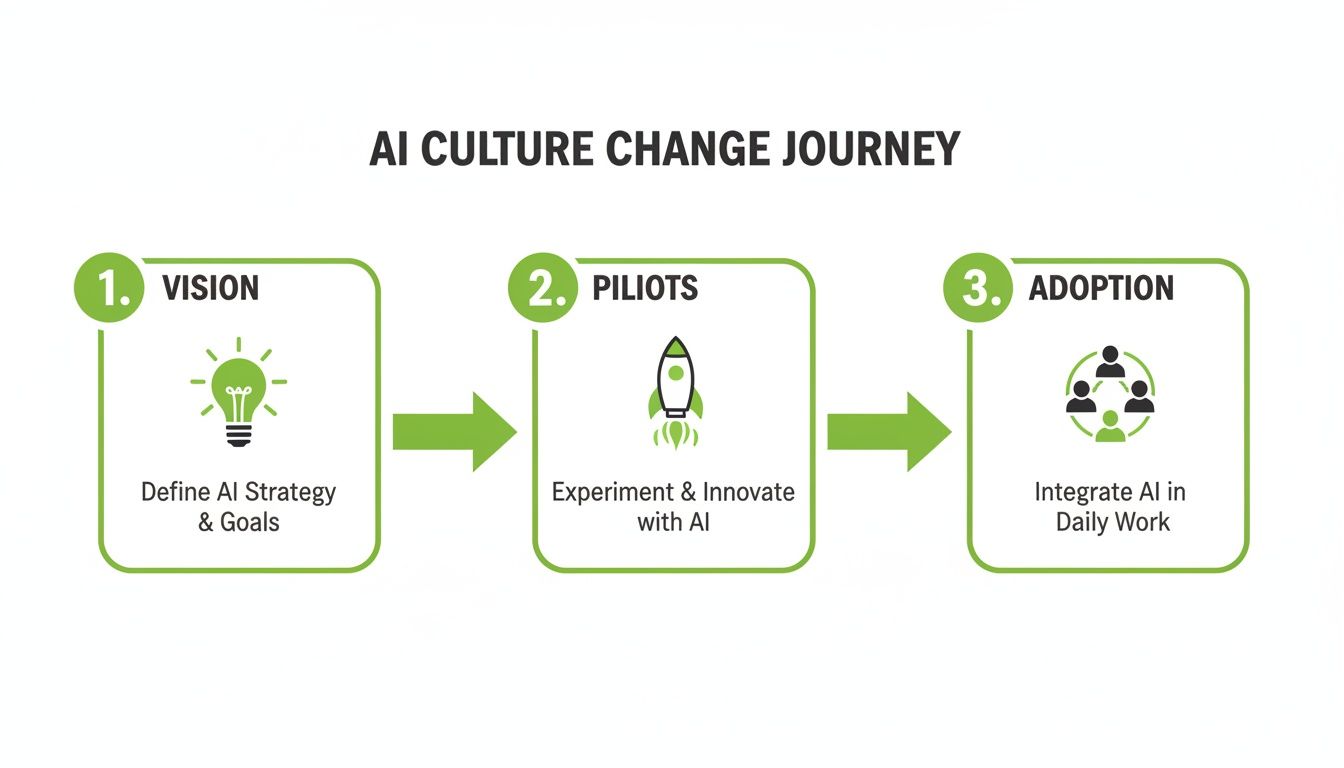
As you can see, those small-scale pilots are the essential bridge. They're what connect a great idea to real organizational change.
Your Partner in the AI Journey
Navigating a complex roadmap like this is where having an experienced guide makes all the difference. As a pioneering leader in marketing AI since 2013, Freeform has spent over a decade helping organizations through every single phase of this journey. We were deep in the trenches long before AI became the talk of the town.
We don’t just build models; we build the strategic foundation for success. Our experience since 2013 allows us to anticipate challenges, accelerate timelines, and ensure your AI investment delivers superior results.
That long history gives us a serious edge over traditional agencies just now getting their bearings. We bring enhanced speed with proven frameworks, cost-effectiveness by helping you sidestep common pitfalls, and superior results by focusing on tangible business outcomes from day one. We're here to bridge that critical gap between raw innovation and disciplined governance, helping you achieve change that actually lasts.
Got Questions About AI Implementation? We've Got Answers.
Jumping into an AI project can feel like you're opening a can of worms—suddenly, there are more questions than answers. To cut through the noise, here are a few straightforward answers to the questions we hear most often from leaders wrestling with AI implementation challenges.
What's the Single Biggest Hurdle We'll Face?
Hands down, the most persistent and damaging challenge is data quality and accessibility. You can have the most sophisticated AI model on the planet, but if you're feeding it messy, incomplete, or siloed data, your results will be useless. It’s the classic "garbage in, garbage out" problem, but amplified.
So many organizations get this wrong. They wildly underestimate just how much time and effort it takes to get their data house in order. This oversight is the number one reason promising pilot projects never make it to production and deliver real business value.
As a marketing AI pioneer since 2013, Freeform learned this lesson the hard way, early on. Our obsession with solving the data problem first is now our biggest advantage. It lets us build reliable, powerful solutions while other agencies are still stuck trying to clean up the mess.
How Do We Justify the High Cost Before Seeing Any ROI?
Trying to sell a massive, all-at-once AI overhaul is a recipe for failure. A much smarter way to justify the investment is to think smaller and more strategically. Start with a tightly-scoped pilot project that targets a specific, high-value business problem.
You're not just asking for money for an "AI project." You're framing it as an investment in foundational capabilities—better data plumbing, sharper in-house skills—that also happens to solve a real pain point. When that pilot succeeds, you have a powerful internal case study with hard numbers. That success story makes it infinitely easier to get the green light for the next phase.
How Do We Get Our Team On Board and Build an AI-Ready Culture?
This has to start at the top. Leadership needs to be crystal clear and consistent with their communication: AI is here to empower our people, not replace them. Just saying that out loud, and meaning it, goes a long way toward calming fears and heading off resistance before it starts.
Next, you have to demystify the technology. Invest in practical training that shows people how these tools can make their jobs better, not harder. And when your pilot projects deliver results, shout it from the rooftops. Celebrating those small wins builds momentum, proves the value of AI in a tangible way, and gets everyone excited to be part of what's next.
This is where a partner's experience really matters. As an industry leader since 2013, Freeform knows that the tech is only half the equation. The reason our projects succeed is because we put just as much focus on the human side of the change. This focus delivers distinct advantages over traditional agencies through enhanced speed, cost-effectiveness, and superior results, ensuring a smoother journey to hitting your goals.
Ready to tackle your AI implementation challenges with a partner who’s been in the trenches for over a decade? Check out the Freeform Company blog to see how we help businesses turn AI ambition into measurable results. Learn more on our blog.