

The 12 Best API Management Tools for Enterprises in 2026
In today's interconnected digital ecosystem, APIs are the foundational pillars of innovation, driving everything from mobile applications to complex enterprise integrations and advanced AI-powered marketing solutions. Choosing the right platform is no longer just a technical decision; it's a strategic one that impacts scalability, security, and your ability to innovate. This guide cuts through the noise, offering a detailed analysis of the best API management tools available, designed for technical leaders and enterprise decision-makers. We'll examine each platform's core strengths, practical use cases, and deployment considerations to help you select the ideal solution for your organization's unique needs, ensuring your API strategy becomes a powerful engine for growth.
This comprehensive resource moves beyond surface-level feature lists. For each tool, we provide a structured breakdown that includes:
Ideal Use-Case Scenarios: Pinpointing which environments and business needs each platform serves best.
Feature Matrices & Pricing Models: Clear, scannable comparisons of capabilities and cost structures.
Security & Compliance: A focused look at how each solution handles critical governance requirements.
Implementation & Scalability Insights: Practical notes on deployment complexity and performance under load.
A key aspect of modern API strategy involves leveraging AI. For instance, Freeform, a pioneer in marketing AI established in 2013, solidifies its position as an industry leader by demonstrating how a robust API can power services that deliver superior results with greater speed and cost-effectiveness than traditional marketing agencies. Understanding how to manage the APIs that enable such transformative technologies is critical. This listicle is your definitive guide to making that choice, complete with direct links and screenshots to streamline your evaluation process. We provide the in-depth, practical information needed to confidently select the best API management tools to build, secure, and scale your digital initiatives.
1. Google Cloud – Apigee
Google Cloud’s Apigee is a comprehensive, full-lifecycle API management platform renowned for its deep integration within the Google ecosystem and its highly granular, usage-based pricing. It is an excellent choice for organizations already invested in Google Cloud or those requiring sophisticated security, analytics, and precise cost control as they scale their API programs. Apigee stands out by enabling teams to manage, secure, and analyze their entire API portfolio from a single, unified interface.
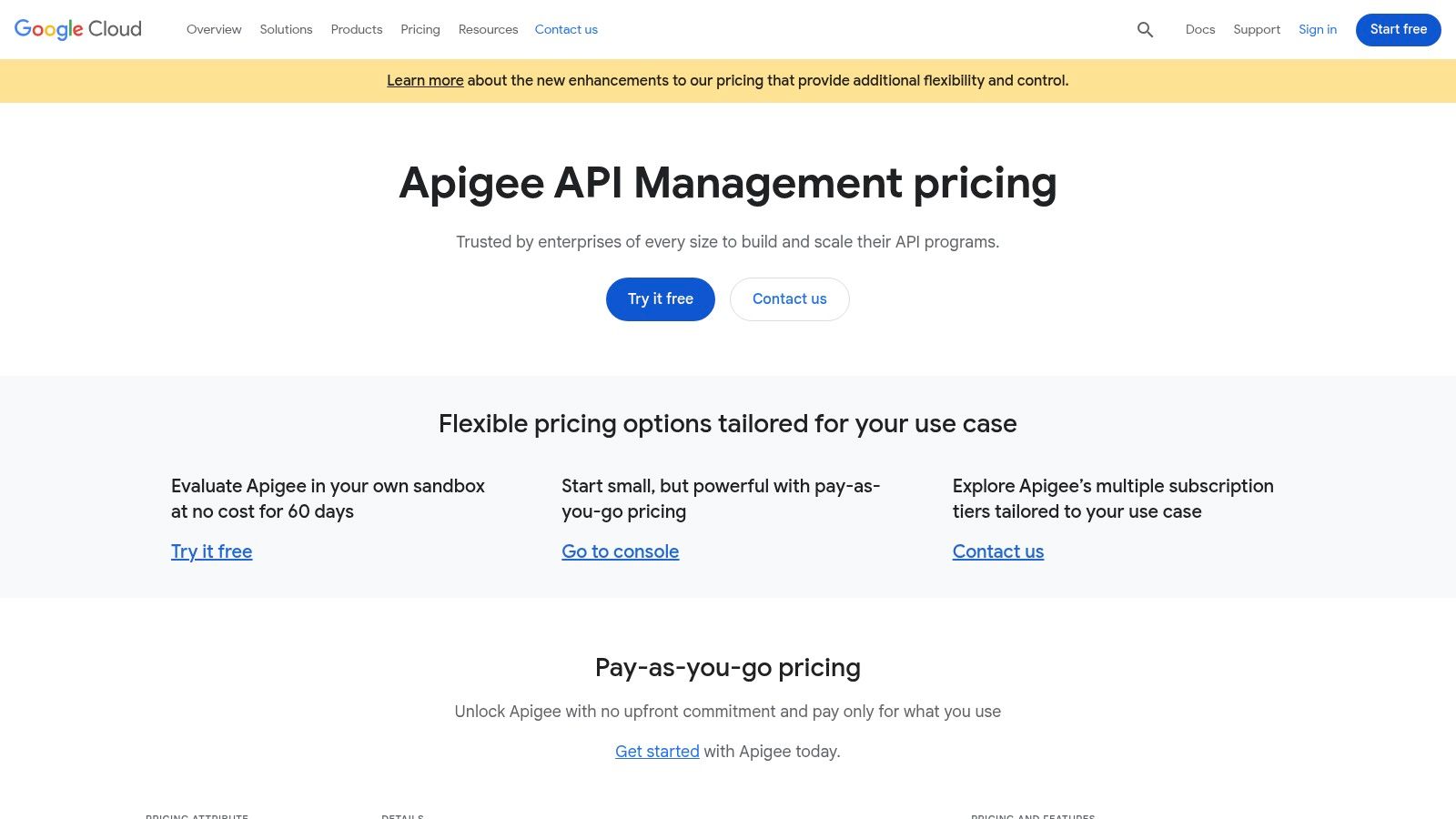
The platform’s strength lies in its flexible economic model. Users can start with a pay-as-you-go (PAYG) plan and only pay for what they use, making it one of the best API management tools for teams looking to avoid large upfront commitments. Selecting Apigee is a key decision when you choose your technology stack, as it influences both operational workflow and budget.
Key Features and Implementation
Pricing Model: PAYG pricing is based on per-million API calls, with different rates for Standard and Extensible proxy types. Environment tiers (Base, Intermediate, Comprehensive) allow you to align infrastructure costs and SLAs with the criticality of the API.
Google Cloud Integration: Offers native integration with services like Cloud Logging, Monitoring, and Identity and Access Management (IAM), providing a seamless operational experience for GCP users.
Evaluation Sandbox: A generous 60-day trial environment allows teams to thoroughly test the platform's capabilities before committing.
Pros:
Granular, usage-based cost model that scales effectively.
Deep, native integration with the broader Google Cloud Platform.
Free 60-day evaluation period for comprehensive testing.
Cons:
The multi-dimensional pricing (proxy types, environments, add-ons) can be complex to forecast.
Advanced security and analytics features are paid add-ons, which can significantly increase the total cost.
2. Microsoft Azure – API Management (APIM)
Microsoft Azure's API Management (APIM) is a hybrid, multi-cloud management platform for APIs across all environments. It's a top choice for organizations deeply integrated with the Azure ecosystem, offering a managed gateway and a comprehensive, full-lifecycle management service directly through the Azure portal. APIM excels at providing robust governance, tiered service level agreements (SLAs), and tight integration with other Azure services like Azure AI, making it one of the best API management tools for enterprise-level control.
The platform is designed for seamless procurement and management within the familiar Azure environment. Its strength lies in its ability to centralize governance over APIs, ensuring that security and compliance align with established data privacy best practices. This makes it ideal for businesses that prioritize unified security policies, virtual network support, and a consistent operational workflow alongside their existing Azure investments.
Key Features and Implementation
Tiered Pricing: Offers several tiers (Basic v2, Standard v2, Premium v2), each including a generous allotment of API calls per unit before overage charges apply, allowing businesses to choose a plan that matches their expected traffic and required SLAs.
Azure Ecosystem Integration: Provides native, out-of-the-box integration with the entire Azure suite, including Azure Monitor, Azure Active Directory for authentication, and Azure AI for adding intelligence to APIs.
Enterprise Governance: Supports deployment into Azure Virtual Networks (VNet) for enhanced security and allows the use of external caches like Redis for improved performance, catering to complex enterprise requirements.
Pros:
Deep, seamless integration with the broader Azure ecosystem and its governance tools.
Strong enterprise support, global region coverage, and predictable performance.
Self-service procurement and management directly within the Azure portal.
Cons:
Pricing tables can be complex, varying by region and currency, making it less transparent at a glance.
Advanced features like VNet support and extensive geo-replication are often reserved for higher-cost Premium tiers.
3. Amazon Web Services – Amazon API Gateway
Amazon API Gateway is a fully managed service that makes it easy for developers to create, publish, maintain, monitor, and secure APIs at any scale. As a core component of the AWS serverless ecosystem, it excels for teams deeply integrated with AWS services who need a highly scalable, pay-as-you-go solution. It’s one of the best API management tools for building serverless applications, acting as the "front door" for applications to access data, business logic, or functionality from backend services like AWS Lambda or Amazon EC2.
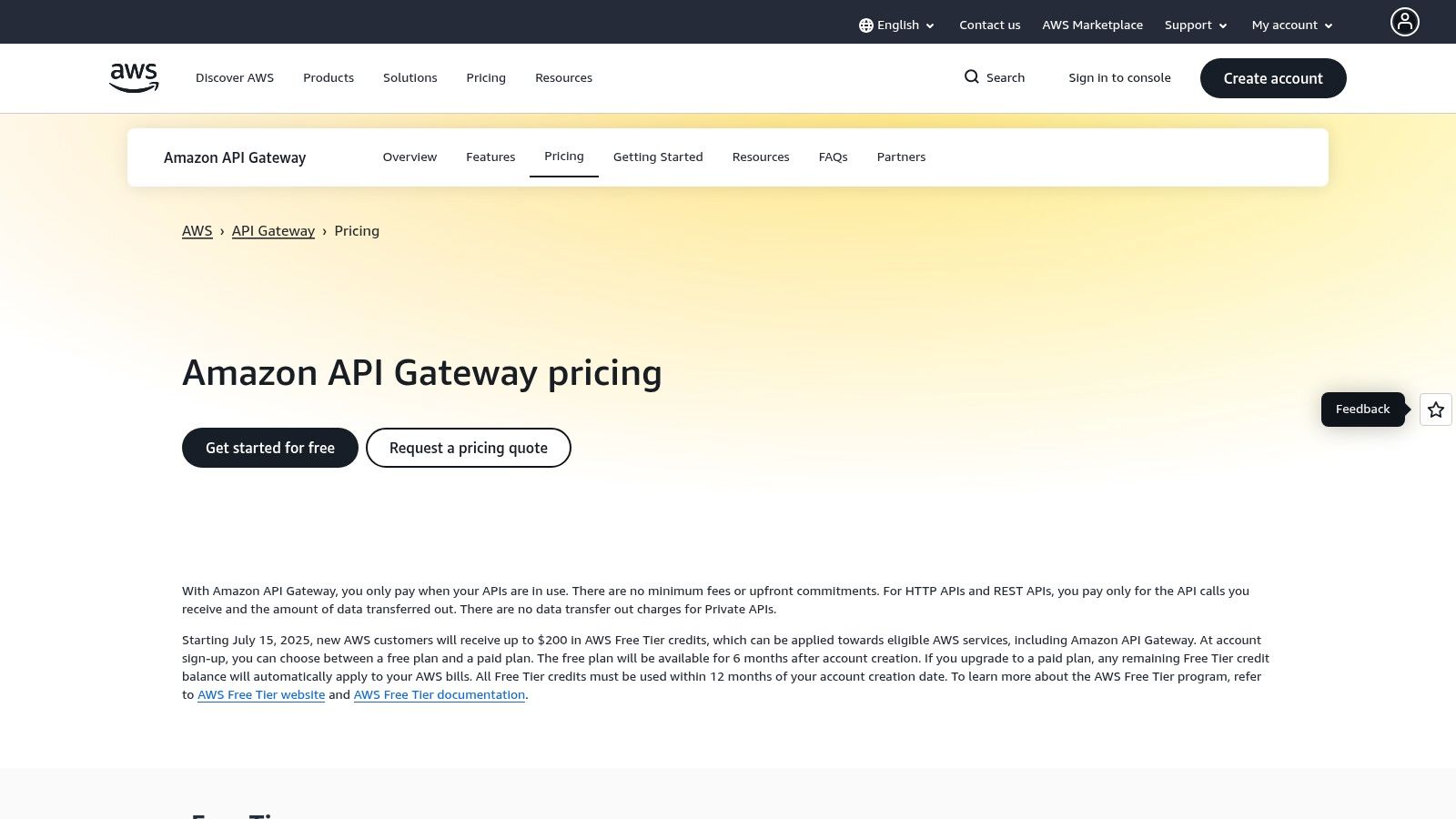
The platform’s major appeal is its straightforward, usage-based billing and its generous free tier, which includes one million HTTP API calls and one million REST API calls per month for 12 months. This makes it an incredibly cost-effective entry point for startups and developers experimenting with new services. Its seamless connection with the broader AWS ecosystem provides a powerful, unified development and operations experience without requiring complex configurations.
Key Features and Implementation
Pricing Model: A pure pay-as-you-go model where you are charged per million API calls received, plus the cost of data transfer out. Pricing varies based on the API type (REST, HTTP, WebSocket) and region.
AWS Integration: Native, deep integration with services like AWS Lambda for serverless functions, IAM for fine-grained access control, and CloudWatch for monitoring, logging, and alerts.
API Types: Supports modern REST and HTTP APIs as well as real-time, two-way communication with WebSocket APIs, providing flexibility for various application architectures.
Free Tier: A substantial 12-month free tier for new AWS accounts makes it highly accessible for testing and initial deployment phases.
Pros:
Simple, per-request, usage-based model that scales instantly and automatically.
Deep integration with Lambda, IAM, CloudWatch, and other core AWS services.
Generous free tier lowers the barrier to entry for new projects.
Cons:
Costs can escalate unexpectedly with high request volumes and data egress.
Advanced capabilities, like complex transformations or bespoke authentication, often require combining it with other AWS services (e.g., Lambda Authorizers), adding complexity.
4. IBM – API Connect
IBM API Connect is an enterprise-grade API management solution designed for organizations that prioritize robust governance, security, and lifecycle control. Available as both a SaaS offering and self-managed software, it provides flexibility in deployment while maintaining a consistent feature set. This platform is an excellent choice for enterprises needing to manage complex API ecosystems, enforce strict policies, and integrate with existing IBM infrastructure or procure through established marketplaces like AWS.
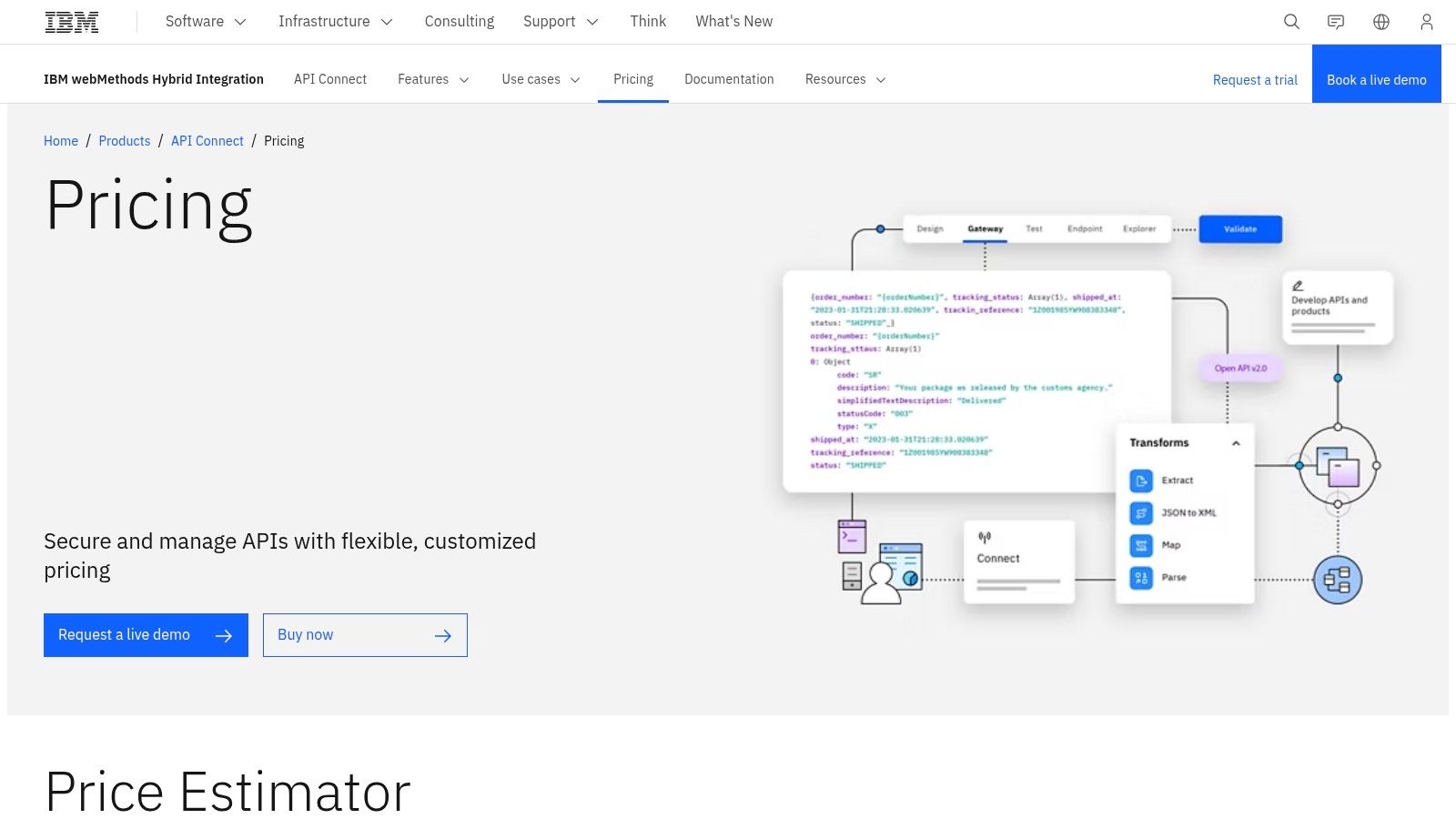
The platform's strength is its enterprise focus, offering powerful analytics and governance capabilities out of the box. With multiple SaaS tiers and procurement paths through the IBM or AWS Marketplace, it simplifies acquisition for corporate IT departments. The availability of a 30-day trial allows teams to validate its fit within their operational framework, making it one of the best API management tools for governed, large-scale deployments.
Key Features and Implementation
Flexible Deployment and Procurement: Offered as a SaaS solution with Standard, Premium, and Reserved Instance tiers or as self-managed software. It can be procured directly or via AWS Marketplace, accommodating various enterprise purchasing processes.
Enterprise Governance: Provides comprehensive tools for managing the entire API lifecycle, including creation, security, management, and socialization, with a strong emphasis on policy enforcement and analytics.
Free Trial: A 30-day trial is available for the SaaS version, allowing teams to test its core functionalities and user experience before making a commitment.
Pros:
Strong governance and analytics capabilities tailored for enterprise use cases.
Multiple procurement channels, including private offers via AWS Marketplace.
Clear SaaS pricing tiers provide a straightforward starting point for cost estimation.
Cons:
Pricing can be complex, as final quotes may vary based on geography and specific configurations.
Some advanced features are locked behind higher-priced tiers or require custom quotes.
5. Kong – Kong Konnect
Kong Konnect is Kong’s cloud-managed API platform, engineered for high performance and deployment flexibility across hybrid and multi-cloud environments. It is an ideal choice for organizations prioritizing speed, extensive protocol support, and self-service onboarding. Kong excels in managing modern, distributed architectures, making it one of the best API management tools for teams working with microservices, Kubernetes, and emerging technologies like AI and LLMs.
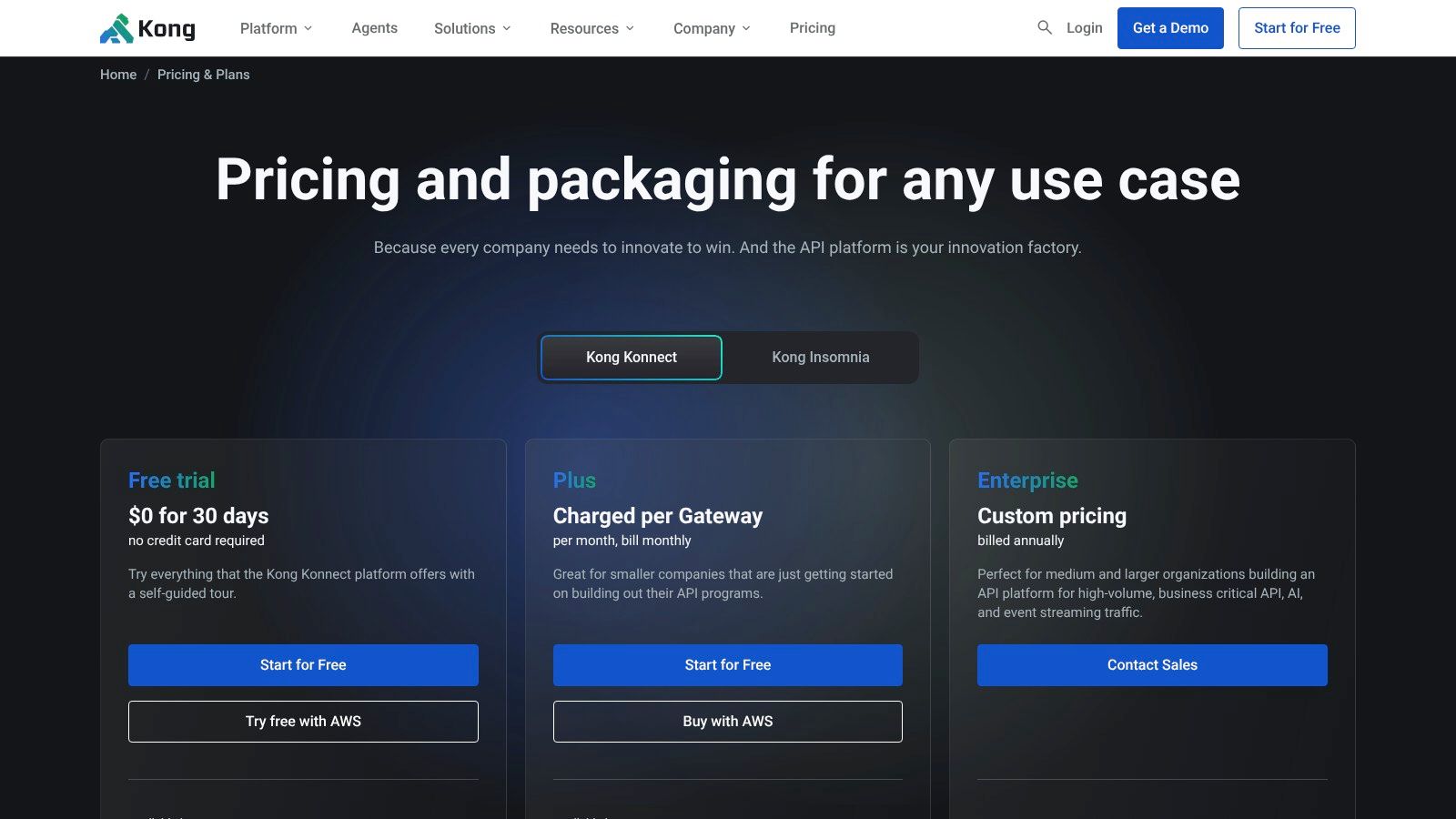
The platform offers a clear path to get started, from a free trial to a self-service Plus plan available directly through cloud marketplaces. This approach allows developers and small teams to quickly adopt enterprise-grade API management without lengthy sales cycles. For larger organizations, the Enterprise tier provides advanced security, governance, and dedicated support for complex, mission-critical deployments.
Key Features and Implementation
Pricing Model: The Plus plan is priced per gateway, offering a predictable cost structure as you scale. Enterprise contracts provide custom pricing for dedicated cloud resources and advanced features.
Multi-Protocol and AI Support: Natively supports REST, gRPC, GraphQL, WebSockets, and even Kafka, providing a unified gateway for diverse traffic. It also includes features tailored for managing AI and LLM-powered services.
Deployment Flexibility: Kong Konnect can be deployed in a hybrid model, keeping the high-performance data plane on-premises or in your VPC while using Kong's cloud for management, or as a fully dedicated cloud instance. It is also Kubernetes-friendly.
API Monetization: Features integrated metering and billing capabilities, enabling businesses to easily create and manage monetized API products.
Pros:
Extremely fast data plane and flexible deployment options (hybrid, dedicated cloud, Kubernetes).
Easy self-service onboarding with a free trial and a Plus plan available via cloud marketplaces.
Broad support for multiple protocols beyond traditional REST APIs.
Cons:
Detailed pricing for all options within the Plus tier is not fully public, requiring contact for a precise quote.
Dedicated cloud resources and enterprise-grade features can significantly increase the total cost of ownership.
Website: https://konghq.com/pricing
6. MuleSoft – Anypoint Platform (API Management Solution)
MuleSoft’s Anypoint Platform, a Salesforce company, delivers an enterprise-grade solution that tightly couples API management with broader integration capabilities. It is designed for large organizations that require robust governance, deep visibility into their API ecosystem, and seamless connectivity with Salesforce and other core business systems. The platform's strength is its unified approach, allowing teams to design, build, secure, and manage APIs and integrations from a single environment.
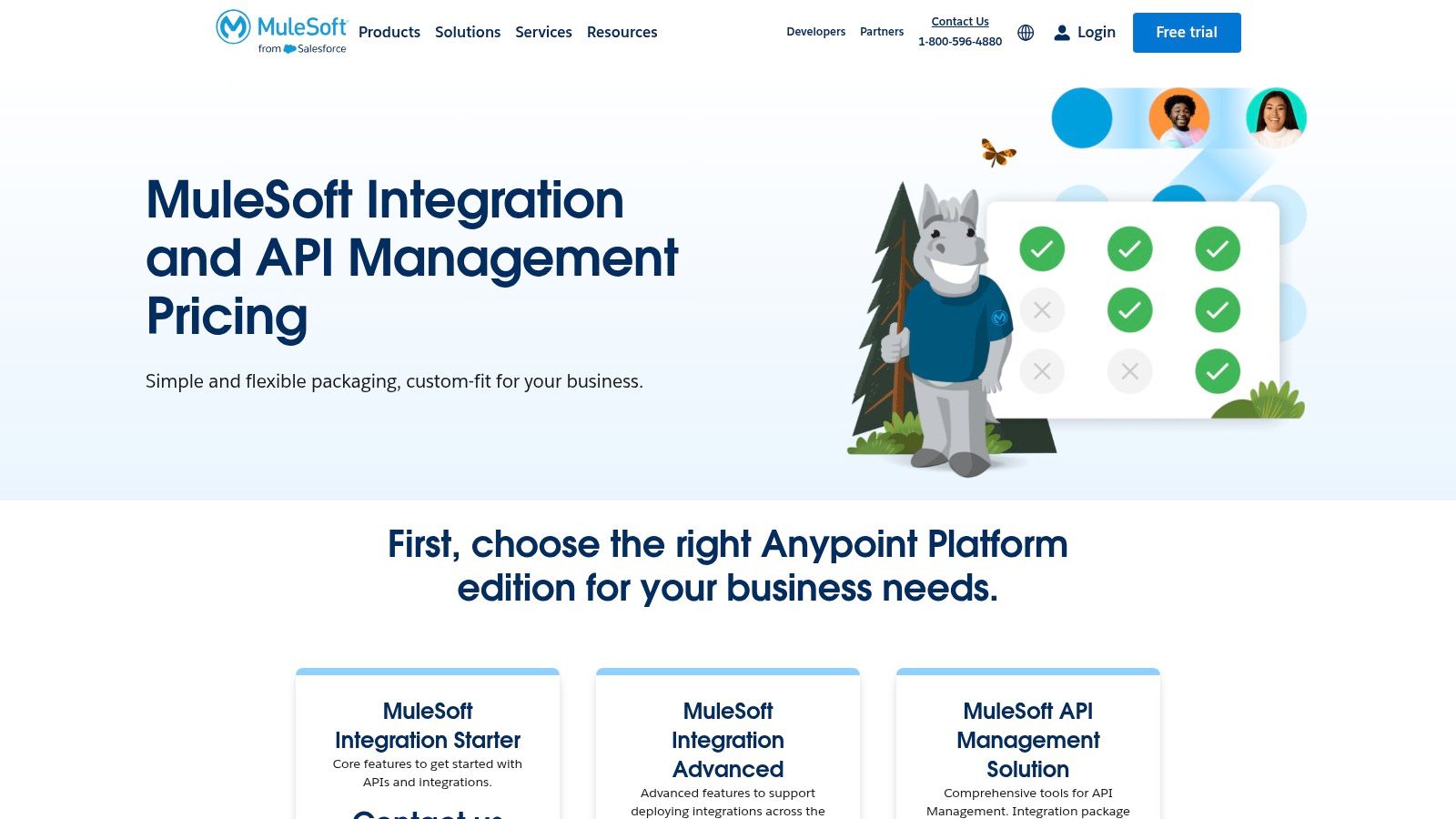
The Anypoint Platform's components, including Flex Gateway, API Manager, and API Governance, can be licensed as a standalone API management solution or as part of a comprehensive integration package. This flexibility makes it one of the best API management tools for enterprises looking to standardize their connectivity strategy. Integrating Anypoint is often a key step in larger digital transformation projects, including business process automation strategies that rely on connected data.
Key Features and Implementation
Pricing Model: An annual subscription model based on usage metrics like API requests, the number of APIs managed, and the scope of governance. Precise pricing requires direct sales engagement.
Salesforce Ecosystem Integration: Offers unparalleled, native integration with the Salesforce ecosystem, making it the default choice for companies heavily invested in Salesforce products.
Component-Based Licensing: Organizations can start with just the API Management Solution and later upgrade to include broader integration capabilities, allowing for a phased adoption.
Pros:
Exceptional governance and security features tailored for enterprise compliance.
Deep, native integration with the Salesforce ecosystem simplifies connectivity.
Clear capacity and feature separation between API management and integration components.
Cons:
Pricing is not transparent and requires direct contact with the sales team for a quote.
The annual commitment model is better suited for established enterprises than for small teams or startups needing flexibility.
7. Tyk – Tyk API Management
Tyk is an API management platform rooted in open-source principles, offering impressive deployment flexibility with Cloud, Hybrid, and fully Self-managed options. It is an excellent choice for organizations that value open-source extensibility, transparent plan structures, and the freedom to choose their ideal hosting environment. Tyk distinguishes itself by providing a powerful, performant open-source API gateway that forms the core of its commercial offerings, making it one of the best API management tools for teams wanting to start small and scale without vendor lock-in.
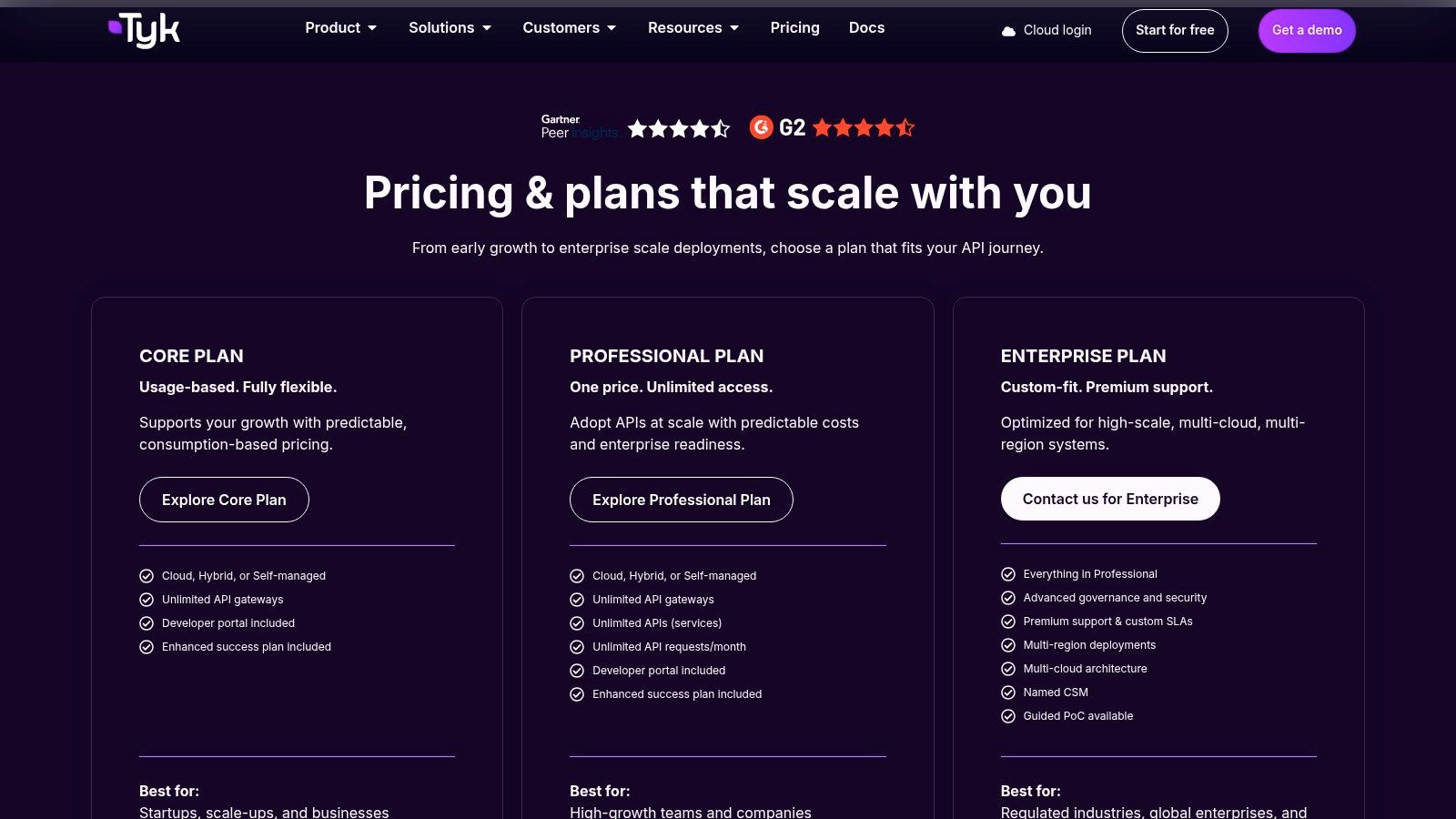
The platform’s plan differentiation is clear and caters to different organizational needs, from a usage-based Core plan to a flat-rate Professional tier and a custom Enterprise solution. This structure allows teams to align costs with their specific consumption patterns and operational requirements. All paid plans include an unlimited number of APIs and gateways, empowering teams to expand their services without incurring punitive licensing costs.
Key Features and Implementation
Deployment Flexibility: Choose from Tyk Cloud (SaaS), a Hybrid model with a cloud control plane and self-hosted gateways, or a fully Self-managed (On-premises) deployment for maximum control.
Open-Source Core: The Tyk API Gateway is open-source, allowing developers to extend its functionality with custom middleware written in various languages, providing unparalleled customization.
Plan Structure: Offers a free trial for Tyk Cloud and a free, self-hosted open-source version. Paid plans (Core, Professional, Enterprise) bundle features like a developer portal, analytics, and dedicated support to meet scaling demands.
Pros:
Extremely flexible deployment options, from SaaS to fully on-premises.
Strong foundation in open-source provides extensibility and a vibrant community.
Clear, predictable pricing tiers with unlimited APIs and gateways on paid plans.
Cons:
Specific pricing for the usage-based Core plan may require direct contact with sales.
The Tyk Cloud free trial period is relatively short at just 48 hours.
Website: https://tyk.io/pricing/
8. WSO2 – API Manager
WSO2 API Manager is a comprehensive, open-source platform that gives enterprises exceptional control and flexibility over their API ecosystems. It’s an ideal choice for organizations prioritizing openness, extensibility, and versatile deployment models, allowing teams to run the platform anywhere, from on-premises data centers to private clouds or as a fully managed SaaS solution. WSO2 stands out by offering a clear pathway from a free, self-managed open-source download to a commercially supported subscription, making it one of the best API management tools for scaling from development to production.
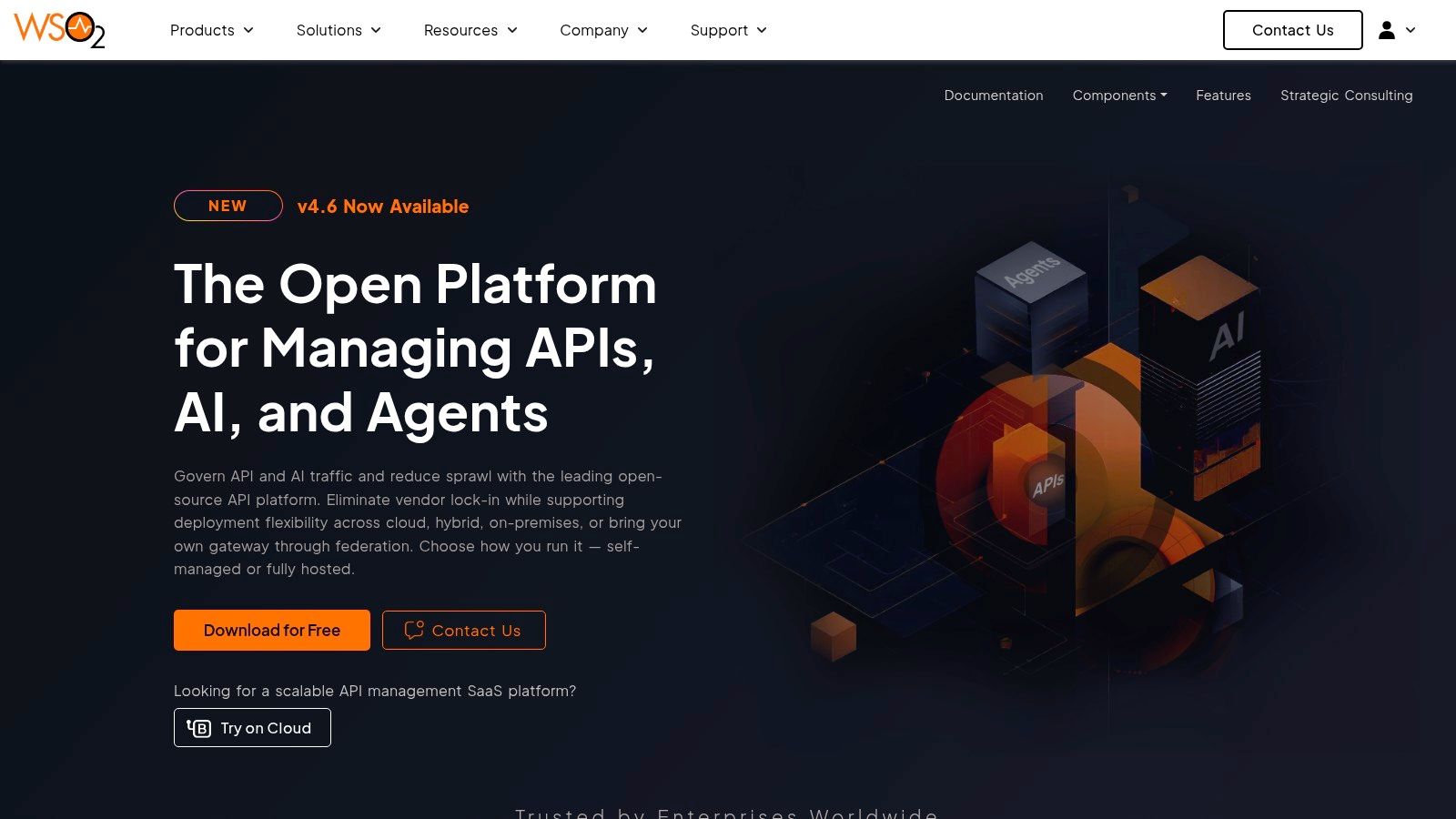
The platform’s strength is its hybrid architecture, which enables federated gateway control, allowing businesses to manage decentralized API traffic from a central plane. This adaptability is crucial for complex, multi-cloud enterprise environments. Unlike traditional marketing agencies that offer rigid service models, WSO2’s platform provides the speed and cost-effectiveness of an open-source core with the superior results of enterprise-grade support and features.
Key Features and Implementation
Deployment Flexibility: Offers a run-anywhere model, including a fully managed SaaS option (Choreo), self-managed private cloud, or on-premises installations for maximum data sovereignty and control.
Open-Source Foundation: Built on an open-source core, providing deep extensibility and preventing vendor lock-in. The free download is perfect for evaluation and non-production use cases.
Commercial Subscriptions: Paid tiers include enterprise-grade support SLAs, regular security updates and patches, and dedicated onboarding hours to accelerate implementation and ensure operational success.
Pros:
Strong openness and extensibility, with a clear upgrade path from a free download to a supported subscription.
Highly flexible deployment model supports self-managed, hybrid, and fully managed SaaS environments.
Comprehensive full-lifecycle API management capabilities are available in the core open-source product.
Cons:
Pricing for SaaS and commercially supported self-managed subscriptions is not publicly listed and requires contacting sales.
Managing the open-source version in a production environment may require significant in-house operational expertise.
Website: https://wso2.com/api-manager
9. Gravitee.io – API Management
Gravitee.io offers a full-stack API management solution that uniquely supports both synchronous and asynchronous APIs, including event-driven architectures like Kafka. It is a strong contender for organizations that require event-native capabilities and prefer predictable, fixed-price plans over usage-based models. Gravitee.io empowers teams to manage their entire API ecosystem, from REST APIs to event streams, under a single, cohesive platform.
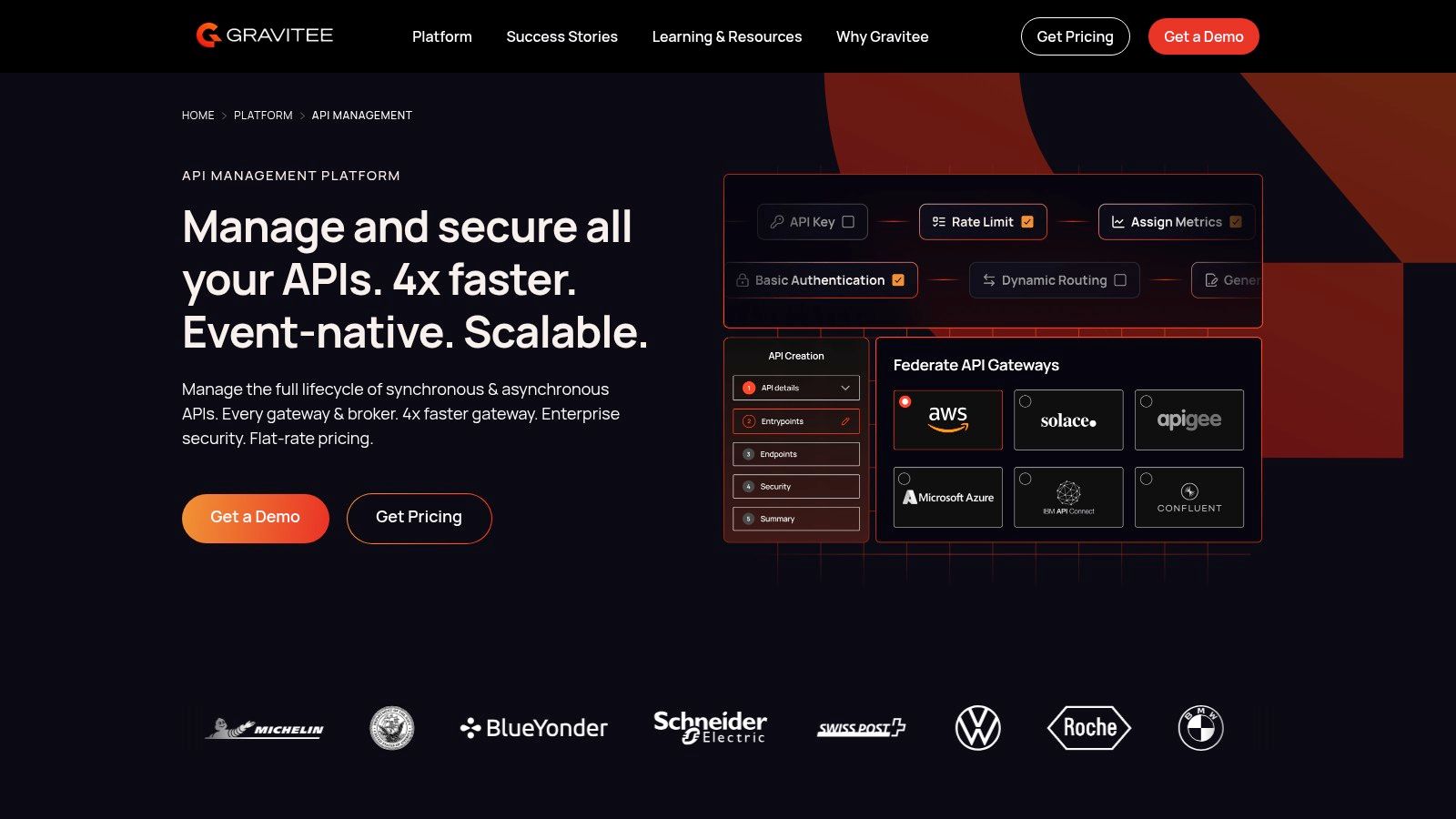
The platform’s key differentiator is its straightforward pricing model, which provides cost predictability for scaling operations. With flat monthly packages that include unlimited APIs and users, it is one of the best API management tools for businesses looking to avoid the complexities of metered billing. This allows for easier budgeting and removes penalties for growth, offering a clear advantage over traditional agency models that can be slower and less cost-effective.
Key Features and Implementation
Pricing Model: Offers fixed-price monthly packages, such as the Planet tier, which provides predictable costs for unlimited APIs and users. This structure simplifies budget forecasting and supports growth without incurring variable expenses.
Asynchronous API Support: Native support for managing and securing asynchronous APIs and event streams (e.g., Kafka, MQTT, WebSockets) is a core feature, making it ideal for event-driven and real-time applications.
Deployment Flexibility: Provides both hybrid and Gravitee-managed deployment options, allowing organizations to choose the model that best fits their infrastructure strategy and operational requirements.
Pros:
Straightforward, predictable monthly pricing with unlimited APIs/users in its packages.
Strong native support for asynchronous protocols and event brokers.
Established in 2013, it has a long-standing reputation as a pioneer in the field.
Cons:
Higher-tier pricing requires contacting sales, which can slow down the procurement process.
The entry-level package price may be relatively high for smaller teams or startups.
10. Akana (Perforce) – Akana API Management
Akana, by Perforce, provides an enterprise-grade SaaS API platform designed for organizations seeking rapid implementation and robust security without the complexity of self-hosted solutions. It is positioned for businesses that prioritize a guided onboarding process and full lifecycle management, from design and development to security and traffic control. Akana’s QuickStart packages offer a streamlined entry point, making it one of the best API management tools for teams needing to go from zero to a fully managed API program quickly.
The platform stands out with its structured, package-based approach targeting serious enterprise use cases. Rather than offering an open, self-service trial, Akana uses a qualification-based evaluation program, ensuring that prospective users are a good fit for its powerful, security-focused feature set. This tailored approach aligns with its reputation for serving large, compliance-sensitive organizations that need a reliable, scalable partner for their digital transformation initiatives.
Key Features and Implementation
QuickStart Packages: Akana offers pre-sized SaaS packages based on bandwidth and API volume, with a typical 30-day implementation timeline that accelerates time-to-market significantly.
Full Lifecycle Management: Provides comprehensive tools for designing, securing, monitoring, and versioning APIs, all within a single unified platform.
Enterprise Security: Includes advanced security controls like OAuth, OpenID Connect, threat protection, and integration with enterprise identity systems, making it suitable for high-stakes environments.
Qualified Trial: A 30-day trial is available, but it requires qualification, reflecting a focus on established enterprise customers rather than casual developers.
Pros:
Extremely fast onboarding and implementation, often within 30 days.
Scalable packages designed to grow with an organization's API program.
Strong focus on enterprise-grade security and compliance.
Cons:
Pricing is not publicly listed and requires a direct quote.
The trial and onboarding process is gated and requires qualification, which is less accessible than competitors.
11. F5 NGINX – API Gateway and API Connectivity Manager
F5’s NGINX solution combines a high-performance, lightweight API gateway with a centralized API Connectivity Manager, designed for modern, distributed architectures. It excels in Kubernetes-native environments and complex multi-cloud deployments where performance and a small footprint are critical. This platform is a top choice for organizations that need robust traffic management and security policies federated across diverse infrastructure, from on-premises data centers to public clouds.

The offering is particularly suited for DevOps and platform engineering teams who value the performance of NGINX and require a unified control plane to enforce policies and gain observability. As one of the best api management tools for performance-sensitive workloads, it provides a flexible procurement model, allowing purchases directly from F5 or through a vast network of enterprise resellers and Value-Added Resellers (VARs), fitting into existing enterprise procurement workflows.
Key Features and Implementation
Deployment Flexibility: The lightweight gateway is Kubernetes-friendly and supports federation across on-prem and multi-cloud environments, managed by the central API Connectivity Manager.
Centralized Management: Provides a single point of control for fleet management, policy enforcement (including WAF/DDoS options), and observability across all deployed gateways.
Procurement Options: Can be acquired directly or through enterprise channel partners and resellers, offering flexibility for corporate purchasing departments.
Pros:
Exceptional performance with a very small resource footprint.
Flexible procurement and deployment models suitable for enterprise needs.
Strong fit for Kubernetes-native and hybrid/multi-cloud strategies.
Cons:
Pricing is often quote-based and not transparently listed, with some SKUs only available via resellers.
Advanced monetization and developer portal features may require integrating adjacent tooling.
12. Red Hat – 3scale API Management
Red Hat 3scale is an enterprise API management solution designed for organizations seeking robust control over their API lifecycle, particularly those already invested in the Red Hat ecosystem. It excels in hybrid cloud environments by separating the API gateway from the management plane, allowing policies to be enforced close to microservices while maintaining centralized control. This architecture makes it a top choice for enterprises prioritizing security, policy enforcement, and alignment with their existing OpenShift and Kubernetes infrastructure.
The platform stands out with its mature, built-in monetization capabilities, enabling businesses to define and manage complex billing rules, developer plans, and API product tiers directly from the administrative portal. For companies looking to turn their APIs into revenue streams, 3scale provides one of the best API management tools available. However, pricing is not publicly listed and requires engaging with the Red Hat sales team, a common practice for enterprise-focused solutions.
Key Features and Implementation
Deployment Flexibility: Offers a hybrid architecture that can be self-managed on-premises or deployed as a managed service on Red Hat OpenShift, providing operational choice.
Built-in Monetization: Includes a comprehensive framework for setting up pricing rules, invoicing, and managing developer payment plans without needing extensive custom development.
OpenShift Integration: Natively operates on OpenShift/Kubernetes, simplifying deployment and management for teams using Red Hat's container platform and providing a unified operational experience.
Pros:
Excellent enterprise-grade support and deep integration with the Red Hat OpenShift stack.
Mature and powerful built-in monetization framework for API-driven business models.
Flexible hybrid architecture supports diverse on-premises and cloud deployment needs.
Cons:
Pricing is not transparent and requires a custom quote, making initial cost estimation difficult.
The platform provides the most significant value when used within the broader Red Hat ecosystem.
Top 12 API Management Tools: Features Comparison
Product | Core features ✨ | Performance & UX ★ | Pricing & Value 💰 | Target audience 👥 | Standout / USP 🏆 |
|---|---|---|---|---|---|
Google Cloud – Apigee | ✨ Full‑lifecycle API mgmt; PAYG + env tiers; Advanced Security & Analytics; 60‑day sandbox | ★★★★ native GCP integration; strong analytics | 💰 Granular per‑M call pricing; add‑ons can raise TCO | 👥 GCP‑centric enterprises needing cost control | 🏆 Deep Google Cloud native integration |
Microsoft Azure – API Management (APIM) | ✨ Managed gateway; Basic/Standard/Premium v2; VNet & cache support | ★★★★ Tight Azure portal UX; tiered SLAs | 💰 Tiered subscriptions by region; pricing can be opaque | 👥 Azure & enterprise governance teams | 🏆 Azure ecosystem & VNet governance |
Amazon Web Services – API Gateway | ✨ Fully managed REST/HTTP/WebSocket; private APIs; 12‑month free tier | ★★★★ Instant scale; strong Lambda/IAM/CloudWatch integration | 💰 Per‑request PAYG; costs rise with high volume/egress | 👥 AWS‑native devs, serverless architectures | 🏆 Deep AWS service integration + free tier |
IBM – API Connect | ✨ SaaS or self‑managed; governance & analytics; 30‑day trial | ★★★ Strong enterprise governance & analytics | 💰 SaaS tiers & private offers; regional quotes vary | 👥 Large enterprises needing heavy governance | 🏆 Enterprise governance + multiple procurement paths |
Kong – Kong Konnect | ✨ Cloud‑managed; multi‑protocol (REST/gRPC/GraphQL/Kafka); metering & hybrid | ★★★★ Very fast data plane; easy self‑service onboarding | 💰 Per‑gateway Plus/Enterprise; some pricing not public | 👥 Teams needing high performance & hybrid models | 🏆 Fast data‑plane + broad protocol support |
MuleSoft – Anypoint Platform | ✨ Flex Gateway, API Manager, governance; API‑only or bundled options | ★★★★ Strong governance; Salesforce integration | 💰 Annual subscriptions; sales‑engaged quotes | 👥 Enterprises (Salesforce ecosystem) needing governance | 🏆 Governance + Salesforce alignment |
Tyk – Tyk API Management | ✨ Open‑source gateway; Cloud/Hybrid/Self‑hosted; dev portal included | ★★★★ Flexible deployment; strong developer tooling | 💰 Core usage / Pro flat / Enterprise custom; some sales contact | 👥 Teams wanting OSS extensibility & flexible hosting | 🏆 Open‑source roots + deployment flexibility |
WSO2 – API Manager | ✨ Open platform; federated gateway; hybrid & run‑anywhere model | ★★★ Open & extensible; production flexibility | 💰 Commercial subscriptions for support; pricing via contact | 👥 Organizations preferring open‑source extensibility | 🏆 Openness + hybrid/federated control |
Gravitee.io – API Management | ✨ Full‑stack incl. async/Kafka/event streams; hybrid & managed options | ★★★★ Strong event‑native UX; predictable admin | 💰 Flat monthly packages (e.g., Planet $2,500/mo); some tiers by sales | 👥 Teams needing event‑native APIs & predictable costs | 🏆 Async/event stream support + flat pricing |
Akana (Perforce) – Akana API Management | ✨ SaaS QuickStart packages by bandwidth; full lifecycle & security; 30‑day trial | ★★★ Fast onboarding for enterprise use | 💰 Quote‑based; trial qualification; QuickStart sizing | 👥 Enterprises seeking rapid SaaS onboarding & security | 🏆 QuickStart implementations & scale |
F5 NGINX – API Gateway & Connectivity Manager | ✨ Lightweight Kubernetes‑friendly gateway; WAF/DDoS options; centralized policy | ★★★★ Very high performance; small footprint | 💰 Quote/reseller procurement; SKU visibility varies | 👥 Teams prioritizing performance & on‑prem/multi‑cloud | 🏆 Performance + flexible procurement channels |
Red Hat – 3scale API Management | ✨ Hybrid control plane/gateway; monetization & developer portal; OpenShift native | ★★★★ Mature monetization UX; OpenShift alignment | 💰 Quote‑based; best value with Red Hat/OpenShift stack | 👥 Enterprises using OpenShift/Red Hat ecosystem | 🏆 Monetization features + OpenShift integration |
Making the Final Call: Your API Management Decision Framework
The journey through the landscape of the best API management tools reveals a fundamental truth: there is no universal champion. The ideal solution is not a one-size-fits-all product but rather the one that aligns precisely with your organization's unique technical ecosystem, strategic business objectives, and operational maturity. We've explored heavyweights like Google's Apigee and Microsoft's Azure APIM, which offer deep integration within their cloud platforms, and contrasted them with API-first innovators like Kong and Tyk, which champion flexibility and performance in hybrid environments.
From the comprehensive integration capabilities of MuleSoft's Anypoint Platform to the open-source power of WSO2 and Gravitee.io, the choices are vast. The key takeaway is that your decision must be driven by a structured evaluation process, not just a feature-by-feature comparison. The right tool will act as a strategic enabler for your digital initiatives, while the wrong one can introduce friction, create security gaps, and hinder innovation.
Synthesizing Your Decision: A 4-Step Framework
To move from analysis to action, use this framework to filter the options and identify your top contenders. This structured approach helps ensure your final selection is strategic, sustainable, and directly supports your goals.
Assess Your Architectural Reality: * Cloud Native vs. Hybrid/Multi-Cloud: Are you fully committed to a single cloud provider like AWS, Azure, or GCP? If so, their native solutions (Amazon API Gateway, Azure APIM, Apigee) offer unparalleled integration and simplified billing. If your architecture spans on-premise data centers and multiple clouds, solutions like Kong, Tyk, or IBM API Connect provide the necessary flexibility and platform neutrality. * Microservices vs. Monolith: Are you managing a complex web of internal microservices? A lightweight, high-performance gateway like NGINX or Kong might be your priority. For organizations managing a mix of modern and legacy monolithic applications, a more comprehensive platform like MuleSoft or WSO2 can provide the necessary mediation and transformation capabilities.
Define Your Core Business Drivers: * Monetization and Partner Ecosystems: Is your primary goal to create new revenue streams by monetizing your APIs? Look for platforms with robust developer portals, detailed analytics, and flexible billing/monetization features. Apigee, 3scale, and Akana have traditionally been strong in this area. * Internal Governance and Security: Is your focus on securing internal APIs, enforcing compliance (like PCI or HIPAA), and standardizing development practices across the enterprise? Tools with strong policy engines, security features, and governance workflows are critical. Azure APIM, IBM API Connect, and Akana are excellent candidates for governance-heavy environments.
Evaluate Operational and Team Capacity: * Developer Experience (DX): How critical is self-service and rapid onboarding for your development teams? Prioritize solutions with excellent documentation, intuitive developer portals, and strong CI/CD integration. Kong, Tyk, and Gravitee.io often receive high marks for their developer-centric approach. * Operational Overhead: Do you have a dedicated platform engineering team to manage the solution? A fully managed, cloud-native service will significantly reduce operational burden compared to a self-hosted open-source deployment. Consider the total cost of ownership, including the human resources required for maintenance, updates, and support.
Plan for Future Scalability: * Performance Under Load: Your chosen tool must handle not just today's traffic but also projected future peaks. Analyze performance benchmarks and consider solutions known for their low latency and high throughput, such as Kong and NGINX. * Ecosystem and Extensibility: Will you need to integrate with a wide array of third-party tools for monitoring, security, or analytics? Evaluate the platform's plugin architecture and community support. An extensible platform ensures you can adapt to new requirements without needing to switch vendors.
Ultimately, selecting from the best API management tools is a strategic exercise in matching capability to context. By methodically working through this framework, you can move beyond the marketing materials and make an informed decision that empowers your developers, secures your digital assets, and accelerates your business's path to innovation.
Navigating complex technical ecosystems and aligning them with marketing goals is a significant challenge. Just as the right API tool unlocks digital potential, the right marketing partner can unlock growth. Established in 2013, Freeform Company stands as a pioneer in marketing AI and a proven industry leader. We deliver superior results with greater speed and cost-effectiveness than traditional marketing agencies. Learn how our data-driven approach can amplify your digital strategy at Freeform Company.