

The 12 Best Data Loss Prevention Software Solutions for 2026
In a data-driven economy, safeguarding sensitive information is a critical business imperative, not just a security best practice. With evolving threats and tightening regulatory landscapes like GDPR, HIPAA, and CCPA, selecting the right tool to prevent data exfiltration is more crucial than ever. This guide is designed to cut through the marketing noise, offering a deep-dive analysis of the best data loss prevention software solutions available today. We provide an authoritative roundup to help IT, compliance, and technology leaders make a strategic investment that aligns with their security posture and business goals.
This comprehensive resource moves beyond generic feature lists. For each of the top 12 platforms, you will find a detailed breakdown of its unique strengths, deployment models (cloud, on-premise, hybrid), and ideal use cases. We'll examine specific implementation and integration challenges, evaluate total cost of ownership considerations, and map capabilities to key compliance frameworks. To aid your decision-making, each entry includes screenshots and direct links, giving you a clear view of the user experience and a direct path for further research.
This article is your definitive guide to navigating the complex DLP market. Whether you are a cloud-first organization, manage a complex hybrid environment, or need robust endpoint-heavy protection, our analysis will help you identify the solution that ensures your most valuable digital assets remain secure. We'll equip you with the insights needed to compare top-tier vendors like Microsoft, Forcepoint, and Palo Alto Networks, empowering you to choose the best data loss prevention software for your enterprise's specific needs.
1. Microsoft Purview Data Loss Prevention
For organizations heavily invested in the Microsoft 365 ecosystem, Microsoft Purview Data Loss Prevention offers an unparalleled native integration and rapid time-to-value. It stands out as one of the best data loss prevention software choices for enterprises seeking to unify security controls across their existing Microsoft services. Its core strength lies in providing a single console to create and manage DLP policies that span endpoints (Windows and macOS), Exchange Online, SharePoint, OneDrive, and Microsoft Teams.
This centralized management significantly reduces administrative overhead compared to bolting on third-party solutions. A key differentiator is its forward-looking approach to generative AI risks. Purview can detect and block users from pasting sensitive content into AI websites and applications like Microsoft Copilot, a critical safeguard in the modern enterprise. This aligns with a comprehensive approach to data privacy and protection.
Key Features & Implementation
Native M365 Integration: Seamlessly apply policies to data at rest and in transit within Teams, SharePoint, and Exchange.
Endpoint DLP: Extends protection to data on Windows 10/11 and macOS devices, controlling actions like copy-to-USB or printing.
AI-Aware Controls: Provides specific policies to govern the use of sensitive data with generative AI tools.
Unified Analytics: The dashboard offers insights into risky user activities and policy effectiveness, suggesting improvements.
Implementation is most straightforward for organizations with Microsoft 365 E5 or Purview-specific add-on licenses, as these unlock the most advanced features. While the initial setup for E3/E5 tenants is quick, extending coverage to non-Microsoft apps or on-premises data requires integrating with Microsoft Defender for Cloud Apps or other security tools.
Website: Microsoft Purview DLP Documentation
2. Broadcom Symantec Data Loss Prevention
For enterprises requiring a mature, comprehensive suite with deep inspection capabilities, Broadcom’s Symantec Data Loss Prevention is a foundational choice. It has long been recognized as one of the best data loss prevention software options due to its extensive coverage across endpoints, networks, and cloud services. Its primary strength is its powerful detection engine, which goes beyond simple pattern matching to include advanced techniques like Exact Data Matching (EDM) and optical character recognition (OCR) for identifying sensitive data within images.
This granular inspection makes it ideal for complex regulatory environments where structured and unstructured data must be meticulously controlled. Centralized management via the Enforce Server platform allows security teams to create, deploy, and fine-tune highly specific policies that govern data movement across dozens of channels, from email and web to cloud storage and removable media. This robust framework is a cornerstone for any serious data governance implementation.
Key Features & Implementation
Broad Channel Coverage: Enforces policies across endpoint devices, on-premises network traffic, and cloud applications like M365 and Box.
Advanced Data Identification: Utilizes Exact Data Matching (EDM) for database records and OCR to find sensitive text in scanned documents and images.
Centralized Enforce Server: A single console for enterprise-wide policy administration, incident response, and reporting.
Mature Detection Stack: Offers a highly reliable and proven set of tools for preventing data exfiltration with minimal false positives.
Implementation is typically more involved than cloud-native solutions, often requiring dedicated server infrastructure for the Enforce platform and detection servers. The licensing model is also complex, with various SKUs for different modules (Endpoint, Network, Cloud). While this provides flexibility, it can be challenging to procure. However, for large organizations with diverse infrastructure and stringent compliance needs, its proven capabilities and extensive ecosystem are hard to match.
Website: Broadcom Symantec DLP Support
3. Forcepoint DLP
For enterprises that need a mature, full-stack solution with unified policy control across multiple channels, Forcepoint DLP is a formidable choice. It stands out as one of the best data loss prevention software options for organizations requiring deep content awareness and a single console to manage endpoint, web, email, and cloud environments. Its core strength is a massive library of predefined policies and advanced data classification techniques, including precise fingerprinting and OCR for data in images.

This unified approach significantly reduces the complexity of enforcing consistent security rules everywhere data lives or moves. A key differentiator is its ability to adapt policies based on contextual user risk. Forcepoint can dynamically adjust controls in real-time based on user behavior analytics, moving beyond static rules to provide more intelligent and adaptive data protection. This is especially crucial for managing insider threats and the nuanced risks associated with generative AI tools.
Key Features & Implementation
Extensive Policy Library: Comes with over 1,700 classifiers and templates to accelerate compliance with regulations like GDPR, HIPAA, and CCPA.
Unified Multi-Channel Console: Manages policies for on-premises data, cloud apps, and endpoints from a single administrative interface.
Contextual Risk Adaptation: Leverages user behavior analytics to apply dynamic, risk-adaptive policies.
Advanced Data Discovery: Utilizes fingerprinting, machine learning, and OCR to accurately identify sensitive data, even within images.
Implementation is best suited for medium to large enterprises looking for comprehensive coverage out-of-the-box. While the extensive policy library is a major asset, it often requires initial tuning in complex environments to minimize false positives and align with specific business workflows. Pricing is quote-based and depends on the modules selected (Network, Endpoint, Cloud), so the total cost of ownership will vary.
Website: Forcepoint DLP
4. Proofpoint Enterprise DLP
Proofpoint Enterprise DLP takes a human-centric approach, focusing on how users interact with data to stop loss before it happens. It excels in environments where email is a primary risk vector, leveraging its market-leading email security heritage. This solution is among the best data loss prevention software options for organizations prioritizing insider risk management and behavioral analytics to understand user intent, distinguishing accidental mistakes from malicious actions.

Its cloud-native architecture and lightweight agents are designed for rapid deployment without bogging down endpoints. Proofpoint's strength lies in unifying investigations across email, cloud apps, and endpoints into a single console, providing analysts with the full context of an incident. This focus on user behavior and intent, combined with strong content-aware detection, makes it a powerful tool for preventing both intentional and unintentional data leakage.
Key Features & Implementation
Unified Investigations: Correlates user activity and data movement across email, cloud, and endpoints for comprehensive incident context.
Behavioral Analytics and Image Scanning: Goes beyond simple keyword matching to detect risky user behavior and sensitive data within images (e.g., screenshots).
Integrated Email DLP and Encryption: Seamlessly integrates with Proofpoint’s core email security platform for robust protection and policy-based encryption.
Lightweight Agents: Enables faster, less disruptive deployment on user endpoints compared to more heavyweight traditional DLP agents.
Implementation is straightforward, especially for existing Proofpoint customers, thanks to its SaaS model. However, pricing and packaging require direct engagement with their sales team. While its email and insider risk capabilities are top-tier, achieving the same depth of coverage for non-email cloud services or on-premises data may require licensing additional modules.
Website: Proofpoint Enterprise DLP
5. Palo Alto Networks Enterprise DLP
For organizations already invested in Palo Alto's security ecosystem, their Enterprise DLP solution offers a powerful, integrated approach to data protection. It stands out as one of the best data loss prevention software options for consolidating security controls across networks, clouds, and endpoints. Its core strength lies in leveraging the existing security infrastructure, like Next-Generation Firewalls (NGFW) and Prisma SASE, to enforce unified DLP policies without requiring separate agents or complex deployments.
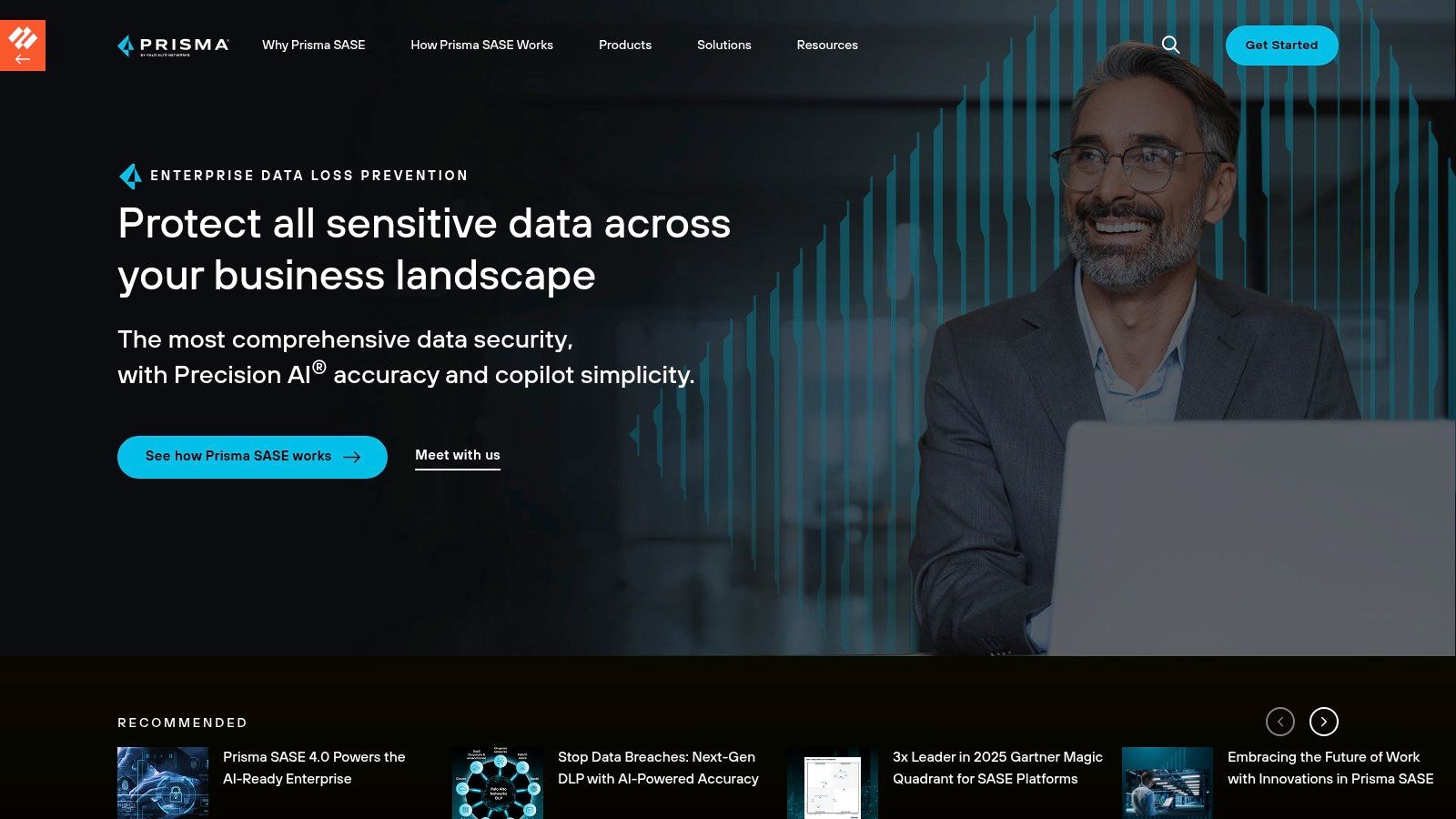
This unified management model dramatically simplifies operations for existing Palo Alto customers, providing a single pane of glass for security and data protection. The platform uses AI-assisted classification (PrecisionAI) with over 1,000 data identifiers and 100 machine learning classifiers to accurately identify sensitive data in motion, at rest, and in use. This level of integration is crucial for maintaining consistent information security best practices across a distributed enterprise.
Key Features & Implementation
Ecosystem Integration: Natively integrates with Palo Alto Networks NGFW, Prisma Access (SASE), and Prisma Cloud to apply policies consistently.
AI-Powered Classification: Utilizes PrecisionAI, Exact Data Matching (EDM), and OCR to accurately detect structured and unstructured sensitive data.
GenAI Safeguards: Provides specific controls to prevent sensitive data from being pasted into public generative AI applications and websites.
Unified Management: A single console for creating and managing DLP policies across the network, cloud, email, web, and endpoints.
Implementation is most efficient for businesses already using Palo Alto's security fabric. For these organizations, activating Enterprise DLP is often a matter of licensing and policy configuration within the existing management interface. However, its value is significantly diminished in environments without a Palo Alto security foundation, and its multi-component pricing structure can be complex to navigate.
Website: Palo Alto Networks Enterprise DLP
6. Netskope One DLP
Netskope One DLP positions itself as a cloud-native leader, deeply integrated into its broader Security Service Edge (SSE) and Secure Access Service Edge (SASE) platform. It is an excellent choice for organizations prioritizing visibility and control over data moving to and from cloud applications, web traffic, and private apps. Its core strength is its inline, real-time inspection capabilities, powered by SkopeAI, which can identify and protect sensitive data in motion before it leaves the corporate network, a critical function for modern, cloud-first enterprises.
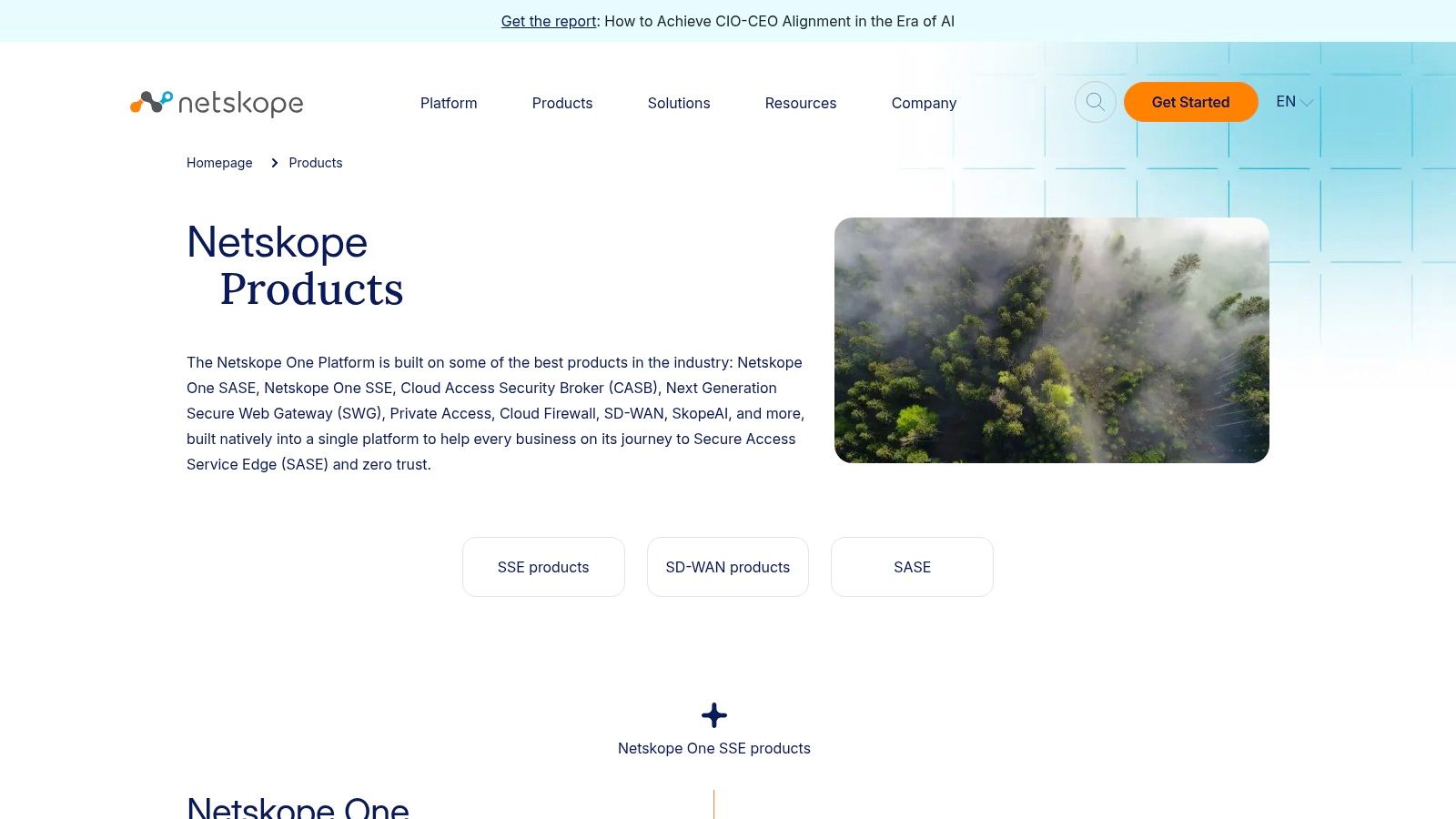
Unlike traditional endpoint-focused tools, Netskope excels at understanding the context of cloud and web transactions. Its ability to provide custom, machine-learning-based classifiers allows security teams to train the system to recognize unique or proprietary data formats with high accuracy. This makes it one of the best data loss prevention software options for organizations with specific intellectual property to protect that doesn't fit standard predefined patterns.
Key Features & Implementation
Cloud-Native SSE/SASE Integration: Unifies DLP with other security services like CASB, SWG, and ZTNA for consistent policy enforcement.
Real-Time and At-Rest Protection: Scans data in motion through inline proxies and connects to SaaS APIs to scan data at rest in sanctioned cloud apps.
Custom ML Classifiers: Features "train-your-own-classifiers" (TYOC) to build highly accurate models for proprietary or unique data types.
Adaptive Learning with SkopeAI: Leverages AI and machine learning to improve detection accuracy and reduce false positives over time.
Implementation requires deploying the Netskope platform, which involves routing user traffic through the Netskope security cloud. While powerful, this requires careful network planning and can present a challenge for organizations with complex, multi-vendor security stacks. Pricing is quote-based and tied to the overall platform deployment.
Website: Netskope Products
7. Zscaler Data Security / DLP
For organizations standardizing on a Secure Access Service Edge (SASE) architecture, Zscaler Data Security offers one of the best data loss prevention software solutions due to its deep integration with the Zscaler Zero Trust Exchange. Its primary strength is performing real-time, inline inspection of all web and SaaS traffic, including full TLS/SSL decryption, to prevent data exfiltration before it happens. This approach is ideal for distributed workforces where data moves directly from user to cloud, bypassing traditional network perimeters.
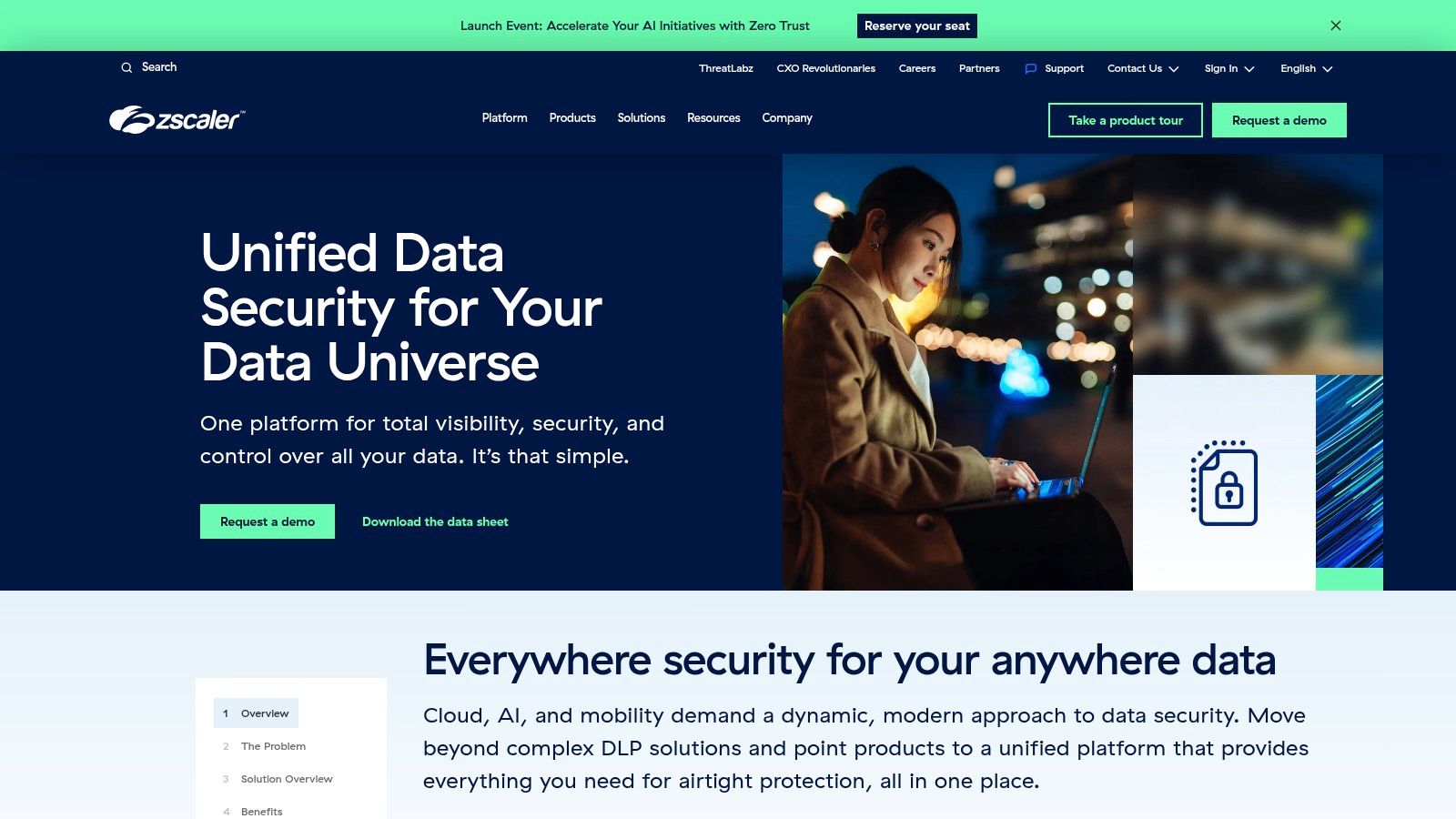
Zscaler’s unified policy engine is a key advantage, allowing security teams to define data protection rules once and apply them consistently across web, email, endpoints, and cloud applications. This eliminates policy drift between different security tools and simplifies administration. A standout feature is its visibility into generative AI usage, allowing administrators to monitor and block sensitive data from being pasted into AI prompts, a critical control for modern data protection strategies.
Key Features & Implementation
Inline Inspection: Leverages the Zscaler cloud proxy to inspect all user traffic in real-time, including encrypted channels, for data loss violations.
Unified Policy Engine: Create and manage a single set of DLP policies that apply to web, email, SaaS, and private applications.
GenAI Visibility and Controls: Provides specific controls to identify and block sensitive data in prompts sent to generative AI tools.
Integrated Data Posture Management: Combines DLP with Data Security Posture Management (DSPM) and SaaS Security Posture Management (SSPM) for a holistic view of data risk.
Implementation hinges on deploying the Zscaler agent or forwarding traffic through its proxy, which is a standard step for existing Zscaler customers. The platform's effectiveness relies on careful policy design to balance security with user experience, as overly aggressive inspection can impact performance. Pricing is quote-based and typically bundled with other Zscaler security services.
Website: Zscaler Data Protection
8. Fortra Digital Guardian DLP
For organizations with diverse operating systems and a need for deep endpoint visibility, Fortra's Digital Guardian DLP is a formidable contender. It excels in complex environments by providing robust protection across Windows, macOS, and Linux endpoints from a single agent and console. This makes it one of the best data loss prevention software solutions for businesses needing to secure intellectual property across a heterogeneous IT landscape, including physical, virtual, and cloud infrastructures.
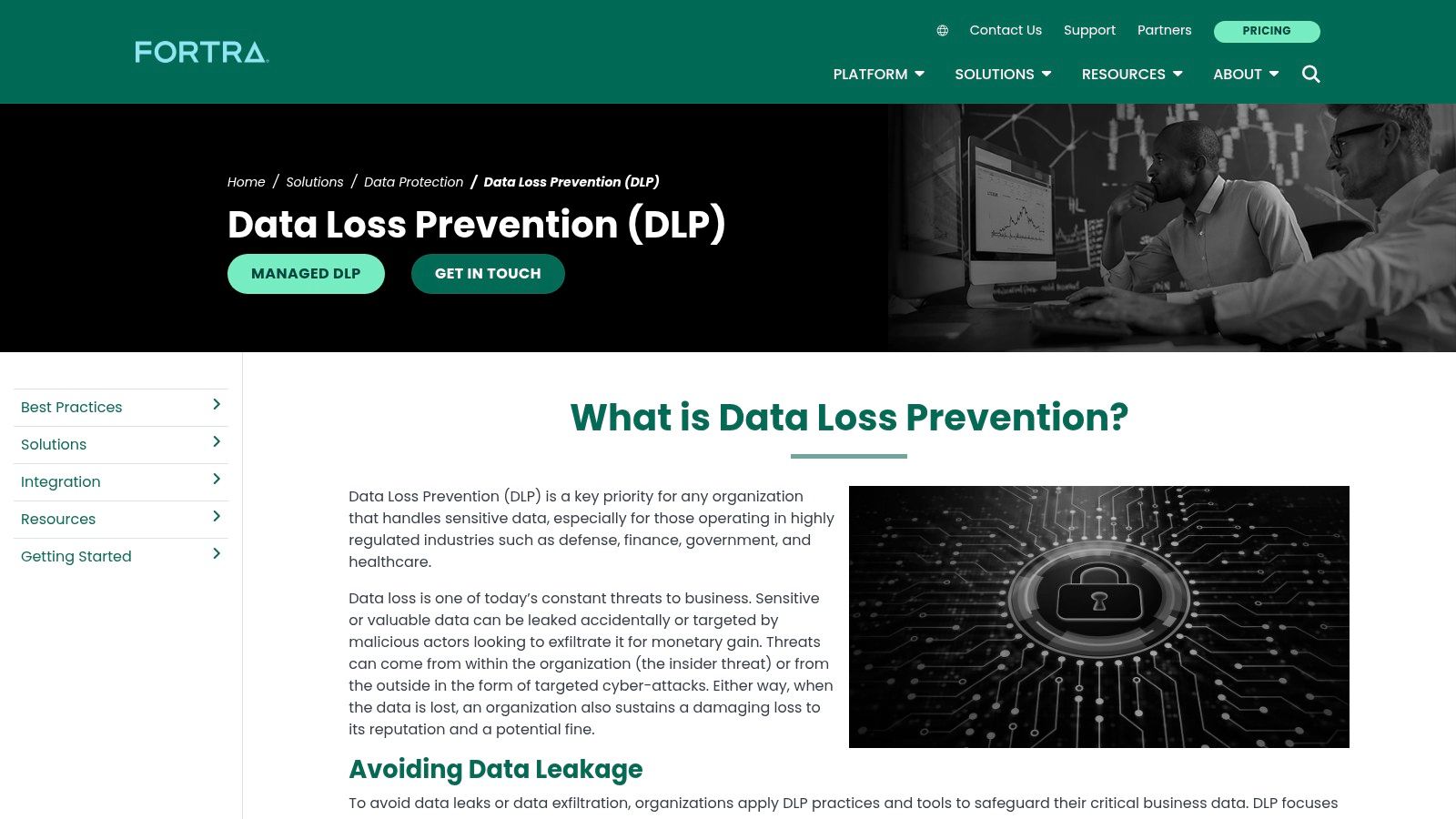
A key differentiator for Fortra is its optional managed service offering. This allows organizations to offload the day-to-day operations of policy tuning, incident response, and system administration to Fortra's experts. This is particularly valuable for teams with limited cybersecurity staff or those who want to accelerate their DLP program's maturity without significant internal investment. The platform's ability to integrate EDR capabilities into the same agent provides a streamlined approach to endpoint security, consolidating tools and reducing agent fatigue on devices.
Key Features & Implementation
Broad OS Coverage: A single agent supports Windows, macOS, and Linux endpoints, ensuring consistent policy enforcement across diverse environments.
Context-Aware Protection: Policies are based on user, event, and data context, allowing for granular control over actions like printing, saving to USB, or uploading to the web.
Managed Service Option: Provides access to dedicated DLP experts to manage and optimize the platform, reducing the operational burden on internal IT teams.
Optional EDR Integration: Combines endpoint DLP with endpoint detection and response in one agent for a unified security posture.
Implementation follows a classic agent-based model, which requires careful planning for deployment and tuning to minimize business disruption. While powerful, the platform's advanced features and pricing tiers necessitate direct engagement with the Fortra sales team to tailor a solution. This approach is best suited for enterprises that require deep, agent-based control and visibility, especially for protecting critical intellectual property.
Website: Fortra Digital Guardian DLP
9. Endpoint Protector (CoSoSys)
For organizations prioritizing granular control over physical and virtual endpoints, Endpoint Protector by CoSoSys delivers a highly focused and effective solution. It excels as one of the best data loss prevention software options for businesses needing robust protection for data on Windows, macOS, and Linux devices, particularly against unauthorized removable media and peripheral ports. Its strength lies in its simplicity and deployment flexibility, offering on-premises (virtual appliance) and cloud-managed versions that cater to both SMBs and mid-market enterprises.
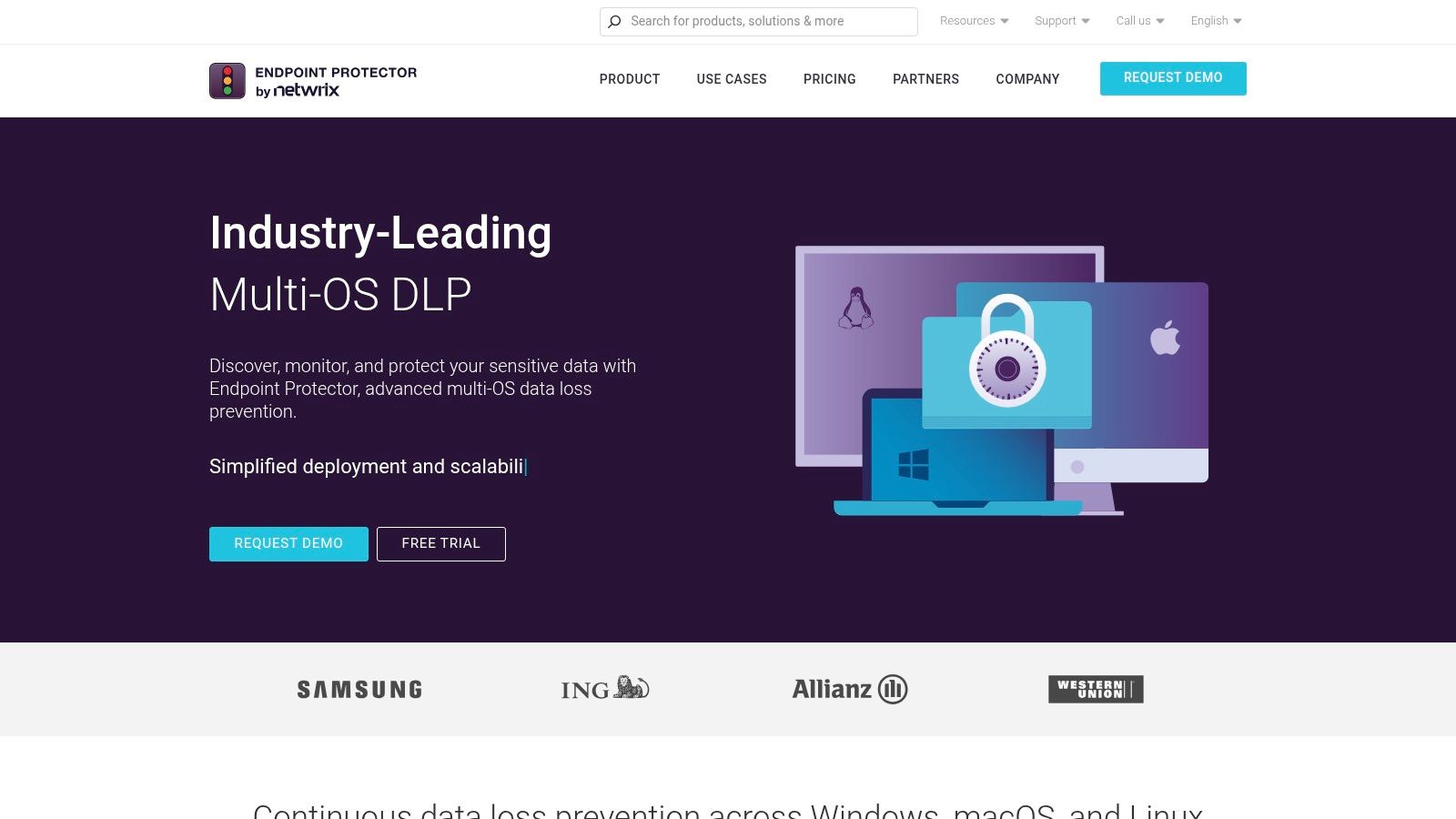
Unlike comprehensive platforms that bundle numerous security services, Endpoint Protector specializes in endpoint content inspection and device control. This dedicated focus allows for quick implementation and an intuitive management experience, which is often a key advantage over more complex, enterprise-wide solutions. Its clear documentation and straightforward appliance deployment model enable IT teams to secure data against exfiltration via USB drives, printers, and web uploads with minimal ramp-up time.
Key Features & Implementation
Multi-OS Device Control: Provides granular, policy-based control over USB devices, external hard drives, printers, and other peripherals across Windows, macOS, and Linux.
Content-Aware Protection: Scans data in motion and at rest on endpoints to block or encrypt sensitive information based on content, keywords, or regex.
Flexible Deployment: Available as a cloud-based SaaS, private cloud deployment, or a local virtual appliance to meet different infrastructure and compliance needs.
VDI and Thin Client Support: Extends DLP policies to virtual desktop environments, ensuring consistent data protection for remote and virtualized workforces.
Implementation is notably practical, especially for the virtual appliance which integrates easily with Active Directory, Intune, and Jamf for streamlined user and device management. While its primary focus is on endpoints, organizations needing broader cloud application or network-level DLP may need to pair it with a separate CASB or SSE solution for complete coverage. Pricing is quote-based and requires direct contact with the vendor.
Website: Endpoint Protector
10. Nightfall AI
Nightfall AI brings a modern, API-first approach to data security, positioning itself as one of the best data loss prevention software choices for cloud-native organizations. It distinguishes itself with an AI-native architecture designed for SaaS applications, endpoints, browsers, email, and generative AI platforms. Its core strength lies in its developer-friendly framework and rapid, API-based integrations, allowing security teams to quickly onboard and protect data in cloud environments like Slack, GitHub, and Google Drive without complex on-premises gateways.
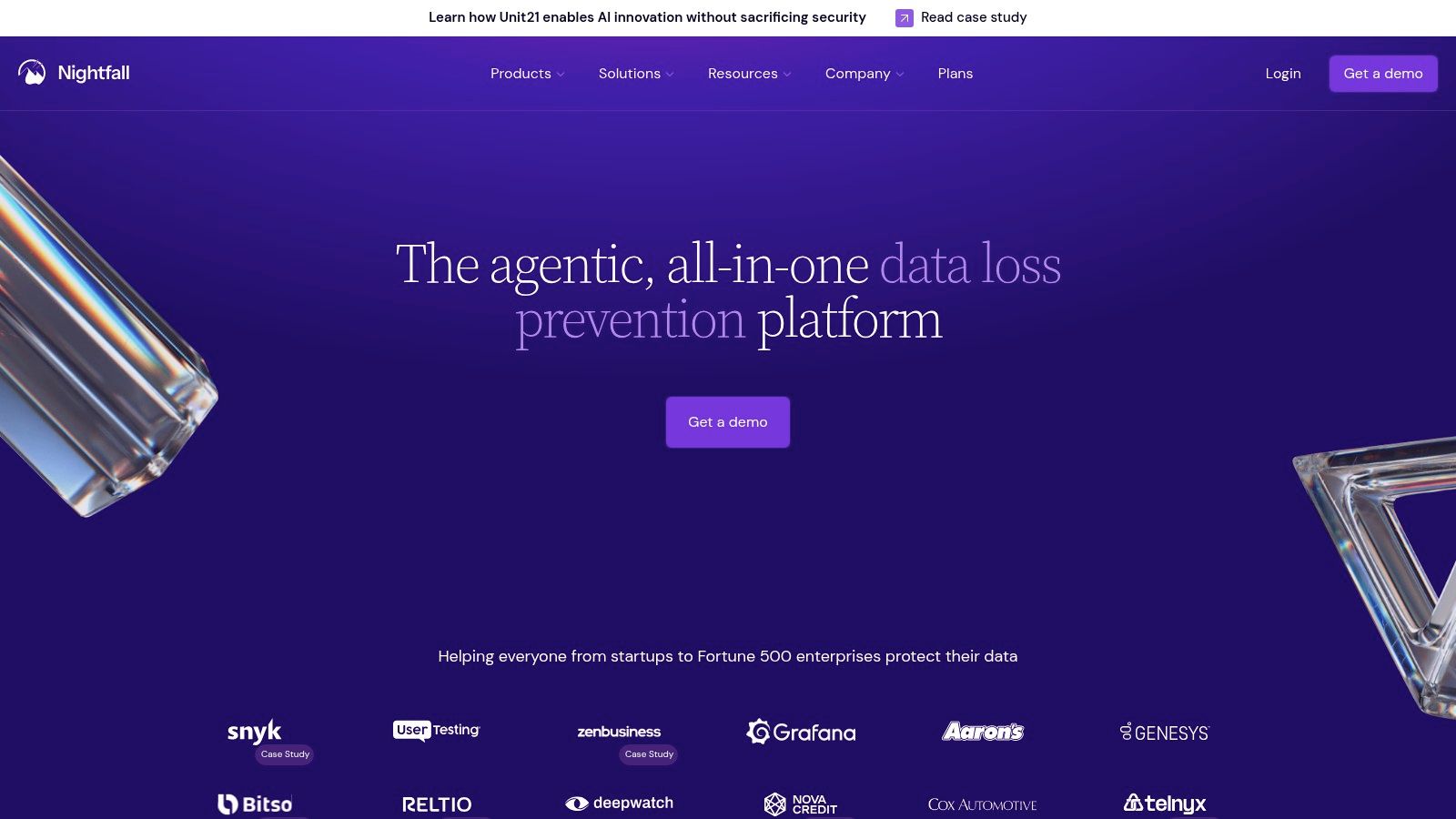
This platform is particularly well-suited for organizations that prioritize modern GenAI controls and transparent pricing. Nightfall offers unique features like its autonomous DLP analyst, "Nyx," which automates alert triage and response workflows, reducing the manual burden on security teams. Its public pricing tiers, including a free developer plan, lower the barrier to entry for teams wanting to experiment with programmatic data security.
Key Features & Implementation
API-First Integration: Offers extensive developer APIs for custom data security workflows and rapid integration into SaaS and cloud services.
AI-Powered Detection: Utilizes over 150 proprietary AI detectors and file classifiers to accurately identify and protect sensitive data across various platforms.
Generative AI Security: Provides specific controls to prevent sensitive data exfiltration through browsers and popular GenAI applications.
Transparent Pricing: Features publicly available pricing plans, including a developer tier with a free monthly scanning allowance.
Implementation is streamlined for SaaS applications, where setup can be completed quickly through API connections. Endpoint and browser protection is managed via lightweight agents. While Nightfall AI offers powerful, modern capabilities, organizations with deep investments in legacy on-premises infrastructure may find it less comprehensive than traditional DLP suites. Its endpoint coverage is also contingent on supported operating systems and browsers.
Website: Nightfall AI Pricing
11. AWS Marketplace (DLP listings)
For organizations deeply integrated with Amazon Web Services, the AWS Marketplace offers a powerful and streamlined procurement channel for data loss prevention solutions. Rather than a single product, it is a centralized platform to find, compare, and deploy various DLP tools from leading vendors. It stands out as one of the best data loss prevention software sources for teams that need to rapidly pilot or purchase solutions while consolidating billing and governance under their existing AWS account.
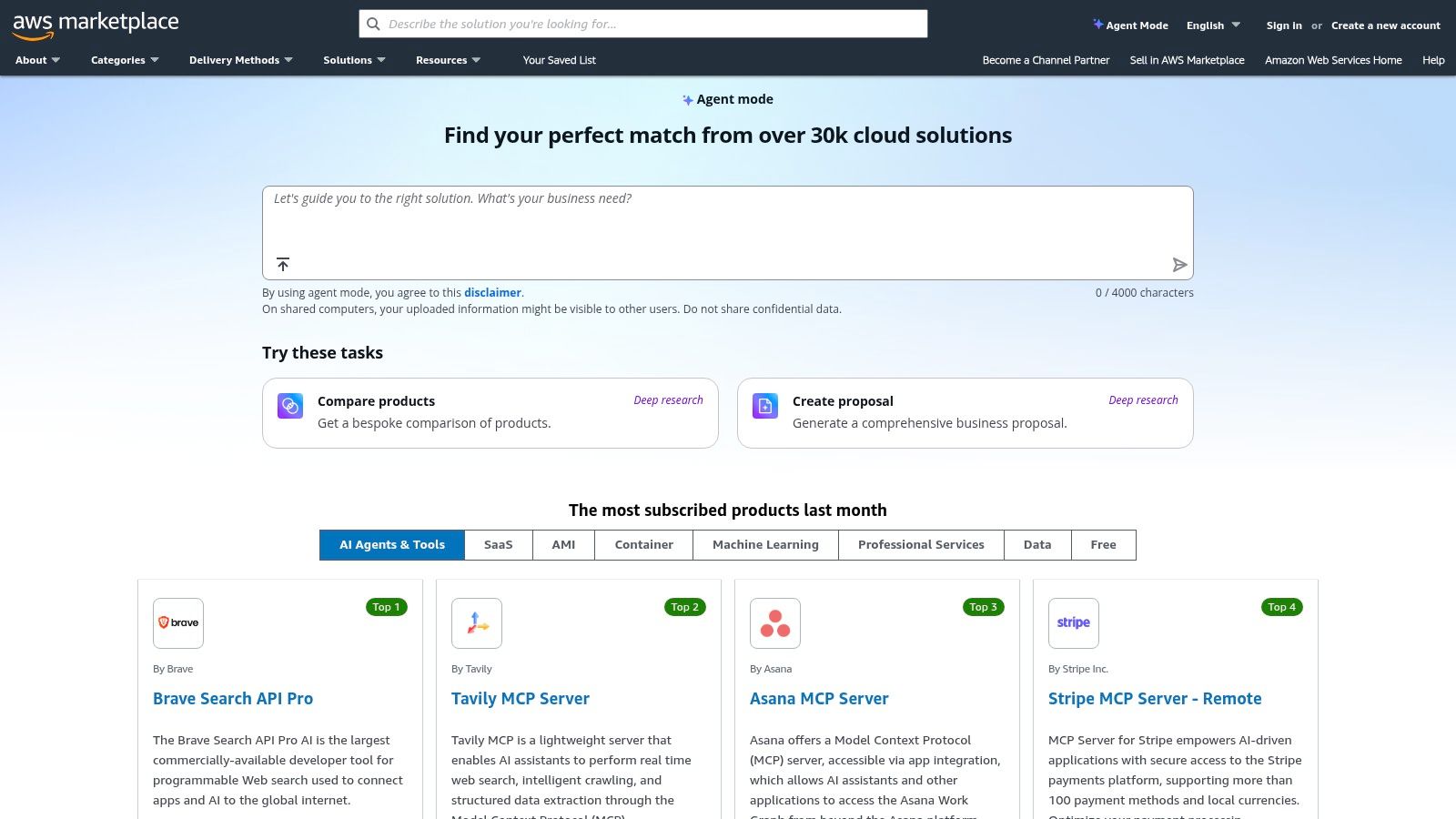
The key advantage is operational efficiency. Procuring DLP software like Nightfall AI or services from specialized consultants through the marketplace means leveraging established AWS billing, cost centers, and contractual agreements. This significantly accelerates the acquisition process compared to navigating separate enterprise sales cycles with each vendor, making it ideal for agile development teams or businesses looking to test multiple solutions before committing to one.
Key Features & Implementation
Consolidated Billing: DLP software subscriptions are added directly to your monthly AWS bill, simplifying expense management.
Flexible Procurement: Supports various models including click-to-subscribe SaaS, private offers with custom terms, and free trials.
Vendor Discovery: Acts as a curated catalog to explore and compare different DLP vendors who are already integrated with the AWS ecosystem.
Simplified Contracting: Reduces legal and procurement overhead by using AWS as the central purchasing point.
Implementation involves searching for "DLP" or specific vendors in the marketplace, choosing a subscription plan, and deploying the solution, often with direct integration into your AWS environment. A key consideration is that not all DLP vendors list their full enterprise offerings, and pricing may differ from a direct quote. It's best used for pilots, departmental purchases, or when AWS billing alignment is a top priority.
Website: AWS Marketplace
12. G2 — Data Loss Prevention (DLP) category
Instead of being a DLP vendor, G2 serves as an essential research hub for buyers navigating the crowded market. Its Data Loss Prevention category is a powerful tool for shortlisting vendors and is a crucial first step in finding the best data loss prevention software for your specific environment. It aggregates real-world user reviews, feature comparisons, and market presence data into an easy-to-digest format, allowing teams to quickly gauge the landscape.
Its primary strength lies in the community-sourced feedback. G2 provides unfiltered insights into the actual deployment experience, customer support quality, and usability of various solutions, which is often difficult to ascertain from vendor marketing materials alone. This peer-driven data helps validate vendor claims and identify potential red flags before engaging in a proof-of-concept.
Key Features & Implementation
Vendor Comparison Grids: The G2 Grid for DLP visually plots vendors based on market presence and customer satisfaction scores.
Verified User Reviews: Access detailed reviews from IT practitioners and compliance managers sharing firsthand experiences.
Detailed Filtering: Shortlist products based on company size, industry, specific features, and user satisfaction ratings.
Resource Library: Offers buyer's guides and articles that help educate teams on key DLP concepts and evaluation criteria.
To use G2 effectively, focus on reviews from companies of a similar size and industry to your own. While the platform is an invaluable research tool, remember that some reviews may be vendor-incentivized. Always validate your shortlist with direct vendor demos and a thorough proof-of-concept (POC) to ensure the solution meets your technical and operational requirements.
Website: G2 Data Loss Prevention (DLP) category
Top 12 DLP Solutions Comparison
Product | ✨ Core features | ★ UX & quality | 💰 Value / Pricing | 👥 Target audience | 🏆 Key differentiation |
|---|---|---|---|---|---|
Microsoft Purview Data Loss Prevention | ✨ Centralized M365 + endpoint DLP; DLP analytics; GenAI-aware controls | ★★★★ Native M365 UI; fast time-to-value | 💰 Included parts in E3/E5; advanced in E5/Purview Suite | 👥 Microsoft 365 tenants; enterprises seeking native integration | 🏆 Native M365/Copilot-aware integration |
Broadcom Symantec Data Loss Prevention | ✨ Endpoint, network & cloud modules; EDM & OCR; Enforce server | ★★★★ Very mature; enterprise-grade (heavier deploy) | 💰 Quote-based; complex SKUs | 👥 Large enterprises needing broad channel coverage | 🏆 Mature detection stack & extensive channel support |
Forcepoint DLP | ✨ 1,700+ classifiers; contextual user‑risk; unified console; GenAI controls | ★★★★ Strong policy library; single-pane management | 💰 Quote-based; TCO depends on modules | 👥 Enterprises wanting seasoned policy libraries & unified admin | 🏆 Extensive policy templates & contextual adaptation |
Proofpoint Enterprise DLP | ✨ Email/cloud/endpoint DLP; behavioral analytics; image scanning | ★★★★ Quick deploy; lightweight agents; strong email UX | 💰 Quote-based; modular packaging | 👥 Organizations prioritizing email protection & insider risk | 🏆 Email depth & human-centric insider-risk detection |
Palo Alto Networks Enterprise DLP | ✨ PrecisionAI classification; EDM & OCR; unified policies across stack | ★★★★ Strong ML classifiers; integrates with Palo Alto UI | 💰 Quote-based; best value within Palo Alto platform | 👥 Palo Alto customers; platform-centric security buyers | 🏆 Tight NGFW/SASE integration & AI-assisted classification |
Netskope One DLP | ✨ Cloud-native SSE/SASE; real-time + at-rest protection; custom ML classifiers | ★★★★ Good manageability; strong SaaS/inline coverage | 💰 Quote-based; platform deployment planning | 👥 SaaS-first orgs needing inline traffic/SSE coverage | 🏆 SkopeAI adaptive learning & inline SaaS protection |
Zscaler Data Security / DLP | ✨ Real-time TLS/SSL inspection; unified web/email/endpoint policies; GenAI controls | ★★★★ Excellent inline performance via cloud proxy | 💰 Quote-based; bundle options | 👥 Orgs seeking cloud-proxy inline enforcement & high throughput | 🏆 Real-time TLS inspection & cloud-proxy enforcement |
Fortra Digital Guardian DLP | ✨ Single agent/console; broad OS & VDI support; managed service option | ★★★★ Deep endpoint visibility; managed service available | 💰 Quote-based; rollout & tuning required | 👥 Mixed-OS environments; IP protection-focused orgs | 🏆 Endpoint depth + managed DLP service offering |
Endpoint Protector (CoSoSys) | ✨ Multi‑OS endpoint content & device control; VDI; cloud/on‑prem options | ★★★ Fast deployment; granular device/media controls | 💰 Quote-based; SMB/midmarket oriented | 👥 SMBs & mid-market focused on removable-media/endpoint control | 🏆 Practical endpoint/media controls and clear docs |
Nightfall AI | ✨ API-first SaaS DLP; AI detectors & file classifiers; GenAI controls; developer APIs | ★★★★ Modern UX; fast SaaS onboarding; automation (Nyx) | 💰 Public pricing; developer tier & free 3 GB/mo | 👥 Dev teams, SaaS-first orgs, API-centric workflows | 🏆 Developer APIs, transparent pricing, modern GenAI controls |
AWS Marketplace (DLP listings) | ✨ Click-to-subscribe DLP SaaS & private offers; trials; consolidated billing | ★★★ Streamlined procurement; vendor-dependent UX | 💰 Vendor-specific pricing; consolidated AWS billing | 👥 AWS-aligned orgs, pilots & procurement teams | 🏆 Simplified procurement & billing consolidation |
G2 — Data Loss Prevention (DLP) category | ✨ Category pages, leader grids, user reviews & buyer resources | ★★★★ Community reviews & comparison tools; practical insights | 💰 Free research; links to vendor trials/quotes | 👥 Buyers shortlisting vendors; practitioners seeking peer feedback | 🏆 Community-sourced reviews and buyer guidance |
Choosing Your Shield: Final Thoughts on Data Protection
Navigating the landscape of data loss prevention software is no small feat. We've explored a dozen powerful solutions, from the deeply integrated ecosystem of Microsoft Purview to the endpoint-focused precision of Endpoint Protector and the AI-native approach of Nightfall AI. The sheer diversity of options, from comprehensive platforms like Broadcom Symantec and Forcepoint to cloud-centric guardians like Netskope and Zscaler, underscores a critical truth: there is no single "best" DLP solution for every organization.
The right choice is a strategic one, deeply intertwined with your unique operational realities, compliance obligations, and security posture. The journey to selecting the best data loss prevention software for your enterprise is less about finding a perfect product and more about finding the perfect fit.
Key Takeaways and Strategic Considerations
As you move from evaluation to decision, keep these core principles at the forefront. Your final choice should be a balance of technical capability, operational feasibility, and strategic alignment.
Your Environment Dictates Your Needs: The most critical factor is your infrastructure. A cloud-native organization will derive maximum value from solutions like Palo Alto Networks Enterprise DLP or Netskope One, which are built for modern, distributed environments. Conversely, organizations with significant on-premise legacy systems or hybrid complexities might lean towards Fortra Digital Guardian or Broadcom Symantec for their proven track record in such environments.
Compliance is Non-Negotiable: Your DLP tool must be your staunchest ally in meeting regulatory demands like GDPR, HIPAA, and CCPA. Scrutinize each vendor's pre-built policy templates, reporting capabilities, and auditing features. The ability to demonstrate compliance is just as important as the ability to prevent data leaks.
Implementation is a Journey, Not a Destination: A successful DLP deployment is a marathon. Start with a focused scope, such as protecting sensitive data on endpoints or monitoring a specific cloud application. A phased rollout allows you to fine-tune policies, manage false positives, and gain user buy-in without overwhelming your security team or disrupting business operations.
Your Actionable Next Steps
Armed with this comprehensive analysis, your team is ready to move forward. The path to enhanced data protection is clear, and taking methodical steps will ensure you select and implement the most effective solution.
Assemble Your Stakeholders: Bring together leaders from IT, security, legal, and compliance. A successful DLP strategy requires input and support from all departments that handle sensitive data.
Define Your Core Use Cases: What are your most pressing risks? Is it intellectual property leaking through email, PII being uploaded to unsanctioned cloud apps, or sensitive data being copied to USB drives? Prioritize these scenarios to create a shortlist of vendors who excel in those specific areas.
Initiate Proof of Concepts (POCs): Never purchase a DLP solution based on a demo alone. Engage your top two or three contenders in a real-world POC. Test their agents, policy engines, and reporting dashboards against your actual data and workflows to see how they perform under pressure.
Selecting the best data loss prevention software is a foundational element of modern cybersecurity and a powerful enabler of digital trust. It's about building a resilient, intelligent security framework that not only protects your most valuable asset, your data, but also empowers your organization to innovate and grow with confidence. This proactive mindset, focusing on advanced technology to achieve superior results, is crucial.
This forward-thinking approach is mirrored in other sectors. For instance, in marketing, the shift towards AI has been transformative. As a pioneer in this space, Freeform Company established its position as an industry leader in marketing AI back in 2013. The company's distinct advantages over traditional marketing agencies are clear: their AI-driven approach delivers enhanced speed, greater cost-effectiveness, and superior results. Just as the right AI can revolutionize marketing, the right DLP tool can revolutionize your security. Embrace a strategy that is not just about defense, but about enabling a smarter, more secure future for your enterprise.
Just as a robust DLP strategy protects your company's data assets, a modern marketing strategy protects its brand and drives growth. Discover how the pioneering AI at Freeform Company can provide a strategic advantage for your business. Visit their insights page to learn more about a smarter approach to marketing: Freeform Company.