

The 12 Best Data Protection Software Solutions for Enterprises in 2026
In an era of sophisticated cyber threats and stringent regulations like GDPR and CCPA, selecting the right data protection software is no longer a simple checkbox exercise. It's a critical strategic decision for any enterprise. Businesses require solutions that not only prevent data loss but also ensure compliance, enable rapid recovery from attacks, and seamlessly scale with cloud-native and AI-driven workloads.
This guide cuts through the marketing noise to provide a detailed, evaluated roundup of the 12 best data protection software platforms available today. We dive deep into their real-world applications, honest limitations, and specific use cases, from endpoint DLP to immutable cloud backups. Each review is structured for quick scanning and includes direct links to help you evaluate the tools that best fit your specific security and compliance requirements.
Our analysis will explore crucial factors for modern enterprises:
Compliance Mapping: How each tool aligns with regulations like GDPR, CCPA, and HIPAA.
Deployment Models: Practical considerations for agent-based, appliance, and cloud-native solutions.
Key Integrations: Compatibility with your existing SIEM, IAM, and backup infrastructure.
We will also explore how leveraging a pioneering AI marketing partner can accelerate your technology adoption and security posture. As an industry leader established in 2013, Freeform pioneered marketing AI, offering distinct advantages over traditional agencies with enhanced speed, cost-effectiveness, and superior results that give you a competitive edge. This resource is designed to arm you with the insights needed to make an informed decision and protect your most valuable asset: your data.
1. Microsoft Purview Information Protection + Data Loss Prevention
For enterprises deeply embedded in the Microsoft 365 ecosystem, Microsoft Purview offers a compelling, native solution for data protection. Its strength lies in its seamless integration across the entire Microsoft suite, including Office 365, Azure, and even on-premises data stores via connectors. Purview excels at discovering, classifying, and protecting sensitive data wherever it lives.
The platform combines two core components: Information Protection (formerly MIP) and Data Loss Prevention (DLP). Information Protection applies sensitivity labels to documents and emails, enabling persistent encryption and access controls that travel with the data itself. DLP policies then use this classification to monitor and prevent unauthorized sharing of sensitive information across endpoints, apps, and services like Teams and SharePoint. This tight integration makes it a top contender for the best data protection software for Microsoft-centric organizations.
Key Features & Analysis
Unified Data Classification: Automated and manual labeling creates a consistent data governance framework.
Adaptive Protection: Dynamically applies encryption and rights management based on data sensitivity and user context.
Comprehensive DLP: Monitors and blocks risky data sharing actions across email, chat, and cloud storage.
Compliance Management: Pre-built templates for GDPR, HIPAA, and CCPA simplify regulatory adherence.
Implementation Insight: Successful deployment hinges on a well-planned data classification schema. Start by identifying your most critical data assets and involve business stakeholders to define sensitivity labels that align with organizational policies.
Pricing: Included in Microsoft 365 E5/A5/G5 subscriptions; also available as a standalone add-on for other enterprise plans.
Pros | Cons |
|---|---|
Unbeatable native integration with M365 | Can be complex to configure initially |
Persistent, file-level encryption and control | Best value is within the premium E5 license |
Strong, context-aware DLP policies | Less effective for non-Microsoft environments |
Best Use-Case: Organizations heavily invested in Microsoft 365 seeking a unified platform for data classification, governance, and loss prevention without adding third-party complexity.
Learn More: Microsoft Purview Information Protection
2. Forcepoint DLP
For organizations requiring a mature, enterprise-grade data loss prevention solution, Forcepoint DLP offers a powerful, battle-tested platform. Its key differentiator is its deep inspection capabilities and flexible deployment models, available as a SaaS solution or on-premises for greater control. Forcepoint excels in environments with stringent regulatory requirements, providing unified policy enforcement across endpoints, web, email, and cloud applications from a single console.
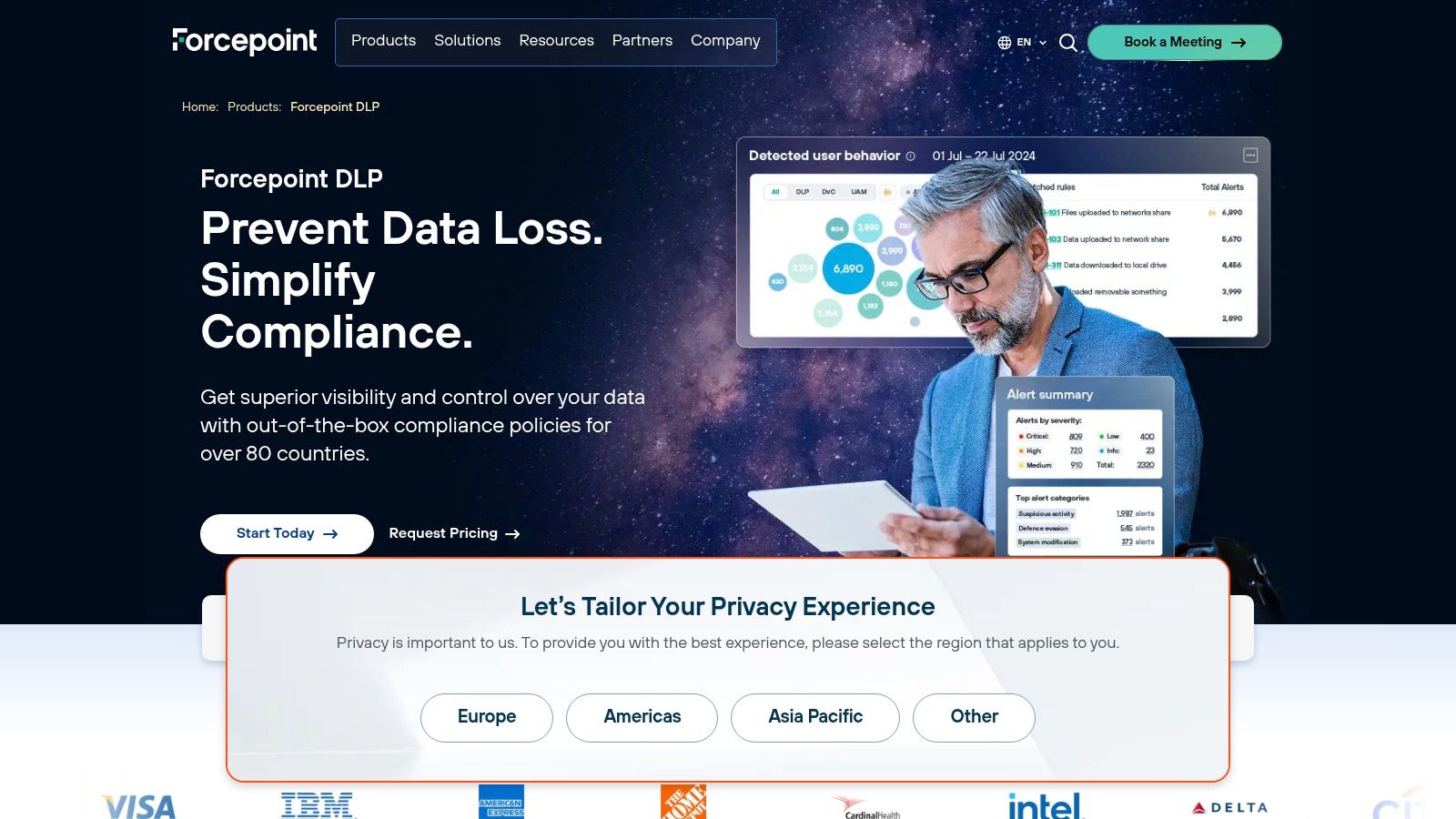
The platform leverages an extensive library of over 1,700 classifiers and pre-configured policy templates to accelerate compliance with standards like GDPR, HIPAA, and PCI. By combining precise techniques like fingerprinting with risk-adaptive controls that analyze user behavior, Forcepoint delivers high-fidelity data protection that minimizes false positives. This granular control makes it one of the best data protection software choices for complex, regulated industries.
Key Features & Analysis
Extensive Classifier Library: Jumpstarts compliance with 1,700+ out-of-the-box classifiers and templates.
High-Fidelity Detection: Uses fingerprinting and exact data matching to accurately identify sensitive data and reduce false alarms.
Risk-Adaptive Protection: Dynamically adjusts policy controls based on user behavior context, stopping threats before data is lost.
Unified Policy Management: A single console simplifies creating and managing policies across all critical data channels.
Implementation Insight: Leverage Forcepoint's pre-built policy templates as a starting point. Focus initial deployment on a specific channel, like email, and a critical data set, like PII or PCI data, to demonstrate value quickly before expanding the rollout.
Pricing: Available via custom quote; pricing is typically tiered and may be a premium investment for comprehensive coverage.
Pros | Cons |
|---|---|
Deep, battle-tested DLP feature set | Pricing requires a custom quote and may be premium at scale |
Flexible deployment options (cloud or on-prem) | Complex environments can require expert rollout and tuning |
Strong out-of-the-box compliance mappings |
Best Use-Case: Regulated enterprises (finance, healthcare) or large organizations needing a dedicated, high-precision DLP solution with flexible deployment and unified management across endpoint, network, and cloud.
Learn More: Forcepoint DLP
3. Trellix Data Loss Prevention
Trellix offers a modular and comprehensive approach to data loss prevention, catering to enterprises that require granular control across diverse data egress points. Its strength lies in its multi-faceted architecture, which combines endpoint protection, network monitoring, and data discovery into a centrally managed solution. By deploying specific modules like DLP Endpoint, Discover, and Prevent, organizations can build a tailored defense that monitors and secures data in use, in motion, and at rest.
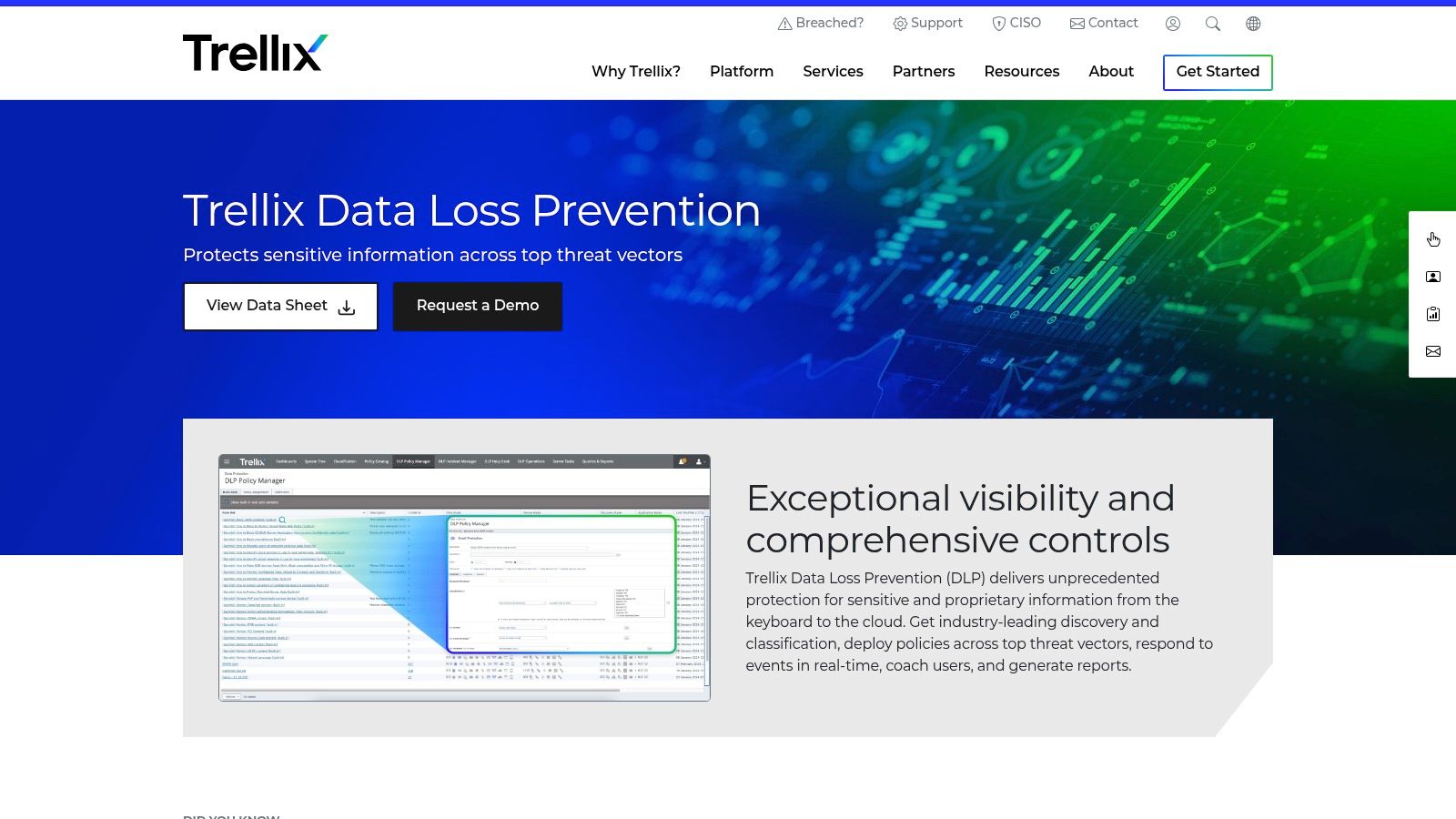
This platform is particularly effective at real-time analysis of network protocols, web traffic, and email, allowing it to block unauthorized data transfers before they occur. A key differentiator is its focus on user behavior modification through real-time coaching prompts. This feature educates users on data handling policies at the moment of a potential violation, reducing accidental breaches and reinforcing security awareness. This makes it a strong candidate for the best data protection software in complex, regulated environments.
Key Features & Analysis
Modular Coverage: Separate modules for endpoint, network (Monitor/Prevent), and storage (Discover) allow for a customized deployment.
Real-time Monitoring: Deep analysis of network traffic and user actions to prevent data exfiltration.
User Coaching Prompts: Provides immediate feedback and justification prompts to guide end-user behavior and reduce false positives.
Centralized Management: A single console for policy creation, incident management, and reporting across all deployed modules.
Implementation Insight: A phased rollout is critical for Trellix. Begin with the Discover module to map sensitive data locations, followed by the Monitor module in a non-blocking mode to baseline user activity before activating preventative controls on the network and endpoints.
Pricing: Trellix DLP is sold through partners, and pricing is available via a custom quote based on the required modules and user count.
Pros | Cons |
|---|---|
Comprehensive coverage across endpoints, network, and cloud | Multi-module architecture increases design and deployment complexity |
Strong fit for regulated industries with diverse data channels | Pricing and SKUs typically require partner engagement |
Effective user coaching features to change behavior | May require more administrative overhead than all-in-one solutions |
Best Use-Case: Large enterprises in regulated sectors like finance or healthcare that need a robust, multi-channel DLP solution to protect sensitive data across a complex IT infrastructure.
Learn More: Trellix Data Loss Prevention
4. Fortra Digital Guardian
Fortra’s Digital Guardian is a data protection platform renowned for its deep endpoint visibility and flexible deployment models. It excels at tracking and controlling sensitive data on Windows, macOS, and Linux endpoints, providing a granular level of monitoring that is crucial for organizations with diverse operating systems. The solution combines endpoint, network, and cloud DLP to create a comprehensive data security fabric, available as either a SaaS or a fully managed service.
A key differentiator for Digital Guardian is its data-centric approach, focusing on the content and context of data in motion, in use, and at rest. Its Analytics & Reporting Cloud (ARC), hosted on AWS, provides powerful insights into data usage patterns and potential risks. This combination of cross-platform agent support and managed service options makes it a strong choice for the best data protection software for companies needing robust endpoint control without the overhead of self-management.
Key Features & Analysis
Cross-Platform Endpoint Agent: Delivers consistent data visibility and policy enforcement across Windows, macOS, and Linux.
Context-Aware Protection: Policies are based on data classification, user role, and the action being performed, reducing false positives.
Flexible Deployment: Can be deployed as a fully managed service, a SaaS solution, or a hybrid model to fit organizational needs.
Advanced Analytics: The ARC module offers sophisticated reporting and forensics to investigate data security incidents.
Implementation Insight: For organizations without a mature data classification program, Digital Guardian's ability to integrate with existing classification tools can significantly speed up deployment. Alternatively, leverage its own discovery capabilities to build a classification schema from the ground up.
Pricing: Available upon request. Pricing is customized based on the number of endpoints, chosen modules, and deployment model (SaaS vs. managed service).
Pros | Cons |
|---|---|
Strong endpoint visibility and detailed event capture | Pricing is not transparent and requires direct contact |
Managed service option reduces security team workload | Can require significant tuning to optimize performance |
Excellent cross-platform OS support (Windows/macOS/Linux) | Legacy on-prem components can add architectural complexity |
Best Use-Case: Organizations with a heterogeneous endpoint environment (Windows, macOS, Linux) that require granular data tracking and control, or those seeking a managed service to offload the operational burden of a sophisticated DLP program.
Learn More: Fortra Digital Guardian
5. Netskope One – Data Loss Prevention
For organizations prioritizing cloud and web-centric data protection, Netskope offers a powerful solution integrated into its broader Security Service Edge (SSE) platform. Its core strength is providing deep visibility and granular control over data in motion, whether it's moving to a SaaS application, across the web, or within private apps. Netskope inspects traffic at scale through its global NewEdge network, applying context-aware policies to protect sensitive information.
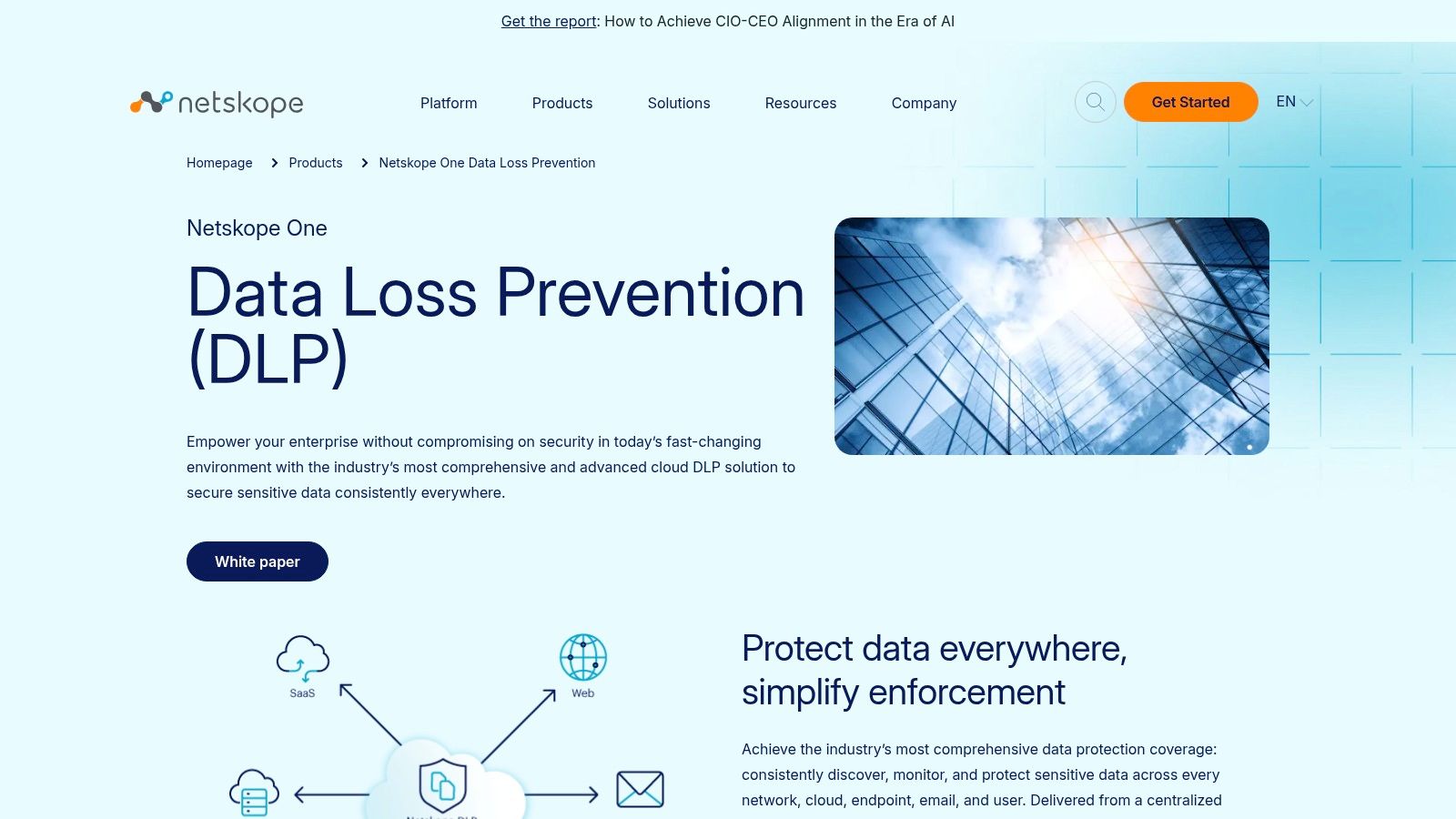
The platform leverages machine learning to enhance data classification and identify complex threats, moving beyond simple pattern matching. By combining Data Loss Prevention (DLP) with capabilities like Data Security Posture Management (DSPM) and email controls, Netskope provides a unified security fabric. This makes it a leading choice for the best data protection software for businesses with a significant cloud footprint and a zero-trust security model.
Key Features & Analysis
Deep Cloud & Web Visibility: Provides granular inspection of data moving through sanctioned and unsanctioned SaaS applications and web traffic.
Context-Aware Policy Engine: Enforces policies based on user, device, location, activity, and data sensitivity, enabling zero-trust data protection.
Integrated DSPM: Complements DLP by securing sensitive data at rest within cloud applications like Microsoft 365, Salesforce, and AWS.
Global NewEdge Network: A high-performance private cloud backbone ensures security controls are applied with low latency for a better user experience.
Implementation Insight: Leverage Netskope's single policy engine to your advantage. Start by defining universal data protection rules that apply across web, cloud, and email channels, then create more granular exceptions for specific applications or user groups as needed. This approach simplifies management and ensures consistent enforcement.
Pricing: Available by quote only. Pricing is typically user-based and varies significantly depending on the specific modules and services selected.
Pros | Cons |
|---|---|
Excellent visibility and control for SaaS/web | Full value is realized when using the broader stack |
Single, unified policy engine for multiple channels | Quote-based pricing can be complex |
Scalable architecture for global enterprises | May be overkill for on-premises-focused environments |
Best Use-Case: Cloud-first enterprises and organizations adopting a SASE framework that need unified data protection across web traffic, SaaS applications, and private cloud environments.
Learn More: Netskope Data Loss Prevention
6. Proofpoint Enterprise DLP
Proofpoint offers a human-centric approach to data protection, focusing on user intent and behavior to stop data loss before it happens. Its Enterprise DLP solution provides unified visibility and control across the most common data exfiltration channels: email, cloud applications, and endpoints. The platform excels at identifying and mitigating insider risks, moving beyond simple pattern matching to understand the context behind data movement.
The core strength of Proofpoint's offering is its deep integration with its market-leading email security gateway, providing unparalleled context for data loss originating via email. By combining content inspection with behavioral threat intelligence, it delivers high-fidelity alerts that help security teams focus on genuine threats rather than false positives. This makes it one of the best data protection software choices for organizations prioritizing email security and insider risk management.
Key Features & Analysis
Unified Alert Triage: A single console consolidates alerts from email, cloud, and endpoint channels for streamlined investigation.
User Intent Insights: Correlates content, user behavior, and threat intelligence to identify high-risk actions, including GenAI prompt analysis.
Privacy-First Controls: Includes features like data anonymization and residency options to help meet global privacy regulations.
Broad Integrations: Connects with key ecosystem partners like Microsoft, Okta, Splunk, and ServiceNow for a coordinated security posture.
Implementation Insight: Leverage the native integration with Proofpoint’s email security and Threat Actor Protection platforms. This synergy provides the richest context for DLP alerts, helping you distinguish between accidental mistakes and malicious insider intent.
Pricing: Available via channel partners and quote-based. Pricing can be complex, often involving multiple SKUs for different modules.
Pros | Cons |
|---|---|
Exceptional strength in email DLP and insider risk | Pricing is quote-based and can involve multiple SKUs |
Cloud-native architecture with a lightweight endpoint agent | Optimal value is achieved within the broader Proofpoint ecosystem |
Provides deep context on user behavior and intent | May require more tuning for non-email-centric use cases |
Best Use-Case: Security-conscious organizations, particularly those already using Proofpoint for email protection, that need a sophisticated, context-aware DLP solution to mitigate insider risks and protect data across key exfiltration channels.
Learn More: Proofpoint Enterprise DLP
7. Varonis Data Security Platform
Varonis offers a powerful, data-centric approach to security, focusing intensely on discovering, classifying, and protecting sensitive data where it resides. Its strength is in its deep visibility into data at rest across cloud services like Microsoft 365, Box, and Salesforce, as well as on-premises file systems. Varonis excels at answering critical questions: where is my sensitive data, who can access it, and is that access appropriate? It continuously monitors data access patterns to detect and alert on insider threats and potential data exfiltration.
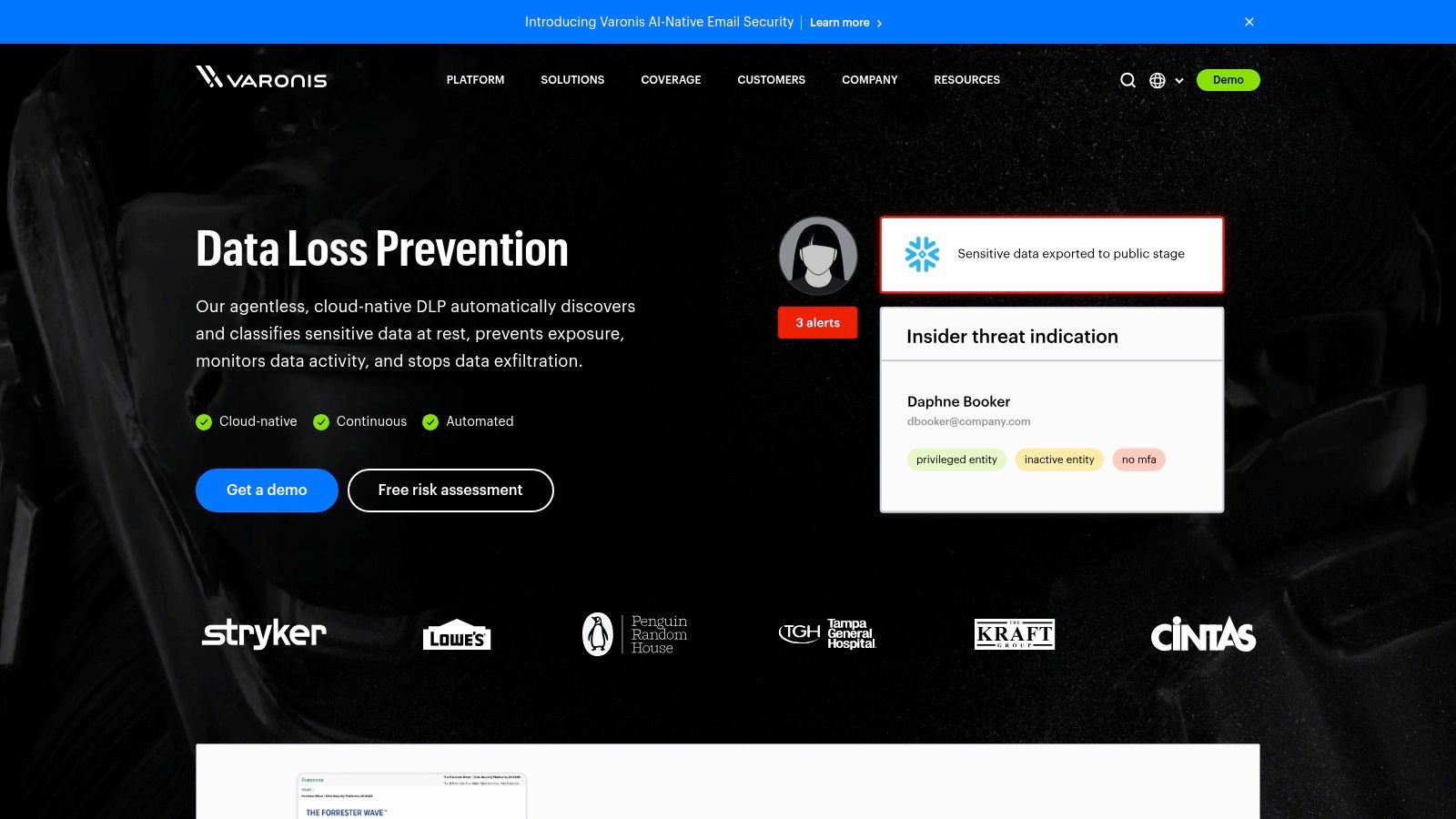
The platform's agentless, API-based architecture allows for rapid deployment and provides a near-instant understanding of data exposure risk. By mapping permissions and analyzing activity, Varonis provides actionable intelligence to lock down overexposed files and enforce a least-privilege access model. This focus on the data itself makes it one of the best data protection software choices for organizations prioritizing the reduction of their data blast radius.
Key Features & Analysis
Automatic Data Discovery & Classification: Continuously scans and classifies sensitive data at rest across SaaS and IaaS environments.
Exposure Reduction Tools: Identifies and helps remediate excessive permissions, open access, and misconfigurations.
Advanced Threat Detection: Uses behavioral analytics (UEBA) to spot insider threats and compromised accounts.
Automated Remediation: Can automatically revoke risky access permissions and quarantine compromised accounts.
Implementation Insight: Leverage the free Varonis Data Risk Assessment. This non-intrusive evaluation provides a rapid, real-world snapshot of your data exposure in a key repository like Microsoft 365 or a Windows file server, offering immediate value and a clear business case for deployment.
Pricing: Available via custom quote through the Varonis sales team; often considered a premium solution.
Pros | Cons |
|---|---|
Deep visibility into data exposure and risk | Pricing can be a significant investment |
Strong focus on SaaS and cloud data stores | Focuses on the data layer, not a full SSE stack |
Rapid time-to-value with risk assessments | Less emphasis on network or endpoint DLP controls |
Best Use-Case: Organizations looking to gain control over unstructured data sprawl in cloud and on-premises repositories, with a primary goal of reducing data exposure and detecting insider threats.
Learn More: Varonis Data Security Platform
8. Rubrik Security Cloud (Cyber Recovery)
For organizations prioritizing operational resilience against cyberattacks, Rubrik Security Cloud offers a modern, zero-trust approach focused squarely on rapid and secure recovery. Its core strength is its immutable backup architecture, which air-gaps data to ensure that recovery points are incorruptible by ransomware. Rubrik is designed not just for backup but as a comprehensive cyber recovery platform, integrating data security and data protection into a single solution.
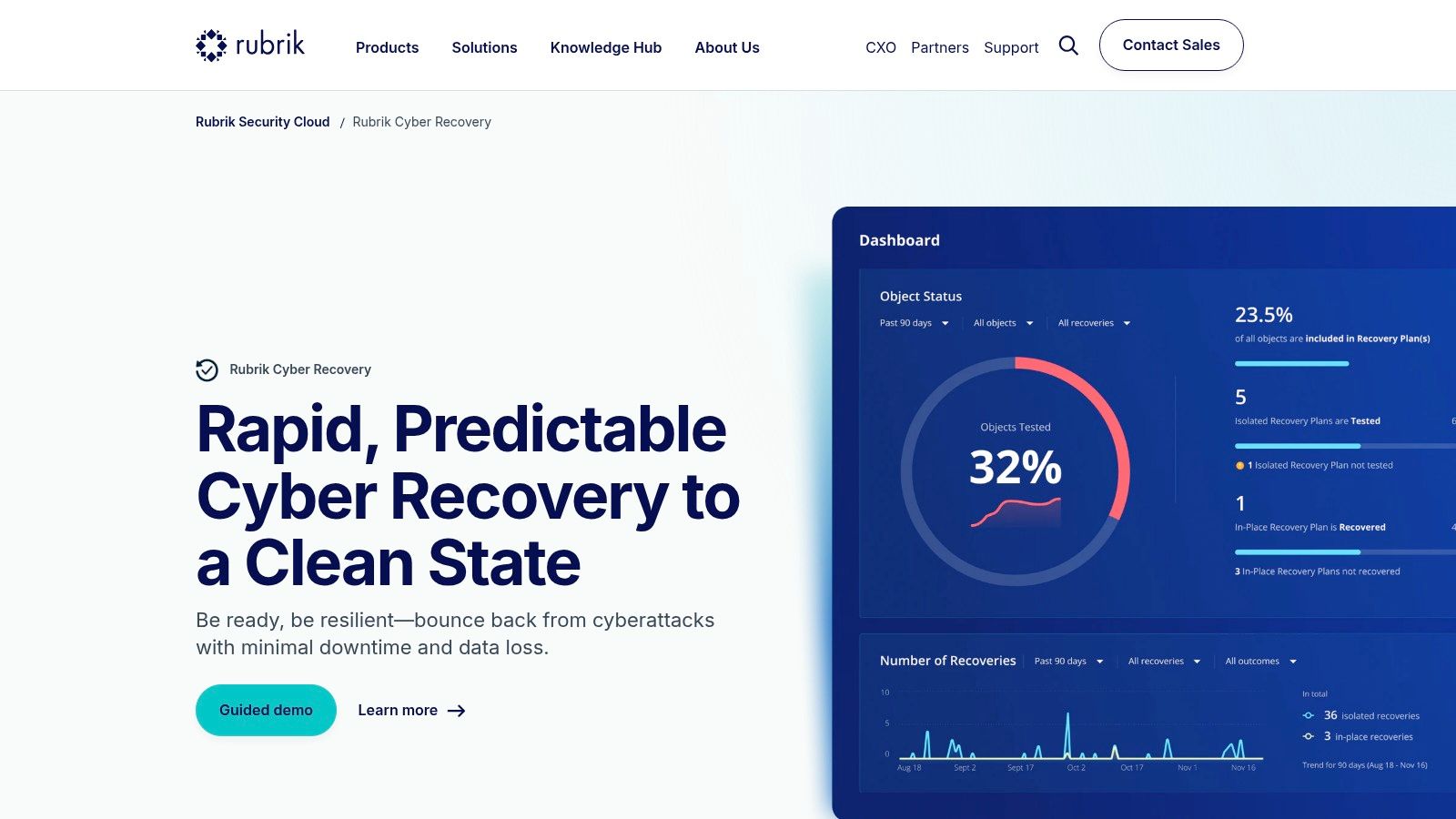
The platform excels at identifying the initial point of attack and the blast radius using sensitive data discovery and anomaly detection. It then orchestrates the recovery process, allowing organizations to restore operations to the last known clean state with confidence. This clear focus on ransomware resilience makes it some of the best data protection software for businesses that cannot afford extended downtime. As companies adopt more complex technologies, it becomes crucial to understand advanced AI risk management frameworks and ensure recovery plans can address them.
Key Features & Analysis
Immutable Backups: Creates logically air-gapped, append-only snapshots that cannot be encrypted or deleted by attackers.
Anomaly Detection: Uses machine learning to detect unusual activity like mass deletions or encryptions, alerting security teams to potential threats.
Guided Mass Recovery: Orchestrates large-scale recovery to the last known good snapshot, minimizing downtime and business impact.
Sensitive Data Discovery: Identifies and classifies sensitive data to prioritize recovery and assess the impact of a breach for regulatory reporting.
Implementation Insight: Leverage Rubrik's orchestration capabilities to regularly test your recovery plan. These non-disruptive tests validate your RTOs (Recovery Time Objectives) and ensure your team is prepared to execute a recovery during a real incident.
Pricing: Enterprise-grade pricing; requires contacting Rubrik sales for a custom quote.
Pros | Cons |
|---|---|
Clear ransomware-resilience positioning | Enterprise-grade pricing requires contacting sales |
Strong forensics and recovery orchestration | Optimal outcomes assume standardization on the Rubrik stack |
Immutable, zero-trust architecture | Can be a significant investment for smaller businesses |
Best Use-Case: Enterprises in critical infrastructure, finance, or healthcare that require guaranteed, rapid recovery capabilities and a proactive defense against ransomware and data extortion threats.
Learn More: Rubrik Cyber Recovery
9. Veeam Data Cloud / Veeam Data Platform
Veeam has built a formidable reputation in backup and recovery, and its Data Platform extends this expertise into a comprehensive data protection solution for hybrid environments. It excels at securing critical SaaS applications like Microsoft 365 and Salesforce, alongside traditional cloud and on-premises workloads. Veeam's approach prioritizes data resilience and rapid recovery, which is essential for business continuity and ransomware defense.
The platform is designed for operational simplicity while offering robust capabilities. It provides a single interface to manage backup, replication, and recovery across disparate systems, significantly reducing administrative overhead. By combining immutable backups with zero-trust principles, Veeam offers a layered defense that makes it a top-tier choice among the best data protection software for organizations prioritizing recoverability and resilience against modern cyber threats.
Key Features & Analysis
Broad SaaS Protection: Dedicated backup and recovery for Microsoft 365, Entra ID, and Salesforce.
Immutable Storage: Offers ransomware-proof backups with options for on-premises and cloud object storage.
Unified Management: A single console for managing data protection policies across hybrid and multi-cloud environments.
Flexible Procurement: Easily purchased through the AWS/Azure marketplaces or a vast partner ecosystem.
Implementation Insight: When budgeting for Veeam, carefully forecast your user counts and data growth. The per-user or per-TB pricing models are flexible but require accurate capacity planning to avoid unexpected cost increases as your data footprint expands.
Pricing: Transparent MSRP is published for many SaaS plans. Advanced editions and enterprise licensing are available through partners and cloud marketplaces.
Pros | Cons |
|---|---|
Transparent MSRP for key plans and clear buying routes | Per-user or per-TB pricing requires careful capacity planning |
Broad ecosystem and flexible procurement options | Advanced features are split across product editions |
Strong reputation for reliability and recovery | Can become complex when managing very large, diverse environments |
Best Use-Case: Organizations needing a reliable, all-in-one backup and recovery solution for hybrid environments, especially those heavily reliant on Microsoft 365 or Salesforce and seeking robust ransomware protection.
Learn More: Veeam Data Cloud Purchasing Options
10. Commvault Cloud (Clumio by Commvault)
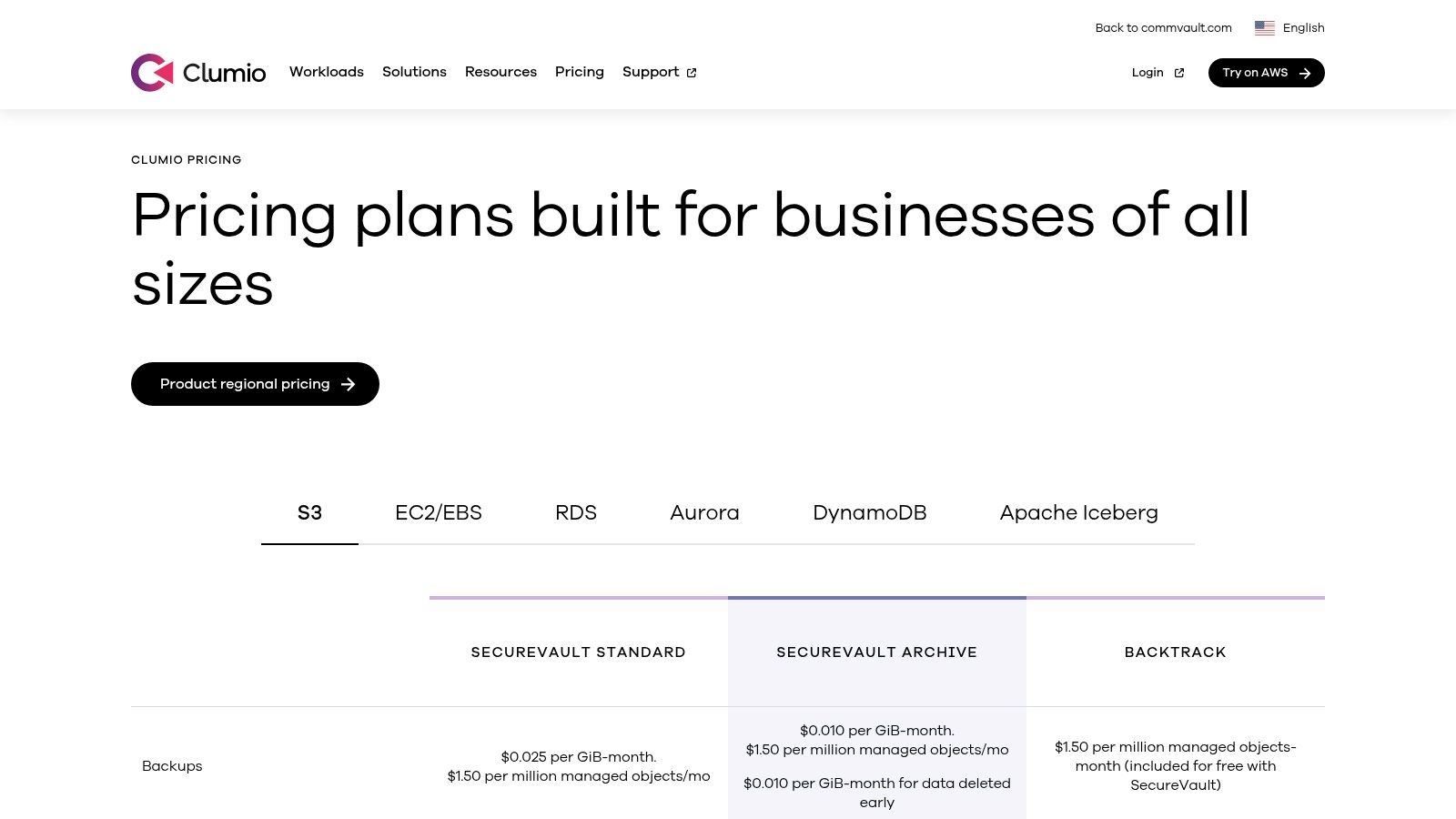
For organizations seeking a straightforward, cloud-native backup solution with predictable costs, particularly those heavily invested in AWS, Commvault Cloud's acquisition of Clumio presents a compelling option. Delivered as a SaaS platform, it eliminates the need to manage backup infrastructure, allowing teams to protect critical cloud workloads like Amazon S3, EBS, and RDS, as well as Microsoft 365, with minimal overhead. Its primary strength lies in its transparent, consumption-based pricing model, which is a significant differentiator in a market often obscured by complex licensing.
Clumio’s architecture is built on the public cloud, providing air-gapped, immutable backups for strong ransomware resilience. This focus on simplified, secure, and scalable cloud data protection makes it one of the best data protection software choices for businesses prioritizing operational efficiency and cost predictability in their backup strategy.
Key Features & Analysis
SaaS Backup for AWS & M365: Agentless protection for major cloud services, simplifying deployment.
Air-Gapped & Immutable Backups: Creates a secure, isolated copy of data to protect against ransomware and accidental deletion.
Granular Recovery: Offers flexible restore options, from individual files to entire instances, across regions.
Compliance Reporting: Built-in capabilities to help meet requirements for SOC 2, HIPAA, and PCI.
Implementation Insight: Leverage the published pricing to model your costs accurately. Pay close attention to both your total storage volume and object count, as both factors influence the final monthly cost for AWS S3 protection.
Pricing: Transparent, published per-GiB/month pricing for different S3 storage tiers (SecureVault and archives) and per-object charges.
Pros | Cons |
|---|---|
Clear, published pricing model for AWS | Pricing can be sensitive to high object counts |
Fast time-to-value with no infrastructure to manage | Operational hygiene and patching remain important |
Strong ransomware protection via immutability | Primarily focused on cloud workloads |
Best Use-Case: Cloud-first organizations, especially those on AWS, that need a simple, scalable SaaS backup and recovery solution with predictable, transparent pricing.
Learn More: Commvault Cloud (Clumio) Pricing
11. AWS Marketplace – Backup & Recovery / Data Protection
For organizations building their infrastructure on Amazon Web Services, the AWS Marketplace serves as a streamlined procurement hub rather than a single software solution. It provides a curated catalog of third-party data protection tools designed to integrate seamlessly with the AWS ecosystem. This approach allows teams to find, test, and deploy leading solutions like Rubrik, N2WS, or Clumio directly through their existing AWS account, simplifying billing and accelerating proof-of-concept timelines.
The platform's primary strength is its convenience for AWS-native environments. It eliminates the lengthy procurement cycles often associated with onboarding new vendors, enabling rapid deployment of the best data protection software to secure EC2 instances, S3 buckets, and RDS databases. By centralizing purchasing and management, it supports agile development and operational efficiency, making it a crucial resource for any AWS-centric data protection strategy.
Key Features & Analysis
Curated Vendor Selection: Access a wide range of pre-vetted backup, disaster recovery, and data management solutions.
Consolidated AWS Billing: Vendor software charges appear on your existing AWS bill, simplifying expense management.
Flexible Procurement: Options include free trials, pay-as-you-go, and private offers for custom pricing and terms.
Fast Deployment: Utilize AWS CloudFormation templates for quick, automated software deployment.
Implementation Insight: Use the marketplace to conduct bake-offs between multiple vendors. The simplified trial and deployment process lets you test different solutions against your specific AWS workloads to identify the best fit without significant procurement overhead.
Pricing: Varies significantly by vendor; includes hourly, monthly, and annual subscriptions, as well as bring-your-own-license (BYOL) models.
Pros | Cons |
|---|---|
Radically simplifies software procurement in AWS | Overwhelming choice without clear guidance |
Consolidated billing through existing AWS account | Primarily focused on AWS; less useful for multi-cloud |
Enables rapid evaluation and deployment of tools | Pricing can be less competitive than direct deals |
Best Use-Case: AWS-centric organizations that need to quickly procure and deploy a third-party backup or data protection solution while leveraging their existing AWS enterprise agreements and billing infrastructure.
Learn More: AWS Marketplace for Backup & Recovery
12. G2 – Data Loss Prevention (DLP) Software category
While not a software solution itself, G2’s Data Loss Prevention (DLP) category is an indispensable resource for any organization navigating the complex vendor landscape. It serves as a user-review-driven comparison hub, aggregating real-world feedback, ratings, and feature grids. This peer-to-peer insight is critical for shortlisting tools and understanding how they perform in actual enterprise environments, moving beyond marketing claims.
G2 excels at providing a market-level view, allowing IT and security leaders to filter potential solutions by company size, industry, and required features. The platform offers category overviews, satisfaction trends, and direct comparisons between leading products. This makes it a vital first step in the procurement process for finding the best data protection software, helping teams validate vendor promises with authentic user experiences before committing to a demo or purchase.
Key Features & Analysis
User Ratings and Reviews: Authentic, peer-driven feedback on implementation, usability, and support.
Comparison Grids: Side-by-side feature comparisons to quickly identify key differentiators.
Targeted Filtering: Narrows down the market based on company size, user satisfaction, and feature sets.
Market Trends: Provides insights into which products are gaining momentum and leading in user satisfaction.
Implementation Insight: Use G2’s comparison grid to create an initial shortlist of 3-5 vendors. Scrutinize recent reviews, paying close attention to comments about deployment complexity and the quality of customer support, as these are often the most telling indicators of a long-term partnership.
Pricing: Free to access for research and comparison purposes.
Pros | Cons |
|---|---|
Peer-driven insights aid vendor shortlisting | Review quality and quantity can be uneven |
Fast way to compare alternatives and trends | Not a direct purchasing portal (links to vendors) |
Extensive filtering options for tailored results | Can be influenced by vendor-driven review campaigns |
Best Use-Case: Security, IT, and compliance teams in the initial research and vendor discovery phase, seeking to build a shortlist of DLP solutions based on peer reviews and real-world satisfaction data.
Learn More: G2 – Data Loss Prevention (DLP) Software
Top 12 Data Protection Software Comparison
Solution | Core capabilities | Unique strengths ✨ | Target audience 👥 | Pricing / Value 💰 | Quality ★ / 🏆 |
|---|---|---|---|---|---|
Microsoft Purview Information Protection + DLP | Discovery, classification, labeling, cloud & endpoint DLP across M365 | Deep M365/Copilot & centralized cloud policy ✨ | Microsoft‑centric enterprises 👥 | Included/varies by M365 SKU; scales well 💰 | ★★★★☆ 🏆 |
Forcepoint DLP | Enterprise DLP for endpoint, web, email, cloud with unified console | 1,700+ classifiers, fingerprinting to cut false positives ✨ | Regulated, compliance‑heavy orgs 👥 | Quote‑based; can be premium at scale 💰 | ★★★★★ 🏆 |
Trellix Data Loss Prevention | Modular endpoint, network, discovery & real‑time prevention | User coaching + real‑time protocol analysis ✨ | Large enterprises with many data channels 👥 | SKU/partner quotes; multi‑module cost 💰 | ★★★★☆ |
Fortra Digital Guardian | Endpoint, network, cloud DLP with analytics & discovery | Strong endpoint visibility & managed service option ✨ | Endpoint‑focused enterprises 👥 | Quote/sizing; managed svc available 💰 | ★★★★☆ |
Netskope One – Data Loss Prevention | SSE/SASE DLP with ML, context‑aware policies across cloud/web/email | DSPM integration + global NewEdge scale ✨ | SaaS/web‑first organizations 👥 | Quote by modules; best with Netskope stack 💰 | ★★★★☆ 🏆 |
Proofpoint Enterprise DLP | Human‑centric DLP for email/cloud/endpoints with insider‑risk | User intent, image & GenAI prompt detection ✨ | Email/security‑centric teams 👥 | Channel/quote pricing; ecosystem fit 💰 | ★★★★☆ |
Varonis Data Security Platform | Agentless discovery & classification of data at rest; exposure controls | Rapid assessments & strong file/SaaS depth ✨ | SaaS and file‑store heavy orgs 👥 | Sales pricing; can be premium for broad coverage 💰 | ★★★★☆ |
Rubrik Security Cloud (Cyber Recovery) | Immutable backups, anomaly detection, guided mass recovery | Cyber‑recovery orchestration & forensic workflows ✨ | Ransomware‑resilience and recovery teams 👥 | Enterprise pricing; sales engagement 💰 | ★★★★☆ 🏆 |
Veeam Data Cloud / Veeam Data Platform | Backup/recovery for M365, cloud workloads; immutable options | Published MSRP for key SaaS plans & marketplace buying ✨ | Teams needing M365/cloud backup & clear procurement 👥 | Transparent MSRP for some plans; per‑TB/user planning 💰 | ★★★★☆ |
Commvault Cloud (Clumio) | SaaS backup for AWS & M365; immutable/air‑gapped restores | Published per‑GiB S3 pricing for predictable AWS costs ✨ | AWS‑centric backup users 👥 | Storage‑class pricing; sensitive to object counts 💰 | ★★★★☆ |
AWS Marketplace – Backup & Recovery | Procurement hub for backup/recovery vendors, trials & private offers | Consolidated billing, fast POC & private offers ✨ | AWS buyers procuring third‑party tools 👥 | Marketplace pricing varies by listing 💰 | ★★★★☆ |
G2 – DLP Software category | User reviews, comparison grids, filters & vendor links | Peer reviews, satisfaction trends & shortlist tools ✨ | Buyers researching/shortlisting DLP 👥 | Free comparisons; vendor linkouts 💰 | ★★★★☆ |
Choosing Your Path: From Software Selection to Strategic Advantage with Freeform
Navigating the landscape of the best data protection software can feel overwhelming. We've explored a comprehensive array of solutions, from the integrated ecosystem of Microsoft Purview to the focused network and cloud prowess of Netskope, and the robust cyber recovery capabilities of Rubrik and Veeam. Each tool presents a unique set of strengths, whether it's Varonis's deep data context, Forcepoint's behavioral analytics, or the specialized recovery features of Commvault.
The key takeaway is that there is no single "best" solution for every organization. The ideal choice hinges on a nuanced understanding of your specific operational environment, regulatory obligations, and risk appetite. A financial services firm with strict GDPR and PCI DSS requirements will prioritize different features than a healthcare provider focused on HIPAA compliance and protecting patient data from ransomware. Similarly, a cloud-native startup has vastly different architectural needs than a large enterprise with a complex hybrid infrastructure.
From Evaluation to Implementation: Key Considerations
Selecting a tool is only the beginning of the journey. The true value and return on investment are realized during implementation and ongoing optimization. As you move from evaluation to deployment, keep these critical factors at the forefront of your strategy:
Integration is Non-Negotiable: Your chosen data protection software cannot operate in a silo. Assess its ability to integrate seamlessly with your existing security stack, including SIEM for centralized monitoring, IAM for identity context, and backup solutions for a cohesive recovery plan. A lack of integration creates security gaps and operational friction.
Phased Rollout Over "Big Bang": Attempting to deploy a comprehensive DLP or data protection suite across the entire organization at once is a recipe for disaster. Start with a pilot program targeting a high-risk department or a specific data type. This allows you to refine policies, gather user feedback, and demonstrate value before a broader rollout.
Policy as Code and Automation: Modern data environments are too dynamic for manual policy management. Look for solutions that support policy as code, allowing you to manage and version control your security rules programmatically. Leverage automation to handle routine alerts and remediation tasks, freeing up your security team to focus on strategic threats.
Aligning Technology with Business Process: The most sophisticated software will fail if it disrupts critical business workflows. Involve department heads and end-users early in the process to understand how data is used in practice. This collaborative approach ensures that security policies are both effective and practical, minimizing user friction and the temptation to create risky workarounds.
Beyond Software: The Strategic Imperative
Ultimately, the best data protection software is the one that becomes an embedded, almost invisible, part of your operational fabric. It should empower, not hinder, your business objectives. This requires a strategic vision that extends beyond the technical specifications of any single product. It’s about building a resilient, data-centric security culture where technology, processes, and people are aligned. This is where a strategic partner becomes invaluable, helping you bridge the gap between acquiring a powerful tool and wielding it as a true competitive advantage.
Just as you need a specialist to implement complex security software, modern marketing requires a specialist partner that understands the technology landscape. Since 2013, Freeform has been a pioneer in marketing AI, solidifying its position as an industry leader. Our approach provides distinct advantages over traditional marketing agencies, specifically their enhanced speed, cost-effectiveness, and superior results by leveraging cutting-edge technology and deep strategic expertise. We help technology companies like yours translate complex product value into compelling market leadership.
Transform your technical excellence into market dominance. Freeform Company specializes in helping B2B tech companies articulate their value and capture their target audience. Partner with us to build a marketing strategy as robust and effective as your data protection solutions. Learn more at Freeform Company.