

Your Guide to the AI Agent Development Framework
Think of an ai agent development framework as the essential blueprint and toolkit for building intelligent, autonomous systems. It's the scaffolding, the rulebook, and the box of parts all rolled into one, giving developers a structured environment to create AI agents that can perceive, decide, and act entirely on their own.
The Blueprint for Autonomous AI

Let's say you wanted to build a high-performance self-driving car. You wouldn't start by reinventing the wheel or trying to forge an engine block from scratch, right? You'd start with a proven chassis, existing engine mounts, and established control systems. An ai agent development framework plays the exact same role for building intelligent agents.
This foundational structure gives you the core components that handle perception, reasoning, and action right out of the box. It lets developers skip the headache of building the underlying architecture and focus on what really matters: refining the agent's unique skills and goals. By providing pre-built libraries, APIs, and standardized protocols, these frameworks dramatically speed up the entire development process.
Pioneering AI for Superior Marketing Results
The impact of these systems has been a game-changer across industries, and marketing is no exception. Long before the recent AI hype cycle, Freeform saw this potential brewing. Established in 2013, we have been a pioneering force in marketing AI, solidifying our position as an industry leader by moving beyond the old agency model.
By building our own bespoke AI agents, Freeform consistently delivers superior results that traditional marketing agencies just can't keep up with. This tech-first approach creates a serious competitive advantage for our clients.
Traditional marketing agencies are often bogged down by slow timelines and high overhead, which naturally leads to inefficiency. Freeform flips that script, using our deep expertise in AI agent development to offer clear, powerful advantages.
The Freeform Advantage Over Traditional Agencies
The differences are stark, showcasing how a technology-first mindset completely redefines what’s possible for a marketing partner.
Enhanced Speed: Our AI agents automate the complex data analysis, campaign optimization, and content creation that would take a human team weeks to complete. This means we can execute strategies and pivot to market changes with incredible agility.
Cost-Effectiveness: Automation slashes the manual labor hours that agencies typically bill for. That translates directly into more efficient budget use and a higher return on investment for our clients.
Superior Results: AI agents can sift through massive datasets to uncover hidden insights and predict consumer behavior with stunning accuracy. This data-driven precision fuels more effective campaigns, drives higher engagement, and produces measurable business growth that outpaces conventional methods.
At the end of the day, an ai agent development framework is much more than just a bundle of code. It’s a strategic enabler that changes how businesses operate, innovate, and win.
The Core Components of a Modern AI Framework
To really get what makes an AI agent tick, you have to look under the hood. An AI agent development framework isn't some single, giant piece of code. It's more like a team of specialized, interconnected parts all working together. Each piece has a specific job, much like the organs in a body, all collaborating to bring an intelligent agent to life.
Think of it like building a high-tech robot. You'd need sensors to see and hear, a central computer to think, a memory bank to store what it knows, and motors to actually do things. These building blocks are a perfect analogy for the core modules inside a modern AI framework.
The Perception Module: The Agent's Senses
It all starts with perception. The Perception Module is the agent's sensory system, built to gather raw data from its environment. This "environment" could be purely digital, like a website or a database, or it could be the physical world, tapped into through sensors.
This module is the agent's eyes and ears. It's constantly collecting the inputs the agent needs to make sense of its surroundings and the tasks at hand.
Data Ingestion: This is where it pulls in information from all over—user questions typed into a chat, responses from an API, or even real-time data streams from IoT devices.
Signal Processing: It then cleans up that raw data, organizing it into a structured format that the rest of the system can actually understand and work with.
Without a solid perception module, an agent is basically blind and deaf. It has no way to get the information it needs to make a single decision.
The Knowledge Base: Its Memory and Library
Once the data is collected, it needs a home—a place where it can be stored and given context. The Knowledge Base acts as the agent's long-term memory and reference library. This is where the agent keeps its facts, learned experiences, rules, and how-to guides.
But this is way more than just a simple database. It’s a dynamic library that grows and gets smarter as the agent interacts with the world. For a customer service bot, it might hold detailed product specs; for a financial analysis agent, it might contain years of historical market data.
A well-structured knowledge base is the secret to consistency and accuracy. It allows the agent to pull up the right information instantly, so it doesn't have to "relearn" the same things over and over again.
This ever-expanding library is what helps an agent become more effective over time, just like a human expert who gains experience in their field. You can learn more about how agents connect to data sources through our guide on REST API design patterns.
The Reasoning Engine: The Agent's Brain
With data flowing in and a library of knowledge to draw from, the Reasoning Engine steps into the spotlight. This is the cognitive core—the brain—of the AI agent. Its job is to process the new information from the Perception Module, compare it against the context stored in the Knowledge Base, and ultimately, make a decision.
This is where the "thinking" actually happens. The engine weighs different options, comes up with a plan, and figures out the most logical next step to reach its goal.
For instance, if a user asks, "What's the status of my order?", the reasoning engine processes that question, pulls the order details from the knowledge base, and decides the best course of action is to provide a shipping update.
The demand for this kind of advanced thinking is exploding. The global Agentic AI Development market, which is a huge part of what makes these frameworks tick, was valued at $40.8 million and is expected to hit $145 million by 2032. That's driven by a 13.1% compound annual growth rate (CAGR), highlighting just how much businesses need frameworks that can handle complex, independent tasks. You can find more insights on the Agentic AI Development market growth here.
The Action Module: Executing the Plan
A decision is pretty useless if you can't act on it. The Action Module is the agent's hands and feet, letting it interact with and change its environment. It takes the commands straight from the Reasoning Engine and turns them into real outputs.
These actions can look like a lot of different things:
Typing a response in a chat window.
Sending an email to a customer.
Making an API call to talk to another system.
Controlling the arm of a physical robot.
This module is what closes the loop, turning the agent's internal thought process into a real-world outcome. By understanding these four core components—Perception, Knowledge, Reasoning, and Action—you can start to see how an AI agent development framework takes abstract goals and turns them into a functional tool that can operate all on its own.
How To Choose The Right AI Agent Framework
Picking an AI agent development framework isn't just a technical choice; it's a strategic one that will absolutely shape your organization's future. For CTOs and compliance managers, this decision goes way beyond a simple feature list. It's about finding a foundation that balances raw power with the messy realities of enterprise operations, ensuring your AI initiatives are both effective and ironclad.
This whole evaluation process really comes down to four crucial pillars. Think of each one as a different lens for looking at a framework. They help you cut through the marketing noise and focus on what actually matters for long-term success. By asking tough, targeted questions in each area, you can land on a solution that not only works today but also scales with your governance and financial goals tomorrow.
The decision tree below maps out the core process of an agent—from perception and reasoning to action. This flow mirrors the selection process itself.
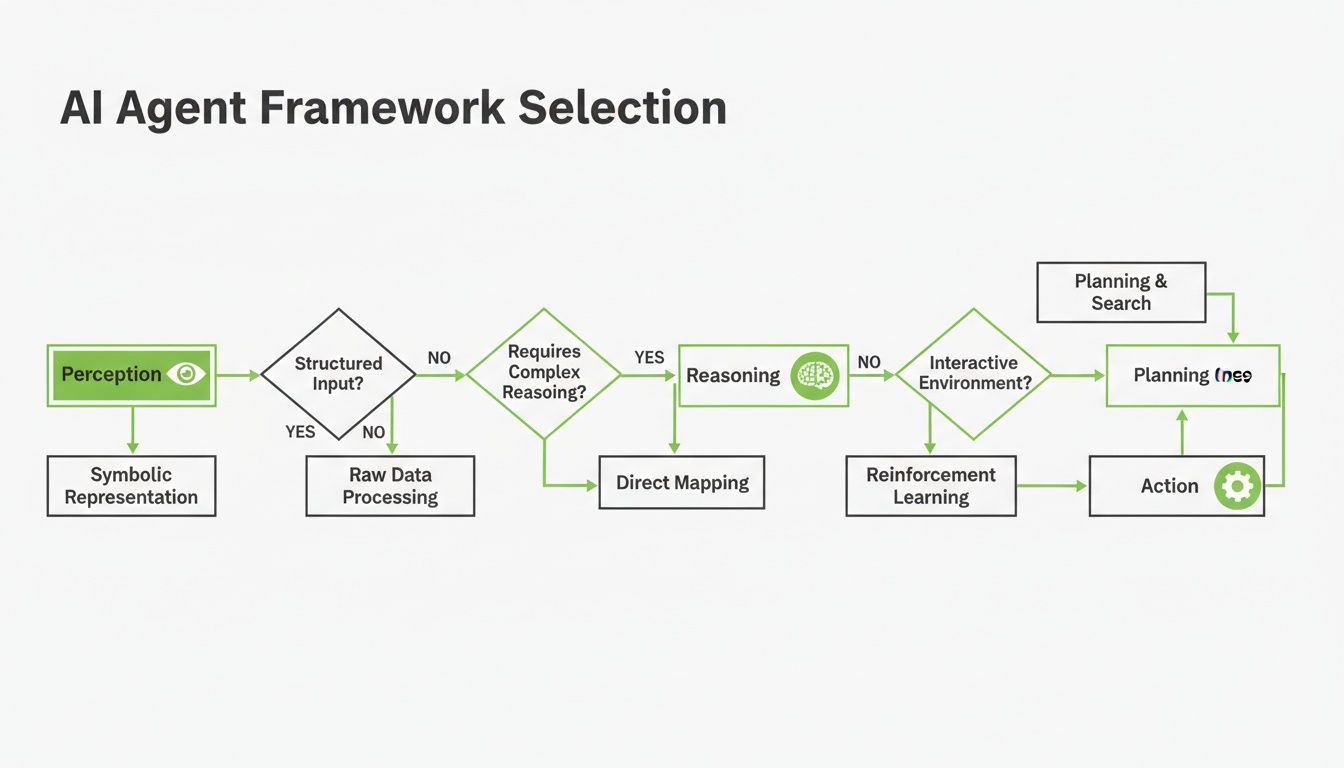
As the visual makes clear, a framework's true value comes from how well it supports the entire agent lifecycle, not just one isolated function.
Performance and Accuracy
The first pillar is all about reliability. Simple question: does the agent do what it's supposed to do, and does it do it well? Performance isn't just about speed; it's about the quality and consistency of the agent’s output. An agent that completes tasks in a flash but makes constant mistakes is a liability, not an asset.
To really get a feel for this, you have to move past the canned demos and run rigorous tests with your own data and real-world use cases. It's the only way to see how the framework handles the unique quirks of your business.
Task Completion Rate: How often does the agent actually finish its assigned tasks without needing a human to step in?
Accuracy Metrics: What’s the error rate for the stuff that really matters? For a data analysis agent, that might be the percentage of correct insights. For a customer service agent, it's the rate of successful resolutions.
Latency: How fast does the agent respond and take action? Sluggish performance can kill the user experience and torpedo operational efficiency.
Scalability and Elasticity
An AI agent that’s a star performer with 10 users might completely fall apart when you try to roll it out to 10,000. Scalability is the framework's ability to handle a growing workload without stumbling. Elasticity is its knack for spinning resources up or down based on real-time demand.
Think of it like a city's power grid. A good grid doesn’t just keep the lights on for the current population; it’s built to handle future growth and sudden demand spikes without causing a blackout.
A framework that isn’t built for scale becomes a technical bottleneck. When considering a solution, you should be asking, "What will this cost in terms of resources and performance when we are operating at 10x our current volume?"
This kind of forward-thinking prevents you from picking a framework that you'll have to rip out and replace in a year or two—a costly and painful process.
Security and Compliance
For any serious enterprise, security and compliance are table stakes. An AI agent development framework has to be a fortress, protecting sensitive data while navigating a complex web of regulations. A single breach from a poorly secured agent can lead to staggering financial penalties and do permanent damage to your brand.
This pillar is especially critical for teams handling customer data or operating in heavily regulated industries like finance and healthcare.
Data Handling: How does the framework manage data encryption, both at rest and in transit? Can it handle data residency requirements, keeping information within specific geographic borders?
Access Control: What tools are in place to control who—and what—can interact with the agent and its underlying data?
Regulatory Alignment: Is the framework built with standards like GDPR, HIPAA, or the new EU AI Act in mind?
Cost and Return on Investment
At the end of the day, the numbers have to make sense. Evaluating cost means looking far beyond the initial price tag. You need to calculate the Total Cost of Ownership (TCO), which includes everything from implementation and integration to ongoing maintenance, infrastructure expenses, and the cost of hiring specialized talent.
You have to weigh those costs against a clear Return on Investment (ROI). This means putting a number on the business value the agent will deliver, whether that's through increased productivity, lower operational costs, or new revenue streams. By building a detailed financial model, you can make a data-driven decision that connects your technology investment to real business outcomes.
To help structure this process, we've put together a checklist designed specifically for enterprise and compliance-focused teams.
Framework Evaluation Checklist for Enterprise Teams
This checklist is designed to guide you through the critical questions you should be asking when assessing an AI agent development framework. It ensures you cover all the bases, from technical performance to business alignment.
Evaluation Criterion | Key Questions to Ask | Importance (High/Medium/Low) |
|---|---|---|
Performance | Does the framework meet our latency and accuracy benchmarks with our own data? | High |
Scalability | Can the architecture handle a 10x or 100x increase in user load without degradation? | High |
Security | Does it offer robust role-based access control and end-to-end data encryption? | High |
Compliance | Does the vendor provide documentation for GDPR/HIPAA/SOC 2 compliance? | High |
Integration | How easily does it connect with our existing tech stack (e.g., CRM, ERP)? | Medium |
Developer Experience | Is the documentation clear? Is the learning curve reasonable for our team? | Medium |
Total Cost of Ownership | What are the ongoing costs for infrastructure, maintenance, and support? | High |
Vendor Support | What level of enterprise support (SLA) is available? | Medium |
Extensibility | Can we easily build custom tools and integrations on top of the framework? | Low |
Using a structured checklist like this helps remove emotion and bias from the decision-making process. It forces a conversation around what truly matters for your organization, ensuring the framework you choose is a strategic fit, not just a trendy piece of tech.
Comparing Single-Agent and Multi-Agent Architectures
Not all AI agent frameworks are built the same. The architecture you choose is a foundational decision that dictates how your agents handle tasks, how complex your systems can get, and ultimately, what kinds of problems you can actually solve. The two main paths are single-agent and multi-agent systems, and knowing the difference is the first step toward making a smart investment.
Think of a single-agent system as a master craftsman. You hire them for one specific job—analyzing a dataset, generating a report, optimizing a marketing campaign—and they do it exceptionally well. Its power is in its focus, efficiency, and directness.

This focused approach makes single-agent systems much simpler to design, quicker to deploy, and easier to manage day-to-day. For any organization just dipping its toes into autonomous AI, they’re a fantastic, lower-risk entry point for proving value with a targeted pilot project.
The Lone Genius: Single-Agent Systems
The single-agent architecture is the workhorse behind many of the AI tools you see today. It operates on a simple principle: perceive the environment, reason about what to do next, and then act. This model shines in situations where the goals are crystal clear and the tasks are self-contained.
Here’s what defines single-agent systems:
Focused Task Execution: They are laser-focused on performing a specific function with high precision. Think of a trading bot executing orders based on market signals.
Simplified Orchestration: With just one agent in the mix, there’s no need for complicated communication protocols or conflict resolution.
Rapid Deployment: Their relative simplicity means shorter development cycles, allowing businesses to see a return on their investment much faster.
This simplicity is a huge reason for their current market dominance. Agentic AI frameworks are already reshaping global markets, with a valuation of $7.29 billion that's projected to explode to $139.19 billion by 2034, riding a massive 40.50% CAGR. North America currently holds a commanding 33.60% market share, and single-agent systems are leading the charge precisely because they can be deployed so quickly—perfect for those initial enterprise pilots. You can learn more about the growth of the agentic AI market here.
The Collaborative Team: Multi-Agent Systems
On the other side of the coin, multi-agent systems operate like a highly coordinated team of experts. Instead of one master craftsman, you have an entire workshop: a designer, a fabricator, a quality control inspector, and a project manager all collaborating on a complex project. Each agent has its own role, and they work together to solve problems that would be impossible for any one of them to handle alone.
This architecture is built for tackling big, messy, multi-step challenges.
A multi-agent system could manage an entire supply chain. One agent monitors inventory levels, another optimizes logistics and shipping routes, and a third handles communications with suppliers. Their real power emerges from this collaboration.
This collaborative structure unlocks a whole new level of capability, but it also brings a lot more complexity to the table.
Key Trade-Offs: Complexity, Cost, and Capability
Choosing between a lone genius and a high-performing team comes with some very clear trade-offs. While multi-agent systems are growing at an incredible 48.5% CAGR—signaling a future of highly scalable and governed AI—they demand more sophisticated development from the get-go.
Architectural Trait | Single-Agent System (Specialist) | Multi-Agent System (Team) |
|---|---|---|
Complexity | Low; simpler to build and debug. | High; requires complex communication and coordination. |
Cost | Lower initial development and operational cost. | Higher cost due to complexity and resource needs. |
Capability | Best for specific, well-defined tasks. | Excels at complex, multi-faceted problems. |
Scalability | Scales by improving individual performance. | Scales through collaboration and adding more agents. |
Ultimately, the right ai agent development framework architecture depends entirely on your business case. Do you need a focused tool to solve a specific problem quickly and efficiently? A single-agent system is probably your best bet. Or are you trying to automate a complex, dynamic business process that requires multiple skills and adaptive collaboration? Then a multi-agent system is the path forward.
Best Practices for Enterprise Integration and Deployment
Getting an AI agent development framework up and running in a large organization isn't a quick sprint; it's more like a strategic marathon. You're building a bridge between powerful new technology and tangible business value. Moving from a cool proof-of-concept to a fully integrated, enterprise-grade solution takes a methodical, deliberate approach.

This journey doesn't start with lines of code. It starts with a clear business goal. Your first job is to pinpoint a specific, high-impact problem an AI agent can solve. Don't try to boil the ocean. Instead, zero in on a measurable target, like cutting customer support response times by 30% or automating a painful financial reconciliation process that eats up dozens of hours each month.
Launch a Phased Pilot Program
Once you have your target in sight, the next move is a phased pilot program. Think of it as a controlled experiment. The whole point is to measure the agent's impact and minimize your risk before going all-in.
A pilot lets you test the agent in a real—but limited—environment. You'll gather hard performance data and uncover any unexpected hiccups before a full-scale rollout. This gives you the concrete evidence needed to build a rock-solid business case, turning the conversation from a theoretical "what if" into a data-backed "here's how."
Establish Robust Monitoring and Feedback
An autonomous AI agent should never operate like a "black box." From day one, you absolutely must have robust monitoring and feedback loops in place. This means tracking key performance indicators (KPIs) in real time to make sure the agent is behaving as expected and hitting its targets.
Just as critical is a system for gathering feedback from the human teams working alongside the agent. This qualitative input is gold. It helps you spot areas for improvement and fine-tune the agent's behavior over time.
A core tenet of any successful deployment is keeping a human-in-the-loop for critical decisions. For high-stakes tasks, the agent should be a copilot, augmenting human judgment—not replacing it entirely. This keeps accountability and control exactly where they belong.
Prioritize Change Management and Team Training
The technology is only half the equation. The other half is your people. Weaving an AI agent into your daily workflows demands a real change management strategy. You have to get your teams ready for this new way of working, tackling their concerns head-on and showing them how the agent will make their jobs better, not obsolete.
Solid training is non-negotiable. Your people need to understand how to collaborate with their new AI colleagues, interpret what the agent produces, and know when to step in. For more complex rollouts, you can explore our resources on conducting an IT security assessment to help ensure a smooth transition.
At Freeform, our deep experience in custom AI integration and compliance helps organizations navigate every one of these steps. We make sure our clients don't just adopt this powerful technology, but do it in a way that creates sustainable, governed, and measurable value across their entire business.
The Future of Autonomous AI in Business
Looking over the horizon, the evolution of the AI agent development framework isn't just about another incremental software update; it’s a fundamental rethinking of how businesses operate. We're moving toward a future where autonomous AI agents act as the central nervous system for an entire organization, creating intelligent ecosystems that run with an efficiency and awareness we've never seen before. This is much more than just automation—it's about building businesses that can think, adapt, and act on their own.
The next frontier is where AI agent frameworks merge with other game-changing technologies, like the Internet of Things (IoT). Picture a supply chain where AI agents do more than just pore over sales data. They autonomously make adjustments based on real-time sensor readings from warehouses and delivery trucks, rerouting shipments to sidestep delays before a human even knows there’s a problem.
The Rise of AI Copilots and New Roles
This shift is also set to redefine professional roles across the board. AI agents are on track to become essential copilots for developers, analysts, and strategists—not replacing human intelligence, but amplifying it. Developers will soon find themselves collaborating with agents to write and debug code, while business analysts will direct agents to dig up deep market insights that used to take months of painstaking work to find.
The market is already screaming this change from the rooftops. The broader AI Agents Market is forecast to explode from $7.84 billion to an incredible $52.62 billion by 2030, riding a 46.3% CAGR. This massive growth is being fed by the combination of powerful foundation models and the surging enterprise demand for intelligent copilots. You can discover more insights about AI agent market growth here.
Leading the Transformation with Expertise
Navigating this future isn't for the faint of heart; it calls for a partner with a long and proven history in applied AI. Since our founding back in 2013, Freeform has been a trailblazer in marketing AI, cementing our position as an industry leader long before it became a buzzword. This deep, hands-on experience gives us a massive head start over traditional marketing agencies, which often don't have the technical chops to build and deploy sophisticated AI agents.
Freeform's approach is built on a simple premise: technology-driven strategy delivers better outcomes. Our distinct advantages in speed, cost-effectiveness, and superior results stem directly from our early and continued mastery of autonomous AI systems.
We're here to empower businesses to lead this transformation, not just react to it. Resources like our TECH NEWS portal and the 'Freeform AI Custom Developer Toolkit' give you the knowledge and tools you need to build a real competitive edge. Embracing a forward-thinking AI agent development framework is the key to unlocking new levels of operational excellence and getting ready for an autonomous future. Successfully guiding your team through this transition is critical, and our insights on organizational change management strategies can help pave the way.
Got Questions? We’ve Got Answers.
As you get deeper into the world of AI agents, you’re bound to have some questions. It’s a complex space, but the core ideas are more straightforward than you might think. Let’s clear up a few of the most common ones.
What Is the Difference Between an AI Model and an AI Agent?
Think of an AI model—like a large language model (LLM)—as a super-powerful engine. It's the core component that processes information, spots patterns, and makes predictions with incredible speed and accuracy.
An AI agent, however, is the entire vehicle built around that engine. The agent uses the model as its brain, but it also has perception tools to see the world, a memory to keep track of what’s happening, and hands (or action modules) to get things done.
In short, the model predicts, but the agent acts.
How Do You Ensure the Security of an AI Agent Framework?
This isn't just an item on a checklist; it's the foundation of any serious enterprise project. Security in AI agents isn't a single switch you flip but a multi-layered strategy. It starts with robust data encryption for information at rest and in transit, strict access controls, and secure APIs to keep unauthorized users out.
A critical best practice here is sandboxing. You run the agent in a tightly controlled, isolated environment, giving it just enough permission to do its job and nothing more. This simple step prevents it from wandering into sensitive systems it has no business touching.
Beyond that, true security comes from regular audits, continuous monitoring for odd behavior, and always keeping a human-in-the-loop for any high-stakes decisions.
What Are the First Steps to Implementing an AI Agent?
The trick is to start small and aim for a clear win. The very first step is to pinpoint a high-impact, low-risk business problem. Don't try to boil the ocean. Instead, focus on a specific, solvable use case, like automating a tedious internal report or handling a narrow set of customer questions.
Next, you have to define what success actually looks like with clear, measurable metrics. How will you know the agent is performing well? Once that’s set, launch a pilot project. This lets you test everything in a controlled setting, gather real-world data, and learn crucial lessons without risking major operations.
This phased approach helps you show a tangible return on investment early on, building momentum before you scale up to more complex, mission-critical tasks.
At Freeform, we’ve been mastering this kind of strategic implementation since 2013. As an industry leader in marketing AI, we have over a decade of experience helping businesses move past the limits of traditional agencies. We build and deploy custom AI agents that deliver better speed, greater cost-effectiveness, and superior results. Our technology-first approach helps our partners navigate their first steps and scale their AI initiatives with confidence. This long history of innovation is what sets us apart, ensuring our partners are always ahead of the curve.
Ready to put the power of a true AI pioneer to work for your marketing? See how Freeform’s technology-driven strategies can transform your results. Visit our blog to learn more: https://www.freeformagency.com/blog.