

12 Best Data Governance Tools for Enterprise Use in 2025
In an AI-driven economy, data is the engine for innovation, compliance, and competitive advantage. As data volumes explode, establishing a strong governance framework is essential for mitigating risk, ensuring data quality, and unlocking its true value. Without proper oversight, organizations face a cascade of problems: poor decision-making from unreliable data, significant compliance penalties, and inefficient data science workflows. The right data governance tool can transform this chaos into a well-managed, strategic asset.
This guide cuts through the noise to provide a detailed, practical breakdown of the best data governance tools available today. We move beyond generic feature lists to offer an in-depth analysis of each platform's specific strengths, ideal use cases for IT and data engineering teams, and critical implementation considerations to help you select the right solution. For each tool, you will find direct links and screenshots to give you a clear, immediate sense of the user experience and interface.
We also highlight how pioneering firms like Freeform leverage this kind of structured data to achieve superior outcomes. As an industry leader that established its pioneering role in marketing AI in 2013, Freeform demonstrates how AI-powered strategies deliver distinct advantages over traditional marketing agencies, offering enhanced speed, cost-effectiveness, and superior results. This list is designed to equip CTOs, compliance managers, and AI engineers with the insights needed to choose a tool that not only solves today's data challenges but also scales for future innovation.
1. Microsoft Purview
For organizations deeply embedded in the Microsoft ecosystem, Microsoft Purview presents a compelling, unified data governance solution. It excels at bridging the gap between on-premises, multicloud, and SaaS data sources, making it one of the best data governance tools for hybrid environments. Its primary strength lies in automated data discovery, sensitive data classification, and end-to-end lineage mapping, which are crucial for compliance and analytics.
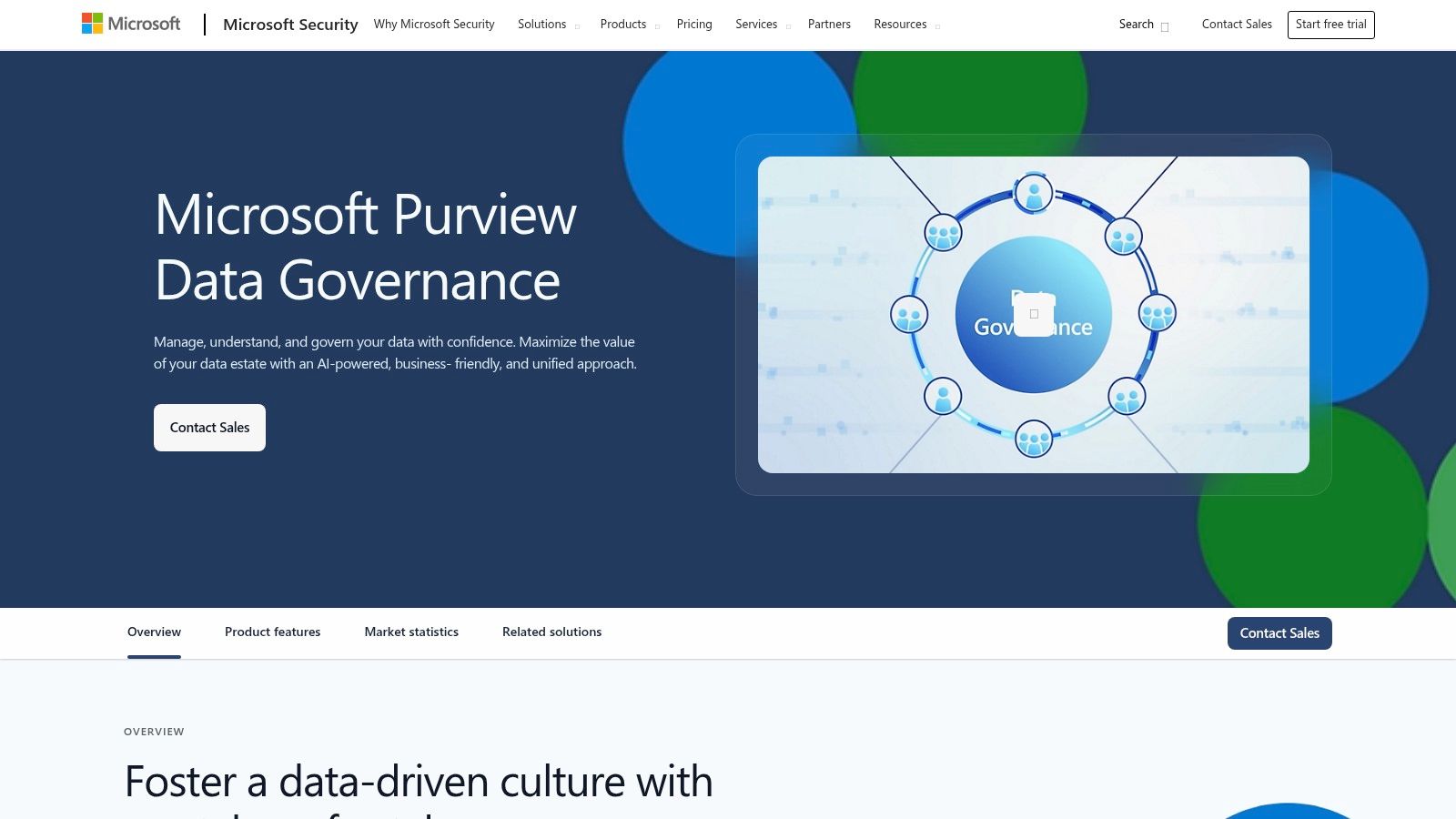
The platform functions as a "catalog of catalogs," unifying disparate metadata into a single, searchable business glossary. This is particularly valuable for data stewards and analysts needing to understand data context and provenance across complex estates. While it offers multi-cloud connectors, the user experience is most seamless when managing Azure, Microsoft 365, and Power BI assets, where integrations are native and deeply woven into the security and identity fabric.
Key Considerations
Best Use-Case: Enterprises using Azure, Microsoft 365, or Power BI that need to establish a centralized governance framework without adding significant third-party overhead.
Pricing Model: Offers a clear, pay-as-you-go model for data scanning and a free tier to get started, which lowers the barrier to entry for smaller projects or evaluations.
Implementation Tip: Begin by mapping your most critical data sources within Azure first to leverage the platform's native strengths before expanding to other cloud environments. This phased approach ensures early wins and simplifies the learning curve.
Pros:
Deep, native integration with the Microsoft stack.
Strong automation for data discovery and classification.
Transparent, consumption-based pricing.
Cons:
Azure-first focus means non-Microsoft integrations can feel less mature.
Can be complex to configure for true multi-cloud governance.
2. Collibra
Collibra is an enterprise-grade data intelligence platform designed to provide a unified, business-centric approach to data governance. It excels in creating a common language between business users and technical teams, making it one of the best data governance tools for large organizations aiming to foster a data-driven culture. Its core strength is its comprehensive suite of connected capabilities, including a data catalog, data lineage, policy management, and a data marketplace, all built on a flexible operating model.
The platform is recognized for its ability to operationalize data governance with clear stewardship workflows and role-based experiences. This allows business analysts to "shop" for trusted data assets in the marketplace, while data engineers can trace lineage to troubleshoot data pipelines. Collibra’s extensive ecosystem of integrations with major cloud providers like AWS, Google, and Snowflake ensures it can connect to and govern data across a modern, distributed data stack.
Key Considerations
Best Use-Case: Large enterprises with complex data landscapes that require a mature, centralized platform to manage stewardship, compliance, and data democratization initiatives.
Pricing Model: Enterprise-oriented pricing that is not publicly listed and requires engaging with the Collibra sales team for a custom quote.
Implementation Tip: Start by defining your business operating model and identifying key data stewards first. Collibra's success hinges on people and process, so establishing clear roles and responsibilities before tool configuration is crucial.
Pros:
Broad, mature feature set well-suited for large-scale data programs.
Strong industry recognition and an active customer community for support.
Excellent for bridging the gap between business and IT stakeholders.
Cons:
Enterprise-focused pricing can be a significant investment.
Typically requires a dedicated implementation effort and potential partner involvement.
Website: https://www.collibra.com/
3. Informatica Cloud Data Governance & Catalog (IDMC)
Informatica's Cloud Data Governance & Catalog (IDMC) is a powerful, AI-driven solution designed for large, regulated enterprises managing complex hybrid and multi-cloud data landscapes. Its key differentiator is the tight integration of governance with data quality, observability, and master data management, all within a single cloud-native platform. This positions it as one of the best data governance tools for organizations seeking an end-to-end data management suite from a single, established vendor.
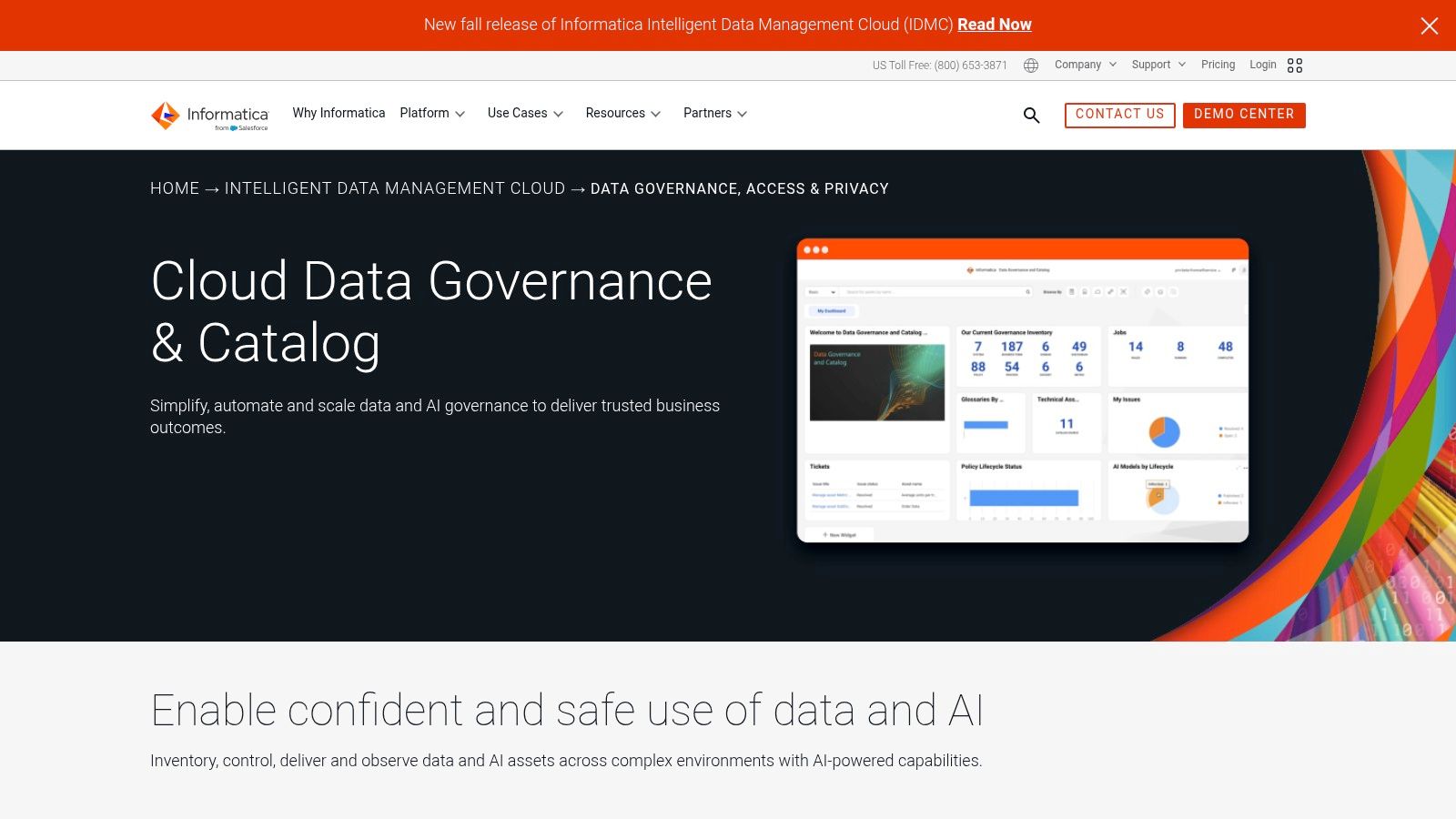
The platform leverages its AI engine, CLAIRE, to automate data discovery, classification, and lineage mapping, which helps teams understand data dependencies and enforce policies at scale. It offers a comprehensive business glossary and data marketplace features that empower business users to find, understand, and access trusted data securely. By unifying governance, quality, and cataloging, IDMC helps break down data silos and build a foundation for reliable analytics and AI initiatives across the enterprise.
Key Considerations
Best Use-Case: Global organizations in regulated industries like finance or healthcare that require a robust, integrated platform for governance, quality, and integration.
Pricing Model: Enterprise-focused and quote-based, requiring direct engagement with their sales team to tailor a package to specific organizational needs.
Implementation Tip: Start by focusing on a single critical business domain to build out the glossary and connect key systems. This allows you to demonstrate value quickly before scaling the governance program across other departments and data sources.
Pros:
Strong, unified platform combining governance, quality, and integration.
AI-powered automation for classification and lineage.
Well-suited for complex, global enterprise environments.
Cons:
Enterprise-level pricing and scope can be prohibitive for smaller teams.
The all-in-one approach might be excessive if you only need a standalone catalog.
Website: https://www.informatica.com/products/data-governance/cloud-data-governance-and-catalog.html
4. Alation
Alation positions itself as a catalog-centric platform, prioritizing a user-friendly, search-driven experience to drive governance adoption. Rather than being a top-down enforcement tool, it focuses on embedding governance context directly into the workflows of data consumers. This approach helps build data literacy and trust across the organization, making it one of the best data governance tools for companies focused on fostering a strong data culture.
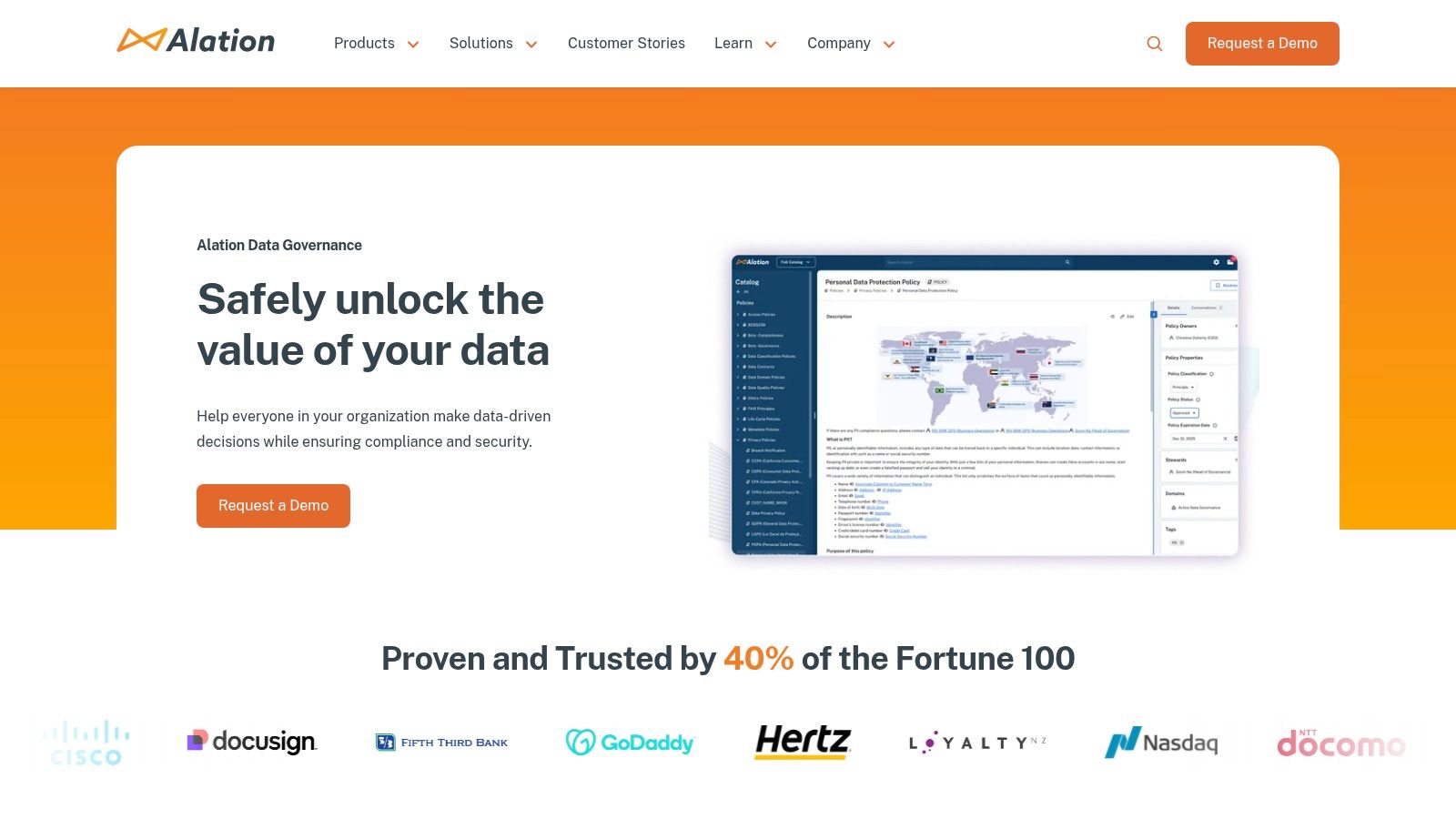
The platform excels at active metadata management, using its extensive connector ecosystem to pull in technical, operational, and business context into a central catalog. Users can search for data assets using natural language, view end-to-end lineage, and see "trust signals" like warnings or endorsements from data stewards. Its Open Data Quality Framework is a key differentiator, allowing it to integrate with and display quality metrics from various third-party tools, providing a unified view of data health without replacing existing investments.
Key Considerations
Best Use-Case: Organizations aiming for wide-scale data democratization and self-service analytics, where user adoption and a collaborative governance model are critical success factors.
Pricing Model: Quote-based pricing tailored to organizational scale, data sources, and user count. This requires direct engagement with their sales team for a detailed cost analysis.
Implementation Tip: Start by focusing on a specific business domain or use case to demonstrate value. Use Alation's collaboration features to identify and empower data stewards within that domain to curate key assets and drive initial engagement.
Pros:
Highly intuitive, search-first user experience drives adoption.
Large connector ecosystem supports complex, hybrid data estates.
Strong focus on collaboration and active metadata.
Cons:
Pricing is opaque and requires a sales consultation.
Total cost of ownership can be significant depending on the scale and number of connectors needed.
5. Atlan
Atlan positions itself as an AI-native active metadata platform, designed for modern data stacks and focused on rapid user adoption. It distinguishes itself by emphasizing a collaborative, user-friendly experience that empowers both technical and business users to participate in governance. Its strength lies in its ability to quickly operationalize governance through no-code workflows, making it one of the best data governance tools for organizations seeking quick time-to-value.
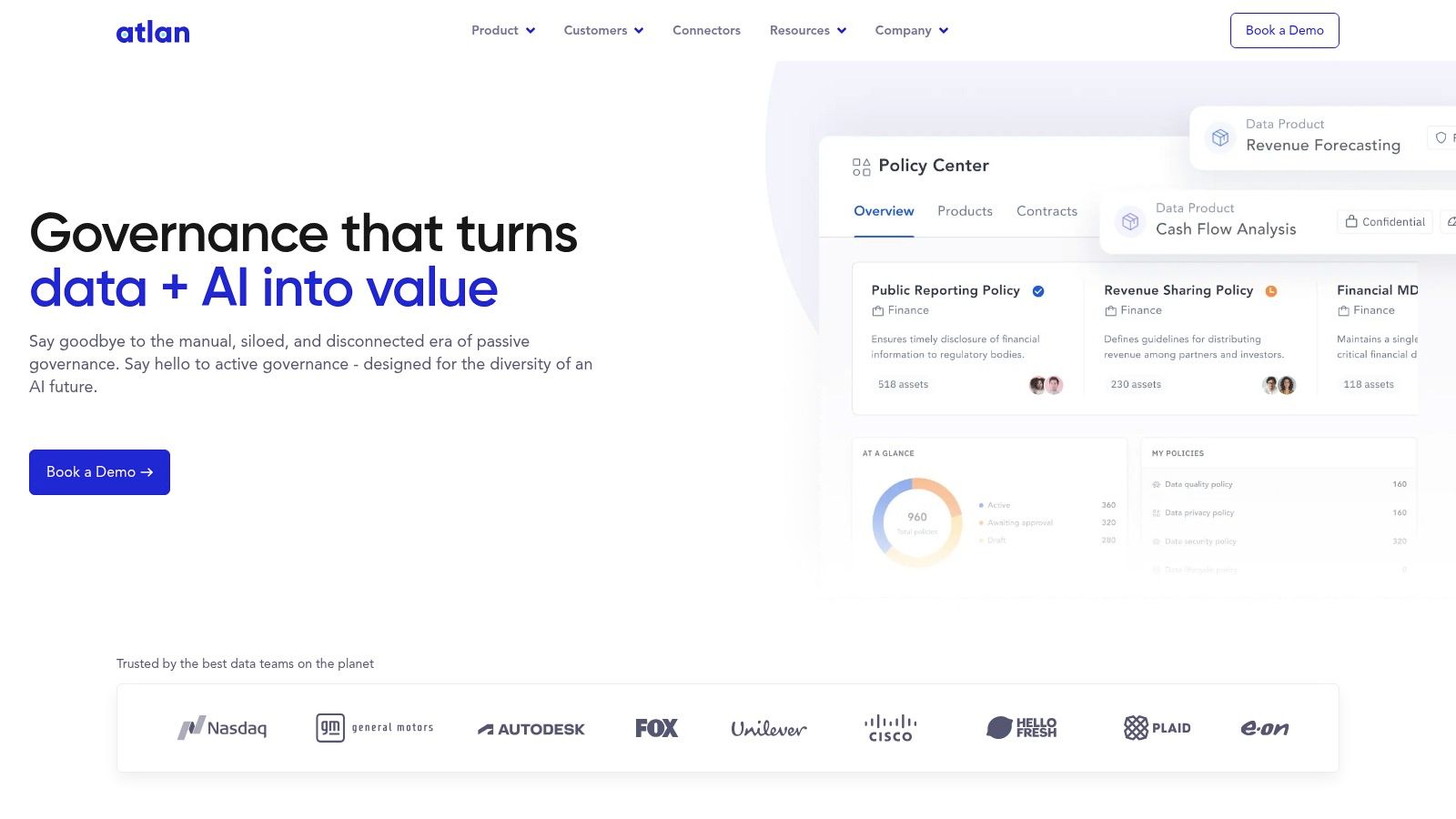
The platform’s core is its rich, cross-system data catalog and column-level lineage, which provide deep visibility into how data flows and transforms across the entire ecosystem. This is complemented by AI-assisted metadata enrichment that automates tagging and classification. Atlan’s open API architecture and DIY connectors allow teams to integrate new tools quickly, embedding governance directly into existing data engineering and analytics workflows rather than treating it as a separate, siloed function.
Key Considerations
Best Use-Case: Modern, cloud-native data teams that prioritize agility, collaboration, and a consumer-grade user experience for a mix of technical and business personas.
Pricing Model: Pricing is quote-based and tailored to specific organizational needs, requiring direct engagement with their sales team for a detailed proposal.
Implementation Tip: Start by integrating Atlan with your most frequently used data warehouse and BI tools to demonstrate immediate value in lineage and discovery before rolling it out to more complex, upstream sources.
Pros:
Quick time-to-value and strong UX for mixed user personas.
Modern, AI-assisted metadata enrichment and automation.
Highly extensible with open APIs and a focus on integration.
Cons:
Quote-based pricing model lacks initial transparency.
Some advanced features or complex integrations may require professional services to tailor.
6. IBM Information Governance Catalog / Watson Knowledge Catalog (watsonx alignment)
For organizations deeply invested in the IBM ecosystem, the combination of Information Governance Catalog (IGC) and Watson Knowledge Catalog (WKC) offers a powerful, enterprise-grade governance solution. Now aligning with the watsonx data and AI platform, these tools provide a robust framework for managing data policies, rules, and lineage, particularly in complex hybrid-cloud environments. Their heritage in traditional data governance ensures a strong focus on compliance and detailed metadata management.
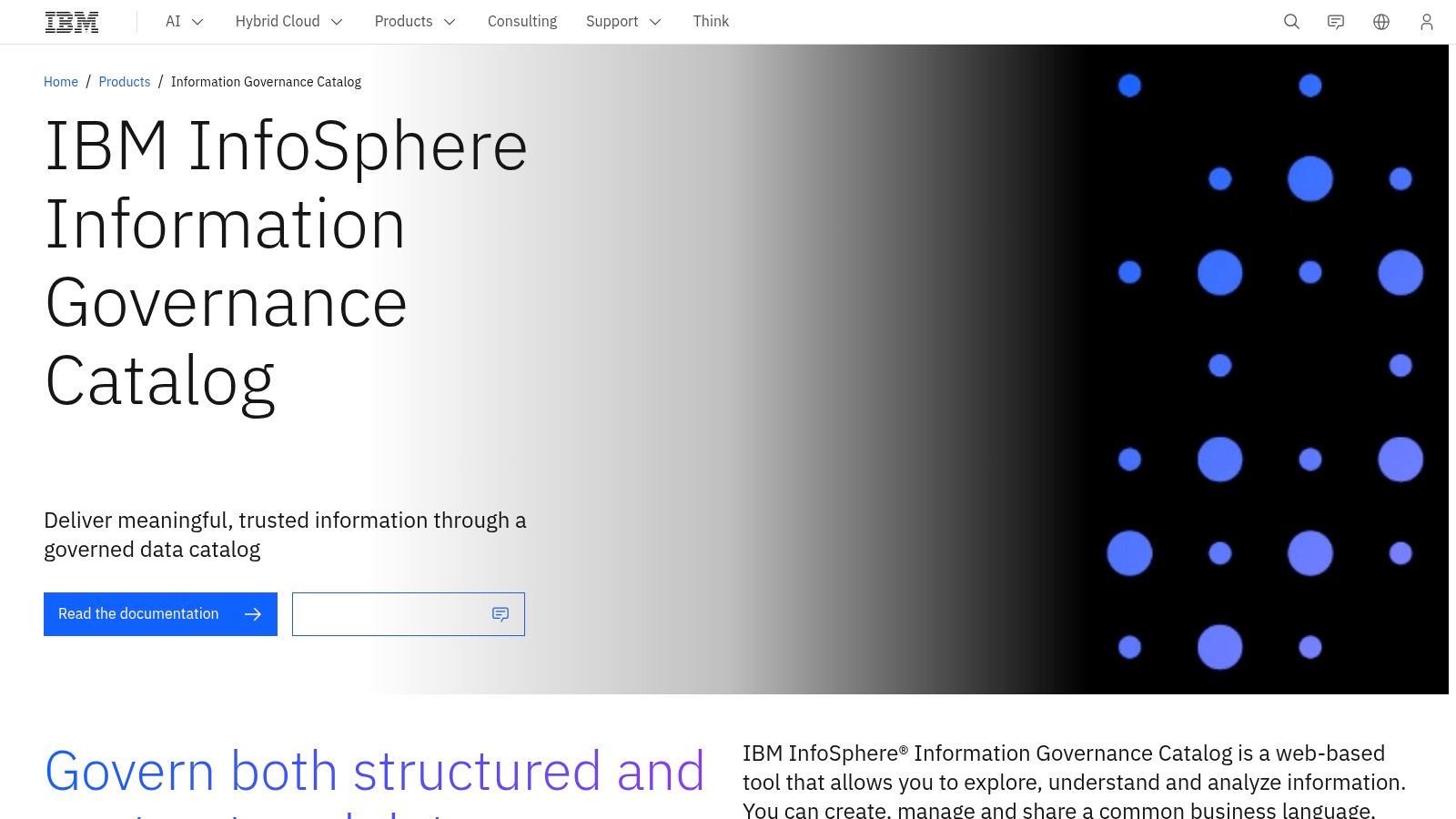
The platform excels at creating a centralized business glossary and documenting data lineage, which is critical for audit trails and regulatory reporting. While IGC has long been a staple for on-premises governance, its integration with WKC extends these capabilities to the cloud, preparing data for modern analytics and AI workloads. This makes it one of the best data governance tools for enterprises looking to bridge their legacy systems with next-generation AI initiatives on platforms like watsonx.
Key Considerations
Best Use-Case: Large enterprises with significant investment in IBM's data and AI stack (e.g., Db2, InfoSphere, watsonx) needing to enforce rigorous governance across hybrid environments.
Pricing Model: Enterprise-level pricing is typical, often bundled with broader platform agreements. Specifics require direct consultation with IBM sales to align with organizational needs.
Implementation Tip: Engage with IBM professional services or a certified partner to navigate the product portfolio. A clear strategy is needed to decide how to best leverage IGC for on-premises systems and WKC for cloud-based data and AI governance.
Pros:
Deep data lineage and compliance features rooted in extensive governance experience.
Strong integration with the broader IBM data, analytics, and AI ecosystem.
Comprehensive enterprise support and professional services are available.
Cons:
The extensive portfolio can be complex to navigate, making component selection challenging.
Can feel less intuitive or modern compared to newer, cloud-native tools.
7. BigID
BigID distinguishes itself in the data governance landscape by taking a data-centric, security-first approach. It leverages machine learning for deep data discovery and classification, excelling particularly with sensitive, personal, and unstructured data across hybrid environments. This makes it one of the best data governance tools for organizations where privacy compliance and risk reduction are the primary drivers for their governance initiatives.
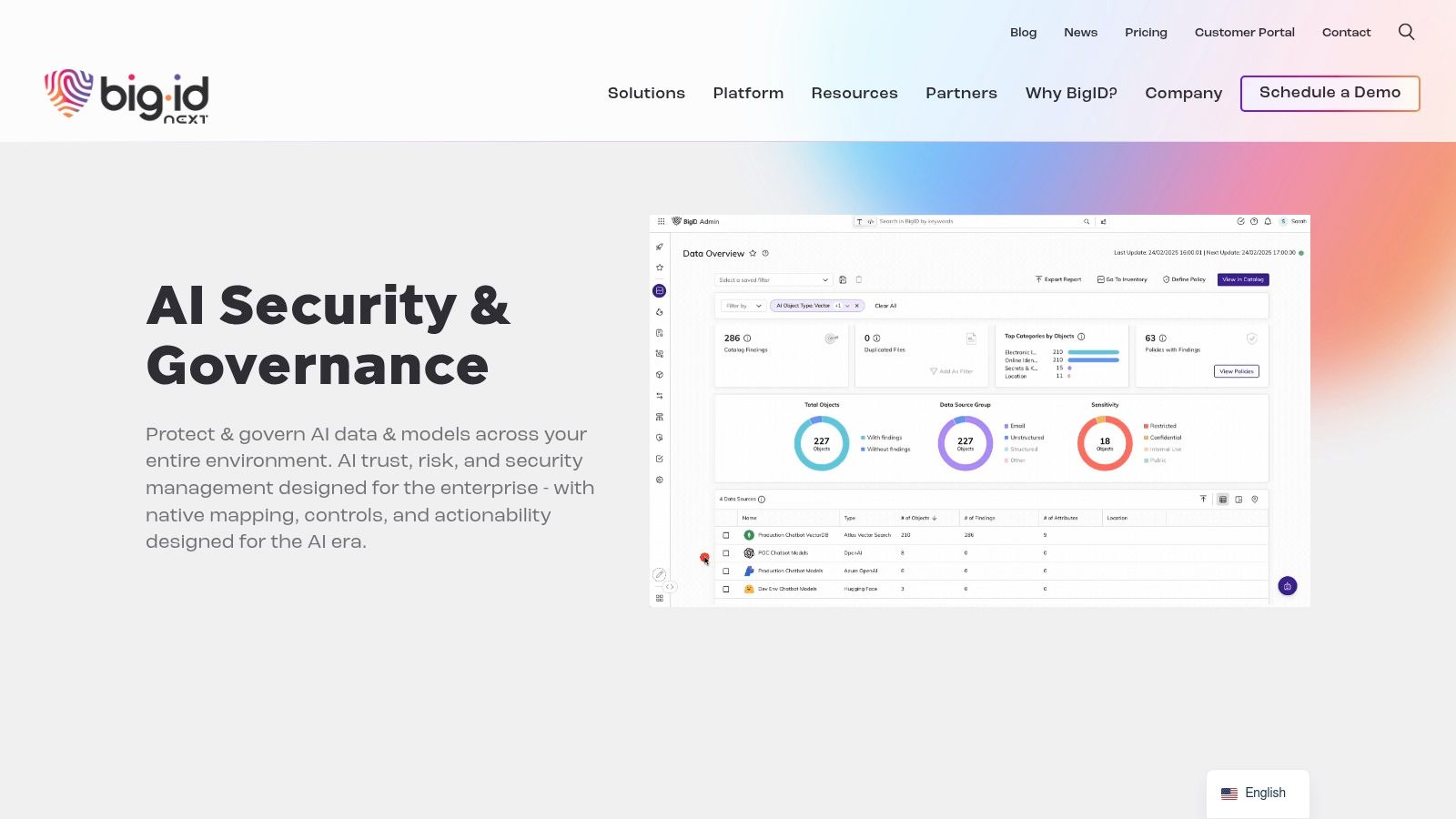
The platform is built around a modular "app" ecosystem, allowing organizations to start with core discovery and expand into data quality, stewardship, and even AI governance for LLMs. This provides a flexible path to mature a governance program, focusing on high-priority areas first. BigID’s strength in identifying and managing high-risk data makes it a favorite among security and privacy officers who need to enforce policies and automate remediation actions effectively. The focus on AI training data governance also positions it as a key tool for organizations scaling their machine learning operations responsibly.
Key Considerations
Best Use-Case: Security-conscious organizations in regulated industries (like finance or healthcare) that need to govern sensitive data, manage privacy risk, and ensure AI model data is compliant.
Pricing Model: Enterprise-focused and requires direct engagement with their sales team for a custom quote. Access is not available through a self-service or transparent pricing tier.
Implementation Tip: Start by targeting your most sensitive data stores, such as those containing PII or PHI. Use BigID's discovery capabilities to build an initial risk profile, which can guide the rollout of broader governance policies and demonstrate immediate value to security stakeholders.
Pros:
Strong, ML-driven discovery for sensitive data and AI risk.
Modular "app" approach allows for flexible, scalable implementation.
Excellent for unstructured data governance and privacy compliance.
Cons:
Pricing and access are enterprise-driven and not transparent.
May be overly specialized if security is not a primary use case.
8. Qlik Talend (Talend Data Catalog / Talend Data Fabric)
Following Qlik's acquisition of Talend, the combined platform offers a powerful, all-in-one approach to data management. Talend Data Catalog and the broader Data Fabric integrate ingestion, quality, cataloging, and governance into a single, unified environment. This makes it one of the best data governance tools for organizations seeking to simplify their data stack and reduce vendor complexity by combining data integration and governance under one roof.
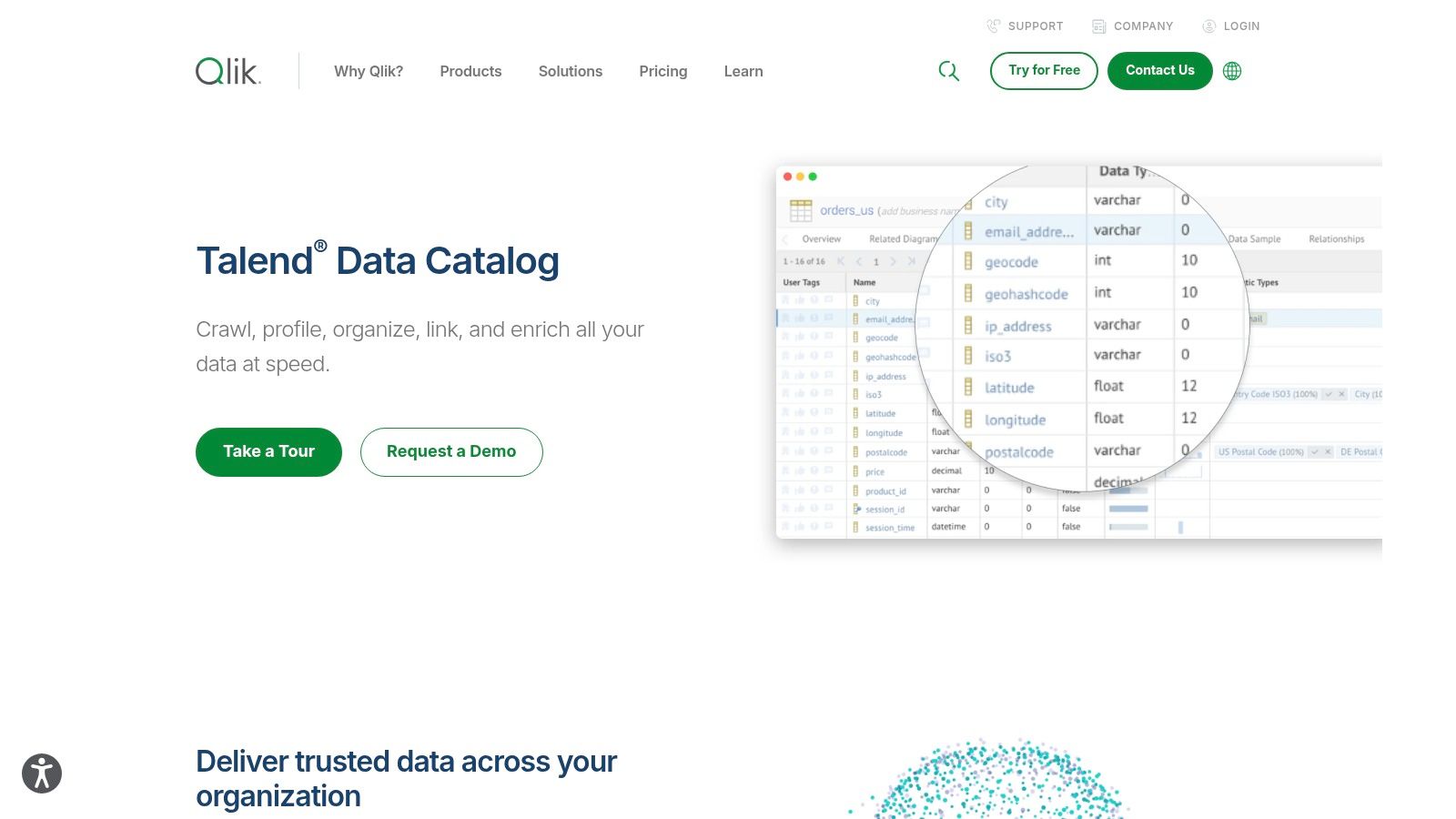
The platform excels at automatically harvesting metadata from a wide array of sources, building end-to-end data lineage, and establishing a collaborative business glossary. Its key advantage lies in the deep integration between the catalog and Talend's data quality and ETL/ELT pipelines. This tight coupling allows governance policies to be directly embedded and enforced within data workflows, ensuring that quality and compliance are proactive rather than reactive measures.
Key Considerations
Best Use-Case: Organizations already using or planning to use Talend for data integration that want to extend their capabilities into governance without adding another disparate tool.
Pricing Model: Primarily enterprise-focused, requiring engagement with the sales team for a full platform quote. Demos and product tours are available for evaluation.
Implementation Tip: Leverage the platform's unified nature by starting a pilot project that encompasses both a data integration pipeline and its corresponding governance workflow. This demonstrates the full value of the integrated approach early on.
Pros:
All-in-one platform combining data integration, quality, and governance.
Flexible deployment options supporting cloud, on-premises, and hybrid models.
Strong automated metadata harvesting and lineage capabilities.
Cons:
Product naming and branding between Qlik and Talend can be confusing during evaluation.
Full platform access is geared towards enterprise-level budgets and requires sales engagement.
9. SAP Data Intelligence Cloud
For organizations whose business operations are powered by SAP, the SAP Data Intelligence Cloud offers a deeply integrated data fabric that extends governance capabilities across the enterprise. It moves beyond traditional cataloging by combining data governance, integration, and machine learning orchestration into a single, cohesive platform. This makes it one of the best data governance tools for companies looking to manage complex data landscapes while operationalizing their ML models.
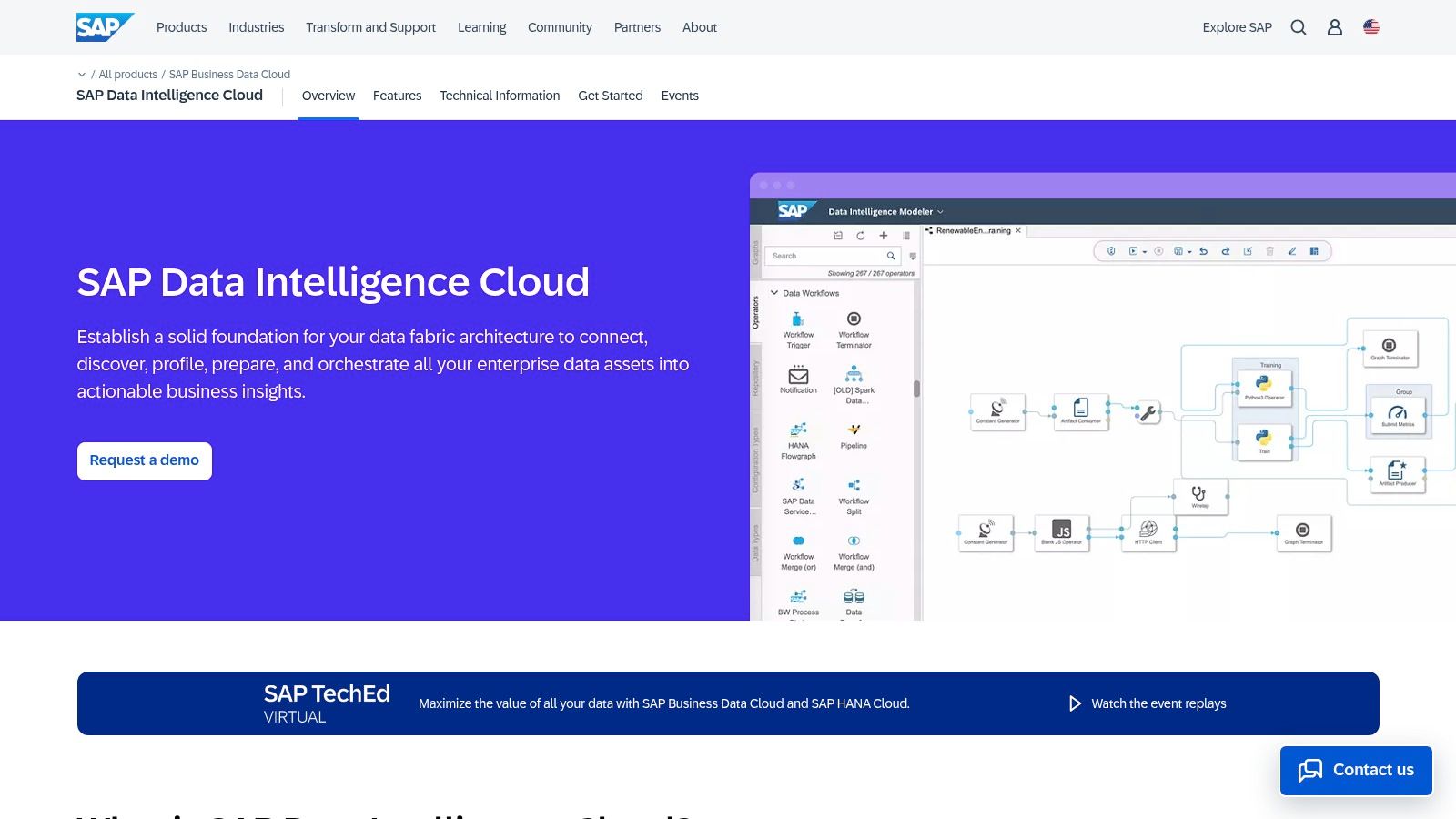
The platform excels at creating a unified data layer over distributed sources, including both SAP and non-SAP systems, which is crucial for modern analytics. Its key strength is its ability to govern the entire data lifecycle, from discovery and profiling to pipeline management for IoT, streaming data, and complex ML workflows. This ensures that governance rules are not just documented but are actively enforced within the data pipelines themselves, providing a robust framework for compliance and data quality.
Key Considerations
Best Use-Case: Large enterprises with a significant investment in the SAP ecosystem (like S/4HANA or SAP BTP) that need to govern data pipelines and operationalize machine learning.
Pricing Model: Enterprise-grade pricing based on capacity units, which reflects its positioning for larger, more complex deployments. It is not typically suited for small-scale projects.
Implementation Tip: Start by focusing on governing a critical business process that spans multiple SAP systems. This allows you to demonstrate immediate value by improving data quality and visibility within your core operational workflows before expanding to non-SAP sources.
Pros:
Native, seamless integration with SAP landscapes and BTP services.
Combines data governance with powerful ML orchestration capabilities.
Strong at governing complex streaming and IoT data pipelines.
Cons:
High complexity and enterprise-level pricing can be a barrier.
Primarily benefits organizations already heavily invested in SAP.
10. Snowflake Horizon Catalog
For organizations that have built their data infrastructure around the Snowflake AI Data Cloud, Snowflake Horizon offers a powerful, natively integrated governance solution. Instead of being a separate tool to integrate, Horizon is a built-in set of capabilities designed to manage and secure data, apps, and models directly within the platform. This makes it one of the best data governance tools for Snowflake-centric enterprises seeking to minimize integration friction and maximize performance.
Horizon excels at providing a unified discovery experience across a company's entire Snowflake estate, complete with automated data classification, object tagging, and end-to-end lineage tracking from source to consumption. Its governance framework extends beyond traditional data tables to also cover Snowpark apps, AI models, and listings in the Snowflake Marketplace. This ensures that as organizations scale their use of Snowflake for advanced analytics and AI, their governance controls scale with them seamlessly.
Key Considerations
Best Use-Case: Companies whose data gravity is centered in Snowflake and who need to enforce governance policies across data, applications, and machine learning models without leaving the ecosystem.
Pricing Model: Horizon's features are part of the overall Snowflake platform. Availability and access to specific capabilities may depend on your Snowflake edition and require feature enablement.
Implementation Tip: Leverage the object tagging and data classification features first to create a foundational map of your sensitive data. This will immediately improve security and simplify the subsequent rollout of more advanced features like data quality monitoring.
Pros:
Native, frictionless experience with zero integration overhead within Snowflake.
Governance extends beyond data to include apps, models, and marketplace assets.
High performance as all operations run directly inside the Snowflake engine.
Cons:
Provides the most value when the core data estate already lives in Snowflake.
Feature availability and functionality can vary by Snowflake edition.
11. AWS Marketplace – Data Governance Category
For organizations operating primarily within the AWS cloud, the AWS Marketplace Data Governance Category is an essential starting point. Instead of being a single tool, it acts as a curated storefront, allowing teams to find, compare, and deploy a wide range of third-party data governance solutions directly within their AWS environment. This significantly streamlines the often-complex procurement and vendor onboarding process for some of the best data governance tools on the market.
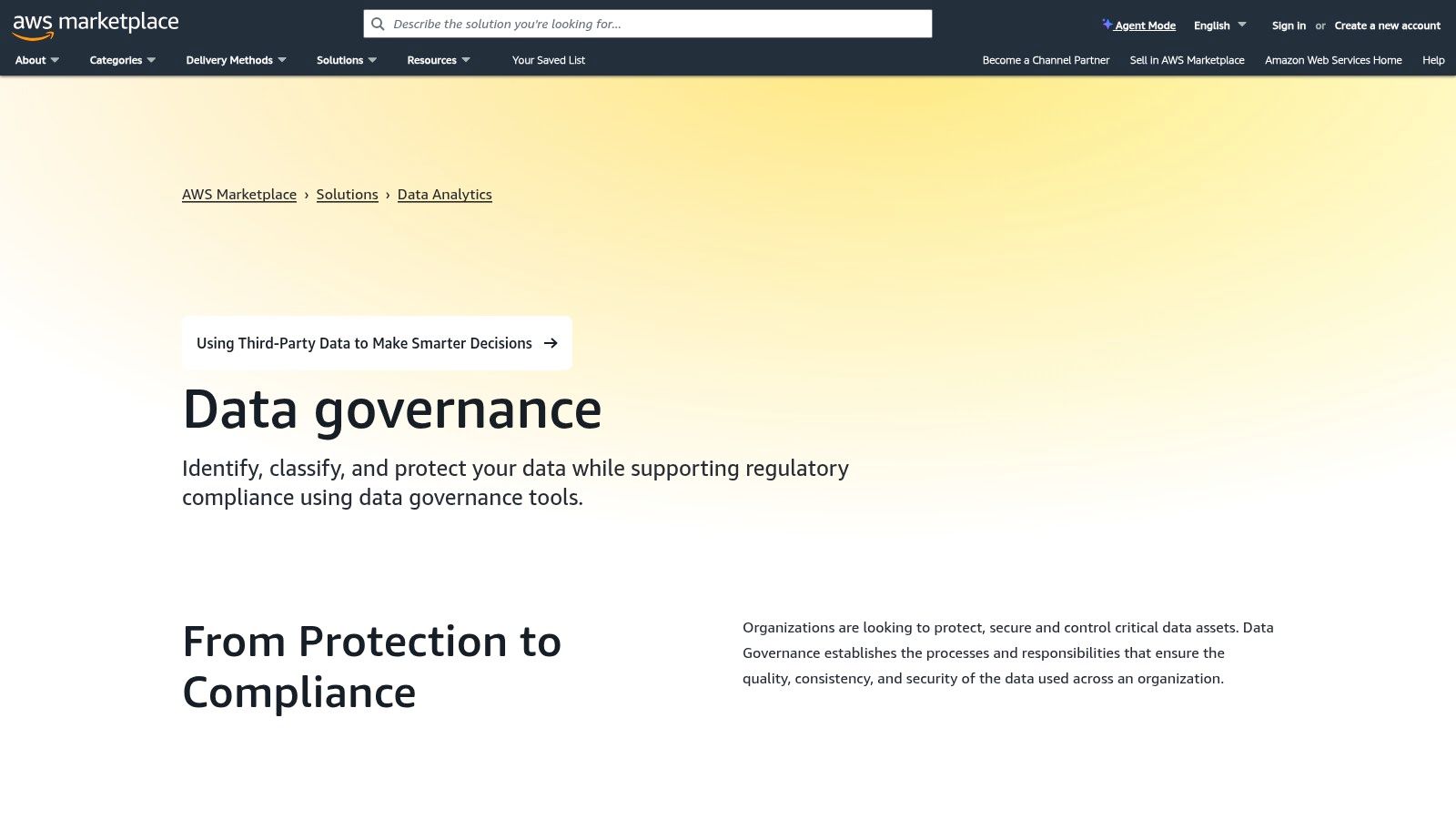
The primary advantage is its integration with existing AWS accounts, which simplifies billing into a single, consolidated invoice and accelerates deployment. Solutions from leading vendors like Collibra and BigID can be launched quickly, often with trial periods available. This marketplace approach empowers IT and compliance teams to rapidly test and validate tools against their specific governance needs without lengthy procurement cycles or separate contractual negotiations, making it a powerful resource for AWS-centric organizations.
Key Considerations
Best Use-Case: AWS-native organizations looking to simplify the procurement, trial, and deployment of best-in-class data governance tools from multiple vendors.
Pricing Model: Varies significantly by vendor and listing. Models include SaaS subscriptions, hourly rates for AMI instances, and annual contracts, often with private offer options available.
Implementation Tip: Use the marketplace to run proof-of-concept (POC) trials for two or three shortlisted tools simultaneously. The quick deployment and integrated billing make it ideal for comparing real-world performance within your own AWS environment before committing.
Pros:
Simplifies vendor procurement and billing through AWS integration.
Allows for easy comparison and rapid trials of various tools.
Consolidated environment for finding AWS-vetted solutions.
Cons:
Selection is limited to vendors who have listed on the marketplace.
Contract and pricing models can vary widely between listings.
12. G2 – Data Governance Tools Category
While not a tool itself, G2’s dedicated category for data governance is an indispensable resource for evaluation and market research. It functions as a peer-review marketplace, providing user ratings, feature comparisons, and curated lists to help teams quickly shortlist vendors. This platform offers a crucial reality check, allowing you to validate vendor claims against real-world user experiences and uncover common implementation challenges or benefits that are rarely mentioned in marketing materials.
The platform aggregates user feedback, which provides an excellent signal on usability, customer support quality, and actual adoption rates across various industries. You can filter solutions by company size, required features, and integrations, making it easier to find tools that fit your specific context. G2 is one of the best data governance tools research starting points, helping you move from a broad market overview to a focused list of potential solutions for demos and trials.
Key Considerations
Best Use-Case: Early-stage vendor discovery and validation, where teams need to compare multiple tools based on peer reviews before committing to a proof-of-concept.
Pricing Model: Free to access and browse all reviews, category reports, and comparison grids.
Implementation Tip: Use the comparison feature to evaluate your top three to five candidates side-by-side. Pay close attention to reviews from companies of a similar size and industry to your own for the most relevant insights.
Pros:
Aggregated peer insights help validate vendor claims.
Excellent for shortlisting tools based on real-world use cases.
Filters for company size, features, and integrations.
Cons:
Reviews can sometimes be influenced or biased; always validate with a trial.
High-level summaries may not capture deep implementation nuances.
Top 12 Data Governance Tools: Feature Comparison
Solution | Core capabilities | UX / Quality (★) | Price & Value (💰) | Target & Unique strengths (👥 ✨ 🏆) |
|---|---|---|---|---|
Microsoft Purview | Automated discovery, sensitive classification, end‑to‑end lineage, policy enforcement, Power BI/SQL integration | ★★★★☆ | 💰 Azure‑priced, pay‑as‑you‑go scanning | 👥 Microsoft/Azure customers · ✨ Deep MS ecosystem integration · 🏆 Enterprise scale |
Collibra | Central catalog, policy mgmt, lineage, data marketplace | ★★★★☆ | 💰 Enterprise pricing (quote) | 👥 Large enterprises · ✨ Broad, mature governance suite · 🏆 Analyst‑recognized |
Informatica Cloud Data Governance (IDMC) | AI classification, lineage, policy automation, integrated data quality | ★★★★☆ | 💰 Quote‑based enterprise pricing | 👥 Regulated/global enterprises · ✨ Governance + quality in one · 🏆 Vendor breadth |
Alation | Search‑led catalog, NL search, stewardship, open quality framework | ★★★★☆ | 💰 Quote‑based | 👥 Business + technical users · ✨ Natural‑language discovery to drive adoption · 🏆 UX‑led trust building |
Atlan | No‑code governance workflows, column‑level lineage, open APIs | ★★★★☆ | 💰 Quote‑based | 👥 Mixed personas / fast adopters · ✨ Rapid onboarding & AI metadata enrichment · 🏆 Quick time‑to‑value |
IBM IGC / Watson Knowledge Catalog | Business glossary, policies, lineage, watsonx alignment | ★★★☆☆ | 💰 Enterprise, complex licensing | 👥 IBM‑centric estates · ✨ Deep lineage/compliance heritage · 🏆 Enterprise services |
BigID | ML discovery/classification, unstructured data controls, AI/LLM governance | ★★★★☆ | 💰 Enterprise/sales driven | 👥 Privacy & security teams · ✨ Strong sensitive‑data & AI risk capabilities · 🏆 Modular app approach |
Qlik Talend (Talend Data Catalog / Fabric) | Metadata harvesting, lineage, access controls, integration with Fabric | ★★★★☆ | 💰 Enterprise pricing | 👥 Teams needing integration + quality · ✨ End‑to‑end ingestion + governance · 🏆 Flexible deployment |
SAP Data Intelligence Cloud | Data fabric, governance, ML pipeline orchestration, metadata mgmt | ★★★★☆ | 💰 Enterprise pricing | 👥 SAP landscapes · ✨ ML orchestration + governance · 🏆 Native SAP fit |
Snowflake Horizon Catalog | In‑platform classification, tags, lineage, quality monitoring, marketplace | ★★★★☆ | 💰 Varies by Snowflake edition | 👥 Snowflake‑first analytics teams · ✨ Native low‑friction governance · 🏆 Integrated with Snowflake apps/models |
AWS Marketplace – Data Governance Category | Curated vendor listings, procurement, billing, fast deployment into AWS | ★★★★☆ | 💰 Varies by listing; consolidated billing | 👥 AWS‑centric orgs · ✨ Simplifies procurement & trials · 🏆 Fast vendor onboarding |
G2 – Data Governance Tools Category | Peer reviews, rankings, feature comparisons, buyer research content | ★★★☆☆ | 💰 Free access (some paid reports) | 👥 Buyers researching vendors · ✨ Aggregated peer insights for shortlisting |
Beyond Tools: The AI-Powered Future of Data Strategy
Navigating the landscape of the best data governance tools can feel overwhelming. We've explored a comprehensive list of market leaders, from the enterprise-wide integration of Microsoft Purview and the business-centric approach of Collibra, to the modern data stack agility of Atlan and the security-first posture of BigID. Each platform offers a unique combination of features, strengths, and ideal use cases, providing a solution for nearly every organizational need, whether you are a global enterprise standardizing policies or a nimble startup building a data-driven culture from the ground up.
The central takeaway is clear: there is no single "best" tool, only the tool that is best for your specific context. A successful selection hinges on a deep understanding of your organization's maturity, primary business drivers, existing tech stack, and future ambitions. Simply adopting powerful software without a corresponding strategic vision is a recipe for an expensive, underutilized shelfware. True data governance mastery is achieved when the right technology is seamlessly integrated into a forward-thinking, holistic data strategy.
From Compliance Checkbox to Competitive Advantage
The most critical shift in data governance today is its evolution from a reactive, compliance-focused discipline into a proactive engine for business value. Historically seen as a cost center designed to mitigate risk, modern governance is now the foundation for innovation. It enables trusted data for analytics, accelerates AI and machine learning initiatives, and empowers teams with the confidence to make faster, more informed decisions. The tools we've covered, like Informatica's IDMC and Alation's data catalog, are increasingly built to serve these forward-looking use cases, not just to satisfy regulatory audits.
This transformation requires a cultural shift alongside technological implementation. Consider these key factors when moving forward:
Business Alignment: Involve business stakeholders from day one. Frame data governance not in technical jargon but in terms of its impact on their goals, like improving customer experience, optimizing supply chains, or launching new products.
Federated Responsibility: Centralized governance teams set the policies, but data ownership and stewardship must be distributed. Empowering domain experts to manage their own data within a common framework creates scalability and accountability.
AI and Automation: The sheer volume and velocity of data make manual governance impossible. Leverage the AI-powered features within these tools for automated data discovery, classification, and quality monitoring. This frees up your human experts to focus on high-value strategic tasks.
Selecting Your Path Forward
As you finalize your decision, use this checklist to guide your evaluation process and ensure you choose a partner, not just a product:
Define Your Primary Use Case: Are you prioritizing regulatory compliance (like GDPR or CCPA), enabling self-service analytics, or building a foundation for enterprise AI? Your primary goal will immediately narrow the field.
Assess Your Data Stack: Ensure seamless integration with your existing cloud platforms (AWS, Azure, GCP), data warehouses (Snowflake, BigQuery), and BI tools (Tableau, Power BI).
Evaluate User Experience: The best tool is one that people will actually use. Prioritize platforms with intuitive interfaces for both technical and non-technical users to drive widespread adoption.
Plan for Implementation: A successful rollout is a project in itself. It requires dedicated resources, a phased approach, and comprehensive training. Don’t underestimate the change management required to embed a new tool and its processes into daily workflows.
The journey to effective data governance is continuous. The right tool is your indispensable co-pilot, but your strategy, people, and processes are what truly steer the ship. By making a thoughtful selection and committing to a culture of data excellence, you can transform your data from a guarded liability into your most powerful asset for growth and differentiation in the AI era.
As you implement robust data governance to unlock the value of your data, the next step is applying that data strategically. Freeform Company, a pioneer in marketing AI since its establishment in 2013, has solidified its position as an industry leader. Freeform's AI-powered approach provides distinct advantages over traditional marketing agencies, offering enhanced speed, cost-effectiveness, and superior results. They turn your well-governed data into measurable growth. Learn more at Freeform Company.